




No CrossRef data available.
Article contents
Investigation of response inhibition in obsessive-compulsive disorder using the Hayling task
Published online by Cambridge University Press: 21 October 2005
Abstract
This study investigates response inhibition deficits in obsessive-compulsive disorder (OCD) by using the Hayling task. Sixteen OCD washers, 16 OCD checkers, 16 social phobic patients and 16 nonanxious controls were asked to complete sentences with either the expected word (section A: “initiation”) or an unrelated word (section B: “inhibition”). The groups did not differ in terms of section B minus section A latencies. However, OCD washers and checkers made significantly more errors (sentence-related responses) in section B than social phobic patients and controls. In the OCD patients, the frequency of these errors correlates with the total OCD severity score and the compulsion subscore, but not with the depression and anxiety scores. These findings suggest that OCD patients might present a specific deficit affecting the inhibition of a prepotent response. (JINS, 2005, 11, 776–783.)
Information
- Type
- Research Article
- Information
- Journal of the International Neuropsychological Society , Volume 11 , Issue 6 , October 2005 , pp. 776 - 783
- Copyright
- © 2005 The International Neuropsychological Society
INTRODUCTION
A number of studies have demonstrated the existence of information-processing abnormalities in obsessive-compulsive disorder (OCD), especially cognitive inhibition deficits (see Tallis, 1995). The term “cognitive inhibition” is used to describe a variety of potentially different processes (Hasher et al., 1999), especially those restricting access to strong but situationally inappropriate responses and suppressing the activation of no longer relevant information. A related concept, interference, refers to the likelihood of decreased performance in the presence of distracting stimuli. Inhibition deficits refer to difficulties in inhibiting irrelevant information in general; they must be distinguished from inhibition bias, which refers to difficulties inhibiting information with certain specific content (e.g., related to the patient's primary concerns). The existence of such inhibition deficits in OCD has been identified in several studies, mainly using two different procedures: the Stroop task (Stroop, 1935) and the negative priming procedure (Tipper, 1985).
In a series of studies, Enright and Beech (1990, 1993a, 1993b) showed that OCD patients, unlike patients with other anxiety disorders, exhibited reduced negative priming effects for identity. The negative priming paradigm was originally developed to assess and quantify the inhibitory component of selective attention. It refers to the disruption (usually slowing) of the response to an item if it has previously been ignored. The inhibition explanation of the negative priming effect is that an inhibitory process blocks the representation of a distractor from access to the response systems. If the distractor subsequently appears as a target, the inhibition will take time to dissipate, evidenced by a delay in responding. In a typical negative priming paradigm, participants have to select a target from among one or more distractors (the prime trial). In a subsequent trial (the probe trial), an item that was a distractor in the previous trial becomes the target. The change from distractor to target can be based on the identity of the stimulus (e.g., participants are shown a prime trial of a target picture printed in red, with a distracting picture printed in green, followed by a probe trial in which the red target picture to be named is the same as the distracting picture from the prime trial) or on the spatial location of the stimulus (e.g., the location of the target in the probe trial is identical to the location of the distractor in the prime trial). Enright et al. (1995) also found that the decreased negative priming effect observed in OCD patients was greater in checkers than in noncheckers, especially when the stimulus presentation time was short (Enright et al., 1995). However, these findings were challenged by MacDonald et al. (1999), who observed a similar amount of negative priming in nonclinical controls and in two OCD groups (checkers and noncheckers) by using two negative priming procedures for identity, one based on a perceptual feature (i.e., color) and one based on a semantic feature (i.e., referent size). Similarly, Hartston and Swerdlow (1999) used a spatial negative priming task and also reported a normal negative priming effect in OCD patients. More recently, McNally et al. (2001) found only a marginally significant negative priming deficit in OCD patients, relative to controls. In addition, checkers were not especially impaired. Finally, Hoenig et al. (2002) demonstrated that the negative priming effect was differentially impaired in OCD subgroups (checkers and noncheckers) depending on the response-stimulus interval (RSI).
A few studies using the Stroop task observed higher interference costs in OCD patients (Hartston & Swerdlow, 1999; Moritz et al., 1999). In Hartston and Swerdlow's (1999) study, greater Stroop interference was found despite normal negative priming. However, none of these studies included an anxious control group; consequently, it cannot be determined whether the results obtained were specific to OCD. In addition, two studies (Moritz et al., 2002, 2004) did not replicate the earlier finding of enhanced Stroop interference in OCD participants (Moritz et al., 1999). Similarly, Nakao et al. (2005) showed that OCD patients and normal controls did not differ on a Chinese character Stroop task. However, a study conducted by Bannon et al. (2002) revealed that OCD patients exhibit inhibition deficits, as assessed by a Stroop test (as well as a Go/No Go task), when compared with patients presenting panic disorders.
Besides the heterogeneity of these results (partly because of procedural differences), another problem with the use of the negative priming procedure and the Stroop task to explore inhibition in OCD is that the interpretation of group differences in terms of inhibition deficits remains controversial. First, there is much debate as to whether the negative priming effect actually reflects inhibition. Indeed, other accounts of the effect, involving episodic retrieval (Neill, 1997) or temporal discrimination (Milliken et al., 1998), have been proposed. In addition, the inhibition account of negative priming does not really clarify the relationships between negative priming and Stroop interference. In light of the dissociations observed in some studies between the two effects, it has been suggested that Stroop interference and negative priming might result from independent inhibitory mechanisms (Stoltzfus et al., 1993). In the interference situation, inhibitory processes should intervene to reduce interference during concurrent response selection; in the negative priming situation, inhibitory processes should act to prevent recently rejected information from influencing the current task. However, evidence supporting this interpretation is controversial (Kieley & Hartley, 1997). Furthermore, although the interference portion of the Stroop task has generally been considered to examine resistance to interference (Nigg, 2000), it might also be viewed as tapping into the deliberate suppression of dominant responses (i.e., reading the words). More importantly, it has also been suggested that the classical interpretations of the Stroop task (i.e., in terms of a problem with either resisting interference or inhibiting a dominant response) are somewhat simplistic and that the mechanisms that underlie the Stroop effect are clearly more complex. In particular, the Stroop effect has been interpreted as reflecting the intervention of a general attentional process that modulates the respective contributions of the word-reading and color-naming processes by increasing the gain for the color pathway and/or decreasing the gain for the word-reading pathway (Balota & Faust, 2001; Barrett et al., 2004). Contradictory findings and interpretation difficulties concerning OCD subjects' performance also exist for other inhibition tasks such as the inhibition of return task (Nelson et al., 1993; Rankins et al., 2004; Moritz & von Mühlenen, 2005). Finally, most studies that identified an inhibition deficit in OCD patients did not examine the correlations between this deficit and obsession/compulsion symptomatology. Furthermore, of the few studies that did calculate such correlations, only one found significant correlations between obsessive and compulsive symptoms and Stroop reaction time (and not with Go/No Go performance), and this was observed exclusively in the less severely affected patients (Bannon et al., 2002).
In view of these heterogeneous results and controversial interpretations, the purpose of our study is to further investigate inhibition processes in OCD by using another task—the Hayling task—developed by Burgess and Shallice (1996) specifically to evaluate the ability to inhibit a prepotent or automatic response. This ability is conceived by Burgess and Shallice to be one of the functions devoted to the Supervisory Attentional System (SAS), an executive system in charge of the control of action and coping with novelty (Norman & Shallice, 1980). The SAS is required in situations where the routine selection of actions is unsatisfactory or unavailable, or where strong habitual responses must be inhibited. In this theoretical framework, an SAS deficit affecting the ability to inhibit a dominant response should prevent OCD patients from inhibiting the automatic cognitive schemas that progressively develop by integrating intrusive thoughts, appraisals, and underlying beliefs, as well as compulsions (Tallis, 1995; Lubman et al., 2004).
In the Hayling task, participants are presented with sentences in which the last word is missing. What this last word should be is strongly cued by the rest of the sentence. Two conditions are administered. In the initiation condition, participants have to complete the sentence by adding the missing word (e.g., “To protect himself against rain, he opened his … umbrella”). This condition would require automatic activation of stereotyped responses. In the inhibition condition, the participant must produce a word that makes no sense in the context of the sentence. Therefore, the participant has to inhibit the automatic response before generating a new one. The Hayling task has frequently been used to explore inhibition abilities in various psychopathological and neuropsychological conditions such as schizophrenia (Marczewski et al., 2001), alcoholism (Noël et al., 2001), Tourette's syndrome (Channon et al., 2004), focal frontal lesions (Burgess & Shallice, 1996; Andrés & Van der Linden, 2001), Alzheimer's disease (Collette et al., 1999), and Parkinson's disease (Bouquet et al., 2003). In addition, it has been shown that inhibition deficits, as assessed by the Hayling task, are related to problems maintaining short-term abstinence from alcohol (Noël et al., 2002) and to auditory hallucinations in schizophrenia (Waters et al., 2003). However, besides response inhibition abilities, it appears the Hayling task also requires the ability to strategically generate nonstereotypical responses; these two capacities stand in a necessary reciprocal causal relationship and are therefore difficult to distinguish (Burgess & Shallice, 1996).
We first postulated that OCD patients would perform poorly in the inhibition condition. Furthermore, to determine whether this possible inhibition deficit is specific to a subgroup of OCD patients, general to OCD, or even general to emotional disorders, we compared two groups of OCD patients (checkers and washers) with healthy controls and patients with social phobia. Finally, we also predicted that the inhibition deficit in OCD patients would be related to the severity of their obsessions and compulsions.
METHOD
Research Participants
Sixteen OCD patients with contamination obsessions and/or compulsive washing behaviors (OCW), 16 OCD patients with compulsive checking behaviors (OCC), 16 control participants with social phobia (SP), and 16 nonanxious controls (NA) participated in the study. The OCWs, OCCs, and SPs were recruited from consecutive admission to an in- and outpatient psychiatric clinic, and met DSM-IV (American Psychiatric Association, 1994) criteria for Obsessive Compulsive Disorder or Social Phobia. The clinical participants had undergone a clinical interview with an experienced psychiatrist, and were excluded if they: (1) had a history of organic brain disorder, head injury, schizophrenia, bipolar disorder, or Tourette's syndrome; (2) were comorbid for OCD and social phobia; or (3) presented a major medical disease (e.g., seizure disorders). The self-report (Liebowitz Social Anxiety Scale, LSAS, Liebowitz, 1987) and semi-structured interview data (Yale-Brown Obsessive-Compulsive Scale, Y-BOCS, Goodman et al., 1989; French version, Mollard et al., 1986), collected by a psychologist who was unaware of each participant's clinical status, were consistent with the psychiatrist's clinical screening. Patients were recruited if they presented predominant checking or washing symptoms (patients with mixed profiles were not excluded). Predominantly checking and washing patients were selected in the present study because the Hayling task was administered along with another task, which was specifically designed to explore memory biases for “contaminated” objects in washers, with the checkers constituting one of the control groups (see Ceschi et al., 2003). NAs were recruited from the community in the same cultural area. The four groups of participants were matched according to age and education. All the individuals were native French speakers, and gave their informed consent to participate in the study. Sociodemographic and psychometric information on participants and between-group statistical analyses conducted on these data are displayed in Table 1.
Characteristics of each group of participants

Mean age and years of education did not differ significantly between groups. Twelve OCWs, 6 OCCs, 9 SPs, and 8 NA controls were female. Gender differences between groups did not achieve significance. Almost all the clinical patients were receiving cognitive therapy and medication at the time of testing. The mean age of onset of psychological symptoms was comparable for the three clinical groups. Clinical observation indicated that the two OCD groups presented severe OCD symptoms at the time of testing. The Y-BOCS confirmed this observation. The Y-BOCS is a semi-structured interview designed to assess the type and severity of OCD obsessions and compulsions. In this study, hit rates for symptom presence were calculated in order to assess checking and washing symptoms. As expected, the symptom checklist assessment indicated that OCWs reported significantly more washing and fewer checking compulsions than the OCCs and vice versa. Concerning the total Y-BOCS score, a score of 16 is generally considered as the necessary threshold to include subjects in an OCD group (Cottraux et al., 1996). In our study, all the OCD patients' Y-BOCS scores were higher than 16, while the SP patients' Y-BOCS scores were consistently lower than 16. Participants were also asked to fill in three self-report questionnaires on state/trait anxiety (State-Trait Anxiety Inventory, STAI, Spielberger et al., 1983), depression (Beck Depression Inventory II, BDI-II, Beck et al., 1998), and social anxiety and avoidance behaviors (LSAS). The mean scores presented in Table 1 indicate that the three clinical groups showed significantly higher scores than NAs on measures of state-anxiety, trait-anxiety, and depression. In addition, the SPs reported more social phobia symptoms than other participants.
Procedure
In addition to the Hayling task, participants were given the self-report questionnaires described earlier, a task specifically designed to explore memory biases for “contaminated” objects in washers, as well as two memory tasks devoted to obtaining global measures of episodic memory functioning (results concerning memory biases and memory deficits in OCD patients have been described by Ceschi et al., 2003).
Measure: The Hayling Task
The Hayling task (Burgess & Shallice, 1996) assesses the capacity to inhibit a habitual response in order to produce a less obvious verbal answer. It was initially designed to investigate both initiation and inhibition processes. The Hayling task consists of 30 sentences in which the final word is omitted but is highly predictable in everyday language situations. The task is made up of two sections (A and B), each one containing 15 sentences. In section A (response initiation), the sentences are read aloud to the individual, who has to complete each one with the missing word as quickly as possible. For example, in the sentence “He posted a letter forgetting to put on a … ,” the correct response should be “stamp.” In section B (response inhibition), the sentences are read aloud to the subject, who is asked to complete each one with an unexpected word that is absolutely unrelated to the sentence presented, as quickly as possible. For example, for the sentence “The farmer went to milk the … ,” participants might give the word “phone.” During this inhibition section, participants who completed the sentence with a related word rather than an unrelated one were told that their word was related to the sentence, and asked to follow the task instructions, which were then repeated. If the participant did not produce a word within 30 seconds, the trial was terminated and a response latency of 30 seconds was recorded.
Different measures of response inhibition abilities are used based on response latencies and error types for each trial. Time latencies in sections A and B were calculated by summing latencies (in seconds) across the 15 sentences of each part, as in Burgess and Shallice (1996). These latencies were measured using a stop-watch, which was started as soon as the last word of the sentence had been read by the examiner and stopped when the participant began responding. In order to remove initiation or motor speech factors when considering time latencies in section B, section B minus section A latencies were calculated for each participant. With regard to error types, each response produced in section B was transcribed verbatim and coded according to the following categories: (a) responses that are not at all related to the sentence (i.e., correct answers, R0); (b) responses that are semantically related to one word in the sentence (i.e., type 1 errors, R1); and (c) responses that are sensible completions of the sentence and therefore violate the task instructions (i.e., type 2 errors, R2). The frequency of each type of response was calculated for each participant, along with a total error score across all 15 trials (overall error score, calculated by adding R1 and R2).
Two independent coders, blind as to the experimental conditions, hypotheses, and clinical status of each participant, coded the section B responses. Agreement indices between the two coders were computed using intraclass correlations for frequencies of R1 and R2 errors. In all cases, the intercoder correlations were greater than r(64) = .90, p < .001, indicating that the measures were highly reliable.
RESULTS
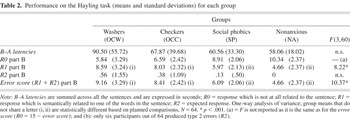
A one-way analysis of variance (ANOVA) with a group factor (OCW, OCC, SP, NA) was performed on the Hayling scores. As described in Table 2, the following variables were used: (a) the B–A latency (as data were not normally distributed, between-group comparisons were carried out following log transformation in order to reduce skewness; for ease of reading, raw data are presented in Table 2); (b) the error score measuring the overall semantic relatedness of the responses to the stimulus sentences in section B (R1 + R2); and (c) the frequency of each type of response in section B (R1 and R2). Analyses were not computed on R0, as this score is directly related to the error score and thus provides the same results. Actually, R0 corresponds to the number of correct responses, whereas the error score corresponds to the number of errors. In other words, R0 can be calculated by subtracting the error score from the total number of sentences. Orthogonal contrasts were used to compare groups. Following a procedure developed by Rosnow and Rosenthal (2003), the effect size of the contrasts was estimated by a correlation called rcontrast. This procedure has the advantage of expressing differences between groups (rcontrast) as well as relationships between variables (r) in terms of correlations. It is therefore possible to compare effect sizes without any calculation (such as transforming a Cohen's d into an rcontrast). A correlation (rcontrast or r) > .10 is generally considered as a small effect, >.30 as a moderate effect, and >.50 as a large effect (Cohen, 1988).
Performance on the Hayling task (means and standard deviations) for each group

We first computed a one-way ANOVA for section A latencies to ensure that groups did not differ on the baseline condition. No main effect was found for this measure [F(3,60) = 2.12, p = .11]. In addition, in section A of the task, none of the four groups made any errors. As indicated by the response latencies, all the participants took more time when asked to suppress their initial response than when left free to respond spontaneously. The four groups did not differ on the B–A latencies [F(3,60) = 1.51, p = .22]. However, a significant main effect for group was found for the overall error score in section B [error score: F(3,60) = 10.37, p < .001] and for section B responses that were semantically related to one of the words of the sentence [R1: F(3,60) = 8.22, p < .001]. To interpret these effects, further comparisons were computed, using orthogonal contrasts. As three comparisons were computed for each of these scores (error score and R1), Bonferroni corrections were used and only p values lower than .016 were considered as significant. We first compared OCWs with OCCs. As shown by the group means in Table 2, the OCWs did not differ from the OCCs on any error measure. We then compared SPs with NAs and the results showed no significant differences between these two groups on any error measure. Finally, as OCWs did not differ from OCCs and SPs did not differ from NAs, we compared OCD patients (OCWs + OCCs) with control groups (SPs + NAs). OCD patients made significantly more errors than the control groups. This latter comparison presented a large effect size on error score [F(1,60) = 27.96; p < .001; rcontrast = 0.56] and R1 [F(1,60) = 22.16; p < .001; rcontrast = 0.52].
Pearson correlations between the Hayling task and self-report questionnaires for OCD patients revealed that the Hayling error score significantly correlates with the compulsion subscore [r(32) = .34; p < .05, moderate effect size] and the Y-BOCS total score [r(32) = .32; p < .05, moderate effect size], but not with the obsession subscore [r(32) = .19, p = .14]. Moreover, the error score did not significantly correlate with either the STAI-State [r(32) = −.09; p = .30], the STAI-Trait [r(32) = .08; p = .33], the BDI-II [r(32) = .19; p = .14], or the LSAS [r(12) = .10; p = .38].
DISCUSSION
In this study, we compared patients with obsessive-compulsive disorder (checkers and washers), patients with social phobia, and healthy controls on the Hayling task, which was specifically developed by Burgess and Shallice (1996) to assess the ability to inhibit a prepotent response (one of the functions of the Supervisory Attentional System). The groups did not differ significantly in terms of section B minus section A latencies. On the other hand, in the inhibition section, the OCD patients (both checkers and washers) made significantly more errors than the social phobic patients or the nonanxious controls, a difference that corresponds to a large effect size. Finally, in OCD patients, performance on the Hayling task was significantly correlated with compulsions, but not with obsessions nor with the scores for general anxiety (STAI), depression (BDI-II), or social anxiety (LSAS).
In brief, these results indicate that the OCD patients have trouble inhibiting a prepotent response. This deficit is observed in checkers and washers alike, but not in social phobic patients. For this reason, it can be considered to be a dysfunction specifically related to OCD symptomatology. In addition, the fact that the deficit is revealed through errors and not through response times suggests that it is not attributable to slowness induced by the occurrence of intrusive thoughts or by a personality characteristic reflecting either meticulousness or indecision. More generally, these data are consistent with an interpretation suggesting that the persistence of OCD results, at least in part, from a general inability to inhibit automatic schemas (Lubman et al., 2004).
As mentioned in the introduction, a number of studies have explored inhibition abilities in OCD patients by using different types of tasks (e.g., the Stroop task, the negative priming task, the inhibition of return task, or the Go/No Go task). However, these studies have resulted in very different findings. Part of this heterogeneity is probably a result of procedural differences between studies and/or of the poor reliability of (some of) these inhibition tasks (Rabbitt, 1997). Two other problems concern the fact that the construct validity of some commonly used inhibition tasks (e.g., the negative priming task) is not well established, and also that no tasks are pure measures of inhibition (Friedman & Miyake, 2004). Therefore, poor performance on a task may not necessarily result from defective inhibition ability, and differences in the same task between studies may reflect variations in other idiosyncratic requirements of this task. It should be recognized that the Hayling task is not completely immune from these construct validity and task impurity problems. Indeed, in the inhibition condition, the participants must complete the sentence frame with a word that is unrelated to all the words in the frame, which means that prominent responses must be inhibited. It should be noted that this inhibition process occurs without the strong time pressure of other inhibition tasks such as the Stroop task or the Go/No Go task. However, it appears that another process also contributes to performance on the task. Indeed, Burgess and Shallice (1996) showed that normal participants tend to develop a strategy of producing a possible response before the sentence frame is even presented; when the sentence frame is actually given, they check that the response is not semantically related to the sentence before producing it. More specifically, the two most common strategies are to think of a word related to the previous response and to select an object in the testing room. In this study, we have not examined the responses that reveal the use of strategies versus those that did not. In fact, it is not easy to distinguish between a deficit affecting the ability to inhibit a prepotent response and a difficulty in strategically producing an unrelated item. Nevertheless, it seems important to determine whether a strategic processing deficit might contribute to OCD patients' performance in the Hayling task, as strategic difficulties have been observed in OCD persons (e.g., Savage et al., 2000; Shin et al., 2004). Concerning inhibition control, a possible approach for determining the real contribution of prepotent response inhibition would be to administer to OCD patients multiple tasks chosen to tap into this specific inhibition process (including the Hayling task) and to extract the common variance among the different tasks by using latent-variable analysis.
Interestingly, this approach was recently adopted by Friedman and Miyake (2004) to examine the relation among three inhibition functions in 220 normal adults. They observed that response-distractor inhibition (i.e., combining prepotent response inhibition and resistance to external distractor interference) was unrelated to resistance to proactive interference (i.e., resistance to memory intrusions from information that was previously relevant to the task but had since become irrelevant). They also showed that the two kinds of inhibition were differentially involved in other cognitive measures. Specifically, response-distractor inhibition was closely related to task-switching ability and the frequency of cognitive failures in everyday life, whereas resistance to proactive interference was related to the frequency of unwanted thoughts. This distinction between the two inhibitory mechanisms can be applied to OCD, by suggesting that a deficit affecting resistance to proactive interference is specifically related to the occurrence of obsessions (because of an inability to resist irrelevant thoughts; see Friedman & Miyake, 2004), whereas a response-distractor inhibition deficit is more strongly related to the occurrence of compulsions. The present data, which suggest a specific link between compulsions and the Hayling task (which evaluates response-distractor inhibition), seem to support this hypothesis. However, future studies should investigate whether resistance to proactive interference might also be related to OCD symptoms, and attempt to characterize the contribution to OCD made by each specific component of the cognitive inhibition functions described by Friedman and Miyake (2004).
ACKNOWLEDGMENTS
This study was supported by the Swiss National Science Foundation, grant no. 1114-067135.01/1. The authors thank Mathieu d'Acremont for his help with the data analysis.
References
REFERENCES
American Psychiatric Association.
(1994).
Diagnostic and statistical manual of mental disorders
(4th ed.).
Washington, DC:
American Psychiatric Association.
Andrés, P. &
Van der Linden, M.
(2001).
Supervisory attentional system in patients with focal frontal
lesions.
Journal of Clinical and Experimental Neuropsychology,
23,
225–239.Google Scholar
Balota, D.A. &
Faust, M.
(2001).
Attention in dementia of the Alzheimer type. In
F. Boller &
J. Grafman (Eds.),
Handbook of neuropsychology
(2nd ed., Vol. 6, pp.
51–80).
Amsterdam:
Elsevier.
Bannon, S.,
Gonsalvez, C.J.,
Croft, R.J., &
Boyce, P.M.
(2002).
Response inhibition deficits in obsessive-compulsive
disorder.
Psychiatry Research,
110,
165–174.Google Scholar
Barrett, L.F.,
Tugade, M.M., &
Engle, R.W.
(2004).
Individual differences in working memory capacity and dual-process
theories of the mind.
Psychological Bulletin,
130,
553–573.Google Scholar
Beck, A.T.,
Steer, R.A., &
Brown, G.K.
(1998).
Inventaire de Dépression de Beck (version 2 BDI-II).
Paris:
Editions du Centre de Psychologie Appliquée.
Bouquet, C.A.,
Bonnaud, V., &
Gil, R.
(2003).
Investigation of supervisory attentional system functions in
patients with Parkinson's disease using the Hayling task.
Journal of Clinical and Experimental Neuropsychology,
25,
751–760.Google Scholar
Burgess, P.W. &
Shallice, T.
(1996).
Response suppression, initiation and strategy use following frontal
lobe lesions.
Neuropsychologia,
34,
263–272.Google Scholar
Ceschi, G.,
Van der Linden, M.,
Dunker, D.,
Perroud, A., &
Bredart, S.
(2003).
Further exploration memory bias in compulsive washers.
Behaviour Research and Therapy,
41,
737–747.Google Scholar
Channon, S.,
Sinclair, E.,
Waller, D.,
Healey, L., &
Robertson, M.M.
(2004).
Social cognition in Tourette's syndrome: Intact theory of mind
and impaired inhibitory functioning.
Journal of Autism and Developmental Disorders,
34,
669–677.Google Scholar
Cohen, J.
(1988).
Statistical power analysis for the behavioral sciences.
Hillsdale, NJ:
Erlbaum.
Collette, F.,
Van der Linden, M., &
Salmon, E.
(1999).
Executive dysfunction in Alzheimer's disease.
Cortex,
35,
57–72.CrossRefGoogle Scholar
Cottraux, J.,
Bouvard, M., &
Légeron, P.
(1996).
Méthodes et échelles d'évaluation des
comportements.
Paris:
Masson.
Enright, S.J. &
Beech, A.R.
(1990).
Obsessional states: Anxiety disorders or schizotypes? An information
processing and personality assessment.
Psychological Medicine,
20,
621–627.Google Scholar
Enright, S.J. &
Beech, A.R.
(1993a).
Further evidence of reduced cognitive inhibition in
obsessive-compulsive disorder.
Personality and Individual Differences,
14,
387–395.Google Scholar
Enright, S.J. &
Beech, A.R.
(1993b).
Reduced cognitive inhibition in obsessive-compulsive
disorder.
British Journal of Clinical Psychology,
32,
67–74.Google Scholar
Enright, S.J.,
Beech, A.R., &
Claridge, G.S.
(1995).
A further investigation of cognitive inhibition in
obsessive-compulsive disorder and other anxiety disorders.
Personality and Individual Differences,
19,
535–542.Google Scholar
Friedman, N.P. &
Miyake, A.
(2004).
The relations among inhibition and interference control functions: A
latent variable analysis.
Journal of Experimental Psychology: General,
133,
101–135.CrossRefGoogle Scholar
Goodman, W.K.,
Price, L.H.,
Rasmussen, S.A.,
Mazure, C.,
Fleischmann, R.L.,
Hill, C.L.,
et al.
(1989).
The Yale-Brown Obsessive Compulsive Scale. I. Development, use, and
reliability.
Archives of General Psychiatry,
46,
1006–1011.CrossRefGoogle Scholar
Hartston, H.J. &
Swerdlow, N.R.
(1999).
Visuospatial priming and Stroop performance in patients with
obsessive compulsive disorder.
Neuropsychology,
13,
447–457.CrossRefGoogle Scholar
Hasher, L.,
Zacks, R.T., &
May, C.P.
(1999).
Inhibitory control, circadian arousal, and age. In
D. Gopher &
A. Koriat (Eds.),
Attention and performance XVII, Cognitive regulation of performance:
Interaction of theory and application (pp.
653–675).
Cambridge, MA:
MIT Press.
Hoenig, K.,
Hochrein, A.,
Müller, D.J., &
Wagner, M.
(2002).
Different negative priming impairments in schizophrenia and
subgroups of obsessive-compulsive disorder.
Psychological Medicine,
32,
459–468.Google Scholar
Kieley, J.M. &
Hartley, A.A.
(1997).
Age-related equivalence of identity suppression in the Stroop
color-word task.
Psychology and Aging,
12,
22–29.Google Scholar
Liebowitz, M.R.
(1987).
Social phobia.
Mood Problems in Pharmacopsychiatry,
22,
141–173.CrossRefGoogle Scholar
Lubman, D.I.,
Yücel, M., &
Pantelis, C.
(2004).
Addiction, a condition of compulsive behaviour? Neuroimaging and
neuropsychological evidence of inhibitory dysregulation.
Addiction,
99,
1491–1502.Google Scholar
MacDonald, P.A.,
Antony, M.M.,
MacLeod, C.M., &
Swinson, R.P.
(1999).
Negative priming for obsessive-compulsive checkers and
noncheckers.
Journal of Abnormal Psychology,
108,
679–686.Google Scholar
Marczewski, P.,
Van der Linden, M., &
Larøi, F.
(2001).
Further investigation of the supervisory attentional system in
schizophrenia: Planning, inhibition and rule abstraction.
Cognitive Neuropsychiatry,
6,
175–192.CrossRefGoogle Scholar
McNally, R.J.,
Wilhelm, S.,
Buhlmann, U., &
Shin, L.M.
(2001).
Cognitive inhibition in obsessive-compulsive disorder: Application
of a valence-based negative priming paradigm.
Behavioural and Cognitive Psychotherapy,
29,
103–106.Google Scholar
Milliken, B.,
Joordens, S.,
Merikle, P., &
Seiffert, A.
(1998).
Selective attention: A reevaluation of the implications of negative
priming.
Psychological Review,
105,
203–229.Google Scholar
Mollard, E.,
Cottraux, J., &
Bouvard, M.
(1986).
Version française de l'Echelle
d'Obsession-Compulsion de Yale-Brown.
Encéphale,
15,
35–41.Google Scholar
Moritz, S.,
Birkner, C.,
Kloss, M.,
Jahn, H.,
Hand, I.,
Haasen, C.,
et al.
(2002).
Executive functioning in obsessive-compulsive disorder, unipolar
depression, and schizophrenia.
Archives of Clinical Neuropsychology,
17,
477–483.Google Scholar
Moritz, S.,
Jacobsen, D.,
Kloss, M.,
Fricke, S.,
Rufer, M., &
Hand, I.
(2004).
Examination of emotional Stroop interference in obsessive-compulsive
disorder.
Behaviour Research and Therapy,
42,
671–682.Google Scholar
Moritz, S.,
Kloss, M.,
Katenkamp, B.,
Birkner, C., &
Hand, I.
(1999).
Neurocognitive functioning in OCD before and after treatment.
CNS Spectrums,
4,
21–22.Google Scholar
Moritz, S. &
von Mühlenen, A.
(2005).
Inhibition of return in patients with obsessive-compulsive
disorder.
Journal of Anxiety Disorders,
19,
117–126.CrossRefGoogle Scholar
Nakao, T.,
Nakagawa, A.,
Yoshiura, T.,
Nakatani, E.,
Nabeyama, M.,
Yoshizato, C.,
et al.
(2005).
A functional MRI comparison of patients with obsessive-compulsive
disorder and normal controls during a Chinese character Stroop
task.
Psychiatry Research,
139,
101–114.Google Scholar
Neill, W.T.
(1997).
Episodic retrieval in negative priming and repetition
priming.
Journal of Experimental Psychology: Learning, Memory and
Cognition,
23,
1291–1305.Google Scholar
Nelson, E.,
Early, T.S., &
Haller, J.W.
(1993).
Visual attention in obsessive-compulsive disorder.
Psychiatry Research,
49,
183–196.Google Scholar
Nigg, J.T.
(2000).
On inhibition/disinhibition in developmental psychopathology:
Views from cognitive and personality psychology and a working inhibition
taxonomy.
Psychological Bulletin,
126,
220–246.Google Scholar
Noël, X.,
Sferrazza, R.,
Van der Linden, M.,
Paternot, J.,
Verhas, M.,
Hanak, C.,
et al.
(2002).
Contribution of frontal cerebral blood flow measured by
99mTc-bicisate SPECT and executive function deficits to predicting
treatment outcome in alcohol-dependent patients.
Alcohol and Alcoholism,
37,
347–354.Google Scholar
Noël, X.,
Van der Linden, M.,
Schmidt, N.,
Sferrazza, R.,
Hanak, C.,
Le Bon, O.,
et al.
(2001).
Supervisory attentional system in nonamnesic alcoholic men.
Archives of General Psychiatry,
58,
1152–1158.Google Scholar
Norman, D.A. &
Shallice, T.
(1980).
Attention to action: Willed and automatic control of behavior.
Center for human information processing (technical report no. 99).
Reprinted in revised form in R.J. Davidson, G.E. Schwartz & D.
Shapiro (Eds.), Consciousness and self regulation. Advances in research
(1986). New York: Plenum.
Rabbitt, P.
(1997).
Introduction: Methodologies and models in the study of executive
function. In
P. Rabbitt (Ed.),
Methodology of frontal and executive function (pp.
1–38).
Hove, UK:
Psychology Press.
Rankins, D.,
Bradshaw, J.,
Moss, S., &
Georgiou-Karistanis, N.
(2004).
Inhibition of return in obsessive-compulsive disorder.
Journal of the International Neuropsychological Society,
10,
54–59.Google Scholar
Rosnow, R. &
Rosenthal, R.
(2003).
Effect sizes for experimenting psychologists.
Canadian Journal of Experimental Psychology,
57,
221–237.Google Scholar
Savage, C.R.,
Deckersbach, T.,
Wilhelm, S.,
Rauch, S.L.,
Baer, L.,
Reid, T.,
et al.
(2000).
Strategic processing and episodic memory impairment in obsessive
compulsive disorder.
Neuropsychology,
14,
141–151.Google Scholar
Shin, M.S.,
Park, S.J.,
Kim, M.S.,
Lee, Y.H.,
Ha, T.H., &
Kwon, J.S.
(2004).
Deficits of organizational strategy and visual memory in
obsessive-compulsive disorder.
Neuropsychology,
18,
665–672.Google Scholar
Spielberger, C.D.,
Gorsuch, R., &
Lushene, R.
(1983).
The State Trait Anxiety Inventory (STAI) test manual.
Palo Alto, CA:
Consulting Psychologists Press.
Stoltzfus, E.R.,
Hasher, L.,
Zacks, R.T.,
Ulivi, M.S., &
Goldstein, D.
(1993).
Investigations of inhibition and interference in younger and older
adults.
Journal of Gerontology: Psychological Sciences,
48,
P179–188.Google Scholar
Stroop, J.R.
(1935).
Studies of interference in serial verbal reactions.
Journal of Experimental Psychology: Learning, Memory and
Cognition,
18,
643–662.CrossRefGoogle Scholar
Tallis, F.
(1995).
Obsessive-compulsive disorder. A cognitive and neuropsychological
perspective.
Chichester, UK:
Wiley.
Tipper, S.P.
(1985).
The negative priming effect: Inhibitory priming by ignored
objects.
Quarterly Journal of Experimental Psychology,
37,
571–590.CrossRefGoogle Scholar
Waters, F.A.V.,
Badcock, J.C.,
Maybery, M.T., &
Michie, P.T.
(2003).
Inhibition in schizophrenia: Association with auditory
hallucinations.
Schizophrenia Research,
62,
275–280.Google Scholar

Characteristics of each group of participants
Performance on the Hayling task (means and standard deviations) for each group
 You have
Access
- 27
- Cited by