Carbapenem-resistant Acinetobacter baumannii (CRAB) has emerged as a leading cause of healthcare-associated infections associated with high mortality.Reference Peleg, Seifert and Paterson 1 , Reference Lemos, de la Hoz and Alvis 2 Multimodal infection control strategies, including isolation or cohorting of carriers, strict contact precautions and environmental cleaning, are essential components to prevent nosocomial transmission. 3 , Reference Tomczyk, Zanichelli and Grayson 4 Colonization with CRAB may persist for months; however, data on the natural history of carriage and risk factors for extended duration of carriage are limited.Reference Marchaim, Navon-Venezia and Schwartz 5 These data can guide policies on whether previously identified carriers should be isolated preemptively on subsequent hospital admissions. Here, we aimed to evaluate the risk of CRAB carriage upon first readmission among patients previously diagnosed with CRAB, to identify the anatomic sites with the highest sensitivity for screening in this population, and to identify risk factors for persistent carriage.
Methods
Setting and study design
This study was conducted between June 2015 and November 2017 at Tel-Aviv Sourasky Medical Center, Israel. We included adult patients who had a CRAB clinical culture during a prior hospitalization and who could be screened within 7 days upon first readmission. Patients with <1 week between discharge and readmission were excluded. The study was approved by the hospital’s institutional review board.
Data collection
Data were extracted from patient medical records and from computerized laboratory and administrative databases. Variables collected included age, sex, primary diagnosis on admission, origin (home or another institution), functional status, comorbidities, presence of a chronic wound, presence of an invasive device, antibiotic use in the past 30 days, time from the previous hospital discharge to first readmission, and whether patients had a microbiologically confirmed CRAB infection during the recurrent hospitalization.
Screening cultures
Samples from patients and their immediate surroundings were collected as described previously.Reference Nutman, Lerner, Schwartz and Carmeli 6 All patients were sampled at 3 sites: the buccal mucosa and rectum using a swab and the skin using sterile premoistened sponges. Sponges were also used to sample the environment: bedrail, bedsheet, bedside cabinet, bedhead outlets, and medical devices connected to the patient.
Sample processing
Specimens were transferred immediately to the laboratory for processing. Samples were processed in parallel using two procedures: (1) direct plating onto ChromAgar MDR Acinetobacter plates (Hylabs, Israel) and incubation overnight at 37°C. (2) an enrichment procedure, which included suspending the sponges in a tube containing 20 mL brain-heart infusion broth (BHI; Hylabs, Israel) and the swabs in 3 mL BHI, vortex for 1 minute at maximum speed and incubation overnight at 37°C. The broth suspension was then inoculated onto CHROMagar MDR Acinetobacter plates using a sterile loop, and the plates were incubated overnight. Suspicious colonies (red) were isolated and identified using VITEK-MS (bioMérieux, Marcy l’Etoile, France). For both the screening cultures in this study and the initial CRAB-positive clinical cultures, carbapenem resistance was determined by VITEK-2 system (bioMérieux), and the results were interpreted according to the Clinical and Laboratory Standards Institute (CLSI) guidelines.
Statistical analysis
The Wilcoxon rank-sum test, the χ2 test, and the Fisher exact test were used to compare characteristics between readmitted patients with positive or negative CRAB screening cultures. A Kaplan-Meier curve and a proportional hazards regression model for interval-censored data were used to analyze the risk of CRAB carriage upon readmission. Statistical analyses were performed using SAS version 9.4 software (SAS Institute, Cary, NC).
Results
Our study included 38 patients. The median time from discharge to readmission was 59 days (interquartile range [IQR], 35–147). The median time from readmission to screening was 2 days (range, 1–7).
Screening cultures were positive for CRAB in 12 patients (31.6%). Positive yield by body site was 9 of 12 (75%) for skin, 7 of 12 (58.3%) for buccal mucosa, and 6 of 10 (60%) for rectum. Using enriched cultures as the gold standard, direct plating detected 6 of 7 positive buccal mucosa cultures (85.7%), 6 of 6 positive rectal cultures (100%), and 5 of 9 positive skin cultures (55.5%). Furthermore, 2 patients were positive only on the skin, and 2 patients were positive only in the buccal mucosa. No patients were positive only in the rectum.
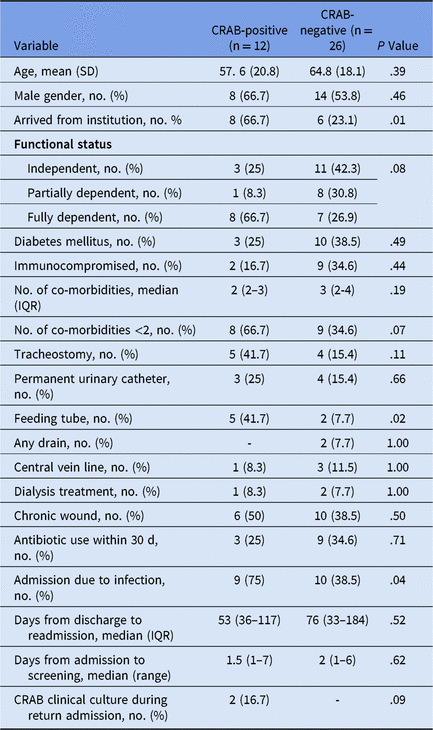
A comparison between patients who screened positive and negative upon readmission is presented in Table 1. Patients who screened positive were more likely to have arrived from an institution (66.7% vs 23.1%; P = .01), to have a feeding tube (41.7% vs 7.7%; P = .02), and to have been admitted with an infection-related diagnosis (75% vs 38.5%; P = .04). Also, 2 patients who screened positive had a microbiologically confirmed CRAB infection during the recurrent admission; however, in both cases, the CRAB infection was not present on admission.
Characteristics of Patients with Carbapenem-Resistant Acinetobacter baumannii (CRAB)-Positive Clinical Cultures During a Prior Hospitalization who Screened Positive or Negative Upon Readmission.

Note. SD, standard deviation; IQR, interquartile range.
At screening, we found a high level of contamination of the immediate patient environment in carriers: beds were positive in 11 of 12 patients (91.7%); cabinets were positive in 6 of 12 patients (50%); and medical equipment was positive in 8 of 14 devices sampled (57%).
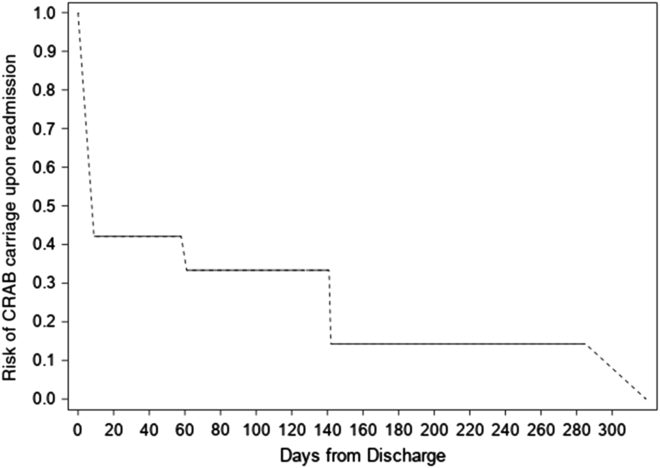
Figure 1 presents the Kaplan-Meier curve of CRAB-positive screening upon first readmission. The risk of CRAB carriage was 42% (95% confidence interval [CI], 24%–59%) up to 58 days from discharge, 33% (95% CI, 17%–51%) up to 141 days from discharge, and 14% (95% CI, 3%–34%) up to 285 days from discharge. When carriage risk was stratified by origin, in patients arriving from home, the risk of CRAB carriage was 23% (95% CI, 8%–44%) up to 127 days from discharge, and in patients arriving from an institution, the risk of carriage was 86% (95% CI, 44%–97%) up to 53 days from discharge, and 33% (95% CI, 9%–60%) up to 285 days from discharge.
Kaplan-Meier curve of risk of positive carbapenem-resistant Acinetobacter baumannii (CRAB) screening upon first readmission of patients with CRAB-positive clinical cultures during a prior hospitalization.

Discussion
Contact isolation and cohorting of carriers is the cornerstone of effective infection control programs to reduce nosocomial transmission of multidrug-resistant organisms (MDRO). 3 Because readmission of patients colonized with MDRO is common,Reference Burnham, Kwon, Olsen, Babcock and Kollef 7 it is important to identify persistent carriers on admission to isolate them preemptively.
We screened patients with a CRAB-positive clinical culture during a previous hospitalization upon first readmission. Of 38 patients screened, 31.6% were positive. Median time from discharge to first readmission was 53 days (range, 27–285) in patients who screened positive, and 76 days (range, 9–552) in patients who screened negative. Although carriage was persistent up to 285 days in this study, we found that up to 2 months from discharge, 42% of patients were carriers, and after 5 months, only 14% were carriers. The chance of positive screening for CRAB on readmission was higher for patients originating from an institution than from home.
We found widespread contamination in the immediate environment of persistent carriers, which underscores the importance of early identification and isolation of carriers to prevent transmission.
This study has several limitations. Our sample size was small; thus, true differences between patients who were CRAB positive and CRAB negative upon readmission may have gone undetected. Clinical isolates from the previous admission were not available for typing; thus, we could not verify that the strains identified by screening were the same strain as the original clinical culture. Because of the small sample size, we did not compare the impact of specific antibiotics administered in the 30 days before readmission on persistent CRAB carriage. Furthermore, because only patients with a readmission were included in the study (selection bias), we were not able to evaluate the true natural history of CRAB carriage.
Our study has 2 important clinical implications: (1) CRAB carriage may be prolonged, especially in patients arriving from an institution and (2) screening for CRAB upon readmission is feasible. Further research is needed to build evidence on which to base CRAB screening recommendations.
Acknowledgments
We thank Dr Elizabeth Temkin for her helpful comments on this manuscript.
Financial support
This study was partially supported by the European Commission FP7 AIDA project (“Preserving old antibiotics for the future: Assessment of clinical efficacy by a pharmacokinetic/pharmacodynamic approach to optimize effectiveness and reduce resistance for off-patent antibiotics”; grant no. Health-F3-2011-278348).
Conflicts of interest
All authors report no conflicts of interest relevant to this article.