INTRODUCTION
Ichthyophthirius multifiliis is a holotrichous protozoan parasite, which invades the skin and gills of freshwater fish and thereby causes the so-called white spot disease, which can cause high mortalities in aquaculture. It is one of the most common and persistent diseases of freshwater fish (Traxler et al. Reference Traxler, Richard and McDonald1998). The life stages of the parasite include an infective theront, a parasitic trophont and a reproductive tomont (Dickerson, Reference Dickerson and Woo2006; Matthews, Reference Matthews2005).
Ichthyophthirius-infected ornamental fish can be treated effectively with a wide spectrum of agents, especially malachite green. Fish for human consumption had been treated with malachite green until the early 1990s. It was highly effective, inexpensive and potent against many different parasites (Callinan and Rowland Reference Callinan, Rowland, Rowland and Bryant1995). However, because of its carcinogenic potential, it is no longer permitted to treat fish for human consumption with malachite green in many countries. Other chemotherapeutants, such as formalin (Rowland et al. Reference Rowland, Mifsud, Nixon, Read and Landos2009), Chlorophyllin (Wohllebe et al. Reference Wohllebe, Richter and Häder2012), chloramine-T (Rintamäki-Kinnunen et al. Reference Rintamäki-Kinnunen, Rahkonen, Mannermaa-Keränen, Suo-malainen, Mykrä and Valtonen2005), copper sulphate (Rowland et al. Reference Rowland, Mifsud, Nixon, Read and Landos2009), potassium ferrate (VI) (Ling et al. Reference Ling, Wang, Wang and Gong2011), potassium permanganate (Straus and Griffin, Reference Straus and Griffin2002), tricaine methanesulfonate (Xu et al. Reference Xu, Shoemaker and Klesius2008) and bronopol (Shinn et al. Reference Shinn, Picóncamacho, Bron, Conway, Yoon, Guo and Taylor2012) have been tested as alternatives but without great success. Therefore, there is an urgent need for the development of affordable, effective and safe alternative agents to combat the disease.
Recently, there have been increased researches on the utilization of natural plant products to control I. multifiliis infection (Yao et al. Reference Yao, Shen, Li, Xu, Hao, Pan, Wang and Yin2010, Reference Yao, Li, Li, Xu, Ai and Shen2014; Fu et al. Reference Fu, Zhang, Xu, Liang and Wang2014). Effective compounds of natural origin are expected to be more effective than synthetic antiparasitic agent, as they have generally a lower environmental impact and are easily biodegradable. Yao et al. (Reference Yao, Shen, Li, Xu, Hao, Pan, Wang and Yin2010, Reference Yao, Zhou, Li, Yin, Ru, Pan, Hao, Xu and Shen2011) found that sanguinarine, dihydrosanguinarine and dihydrochelerythrine from Macleaya cordata were effective against I. multifillis. Two compounds, Chelerythrine and Chloroxylonine, from Toddalia asiatica have been reported to have the antiparasitic activity against I. multifillis (Shan et al. Reference Shan, Meng, Kang, Bian, Gao, Wang and Qian2014). Use of antiparasitic compounds extracted from plants could be a new approach to treat ichthyophthiriasis.
Cynanchum paniculatum (Bge.) Kitag, is distributed chiefly in China, Japan and Korea. Ethanol extracts of C. paniculatum was active against I. multifillis, which leads us to consider if it is capable of controlling ichthyophthiriasis. The principal objective of this study was to assess the antiparasitic properties of C. paniculatum and its active constituents.
MATERIALS AND METHODS
Plant material
The roots of C. paniculatum were collected in LiaoNing province, China, in October 2014. They were cleaned and air dried for 7 days at 55 °C and pulverized in electric grinder. The powdered plant samples were stored at −20 °C until further use.
Source of uninfected fishes
Goldfish (Carassius auratus), weighing approximately 8·5 g each, were obtained from a local ornamental fish market in Changchun and were kept in 1500 L tanks. Prior to experiments, the skin surface and gills of ten randomly sampled fish were examined under a microscopically to confirm that they were not infected with gill or skin parasites.
Parasites and hosts
The sources of I. multifiliis, its propagation on grass carp and collection of the cysts have been described by Yao et al. (Reference Yao, Li, Li, Xu, Ai and Shen2014). Several heavy infected grass carp (Ctenopharyngodon idella) obtained from a local producer in Changchun were placed into filtered aquarium water for 30–60 min. Mature trophonts were allowed to detach from the host by body movements of the fish. Isolated trophonts were randomly divided into two batches, one was used to assay the activity of the fraction and active compounds isolated from C. paniculatum for killing the tomonts, and the other placed in plastic beaker with aerated groundwater filtered and incubated for 24 h at 23 °C. The water containing the hatched theronts in the plastic beaker was agitated and 50 µL of the water was withdrawn five times. The number of theronts in each 50 µL of water was counted, and the average number of parasites per milliliter was calculated to estimate the total number of hatched theronts.
Isolation and identification of antiparasitic components from C. paniculatum
The antiparasitic component was isolated via an in vitro bioassay-guided fractionation based on anti-Ich (theronts) effect of fractions from C. paniculatum. Only the fractions with strong anti-Ich activity were further purified until the target component was obtained.
Air-dried and powdered rhizomes of C. paniculatum were exhaustively extracted with 50 L methanol at room temperature by percolation. This extract was subjected to macroporous resin HP20 (lvbaicao chemical Co., Ltd., Beijing province, China) as determined by preliminary experiments and eluted with 70% methanol to give 480 fractions (300 mL each fraction). Fractions were monitored using thin-layer chromatography (TLC) and fractions showing similar TLC chromatograms were combined into five fractions (Fr. A, 1–56 fractions; Fr. B, 57–143 fractions; Fr. C, 144–298 fractions; Fr. D, 299–368 fractions; Fr. E, 369–480 fractions). These five fractions were submitted to anti-Ich test (in vitro test), and Fr. E was the most active and was then applied to reverse-phase high-performance liquid chromatography (RP-HPLC) successively eluted with water–methanol (3:7;4:6;5:5;6:4;7:3) gradients, Repetition of the chromatographic separations and recrystallization led to the isolation of the two active compounds.
In vitro antiparasitic of extracts and active compounds from C. paniculatum against I. multifiliis theronts
The tests were conducted to access a comprehensive antiparasitic activity of fractions and active compounds against I. multifiliis theronts. The crude extracts, fractions and the pure compound were dissolved in 1 mL DMSO, respectively, and made up to 50 mL with distilled water, which were used for the preparation of the different concentrations of the test solutions. Tests were conducted in each well of a 24-well tissue culture plate, the theronts were placed into plates at a final concentration of about 100 theronts per well, and exposed to different concentrations of test samples. Microscopic examination (×40 magnifications) was used to determine the antiparasitic activity of each well at various intervals up to 4 h after exposure. The trial was repeated three times.
Antiparasitic activities of Cynatratoside-A and Cynanversicoside C against I. multifiliis encysted tomonts
Twenty protomonts were placed into each well of a 24-well tissue culture plate. Until the parasites had produced a cyst coat, the water in each well was removed carefully by a pipette, and 1 ml Cynatratoside-A and Cynanversicoside C at a concentration of 1·0, 2·0, 4·0, 6·0 and 8·0 mg L−1 were added to each well (each concentration was repeated three times), respectively. A negative control was included using aerated groundwater containing the same amount of DMSO as the maximum concentration of the test group. The solutions were replaced by filtered aquarium water with no active compounds after 6 h exposure. Then the plates were incubated for 20 h at 23·0 ± 1·0 °C. After counting dead tomonts, theronts in each well were enumerated as described above. The mortality and reproduction of tomonts were determined for each well. The tomont reproduction was expressed as number of theronts released by each tomont, calculated by total theronts/live tomonts.
In vivo efficacy of Cynatratoside-A and Cynanversicoside C from C. paniculatum in protection of goldfish against Ich
In vivo test was conducted according to our previous study (Zheng et al. Reference Zheng, Yan, Zhang, Li, Li, Li, Wang, Wang, Chen and Yu2014) with slight modifications. Briefly, 210 uninfected goldfish, weighing approximately 30 g each, were transferred to 1000 L tanks and were acclimated to laboratory conditions for 7 days before the experiment. After acclimation, approximately 10 500 000 I. multifiliis theronts were put into the 1000 L tanks, the fish were held in the tank for 24 h with gentle aeration to promote infection. After exposure, the fish were divided into seven groups: Cynatratoside-A-challenged (5·0, 10·0, 15·0 mg L−1), Cynanversicoside C-challenged (5·0, 10·0 and 15·0 mg L−1) and control group (challenged with no chemical). Each group consisted of three replicates of 100 L groundwater and ten infected goldfish. The Cynatratoside-A and Cynanversicoside C in each tank was replaced on day 3 with a fresh solution at the same concentration.
Ten days after exposure to theronts, all remaining fish from each group were randomly sampled and the number of trophonts on the gills and fins was examined. The fish were carefully observed every hour for signs of distress, the fish held to count the trophonts on the gills and fins as soon as dead. Fish mortality was recorded daily and the parasites on the gills and fins of dead fish were counted.
Data analysis
All data in this study were performed using the SPSS 16·0 probit procedure, Tomont survival, tomont reproduction, and infection intensity were compared with the Student–Newman–Keuls test procedure for multiple comparisons (α = 0·05).
RESULTS
Structure identification of active compounds
The chemical structure confirmations of active compounds from C. paniculatum were accomplished by comparing m p, MS, 1H NMR and 13C NMR data obtained to those published.
Compound 1 was obtained as colourless crystal; m p: 189–191°C. IR (KBr) ν 3400, 1730, 1650, 1470, 1450, 1380, 1310, 1190,1160,1110, 1078, 1010, 982, 918, 900, cm−1; EI-MS m/z: 504[M+ 6·7]. 1H-NMR (500 MHz, MeOD) δ 0·94 (3H, s, 19CH3), 1·36 (3H, d, J = 5·3 Hz, 5′-CH3), 1·44 (3H, s, 21-CH3), 3·29 (3H, d, 3′-OCH3), 1·47(3H, s, 21-CH3), 3·446 (3H, s, 3′-O CH3), 3·94 (1H, dd, J = 9·6 6·2 Hz,15 CH β ), 4·32 (1H, dd, 3′-CH), 4·21(1H, dd, J = 8·6 7·0 Hz, 15-CHa), 4·66 (1H, dd, J = 9·6 1·8 Hz,1′-CH), 5·39 (1H, ddd, J = 9·6, 7·5 7·5 Hz, 16-CH), 5·32 (1H, d, J = 5·3 Hz, 6-CH), 6·11 (1H, br, s, 18-CH). 13C-NMR (125 MHz, MeOD) δ 35·6 (C-1), 30·2 (C-2), 76·9 (C-3), 39·4 (C-4), 141·4 (C-5), 121·2 (C-6), 28·4 (C-7), 51·2 (C-8), 39·8 (C-9), 38·8 (C-10), 25·8 (C-11), 27·8 (C-12), 115·3(C-13), 175·8 (C-14), 65·5 (C-15), 75·8 (C-16), 55·2 (C-17), 145·8 (C-18), 17·6 (C-19), 115·2 (C-20), 25·1 (C-21), 97·4 (C-1′), 38·2 (C-2′), 81·0 (C-3′), 75·8 (C-4′), 72·3 (C-5′), 17·9 (C-6′), 55·8 (OCH3); agree well with the data reported (Qiu et al. Reference Qiu, Zhang and Zhou1989). So the compound was identified as Cynatratoside-A.
Compound 2 was obtained as colourless crystalline powder; IR (KBr) ν 3450, 2950, 1730, 1650, 1450, 1380, 1300, 1170, 1080, 1040, 870, cm−1; EI-MS m/z: 559[M+ + Na]+, 1095 [2 M+ + Na]+. 1H-NMR (500 MHz, MeOD) δ 3·55 (1H, m, H-3), 5·32 (1H, br, d, J = 5·0 Hz, H-6), 4·15 (1H, m, H-15α), 4·24 (1H, dd, J = 10·0, 9·4 Hz, H-15β), 5·44 (1H, ddd, J = 10·0, 9·4 Hz, H-16), 3·55 (1H, d, J = 7·0 Hz, H-17), 6·48 (1H, br, s, H-18), 0·97 (3H, s, H-19), 1·55 (3H, s, H-21), 4·81 (1H, s, J =7·7 H-1′). 13C-NMR (125 MHz, MeOD) δ 35·2 (C-1), 28·4 (C-2), 77·9 (C-3), 37·9 (C-4), 141·5 (C-5), 123·2 (C-6), 66·4 (C-7), 49·5 (C-8), 48·6 (C-9), 37·8 (C-10), 22·4 (C-11), 28·8 (C-12), 117·2 (C-13), 174·0 (C-14), 67·5 (C-15), 73·8 (C-16), 55·2 (C-17), 143·8 (C-18), 18·6 (C-19), 114·2 (C-20), 24·4 (C-21), 100·4 (C-1′), 73·2 (C-2′), 84·0 (C-3′), 74·4 (C-4′), 70·7 (C-5′), 16·7 (C-6′), 59·5 (OCH3); agree well with the data reported (Qiu et al, Reference Qiu, Zhang and Zhou1989). So the compound was identified as Cynanversicoside C.
In vitro antiparasitic efficacy of fractions and active compounds from C. paniculatum against I. multifiliis theronts
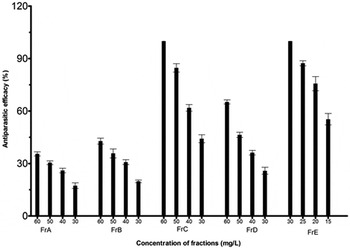
The in vitro antiparasitic efficacy of five fractions from the methanol extract were depicted in Fig. 1, which showed that Fr. E had a 100% antiparasitic effect against I. multifiliis at concentrations of 30·0 mg L−1, after 4 h of exposure. Fr. C was 100% effective against I. multifiliis at a concentration of 60·0 mg L−1 after 4 h of exposure. Fr .A, Fr. B and Fr. D had low efficacy at 60·0 mg L−1 with the efficacy of 35·5, 42·8 and 65·2%, respectively. Fr. E was considered to be the fraction that contained active compounds.
Efficacy of the five fractions (A–E) against I. multifiliistheronts after 4 h exposure. Note: Antiparasitic efficacy (%) = (B-T) × 100%/B, B is the mean number of the theronts in the negative group and T is the treatment. Error barsdenoted standard deviation (S.D.) of three replicates.

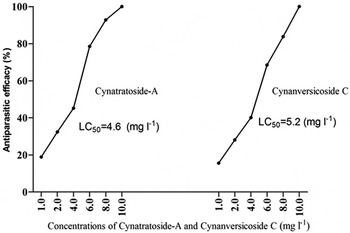
The treatment with Cynatratoside-A and Cynanversicoside C lead to a significant dose-dependent decrease in the number of I. multifiliis theronts compared with the controls. In vitro tests exhibited that Cynatratoside-A and Cynanversicoside C could be 100% effective against I. multifiliis at the concentration of 10·0 mg L−1, with the median effective concentration (EC50) values of 4·6 and 5·2 mg L−1, respectively (Fig. 2).
Efficacy of Cynatratoside-A and Cynanversicoside C against I. multifiliis theronts after 4 h exposure.

In vitro antiparasitic activity of Cynatratoside-A and Cynanversicoside C against I. multifiliis encysted tomonts
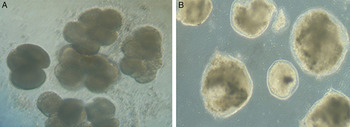
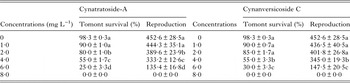
The effects of Cynatratoside-A and Cynanversicoside C on I. multifiliis encysted tomonts are shown in Table 1. The results showed that the two active compounds were effective against I. multifiliis encysted tomonts. All tomonts were killed when the concentrations of Cynatratoside-A and Cynanversicoside C reached 8·0 mg L−1. During microscopic examination, dead tomonts were distinctly apparent than live tomonts (Fig. 3), and no signs of division and no cilia movement were noted; in contrast, most live tomonts could divide and release theronts. Additionally, it was observed that the treatment with Cynatratoside-A and Cynanversicoside C resulted in a distinct dose dependent decrease in the total number of I. multifiliis released by tomonts compared with the controls.
Morphology of I. multifiliis Tomonts. (A) Control group (untreated with cynatratoside-A). (B) Treated with cynatratoside-A. Cynatratoside-A treated: the outer cell membrane of tomonts was destroyed, macronucleus was invisible, the cilia could not be recognized, and the cytoplasm of the trophozoites was characterized by vacuoles. Control group: no deformities to the cell membrane were observed.

Ichthyophthirius multifiliis tomont survival and reproduction after 6-h exposure of tomonts to Cynatratoside-A and Cynanversicoside C

The reproduction was represented as number of theronts released by each live tomont. Each value is expressed as mean ± S.D. of three replicates, and within a column, values followed by the different letters are significantly different (P < 0·05).
In vivo efficacy of Cynatratoside-A and Cynanversicoside C against I. multifiliis
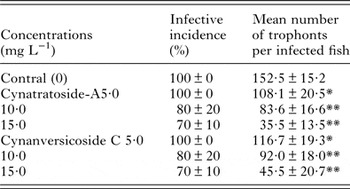
Table 2 shows the results of an in vivo study on the efficacy of Cynatratoside-A and Cynanversicoside C against I. multifiliis. A concentration of 15·0 mg L−1 of Cynatratoside-A demonstrated 100·0% survival to infected grasscarp at the end of the trial, the fish in this treated group also showed the lowest infectivity incidence and intensity. Exposure of infected grasscarp to 10·0 and 15·0 mg L−1 of Cynatratoside-A resulted in 80·0 and 100·0% survival, respectively.
In vivo efficacy of Cynatratoside-A and Cynanversicoside C against Ich at 10 days

Each value is expressed as mean ± S.D. of three replicates, and within a column, the values followed by the different letters are significantly different (P < 0·05) Note: *: P < 0·05; **: P < 0·01.
Infective incidence (%) = (number of infected goldfish in agroup/number of total goldfish in the group) × 100.
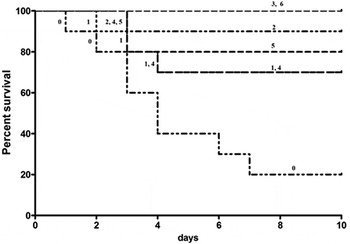
The treatment with Cynanversicoside C leads to a significant dose-dependent decrease in the number of I. multifiliis on surface body of treated fish compared with the controls. When the concentrations of Cynanversicoside C were 15·0 mg L−1, the numbers of parasites was reduced by 70·2% for infected grass carp. 75·0% fish mortality was observed in the control group, while mortality of fish did not occur in the 15·0 mg L−1 treatments to goldfish (Fig. 4).
Survival curves of fish infected with I. multifiliis treated with Cynatratoside-A and Cynanversicoside C. Note: Cv represents Cynatratoside-A; Cy represents Cynanversicoside C (0, control group; 1, Cy-5; 2, Cy-10; 3, Cy-15; 4, Cv-5; 5, Cv-10; 6, Cv-15).

DISCUSSION
Currently, most countries have little effective and safe chemical treatments that can be used to control I. multifiliis. More and more efforts have been spent on searching for more effective anti-I. multifiliis drugs. Plant secondary metabolites have been used for centuries in traditional medicine and therefore represent a source of potentially active compounds (Bourgaud et al. Reference Bourgaud, Gravot, Milesi and Gontier2001; Yao et al. Reference Yao, Zhou, Li, Yin, Ru, Pan, Hao, Xu and Shen2011). These compounds undergo degeneration in fish and water and show no harmful effects on human health or the environment (Chu et al. Reference Chu, Zhang and Luo2010). Use of antiparasitic compounds extracted from plants could be a new approach to treat ichthyophthiriasis (Yao et al. Reference Yao, Shen, Li, Xu, Hao, Pan, Wang and Yin2010, Reference Yao, Zhou, Li, Yin, Ru, Pan, Hao, Xu and Shen2011; Zhang et al. Reference Zhang, Xu and Klesius2013). Antiparasitic plant-derived compounds have been used as leads to develop semi-synthetic or synthetic drugs with better efficacy and safety (Tagboto and Townson, Reference Tagboto and Townson2001). In the present study, an attempt has therefore been made to exploit the active compounds from C. paniculatum for their antiparasitic activity against I. multifiliis, and two active compounds, Cynatratoside-A and Cynanversicoside C were isolated by bioactivity-guided isolation. Cynatratoside-A and Cynanversicoside C, naturally occurring in a various plant belonging to Cynanchum species, are representative C21 steroidal glycosides. Published reports revealed that C21 steroids have anti-tumor, immunosuppressive, antidepressant, neuroprotective, antivirus and appetite-suppressing activities (Peng et al. Reference Peng, Li, Liu, Zhang and Duan2008; Wang et al. Reference Wang, Yin, Zhang, Zhang, Zhang and Liu2011; Yang et al. Reference Yang, Ge, Huang and Sun2011; Jadhave et al. Reference Jadhav, Ahmed, Swamy and Sanaullah2013; Liu et al. Reference Liu, Chen, Wu, Wang, Wang and Zhao2013). To the best of our knowledge, the effects of the two compounds against parasites in fish have not been investigated. Therefore, this study is the first report of the antiparasitic efficacies of them. This result extended the general knowledge about the antiparasitic activity of Cynatratoside-A and Cynanversicoside C and the plants application to control fish parasite.
Theront stage is external elements in the life cycle of I. multifiliis (Buchmann et al. Reference Buchmann, Sigh, Nielsen and Dalgaard2001). The treatment aimed at interrupting the life cycle by killing the free-living stages of the parasite is considered as an effective means of controlling the infections (Matthews, Reference Matthews2005). Most theronts (95·3%) can survive in water for 48 h (Shinn et al. Reference Shinn, Picóncamacho, Bron, Conway, Yoon, Guo and Taylor2012) and possess an increased propensity to infect fish, especially when fish are raised at a high density. Rapidly eliminating theronts can prevent I. multifiliis infestation of host fish. In vitro tests in this study were performed to evaluate the susceptibility of I. multifiliis theronts to Cynatratoside-A and Cynanversicoside C. The results showed that all theronts could be killed when the concentration of the two active compounds reached 10·0 mg L−1, which are more effective than many of the chemicals currently used in an attempt to control this parasite: formaldehyde and hydrogen peroxide (Shinn et al. Reference Shinn, Picóncamacho, Bron, Conway, Yoon, Guo and Taylor2012). The EC50 of two active compounds were also lower than some plant compounds, such as dihydrosanguinarine (13·299 mg L−1) and dihydrochelerythrine (18·231 mg L−1) (Yao et al. Reference Yao, Zhou, Li, Yin, Ru, Pan, Hao, Xu and Shen2011). Thus, the two active compounds could effectively eradicate theronts in water.
Tomonts are another free-living stage of the I. multifilliis life cycle and each tomont reproduces hundreds to thousands of infective theronts (Matthews, Reference Matthews2005; Dickerson, Reference Dickerson and Woo2006), I. multifilliis infection can be easily amplified under practical fish farming conditions. Published reports demonstrated that non-encysted tomonts were more sensitive to drugs than encysted tomonts, because an encysted tomont in inclosed in a thick cyst wall that prevents drugs from reaching the tomont (Ling et al. Reference Ling, Wang, Liu, Li, Ye and Gong2010). But interestingly, in contrast to their findings, we found that EC50 values of the Cynatratoside-A and Cynanversicoside C against tomonts were lower than theronts. In line with our results, Fu et al. (Reference Fu, Zhang, Xu, Liang and Wang2014) reported that the encysted tomonts were more susceptible to Cynatratoside-C than theronts. This may because the action site of Cynatratoside-A and Cynanversicoside C on tomonts and theronts are different. However, the mechanism remains to be further investigated.
Glycosylation plays a key role in the activity of some natural compounds. Mimaki et al. (Reference Mimaki, Nakamura, Sashida, Koike, Nikaido, Ohmoto, Nishino, Satomi and Nishino1995) reported that the antitumor compound (25S)–ruscogenin 1-O-[O-β-D-glucopyranosyl-(1→3)-O-α-L-rhamnopyranosy l-(1→2)-β-D-glucopyranoside] from Brodiaea has a D-xylose added at the C-3 position of its inner glucose, the antitumor activity is significantly reduced. The in vitro test in the present study showed that Cynatratoside-A could kill all the theronts at 10·0 mg L−1, with the median effective concentration (EC50) values of 4·6 mg L−1, while cynatratoside-C isolated from Cynanchum atratum demonstrated a 100% mortality against I. multifiliis theronts in vitro at 0·25 mg L−1 after 5 h exposure (Fu et al. Reference Fu, Zhang, Xu, Liang and Wang2014) which is 40-fold more effective than Cynatratoside-A. The structural differentiation between cynatratoside-C and cynatratoside-A is the sugar number of the side chain. There have three sugar at C-3 position in the 13, 14:14, 15-disecopregnane-type skeleton of cynatratoside-C, while cynatratoside-A have one. So we infer that the sugar number of the side chain could obviously affect the anti-I. multifiliis effect.
In conclusion, the results obtained in the present study provided a scientific basis for use of the Cynatratoside-A and Cynanversicoside C from C. paniculatum for the treatment of I. multifilliis. However, the field evaluations in the practical system remained to be further elucidated.
ACKNOWLEDGEMENT
We thank Pro Li Xiu-min for elucidating the structures of these compounds.
FINANCIAL SUPPORT
The research was supported by Jilin province science and technology development plan item (No. 201205069, received by Li Ze-Hong).