INTRODUCTION
From an early age, children produce oral stories, and by the time children enter elementary school, they also start to compose written stories. Although narrative writing has its roots in oral narration (Roth, Reference Roth2000), it is generally acknowledged that speaking and writing are different modalities that each require a different style (Carvalho, Reference Carvalho2002). As such, children need to become aware of these modality differences and learn how to reflect them in the linguistic encoding of their narratives. In both modalities, a coherent story typically consists of essential story elements including the main events, actions, and characters of the story – the referential aspects – as well as information on the thoughts, feelings, beliefs, and motivations that underlie these essential story elements – the evaluative aspects (Labov & Waletzsky, Reference Labov, Waletzky and Helm1967). The present study compares the development of evaluative aspects of spoken and written fictional narratives in middle to late elementary school, by analyzing the diversity and frequency of evaluative devices in the two modalities in a longitudinal sample.
Narratives are extended pieces of discourse that can be found in a variety of meaningful social contexts. According to the Labovian framework (Labov, Reference Labov1972; Labov & Waletzky, Reference Labov, Waletzky and Helm1967), a narrative consists of a series of temporally ordered events whose importance is highlighted through evaluation. More specifically, in Labov's narrative model, the story's main events, actions, and characters are structured in a prototypical narrative structure, comprising an initial orientation, a complication, and a resolution, which is intertwined with evaluative information, conveying a meaningful interpretation of the narrated events. While the recapitulation of successive events is a basic requirement of a narrative, the evaluative aspects of the narrative stimulate real interest in the audience and increase the audience's knowledge state and involvement in the story (van Beijsterveldt & van Hell, Reference van Beijsterveldt and van Hell2009). The inclusion of evaluative aspects represents not only what the storyteller believes, but also what he perceives that the audience needs to be told in order to comprehend the narrative (Eaton, Collis & Lewis, Reference Eaton, Collis and Lewis1999), thereby providing overall coherence to the narrative (Bamberg & Damrad-Frye, Reference Bamberg and Damrad-Frye1991). Originally, Labov and Waletzky (Reference Labov, Waletzky and Helm1967) stated that evaluation is a separate component, positioned between the complication and the resolution, which serves to emphasize the highpoint where the complication reaches its climax. However, Labov (Reference Labov1972) revised the original model and suggested that evaluative devices can be found distributed throughout the whole narrative. Evaluative devices can be manifold. They often involve explicit reference to the feelings, thoughts, and intentions of the story characters, but also more implicit devices that impart the narrator's perspective are considered evaluative (e.g. Bamberg & Damrad-Frye, Reference Bamberg and Damrad-Frye1991; Eaton et al., Reference Eaton, Collis and Lewis1999; Mason, Reference Mason2008; Peterson & Biggs, Reference Peterson and Biggs2001; Shiro, Reference Shiro2003; Ukrainetz, Justice, Kaderavek, Eisenberg, Gillam & Harm, Reference Ukrainetz, Justice, Kaderavek, Eisenberg, Gillam and Harm2005; van Beijsterveldt & van Hell, Reference van Beijsterveldt and van Hell2009; Zevenbergen, Whitehurst & Zevenbergen, Reference Zevenbergen, Whitehurst and Zevenbergen2003). In spoken discourse, non-linguistic and paralinguistic devices, such as facial expression, gestures, and prosody, can also serve an evaluative function (Reilly, Reference Reilly1992).
Since Labov and Waletzky's paper in 1967, researchers have extensively studied the use of evaluation in narratives from a developmental perspective. This is not surprising, given its potential to illuminate the development of both linguistic as well as socio-cognitive skills. Evaluation relies on linguistic proficiency in both lexicon and syntax, but it also requires two fundamental abilities of social cognition: the ability to adopt the perspective of the audience and adjust the story to the audience's needs (van Dongen & Westby, Reference van Dongen and Westby1986), and the ability to understand, talk about, and reflect upon characters’ actions, mental states, and beliefs, and to make inferences about them (Bamberg & Damrad-Frye, Reference Bamberg and Damrad-Frye1991; Eaton et al., Reference Eaton, Collis and Lewis1999; Fox, Reference Fox1991). Indeed, populations with atypical socio-cognitive development show differences in the use of evaluation in narratives. For instance, it has been found that children with autism, who exhibit impaired social and emotional understanding, rely on a more restricted amount and range of evaluative devices (Losh & Capps, Reference Losh and Capps2003; Tager-Flusberg & Sullivan, Reference Tager-Flusberg and Sullivan1995), whereas the highly social nature of children with Williams syndrome is evident in an excessive use of evaluation in narratives (Losh, Bellugi, Reilly & Anderson, Reference Losh, Bellugi, Reilly and Anderson2000; Reilly, Losh, Bellugi & Wulfeck, Reference Reilly, Losh, Bellugi and Wulfeck2004). Typically developing children as young as 2;5–3;0 are able to adhere to the evaluative function of a narrative, and have been found to include evaluative devices in their narratives, although the use of these devices in preschoolers is still scarce (Burger & Miller, Reference Burger and Miller1999; Haden, Haine & Fivush, Reference Haden, Haine and Fivush1997; Miller & Sperry, Reference Miller and Sperry1988; Umiker-Sebeok, Reference Umiker-Sebeok1979). With age, the diversity and frequency of evaluative devices in narratives increases significantly, both in personal (e.g. Peterson & Biggs, Reference Peterson and Biggs1998; Peterson & McCabe, Reference Peterson and McCabe1983; Peterson & Biggs, Reference Peterson and Biggs2001), as well as in fictional narratives (e.g. Bamberg & Damrad-Frye, Reference Bamberg and Damrad-Frye1991; Eaton et al., Reference Eaton, Collis and Lewis1999; Longobardi, Spataro, Renna & Rossi-Arnaud, Reference Longobardi, Spataro, Renna and Rossi-Arnaud2014). Furthermore, development may not only reside in a quantitative change, but may also alter the qualitative nature of evaluative devices. The use of frames of mind, for instance, illustrates this qualitative development. Frames of mind encompass evaluative expressions that refer to cognitive, physical, and affective states of characters in a narrative. Frames of mind are among the most commonly used evaluative devices (Sah, Reference Sah2011). Similar to other evaluative devices, they function to qualify the nature of links between events, and they provoke empathy and interest in the audience (Küntay & Nakamura, Reference Küntay, Nakamura, Strömqvist and Verhoeven2004). Research has shown that young children tend to tie frames of mind to a local outcome, whereas with an increasing age, frames of mind are used to signal the hierarchical organization of the story from a global perspective, clustered around the emotional highpoints of a story (Bamberg & Damrad-Frye, Reference Bamberg and Damrad-Frye1991; Chen & Yan, Reference Chen and Yan2011).
Although evaluation in narratives is an active area of research, most studies in typically developing children consider preschoolers (e.g. Burger & Miller, Reference Burger and Miller1999; Miller & Sperry, Reference Miller and Sperry1988; Umiker-Sebeok, Reference Umiker-Sebeok1979) and early childhood (e.g. Peterson & Biggs, Reference Peterson and Biggs2001), or adopt a cross-sectional approach, focusing on the comparison between preschoolers, middle childhood, adolescence, and adulthood (e.g. Bamberg & Damrad-Frye, Reference Bamberg and Damrad-Frye1991; Longobardi et al., Reference Longobardi, Spataro, Renna and Rossi-Arnaud2014; Peterson & McCabe, Reference Peterson and McCabe1983; Ukrainetz et al., Reference Ukrainetz, Justice, Kaderavek, Eisenberg, Gillam and Harm2005). A limitation of the latter approach is that improvement in smaller age ranges, such as in the transition from middle to late childhood, is neglected. The transition from middle to late childhood is a particularly interesting stage in terms of evaluation. From middle childhood onwards several areas of development undergo substantial changes, notably the areas of linguistic proficiency (Berman, Reference Berman2008; Nippold, Reference Nippold and Berman2004) and socio-cognitive skills (Rubin, Reference Rubin1984). A central component of later language development is the acquisition of a literate lexicon and figurative language, referring to a rich, abstract, and complex vocabulary (Berman, Reference Berman2008; Nippold, Reference Nippold and Berman2004; Ravid & Tolchinsky, Reference Ravid and Tolchinsky2002). Another aspect of linguistic acquisition beyond the early school years is the ability to recruit different morphosyntactic structures (Ravid & Tolchinsky, Reference Ravid and Tolchinsky2002). This implies an increased ability to package information into larger syntactic units, reflected in syntactically denser structures and hierarchically organized texts (Berman, Reference Berman2008). Overall, language proficiency in later school years is characterized by the availability of multiple linguistic resources, and the ability to use them flexibly for diverse communicative purposes (Ravid & Tolchinsky, Reference Ravid and Tolchinsky2002). Linguistically, children's ability to deploy a larger range of advanced linguistic forms (Berman, Reference Berman2008) might extend to an increased diversity of evaluative devices in narratives. In addition, evaluative devices, and specifically those that require complex language skills, may increase, as children become increasingly able to call upon their sophisticated lexical and syntactic skills. With augmented socio-cognitive skills, evaluative devices could be expected to increase in frequency, as children refine their ability to represent the story characters’ inner world, and become more conscious of the role of evaluation in involving the audience in narrative discourse. An empirical investigation of the development of evaluation in this age group is, however, lacking.
Most of what we know about children's use of evaluative devices results from studies on spoken narratives. Little is known about children's evaluation in written narratives and how it relates to their evaluation in spoken narratives. Developmentally, this issue is particularly relevant within the context of children's developing linguistic literacy (Ravid & Tolchinsky, Reference Ravid and Tolchinsky2002). Acquisition of linguistic literacy means gaining increased control over a large linguistic repertoire and simultaneously recognizing that speech and writing are essentially two different linguistic modalities (Olson, Reference Olson1994; Ravid & Tolchinsky, Reference Ravid and Tolchinsky2002). Speaking and writing differ, first of all, in terms of processing constraints: compared with rapid speech production, writing does not suffer from the same time constraints and thus allows for more planning, revising, and monitoring of the production process (Ravid & Berman, Reference Ravid and Berman2006). A writer thus has a higher control over the linguistic output. More specifically, writing provides more off-line time to look for the appropriate words or for syntactic structures that provide a different perspective, and to ensure variety in linguistic expression. Written discourse has therefore been found to exhibit a greater variety of vocabulary (e.g. Chafe & Daneliewicz, Reference Chafe, Danielewicz, Horowitz and Samuels1986; Purcell-Gates, Reference Purcell-Gates2001; Strömqvist, Johansson, Kriz, Ragnarsdöttir, Aisenman, & Ravid, Reference Strömqvist, Johansson, Kriz, Ragnarsdöttir, Aisenman and Ravid2002) and to be lexically and syntactically more complex with many embedded constructions, also referred to as ‘integration’ (Perera, Reference Perera1984; Ravid & Tolchinsky, Reference Ravid and Tolchinsky2002; Rubin, Reference Rubin1982). Significantly more often in written than in spoken narratives, embeddedness is accomplished with constructions such as dependent clauses, nominalizations, adjectival and adverbial clauses, and attributive adjectives (Purcell-Gates, Jacobson & Degener, Reference Purcell-Gates, Jacobson and Degener2009). Furthermore, the processing constraints of speech and writing interact with their communicative conditions. Speaking is typically produced and comprehended within a shared physical context, whereas in the most prototypical writing situation, there exists a physical and temporal distance between writer and audience. As a consequence, in order for the reader to form the right image, a writer is forced to lexicalize and grammaticalize all information that in oral discourse can also be conveyed through non-linguistic and paralinguistic channels, including gestures, prosody, facial expression, and use of shared context (Tannen, Reference Tannen1982). Written discourse is therefore inherently more often than spoken discourse characterized by highly decontextualized language (Rader, Reference Rader and Tannen1982), that is, language that is explicit, precise, and complex, providing all the contextual information for the audience (Kantor & Rubin, Reference Kantor, Rubin, Kroll and Vann1981). In other words, more than in speech, a writer must appeal to linguistic means to control and shape the flow of information (Olson, Reference Olson1994; Ravid & Tolchinsky, Reference Ravid and Tolchinsky2002). For written narratives it has been suggested that a writer must create a more explicit, vivid, and detailed story world, conveyed strictly through linguistic means, to set in motion the reader's imagination (Purcell-Gates, Reference Purcell-Gates1991; Rader, Reference Rader and Tannen1982; Tannen, Reference Tannen1982).
Taking differences in processing constraints and communicative context into account, we might expect the use of evaluative devices to differ between spoken and written narratives. More specifically, it can be expected that the lack of on-line processing constraints in writing affects the range of evaluative devices that the writer chooses, as writing allows for more accurate and more varied linguistic choices. Furthermore, evaluative devices in written narratives could be expected to outnumber those in spoken narratives for two reasons. First, there is more off-line time to elaborate the referential plane of the narrative with evaluative information. This can be expected to have powerful linguistic consequences for lexically and syntactically complex devices. Second, the writer solely relies on linguistic means to create a vivid story for the reader, whereas the speaker may also bring non-linguistic and paralinguistic means into play to achieve an evaluative effect. The comparison of evaluation in spoken and written narratives has received little attention in previous research. A developmental study by De Temple, Wu, and Snow (Reference De Temple, Wu and Snow1991) showed that late elementary school grade children used more references to characters’ internal states in their written as opposed to their spoken narratives. Nevertheless, the results only encompassed a global narrativity rating, as their research was not specifically targeted at the study of evaluation. A more recent study by Özyildirim (Reference Özyildirim2009) analyzed evaluative language in adults’ personal spoken and written narratives. She concluded that the use of evaluative language was significantly more prominent in the written version, and found the frequency of occurrence of different categories of evaluative devices to be similar in the two modalities, with emotional and cognitive terms being most frequently used. However, the study did not discuss modality differences of individual categories, nor did it address questions regarding development.
Learning to differentiate between speaking and writing, as a feature of linguistic literacy, has a long developmental timecourse. Previous research has demonstrated that sensitivity to modality differences is present early in childhood (e.g. Kaderavek & Sulzby, Reference Kaderavek and Sulzby2000; Purcell-Gates, Reference Purcell-Gates2001; Sulzby, Reference Sulzby, Ruddell, Ruddell and Singer1994), but does not extend directly into writing tasks in elementary school (Fey, Catts, Proctor-Williams, Tomblin & Zhang, Reference Fey, Catts, Proctor-Williams, Tomblin and Zhang2004; Gillam & Johnston, Reference Gillam and Johnston1992; Scott & Windsor, Reference Scott and Windsor2000). Only from the age of nine does a cross-over effect start to occur, with written texts becoming linguistically superior to spoken texts. From middle elementary school onwards, speaking and writing thus become increasingly differentiated (Kroll, Reference Kroll, Kroll and Vann1981). An explanation for this cross-over effect can be found in the interplay of several areas of development, some of which have been mentioned previously. First, a high control of all the components of language, typical of later language development (Berman, Reference Berman2008; Nippold, Reference Nippold and Berman2004), enables the developing writer to reflect differences between speaking and writing in the linguistic encoding of discourse to a greater extent (Ravid & Tolchinsky, Reference Ravid and Tolchinsky2002). Second, developing maturity in socio-cognitive skills enhances writers’ awareness of the absent reader and increases their desire to engage in interaction with this audience (Kantor & Rubin, Reference Kantor, Rubin, Kroll and Vann1981; Rubin, Reference Rubin1984). Third, from middle to late elementary school, children begin to automatize their handwriting and spelling, which frees cognitive resources that can be dedicated to higher-level aspects of composition (Alamargot & Chanquoy, Reference Alamargot and Chanquoy2001; Carvalho, Reference Carvalho2002), such as reflecting modality differences in written texts. Finally, education provides the school-age child with ample exposure to reading and writing tasks, increasing their sensitivity to characteristics of written discourse. Similarly, with increasingly demanding writing tasks, requiring a more thoughtful and reflective approach (Graham, Harris & Olinghouse, Reference Graham, Harris, Olinghouse and Meltzer2007), children start to plan before they write, learn to revise, and begin to evaluate whether their texts address the audience's needs (Bereiter & Scardamalia, Reference Bereiter and Scardamalia1987).
The present study
The present study aims to enhance our understanding of the development of evaluation in narratives from middle to late childhood, within the context of learning to produce spoken and written narratives. In considering the interaction of modality differences with evaluation in narratives in this age group, our research contributes to the literature in two important ways: first, we extend previous research on children's use of evaluation in narratives, by conducting a longitudinal study in middle to late childhood, an age range that has previously been understudied in this respect. Second, by comparing evaluation in spoken and written narratives, we assess children's ability to reflect modality differences in a significant, yet neglected, area of narrative discourse. Investigating these issues in this population is relevant, given the development of linguistic and socio-cognitive skills, and the crucial steps in writing development, typically occurring between middle and late childhood.
We explored and compared the development of evaluative devices in spoken and written fictional narratives from fourth to sixth grade. Narratives were elicited with a wordless picture book that provided enough referential support along with the opportunity for evaluative elaboration. In short, ten categories of evaluative devices were considered, including direct speech, emotive terms, intellectual terms, perceptual terms, negative qualifiers, hedges, modal verbs, figurative language, evaluative comments, and intensifiers. We chose these categories based on their frequent occurrence in previous research, or on the fact that they rely on complex language skills (e.g. modal verbs) or socio-cognitive skills (e.g. figurative language) that develop later in childhood, rendering them particularly relevant for this age group. Both diversity and frequency of evaluative devices were analyzed.
The first aim of the study was to investigate how the use of evaluative language in spoken and written narratives changes from fourth to sixth grade. We expected to find an increase in both the diversity and frequency of evaluative language, as a result of overall improvement in linguistic proficiency, and increased socio-cognitive maturity. The developmental increase was expected to be most prevalent in written narratives, as a result of an increasing automatization of spelling and handwriting, and a gradual change in writing strategies.
The second aim of the study was to compare the use of evaluative devices between spoken and written narratives. Based on differences in processing constraints and communicative context, we expected that children's written narratives would possess a higher diversity and a higher frequency of evaluative devices compared to their spoken narratives. In terms of particular categories of evaluative devices, we expected that all categories would exhibit such a modality difference. However, we predicted the modality difference to be particularly evident for the evaluative categories that in the literature have also been referred to as markers of decontextualized language, such as intellectual terms (Curenton & Justice, Reference Curenton and Justice2004; Greenhalgh & Strong, Reference Greenhalgh and Strong2001), direct speech (Sulzby, Reference Sulzby, Ruddell, Ruddell and Singer1994; Sulzby & Zecker, Reference Sulzby, Zecker, McCabe and Peterson1991), and figurative language (Halliday, Reference Halliday, Page, Elkins and O'Connor1979; Olson, Reference Olson1977). Furthermore, we expected the category of modal verbs, requiring advanced syntactic skills, to be particularly prone to modality differences. For the categories of emotive and perceptual terms, evaluative comments, intensifiers, negative qualifiers, and hedges, no strong a priori hypotheses were proposed.
METHOD
Participants
Participants were tested at two developmental time-points, namely in fourth grade and later in sixth grade. Children with neurodevelopmental disorders were excluded from participation. At the start of the study, 102 Dutch children in fourth grade (Age M = 9;6, SD = 5·74 months) took part in the study. The children in the study came from four primary schools in the Netherlands. Information on socioeconomic status for the individual children was unavailable, but examining factor scores reflecting parental education, income, and work status provided by the Netherlands Institute for Social Research for the zip code areas the schools were located in, suggest a middle to middle-high socioeconomic background for the children (M = 0·45, SD = 1·13; scale in the Netherlands ranges from –7·25 to 3·19). Parents gave their active consent for the participation of their child. Due to dropouts throughout the years, the final sample consisted of ninety-three children (46·6% girls) in the second testing phase in sixth grade (Age M = 11;1, SD = 5·29 months). Participants showed normal non-verbal cognitive ability (M = 6·74, SD = 1·58), as assessed by the Raven's Coloured Progressive Matrices (standard score: M = 5, SD = 2; Raven, Reference Raven1956) and average vocabulary ability (M = 102·25, SD = 10·73), as assessed by the Peabody Picture Vocabulary Test (standard score: M = 100, SD = 15; Dunn & Dunn, Reference Dunn and Dunn2005, Reference Dunn and Dunn2007). Analyses were conducted on the data of children who participated both in fourth and in sixth grade.
Materials and procedure
Testing was done by the first author and by three trained research assistants. One individual session and one classroom session were organized. The Raven's Coloured Progressive Matrices, the Peabody Picture Vocabulary Test, and the elicitation of the spoken narratives were administered during the individual session, whereas the written narratives were collected during the classroom session. Individual sessions took place in a quiet room in each of the schools.
The Expression, Reception, and Recall of Narrative Instrument (ERRNI; Bishop, Reference Bishop2004) was used to elicit the spoken and written narratives. The ERRNI is a wordless picture book that tests children's ability to tell a story based on pictures, understand the story, and remember it after a delay. In the current study, only story-telling ability was assessed. The instrument consists of two parallel forms, the Beach Story and the Fish Story, that each consist of a series of fifteen sequenced pictures. The parallel nature of the stories allowed for testing narrative production in the two modalities whilst minimizing practice effects. The Fish Story was used to elicit the written narratives, whereas the Beach Story was used to elicit the spoken narratives.
For the elicitation of the written narratives, children were each presented with the picture booklet for the Fish Story. They were instructed to familiarize themselves with the pictures that told a narrative, and to take their time to look at the pictures, before starting to write a story. The researcher ensured that the children looked through the pictures carefully prior to writing. The booklet remained available to the children while writing, so they could consult the booklet as and when they liked. If the researcher noticed that a child had difficulty starting to write, a prompt was used for that individual child: “What happened at the beginning of the story?” No other prompts were provided. Children were allowed to edit their written texts as needed, until they were satisfied and handed in their stories.
For the elicitation of the spoken narratives, the participants were presented with the picture booklet for the Beach Story and were given the same instructions as for the written narratives. Similarly, if a child appeared to have difficulty starting to tell the story, he was encouraged with the same prompt as in the case of the written narratives. If children fell silent during the task, they were probed with a neutral prompt, such as “What happened next?” No further support or other prompts were provided throughout the task. Children were complimented on their story after they finished. Children's spoken narratives were registered using a digital tape-recorder.
Children were encouraged to do their best for these story-telling tasks, by announcing that the best stories would be rewarded with a prize. The tasks and the procedure were identical in fourth and sixth grades.
Coding
All narratives were transcribed using CLAN from Childes (MacWhinney, Reference MacWhinney2000). In the transcription process, narratives were divided into clauses, each containing a subject and a predicate. Typical features of spoken language such as hesitations, intonation, and false starts were ignored in the transcriptions. Likewise, features of written language such as deleted words or spelling mistakes were not considered.
Two raters coded the evaluative devices in the narrative, after having received brief training from the first author. Half of the transcripts were scored by each of the two raters. Inter-rater agreement was assessed for 20% of the narratives. Cohen's kappa was estimated at 0·97, indicating that the coding scheme was reliable for the purposes of this study.
Our coding scheme is adapted from Labov and Waletzky (Reference Labov, Waletzky and Helm1967), and van Beijsterveldt and van Hell (Reference van Beijsterveldt and van Hell2009). The coding scheme included the following categories of evaluative devices:
-
1. direct speech involves the narrator reporting the speech of characters in the narrative speaking directly to each other. Labov (Reference Labov1972) considered direct speech such as “He said I go to the beach” to be evaluative, because it suspends the action by reporting dialogue taking place during the described events. Additionally, when using character speech, the narrator must adopt a different epistemic stance and interpret how the story character might be thinking or feeling. Clauses that directly report character speech may also convey referential content. As the referential function does not exclude the evaluative effectiveness, such clauses were coded as evaluative. Indirect speech was not coded in this study, because the evaluative impact of indirect speech is much more limited (Mason, Reference Mason2008). Indirect speech involves the narrator reporting the speech of characters by rephrasing the speaker's original utterance. Grammatically, indirect speech entails syntactic transformations of the wording of the original utterance, often also including semantic adjustments. Compared to indirect speech, direct speech provides a more direct and authentic reproduction of wording of the original utterance expressed by the story characters (Holt, Reference Holt2000), which contributes to its vividness and dramatization and to interpersonal involvement (Mason, Reference Mason2008; Tannen, Reference Tannen1989). In this respect, Baynham (Reference Baynham1988) commented that direct speech foregrounds the utterance, whereas indirect speech backgrounds the utterance.
-
2. emotive terms refer explicitly to the feelings of the story characters, leading to audience interest and sympathy. This category included adjectives describing emotional feelings (“He was sad”), verbs describing emotional actions (“He was smiling”), or verbs describing volitional feelings of hopes, intentions, or desire (e.g. “She hopes that she can find him”, “He wants to buy a new fish”).
-
3. intellectual terms provide explicit information about the cognitive processes of story characters. This category comprised verbs denoting thinking, believing, knowledge, or mental ability (e.g. “He thought”, “The child knew”, “She believes the watch was lost”).
-
4. perceptual terms included verbs that refer to seeking or obtaining information through senses (“He saw the bird”, “The man heard his dog barking”). These terms enrich the action of the event by providing information on the character's internal perceptual processes.
-
5. negative qualifiers provide a means of evaluating events by comparing them with events that did not happen. Emphasizing the non-occurrence of an event enriches the narration of what did happen, rendering it therefore evaluative. For example, “I don't like that”, “He never listens”.
-
6. hedges such as “The watch is probably lost” express the narrator's or story character's uncertainty, and thus characterize the event in terms of multiple, possible worlds. Hedges function as distancing devices.
-
7. modal verbs can be either epistemic (“He should be home by now”), expressing the degree of certainty or possibility of a given state of affairs, or deontic (“He must buy the fish today”), expressing the necessity or obligation for such state of affairs to occur (Chung & Timberlake, Reference Chung, Timberlake and Shopen1985; Reilly, Zamora & McGivern, Reference Reilly, Zamora and McGivern2005). As both deontic and epistemic verbs share the characteristic of non-commitment to the truth-value of the proposition, we did not distinguish between them in the coding of the current study.
-
8. figurative language included irony and metaphors (“I was burning with anger”) and nicknames (“He acted like the boss of the class”). Figurative language has an evaluative function because it involves imagery, and it adds a non-literal connotation to the conceptual meaning (van Beijsterveldt & van Hell, Reference van Beijsterveldt and van Hell2009).
-
9. evaluative comments are adjectives that express an opinion about an event or a person (“It was a fun afternoon”). Through this evaluative device, the subjective perception of the narrator or a story character is expressed. In clauses such as “The tall man helped him”, “The sky was blue”, or “The man runs fast”, the italicized words can perform both a referential and an evaluative function. Such occurrences, where the evaluative function cannot clearly be distinguished from the referential function, were not coded.
-
10. intensifiers are devices for emphasizing particular parts of a narrative, and include both emphatic lexical markers as well as repetition of words or ideas. Emphatic lexical markers are adverbs of intensification that function to emphasize the words they modify (“She was really sad”). They obtain their meaning only within a particular context; on their own they serve little function. Repetition of words or ideas involves the literal reiteration of words (“He ran and ran”) or a close paraphrase of previously mentioned ideas (e.g. “It was a fun day … that was fun”). Repetition has an evaluative function in intensifying a particular part within a narrative. More specifically, repetition intensifies the importance of the word or the expressed idea by stating it multiple times.
Non-linguistic and paralinguistic means of evaluation were not coded in this study.
RESULTS
Diversity
The diversity of evaluative categories was calculated by summing the number of types of evaluative categories (out of ten) used in each narrative. Table 1 presents the mean number of types in spoken and written narratives in fourth and sixth grade. A 2 × 2 within-subjects ANOVA was conducted to compare the diversity of evaluative categories in spoken and written narratives across development. The analysis showed a significant main effect of modality (F(1,92) = 26·16, p < ·001, partial η 2 = ·22), with children using a wider range of evaluative categories in their written as opposed to their spoken narratives. Although the main effect of development was not significant (F(1,92) = 1·05, p = ·31, partial η 2 = ·01), a statistically significant interaction between modality and development was observed (F(1,92) = 11·40, p < ·01, partial η 2 = ·11). Pairwise comparisons using t-tests with Bonferroni adjustment for multiple comparisons were conducted to follow up the significant interaction. The diversity of evaluative devices did not change across development in written narratives (t(92) = –1·72, p = ·09, d = –0·17), but decreased significantly in spoken narratives (t(92) = 2·74, p < ·01, d = 0·28).
Mean (SD) for number of types of evaluative categories in spoken and written narratives across development

The measure of diversity used in this study does not take the length of the narrative into account. Nevertheless, longer narratives are likely to display a higher diversity of evaluation, as they provide more opportunities for the child to produce different types of evaluation (Shiro, Reference Shiro2003). In our study, however, written narratives were significantly shorter than spoken narratives (F(1,92) = 6·31, p = ·01, partial η 2 = ·06). This suggests that the higher diversity of evaluation in written narratives is not due to length differences but reflects an actual modality difference in the extent to which children employ various linguistic realizations of evaluation.
Frequency
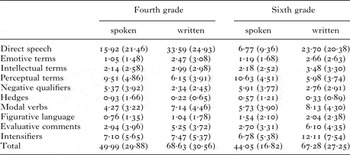
To ensure that appropriate comparisons would be conducted for frequency measures of evaluation, it was necessary to control for the length of children's stories. Hence, in order to take length differences into account, proportional measures were calculated. The frequency of each evaluative category was calculated by multiplying the number of occurrences by 100 and dividing by the total number of clauses in the narrative. The frequency of an evaluative category then roughly represents the percentage of clauses that contain an evaluative device of that specific category. The percentage should not be interpreted too strictly, as some clauses may contain more than one evaluative device. Table 2 presents the mean frequency of evaluative devices in children's spoken and written narratives across development, including a composite score, summing the percentages of the individual evaluative categories, which provides a measure for the total frequency of evaluative devices.
Mean (SD) for frequency of evaluative devices in percentages in children's spoken and written narratives across development

A three-way 2 × 2 × 10 within-subjects ANOVA was conducted to evaluate the effects of modality (i.e. spoken vs. written), development (i.e. fourth grade vs. sixth grade), and category on the mean frequency of evaluative devices. Mauchly's test indicated that the assumption of sphericity had been violated for the main effects of category (χ 2(44) = 1344·57, p < ·001), for the interaction between modality and category (χ 2(44) = 861·36, p < ·001), for the interaction between development and category (χ 2(44) = 1277·01, p < ·001), and for the interaction between modality, development, and category (χ 2(44) = 894·57, p < ·001). Degrees of freedom were therefore corrected using Greenhouse–Geisser estimates of sphericity (ε = ·16 for the main effect of category, .21 for the interaction between modality and category, .16 for the interaction between development and category, and .21 for the interaction between modality, development, and category). The analysis showed significant main effects of modality (F(1,92) = 80·06, p < ·001, partial η 2 = ·47), and category (F(1·41,129·75) = 160·16, p < ·001, partial η 2 = ·64), but not development (F(1,92) = 2·89, p = ·09, partial η 2 = ·03). However, the interactions between modality and category (F(1·90,175·02) = 93·20, p < ·001, partial η 2 = ·50), and between development and category (F(1·43,131·95) = 19·69, p < ·001, partial η 2 = ·18) proved to be significant. Finally, the three-way interaction between modality, development, and category approached significance (F(1·89,173·75) = 2·54, p = ·09, partial η 2 = ·03).
The two-way and three-way interactions were further explored in a series of 2 × 2 within-subjects ANOVAs. For each category of evaluative devices, a separate analysis with modality and development as factors was conducted. For direct speech, the analyses revealed that direct speech was used significantly more often in written than in spoken narratives (F(1,92) = 111·10, p < ·001, partial η 2 = ·55). In addition, the frequency of use of direct speech decreased significantly from fourth grade to sixth grade (F(1,92) = 20·24, p < ·001, partial η 2 = ·18). For emotive terms, for intellectual terms, and for perceptual terms a main effect of modality was found (emotive terms: F(1,92) = 31·77, p < ·001, partial η 2 = ·26; intellectual terms: F(1,92) = 10·58, p < ·01, partial η 2 = ·10; perceptual terms: F(1,92) = 126·43, p < ·001, partial η 2 = ·58). Emotive terms and intellectual terms were used more often in written than in spoken narratives. Perceptual terms, by contrast, were used more often in spoken than in written narratives. Similarly, both for negative qualifiers as well was for hedges, the analyses indicated that their use occurred more often in spoken than in written narratives (negative qualifiers: F(1,92) = 94·17, p < ·001, partial η 2 = ·51; hedges: F(1,92) = 19·06, p < ·001, partial η 2 = ·17). For modal verbs, the analyses showed that they were used more often in written than in spoken narratives (F(1,92) = 41·17, p < ·001, partial η 2 = ·31). In addition, the use of modal verbs increased significantly across development (F(1,92) = 8·29, p < ·01, partial η 2 = ·08). For figurative language, we found that it was used more frequently in written than in spoken narratives (F(1,92) = 6·08, p < ·05, partial η 2 = ·06). Additionally, the use of figurative language increased significantly across development (F(1,92) = 17·42, p < ·001, partial η 2 = ·16). For evaluative comments, the analyses showed a significant main effect of modality (F(1,92) = 45·76, p < ·001, partial η 2 = ·33), with evaluative comments being expressed more frequently in written than in spoken narratives. For intensifiers, significant main effects of modality (F(1,92) = 20·67, p < ·001, partial η 2 = ·18) and development (F(1,92) = 12·22, p = ·001, partial η 2 = ·12) were modified by a significant interaction (F(1,92) = 33·22, p < ·001, partial η 2 = ·26). Pairwise comparisons using t-tests with Bonferroni adjustment for multiple comparisons were conducted to follow up the significant interaction. The difference in the frequency of use of intensifiers in written narratives across development was significant (t(92) = –5·97, p < ·001, d = –0·62), with a higher frequency observed in sixth grade than in fourth grade. No such effect of development was observed in spoken narratives (t(92) = 0·75, p = ·45, d = 0·08).
DISCUSSION
The transition from middle to late childhood is a particularly interesting stage of development in terms of linguistic proficiency and socio-cognitive skills. These skills are deemed important for both the development of evaluative language, a prerequisite of successful story-telling, as well as for the ability to reflect modality differences in the linguistic encoding of spoken and written discourse. To our knowledge, this is the first study to directly compare evaluative language in spoken and written narratives from a developmental perspective in middle to late childhood. We expected both developmental differences, revealing an increasing diversity and frequency of evaluative devices with age, as well as modality differences, reflecting a higher diversity and frequency of evaluative devices in written compared to spoken narratives.
The overall picture that emerges from the results is complex, and demands a differentiation between different categories of evaluative devices, both in terms of developmental trajectories as well as regarding their susceptibility to modality differences. Below, we discuss the quantitative results regarding developmental differences and modality differences separately, illustrated by a qualitative analysis when appropriate. In the examples that support the qualitative analysis, the underlined words or phrases comprise the evaluative devices.
Developmental differences
The ability to employ evaluative devices in narrative discourse presupposes a combination of linguistic proficiency and sophisticated socio-cognitive skills (Bamberg & Damrad-Frye, Reference Bamberg and Damrad-Frye1991), two areas that develop substantially from middle to late childhood (Berman, Reference Berman2008; Nippold, Reference Nippold and Berman2004; Rubin, Reference Rubin1984). In this regard, it is surprising that the diversity of evaluative devices used by the children in this study did not increase between fourth and sixth grade, and even slightly decreased in spoken narratives. A possible explanation is that the nature of the story does not trigger a higher diversity of devices. Alternatively, it may be that, at this age, children already possess the necessary linguistic skills to use all ten evaluative categories distinguished in our study, given the high mean number of types of evaluative categories.
Furthermore, only a few categories showed the expected developmental change in their frequency of use. A clear developmental increase was observed for the categories of figurative language and modal verbs. The use of figurative language and modal verbs requires a rich lexicon and advanced syntactic skills, respectively, two hallmarks of later language development (Berman, Reference Berman2008; Nippold, Reference Nippold and Berman2004; Ravid & Tolchinsky, Reference Ravid and Tolchinsky2002). It should be noted that we did not distinguish between epistemic and deontic modality. Reilly et al. (Reference Reilly, Zamora and McGivern2005) have found that, between late childhood and adolescence, children shift from predominantly using deontic types of modal expressions to an increased use of epistemic modality. Future research might be directed at a more fine-grained analysis of modality to shed additional light on the emergent use of modal verbs and related syntactic skills in this age group. Furthermore, the frequency of use of intensifiers increased significantly with age in written, but not in spoken, narratives. Prior research did find a developmental increase in the use of intensifiers in spoken narratives, but focused on younger children (Bamberg & Damrad-Frye, Reference Bamberg and Damrad-Frye1991; Peterson & Biggs, Reference Peterson and Biggs2001). A possible explanation is that children use other means to signify intensifiers in speech. For example, when speaking, children may also use prosodic signals such as a higher pitch, an increased volume, a higher density of accented syllables, and lengthened pitch accents that highlight salient clauses of discourse and render them evaluative (Labov, Reference Labov1972; Wennerstrom, Reference Wennerstrom2001). It might be that sixth-graders do not elaborate further upon the lexical intensifiers in their spoken narratives, as they start to enrich their spoken discourse with prosodic intensifiers instead. In this sense, we suggest that the developmental increase found for written but not for spoken narratives is not so much related to language development, but is caused by differences between modalities.
A surprising finding was the substantial developmental decrease of direct speech in both modalities. Direct speech renders the story dynamic and vivid. The notable decrease in its use, however, suggests that frequency is not always directly associated with the quality of the narrative. This premise can be illustrated by the following two stories told by a fourth-grader and by a sixth-grader. The excerpt of the fourth-grader's story is almost entirely composed of direct speech. Based on the content, it can be concluded that the fourth-grader switches between characters while reporting their speech.
-
(1)
-
a. Spoken narrative by a fourth-grader
“Hoe gaat ie?” “Goed ik ben aan het vissen.” “Zie je het?” “Ja ik zie het inderdaad.” “Wat ga je vissen?” “Misschien baars.” “Misschien zelfs goudvissen.” “Oke ik ga ervandoor.” “Ik ga naar het strand.” “Hoi.” “Hoe gaat ie?” “Ja goed.”. “Ik ga lekker in het water.” Dan gaat ze uit het water.
‘“How are you?” “Fine I am fishing.” “Can you see it?” “Yes, I can indeed.” “What are you going to fish?” “Maybe perch.” “Maybe even goldfish.” “OK I am off.” “I am going to the beach.” “Hi.” “How are you?” “I am fine.” “I am going into the water.” Then she gets out of the water.’
-
b. Spoken narrative by a sixth-grader
Onderweg komt ze iemand tegen. Dat is Bart. Die zit te vissen. “Hallo”, zegt Ilse. “Hoi”, zegt Bart. “Waar ga je heen?”, vraagt hij. “Ik ga naar het strand”, antwoordt Ilse blij. Eenmaal bij het strand komt ze Mohammed tegen. Mohammed zegt “hoi”.
‘She meets someone on the way. It's Bart. He's fishing. “Hello”, Ilse says. “Hi”, Bart says. “Where are you going?”, he asks. “I am going to the beach”, Ilse answers happily. Once she's at the beach, she meets Mohammed. Mohammed says “hi”.'
-
Two important aspects downgrade the evaluative effectiveness of direct speech in the fourth-grader's story. First, the excerpt presents a dialogue between two or more story characters, but no reference is made to the identity of the characters, nor is turn-taking overtly signalled by introductory verbs. A listener unknown to the story may experience difficulties in understanding this dialogue. Second, with a predominance of evaluative utterances, the referential content is entirely neglected. The sixth-grader, by contrast, alternates direct speech with referential utterances describing the actions that precede the dialogues. In this way, the listener gets a better grasp of how the characters’ thoughts and feelings support and affect the story events. As noted by Shiro (Reference Shiro2003), it is the combination of evaluative and referential content that contributes to the overall coherence of a story. In addition, the sixth-grader also makes use of introductory verbs that signal the identity of the character whose speech is reported, providing additional contextual information. A possible explanation for the abundant use of direct speech by younger children resides in its grammatical form. Whereas direct speech reproduces literally the deictic references of the original speech act, other types of reported speech, such as indirect speech, require a syntax transformation that involves embedding the original linguistic form into a subordinate clause, often also including semantic adjustments. The mastery of this transformation is a gradual process that extends throughout childhood (Goodell & Sachs, Reference Goodell and Sachs1992). In addition to balancing the evaluative and the referential content more carefully, it might therefore be that children in sixth grade start to make use of their improved syntactic skills to manage the syntactic complexity of other types of reported speech (Berman, Reference Berman2008; Nippold, Reference Nippold and Berman2004), and consequently use direct speech less than fourth-graders. The idea that the use of direct speech functions as a tool to avoid syntactic complexity is supported by a significant negative correlation between the frequency of direct speech and the syntactic complexity of the narratives (as measured by the mean length of a t-unit in words, where a t-unit is defined as a main clause with all subordinate clauses associated with it (Hunt, Reference Hunt1966)), both in speech (r = –0·69, p < ·001) and in writing (r = –0·64, p < ·001). Coding indirect speech in future research would be useful to underpin the idea that with age children reduce their use of direct speech in favour of grammatically more complex types of reported speech, such as indirect speech.
Another category that did not show the expected developmental increase is the category of evaluative comments. A careful observation of the narratives shows that evaluative comments, through which opinions are expressed, frequently occur in contexts of direct speech, as in the following examples:
-
(2)
-
a. Written narrative by a fourth-grader
“Kijk”, riep hij. “Een man op een coole, rode motor.”
‘“Look”, he screamed. “A man on a cool, red motorbike.”’
-
b. Written narrative by a sixth-grader
De mevrouw gaf hem de vis en zei “dit is een speciale vis.” “Bewaar hem goed.”
‘The lady gave him the fish and said “this is a special fish”. “Keep him safely.”’
-
These examples demonstrate that the narrator often uses the voice of a story character to comment upon an object. The lack of an age-related increase in the use of evaluative comments – its use remains stable across development – might therefore be related to the decrease in the use of direct speech. In this sense, it could even be said that children in sixth grade do show progress on their use of evaluative comments, as they continue to use them as frequently as in fourth grade, despite the overall decline of direct speech. Example (3) illustrates how a sixth-grader not only uses evaluative comments to overtly present a story character's perspective, but also employs the comments to represent evaluative information on the story events from the perspective of an omniscient narrator. Mature perspective-taking abilities are required to shift between this narrator's stance and the story character's perspective (Sah, Reference Sah2011).
-
(3) Spoken narrative by a sixth-grader
Op een mooie lentedag zat Vera met haar kat te spelen. Opeens ging de telefoon. Vera pakte de telefoon en hoorde dat het Bram was. Bram is een hele goede vriend van Vera. Bram vroeg of Vera mee wou naar het strand. “Wat een leuk idee!”, zei Vera.
‘On a beautiful spring day Vera was playing with her cat. Suddenly, the telephone rang. Vera took up the telephone and heard that it was Bram. Bram is a very good friend of Vera's. Bram asked if Vera wanted to come with him to the beach. “What a nice idea!”, Vera said.’
Also, negative qualifiers and hedges failed to show a developmental increase with age. As children move into middle childhood, they exhibit an increased tendency to be more concrete and to be more tied to facts (Ely, MacGibbon & McCabe, Reference Ely, MacGibbon and McCabe2000). In the light of this tendency, children in middle to late childhood may be less willing to make reference to non-events or possible events. Alternatively, a more detailed coding of specific forms of negative qualifiers and hedges could reveal whether some devices are more evaluative than others, as suggested by Ely et al. (Reference Ely, MacGibbon and McCabe2000), and are thus more likely to decrease or increase with age.
While children used a variety of emotive, intellectual, and perceptual terms to enrich their narratives, none of these terms showed any developmental change in the sample of our study. This result contradicts Bamberg and Damrad-Frye (Reference Bamberg and Damrad-Frye1991), who found that reference to cognitive and emotional states increased markedly with age. The lack of developmental growth may be explained in different ways. First, Bamberg and Damrad-Frye studied evaluation in younger children. It may be that the use of these terms undergoes significant improvement in preliterate and early elementary school children until becoming one of the dominant forms of evaluation in late elementary school. Second, the nature of the story in our study may have influenced the use of these terms. In older children and adults, these types of terms tend to be clustered around the emotional highpoints of the story (Bamberg & Damrad-Frye, Reference Bamberg and Damrad-Frye1991). The relatively simple story used in this study does not involve a high number of emotional highpoints, and may therefore not invite the narrator to label the character's emotional, intellectual, or perceptual state more than once. While development does not affect the frequency of these terms, the quality or strategy of use may change with later development (Bamberg & Damrad-Frye, Reference Bamberg and Damrad-Frye1991; Chen & Yan, Reference Chen and Yan2011). Consider the following two excerpts of a story, one written by a fourth-grader and one by a sixth-grader.
-
(4)
-
a. Written narrative by a fourth-grader
De moeder vraagt waar zijn vis is. De jongen geeft zijn pop en de meisjes zijn vis. Ze zijn allebei blij. Einde.
‘The mother asks where his fish is. The boy gives his doll and the girls his fish. They are both happy. End.’
-
b. Written narrative by a sixth-grader
Het meisje gaf de vis terug. Het meisje zei dat het haar speet en dat ze het nooit meer zou doen. Maar Henk was niet boos. Hij was blij omdat hij zijn goudvis terug had. “Kom, we gaan hem in het aquarium doen”, zei hij. En zo kwam het toch nog goed.
-
‘The girl returned the fish. The girl said that she was sorry and that she would never do it again. But Henk was not angry. He was happy because he had his goldfish back. “Come on, let's put him in the aquarium”, he said. And that's how it all turned out fine.’
These excerpts describe the concluding sequence, showing the two girls returning the fish they took from the boy and the boy finally showing his fish in the aquarium to the girls. This sequence represents an emotional highpoint related to the resolution of the story. Both the fourth-grader and the sixth-grader refer to the positive emotion of the boy after the girls return his fish. However, contrary to the sixth-grader, the fourth-grader does not explicitly express the causal link between the boy's happiness and the fact that his fish was returned. Though the reader can probably infer the causal link between these two events, the lack of an explicit relationship results in a fragmented story ending. The sixth-grader, by contrast, does not only refer to the boy's emotions but also includes the girl's expression of regret. In this way, the narrator not only provides a causal justification of the boy's happiness, but also embeds the emotion in a dynamic interaction between the story characters. The attention towards the resolution of the story helps the audience in interpreting the plotline and contributes greatly to the coherence of the story as a whole. This descriptive analysis corresponds to Bamberg and Damrad-Frye's (Reference Bamberg and Damrad-Frye1991) findings that younger children tend to tie emotions to a local outcome, but not to the global coherence of the story.
Modality differences
Speech and writing have been shown to differ along several linguistic dimensions. Intrinsic differences between the two modes of language production, i.e. a difference in processing constraints and in communicative context, are thought to underlie these modality differences. Previous research has shown that, from middle childhood onwards, children start to show sensitivity to these modality differences in their written texts, reflecting their acquisition of linguistic literacy. Hence, the use of evaluative devices in children's spoken and written narratives was expected to display a modality difference as well. Extending previous research by De Temple et al. (Reference De Temple, Wu and Snow1991) and Özyildirim (Reference Özyildirim2009), our results largely support this hypothesis.
In terms of diversity, children recruited a wider range of evaluative devices in their written as opposed to their spoken narratives. These results are in agreement with previous findings of a greater variety of vocabulary in written than in spoken discourse (e.g. Chafe & Danielewicz, Reference Chafe, Danielewicz, Horowitz and Samuels1986; Purcell-Gates, Reference Purcell-Gates2001; Strömqvist et al., Reference Strömqvist, Johansson, Kriz, Ragnarsdöttir, Aisenman and Ravid2002), and confirm our hypothesis that children are more likely to ensure variety in evaluative expression in writing, as a result of a lack of on-line processing constraints.
In terms of frequency, the majority of categories exhibited the expected modality effect, showing a higher frequency of use in written as opposed to spoken narratives. Our findings suggest that the off-line benefits of planning, reflection, and revision available to the writer (Ravid & Berman, Reference Ravid and Berman2006) are particularly beneficial for evaluative devices requiring a certain level of lexical or syntactic complexity. For instance, modal verbs, requiring advanced syntactic skills, occurred more often in written than in spoken narratives. This is convergent with previous findings showing that written discourse is syntactically more complex than spoken discourse, as the writer has more time at his disposal to carefully integrate information into complex syntactic units (Perera, Reference Perera1984; Purcell-Gates et al., Reference Purcell-Gates, Jacobson and Degener2009; Rubin, Reference Rubin1982). A similar explanation may hold for the finding of a higher frequency of evaluative comments in written than in spoken narratives. Evaluative comments mostly take the form of adjectives that modify a noun or verb, also called ‘attributive adjectives’. In addition to providing a semantically more rich object or event description, evaluative comments thus also represent a certain degree of syntactic embeddedness (Purcell-Gates et al., Reference Purcell-Gates, Jacobson and Degener2009). Hence, similar to modal verbs, semantic and syntactic enrichment associated with the production of evaluative comments may be more difficult to achieve under the on-line processing constraints imposed by speech. Much in the same way, regarding the higher frequency of figurative language in written than in spoken narratives, it can be assumed that the weaker on-line processing demands of writing provide the writer with more time to elaborate upon literal discourse and opt for the more complex use of figurative language instead.
Besides processing constraints, communicative context is also thought to result in modality differences between spoken and written discourse. A writer, in the absence of his reader, needs to produce an explicit and autonomous text without the external cues that exist in spoken communication (e.g. Purcell-Gates, Reference Purcell-Gates1991; Tannen, Reference Tannen1982). External cues can, among other non-linguistic and paralinguistic means, refer to prosodic intensifiers (Labov, Reference Labov1972; Wennerstrom, Reference Wennerstrom2001). As previously discussed, this might explain why the evaluative category of intensifiers occurred more often in sixth-graders’ written narratives as opposed to their spoken narratives. Decontextualized language has also been shown to be particularly suitable for rendering a text explicit and autonomous (Kantor & Rubin, Reference Kantor, Rubin, Kroll and Vann1981; Purcell-Gates, Reference Purcell-Gates1991). In this study, evaluative devices that have also been identified as markers of decontextualized language, i.e. figurative language, direct speech, and intellectual terms, were indeed found to occur more frequently in written than in spoken language. Figurative language, for instance, has been shown to serve a self-contextualizing function to render decontextualized discourse, such as written texts, more autonomous (Halliday, Reference Halliday, Page, Elkins and O'Connor1979; Olson, Reference Olson1977). Furthermore, direct speech aids in providing the contextual information in decontextualized discourse, by making events in a narrative more explicit, immediate, and realistic (Sulzby, Reference Sulzby, Ruddell, Ruddell and Singer1994; Sulzby & Zecker, Reference Sulzby, Zecker, McCabe and Peterson1991). Finally, intellectual terms have also been associated with decontextualized language, as they provide explicit and elaborated information about the story characters (Curenton & Justice, Reference Curenton and Justice2004). The idea that intellectual terms render discourse more explicit may equally hold for emotive terms, which also occurred more frequently in written than in spoken narratives. These findings, along with those by De Temple et al. (Reference De Temple, Wu and Snow1991), indicate that such explicitness may be particularly warranted in written discourse, where only linguistic means can be employed to denote cognition and emotion.
Some categories did not exhibit the expected modality effect. More specifically, perceptual terms, negative qualifiers, and hedges occurred more often in spoken than in written narratives. A possible explanation for the finding that perceptual terms occurred more often in spoken narratives is that children used these terms to point out information in the extralinguistic context to the listener (“In this picture you can see that …”) rather than to portray the characters’ perceptual processes. Regarding negative qualifiers and hedges, this modality effect may also be explained by the tendency to be more concrete with age (Ely et al., Reference Ely, MacGibbon and McCabe2000), previously referred to in order to explain the lack of a developmental increase. More specifically, children may show this tendency more clearly towards the absent audience in writing.
CONCLUSIONS AND FUTURE RESEARCH
The comparison of evaluative language in spoken and written fictional narratives across development demonstrates that children in middle and late elementary school are able to recruit a varied range of linguistic means to meet the evaluative function of a narrative.
From a developmental perspective, we can conclude that diversity of evaluative devices does not increase, and only few categories show a clear developmental increase in frequency of use with age. Some considerations are worth noticing here. First, our hypothesis that a developmental increase would be most prevalent in written narratives was not confirmed, except for the category of intensifiers. It might be that the increasing automatization of handwriting skills, typically occurring in late childhood, does not boost the development of evaluative language more than what would be expected from normal language development. This would imply that the high-level aspects associated with attending to modality requirements do not entirely rely on the availability of cognitive resources. An alternative, but less likely, explanation is that an influential change in the degree of automatization of handwriting skills is yet to occur in this sample. Second, the decrease in the use of direct speech suggests that frequency of evaluative language is not always directly associated with excellent story-telling. In this respect, a qualitative analysis of the narratives proved to be a fruitful method to underpin this statement. Third, the same qualitative approach was helpful in demonstrating that developmental changes are not always reflected in the frequency of use, but may also reside in the way evaluative language is used to support the referential content and structure, and thus the overall coherence, of the narrative. While qualitative analyses have been widely used in the study of evaluative language in young children (e.g. Bamberg & Damrad-Frye, Reference Bamberg and Damrad-Frye1991; Losh et al., Reference Losh, Bellugi, Reilly and Anderson2000; Shiro, Reference Shiro2003; Ukrainetz et al., Reference Ukrainetz, Justice, Kaderavek, Eisenberg, Gillam and Harm2005), they might be particularly interesting for studying language development in older children, in whom acquisition of linguistic forms is no longer central to language production. Rather, later language development revolves around learning to deploy linguistic forms flexibly and appropriately to meet communicative goals (Berman, Reference Berman2008; Ravid & Tolchinsky, Reference Ravid and Tolchinsky2002).
Based on our results, we can conclude that in this age group modality has a major impact on the diversity of evaluative language, and on the frequency of most, but not all, categories of evaluative devices. Specifically, categories of evaluative devices that have been referred to as markers of decontextualized language and those with a high degree of syntactic complexity reflect modality differences. In considering the interaction between modality and evaluative language, our study thus demonstrates that children in this age group understand and reflect the greater need for evaluative language in written as opposed to spoken narratives, resulting from the intrinsic differences between the two modes of production (e.g. Berman, Reference Berman2008; Ravid & Berman, Reference Ravid and Berman2006). Such a reflection of modality differences provides evidence for children's consolidation of linguistic literacy (Ravid & Tolchinsky, Reference Ravid and Tolchinsky2002).
Some limitations of our study are worth noting, and pave the way for future research. In this study, a fictional picture-description task was chosen to assess written and spoken narrative production. The predefined content of such a narrative reduces the influence of prior topic knowledge, and constitutes an economical way of assessing narrative skills. Nevertheless, it is important to note that our results cannot be generalized to other narrative genres. It has been shown, for instance, that a child's performance on fictional narratives is minimally related to performance on personal narratives (McCabe, Bliss & Barra, Reference McCabe, Bliss, Barra and Bennett2008), and might follow a different developmental path (e.g. Allen, Kertoy, Sherblom & Petit, Reference Allen, Kertoy, Sherblom and Petit1994). In terms of evaluation, there is some evidence that the ability to evaluate does not transfer from one narrative genre to the other (Shiro, Reference Shiro2003), and is engaged in more frequently in personal than in fictional narratives (Losh & Capps, Reference Losh and Capps2003). It is therefore warranted that future studies compare our results to the use of evaluative language in other narrative genres.
Furthermore, one of the rationales guiding our hypothesis regarding modality differences was that written narratives would exhibit more evaluative devices, because the writer cannot rely on non-linguistic and paralinguistic channels to achieve an evaluative effect. While our findings support this hypothesis, we cannot formulate any conclusions about the extent to which non-linguistic and paralinguistic evaluative tools were used in children's spoken narratives. In the current study, spoken narratives were tape-, but not video-recorded. As such, no information on facial expressions and gestures is available. From an exploratory observation of the data, however, it does seem that children often made use of prosodic features in their spoken narratives to differentiate between their own voice as the reporter of events, and the voices of story characters anchored in the story-world. Explorations along this dimension would provide an additional, solid foundation for the idea that modality differences are reflected in the use of evaluation in narratives.
Furthermore, as not all categories showed a developmental increase, future studies could test the possibility that some evaluative devices contribute more to the quality of a narrative than others, and are thus more likely to increase with age. In this context, the relationship between evaluation and narrative coherence would be a relevant topic for further research.
Finally, fundamental skills for producing a coherent narrative enriched with evaluation are linguistic skills and socio-cognitive abilities. The present study could be extended to include variables assessing these skills in order to determine their role as a source of individual differences in the ability to use evaluation in spoken and written narratives. In a similar vein, it is commonly known that home environment and home literacy can have an impact on the emerging literacies of children. Parallel to previous studies (e.g. Carmiol & Sparks, Reference Carmiol, Sparks and Mathews2014; Haden et al., Reference Haden, Haine and Fivush1997; Küntay & Nakamura, Reference Küntay, Nakamura, Strömqvist and Verhoeven2004; Shiro, Reference Shiro2003), future research on evaluation could therefore integrate variables such as socioeconomic status, home literacy practices, or cultural background.
In sum, the present study clearly demonstrates that to fully describe developmental progression in the use of evaluation in narratives in the upper elementary grades, one should combine a quantitative and a qualitative approach to children's narratives. Importantly, this study is the first one to provide evidence for children's ability to reflect the intrinsic differences between speech and writing in the evaluative encoding of their narratives, confirming an important aspect of the acquisition of linguistic literacy.