


INTRODUCTION
In agriculture, projected climatic changes will affect crop yields, livestock management and the location of production in Europe (Olesen & Bindi Reference Olesen and Bindi2002). Climate change will affect crop growing processes not only directly through changed agroclimatic conditions (Eitzinger et al. Reference Eitzinger, Stastná, Zalud and Dubrovský2003; Trnka et al. Reference Trnka, Eitzinger, Semeradova, Hlavinka, Balek, Dubrovsky, Kubu, Stepanek, Thaler, Mozny and Zalud2011a,Reference Trnka, Olesen, Kersebaum, Skjelvag, Eitzinger, Seguin, Peltonen-Sainio, Rötter, Iglesias, Orlandini, Dubrovsky, Hlavinka, Balek, Eckersten, Cloppet, Calanca, Gobin, Vucetic, Nejedlik, Kumar, Lalic, Mestre, Rossi, Kozyra, Alexandrov, Semeradova and Zaludb) but also indirectly, e.g. by changing soil properties that affect soil water and nutrient balance (M. Trnka et al., personal communication) or by changing pest, disease and weed occurrence (Porter et al. Reference Porter, Parry and Carter1991), resulting in altered yield potentials that are crop-specific. Further, the increasing likelihood and severity of extreme weather events (especially heat waves, droughts and heavy precipitation) can considerably increase the risk of crop failure and enhance yield variability (Peltonen-Sainio et al. Reference Peltonen-Sainio, Jauhiainen, Trnka, Olesen, Calanca, Eckersten, Eitzinger, Gobin, Kersebaum, Kozyra, Kumar, Dalla Marta, Micale, Schaap, Seguin, Skjelvag and Orlandini2010; Semenov & Shewry Reference Semenov and Shewry2011). In particular, climate change will cause significant changes in the quality and availability of water resources for crop irrigation (IPCC Reference Field, Barros, Stocker, Qin, Dokken, Ebi, Mastrandrea, Mach, Plattner, Allen, Tignor and Midgley2011; Iqbal et al. Reference Iqbal, Eitzinger, Formayer, Hassan and Heng2011; Thaler et al. Reference Thaler, Eitzinger, Trnka and Dubrovsky2012), affecting food production and security; in this scenario, the occurrence of extreme events such as droughts will play a crucial role.
In general, climate change impacts crop production in various and complex ways at different levels, different scales and depending on local natural crop growing limitations. The main impacts of changing climatic parameters and weather extremes on crops are well known, such as the impact of temperature on phenology and on various physiological processes that depend on temperature such as maintenance, which influences net biomass accumulation. Photosynthetic activity and water use efficiency can increase through the interaction of plant responses with increasing atmospheric CO2 levels; however, a wide variation in these responses is expected between crops and environments (Fuhrer Reference Fuhrer2003). In addition, short- and long-term effects on crop growing conditions are reported, such as the direct impact of weather extremes or the influence of changing climate on soil conditions such as water holding capacity due to desertification processes. Although many results have already been obtained using, e.g. the application of ecosystem or crop models, many research questions remain; these questions are often related to processes or impacts that are insufficiently considered by single crop models or modelling approaches (Rötter et al. Reference Rötter, Carter, Olesen and Porter2011). A related issue is that large-scale crop simulation studies do not consider the variability of region-specific conditions sufficiently (White et al. Reference White, Hoogenboom, Kimball and Wall2011), and there is a need for high-spatial resolution of inputs for the calibration of regional models (Eitzinger et al. Reference Eitzinger, Formayer, Thaler, Trnka, Zdenek and Alexandrov2008; Strauss et al. Reference Strauss, Schmid, Moltchanova, Formayer and Wang2012). Therefore, considering regional aspects (including model calibration) in regional climate change impact studies is of increasingly high importance; the present study contributes directly to this topic.
The results of climate change impact and adaptation studies, therefore, often show considerably different results, depending on the spatial scale of regionalization. However, reliable recommendations are crucial for stakeholders for early risk recognition and the implementation of anticipatory adaptation strategies; precautionary adaptation is more effective and less costly than forced, last-minute or emergency adaptation (ANL 1994; EEA 2005, 2007; Eitzinger et al. Reference Eitzinger, Utset and Alexandrov2007; Parry & Carter Reference Parry and Carter1998). In this context, it is recommended that regional studies should be undertaken and recommendations developed for adaptations considering local conditions (environmental and socio-economic) (Reidsma et al. Reference Reidsma, Ewert, Lansink and Leemans2009).
The present study addressed these aspects using a regional and holistic approach by modelling various types of climate change impacts on crop production within the same region. The key results from Central and Eastern Europe, including local case studies with different focuses in Austria, the Czech Republic and Slovakia, are presented. The study domain experiences a continental European climate and is characterized by strong climatic gradients, which may foster regional differences or trends in climate change impacts on agriculture.
To study the regional aspects and variability of the effects of climate change on agriculture, the following objectives were addressed:
(1) The effect of climate change on selected future agroclimatic conditions;
(2) The effect of climate change (including the effect of higher ambient CO2 concentration) on yield levels and variability;
(3) The effect of climate change on the most important yield-limiting factors, such as water availability, nitrogen balance and infestation risks posed by selected thermophile insects (pests);
(4) Assessment of potential adaptation options based on case study results.
MATERIALS AND METHODS
Agroclimatic indices
Agroclimatic indices describe the complex relations existing between climate and crops (their development and/or production) as well as the agrosystems in a simplified manner (Orlandini et al. Reference Orlandini, Nejedlik, Eitzinger, Alexandrov, Toulios, Calanca, Trnka and Olesen2008) and can be applied over large regions and with limited data input. To describe specific agroclimatic conditions over the Central European domain examined in the present study, seven agroclimatic indicators were used. The goal was to select a set of key indices that would be relevant for various aspects of crop production and complement the other tools applied (pest and crop models) to assess climate change impacts on crop production conditions.
The first indicator, the sum of effective global radiation (EGR), was calculated as the sum of global radiation during the period over which the mean air temperature was continuously above 5 °C (and without snow cover (SC) or frost occurrence) and with sufficient soil water available for evapotranspiration. The soil profile necessary for calculating EGR was assumed to have a maximum rooting depth of 1·3 m and an available soil water holding capacity of 270 mm. The critical ratio between actual and potential evapotranspiration was chosen to be greater than 0·4, based on the settings used by Trnka et al. (Reference Trnka, Eitzinger, Semeradova, Hlavinka, Balek, Dubrovsky, Kubu, Stepanek, Thaler, Mozny and Zalud2011a).
As the second indicator, the climatological water balance (CW) during the climatological spring (March–May) and summer (June–August) was calculated (i.e. difference between reference evapotranspiration (ETr) and precipitation). This indicator reflects drought intensity during the most critical crop growing periods.
To assess wine-growing conditions, the Huglin index (HUG) was used to classify potential wine-growing regions in terms of the sum of temperatures required for grape development and ripening (Huglin Reference Huglin1978). The minimum requirement for grape wine is defined as a HUG value of c. 1500. The attribution of particular varieties to thermal conditions estimated using HUG was based on the study by Schultz et al. (Reference Schultz, Hoppmann and Hofmann2005) and should be treated as an approximation only.
For assessing agroclimatic winter conditions, three further indicators were used. The number of days with SC was estimated using the SnowMAUS model (Trnka et al. Reference Trnka, Kocmánková, Balek, Eitzinger, Ruget, Formayer, Hlavinka, Schaumberger, Horáková, Možný and Zalud2010a); this model estimates SC absence/presence using daily temperature and total precipitation. Potential frost risk (FR) for field crops was estimated as the number of days from September to April without SC and during which the minimum daily temperature (at 2 m above ground level) dropped below −10 °C (Trnka et al. Reference Trnka, Kocmánková, Balek, Eitzinger, Ruget, Formayer, Hlavinka, Schaumberger, Horáková, Možný and Zalud2010a). To estimate changes in the conditions relevant to the vernalization of winter wheat (V), the temperature thresholds derived from Petr & Hnilička (Reference Petr and HniliČka2002) were used to estimate the number of conducive days required for the vernalization of winter wheat. Vernalization days from October to April were accumulated from 3 to 6 °C daily mean temperature (estimated optimum range) and the accumulation was reduced or stopped when daily maximum, minimum or mean temperatures were beyond optimum ranges. Vernalization was cancelled when mean daily temperature rose above 20 °C for more than 2 days during the vernalization period (40 vernalization days).
As an indicator for field operation conditions (FOCs) during spring and autumn, the suitabilities of sowing windows (spring and autumn) and harvest (June) were estimated. A given day is considered suitable for sowing or harvest when the soil water content in the top 100 mm layer of soil is between 10 and 70% of the available soil water-holding capacity (this parameter was set at 20 mm for all soils in the present study). The thresholds of soil moisture that were used to define days suitable for sowing and harvesting were parameterized at 30 experimental stations in the Czech republic (1985–2005); these thresholds were stricter than those used by Rounsevell (Reference Rounsevell1993) and Cooper et al. (Reference Cooper, Mcgechan and Vinten1997) to avoid potential soil compaction, which is considered as unsustainable in the long term.
All agrometeorological parameters described above were calculated using the software package AgriClim (Trnka et al. Reference Trnka, Eitzinger, Semeradova, Hlavinka, Balek, Dubrovsky, Kubu, Stepanek, Thaler, Mozny and Zalud2011a). This software uses daily inputs of global radiation, maximum and minimum temperatures, precipitation, water vapour pressure and mean daily wind speed. To allow grid-to-grid comparability, the same soil profile was used at all sites, and spring barley was used as a reference crop. While calculating evapotranspiration under climate change scenarios (see below), an adjustment was made for increased CO2 concentrations using the method proposed by Kruijt et al. (Reference Kruijt, Witte, Jacobs and Kroon2008), which resulted in a decrease in reference evapotranspiration rates compared with runs that did not consider increases in CO2 levels. The ambient CO2 concentration in air for the time horizon of the study (i.e. 2050) was set at 536 ppm, and the baseline calculations were set at 360 ppm. The agroclimatic indicators noted above were calculated for 99 years and the growing seasons in each grid of the entire domain for the applied climate change scenarios representing 2050 (Table 1).
Climate change (CC) signals of the climate change scenarios applied to the presented studies as a mean for the entire domain and for the regional case study regions related to the reference period
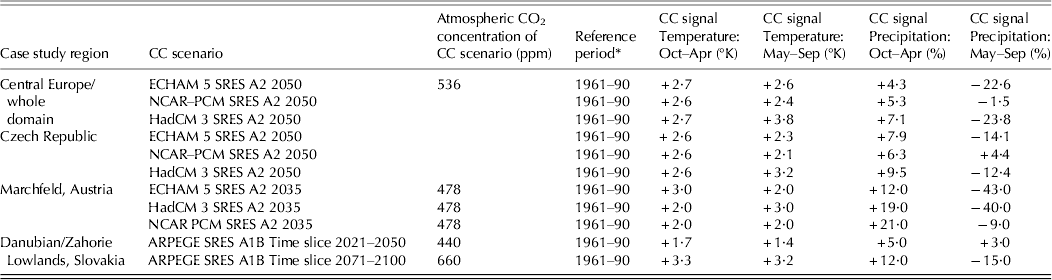
* The atmospheric CO2 concentration of the reference period 1961–90 was set as 360 ppm for crop simulation.
In most cases, the median value of the parameter and the 5th and 95th percentiles were analysed to determine 20-year extremes of the given agroclimatic index. To increase the spatial resolution of the interpolated outputs, the values in the 10 × 10 km grids were regridded at a 1 × 1 km resolution using co-kriging techniques with altitude used as an additional parameter.
Pest models
From the range of pests that could have been studied, two thermophile insects, the Colorado potato beetle (Leptinotarsa decemlineata, referred to as CPB) and the European corn borer (Ostrinia nubilalis, referred to as ECB), were selected. The CPB is one of the most important insect pests of potato globally and is widespread in Europe (EPPO 2009). The ECB, as the most important pest of grain maize (Mason et al. Reference Mason, Rice, Calvin, Van Duyn, Showers, Hutchinson, Witkowski, Higgins, Onstad and Dively1996), has also been recorded to occur across all of Europe (Keszthelyi & Lengyel Reference Keszthelyi and Lengyel2003; EPPO 2009) and the development of this pest is closely related to temperature.
The pest model CLIMEX (Sutherst & Maywald Reference Sutherst and Maywald1985; Sutherst et al. Reference Sutherst, Maywald, Bottomley and Bourne2001) was applied in the study of these two pests. Knowing the climatological requirements of a given species, the model allows the suitability of a given area for the population growth of the pest in question to be assessed and determines the stress exposure due to unsuitable climatic conditions. These factors are expressed in terms of the Ecoclimatic index (EI), which describes the overall suitability of a climate for the establishment and long-term presence of a pest's population at a given location. Generally, EI lies in the range 0–100; EI = 0 indicates locations experiencing climate conditions that are unfavourable for long-term species occurrence, and EI > 25–30 represents a climate that is very suitable for species occurrence (Hoddle Reference Hoddle2004). The observed occurrence data obtained from field observations in the Czech Republic constituted the base material for the validation of the pest model CLIMEX under recent climate conditions (Kocmánková et al. Reference Kocmánková, Trnka, Zalud, Semeradova, Dubrovsky, Muska and Mozny2008). Following validation and calibration of the model outputs, the model was applied over the entire domain of the present study and for the applied climate change scenarios (Table 1).
Crop models
In recent years, process-oriented (mechanistic) crop models have been among the most frequently used tools in climate change impact studies (Audsley et al. Reference Audsley, Pearn, Simota, Cojocaru, Koutsidou, Rounsevell, Trnka and Alexandrov2006; White et al. Reference White, Hoogenboom, Kimball and Wall2011). To explore the effect of climate change in the various case study regions on crop yields and growth conditions (phenology and crop water stress), three crop models were applied: CERES-Barley (Otter-Nacke et al. Reference Otter-Nacke, Ritchie, Godwin and Singh1991), CERES-Wheat (Ritchie & Otter Reference Ritchie, Otter and Willis1985) and DAISY (Hansen et al. Reference Hansen, Jensen, Nielsen and Svendsen1990, Reference Hansen, Jensen, Nielsen and Svendsen1991; Abrahamsen & Hansen Reference Abrahamsen and Hansen2000; Hansen Reference Hansen2000). The CERES models operate within the Decision Support System for Agrotechnology Transfer (DSSAT) (Hoogenboom et al. Reference Hoogenboom, Jones, Wilkens, Batchelor, Bowen, Hunt, Pickering, Singh, Godwin, Bear, Boote, Ritchie and White1994; Tsuji et al. Reference Tsuji, Uehara and Balas1994, Reference Tsuji, Hoogenboom and Thorton1998). All crop models considered the impact of enhanced atmospheric CO2 concentration under the relevant climate scenarios (Table 1) for crop growth.
Crop model and simulation setup – a case study in the Czech Republic
Experimental data used for model evaluation were derived from field trials of the State Institute for Agricultural Supervision and Testing (SIAST). The CERES-Barley calibration was based on 50 experimental seasons at four sites; during calibration, the crop parameters of spring barley cultivar ‘Akcent’ were determined. The evaluation of the model used independent data sets from 13 experimental sites over 155 experimental seasons. The simulated values of the anthesis and maturity dates fit well with the observations. Despite the large variability of the experimental data, few simulated yields (<0·05) differed by more than 25% from the observations. In most seasons (0·90), the difference between simulated and observed grain yields was smaller than 20%, and 0·80 of the yields were simulated with a bias of < 800 kg/ha. CERES-Barley was able to explain 65–74% of the variability of key developmental stages and almost 70% of the yield variability. Calibration of the CERES-Wheat model for winter wheat cultivar ‘Hana’ has been described previously (Trnka et al. Reference Trnka, Dubrovský, Semerádová and Žalud2004a) and shows very similar results to those for spring barley described above.
The simulation of mean potential yields scaled up from 1 km grids to the district level (areas of c. 1000 km2) showed that attainable yields are over 40% higher than observed yields. This was, however, expected, as the model assumes optimum growing conditions without any yield-limiting factors. Both crop models also show a consistent performance under varying conditions within individual districts and are able to explain almost two thirds of the inter-regional variability.
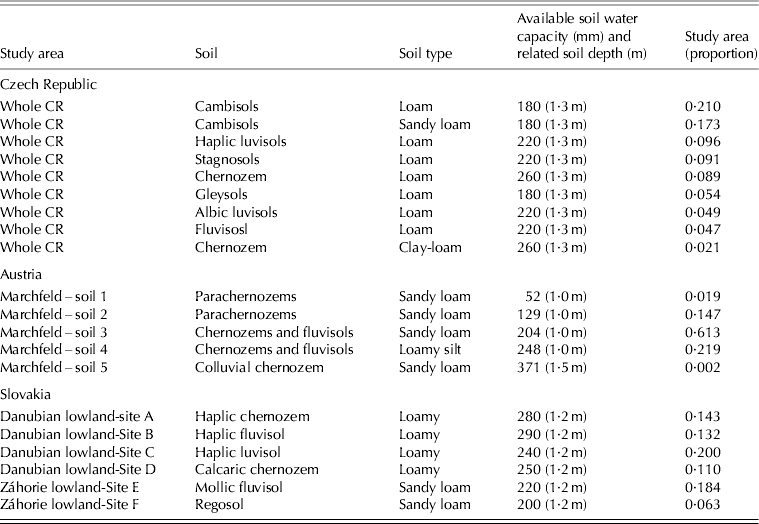
Crop model simulations accounted for autonomous adaptation of the sowing date, which was simulated based on soil temperature and workability. Medium fertilizing intensity (a nitrogen dosage of 60 kg/ha for spring barley and 100 kg/ha for winter wheat) and a leguminous pre-crop were considered as further conditions. The main soil type characteristics over the Czech domain used for the simulations are shown in Table 2.
Main arable soil types of the study areas in the Czech Republic, Austria and Slovakia and their relation to the crop model inputs of soil properties that are relevant for soil water balance
For a spatial analysis, each crop model was run for each climate scenario for all 125 weather stations using 400 soil type groups in 1600 soil polygons. The native resolution of the soil map was 1 : 500 000 (Tomášek Reference Tomášek2007).
Crop model and simulation setup – Austrian case study
The region of Marchfeld (48°17′N, 16°38′E, c. 1000 km2, in the north-east of Austria) was chosen to simulate the effects of climate change on winter wheat and spring barley using CERES-Wheat and CERES-Barley. Marchfeld is a major crop production area and one of the warmest and driest regions in the country. The groundwater table in the Marchfeld region is very deep; crops have no access to groundwater and there is no capillary rise from groundwater to the rooting zone. The main soil types in Marchfeld are Parachernozems, Chernozems and Fluvisols, which are characterized by a high-spatial variability and include soils with low to moderate water-storage capacity. To simulate crop yields in the Marchfeld region, five soil classes were created; these were based on the 1 : 25 000-scale Austrian digital soil map (BFW 2007) and the amount of available water capacity of the individual soil classes (Table 2) in conjunction with pseudo-transfer function (Murer et al. Reference Murer, Wagenhofer, Aigner and Pfeffer2004). Soil-layer-specific model input parameters of soil physical properties represent the dominant type of soil cultivation in Marchfeld, which is ploughing. In addition, area-weighted mean values of physical and chemical soil properties (i.e. texture and humus content) were calculated for these soil classes (Rischbeck Reference Rischbeck2007) (Table 2). Two different tillage operations (ploughing and minimum tillage) were simulated to analyse the effect of soil cultivation on soil water balance under the climate change scenarios. For this purpose, undisturbed soil or minimum tillage conditions were determined from the values of the Austrian soil map (BFW 2007). For ploughed soil, selected soil input parameters (bulk density, soil saturation, field capacity and wilting point) were modified based on field experiment results (Thaler et al. Reference Thaler, Eitzinger, Trnka and Dubrovsky2012).
To validate the two CERES models, simulated outcomes were compared with measured results obtained from field trials. The CERES wheat model for winter wheat was calibrated for the winter wheat cultivar ‘Capo’ using agrotechnological, phenological, yield and weather data from an experimental site at Fuchsenbigl, Marchfeld (48°12′N, 16°44′E, 157 m a.s.l.) during 1989–2005. The difference between the simulated and observed dates of anthesis and the physiological maturity of winter wheat for calibration varied from 0 to 4 days. Simulated grain yields mostly agreed with the measured data (R 2 = 0·61; root-mean-square error (RMSE) = 590 kg/ha), and the deviation in annual yield predictions was less than 20% (Thaler et al. Reference Thaler, Eitzinger, Trnka and Dubrovsky2012).
The CERES barley model for spring barley was calibrated in the same way and verified for the periods 1989–95, 1998 and 2001/02 using data for the cultivar ‘Magda’. The difference between the simulated and observed dates of anthesis and physiological maturity varied from 0 to 7 days, and the simulated yield was within 20% of the measured values for each year (R 2 = 0·57; RMSE = 623 kg/ha).
Long-term weather data from the representative weather station Groß-Enzersdorf (48°12′N, 16°33′E, 157 m a.s.l.) were used as data for the reference period and for creating the climate scenarios (Table 1); this methodology is the same as that used for the Czech Republic case study.
Crop model and simulation setup – Slovakian case study
In the present study, the effects of climate change on spring barley, winter wheat and maize in two crop production regions of Slovakia were simulated using the crop model DAISY. Crop modules of spring barley, winter wheat and maize were calibrated and validated using long-term data (1973–2006) obtained from the experimental station at the Research Institute of Irrigation near Bratislava (48°10′N, 17°12′E, 131 m a.s.l.). Yield data of various cultivars that did not differ significantly in growing period length and potential yield under the specific environmental conditions (Patil et al. Reference Patil, Laegdsmand, Olesen and Porter2010; Hakala et al. Reference Hakala, Jauhiainen, Himanen, Rötter, Salo and Kahiluoto2012) were used for this purpose. Comparisons of measured and simulated dry matter production, crop nitrogen uptake and soil inorganic nitrogen content proved good performance of the crop model (Takáč & Šiška Reference Takáč and Šiška2011). Simulated winter wheat grain yields mostly agreed with the measured yields (R 2 = 0·81, RMSE = 924 kg/ha, coefficient of variation (CV) (RMSE) = 0·15). Simulated spring barley yields also showed generally good agreement with the measured yields (R 2 = 0·77, RMSE = 759 kg/ha, CV (RMSE) = 0·15). The mean deviation from predicted grain yields of spring barley and winter wheat was 12%. Measured and simulated maize yields were in good agreement (R 2 = 0·94, RMSE = 834 kg/ha, CV (RMSE) = 0·11).
The mean deviation in predicted maize grain yields from observed yields was 9%. The differences between simulated and observed dates of maturity of all three crops were all less than 7 days.
Representative soil profiles of the Danubian and Záhorie lowlands were defined according to texture, humus content and C/N ratio. The database of the Soil Science and Conservation Research Institute in Bratislava (17741 soil samples) was used for creation of soil characteristics in a 10 × 10 km grid. Based on soil parameters, soils were classified as shown in Table 2. Various crop rotations and management practices (including irrigation and fertilization) were considered while preparing representative datasets for yield simulations. Crop rotation involved the dominant crops in the Danubian and Záhorie lowlands (winter wheat, spring barley, sugar beet, maize, potato, winter rape and pea). Fertilization rates of 150 kg N/ha for winter wheat and 160 kg N/ha + 40 t farmyard manure/ha for maize were applied during the crop simulation. Maize was also fertilized in the autumn, before the growing season. Soil trafficability, which is limited by topsoil water content and soil temperature, was considered for field operations such as the simulated sowing date.
The crop model was run for the regions of the Záhorie and Danubian Lowlands with two different climatic datasets for 1971–2000 and two climate scenarios for the periods 2021–51 and 2071–2100 (Table 1).
Climate scenarios
Climate change scenarios for Central Europe (whole domain) and the case study regions in the Czech Republic and Austria (Table 1) were developed via a ‘pattern-scaling’ technique (Santer et al. Reference Santer, Wigley, Schlesinger and Mitchell1990) and then applied to modify the parameters of the weather generator. The pattern-scaling technique defines a climate change scenario based on the product of the standardized scenario and the change in global mean temperature. The standardized scenarios, which relate the responses of climatic characteristics to a 1 °C rise in global mean temperature (ΔT G), were determined by applying a regression method (Dubrovský et al. Reference Dubrovský, Nemešová and Kalvová2005) to the 2000–99 period, which was obtained from three global climate models (GCMs) from the IPCC Fourth Assessment Report (Solomon et al. Reference Solomon, Qin, Manning, Chen, Marquis, Averyt, Tignor and Miller2007). The three GCMs used (Table 1) include ECHAM5/MPI-OM, HadCM3 and NCAR-PCM, hereafter referred to as ECHAM, HadCM and NCAR, respectively. The climate scenarios of the whole domain and the Czech Republic were calculated for an increase in global mean temperatures by 2·1 °C until 2050, specifically for a time-slice centred at c. 2050 (Hulme et al. Reference Hulme, Wigley, Barrow, Raper, Centella, Smith and Chipanshi2000). This assumed the A2 emission scenario (SRES) and high climate sensitivities (i.e. an equilibrium change in global mean surface temperature following a doubling of the atmospheric equivalent CO2 concentration, T G,2 × CO2). The scenarios of the Austrian case study were calculated accordingly for 2035 (time slice 2021–50), based on the SRES-A2 scenario. To create the daily model weather input data for the climate change scenarios, the authors applied a method originally developed by Semenov & Porter (Reference Semenov and Porter1995) and adapted by Žalud & Dubrovský (Reference Žalud and Dubrovský2002). A weather generator was parameterized on observed weather data (1961–2001) and used to generate daily weather data for the climate scenarios.
The climate scenarios applied for the case study in Slovakia (Table 1) included data generated by the ALADIN climate model (Farda et al. Reference Farda, Štepánek, Halenka, Skalák and Belda2007) and the measured climatic data for the particular locality. The climate scenarios applied are based on the ARPEGE climate model (Lopez et al. Reference Lopez, Schmith and Kaas2000) for two intervals (2021–51 and 2071–2100).
RESULTS
The results illustrate general agricultural production conditions based on agroclimatic indices for the domain of Central–Eastern Europe (Fig. 1), and this information is complemented with three regional case studies (Fig. 1(a)) that focus on simulated climate change impacts on crop yields. When combined, these results should allow for the development of recommendations for regional adaptation options for the various production regions that consider regional differences in production conditions (soils, climate and crop management) as well as the development and shifts of the overall climatic conditions under the applied climate scenarios.
(Colour online). The sum of EGR in Central-Eastern Europe for a) the baseline period (1961–90) and for an increase in global mean temperatures by 2·1 °C until 2050 under three standardized scenarios based on the HadCM, ECHAM and NCAR GCMs (b–d). The numbers in (a) show the location of the case study regions in the Czech Republic (1 – includes the entire country), Austria (2) and Slovakia (3). The white lines show the division of the region into four quadrants.

The effect of climate change on agroclimatic conditions in Central–Eastern Europe
The following section presents the results of the applied agroclimatic indices for the entire domain of Central and Eastern Europe.
Based on the applied climate scenarios (Table 1), the annual sum of EGR would rise via increases in the duration of the potential growing period (i.e. with mean air temperatures continuously above 5 °C). In addition, EGR would be affected in some cases by the increase in global radiation that occurs due to reduced cloudiness associated with decreased precipitation, especially during the summer months. Although these changes may increase crop production potential, the decrease in precipitation would also increase the probability of water deficit, leading to a lower overall value of this key parameter. Under present conditions, the southern and southeastern areas of the domain exhibited the highest EGR values (Fig. 1(a)), indicating the potential productivity of rainfed agriculture. The western and northern parts of the domain would benefit most from the changed climate conditions, with areas in Germany, Poland, parts of Austria, Slovakia and the Czech Republic showing a sustained increase in the values of this parameter (Fig. 1(b–d)). The largest decreases are to be expected within the Pannonian lowland, which includes almost all of Hungary, northern Serbia and Croatia, as well as parts of southern Slovakia, eastern Austria and western parts of Romania. The most marked changes (both positive and negative in regard to growing conditions) within the regions are to be expected under HadCM-driven scenarios; NCAR-based results indicate a much lower rate of change. The overall spatial pattern of these changes remained the same, regardless of the scenario used.
Regarding drought intensity, the spatial patterns of the 20-year extremes of CW balance during spring (MAM) and summer (JJA) months (results not shown in the figures) showed the highest water deficit in the Pannonian region and the lowest water deficit in the Alps and mountain regions in general. The climate change scenarios (in particular, the HadCM-based scenario) demonstrated an increase in the present spatial gradients during spring (i.e. dry areas becoming drier and wet areas wetter), but significant changes are to be expected over the entire region during the summer months. The magnitude of the changes exhibited a southeast gradient, in which the arable land in the Czech Republic would be affected least and Hungary and Slovenia would experience the most marked increase in drought intensity. However, a slight easing of the 20-year drought intensity was seen in the Czech Republic, Austria, Slovakia and Slovenia under the NCAR scenario, leaving only the arable lands in Hungary worse off.
The HUG indicated a significant increase across the entire domain as a direct consequence of the expected temperature increase based on the climate projections used. Figure 2 illustrates that the present mean HUG value would not allow for permanent successful production of grapes across most of the domain except in areas already established as wine-growing regions. Very good thermal conditions for wine growing were found especially in the southeastern part of the domain. Under the climate scenarios studied, the area with wine-growing potential would increase substantially, providing HUG values sufficient for wine production across most of the region with the exception of mountainous areas. It must be stressed that HUG only considers temperature requirements during the summer period, and this is not the sole factor in wine production (Dalla Marta et al. Reference Dalla Marta, Grifoni, Mancini, Storchi, Zipoli and Orlandini2010). Other limitations such as amount of precipitation, soil conditions and small-scale local climatic variations based on terrain effects (such as the effects of slope on temperature or cold air lake conditions) were not considered in the present paper. The results clearly showed that the present wine-growing regions in Central Europe will generally experience much warmer conditions, and this may force the use of cultivars other than those grown currently. The results also indicated that wine growing may be possible even in northern latitudes where wine production is currently infeasible for climatic reasons.
(Colour online). Value of the HUGLIN index, which serves as a proxy for wine growing suitability in Central-Eastern Europe, for (a) the baseline period (1961–90) and for an increase in global mean temperatures by 2·1 °C until 2050 under three standardized scenarios based on the HadCM, ECHAM and NCAR GCMs (b–d).
Agroclimatic conditions during winter will change significantly, including such factors as the number of days with SC. Figure 3(a) and (b) indicates that by 2050, more than 0·8 of the domain will have an average SC of less than 50 days, and in one-third of the domain, SC will be less than 25 days. Despite less frequent SC, the risk of severe frost to field crops (FR) resulting from low temperatures (air temperature less than −10 °C) is likely to decrease (Fig. 3(c) and (d)) across most of the domain. However, the reduction of SC, which protects winter crops effectively against frost damage, could partly overcome this positive effect. The occurrence of late FR (especially radiative frost) is unlikely to be altered much. However, perennial crops such as orchards will tend to start their growing season earlier and will consequently lose their frost tolerance earlier (Arora & Rowland Reference Arora and Rowland2011).
(Colour online). (a) The mean number of days with SC in Central–Eastern Europe for the baseline period (1961–90); (b) the expected change of the number of snow days based on an increase in global mean temperatures by 2·1 °C until 2050 based on the HadCM standardized scenario; (c) the number of days at high risk of frost damage with a 20-year return period for the baseline period and (d) the expected change of FR based on an increase of global mean temperatures by 2·1 °C until 2050 under the HadCM standardized scenario.
An increase of winter temperatures will inevitably influence the vernalization conditions (V) for winter wheat (results not shown in the figures) but the expected change does not exceed critical levels that hinder the vernalization. With the exceptions of the Pannonian basin and Rhine valley, an increase in the mean value of V is expected mainly due to an increase in the number of days with the optimum temperature for vernalization. The majority of the presently used cultivars of winter wheat or winter barley require at least 40 vernalization days, and in most cases, they require 50–60 vernalization days (Petr & Hnilička Reference Petr and HniliČka2002). In light of the present results, the vernalization season will be sufficiently long in most years. The expected change would only prevent vernalization for most of the presently grown winter wheat cultivars in extremely warm winters.
Agroclimatic conditions during spring and autumn for field operations (FOCs), (results not shown in the figures) will be altered in that the growing season will start earlier, and this will be accompanied by changes in the proportion of days suitable for sowing in spring. However, the three GCM-based predictions showed little agreement regarding the proportion of suitable sowing days during early spring. The NCAR-based projections showed a slight decrease in the number of suitable days in the centre and north and increases in the south of the domain. The ECHAM-based results showed an overall increase in early spring sowing suitability. However, HadCM differed from the other two predictions in that it predicted a substantial drop in the number of suitable days for sowing in spring in most of the Czech Republic, Bavaria, northern and eastern Austria and in some regions of Hungary and Romania. This particular result was caused by the predicted increases, compared with the present, in precipitation during March and April according to the HadCM model. At the same time, FOC increased sharply in spring in northern Italy, eastern Hungary and in parts of Saxony that are within the domain.
The increase of FOCs during the autumn (25 September–25 November) was very pronounced. The positive development mainly affected areas with low suitability under present conditions (mountainous areas of Austria, Italy, Slovenia, the Czech Republic, Poland and Slovakia), whereas areas in the southeastern part of the domain (Hungary, eastern Austria, northern Serbia and Croatia) showed no change or a slight decrease. According to all three projections (ECHAM, HadCM and NCAR), increases in the suitable days are to be expected mainly due to an increase in the growing season (thus causing a prolongation of the sowing window) and a drop in precipitation in September and partly also in October and November.
The earlier start of the growing season and the higher rate of phenological development will lead to earlier harvest dates for crops in general (this effect, however, partly can be mitigated by growing later ripening cultivars). For cereals, FOCs for harvest were analysed for June, when the main cereal harvest will take place under expected climate scenario conditions (Alexandrov et al. Reference Alexandrov, Eitzinger, Cajic and Oberforster2002). According to the NCAR-based scenario, the harvest suitability in June is likely to remain the same or decrease slightly over the main production areas; however, the results obtained using the ECHAM-based scenario indicate increases in the harvesting window, especially in southern parts of the domain. The HadCM-based results indicated a relatively sharp drop (on average by >10%) in the number of suitable harvest days in June, especially across most of the Czech Republic, parts of northern and eastern Austria and almost all of Bavaria, with improvements over northern Italy, most of Hungary and southern Poland.
The effect of climate change on the infestation pressure of two indicator pest species in Central–Eastern Europe
European corn borer
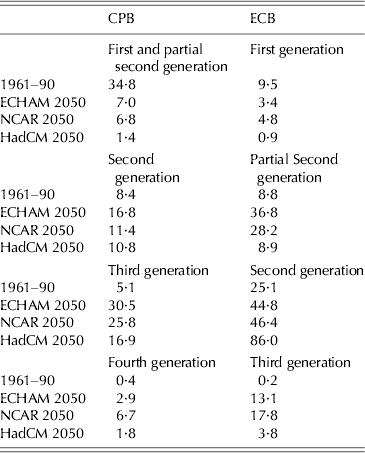
The model indicated the presence of one or two generations of ECB (Fig. 4(a)) under the reference climate conditions (1960–90). Two generations are found in the southern part of the domain, in areas that are more climatically favourable for development of the ECB, i.e. Hungary, the northern parts of Croatia, Serbia and Italy, and the eastern part of Romania. Under future climate conditions in which temperature increases and a prolonged warm season are expected, the area of pest occurrence is expected to expand (Fig. 4(c)). At the same time, the emergence of bivoltine populations and a further increase to a third generation in the warmest areas is indicated. The results showed that the pest would, for example, colonize areas recently unoccupied by univoltine populations, up to an altitude of c. 800 m. The ratio of arable land that is endangered by an increase in the number of generations shows the decrease in the pest's univoltine areas due to an increase in the bivoltine population and the risk of three generations in some regions (Table 3).
(Colour online). Suitability of the EI for (a) the ECB and (b) the CPB in Central–Eastern Europe for the baseline (1961–90) period. (c) and (d) illustrate the likely shift in the number of generations of the pests as a composite of three standardized scenarios (HadCM, NCAR and ECHAM) for 2050. The blank areas indicate no change in the number of generations, grey areas are not suitable for pest occurrence, and dark grey pixels indicate disagreement in the trend between the various models. The intensity of the colour expresses the degree of the agreement between the various models.
The ratio of arable land occupied by a particular number of generations of the CPB and the ECB under current and expected climate conditions according to the HadCM, NCAR and ECHAM scenarios in 2050 (Table 1) over the entire Central European domain
Colorado potato beetle
Under baseline climate conditions (1961–90), the simulated values of the EI predicted one to four generations of CPB over the domain (Fig. 4(b)). Simulations of baseline climate conditions indicated that 0·35 of arable land is threatened by one complete generation of the CPB, 0·08 by two generations and 0·05 by three generations (Table 3). The results of the simulations for the applied climate scenarios exhibited an apparent trend of a widening of the pests’ climatic niche and increase in the number of generations based on the temperature increase (Fig. 4(d)). Similar to the results obtained regarding the ECB, the occurrence of at least one CPB generation is expected to increase in the northern part of the domain up to an altitude of 800 m. In addition, there was a marked increase of approximately two generations in the lowlands, and three generations are expected to occur, but rarely. The overall decrease in the area established by the univoltine population was caused by a shift towards higher number of populations (Table 3). The bivoltine population would therefore occupy 0·17 of arable land, whereas the area occupied by a third generation increases to 0·31 (ECHAM). However, a marked decrease in climates favourable to CPB development under ECHAM is simulated in northern Serbia (the Vojvodina region), where the significant temperature increases under ECHAM exceeds the high-temperature limitation for the development of the pest and a subsequent decrease to approximately one generation.
The effect of climate change on cereal crop production and crop growing conditions in Central–Eastern Europe
Various factors and regional conditions can alter the response of crop production potential to climate change, as demonstrated by the examination of three regional case studies over the domain using crop models. The simulated yield estimates did not account for the influence of pests/diseases, changes in soil workability and extreme events (e.g. hail, heat waves, prolonged drought and floods); therefore, the results should be treated together with outcomes of agroclimatic indicators, e.g. those presented above.
The effect of climate change on spatial cereal production conditions in the Czech Republic
In the first case study, the effects of climate change prior to 2050 were simulated for three scenarios (Table 1) on winter wheat and spring barley for all arable lands of the Czech Republic.
The highest yields of winter wheat and spring barley in the baseline climate (1961–90) were simulated at lower altitudes in the Czech Republic (Fig. 5(a) and (d)). Apart from the effect of climate, this result was also determined by the good soil conditions present at c. 250 m a.s.l. (lowlands), where arable land was composed of chernozem (0·43), fluvisols, phaeozems, haplic Luvisols, cambisols and regosols. The increase in air temperature under all climate scenarios is expected to lead to the shortening of the growing period of both simulated crops (data not shown), as confirmed by many related studies.
(Colour online). Mean yield levels (t/ha) of (a) spring barley and (d) winter wheat during the baseline period (1961–90) in the Czech Republic (78864 km2). Maps (b) and (e) show the change in yield (t/ha) resulting from climate change and effect of increased ambient CO2, and maps (c) and (f) only show the effect of changed climate conditions. Set of maps showing combined and indirect effects are based on composites of three standardized scenarios (HadCM, NCAR and ECHAM) for 2050. The blank areas indicate no change compared to the present conditions, grey depicts areas where estimates based on three scenarios do not agree on the sign of the change, green depicts increased yield, and red indicated decreased yields. The results indicated in red and green represent the average results of all three scenarios.
In general, the changed climate conditions prior to 2050 are expected to lead to a moderate decrease in the yield of winter wheat when the effect of CO2 fertilization is not considered (indirect effect); this effect would be greatest in the lowland and midland areas (Fig. 5(c)). For spring barley, the impact on yield was equally great because the negative effect of a shortened growing period was outbalanced by the earlier sowing dates (Fig. 5(f)). Generally, sites in regions that experience low air temperatures at present would be less negatively or positively affected by the indirect effect (mainly due to the increase of temperatures) of climatic change, as would lowland areas with deep fertile soils. In addition, the potentially positive effect of increased CO2 concentration on crop yields (combined effect) (Trnka et al. Reference Trnka, Dubrovský and Žalud2004b) would lead to an overall increase in the yields of winter wheat (Fig. 5(b)) and spring barley (Fig. 5(e)), especially in areas that currently experience lower annual temperatures (e.g. upland regions).
Assessment of the potential impacts and adaptation options for cereals in a semi-arid region of Austria
In the Marchfeld lowland region (in the north-east of Austria), the changes in winter wheat and spring barley yields were simulated for 2035 relative to the baseline conditions using the same methodologies (crop models and climate scenarios) as those used in the Czech case study.
In accordance with the results of the Czech case study for lowland regions, the impact of the changed weather conditions under ECHAM and HadCM was the decrease or a stagnation in the yields of winter wheat and spring barley until 2035, at which time spring barley exhibits more stable yields. The decrease in yield was caused primarily by a shortened growing season of the simulated cultivars and by reductions in precipitation during the growing season. In Marchfeld, even the additional effect of CO2 fertilization (combined effect) could not fully offset the decrease in yields. The decrease in yield would be more distinct for both crops studied on soils with low water storage capacity (Table 2, Fig. 6). Only NCAR presented a significant increase of winter wheat and spring barley yields, especially on soil classes 3–4 (Table 2) with better soil water storage capacity (Fig. 6). As mentioned above, winter wheat yields differed more among the three climate scenarios than spring barley yields; this result was probably caused by the positive and greater effect of the simulated earlier sowing dates for spring barley under the climate scenarios.
(Colour online). Relative change (%) in the yields of (a) winter wheat and (b) spring barley for various climate scenarios for 2035 (Table 1) in the Marchfeld region (1000 km2) in comparison with those observed under baseline conditions (1961–90).
The interannual yield variability of these two crops is expected to increase for almost all soils, leading to increased economic risk for farmers. Without the positive effect of CO2 fertilization, the mean yield would decrease more, especially on sandy soils (see the results of the Czech Republic case study above).
The effect of climate change on crop water demand and the effect of soil cultivation changes on crop yield and water balance were investigated for the Marchfeld region to evaluate potential adaptation effects. The effects of replacing ploughing by the use of minimum tillage on the simulated yield of winter wheat and spring barley are shown in Fig. 7. The results for the 2035 scenarios showed that such altered cultivation would lead to an increase in the mean yield for both crops; this effect was more pronounced for winter wheat and the NCAR scenario. In general, replacing ploughing with minimum tillage under the 2035 scenarios resulted in an increase of the mean yields of winter wheat (up to 10%) and of spring barley (up to 6%). Especially on sandy soils with low water storage capacity (soil classes 1–2), minimum tillage enhanced the yield potential significantly.
(Colour online). Relative change (%) in the yields of (a) winter wheat and (b) spring barley yield if ploughing were replaced by minimum tillage in the Marchfeld region (1000 km2) in 2035 for the various scenarios.
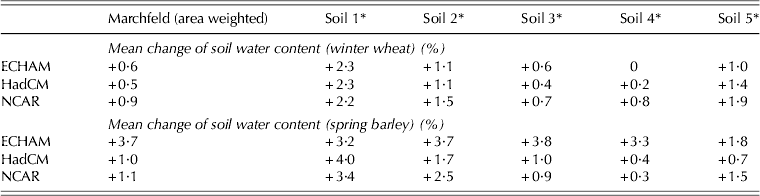
This effect was mainly due to improved water supply for the crops and a decrease in unproductive water losses, resulting in higher water use efficiency. If ploughing were replaced by minimum tillage in 2035 for the three climate scenarios, an increase of up to 2·3% vol. was seen in the simulated mean soil water content for the winter wheat growing season and up to 4% vol. in the simulated mean soil water content for the spring barley growing season on sandy soils (Table 4). This result may be due to the greater (c. 12%) available water storage capacity of the top 250 mm of soils under minimum tillage v. ploughing (Thaler et al. Reference Thaler, Eitzinger, Trnka and Dubrovsky2012). The main effective adaptation options for agricultural crop production in semi-arid regions are related to irrigation. Regarding the crop water demand required in the coming decades to maintain optimum yields of winter wheat and spring barley in Marchfeld, the irrigation option ‘automatic when required’ was used in the simulations for baseline and climate scenarios, respectively. In this context, the effect of nitrate leaching was also considered (in the simulation, nitrogen balance was assumed).
Simulated relative change of mean soil water content during winter wheat and spring barley growing periods in the Marchfeld region under climate change scenarios in 2035, if ploughing were to be replaced by minimum tillage
* Soil classes as defined in Table 2.
The ECHAM and HadCM scenarios generally led to similar results for potential change of water demand of winter wheat (Table 5). Maintaining optimal yield of winter wheat would require more water (e.g. provided by irrigation) per year (up to 33 mm for the area-weighted average) in 2035, except under the wetter NCAR scenario. Soils with low water storage capacity (sandy soils) showed relatively low yields even at present, and additional water input (irrigation) would reduce yields under all three climate scenarios due to strong increases in nitrate leaching (Table 6). Under the NCAR scenario, even less irrigation would be necessary in almost all soil classes to obtain the same winter wheat yields as those obtained under the baseline scenario (Table 5).
Absolute changes of water demand (mm per growing season) required to maintain optimum yield levels of winter wheat and spring barley in the Marchfeld region under climate change scenarios in 2035 with respect to present conditions
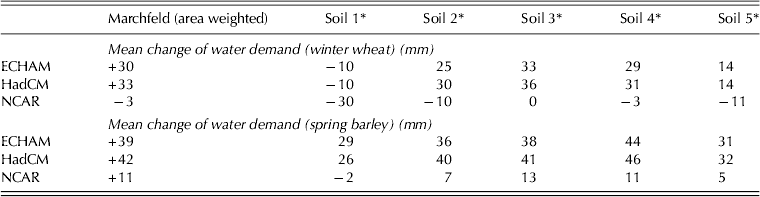
* Soil classes as defined in Table 2.
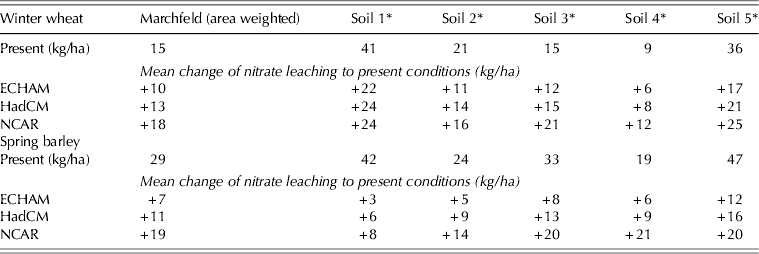
The results showed mostly increased water demand for spring barley for all soils and scenarios (although these are less pronounced under the NCAR scenario); this demand was greater than for winter wheat (Table 5). The nitrate leaching for spring barley was 29 kg/ha, almost twice as much as for winter wheat in the baseline period. The absolute increases in nitrate leaching rates in the climate change scenarios and with optimized irrigation (Table 5) are, in most cases, lower than for winter wheat (Table 6).
The effects of climate change on crop growth and yield in the lowlands of Slovakia
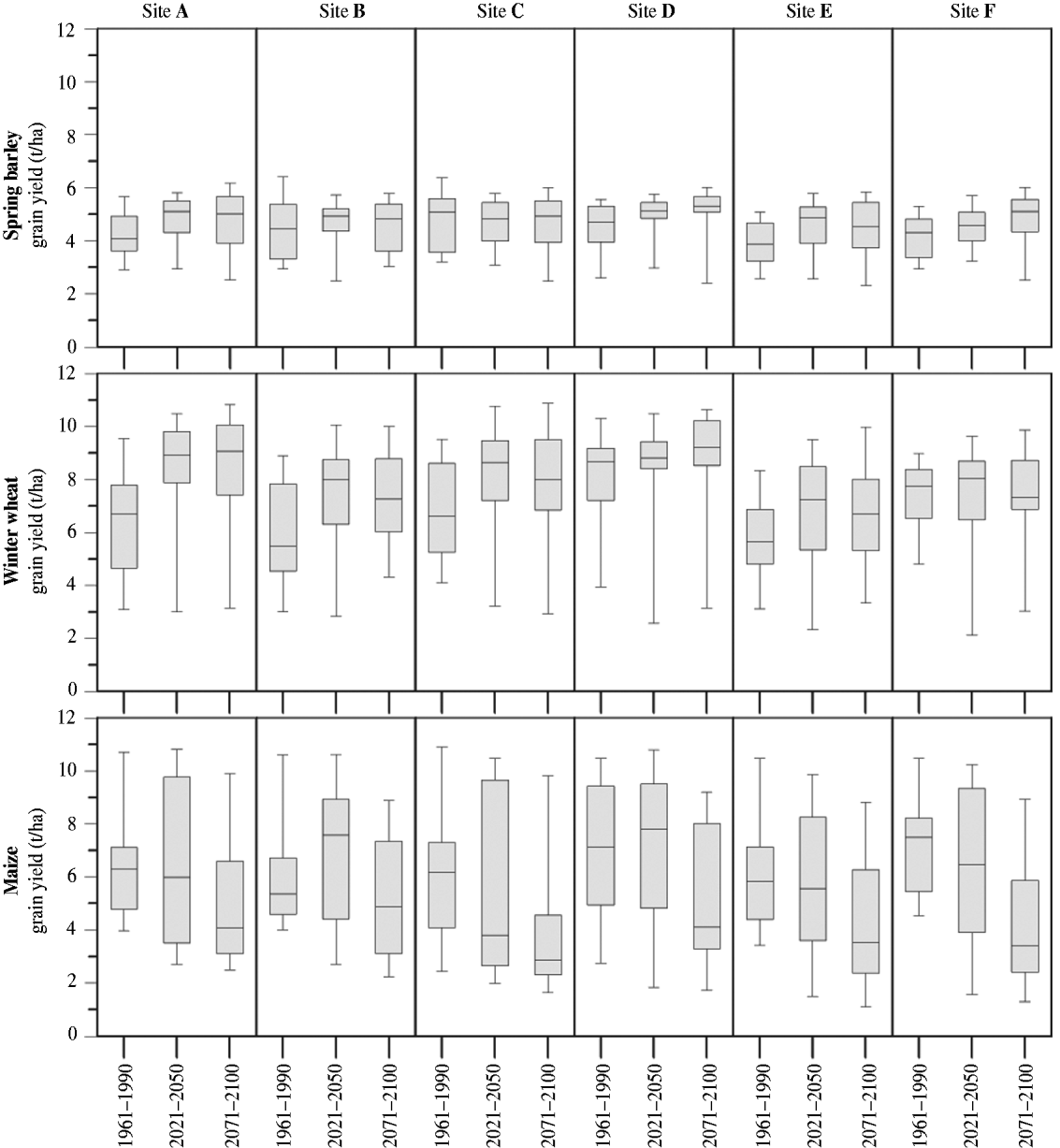
The effects of the climate change scenarios for 2021–50 and 2071–2100 (Table 1) on the simulated crop growth and yield of spring barley, winter wheat and maize were estimated and analysed for the main cropping regions of the Danubian and Záhorie lowlands in Slovakia (Fig. 8).
Grain yields of spring barley, winter wheat and maize for different soils on the Danubian and Záhorie lowlands (Table 2) and the time intervals 1971–2000, 2021–50 and 2071–2100 (statistical distribution: lines represent the simulated full yield range, and columns represent the upper and lower quartiles; the medium yield level is also shown).
As expected, the physiological maturity of all simulated crops (spring barley, winter wheat and maize) grown on different soil types was accelerated under all three scenarios. Owing to the increased air temperature, spring barley, winter wheat and maize reached maturity on average c. 6, 17 and 17 days earlier, respectively during 2071–2100 compared with the baseline of 1971–2000 (results not shown).
The combined effect of changing climate (including the CO2 fertilization effect) would lead to increasing grain yields of spring barley and winter wheat, especially towards the time horizon of 2021–50. This trend, however, would be stabilized for 2071–2100 over almost the entire area of Western Slovakia. The highest positive yield effects for winter wheat and spring barley were simulated for Haplic Chernozems on Danubian lowlands in Western Slovakia. Unlike the Marchfeld case study, the fertilizing effect of increased concentrations of CO2 could more than compensate for any decrease in cereal yield in this case, probably due to lower temperature increases and precipitation changes in the climate change scenario applied for Slovakia (Table 1).
Maize yields tended to decline significantly compared with winter wheat and spring barley under the climate scenarios tested. The highest decrease in rainfed maize yields was found during 2071–2100 for the entire case study region (Fig. 8). This was because maize, as a crop grown during summer, was more affected by drought, and the fertilizing effect of increasing CO2 concentrations is small for C4 crops.
The interannual yield variability of simulated crop yields is influenced mainly by the frequency of extreme weather such as drought and heat waves, although these effects are often not sufficiently considered by crop models (Eitzinger et al. Reference Eitzinger, Trnka, Hösch, Žalud and Dubrovský2004; Rötter et al. Reference Rötter, Carter, Olesen and Porter2011). The present results for the Slovakian case study demonstrated that the interannual variability of yields (indicated as upper and lower quartiles in Fig. 8) in regions with high available water storage capacity was relatively small. However, simulated yields were highly variable in sandy loams, luvisols and fluvisols over the entirety of western Slovakia. Similar relationships were reported from Marchfeld in Austria (Thaler et al. Reference Thaler, Eitzinger, Trnka and Dubrovsky2012).
The interannual yield variability of spring barley and winter wheat, as indicated by the 90% percentile, showed a decreasing trend especially for the 2021–50 periods, except at a few sites. However, in all cases, the differences between the absolute extreme yield levels increased towards 2071. Spring barley generally exhibited lower interannual yield variability than winter wheat and lower differences in the mean yields between the climate scenarios tested (in agreement with the Austrian case study).
Simulated rainfed grain maize yields (representing ripening group FAO310) were affected by increasing temperatures and droughts during summer, as can be seen from the significantly higher interannual yield variabilities especially for 2021–50 and from the strongly decreasing mean yields towards 2071–2100. The simulations clearly showed that the risk for maize cultivation around this ripening group will increase in almost all regions. However, an increase of precipitation during 2021–50 will positively influence the mean yield of grain maize on average (except for the Nitra region). Owing to the lower fertilizing effect of CO2 on C4 crops, the decrease in maize yields will be greater than that of other cereals, especially in warmer regions. Grain maize is often considered to have increased yield potential due to its heat resistance in the agro-climatic conditions of Slovakia. However, as the present study shows, this could be only exploited with later ripening cultivars and irrigation.
DISCUSSION
Common trends in the effects of climate change in Central and South-eastern Europe
Potential crop yield changes under various climate scenarios are affected by the interaction between climate and other local crop growth-limiting factors. Climate change signals together with increased CO2 concentrations influence biomass accumulation directly with respect to the genetically determined optimal conditions for the growth and yield of specific cultivars. However, additional parameters that affect crop yield occur on different time scales; these include pest, disease and weed pressures or the damaging effects of extreme weather events such as hail, floods and heavy precipitation. Agroclimatic conditions also affect crop management options and the suitability of crops for specific regions (Trnka et al. Reference Trnka, Eitzinger, Semeradova, Hlavinka, Balek, Dubrovsky, Kubu, Stepanek, Thaler, Mozny and Zalud2011a,Reference Trnka, Olesen, Kersebaum, Skjelvag, Eitzinger, Seguin, Peltonen-Sainio, Rötter, Iglesias, Orlandini, Dubrovsky, Hlavinka, Balek, Eckersten, Cloppet, Calanca, Gobin, Vucetic, Nejedlik, Kumar, Lalic, Mestre, Rossi, Kozyra, Alexandrov, Semeradova and Zaludb). These additional factors affect crop yields both directly (the plant) and indirectly (e.g. via soil conditions and crop management) and should be considered in long-term and holistic assessments of climate change impact studies, including the related uncertainties (Eitzinger et al. Reference Eitzinger, Formayer, Thaler, Trnka, Zdenek and Alexandrov2008; Trnka et al. Reference Trnka, Eitzinger, Hlavinka, Dubrovský, Semeradova, Stepanek, Thaler, Zalud, Mozny and Formayer2009). The present study, therefore, used an extended set of parameters for the assessment of Central European crop yield potentials under various climate change conditions (Table 7).
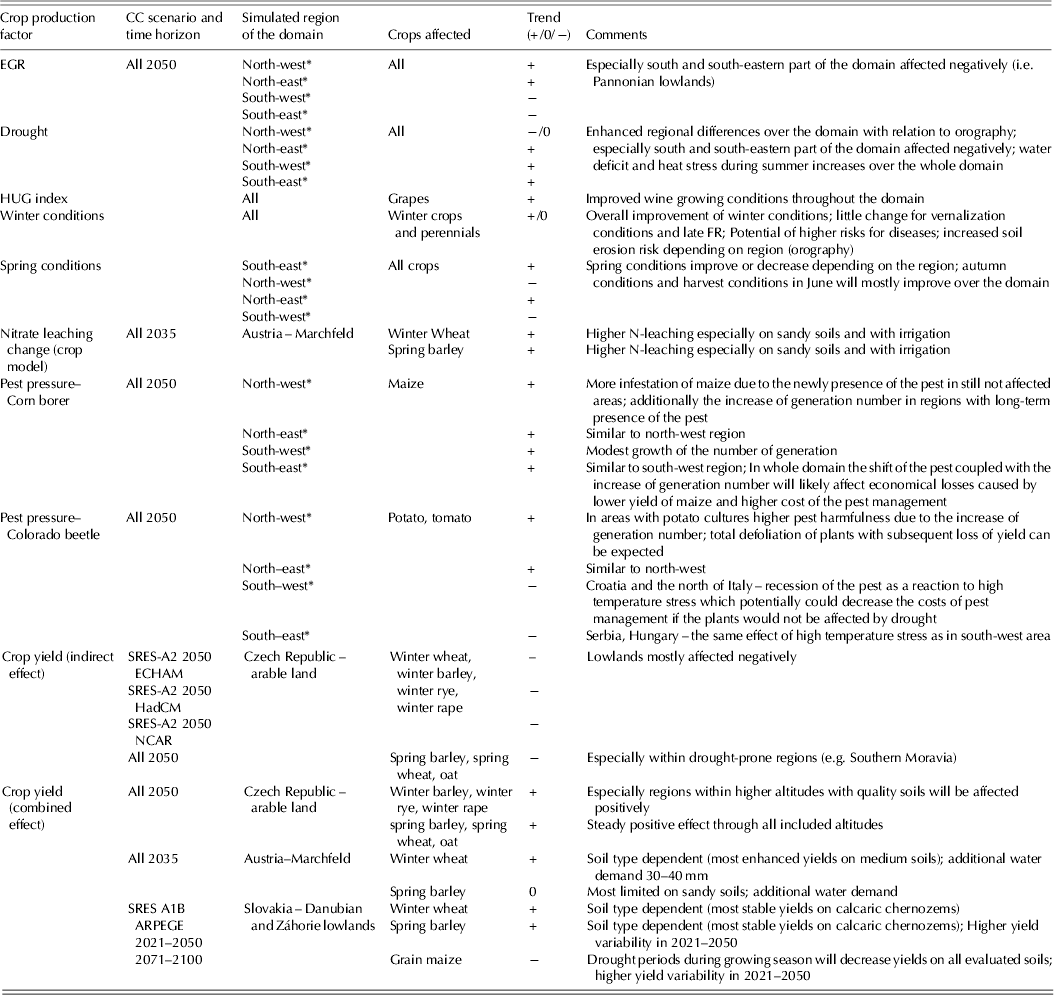
The results showed that most parts of Austria, the Czech Republic, Germany, Poland, Romania, Slovakia, Ukraine and Switzerland exhibited an increase in the mean production potential for the 21st century as a whole (based on the EGR and number of effective growing days). The Pannonian and Mediterranean climatic regions in Hungary, Serbia, Slovenia and Italy were exceptions; in these regions, increases in water deficit will increasingly limit rainfed agriculture. An increase in the severity of the 20-year drought intensity and a more substantial water deficit during the critical part of the growing season are very likely over the central and western parts of the domain. Sowing conditions during spring could deteriorate due to increasing soil wetness, which might further support the preference given to winter crops. Harvest conditions in June (which will become the main harvest period) will generally not improve beyond the current level. In general, it is concluded that rainfed agriculture will face more climate-related risks, and extremely unfavourable years will occur under the applied climate scenarios; however, the overall conditions will probably lead to, on average, increasing yield potentials over the whole domain. This finding is in general agreement with previous studies that have been conducted for this region; however, none of these studies covered the entire domain of Central Europe (Alexandrov et al. Reference Alexandrov, Eitzinger, Cajic and Oberforster2002; Trnka et al. Reference Trnka, Eitzinger, Semeradova, Hlavinka, Balek, Dubrovsky, Kubu, Stepanek, Thaler, Mozny and Zalud2011a) or applied aggregated scales (Trnka et al. Reference Trnka, Olesen, Kersebaum, Skjelvag, Eitzinger, Seguin, Peltonen-Sainio, Rötter, Iglesias, Orlandini, Dubrovsky, Hlavinka, Balek, Eckersten, Cloppet, Calanca, Gobin, Vucetic, Nejedlik, Kumar, Lalic, Mestre, Rossi, Kozyra, Alexandrov, Semeradova and Zalud2011b).
However, based on the combined effects of changing agroclimatic conditions, several additional negative impacts on potential yields can be assumed, such as an increasing risk for soil erosion over the domain, e.g. due to reduced duration of SC and increasing winter precipitation. Overwintering conditions will also change. In winter cereals, for example, this change could affect risk of frost damage and disease pressure either positively or negatively (depending on the combination of SC, temperatures and frost impact). However, no significant negative impacts on the mean vernalization conditions of winter wheat were calculated over the domain with the assumed temperature thresholds.
Further yield-limiting factors include the increasing potential for damage from pests due to warmer conditions, especially from thermophile insects in most of the domain, as demonstrated by the findings related to the ECB and the CPB. Significant shifts in spatial occurrence can also be expected for weeds and diseases (Porter et al. Reference Porter, Parry and Carter1991).
Spatial analysis conducted for winter wheat yields in the Czech case study concerning altitude suggested that cereal yields should increase especially in upland regions, where increasing temperatures will provide favourable conditions, rainfall will remain sufficient and soil conditions are relatively good. The spatial patterns of yield distribution for spring barley were similar for all altitude categories according to all three projections considered. Despite differences between individual regions, the simulated trend seemed to be slightly positive or without any significant change across the entire Czech Republic until 2050.
In the Austrian case study region of Marchfeld, factors that particularly limit crop yields were analysed, and these are comparable with those of the lowland conditions in the Czech Republic. It can be clearly seen for both winter wheat and spring barley that shorter growing periods (Porter & Gawith Reference Porter and Gawith1999) will lead to decreases in yield for currently grown cultivars under the applied climate change scenarios (except the NCAR scenario that includes increasing precipitation) until 2035. Therefore, the decrease in spring and summer precipitation in the climate scenarios is also a crucial factor for this semi-arid region. Owing to the limitation of crop water availability, the decreases in yields would be even more significant without the assumed CO2 fertilizing effect (Amthor Reference Amthor2001). However, the degree of this effect is uncertain from crop model estimates and differs between crops and cultivars (Tubiello et al. Reference Tubiello, Rosenzweig, Kimball, Pinter, Wall, Husanker, Lamorte and Garcia1999; Tubiello & Ewert Reference Tubiello and Ewert2002; Wolf et al. Reference Wolf, Van Oijen and Kempenaar2002; Nendel et al. Reference Nendel, Kersebaum, Mirschel, Manderscheid, Weigel and Wenkel2009). In addition, the effects of direct heat stress and ozone will probably create additional yield risks (Semenov & Shewry Reference Semenov and Shewry2011).
The Marchfeld study on winter wheat and spring barley showed that because of increased water demand, additional irrigation of c. 30–40 mm would be necessary to maintain current yield levels under the drier scenarios because these crops are not irrigated under current conditions. Additional water input can, however, increase nitrate leaching rates, especially on sandy soils, reducing positive effect on yield. Another example of an adaptation measure that could be used to improve crop water availability is alteration of the soil cultivation method (the present study examined a change from ploughing to minimum tillage), and this leads to higher simulated soil water contents and yields due to higher soil water storage capacity under minimum tillage. Based on the two crops studied for the semi-arid lowland region of Marchfeld in central Europe, several crop management factors have to be considered to adapt to new climatic conditions. Soil water and N-fertilization management techniques may play a crucial role in maintaining the production potential of cereals (Thaler et al. Reference Thaler, Eitzinger, Trnka and Dubrovsky2012).
Several studies focused on Europe have noted that climate change can affect interannual crop yield variability (Hlavinka et al. Reference Hlavinka, Trnka, Semerádová, Dubrovský, Zalud and Mozny2009; Peltonen-Sainio et al. Reference Peltonen-Sainio, Jauhiainen, Trnka, Olesen, Calanca, Eckersten, Eitzinger, Gobin, Kersebaum, Kozyra, Kumar, Dalla Marta, Micale, Schaap, Seguin, Skjelvag and Orlandini2010). This fact is confirmed for the present Slovakian case study region for different sites and soils, especially for maize. It revealed increasing maize yield variability towards the middle of the 21st century, followed by a later decrease. As indicated by the Marchfeld study results and the increasing drought frequencies under the various climate scenarios (see the agroclimatic indices), extreme shortages of precipitation in some years will depress crop yields, especially on sandy loam and loamy soils (luvisols, fluvisols and chernozems). However, under good soil conditions, the direct CO2 fertilizing effect may lead to lower yield variability and increasing mean crop yields. Grain maize yields are also expected to decrease for almost all evaluated time horizons if there is no adaptation using later-ripening cultivars and irrigation (Vučetić Reference VučetiĆ2011).
Although several risks and trends can already be described for crop yield potentials for the main areas of the studied domain under climate change conditions (Table 7), it is noted that the current local soil and climate conditions can vary significantly within small areas; changing precipitation levels and temperatures can therefore have variable effects relative to each other on locally grown crops and cultivars.
Recommended adaptation options
Farmers must and will respond to the changing growing conditions by altering their production techniques (Olesen & Bindi Reference Olesen and Bindi2002; Reidsma et al. Reference Reidsma, Ewert, Lansink and Leemans2009). The major climate change impacts of the present study are related to changes in the seasonal water balance for crops accompanied with increased temperatures; under future climate scenarios, increasing drought and heat stress during summer and wetter and warmer conditions during winter can be expected.
Specific recommendations for adaptation can therefore be related to altered production techniques that affect the water balance/demand of crops, the effective use of water and soil resources (EEA 2005), adapted crop timing and selection, and altered pest/disease/weed management.
Rainfed summer crops such as maize and spring crops, particularly in the lowlands of the domains (e.g. the Pannonian region), will lose production potential unless their management is altered (Trnka et al. Reference Trnka, Eitzinger, Dubrovský, Semerádová, Štěpánek, Hlavinka, Balek, Skalák, Farda, Formayer and Žalud2010b). Therefore, the growing of winter crops and the consequent use of intermediate crops can be recommended to reduce yield risks that leading to lower mean yields and higher interannual yield variability. Moreover, vegetation cover during winter will protect against soil erosion resulting from warmer winters with less SC and higher precipitation. This will be especially important for crops grown on hilly terrain and erosive soils over the domain (Klik & Eitzinger Reference Klik and Eitzinger2010).
Several measures for reducing unproductive evaporation will be increasingly crucial for rainfed crops. A number of management options are available for improving water availability and water use efficiency including irrigation, soil cultivation, fertilization, crop rotation and others (Latiri-Souki et al. Reference Latiri-Souki, Nortcliff and Lawlor1998; Connor Reference Connor2004; Tennakoon & Hulugalle Reference Tennakoon and Hulugalle2006; Zhang et al. Reference Zhang, Li, Huang, Cheng and Zhang2006; Hsiao et al. Reference Hsiao, Steduto and Fereres2007). For example, permanent soil cover (mulch) established during periods without crop cover (preferably in connection with reduced soil cultivation methods or direct drilling) can reduce evaporation and nitrate leaching (Thaler et al. Reference Thaler, Eitzinger, Trnka and Dubrovsky2012). Mulching also contributes to reduced soil erosion, surface leakage and crust formation (thereby reducing runoff). Windbreaks such as hedgerows can reduce unproductive water losses, especially in the Pannonian Lowlands, which experience high wind loads (Müller Reference Müller1993). Flexible fertilization schemes, especially for nitrogen, should reflect seasonal shifts of rainfall and rainfall intensity. For example, applying precision farming methods (e.g. considering real-time crop demand, reduced and more frequent applications, using slow-release fertilizers, etc.) can help farmers to adapt to the new conditions.
The present results have shown that crops, especially in the warm and dry lowland regions (the Danubian lowlands and vast regions of the Pannonian area of south-eastern Europe) will need more water to maintain their production potential. With regard to irrigation, efficient management of regional irrigation water resources, improvements in the water use efficiency of irrigation systems and the introduction and application of efficient irrigation methods such as deficit irrigation are recommended.
Owing to the increasing temperatures, growing degree days (GDDs) will increase throughout the domain, leading to longer vegetation seasons and shortened crop growing periods. Simultaneously, the number of heat extremes and heat stress days for crops will increase significantly, and this has been identified as an important yield-limiting factor for cereals (drought stress is another) (Semenov & Shewry Reference Semenov and Shewry2011). Therefore, selection (and breeding) of adapted cultivars with respect to the higher expected GDD demand and for drought and heat tolerance will be important for all regions of the domain.
Other measures that can be used to adapt to longer vegetation periods are shifting sowing dates or changing the crops planted to those that are adapted to higher temperatures and exhibit heat tolerance (e.g. millet, maize, soybeans or sunflowers). Land use, especially in highlands with permanent grasslands, could be increasingly forced towards fodder crops or other farming types such as the planting of orchards or vineyards (Trnka et al. Reference Trnka, Eitzinger, Semeradova, Hlavinka, Balek, Dubrovsky, Kubu, Stepanek, Thaler, Mozny and Zalud2011a). Where this is not possible, a decrease in grassland production potential can be expected (such as in the highlands of the Czech Republic or northern and south-eastern parts of Austria).
As demonstrated in the present study, thermophile pests could spread considerably (and increase their populations by breeding more often within one season) under the future climate scenarios; this may be exacerbated by increases in the areas being devoted to the host crops (e.g. maize). This development will require efficient and better crop protection methods in future decades over the domain. In addition to technical measures such as adapted crop rotations, the use of new genetic cultivars, adapted soil cultivation and monitoring and forecasting systems will be crucial for early warning to allow efficient crop protection.
International cooperation and data for this study were provided through support of the 6th FP EU projects CECILIA (Central and Eastern Europe Climate Change Impact and Vulnerability Assessment (www.cecilia-eu.org)), ADAGIO (Adaptation of Agriculture in European Regions at Environmental Risk under Climate Change) SSPE-CT-2006-044210 and CLIMSAVE (Climate Change Integrated Assessment Methodology for Cross-Sectoral Adaptation and Vulnerability in Europe) no. 244031, OPVK project Partnership in Climate Research and Adaptation Strategies (no.: CZ.1·07/2·4·00/31·0056) and COST 734 action.



