Introduction
A mass-casualty incident (MCI) is defined as a natural or man-made incident that suddenly progressively generates large numbers of injured and/or ill people who require medical and/or mental health care. 1 Rates of occurrence are rising, as evidenced by the numerous natural and man-made disasters that have happened in recent years. 2,Reference Subbarao, Lyznicki and Hsu3
During normal day-to-day operations, emergency departments (EDs) and trauma centers are stressed from the excessive patient load and sometimes are compelled to divert patients due to limited capacity. Mass casualties clearly overwhelm a health care system by creating resource constrained settings on which there are immediate shortages of essential personnel, supplies, and services, necessitating assistance from outside entities. However, outside help can be unfeasible or unreliable due to the difficulties involved in transportation and communication. This predicament triggered the US health care system to develop crisis standards of care, altering the way health care personnel should practice when faced with these types of events. 1,Reference Koenig, Lim and Tsai4
Under the jurisdiction of the US Department of Homeland Security (Washington, DC USA), the Homeland Security Presidential Directive calls upon the medical system to establish the discipline of disaster medicine to conduct research and coordinate care in the face of mass casualties. 5 Advanced training is considered to be an essential tool of this directive. Full-scale drills account for transport, triage, hospital command, resuscitation, and more. Training and preparation were shown to improve performance in mass casualties Reference Krohmer and Bern6,Reference Hack7 and were credited with successful responses to the Madrid and London bombings in 2004 and 2005, respectively. Reference Burstein8
In recent years, simulation of mass casualties has been used as a preferred training method of the US health care system. Simulation training is rooted in the work of Lieutenant Colonel Vincent Hack, who advocated for simulated training for military and civilian disasters using live actors and moulage. He believed that simulation exercises, followed by debriefing, was the best way for the information to be retained. Reference Hack7 Brehm designed something similar and also believed in live actor simulation. Reference Brehm9
Despite the enthusiasm for live actor simulation, it has many drawbacks. Drills are costly, resource intensive, and difficult to coordinate. Effective drilling requires frequent repetition, Reference Burstein8 but the variability and subjectivity introduced by using human actors interferes with objective and reliable assessment of efficacy of the training. Furthermore, without the actual performance of medical procedures, including invasive interventions such as endotracheal intubation and intravenous (IV) placement, the realism of the exercises may be compromised and the benefit to the trainees less than robust. Finally, little data exist on the effectiveness of live moulage casualty drills. Reference Ballow, Behar and Claudius10,Reference Andreatta, Maslowski and Petty11
Simulation exercises using high-fidelity mannequins are replacing those involving role playing actors. Invasive interventions can be performed, which improve experiential fidelity and offer a meaningful learning opportunity for health care workers without risk to live people. The requisite collaboration and psychomotor skills may be enhanced by practicing teamwork and procedural skills. Reproducibility is more reliable because the variability introduced by live actors is eliminated from the exercises. Reference Kobayashi, Shapiro and Sumer12
Numerous studies have shown that mass-casualty simulations with high-fidelity mannequins are excellent for treatment and triage skills. Reference Vincent, Berg and Ikegami13-Reference Gillett, Peckler and Sinert15 The comparison by Gillet, et al of a mass-casualty exercise with high-fidelity simulators to one that uses live actors revealed that high-fidelity mannequins are equivalent to live actors in prompting providers to complete critical actions. However, also observed was the potential for variation in medical knowledge and acting ability in the live actor group. This was associated with suspension of belief in the exercise and inconsistent participation. Participants felt that the high-fidelity simulators increased perception of reality over the live actors, and they preferred the simulators for disease representation, physical exam, treatment options, utility in testing resource allocation, and in testing disaster response. The investigators also noted that invasive procedures were more time consuming when actually performed on the simulators rather than fabricated on live actors. The investigators believed that high-fidelity simulation exercises are under-utilized for mass-casualty training. Reference Gillett, Peckler and Sinert15 Nevertheless, the study does not describe the adverse consequences of constraints on time and of resources that occur with mass casualties.
This study describes a mass-casualty simulation involving 12 victims, all represented by high- and low-fidelity mannequins. The importance was emphasized of appropriate triage and the scarcity of resources, including time. The interrelationship of the care of all of the victims with regard to limitation of time, personnel, and resources and how they affect outcomes was drilled.
Methods
Study Design and Sample/Participants
Health care teams were comprised of ED physicians, nurses, and respiratory therapists. A hospital administrator participated in one of the events. The number of participants ranged from eight to ten per exercise. The exercise was conducted on five separate occasions with different ED personnel from the Chicago (Illinois USA) area who registered in advance in order to receive training on mass-casualty management. The ED personnel were self-selected and assigned to groups based on availability (ie, convenient sampling). Before each exercise began, each group of participants was lectured on the management of blast injuries and on the general approach to mass-casualty management, including triage, and on use of the Simple Triage and Rapid Treatment/Transport (“START”) 16 and “JumpSTART” 17,Reference Ronig18 algorithms. After the lectures, the participants became acquainted with the simulation laboratory and the mannequins. They also had the opportunity to organize their teams and assign roles. The participants were provided with laminated cards of the triage algorithms and a set of color coated tags to place on the beds of victims reflecting their triage status. The exercise commenced after the teams were organized. This is a cross-sectional, observational study that evaluated participant performance during the exercise, as well as training satisfactions of the participants. All participants who completed the training and the survey were included in the study.
Study Setting
The exercise took place in the Rush University Simulation Laboratory (Chicago, Illinois USA) with a variety of high-fidelity computerized simulators (HFCS) manufactured by Laerdal (Laerdal Company; Stavangar, Norway) and Gaumard (Gaumard Scientific; Miami, Florida USA) companies.
Protocol
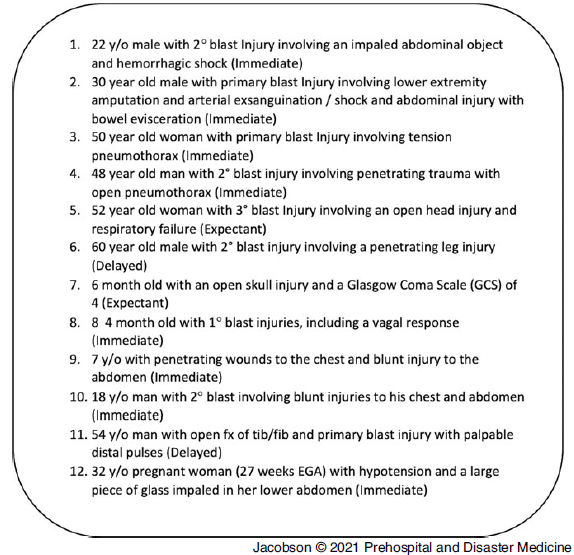
Twelve HFCS were designed as victims of a bombing attack at a popular tourist destination in the city of Chicago. These mannequins were programmed to exhibit a variety of signs and symptoms according to their injury pattern and severity (Figure 1). Two of the victims were designed to perish, regardless of the interventions performed (expectant). Two other victims were designed to sustain relatively minor injuries and did not need any immediate intervention (delayed).
Description of the Victims.

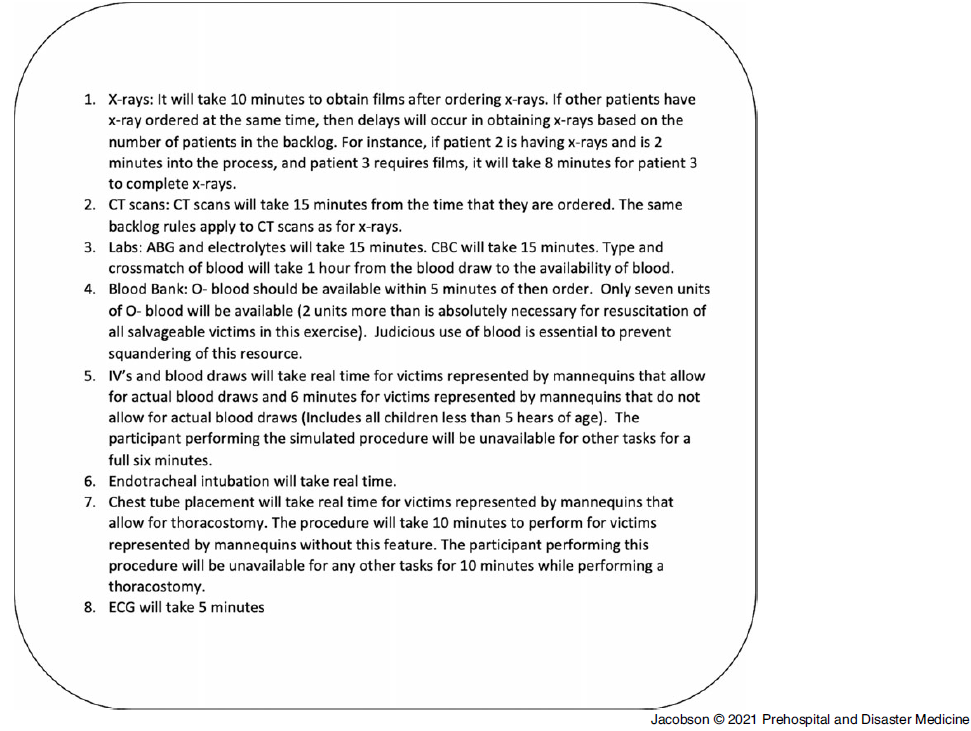
In addition to exhibiting signs and symptoms, the mannequins are designed to allow for the application of life-saving interventions. Health care workers can perform invasive actions, such as insertion of IV catheters, thoracostomies, phlebotomy, and endotracheal intubation, during simulation. Certain models of mannequins were limited as to which actions can be performed. For these models, health care workers would verbally inform the monitors of the actions they would like to perform on the victims. A specific amount of time was designated for each of these actions (Figure 2). Participants performing these tasks were instructed that they had to refrain from any other activities until the time to complete these “virtual tasks” expired. For example, IV placement of a small child would take six minutes. The participant performing this task could not engage in any other activities during this time. Specific expenditure of time was also designated for the retrieval of results from diagnostic tests (Figure 3). For example, all x-rays were programmed for a ten-minute processing time from the moment they were ordered to retrieval of the films and results. Computerized topography scans were programmed for a fifteen-minute processing time. Backlogs for all diagnostic radiology occurred if these tests were in process for other victims.
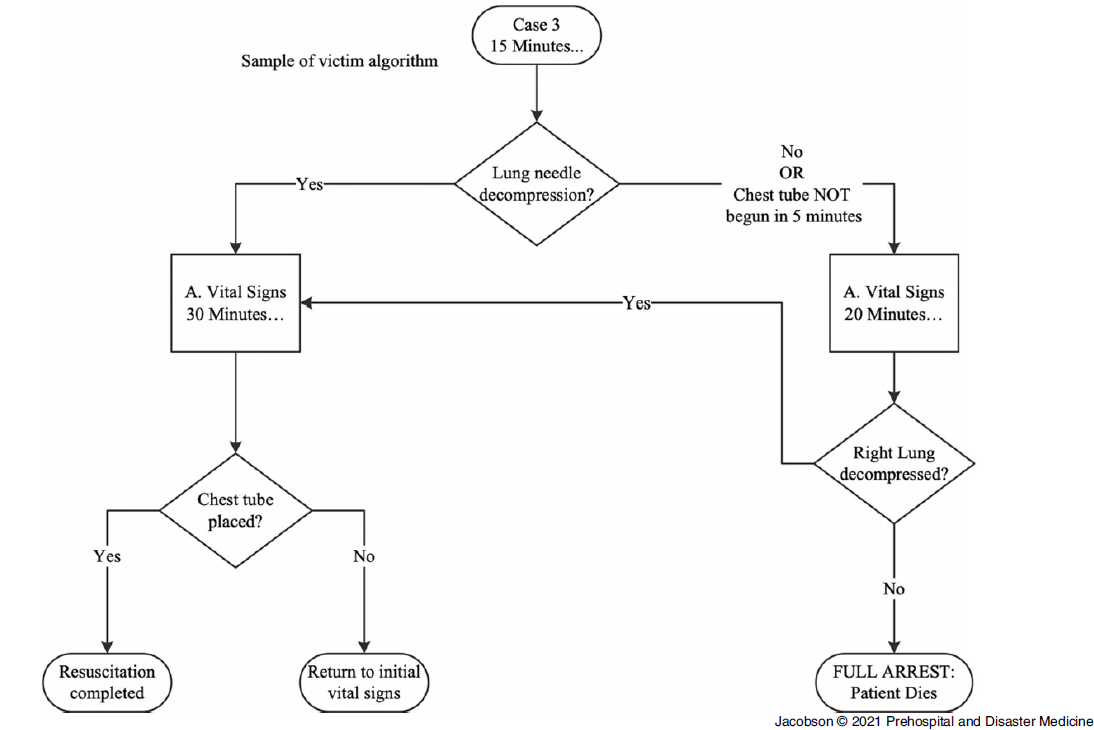
Example of Time Sensitive Algorithm for a Victim during a Mass-Casualty Event.

Expenditure of Time for Common Tasks.
Abbreviations: CT, computerized tomography; ABG, arterial blood gas; CBC, complete blood count; IV, intravenous; ECG, electrocardiogram.

The victims ranged in age from four months to 60 years (Figure 1) and sustained a wide variety of injuries. The victims arrived in the ED at staggered times, within forty-five minutes of the attack. It was required for each victim to be triaged according to severity of injury and priority of care. Based on the degree and type of injury, certain victims required critical actions to facilitate their recovery. Intravenous fluid administration, blood transfusion, thoracostomy, endotracheal intubation, and mechanical ventilation are examples of critical actions. Completion of each critical action was time sensitive (Figure 2), and failure to complete one resulted in worsening of the condition of a victim. Salvageable victims were programmed to perish without timely appropriate intervention, and inappropriate actions resulted in the demise of the victims and/or expenditure of precious time and resources. O- blood units and ventilators were resources that were limited in supply. Health care teams were only provided with the number of ventilators and O- blood units needed to resuscitate salvageable victims, plus two extras of each. Exhaustion of any of these resources could result in the inability to resuscitate some of these victims.
Measurements
After each exercise, each health care team was debriefed on the event and their actions. After the debriefing, the participants were given a questionnaire to rate their training satisfaction, including quality of the exercise. The instrument used was a five-part, 27-question survey.
Part One surveyed participants’ satisfaction on a Likert scale of Strongly Agree (rating of five) through Strongly Disagree (rating of one). Part Two surveyed participants’ program ratings on a Likert scale of one to ten by quality domain: overall program quality; quality of trainers; quality of facilities; usefulness; realism; and pertinence. Part Three surveyed participants’ previous training experience, and where applicable, ratings by comparison across four possible previous training methods: table top training; live actor training; computer or virtual training; or other. Part Four surveyed participants’ likelihood to recommend the exercise to colleagues while Part Five surveyed participant demographics but were not included in this analysis.
The Likert scale responses from the survey were evaluated using mean with 95% confidence interval as well as median and inter-quartile range. In addition, the frequency and proportion for combined Agree and Strongly Agree ratings (ie, top box) were calculated. For the categorical responses, such as prior experience with MCI training, the frequency, proportions, and associated 95% confidence interval were calculated. The performance of the medical teams on treating 12 victims was measured using survival rate of the victims, utilization of scarce resources such as O- blood supply and ventilators, and timeliness of critical treatment actions.
Ethics Statement
This research was reviewed by the Rush University Medical Center Institutional Review Board (protocol # 20100703-IRB01) and determined to be exempt for need of informed consent.
Results
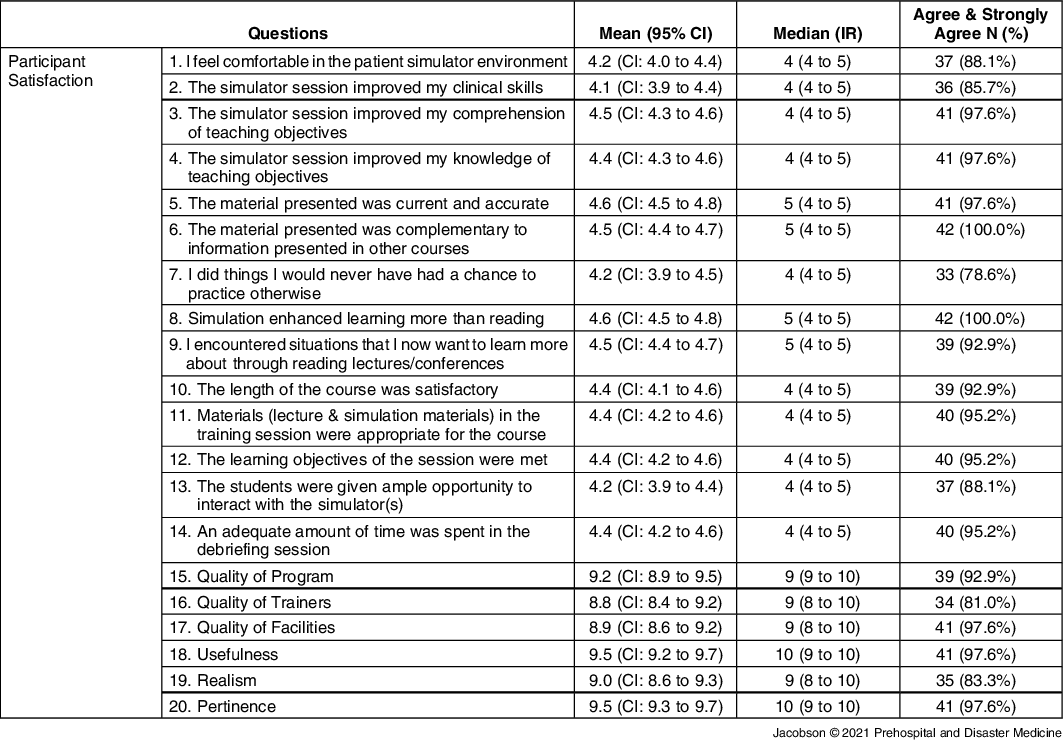
The study participants consisted of 31 ED nurses, nine ED physicians, two respiratory therapists, and one hospital administrator. Due to the clinical nature of the study, the hospital administrator responses were excluded from the analysis. The participants gave high satisfactions rating (mean = 4.6 and median = 5.0) for exercise material as it was current and accurate (Table 1). Most participants indicated that the exercise complemented material taught in other courses (mean = 4.6; CI: 4.4 to 4.7; median = 5.0). Nearly all participants indicated that simulation enhanced learning over reading (mean = 4.6; CI: 4.5 to 4.8; Agree or Strongly Agree responses = 100.0%) and raised new situations about which they wished to learn more (mean = 4.5; CI: 4.4 to 4.7; Agree or Strongly Agree responses = 92.9%). Surveys indicated that the experience piqued curiosity and intrinsically motivated them to continue learning. Participants indicated the course materials were appropriate (mean = 4.4; CI: 4.2 to 4.6; median = 4.0) and learning objectives were achieved (mean = 4.4; CI: 4.2 to 4.6; median = 4.0). Based on the survey, simulation session significantly improved knowledge (mean = 4.4; CI: 4.3 to 4.6; median = 4.0) and comprehension (mean = 4.5; CI: 4.3 to 4.6; median = 4.0) of the participants. Participant mean ratings of the pertinence, usefulness, realism, quality of the facilities, trainers, and program based on a scale of 1.0 to 10.0 were 9.5, 9.5, 9, 8.9, 8.8, and 9.2, respectively.
Participant Satisfaction

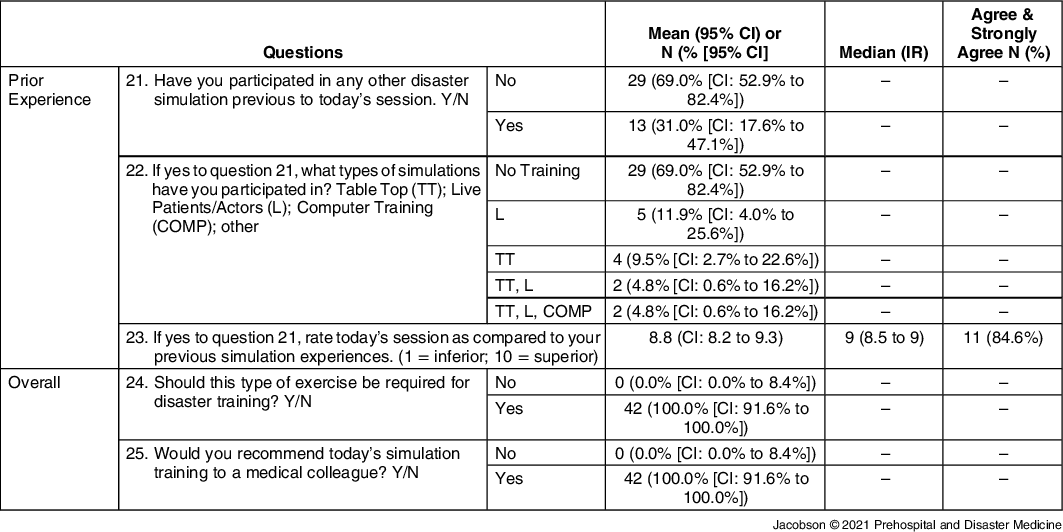
Forty out of 42 participants indicated that adequate time was spent for debriefing (mean = 4.4; CI: 4.2 to 4.6; median = 4.0). Participants issued a slightly lower rating for “given ample opportunity to interact with simulators” (mean = 4.2; CI: 3.9 to 4.4; Agree or Strongly Agree responses = 88.1%), “experience improved their clinical skills” (mean = 4.1; CI: 3.9 to 4.4; median = 4.0), and “gave them an opportunity to do things they would not have otherwise had the chance to practice” (mean = 4.2; CI: 3.9 to 4.5; median = 4.0). Thirteen (30.9%) participants had previous mass-casualty simulation training (Table 2). The participants who had previous mass-casualty simulation training rated this exercise a mean of 8.8 on a scale of 10.0 and median of 9.0 with regard to superiority relative to previous training. Participants unanimously agreed that disaster simulation training should be required and that they would recommend the present exercise to medical colleagues.
Participant Satisfaction and Prior Experience

The performance of the medical teams was as follows: four teams resuscitated the infant that should have been tagged as “expectant” and exhausted the supply of O- blood resulting in mortality of some victims. Three of the medical teams exhausted the supply of ventilators, requiring one member from each of those teams to hand ventilate throughout most of the exercise. Two medical teams began treating the victims labeled as “delayed” too early. The number of deaths ranged from two (including the expectant victims) to six. Thus, the survival rate for 10 salvageable victims ranged from 40.0% to 100.0% depending upon which medical team was responding to the MCI event.
Discussion
For many years, training hospital personnel for many types of typical emergencies was exclusively conducted on real patients with trainees supervised by experienced professionals. Medical education has entered into an era in which the use of high-fidelity simulation is becoming commonplace for preliminary training of a multitude of emergencies. This technology allows for standardization of training, thereby increasing patient safety Reference Reznek, Harter and Krummel19 and translating into improved patient care. Reference Bond, Lammers and Spillane20 A strong case could be made for expansion of the use of high-fidelity simulation to train hospital staff for mass-casualty management. Mass casualties are too infrequent to train personnel reliably during real events, but too frequent to forgo this aspect of education.
In recognition of the need for training using mass-casualty simulation, the US Department of Health and Human Services, Office of the Assistant Secretary for Preparedness and Response (Washington, DC USA), sponsored the creation of a mass-casualty exercise that could be accessed by hospitals nation-wide. However, this exercise focuses on matters of command and control, bed availability, and triage. Reference Waxman, Chan and Pillemer21 It is not designed to simulate the amount of time and effort required to manage multiple casualties by ED personnel. The exercise omits training on teamwork, resource utilization, and psychomotor integration required for multiple patient resuscitation.
The importance of training personnel involved in the direct care of patients is reflected in the Homeland Security Directive of 2007. This directive calls for the establishment of a discipline that recognizes unique principles of disaster-related medicine and public health. Reference Subbarao, Lyznicki and Hsu3 It recognizes three categories of personnel who require training: leaders, practitioners, and informed workers/students. In accordance with this directive, the exercise presented here focuses on the training of practitioners and informed workers/students and allows participants to train on a simulated mass casualty and to treat individual victims. Additionally, it offers exposure to the task of being overwhelmed with an excessive number of casualties, necessitating an altered management approach, consistent with crisis standards of care. 22 Well-defined roles of hospital personnel, teamwork, and careful stewardship of scarce resources are all essential components of this exercise, as they would be in a true mass-casualty event. The exercise also allows instructors to emphasize critical principles of proper management and to assess the performance of the participants in order to provide immediate feedback.
This exercise was somewhat unique from others that used high-fidelity simulation as it incorporated simulated victims who should have been labelled as expectant and required that participants have the discipline to forgo resuscitation of those patients. Limits on time and resources were also instituted, leading to adverse consequences for victims with improper resource management. All groups of participants largely performed well in this exercise and succeeded in performing most of the critical actions necessary for optimal performance. Common mistakes were over- and under-triage. Curiously, all but one group of participants embarked on resuscitation of an infant who, unambiguously, should have been labelled as expectant and not resuscitated. Precious time and resources were utilized in this endeavor. The one group of participants who appropriately triaged this infant attempted to save him after the resuscitation of all other salvageable victims was complete. Perhaps the emotional difficulty of allowing a baby to die affected the discipline of the participants. This point may need to be considered in future training exercises.
Additionally, most groups of participants over used the limited supply of blood and ventilators, causing the deprivation of these items from salvageable victims who needed them. At times, victims were given blood instead of crystalloid, followed by reassessment, when participants felt that they needed fluid resuscitation. Many of these victims would have survived without blood transfusion. One group of participants that transfused blood excessively did “think on their feet” and suggested the use of auto transfusion for a victim with a hemothorax. This type of creativity is likely useful in a mass-casualty event. Some victims with pneumothoraces were treated with endotracheal intubation and mechanical ventilation unnecessarily prior to thoracostomy. These victims were capable of breathing spontaneously once the lungs were re-expanded with thoracostomy alone. Furthermore, positive pressure ventilation may be detrimental in a blast injury, as it may exacerbate lung injury and cause worsening of pneumothoraces.
Ventilator stewardship is not only important during a mass-trauma casualty. It is absolutely vital during a pandemic, such as COVID-19 currently afflicting the entire world. Furthermore, during this pandemic, shortages of personal protective equipment (PPE) for health care workers has been a monumental problem. Reference Emanuel, Persad and Upsur23,24 This exercise could be used as a model to train the workers how to mitigate for shortages of PPE as well as for shortages of vital resources to save the lives of patients.
It should be noted that it is widely believed that help from local and federal governments may take several hours to days to be realized in a disaster. Reference Burstein8 Hospital personnel must be prepared to manage a mass casualty with no outside assistance and exercise greater stewardship of time and resources than they are accustomed.
Kobayashi, et al designed and implemented a similar drill to the one presented here that involved multiple patients arriving at an ED simultaneously, named “Multiple Encounter Simulation Scenario (MESS).” Reference Kobayashi, Shapiro and Gutma25 This exercise included limitations on time and resources, but did not depict an MCI.
Despite the fact that the participants in the exercise presented here were given didactic lectures on patient management in an MCI (including triage) and on the basics of blast injuries, many mistakes were made with regard to triage and resource utilization. Perhaps didactic training is not enough to prepare health care personnel for mass casualties. Aspects of active learning, which include cognitive, technical, and behavioral skills and team performance, are crucial components of training. Reference Halamek26 This concept was validated by Franc-Law, et al who conducted a prospective controlled trial involving two groups of students. Both groups were given didactic lectures on triage and management of victims in a mass-casualty situation. Following the didactic session, the control group participated in a simulation depicting a typical time period in an ED. The investigation group participated in a simulation of a mass-casualty situation. The participants from both groups were responsible for triage and management of simulated patients who arrived in the ED. After this phase of training, each group then participated in a subsequent mass-casualty simulation. Performance of each group was compared. The investigation group performed far more efficiently than the control group in that exercise. Reference Franc-Law, Ingrassia and Ragazzoni27 This work reinforces the importance of active learning for retention and comprehension of vital principles.
Though performance on the MCI simulation indicates that many mistakes were made that resulted in lower survival rates and inefficient utilization of resources (eg, O- blood and ventilators), the post-exercise debriefing provided an opportunity to educate the participants on avoiding under-/over-triaging and exercising appropriate treatment options. In addition to improvement in performance, active learning with high-fidelity simulation training is preferred by participants as a superior method of learning. Collectively, the surveys from the exercise presented here indicate that high-fidelity mass-casualty simulation is well-received by health care personnel and has the potential to inspire self-directed learning. Participants reported overwhelmingly that simulation provided a more meaningful learning experience than reading. Improvements in comprehension and knowledge were strongly indicated. Unanimous agreement that mass-casualty simulation should be compulsory and would be recommended to medical colleagues suggests that, given the opportunity, a high level of health care personnel participation and engagement in mass-casualty simulation is likely and will provide a meaningful learning experience.
Furthermore, all participants who had previous training with tabletop, computer, or live actor drills preferred the exercise presented here. These data are consistent with that of other investigations that described that high-fidelity mannequins and virtual reality exercises are preferred over live actors by participants for mass-casualty training. Reference Andreatta, Maslowski and Petty11,Reference Gillett, Peckler and Sinert15,Reference Atlas, Clover and Carrico28,Reference Wallace, Gillett and Wright29
Limitations of the Study
It is impossible to test the true validity of any kind of mass-casualty training in a rigorous scientific controlled way. This would require a comparison of the conduct of hospital personnel who had prior simulation training with those that did not in a real MCI. It would be impossible to control for the number of victims and the severity of their injuries.
In this study, educational material was not distributed to the participants prior to the exercise. Had this been done, the educational experience would have been enriched and the performance of the teams during the exercise may have been better.
The strength of the work would have been enhanced if this was a prospective study and if the participants were randomly selected. Furthermore, this work would have been optimized if the same groups of participants were tested several weeks later with a different mass-casualty exercise to see if they would retain some of the principles of mass-casualty management and improve on previous performance. Repetition is important for retention and reinforcement of principles taught. Reference Burstein8,Reference Atlas, Clover and Carrico28
Despite the popularity of high-fidelity simulation for mass-casualty training, excessive cost for this type of program is a concerning factor. Costs for each mannequin ranges from US$30,000 to US$200,000. Reference Kobayashi, Shapiro and Sumer12 Moreover, each drill requires technicians and health care personnel supervisors. Perhaps groups of local hospitals could share the costs to establish one local or regional center for mass-casualty simulation training for all hospitals in each area. Local and federal governments could help fund such an endeavor.
In this exercise, there were enough resources to manage all salvageable victims. There are disasters in which there would not be enough resources to save all salvageable victims. Prioritization of who would be eligible for these precious resources and the ethical considerations involved were not part of this curriculum.
Conclusion
Mass-casualty training with high-fidelity mannequins is a preferred style of learning among health care personnel who participated in this exercise. The study suggests that triage, time management, and resource stewardship should be incorporated in all drills. Furthermore, there may be a tendency to under-triage infants who should not be resuscitated, leading to expenditure of precious and limited time and resources.
Conflicts of interest/funding
This exercise was funded by the Assistant Secretary for Preparedness and Response (ASPR) through the Chicago Department of Public Health (CDPH). The authors have no conflicts of interest to declare.
Supplementary Materials
To view supplementary material for this article, please visit https://doi.org/10.1017/S1049023X21000327