


To many laypersons it would seem apparent that personal injuries reduce the quality of life in different ways. They may point to the obvious health difficulties or the many personal problems together with the understandable financial consequences of an accident. There might not be absolute agreement on what constitutes quality of life but there would be a view that in general the majority of persons are likely to be worse off after an accident or injury. Some might expect quality of life to lessen dramatically at first but possibly regain some ground as a person adapts to changed circumstances.
Quality of life is a topic that has both theoretical and practical implications for rehabilitation counselling (see Bishop, Miller, & Chapin, Reference Bishop, Miller and Chapin2008). It is different from concepts such as life-satisfaction, subjective well-being or happiness. For the most part, it is viewed as an aggregate response to a broad spectrum of psychological, social and environmental factors. These factors include health, energy, ability to undertake daily living, satisfaction with self, satisfaction with personal relationships, enough money to meet one's needs as well as satisfaction with living conditions. It has been defined formally by the World Health Organization as someone's ‘…perception of their position in life in the context of the culture and value systems in which they live and in relation to their goals, expectations, standards and concerns’ (World Health Organization, 1997, p. 1). Little is known, however, about the trajectory of life prior to and following a compensable injury. The aim of this article is to document some aspects of this phenomenon.
One view is that quality of life following an injury is a long-lasting reaction to circumstances. It is reduced after trauma (e.g., Holtslag, van Beeck, Lindeman, & Lieven, Reference Holtslag, van Beeck, Lindeman and Leenen2007). This has been reported across a spectrum of conditions from acute respiratory distress syndrome (Hopkins, Weaver, Collingridge, Parkinson, Chan & Orme, Reference Hopkins, Weaver, Collingridge, Parkinson, Chan and Orme2005), through spinal cord injury (Dijkers, Reference Dijkers2005), to traumatic brain injury (Esbjornsson, Skoglund, & Sunnerhagen, Reference Esbjornsson, Skoglund and Sunnerhagen2013), burn injury (Dydter-Aas, Kildal, & Willebrand, Reference Dyster-Aas, Kildal and Willebrand2007) or survivors of severe trauma (Post, Van Der Sluis, & Ten Duis, Reference Post, Van Der Sluis and Ten Duis2006). For instance, Hawthorne, Gruen and Kaye (Reference Hawthorne, Gruen and Kaye2009) linked traumatic brain injury with a reduced quality of life. They compared a random sample of brain injury cases with non-trauma cases from a national health survey and reported decrements in health, increased likelihood of depression, social isolation and reduced return to work. They concluded that overall quality of life was reduced by one-seventh to around one-quarter. Lucas (Reference Lucas2007) summarised the situation as follows: ‘Individuals who acquire a severe disability report life satisfaction levels that are more than a full standard deviation below their baseline levels, and these levels do not appear to rebound over time…’ (p. 77).
The purpose of this study is to examine quality of life in relation to compensable injuries. The latter is a specialised field, but also a very large area of practice within the field of disability and rehabilitation. For instance in New South Wales alone, there were over 133,188 employment injuries reported in 2008/09 (see Workcover, 2010, p. 8) and there were 171,885 motor accident claim notifications over the period 1999–2013 (Motor Accidents Authority, 2013, p. 36). The outcomes of such injuries are widespread and go well beyond the immediate medical consequences to touch upon every aspect of one's life. This study arose from clinical observations about the pervasive effects of injuries and is part of a programme of research into quality of life and return to work following an accident or injury. The key research issues concern: (a) the quality of life following a compensable injury; (b) the extent of individual differences; (c) changes in quality of life as a function of the length of time since the injury; and (d) any pre- or post-accident characteristics linked to quality of life. The answers have direct implications for rehabilitation programmes and services.
Method
Participants
The sample comprised 254 cases (170 male; 84 female) who were aged from 18 to 64 years (M = 38.3, SD = 11.23). They were referred for a vocational assessment and comprised 44% motor vehicle accidents (all percentages rounded), 35% work-related injuries and 20% general liability claims (e.g., medical negligence). The majority of them were from city areas (75%) and this is in keeping with the general distribution of the population.
The average time since the personal injury varied from the same year to 33 years and averaged 3.58 years (SD = 3.61). Some 32% had not been admitted to hospital whereas 62% had undergone surgery and 6% had been admitted to hospital for other treatment. The breakdown of the major disabling conditions using the official Australian Bureau of Statistics (2008) categorisation was 2% disfigurement or deformity, 10% head injury, 8% incomplete use of arms or fingers, 5% incomplete use of legs, 2% loss of sight, 7% nervous or emotional conditions, 65% general restriction in physical activities or physical work, and 2% treatment for other long term conditions. A touch more than one-third had a disc injury (37%) and 8% had a whiplash injury. In the group 24% had a minor adjustment problem and 36% had a major psychiatric issue. In some instances these were co-morbid conditions.
The average level of years completed in school was 10.7 years (students in Australia are permitted to leave school in Year 10). The majority had no formal post-school qualification (49%); around one-third had a trade certificate (34%); 6% had the equivalent of a community college diploma; and around 10% had a degree. The average reading level of the group on the Wide-Range Achievement Test – 4 was around the middle of Year 7.
Around 8% were unemployed at the time of the accident and another 8% were not in the labor force (e.g., children, students, home duties). The majority were labourers (25%), followed by trades (16%), intermediate sales or clerical (12%), elementary sales, service or clerical (11%), associate professionals (8%), professionals and managers (7%), and intermediate production and transport workers (6%). The participants comprised 28% who had never worked at any time following the injury, 28% who had worked but were not working now and 46% who had returned to work and were working at the time of assessment. Around one-fifth (22%) were from areas of high employment but most (46%) were from areas with quite low employment.
Instrument
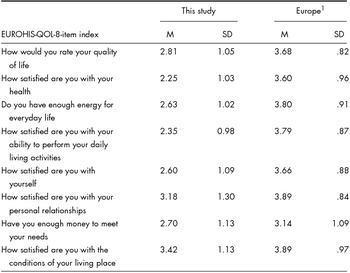
This study used the World Health Organization's EUROHIS Quality of Life Scale. This is an eight-item scale based on large multinational samples (n > 20,000) as a brief measure of quality of life (Schmidt, Muhlan & Power, Reference Schmidt, Muhlan and Power2005). It covers psychological, physical, social and environmental factors (see Table 1 for a list of the items) and has been validated against a range of health criteria (da Rocha et al., Reference Da Rocha, Power, Bushnell and Fleck2012). The EUROHIS has also found application in applied rehabilitation research (Athanasou, Reference Athanasou and Kaufmann2010, Reference Athanasou2011). Responses to the items are on a five-point Likert scale from ‘very dissatisfied’ to ‘very satisfied’ and a summary score is obtained. Despite its brevity of items the Cronbach alpha for the eight-item scale in this study was 0.834. The EUROHIS was administered as part of a vocational assessment.
Comparisons on each indicator of Quality of Life

1 Schmidt, Muhlan & Power (Reference Schmidt, Muhlan and Power2005) N = 4849
Procedure
Participants were referred for a vocational assessment as part of the medico-legal evaluation of a compensable claim. In almost all instances there was greater than 10% whole person impairment, as this is the statutory threshold for claims. Participants underwent a one-and-a-half hour vocational evaluation that comprised a structured educational, vocational, social and medical history. This was accompanied by physical assessments (e.g., grip strength, manual dexterity), a mental status assessment, literacy, aptitude assessment where required and vocational interest assessment. They completed the EUROHIS Quality of Life Scale as part of the overall assessment.
As part of the vocational evaluation a Vocational Rehabilitation Index (Cornes, Reference Cornes1990; Cornes & Roy, Reference Cornes and Roy1991) was calculated at the conclusion of each interview to provide a quantitative indicator of the rehabilitation potential of each person. This seven-item assessment yields a result that ranges from 7 (very high potential for rehabilitation) to a maximum of 24 (very low potential for rehabilitation). The index is based on the age, sex, occupational skill level, length of medical treatment, local labour market conditions, any history of spinal injury and the extent of psychological problems following injury. It was developed in the UK from an analysis of variables associated with early return to work in a representative sample of persons who received compensation for injuries at work or in road traffic accidents. Cornes (Reference Cornes1990, p. 35) classified the overall VRI into four levels: lower (7–11), lower middle (12–14), upper middle (15–17) and upper (18–24).
Analysis
The initial focus was to report descriptive statistics on the quality of life. The emphasis is on the average quality of life across the eight items as this is consistent with prior studies. Moreover, it is readily interpretable in terms of the five-point scale but still retains the total score. This is followed by univariate comparisons of factors against the quality of life. For example, the average quality of life was correlated with the time since injury or compared across pre-accident factors such as gender, age and education or compared with post-accident factors such as those who incurred a spinal injury, suffered a psychiatric impairment, worked or did not work. Correlations were computed for interval level variables such as age or years of schooling or time since injury and for a correlation value of 0.26 (a = 0.05, power 0.95) the estimated sample size required is 155. Some variables such as a spinal cord injury, psychiatric impairment or hospital admission were categorical in nature and t-tests or F-tests were used to determine statistical significance between groups. For the analysis of variance the sample size was determined by assuming an effect size of 0.4 (large) and a = 0.05 and power of 0.95 for three groups. The critical F value was 3.04 and the estimated total sample size required for the study was 102 (Faul, Erdfelder, Lang, & Buchre, Reference Faul, Erdfelder, Lang and Buchner2007).
Results and Discussion
Quality of life following a compensable injury
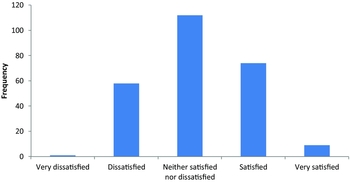
The theoretical range of scores on the EUROHIS is 8 to 40 and in this study scores across the eight items varied from a low of 8 to 35 (M = 22.01, SD = 6.02, 95%CI = 0.791). Average quality of life varied considerably and there were large individual differences, varying from very dissatisfied to very satisfied (M = 2.70, SD = 0.745). Most were in the ‘neither satisfied nor dissatisfied’ category (see Figure 1) and accordingly below the level of being at least ‘satisfied’.
Average quality of life ratings

Some indication of this lowered quality of life is possible in part through comparisons with previous studies. The ratings on every one of the eight indicators were below those of a cross-cultural sample across 10 countries in Europe (n = 4849). The average of 2.70 was also well below that for a non-depressed sample in Australia (n = 192, M = 3.30) (da Rocha, Power, Bushnell & Fleck, Reference Da Rocha, Power, Bushnell and Fleck2012, p. 451). These comparisons suggest that personal injury exacted a toll on every aspect of the quality of life.
Pre–accident individual characteristics
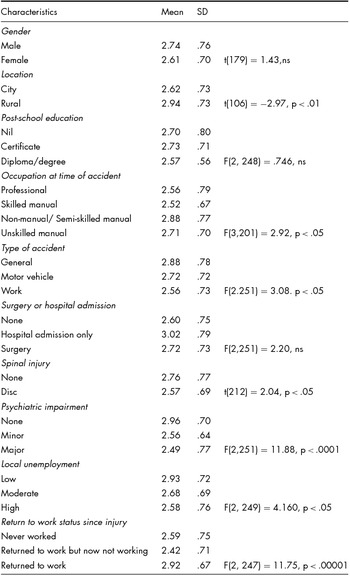
Neither age (r = 0.091), nor one's age at the time of the accident (r = −.100), were correlated significantly with quality of life. The number of years that a person attended high school was not correlated significantly (r = 0.082) with quality of life. There were no statistically significant effects for gender or level of post-school education, but there were statistically significant differences for location (city vs rural) and occupational level at the time of the accident. Those living in rural areas had a higher quality of life as did those with higher skilled levels such as a profession or trade. The results are summarised in Table 2.
Individual characteristics and the Quality of Life

Post-accident factors
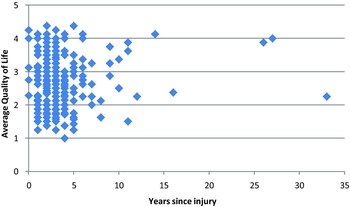
There was no discernible downward or upward trend in the quality of life across the years of injury. This is illustrated in the scatter plot (see Figure 2) which highlights the considerable individual variation at each age time level. The correlation between the time since injury and the average quality of life was 0.057 (ns).
Average quality of life ratings

As expected, there was a relationship between rehabilitation potential and the quality of life ratings. The correlation between average quality of life and the Vocational Rehabilitation Index was –0.218 (p<0.000). Although the proportion of the variance accounted for was small 4–5%, those with a lower Vocational Rehabilitation Index have a greater potential for rehabilitation and they had a higher level of quality of life.
From the educational, physical and cognitive status assessments only the grip strength (converted to a z-score for each gender) was significantly related to quality of life (r = 0.263, p<0.000). Other characteristics for which there were interval scores and that were not statistically significantly related were: manual dexterity (i.e., pegboard) r = 0.004, literacy (i.e., word reading) r = −0.057, malingering (i.e., Rey 15-item memory test [Lezak, Reference Lezak1995]) r = 0.054, and body mass index r = −0.048. The grip strength was viewed not only as a measure of fitness but also willingness to exert effort and partial index of physical adjustment.
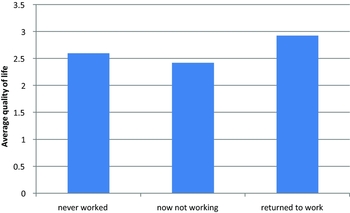
The type of accident had an effect, with work accidents having the lowest level of quality of life compared with motor vehicle accidents or general liability claims. There were no statistically significant differences between those who were or were not admitted to hospital or those who underwent surgery. Having a disc injury, a psychiatric impairment or living in an area of high unemployment all contributed to the level of the quality of life. The mean values for each group and the statistical tests are summarised in Table 2. The overwhelming impact of a successful return to work is highlighted in Figure 3. Those who attempted a return to work but were now not working had an even lower quality of life than those who had never worked. The effect size of the difference between those who were working and those who had a failed attempt at return to work was 0.34 (Cohen's d = 0.724).
Return to work groupings and their average quality of life ratings.

Conclusions
A range of factors are related to post-accident quality of life and this study confirmed that there were large individual differences following a compensable injury. Nevertheless the overall quality of life is lower following a compensable injury. This finding was not unexpected and was consistent with research on specific disability groups.
On closer inspection the decrease was substantial and can only be estimated indirectly. There was a decrease in the order of some 24.8% from the norm in quality of life when compared with an Australian sample (da Rocha, Power, Bushnell & Fleck, Reference Da Rocha, Power, Bushnell and Fleck2012, p. 451). Comparisons with the European sample of Schmidt, Muhlan and Power (Reference Schmidt, Muhlan and Power2005) showed a reduction in every aspect of quality of life (refer to Table 1). The highest difference (38%) was on the item relating to ‘How satisfied are you with your ability to perform your daily living activities?’ and the smallest difference (12%) was on the item ‘How satisfied are you with the conditions of your living place?’
There was no obvious resurgence in the quality of life levels over time and the findings are not consistent with an adaptation theory of subjective well-being which proposes a partial return to a previously established set-point (see for instance Lucas, Reference Lucas2007). Neither was quality of life related to pre-accident factors such as gender, age, years of schooling, or literacy. Post-accident factors such as hospital admission or surgery had no impact when compared with those who were not admitted to hospital.
There were a number of specific factors that affected or were affected by quality of life. These included higher levels of quality of life for those in rural or regional locations and for those living in areas with low unemployment. Those who had non-work accidents had a higher quality of life. Higher skill level occupations also had higher quality of life ratings. The role of grip strength was intriguing but from my clinical observations serves as an indicator of effort as much as strength. There was a positive relationship between the Vocational Rehabilitation Index and quality of life and this augurs well for the potential of rehabilitation services to contribute meaningfully to recovery from injury. Spinal injury and psychiatric impairment are components of the Vocational Rehabilitation Index and were also significantly related to quality of life. As expected return to work was positively related to quality of life but failure to continue working was more detrimental than having never worked but it is not clear whether quality of life affects return to work or vice versa.
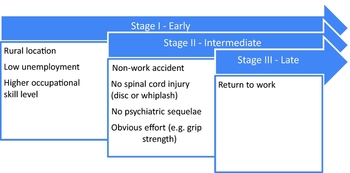
It is now possible to propose a tentative process model of quality of life based on the significant factors from this study. This is set out in Figure 4 and divides the factors into three stages based on their occurrence across time as early, intermediate or late in relation to the injury. These factors might be used in a future study to establish and test a structural equation model of post-injury adaptation.
A tentative model of quality of life influences following a compensable injury.

No claim is made that the findings of this study are conclusive as a longitudinal investigation is really required to address these issues. Moreover assessment of some of the factors in Figure 4 needs to be quantified. Measures such as ‘obvious effort’ require further exploration to ensure their validity and reliability in any structural model. A further limitation of this study is that it relied on self-report of the quality of life and there are inherent shortcomings but few alternatives. Some may baulk at an eight-item measure but the psychometric properties of this scale are well documented (see daRocha et al., 2008; Schmidt, Muhlan & Power, Reference Schmidt, Muhlan and Power2005). It may be argued – quite reasonably – that the participants in this study have a motivation to report negatively on quality of life but this was not a universal response. Nor was it validated by assessment of malingering. Furthermore, almost all had a whole body impairment rated medically as greater than 10%, which is a substantial disability.
Quality of life has featured in rehabilitation research and practice for many years. It formed a foundation of the philosophy of psychosocial adjustment in seminal texts such as Physical Disability: A Psychological Approach (Wright, Reference Wright1960) even though the term did not appear even once in its 407 pages. Of course, this reflected the ethos and nomenclature of another era as the term ‘quality of life’ is of more recent origin (see World Health Organization, 1997). More recently it has featured in calls for its inclusion as a rehabilitation outcome (Bishop, Miller & Chapin, Reference Bishop, Miller and Chapin2008) and this study goes a small way to addressing this topic. The available evidence is that quality of life is intensely individual but affected substantially by a compensable injury and this effect is mediated to a large extent by factors at various stages in the process of rehabilitation. Once these factors are better understood then the process of recovery may be managed for the benefit of all.
Funding
This research received no specific grant from any funding agency in the public, commercial or not-for-profit sectors.
Declaration of conflicting interests
None declared.