BACKGROUND
Waqf is an important traditional institution of Islamic society that normally involves the dedication of a donated property, the income from which is committed to serve specific purposes. Once dedicated, the property becomes waqf in perpetuity. Initially, the proceeds of waqf donations were intended to feed the poor and disadvantaged members of society. Later, buildings designated as waqf provided them with accommodations in the form of caravanserais. Now, the waqf host various public institutions such as mosques, markets, educational buildings, and health centers. In many Islamic cities, particularly the most historic ones, properties dedicated as waqf dominate a considerable share of urban space.Footnote 1 The waqf tradition has endured over 14 centuries of social, political, and economic turmoil since its inception in the medieval Islamic period and has thus shown its value in safeguarding land and building properties. Accordingly, the study of waqf philosophy, as well as its practice, has become relevant in the field of building conservation.
Managing the conservation of buildings in historic cities and towns is a complex undertaking because historic urban areas are often confronted by competing factors. Pressure for change is one of these factors. For example, increases in land value due to economic growth makes conservation more expensive as people tend to look for more cost-effective opportunities,Footnote 2 such as developing high-rise structures in lieu of maintaining old, low-rise urban districts. On the other hand, economic downturns, although not the sole factor, may result in a decline in the importance of these areas, which may eventually result in neglect, abandonment, deterioration, and collapse of building heritage.Footnote 3 There is also pressure from modernity. This trend particularly threatens the legacy of past methods, materials, and craftsmanship, all of which are instrumental to sustaining such areas. With modernity, people are drawn away from old techniques and tend to embrace contemporary means and methods that are often incompatible with historic structures. Being immovable properties, it is difficult and expensive to move historic buildings for preservation elsewhere.Footnote 4 As a result, they often end up replaced. In fact, historic buildings are vulnerable to a variety of social, cultural, political, and economic threats. Thus, successful conservation of historic buildings depends largely on the ways their management system deals with these threats.
In this article, the multifaceted and changing management techniques used by the waqf system to safeguard and preserve its historical buildings are discussed. Theoretical and practical situations governing the administration of waqf properties in the Stone Town of Zanzibar (STZ), a World Heritage Site, are examined. The waqf system in the STZ dates to the fifteenth century, and there is abundant information in Zanzibar National Archives (ZNA) regarding waqf properties over the decades. Although the waqf was first designed as a form of charity to support social welfare, its rules and practices may be applied to support the conservation of historic areas. Thus, in some of these cities, waqf-based systems are used to support the maintenance of historic buildings.Footnote 5 However, the value of the waqf system and its impact on buildings and urban forms have been little understood in past years.Footnote 6 And even though there have been greater efforts to comprehend the institution quite recently,Footnote 7 its relationship with the conservation of historical buildings is largely unknown. AssiFootnote 8 is believed to be one of the first researchers to point out some aspects of the waqf system as it pertains to the cultural heritage management, but she did not delve deeply into the intricate qualities of this tradition as a management tool for the physical conservation of historical buildings.
AIM AND METHODOLOGY
Over the centuries, the waqf system in the STZ (and elsewhere in Muslim world) has encountered a variety of influences seeking to control and remodel its traditional patterns.Footnote 9 These influences challenged the conservation of its properties, but the ability of the waqf system to manage and preserve its endowment has shown considerable durability up to the present time. Therefore, this article reflects upon the efficiency of the waqf management as it pertains to preserving its entrusted properties. It focuses on management's ability to respond to challenges and changing conditions, the way it copes with practical problems and its ability to integrate or successfully navigate contradictory practices. Thus, the key issue addressed herein is, How did the waqf system manage the conservation of its buildings under various conditions and influences over time? To determine the answers, the management implications of waqf practice regarding the conservation of its buildings during different periods is analyzed together with the way waqf system dealt with the two important aspects of finance and maintenance.
The information analyzed here was primarily obtained from archival records. Data were collected from the ZNA,Footnote 10 which contains waqf records dating back to the nineteenth and twentieth centuries. Most of the records were produced during the British colonial administration (1890–1963). The latest waqf records of the present century were acquired from the Waqf and Trust Commission (WTC), an institution dealing with the waqf and other Islamic trusts in Zanzibar. These records include qualitative and quantitative information from waqf administrative files that contain deeds, rent records, decrees, property registers, rules, and court cases. It was imperative, for a comparative analysis, to obtain current information regarding waqf building inventories, as well as information on the general condition of historic buildings in the town. This information was gathered from the Stone Town Conservation and Development Authority (STCDA), a government institution responsible for the conservation and management of the town. Analysis of archival records was later expanded and clarified through interviews with historians and religious elders.
THE WAQF INSTITUTION
The origin of the waqf institution and its influence beyond Islamic territories has long been the subject of scholarly debate. Muslim scholars such as Ibn Majah trace the origin of this institution to the traditions of their Prophet, while other scholars speculate that it has a foreign origin in the pre-Islamic Byzantine and Roman periods. However, this latter opinion was criticized by Hennigan,Footnote 11 who believes the present waqf system developed from an original Islamic tradition, even though it has become infused with foreign practices acquired over time. The possible influence of Islamic law on English Common Law has been studied by MakdisiFootnote 12 (among others), and the influence of the Islamic waqf on the Trust system in England was explored by Gaudiosi.Footnote 13 The latter author is of the opinion that the English Trust system was likely introduced by Crusaders during the twelfth and thirteenth centuries, and that it was probably influenced by waqf institutions they had encountered in the Middle East. The striking similarities between them are what led to this conclusion. For example, the function of the trust manager (trustee) under the English Trust is the same as that of the waqf administrator (mutawalli). Both the waqf and the trust have dedicators, named waqif and settlers, respectively. They also have charity beneficiaries. Waqf charity can be made for family (private) profit (waqf ahli) or public benefit (waqf khayri), as is the case of an English Trust. However, the waqf system seems to favor public charity more highly, because a family waqf will convert to a public charity at those times when its private subjects have ceased to exist.Footnote 14 This point constitutes a significant difference between the waqf and the English Trust system. Regardless, this article focuses on the rules and practices governing the charities, rather than origins, differences, and the influences between them.
The charity mission of the waqf commences with the dedication of a property. And, as explained in the background section of this article, once dedicated to waqf service, such property is governed by religious rules that require that it be devoted to serving charitable purposes in perpetuity. This is known as the eternity rule. As a result, such property cannot be sold, gifted, mortgaged, or inherited from that time forward. Traditionally, the waqf system requires the waqif to choose a mutawalli to collect rent and maintain the property, as well as to ensure the rights of the beneficiaries (those to whom the waqf is dedicated) are protected. There are two ways that beneficiaries can benefit from a waqf. One is through the use of the property, and the other (more common) way is to receive income derived from the property (such as through renting it). Several different types of property can be designated as waqf, but real estate, such as land and buildings, is most common.
Conservation of property within the waqf system is underpinned by the eternity rule and by the rules that require income derived from a waqf property to be first used to maintain the property before any remainders are distributed to the beneficiaries. This requirement establishes a means for continuous finance that, if sustained, provides a way to lengthen the life of the endowed property. Excess funds may be used to enact a new waqf and, in so doing, strengthen the financial foundations supporting a dedicated building or property. Such a system also provides opportunities for fostering future waqf acquisitions, which, once integrated into the system, would see their lives lengthened by inclusion under and protection by the eternity rule. In the traditional waqf administration, properties are decentralized. Each property is administered locally as a self-contained unit by independent mutawalli, guided by the waqif stipulations and by the general rules of this traditional institution.
As described in the aim and methodology section, the waqf institution is and has been administered under various guidelines in different Islamic countries. Some countries regard the waqf as an independent institution, and therefore form a separate ministry (often called the Ministry of Awqaf (singular for waqf)) to handle related matters. Others subordinate it under a branch of a government department. In Zanzibar, the supervision of waqf was entrusted to a semiautonomous body, called the Waqf and Trust Commission (WTC), and placed in the Ministry of Justice and Constitutional Affairs. Under the guidelines set forth in the WTC Act No. 2 of 2007, the commission is responsible for the administration and protection of waqf properties. In previous years, several other laws regarding the administration of waqf properties have been enacted. However, this most recent act imposes stricter rules regarding property management. While past laws allowed for continuous leasing of a property for up to 70 years, the current law limits lease contracts to a maximum of five years (Part III, Section 27(2) of the Act), even though such leases may be further extended. This gives the WTC power to void the lease at any instant, as it deems fit, which helps ensuring close monitoring of waqf properties. Such monitoring helps prevent the probable changes or possible estrangement of waqf properties that might result if a single party were to hold the property over long periods of time, as was possible under the previous long-term leases.
ADMINISTRATION OF WAQF BUILDINGS IN THE STONE TOWN OF ZANZIBAR
Historically, Zanzibar Island (where STZ is the capital) experienced three major eras that influenced the administration of waqf properties. The first was the era of local rule and Omani Sultanate domination. This period corresponds to the traditional administration of the awqaf. The second was the British colonial administration, and the third is the post-British era. The management of waqf buildings and the conservation policies practiced during those three eras are discussed in the following sections.
Traditional Administration
Archeological study of the earliest settlement in the STZ suggests that the area was first inhabited around the twelfth century,Footnote 15 at which time Islam was already the dominant belief in other parts of Zanzibar Island. Islam, and therefore the waqf tradition, would have entered the STZ naturally as the town evolved. In this era, Zanzibar was ruled by various local leaders, and there was no organized national government for the whole island. Therefore, the waqf was presumably administered by individual mutawalli in accordance with traditional rules. With the settlement of Omani Arabs and the establishment of their Sultanate over Zanzibar's territory between 1820 and 1890, the practice of endowing awqaf was widespread.Footnote 16
The Sultanate did not disrupt the existing traditional administration of waqf properties, but instead provided additional support by empowering a Muslim jurist (qadhi) to deal with religious affairs, which included the waqf. The system under the Sultanate would most likely have favored the waqf and the conservation of its buildings because state and religion are not separate in Islam.Footnote 17 This convention existed in the STZ because several poorly endowed waqf buildings (even those endowed by private individuals for public use) were found to have received maintenance money from state (Sultanate) funds.Footnote 18 The state even extended its financial support to other properties that, although not waqf, were religious in nature. In one case, the state rescued what the records described as the oldest Shirazi (Persian) mosque—the second oldest mosque in Zanzibar—which was then in a state of deterioration. That mosque is said to date back to the thirteenth century.Footnote 19 This state support demonstrates the important role that governments today should play when it comes to conservation of their national heritage.
A traditional waqf setup includes a mechanism for regulating its internal affairs. The regulation was made possible through its beneficiaries, who were instrumental in supervising the mutawalli, even in the absence of the dedicator. Because the beneficiaries depended on their share of waqf income, they were motivated to monitor the mutawalli's actions closely. This had a positive impact on the conservation of waqf buildings. To ensure sufficient income to satisfy beneficiaries and remain sustainable, the mutawalli had to make certain that the property was attractive to tenants. That requirement helped ensure that proper maintenance would be performed. Additionally, a mutawalli is remunerated from a proportional share of the same income. Hence, the higher the income generated by a property, the greater the mutawalli's share. Furthermore, the decentralized nature of the waqf system could be expected to promote closer monitoring.
An examination of the relationship between the waqf system and the state reveals another important aspect of the overall conservation of waqf properties. The waqf maintained relations with the state through the qadhi; at the same time, its administration was autonomous (Fig. 1). However, as a religiously affiliated system, the waqf was considered by the Sultanate as an implied (but autonomous) part of the system. In other words, the waqf was more associated with religious affairs than with state affairs, even though religion and state worked together because of the strong influence of Islam in the country. Thus, each waqf property stands as a self-contained unit governed by an independent mutawalli, who must observe universal waqf rules. Those rules are enforced by a qadhi, an intermediate person whose jurisdiction extends to every waqf whether private or public. The qadhi himself is responsible to the state, which is, in turn, responsible to waqf beneficiaries—the public and private individuals who depend on the waqf. Nonetheless, the state is barred from imposing any changes or policies that are contrary to waqf traditions and is expected to seek the qadhi's opinion when dealing with waqf affairs. This limits and clarifies the state's relationship with waqf property. Such a relationship logically imposes an effective check and control mechanism that is useful in safeguarding not only the beneficiaries' interests, but also the properties themselves.
Traditional administration of waqf properties. Source: the authors.

British Waqf Administration
In 1890, the Arab Sultanate was conquered by the United Kingdom and the waqf establishments in those areas were subordinated to British hegemony until 1963. The British enacted some 12 consecutive decrees between 1904 and 1959 to control waqf affairs. The first decree demanded that all waqf properties be handed over to the British-led government.Footnote 20 In 1907, a second decree vested the handed-over properties to the control of a newly formed Waqf Commission (WC). Generally speaking, the British approach deviated from waqf traditions in favor of commercialization over charity. In contrast, the waqf traditions advocated a lesser degree, or more selective application, of commercial means in maintaining and controlling its properties. This was done simply because it avoided conceding too much to financial temptations.Footnote 21 By and large, this control mechanism worked well in the STZ, despite interference from the British. The divergence of the British approach to handling waqf properties was apparently regarded as so contrary to the traditions that most people abstained from handing over their properties, as demanded by the first decree.Footnote 22 Therefore, the first decade of British waqf administration saw no handovers at all until after an ultimatum was issued in 1914, after which some 110 houses were registered.Footnote 23 This number is, nonetheless, far smaller than would be expected, considering that some 2500 buildingsFootnote 24 existed in the town at that time, and a large portion of the urban land, properties and facilities were dedicated to waqf usage.Footnote 25 The handover process was even slower afterward because only 28 houses were acquired by the WC over a period of approximately 30 years,Footnote 26 which is less than one house per year.
The situation described above demonstrates the ability of the waqf to shield its properties from what waqf custodians might have considered to be a threat. It also shows that building conservation is a far more comprehensive undertaking than just the physical repair of the structure. The shielding effect was most likely made possible by the control the waqf system maintained over dedicated property. Although from the dedicator's point of view, property endowed to the waqf is technically regarded as disposed of, that person does have the right to stipulate how it is to be administered.Footnote 27 And, because it originates as a private property, the process has historically been perceived as a strictly private affair that should not be subject to outside interference. Waqf practice might have considered the dedicator to be a better manager, or the one who could solicit suitable administrator, since he had faithfully dedicated his property.Footnote 28 Besides, it would have been difficult for the British to identify and acquire such properties because they were all administered traditionally, not through formal registrations.
Despite the British's divergence from the traditional waqf rules, British administration may be credited with some benefits to waqf properties, and to the system in general. One such benefit was found in its collective management of the properties. Under the British arrangement, the maintenance of poorly endowed and abandoned properties was subsidized by income from rich ones; this would have been difficult to organize under the autonomous property management practice of the traditional system. Another benefit was a result of Section 10 of the 1907 British Waqf Decree, which required excess revenue derived from waqf to be used for “good and charitable purposes on behalf of the Mahommmedans as may be desirable.” That rule seems to have stimulated some opposing sectarian Muslim jurists of the British WC, although it was already allowed by other sects, to consider investing extra revenues in the construction of new waqf properties.Footnote 29 This was a positive development that resulted in an increase in the number of waqf properties and therefore the creation of additional buildings that could become part of the nation's heritage.
Post-British Waqf Administration
The year 1964 was another turning point for the waqf institution in Zanzibar. A revolution overthrew a short-lived independent government and took the waqf under its control. As a consequence of the government's confiscation and nationalization policy,Footnote 30 the waqf system suffered a significant loss of properties, especially land. However, the waqf institution itself was spared because it was a well-established body and supported numerous families,Footnote 31 and possibly because of the social benefits it provided through its public facilities was in keeping with the socialist ideology practiced by the revolutionary government (RG). The government pursued a policy for low-rent housing and public ownership of landed properties. For a long time, waqf buildings provided the least expensive rentable accommodations of all STZ buildings and housed the town's poorest citizens. Therefore, waqf fit well into the government's policy.
The waqf buildings secured by the British during their administration thereafter came under the custodianship of the RG's WC. The commission also received and preserved several other buildings that had been placed under the waqf system's care by individuals fleeing the political upheaval immediately prior to and after the revolution—as can be seen by the increasing number of buildings acquired by the WC around 1960 (Fig. 2). Unfortunately, the RG prohibited endowment of any new private waqf in its 1966 Presidential Decree, even though people could anonymously continue to establish the private awqaf without the government's knowledge.
Buildings administered by waqf commissions at different periods. Source: ZNA and WTC.

A significant aspect of the waqf during this period was its adaptive management practices. For example, several properties were later unofficially withdrawn from the WC and administered individually. Such withdrawals protected those properties from the corruption and mismanagement that is said to have prevailed in the WC, to the detriment of its income. Corruption and mismanagement of the awqaf was, however, common in several postcolonial Muslim countries.Footnote 32 That adaptation actually marked the reestablishment of the traditional waqf management practice lost during British rule. Furthermore, a new form of joint waqf management with the WC emerged, by which waqf beneficiaries sought statutory advice from the WC after withdrawing their properties. Enacting a new private waqf also took another form, beginning in the 1970s. Properties were registered with the WC, yet put under private custodianship, presumably to associate them with the government and obtain legitimacy that would prevent further confiscation. This latter practice began as an experiment, and was done rather cautiously at the outset, but it seems to have gathered strength in tandem with political stability of the 1980s (Fig. 3). As a reasonable explanation, this experience demonstrates the ability of the waqf to reengineer and adapt itself to varying circumstances as necessary to protect its properties.
Waqf properties registered with the WC but administered by individual mutawalli. Source: WTC.

FINANCIAL MANAGEMENT IN THE WAQF
This section details the various financial arrangements involving the waqf that were used to facilitate the maintenance of its properties. It explains the basic forms of finance and discusses the variations that evolved to address financial hardships.
Basic Source of Finance
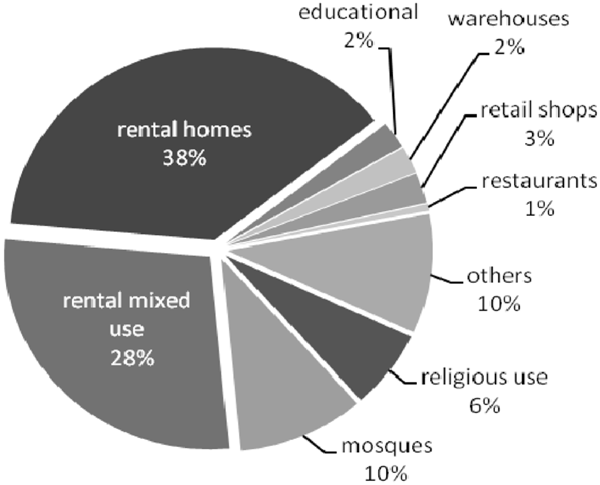
The waqf system was basically designed to provide self-help support for property maintenance. The maintenance of waqf buildings was supposedly achieved through the income the waqf generated. Thus, with the exception of those buildings used for religious purposes, most of its buildings were rental properties (Fig. 4). The maintenance of religious buildings was achieved through funds from the rentals. A considerable number of people allocated portions of their private waqf income to benefit religious buildings, such as mosques and centers of learning. In some cases, entire buildings were allocated to this purpose, whereas in others, pieces of farmland were specifically dedicated to maintain the religious buildings. The availability of funds for maintaining such property was, therefore, not uncertain. This is among factors believed to be what allowed the religious buildings in the STZ to survive longer than any of the other traditional (mud and stone) buildings. In the rest of the town, the oldest surviving structure is a mosque thought to date back to the seventeenth century.Footnote 33
Classification of waqf buildings. Source: STCDA and WTC.

Addressing Financial Deficiency
Real estate properties, such as buildings and land, are generally good prospective sources of income because of the demand for real estate and appreciating values over time. However, these values are influenced by several factors, such as their location and condition, as well as the economic situation of their location. Economic factors are particularly influential. In the past, they affected the waqf institution and at times rendered the income from some properties inadequate for building repairs. The fact that Islamic law prohibits interest-based finance,Footnote 34 such as investment and borrowing, complicated the situation. It prevented borrowing from non-Islamic banking and financial institutions, which were largely the only sources of finance in Zanzibar at the time. Thus, an alternative means had to be devised to address financial inadequacies in varying situations.
Property exchange was one way to address the financial inadequacy of assets situated at poor locations. This exchange took two forms: exchange with another property elsewhere for property that could yield better income or selling the property outright and reestablishing the waqf at another location.Footnote 35 Although some Islamic schools of philosophy (perhaps in agreement with the views of some conservationists) object to both approaches because they separate the waqf from the original property (even though the rules dictate that the waqf is eternal and cannot be sold), other schools support such sales or exchanges because it saves endangered properties. It even saves other properties upon which their maintenance funds depend. Following this policy, several insolvent awqaf were sold during the 1940s. However, the policy was susceptible to prejudiced transfers that may alienate unqualified buildings. Thus, it was later established that the buildings that were acquired as a consequence of exchanges or sales should yield income at least two-thirds greater than that of the original building.Footnote 36 This stipulation set a precondition that required the new waqf property to be healthier than the older property, in order to ensure longer survival and be more lucrative, and thus more likely to ensure maintenance requirements are met.
Another method used to address financial deficiency was the establishment of the so-called general fund (GF). The GF was set forth by the British to overcome problems of traditional administration. It aimed at providing relief to poorly endowed awqaf and to help save neglected, crumbling buildings. As previously explained, when the awqaf were administered traditionally, individual properties had to depend largely on their own incomes. This situation put a number of awqaf at a disadvantage because there was no surety they would generate adequate finances to meet their requirements unassisted. Therefore, while many of the ideas put forward by the British were rejected by Muslim jurists, the GF was among the few exceptions that were embraced. The willingness among such jurists to accept the fund might have been due to the existence of a similar concept in Islamic law—that of zakaat. The term zakaat refers to an annual obligatory offering of one's proportioned wealth to less endowed individuals.
The GF drew its income from wealthy awqaf and so-called unknown dedications (UDs). UDs were described as awqaf for which purposes were unknown because related deeds did not exist.Footnote 37 Detailed annual accounts of the GF over time were unavailable, but existing records show that it played a significant role in building conservation. Funds provided by wealthy awqaf credited to the GF in 1940 were applied to some 15 public waqf buildings.Footnote 38 In 1949, a balance of 11,400 shillings, equal to US$2280, was reported from unknown dedications, of which 2000 shillings (about US$400) were spent in rebuilding a public edifice.Footnote 39 Further contributions were made to meet a building renovation deficitFootnote 40 amounting to 16,364 shillings (about US$3300). The GF also appeared to have become a viable last resort for isolated and ad hoc waqf problems, and proved crucial to financing the renovation of various vulnerable structures. Thus, through its administrators, the fund played four important roles in the conservation of waqf buildings: savior, custodian, finance generator, and maintenance financier.
The way financial deficiencies are dealt with differs from one waqf property to another. For example, mosques cannot be exchanged or sold, yet a number of mosque awqaf were under direct Sultanate administration at the time the British overpowered the Arabs. The British administration felt that maintenance of mosques from state funds was an undesirable drain on public finances, and withdrew from those obligations,Footnote 41 leaving those mosques without maintenance funds. To solve the problem, the British appealed to wealthier ZanzibarisFootnote 42 for donations, which resulted in contributions of some 1657 rupees (about US$500) in 1909. This can be viewed as an experimental beginning for a program of voluntary donations to alleviate the financial deficiencies of the mosques. The success of this program prompted the British to appeal for wider public support. Donation boxes were installed at various mosques to solicit funds. Such boxes still exist today and are helpful in subsidizing mosque functions, including minor repairs. Furthermore, a number of wealthy individuals helped finance maintenance of the mosques,Footnote 43 and the waqf system was able to solicit public support on its own; which had beneficial impacts on historic building conservation.
CONSERVATION OF IMPOVERISHED BUILDINGS
As the waqf institution evolved, political and economic situations in the STZ changed. Economic uncertainty before and the subsequent economic downturn during WWII made it difficult for people to accumulate enough sufficient funds to maintain themselves. As a result, many waqf tenants applied for rent reductions that the WC sometimes had no choice but to grant.Footnote 44 The degraded condition of the economy was observed, even after WWII, when several tenants ran into rent arrears.Footnote 45 A slump in the real estate market occurred, affecting rent earnings over time and ultimately leading to the deterioration of several buildings. It was therefore imperative for the waqf system to evolve so it could withstand market's effects. Although the normal monthly rental arrangement continued to be applied, other means of managing building maintenance evolved in response to the falling rent income. For example, “repairing” leases (leases that involve building repair by tenant), which could be categorized into short- or long-term leases, became available. Nonetheless, it appears that this juncture was not the first time such leases were applied to waqf buildings. Repairing leases seem to have started prior to the British hegemony because in 1914, the British were reported to be unhappy about “the principle of long-term lease … followed in the past.” As a result, long-term leases were ordered to be discontinued, and then limits were imposed that restricted leases to a maximum of seven years.Footnote 46 However, because of their practical relevance in the waqf's case, the leases continued, and terms much longer than seven years were granted throughout the British era. Again, this is another situation in which the waqf prevailed over the effects of an untenable situation.
In Zanzibar, repairing leases may be considered an innovation of the waqf system, since archival records show that private landlords rarely involved themselves in such arrangements.Footnote 47 This is because, even though such arrangements helped protect waqf properties against market risks and enabled them to ensure that property maintenance was performed, they shifted greater responsibilities from the landlord to the tenant. Once in place, the landlord's role then was simply to serve as a supervisor, overseeing the tenants and ensuring that they performed maintenance as agreed. When this technique is applied to managing large and multitudinous real estate investments, it relieves the landlord from the responsibility of employing a large number of individual administrators and their associated financial costs.
The Long-Term Repairing Lease
A long-term repairing lease (LTRL) was an arrangement used as an option to secure the maintenance of poorly endowed buildings over long periods. Although it was not limited to such buildings, it seemed to be a popular last resort tool for handling buildings on the verge of collapse.Footnote 48 Under this arrangement, a lessee was generally expected to perform all needed repairs, be they structural or cosmetic and, in some cases, was required to go as far as rebuilding collapsed portions or even reconstructing an entire building destroyed by fire or other disaster.Footnote 49 Therefore, the lease integrated a sort of property insurance against natural and manmade tragedies, in addition to providing protection against market risks. A desirable LTRL was considered to be 5–70 years, and some lessees even asked for periods up to 99 years, but these requests were often rejected.Footnote 50 An exact rule governing the length of leases in relation to the rent could not be established because building details and market situations could not be found. However, correlations based on the amount of money offered, the number of years granted, the condition of the building, and other situational factors probably existed (Table 1). One factor that was disadvantageous to long leases of waqf property was that nothing could be found in surviving contracts about when and how the annual rental agreement should be renegotiated. This suggests that such leases were set at a fixed amount over the entire lease period, overlooking the potential for recovering real estate markets, presumably due to fears that imposing such conditions might have led to withdrawal by the lessee.
Sample breakdown of rent charges versus their lease duration during the first half of twentieth-century waqf administration.

Source : ZNA
A highly desirable point regarding LTRLs is that they probably encouraged further conservation commitments from the lessee's side. Having been assured of a longer occupation, lessees were compelled to invest in the property. One case reported a lessee having personally replaced less durable coconut thatch roofing with a strong, corrugated iron roof following a 19-year lease offer. In another case, a tenant proposed construction of a permanent structure on a waqf plot if his lease was extended for a further 25 years. The lease was accepted by the WC on the condition that the structure would become waqf property upon expiration of the lease.Footnote 51
Although replacement of the thatch, the original and traditional roofing material, introduced an alien material, it was ultimately beneficial to the buildings.Footnote 52 Coconut thatch must be replaced approximately every five years. However, in the current era, Zanzibar has very few coconut plantations as a result of their replacement by housing developments, and there are extremely few newly established coconut estates. Thus, coconut thatch is becoming increasingly scarce and expensive. If it remained in use as roofing material, it is unlikely that the available supply would be sufficient to meet the demand for the entire STZ, to say nothing of the rest of Zanzibar. Thus, numerous stone and mud buildings within the town would have become vulnerable to the heavy tropical rains, and this is why the town witnessed a change in roofing material from thatch to corrugated iron sheets at the beginning of the twentieth century. Yet, being situated near the sea brings problems as well: Iron sheets rust quickly. Nowadays, however, the red rust is seen in a positive light because it contributes to the old style ambience and provides an atmosphere that is pleasing to most tourists visiting the historic town. Thus, the era when thatch was replaced with iron sheets can be seen as an important period in the historical development of the town, one that epitomizes heritage as a process, rather than as fixed moments.Footnote 53 It also redefined the town's authenticity and has handed down a more durable heritage to the present generation.
An LTRL was a give-and-take contract between landlord and tenant. It also involved sacrifices from both sides. Tenants willingly shouldered the probable high costs of maintenance when structural rehabilitation or the reconstruction of an entire structure was necessary, while landlords opted to accept less rent over long periods, even though they knew that changing times might result in more profitable opportunities in the future. However, for the properties themselves, both sacrifices were beneficial in terms of facilitating conservation efforts.
The Short-Term Repairing Lease
Another maintenance arrangement worth mentioning is the short-term repairing lease (STRL). Such leases aimed at securing routine repairs other than major structural overhauls. Therefore, a lessee under an STRL was only expected to carry out minor repairs, such as plasterwork patching, painting, decorating, and routine service maintenance. Leases of this type were formulated in one of two common forms: monthly and annually. Any lease for a period less than five years was considered short term, and extending the lease to a longer term could be encouraged by further reducing the rent.
New Form of the Long-Term Repairing Lease
The long- and short-term leases continued to remain in force during and after the British era. However, many historic buildings in the STZ, including those of waqf, later began to suffer deterioration. This was largely due to neglect, but was also because of economic and political reasons. Such deterioration was more apparent in the 1980s, at which time nearly 15 town buildings were said to be ruined annually.Footnote 54 Surprisingly, unlike those owned by the government or private individuals, very few waqf buildings crumbled—even though the regular rents received by the WC fell to record lows. SiravoFootnote 55 reports that approximately 20% of the approximately 1700 historic buildings recorded in a 1993 town survey belonged to the waqf. The present study found that this number had remained almost constant since the survey. This situation is believed to have benefited by another form of waqf evolution that was taking place in 1980s, apparently to counteract this worrisome deterioration. Strikingly, this evolution did not originate with the WC, as had previous innovations, but rather was developed by the tenants. The change involved tenants undertaking repairs on their own, thus initiating a new form of an LTRL.
The problem with this new form was that the involvement of the WTC, formerly the WC, was limited, and that some tenants most likely inflated their costs when asked to report maintenance activities to the WTC. In a claim to the commission, one tenant reported having spent some 598,000 Tanzanian shillings.Footnote 56 (US$1087) for a onetime repair in 1993—which was a considerable sum of money. Surprisingly, he only paid a monthly rent of 490 Tanzanian shillings (about US$1) because the WC/WTC almost never reviewed rent agreements. Thus, the tenant would have had to live in that house for roughly 1220 months (102 years) to offset the whole debt—a period far beyond the acceptable 70-year long-term lease discussed earlier. However, the WTC quite recently reviewed its rental schemes.Footnote 57 And, while the LTRL system was retained, a system for regular reviews was put in place.
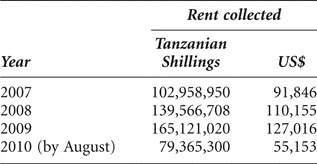
In another significant change, the lessee of an LTRL is now required to pay one-third of the new rent to the WTC, to be used for remunerating beneficiaries and as a management fee. The remaining two-thirds are retained by the lessee in compensation for repairs done at a particular time. This is significantly different from the previous arrangement, in which lessees paid a modest rent over the whole lease period, regardless of the extent of maintenance they performed. The new arrangement may discourage tenants from exaggerating maintenance costs, even in the absence of close WTC monitoring, because they would have to pay one-third proportion of what they report to the WTC. However, low reporting would mean a reduction in the income received by the WTC. Ultimately, the review was successful, with aggregate rent collection dramatically improving, even before all review provisions were fully implemented (Table 2). Thus, the WTC is now in a far better position to preserve its buildings.
Rent collection after the 2007 reform.

Source : WTC
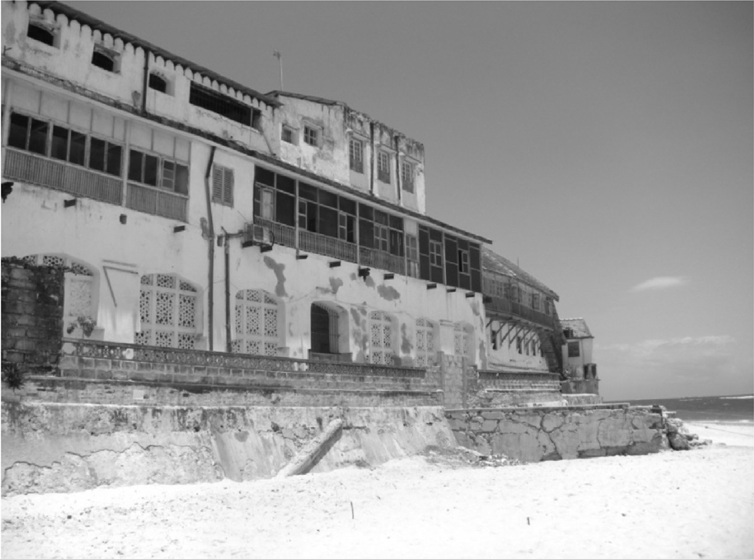
A very recent event in the STZ may trigger rethinking and reorientation of the long-term leasing of waqf buildings in the future. The end of the year 2010 witnessed the leasing of a first-grade monument (Fig. 5), which was formerly the WTC headquarters. That monument was leased for a period of 99 years by the RG to a five-star hotel developer for US$1.5 million. The lease has drawn enormous criticism from the public. People criticize the government for an unreasonably long and inexpensive lease, which some perceive as rather a modest sale, considering its prime seaside location and its historic value.
Mambo Msiige: Contention has arisen between the government and citizenry regarding a 99-year lease of the building that was granted to a five-star hotel investor.

One of STZ's conservationists who spoke to the authors about the lease was of the opinion that it would compromise the historic character of the building. Consequently, he filed a petition with the UNESCO World Heritage Center to stop the lease. Bearing in mind the previous denials for 99-year long-term leases during the British administration, this precedent might raise negative attitudes toward long leases being carried out now. After all, the demand for accommodations (fueled by the tourism boom) in the old town has increased, which means that lucrative rents can be earned. Thus, future leases may no longer necessarily be written to cover long periods of time. If the present situation were to be compared to past motivations for long-term leases, it is likely that the future might see a reduction in—and even abandonment of—long leases and a return to the popular monthly and annual rental arrangements. If that turns out to be the case, LTRLs could be regarded as a further stepping-stone in the dynamic financial management evolution of the waqf system.
AUTHENTICITY IN CONSERVATION OF WAQF BUILDINGS
It can be deduced from the preceding sections that the waqf institution has developed dynamic and relatively high-quality methods for conserving the buildings in its care and that waqf financial arrangements offer a number of potentially valuable aspects. However, the overall quality of waqf maintenance work is uncertain, and might result in conservation consequences in the future. In particular, there is the possibility of compromising the authentic materials used and, more importantly, the loss of historic features that give STZ buildings their unique character—such as their delicate and intricately curved decorations. The major problem lies in the degree of involvement by conservation professionals. As in many other historic areas around the world, professionals are only marginally involved in the upkeep and maintenance of waqf buildings.
In addition to the physical deterioration common to many historic buildings in the town, structural maintenance is often considered a major factor in assessing the need for repairs. This is the most likely reason why the WTC has vested responsibility for all maintenance works on a single general civil engineer. Unfortunately, the engineer usually solicits local firms or individuals to undertake the works, and maintenance decisions are based primarily on their financial prospects rather than their ability to satisfy conservation requirements. That means the firms or individuals that offer the lowest prices are usually selected. However, most such firms are more familiar and comfortable with modern methods and techniques than they are with traditional skills. This shortage of specialized traditional craftsmanship is among major problems hindering authentic conservation efforts. In connection with the low prices offered is the low rent that tenants are charged. Waqf rental fees are the lowest of all STZ buildings, presumably to fulfill its charity objective of supporting disadvantaged and poor tenants. However, because a portion of the rent must be set aside to cover the maintenance costs and support waqf beneficiaries, available funds limit building conservation to prioritized structural repairs. This problem is aggravated by the lack of a comprehensive conservation program focusing on the historic, architectural, and antiquities values of the buildings.
CONCLUSION
One of the remarkable aspects that have helped to preserve waqf buildings is the evolutionary nature of the waqf itself. As can be seen in this article, the waqf system has shown the ability to evolve in an organic way, adapt to different situations, and thus create a shield against various threats that have worked to undermine the buildings in its care. The shielding effect derives from its rules. And even though those rules are very strict, they are nonetheless flexible in the sense that Islamic schools of philosophy are allowed to issue logical, extended interpretations within the reasonable limits of Islamic charity law, thus making the waqf a dynamic system. It is the use of these interpretations that has allowed the application of innovative methods consistent with its charitable aims and that, depending on the prevailing situation, permits it to overcome practical problems involving unfamiliar political motives, various building conditions, and assorted financial hardships.
The process by which waqf dedications are made as private properties (despite their being dedicated to the public), provides the dedicator with a mandate to choose the form of management. The waqf system can thus deal with both religious and secular states, and it can even retain its individuality and self-administration when incorporated into a government because it has well-defined and consolidated rules that state how should it be governed. This fact has led to amenable interactions with various governments over the years, each of which found ways to incorporate it as a self-sufficient branch of its own system. It has, thereby, managed to escape complete dissolution, even though some interference in its practice has been inevitable. The most pressing problem with the waqf institution in Zanzibar is its inability to quickly respond to internal problems. This sluggishness has had financial and conservation consequences. However, setting aside these problems, it is clear that the waqf system has demonstrated the efficacy of its protective measures, and it is unsurprising that the stone and mud buildings under its care have endured for several centuries.