INTRODUCTION
In the course of advanced cancer, patients are required to make many decisions encompassing all facets of life, including, but not limited to, medical treatments, quality of life, employment, finances, and relationships. Some decisions are actively made, with others simply resolved by the course of the illness as real options become limited (Drought & Koenig, Reference Drought and Koenig2003). Palliative care patients report that clear decision making with their doctors can assist, in part, toward relieving their fears (Steinhauser et al., Reference Steinhauser, Clipp and McNeilly2000).
Patients, physicians, and the general public strongly believe people facing the end of life should be fully informed and active participants in the decision-making processes (Rothenbacher et al., Reference Rothenbacher, Lutz and Porzsolt1997; Davison & Degner, Reference Davison and Degner1998; Eisemann et al., Reference Eisemann, Eriksson and Molloy1999; Drought & Koenig, Reference Drought and Koenig2003; Shah & Lloyd-Williams, Reference Shah and Lloyd-Williams2003; Hilden et al., Reference Hilden, Louiala and Palo2004; Harkness, Reference Harkness2005; Kite & Tate, Reference Kite and Tate2005; Woolf et al., Reference Woolf, Chan and Harris2005). To effectively participate in making decisions, however, patients require good health, assertiveness, access to information, and respectful interactive relationships with their health care providers (Sainio et al., Reference Sainio, Lauri and Eriksson2001). In contrast, participation in making decisions is restricted in the setting of poor health, anxiety, increased age, ignorance, poor relationships with staff, and staff pressures, including inadequate time (Sainio et al., Reference Sainio, Lauri and Eriksson2001). The patient–physician relationship that encourages patient participation in making decisions is one characterized by openness, trust, and equity and is based in empathy, support, and respect (Bidmead & Cowley, Reference Bidmead and Cowley2005).
The complex process of making decisions in health care may be open to multiple influences. The roles played by the physician and patient vary according to professional and personal factors (Komesaroff, Reference Komesaroff and Komesaroff1995). Some patients prefer to take a greater role in the decision making than others. Physicians similarly may be more or less comfortable including patients in a collaborative process (Sullivan et al., Reference Sullivan, Hebert and Logan1996; Kite & Tate, Reference Kite and Tate2005).
There are emerging data examining patients' views of the importance of each of the particular factors considered when reaching medical decisions in their care. In a qualitative study of patients with cancer at all stages, the elements reported as necessary to feel confident in decisions made included trust, knowledge of the doctor, and feeling heard and included (Henman et al., Reference Henman, Butow and Brown2002). In advanced illness, the evidence base is frequently unable to directly guide treatments, because it cannot adequately encompass all the complexities of disease in each individual case (Miner, Reference Miner2005). Instead, physicians must rely on their experience, their understanding of the patient, the patient's preferences, the physician's personal preferences and history, and possibly other factors. It is unclear if patients recognize the uncertainty inherent in making decisions for people with advanced illness.
This study seeks to examine the cancer patients' understanding and preferences for factors considered in health care decisions. It is an attempt to “anatomize” the structure of making decisions.
METHOD
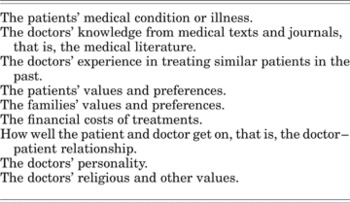
A survey was developed to examine the importance patients assign to factors considered in medical decision making. The factors for consideration were chosen based on the published literature (Table 1). The survey was piloted with five patients demonstrating acceptability and face validity before being distributed to outpatients with advanced cancer attending medical oncology and hematology clinics. Eligible respondents were able to read and write English, had advanced malignancy, had no cognitive impairment, and were judged capable of survey completion by the clinic staff. A total of 50 completed surveys was sought. The study was approved by the Institutional Research and Ethics Committee.
The Factors Considered by Patients for Their Importance and Contribution in Medical Decision Making

RESULTS
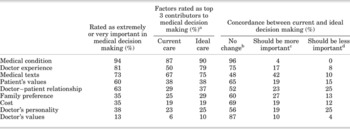
In total, 64 patients were approached to obtain 52 completed surveys, yielding a response rate of 81%. Respondents were asked to consider a series of factors that may be pertinent to arriving at a treatment recommendation and to assign a rating of importance to each, with five choices ranging between extremely important and not important (Table 2). Their medical condition, their doctor's experience, and their doctor's knowledge from medical literature were rated as extremely or very important by 94%, 81%, and 73% of patients, respectively. Patient's values were rated highly by 60%, but, in contrast, the doctor's values were rated highly by just 13%.
Respondents' Views of the Importance of Factors in Decisions Made in Their Care

aA comparison between current and ideal care.
bNo change represents respondents who consider current contribution of factor to decisions is correct.
cShould be more important represents respondents who believe the factor should be given greater consideration than is currently occurring in decisions made.
dShould be less important represents respondents who believe the factor should be given less consideration than is currently occurring in decisions made.
A further 10 respondents detailed other factors they felt important to current decision making. Five of these raised issues surrounding communication. One respondent wrote, “The ability for the doctor to communicate all information clearly and patiently is extremely important.”
Respondents rated the relative importance of each of these factors when considering how decisions were currently being made. They were then asked to repeat this question but on the basis of how they believed decisions should be made, giving an indication of current and ideal practice (Table 2). Once again, respondents considered the patient's medical condition, the doctor's experience, and the knowledge from medical literature as most important both currently and in ideal care, with the only change being the doctors' experience being given a higher rating in the ideal. Overall, there was high concordance between respondents' views on factors considered in the decisions currently being made and the ideal.
A number of respondents indicated that the factors were interdependent. One respondent commented: “[I] only put values and preferences [number] 4 because without the first three [medical condition, textbooks, experience from other people] the doctor cannot give me the clinical information that enables me to express a preference. The doctor's knowledge empowers me.”
Some respondents commented on the importance of having the same doctor when negotiating decisions throughout an illness: “[It is] extremely important to retain continuity with [the] treating doctor and not be fobbed off to a colleague when illness is ongoing.”
A detailed analysis of the concordance between current and ideal ratings of factor importance was undertaken, revealing some expressed preference for change (Table 2). Those who rated the contribution of a factor as the same when considering current and ideal care were said to wish for no change and deemed satisfied with current decision making. The greatest discrepancy between current and ideal existed for the doctors' experience in treating similar patients, with most respondents believing this should be given higher priority than was presently occurring. The importance of the relationship between the patient and doctor showed discordance between what is and what should be; however, the numbers who believe it should be more (n = 12) or less (n = 13) important were balanced. Similar numbers expressed a preference for the doctor's personality to be considered differently in the ideal. For the 21 respondents who felt family preferences should be considered differently, two thirds felt they should be given more importance.
When considering the patient who is very ill and has already undergone a number of treatments, no respondents believed there was a single correct course of action. Forty one respondents (79%) believed there are a few possible courses of action, each with merit, and that other factors unrelated to the illness play a role. Eleven (21%) respondents believed there were not many courses of action available, but that the doctor may suggest something as “worth a try.”
DISCUSSION
Patients with advanced cancer appear to appreciate the opportunity to discuss what they believe to be important to the decision-making process. The high response rate suggests a high level of acceptability and respondent interest in this survey. It is apparent that patients understand the uncertainty in making decisions, with all respondents recognizing there was no clear correct course to follow in the setting of advanced cancer and one fifth recognizing a decision based on trade-offs may offer some benefits.
Patients also appear to understand the importance of factors unrelated to the illness that influence the decisions made, despite suggesting for themselves that the medical condition, the doctors experience, and the medical literature were most important. If it is assumed that medical information and evidence must be brought to all decisions and can therefore be removed from being “optional,” then the values of the patient become most important, followed, in turn, by the relationship between the patient and doctor and the preferences of family members. Most patients did not think the doctors' values should contribute significantly to patient care decisions, despite the available literature suggesting values and physician-related factors are influential (Cook et al., Reference Cook, Guyatt and Jaeschke1995; Asch & Christakis, Reference Asch and Christakis1996; Shen et al., Reference Shen, Andersen and Brook2004).
A number of respondents indicated that the factors they were asked to consider were interdependent. Many respondents refused to give greater importance to some factors over others, instead rating them as equally important. Respondents appeared to indicate that one factor did not necessarily trump others. Instead, the factors were inextricably connected with, for example, the ability of the patient to articulate her values and preferences, being dependent on the quality of information available. Patients appreciated that the decision-making process requires a complex integration of information, communication, and interpersonal relationships. This complexity may be further heightened as patients gather information from a range of sources, including their physician, but also other health professionals, alternative practitioners, family and friends, and commercial sources (Burns et al., Reference Burns, Dixon and Smith2004). This information may have different emphases, different applicability, and different intentions from that which is provided by the physician.
De Haes and Koedoot (Reference de Haes and Koedoot2003) have highlighted the complexities of making decisions as the dynamic processes unfold for patients with advanced cancer. They suggest that patients expect to be involved in making decisions and they often appear to disregard outcomes such as quality of life, preferring to consider survival as the primary aim. Their doctors, in turn, often appeared to prefer “aggressive” treatment even in the likelihood of limited benefit. The authors described a tacit agreement between the parties that control over the illness was maintained by “doing something active.” Despite a patient-centered approach to making decisions, many patients appeared to avoid information, thereby avoiding acknowledgment of their deteriorating status (de Haes & Koedoot, Reference de Haes and Koedoot2003).
In this study, which reveals the anatomy rather than the dynamics of making decisions, respondents believe their values should and do impact the decisions made in their care. This view is increasingly reflected in health care legislative and policy changes (Kite & Tate, Reference Kite and Tate2005). In contrast, patients do not generally believe that their doctors' values should or do inform the decision made, despite the available research suggesting otherwise. These results may represent a confidence in their doctors' ability to remove their own personal values from the process because, in general, patients believed what was happening in the decisions being made concurred with their notion of what should be happening, suggesting a degree of satisfaction with the processes.
A number of respondents commented on the importance of continuity with the same doctor when negotiating decisions throughout an illness. Approximately one third of respondents consistently rated the patient–physician relationship in the top three in importance, reflecting this need. It is likely patients value their doctors' knowledge of past decisions, responses, wishes, and reactions to this complex process. The length and consistency of the relationship enhances the doctor's knowledge of the patient and her or his values, enabling their greater integration into making decisions.
There are a number of limitations to these data. The sampling and therefore responses were limited to those who agreed to complete the survey, introducing a potential for bias with those agreeing to participate possibly not representing the group as a whole. The exclusion of those who do not understand written English means that the results may not be extrapolated across the multicultural population presenting for outpatient cancer treatment in this country. The level of education of respondents is unknown, though the content of comments made may indicate a higher level of educational achievement. This in turn may enhance their understanding of the complexities within decision making, and thus they may not represent the whole cancer population. Despite these limitations, these data provide an indication of what factors patients believe should and do inform decision making. Factors are assigned a relative importance, and the complexities and uncertainties of their integration are clearly understood by patients.
CONCLUSION
The notion of patient centered decision making is widely accepted by patients, their physicians, and society at large. The processes by which such decision making occurs, however, are extremely complex, with patients choosing differing levels of involvement, and even those who wish to be involved having a variable capacity to do so, such as at times of severe illness. The information considered by patients may come from multiple sources and be subject to a variety of influences. The physician will bring her knowledge and her clinical and personal experience to the interaction, and this will, in turn, influence how information is presented and the recommendations made. Finally the relationship within which the decision making occurs will influence the quality of the discourse and the extent to which both parties can consider information, articulate values, and come to a treatment plan. Patients consistently assign most importance to medical factors, but these are closely followed by patient values and the quality of the patient–doctor relationship. The complexities of combining and integrating information are well understood by patients, who appear cognizant of the uncertainties inherent in advanced disease and the intricacies of the decision-making process.
ACKNOWLEDGMENTS
This study formed part of Jennifer Philip's doctoral studies, for which she received NHMRC scholarship support. The authors thank the participating patients for their generous and thoughtful responses.