In Spain, the Royal Decree-Law 16/2012 urged modifications to guarantee the sustainability of the Spanish National Health Service (S-NHS) and established that all new health technologies considered for potential inclusion in the Spanish Common Benefit Portfolio should be subject to assessment by the Spanish Network of Agencies for Assessing Health Technologies (RedETS). The general objective of RedETS, composed of state-wide and regional health technology assessment (HTA) agencies, is to support decision making with rigorous scientific information on the incorporation, financing, disinvestment, and appropriate use of health technologies (excluding drugs) to promote the equity and sustainability of the S-NHS. RedETS uses a common quality methodological framework in the evaluation and preparation of HTA reports and collaborates in the identification and prioritization of needs and opportunities in HTA. The principles that guide RedETS are safety, effectiveness, quality, equity, and efficiency.
Significant patient involvement (PI) means that patients can have real influence on the scientific process and it is not tokenistic (Reference Morrison and Dearden1). Effective participation suggests that patient input will impact on the decisions taken in the evaluation process, from the selection and prioritization of technologies, to the development and recommendations included in the specific HTA reports (2). This commitment requires a procedural and conceptual framework that reflects the values and objectives of PI in HTA (3).
PI in HTA may be guided by the following values: relevance, justice, equity, legitimacy, and capacity building (Reference Facey and Stafinski4) and has four main objectives: democratic, legitimacy, instrumental, and scientific (3). These objectives fit well under the Spanish normative frameworks, approved in 2003 (5) and 2011 (6) which promote user and patient participation in the National Health Service. The 2003 S-NHS Cohesion and Quality law indicates that the administration must guarantee social participation to respect individual autonomy, must consider the collective expectations of the users of the Spanish Health System and allow the exchange of knowledge and experience. The 2011 General Public Health Law states that citizens have the right to effective participation in public health actions and the public administration must establish channels for participation.
Patients contribute to HTA with their specific knowledge based on experience with the disease, symptoms, technologies and the health care system. This “experiential knowledge” about the effects (positive and negative) of technologies in the real world (Reference Caron-Flinterman, Broerse and Bunders7) can complement the knowledge of researchers and clinicians by providing information on the specific needs and preferences of the patients (3).
Over the past 10 years, RedETS has made efforts to involve patients in HTA and related activities such as clinical practice guidelines (CPG) development. The network published a methodological guideline containing specific recommendations to involve patients in CPG from the very early stages of incorporation in the steering committee and scope definition, to the subsequent identification of potential clinical questions relevant for patients, selecting the key recommendations from the patients’ perspective, and helping with the development of the patients’ version of the CPG and its later dissemination among patient associations (8). Other strategic and methodological reports were concomitantly developed by RedETS to guide the design and elaboration of tools to support shared decision making between patients and health care professionals (Reference Perestelo-Pérez, Salcedo-Fernández and Toledo-Chávarri9). In 2011, RedETS published a set of recommendations to adapt HTA reports for patient and consumer use (Reference Hermosilla-Gago10). Later, in 2014, a detailed analysis of the experiences about patients participation in HTA related activities in Spain was also published by RedETS (Reference Rodríguez and Espallargues11).
Despite this experience, it was necessary to develop a strategy that favored an effective implementation of PI in the specific context of HTA for the RedETS. The aim of this study is to develop a strategy to involve patients in the HTA reports and process promoted in Spain by RedETS.
Methods
A three-stage sequential research process was used to accomplish the study aim. The initial literature review was followed by a qualitative study and a Delphi consultation with different stakeholders, before the final consensus phase between the Spanish Ministry of Health and RedETS.
Literature and International Web Site Review
Search Strategy
The objective of the literature review was to examine possible existing international tools and methodologies for PI in HTA, as well as in other evidence-based products, and to identify barriers, facilitators, and resources that could contribute to the success of this initiative. Medline, Embase, Cinahl, SCI-EXPANDED, Cochrane Library, PsycINFO, Scopus, and JSTOR were consulted to carry out a systematic literature search using filters and free-text terms combining two main components: HTA and PI. All databases were searched from their inception up to April, 2016 (see Supplementary Files for search strategies). Language was restricted to Spanish, French, or English. A manual search was also conducted, including a hand-search of the reference lists of included studies. Web pages from international HTA agencies and international organizations such as the European Network for Health Technology Assessment (EUnetHTA), Health Technology Assessment International (HTAi), International Network of Agencies for Health Technology Assessment (INATHA), European Patients' Forum (EPF), and European Patients Academy (EUPATI) were reviewed.
Study Selection
Independent reviewers screened each title and abstract for its potential inclusion. Criteria for inclusion were documents in Spanish, English, and French that could inform PI in HTA contexts. Those references which did not describe the PI methods, participant definition and selection, resources needed or the impact of the PI were excluded. PI in HTA was not a priori defined and selection included both direct strategies (considering patient input from first-hand participation in the assessment process or from primary studies designed ad hoc) and indirect participation (findings obtained from literature reviews). A priori criteria on study design, type of participants or intervention were not established. Full text documents were also revised by paired independent reviewers. In case of doubt or disagreement between them, a third reviewer was consulted both during the title and abstract and the full text selection. Due to the diversity of the documents and studies considered and the descriptive purpose of the review (i.e., to define a national framework), a risk of bias assessment was not conducted.
Extraction of Findings
A single reviewer extracted findings from each study. A standardized form was used for data extraction. The form included the following domains: design, study setting, types of participants involved in PI, PI method, phase of the HTA process involved, study setting, and main findings.
Qualitative Study
A qualitative study was conducted to identify and analyze the perceptions of HTA managers and researchers regarding PI in HTA for the Spanish context. The aims of the qualitative study were: (i) to collect definitions of PI; (ii) to collect experiences of PI in HTA in the Spanish context; (iii) to collect barriers and facilitators for PI in our context.
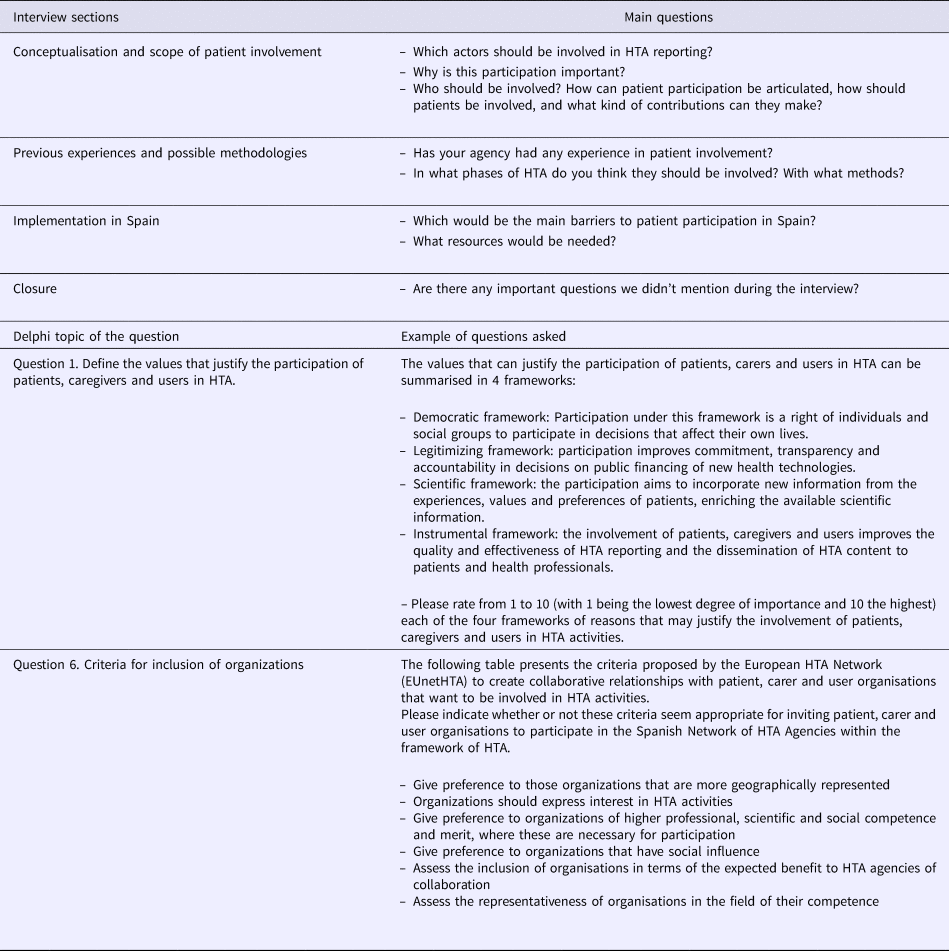
A purposive sample of members of the RedETS was recruited using the snowball technique. The managers of the eight RedETS agencies and units and five methodologists with experience in PI were interviewed. All prospective participants who were contacted accepted the invitation. The interview guide was piloted in the first two interviews. Some minor changes were included in the script after the pilot phase. The structure of the script can be found in Table 1. Participants signed a consent form. Interviews were performed face-to-face or by telephone, audio-recorded, and transcribed. A thematic analysis (Reference Braun and Clarke12) was conducted using Atlas.ti 6.2.
Structure of Interview Script and Examples of Delphi Questions

HTA, Health Technology Assessment.
Delphi Consultation
The Delphi consultation used two rounds to explore the opinions, values, and preferences of representatives of patient and consumer organizations about: (i) the values that justify patient participation in HTA; (ii) alternative methods, times, and activities for successful patient participation in HTA; and (iii) the best way to operationalize patient involvement. The invitation to participate was made by e-mail and disseminated through three large patient and consumer platform organizations representing fifty-five organizations (Spanish Patients’ Forum, Platform of Patients’ Organizations and the Council of Consumers and Users), and to five patient organizations that have collaborated on previous occasions with the Evaluation Unit of the Canary Islands Health Service (SESCS).
An online questionnaire was prepared ad hoc based on the main findings of the narrative review and was sent to patient, carer, and consumer organizations. They were invited through umbrella organizations and directly by those organizations which had previously collaborated with RedETS.
The topics of the questions were: (i) definitions of the values that justify the participation of patients, caregivers, and users in HTA; (ii) forms of participation; (iii) stages of HTA in which patients, caregivers and users may be involved; (iv) activities which the patients, caregivers and users can participate in; (v) Priorities for the participatory process; and (vi) criteria for inclusion of organizations. For each question, a short definition of the concept on which the question was provided and the person was asked to select or rank the answers according to his or her preference (Table 1 shows some examples of questions).
The consensus parameter was established on the basis that at least 70 percent of the answers had obtained scores of 7 to 10 for each question, so the majority vote was used. The second round was conducted only when consensus was not reached for some specific first round questions.
Consensus Process for PI in HTA in Spain
The strategy development involved an iterative process that used the synthesis of the main literature findings as a first step and was complemented by the findings of the qualitative study and the Delphi consultation in the national context of Spain.
A qualitative thematic synthesis of the findings of the literature and Web sites was conducted to obtain key themes and subthemes. Data from the interviews and the Delphi consultation were analyzed separately and used to contextualize findings, when relevant, for RedETS or when no findings were extracted from the literature review. Therefore, only analytical themes but not direct content of the studies were included in the synthesis (Reference Thomas and Harden13). A summary with the main findings and conclusions was used to build a strategic proposal for PI in HTA in the context of the RedETS activities.
The proposal was sent to the members of the RedETS Governing Council. The Council is composed of a Presidency, Vice-Presidency, Technical Secretariat, and the heads of the evaluation agencies or units and its purpose is the management and coordination of the network, establishing common working procedures and methodological framework. The proposal was discussed in a teleconference session. The discussion resulted in minor changes in the proposal regarding the timing of some actions.
The main themes of the thematic synthesis and the PI strategy for RedETS are described below.
Results
A total of 211 references were found in the electronic databases (see search strategy in supplementary files) of which 58 references were finally included. Additionally, forty-three references were identified either by manual search of Web sites or through citations in other references (see Supplementary Files for a complete list). Thirteen qualitative interviews with HTA managers and researchers were conducted. A total of sixty-six answers from the Delphi consultation were received in the first round. Some organizations gave more than one answer (n = 10) and some participants did not state which organization they represented (n = 15). In the second round, thirty-seven responses were obtained. The synthesis of findings explored possible PI activities, designs, patient selection, and invitation considerations, as well as the resources needed for PI.
Synthesis of Main Findings
The main themes identified from the literature and Web site review were: (I) PI methods in the different HTA phases; (II) participant definition and selection; (III) resources needed.
(I) PI Methods in Different HTA Phases
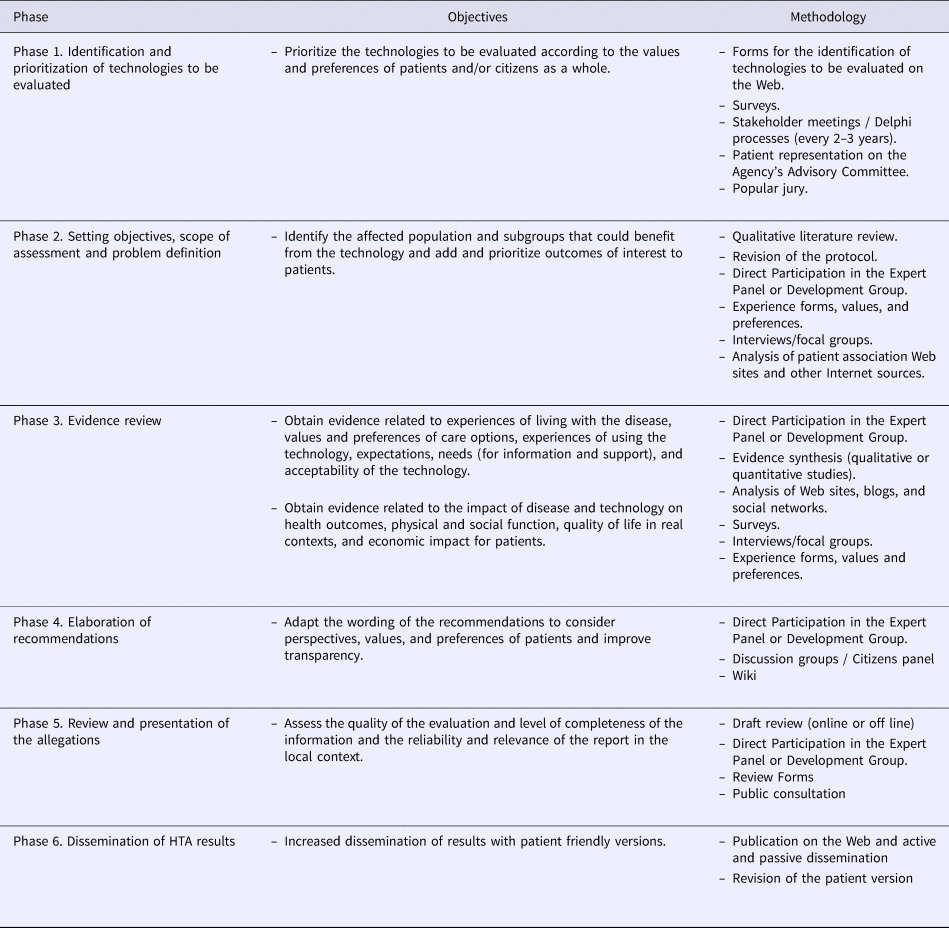
There is no evidence on which method or combination of methods is most appropriate for patients to contribute to and participate in all phases of HTA (Reference Gauvin, Abelson, Giacomini, Eyles and Lavis14). Recommendations based on evidence and international experiences opt for a combination of various methods adapted to the PI objectives, consequently results triangulation and contrast can occur through the use of several procedures (3). Table 2 describes the different PI methodologies according to the different phases of HTA process found from the literature and Web site scan.
PI Methodologies According to the Different Phases of the Process Found in the Literature

Prepared by the authors. Main sources: OHTAC Public Engagement Subcommittee (2015); Kleme et al. (2014); European Patient Forum (2013); Hansen et al. (2011); Facey et al., (2010); Oliver et al., (2009) y Kristensen et al., (2007). See references in Supplementary Materials.
Neither the interviews nor the Delphi consultation provided additional methodologies. The interviews showed a preference to involve patients in the identification and prioritization of technologies to be evaluated, in setting objectives, scope of assessment and problem definition and, in the internal and external review process of the report. Some of the participants (4/13) considered that patients should only participate in these phases while others (4/13) indicated that PI should be present in all of them.
The majority of the Delphi participants considered that patients should be involved in all the HTA phases. A total of 91 percent of the respondents answered that patients should participate in setting objectives and problem definition, 90 percent in ethical, social and economic assessment, 84 percent in the prioritization of technologies to be evaluated, 80 percent in preparing a patient friendly version of the results, 79 percent in public consultation, 78 percent in the identification of technologies to be evaluated, 74 percent in dissemination, and 64 percent in providing documentation for assessment.
(II) Participant Definition and Selection
PI can involve several actors and does not exclusively refer to individual patients. Terminology is wide ranging and includes expert patients, carers, family, patient organizations, users, citizens, public, or consumers (3;15;16). One of the main difficulties is to ensure the representativeness of the participatory processes with respect to the total group of patients or those affected by the technology to be evaluated (17;18).
Selecting and inviting participants was the main concern expressed both in the interviews and Delphi findings. According to the interview findings, the type and number of participants depends on the objective and methodology selected for participation. The combination of a democratic approach, which facilitates broad representation of health experiences, and a technocratic approach, which seeks to incorporate contributions from relevant lay knowledge inputs (Reference Martin19), was the preferred option for the selection of participants for the HTA process.
(III) Resources Needed
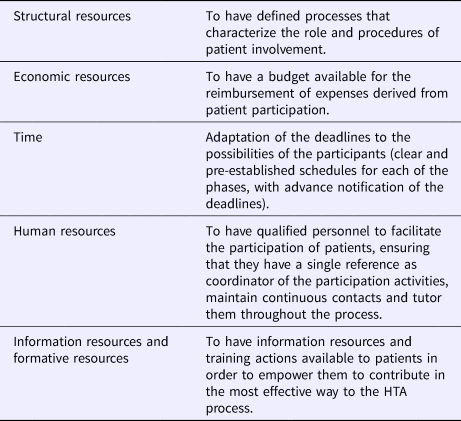
Significant PI requires a range of resources (Reference Gauvin, Abelson and Lavis20–Reference Staniszewska, Brett, Mockford and Barber22), some of them on an ongoing basis, at the infrastructure level and others which are temporary in nature, bearing in mind that participation can range from one-off actions to even years of work (Table 3).
Resources Needed for Participation

Sources: Prepared by the authors.
Interviewees indicated that the lack of specific economic and human resources can be a barrier to effective PI in RedETS activities. Specific perceived barriers were transferred as actions to the strategy, including the patients´ need for informative and formative actions on HTA, the training of HTA professionals in PI techniques, or the need to adjust PI to the methodology used in RedETS.
The Delphi consultation inquired about the resources available in patient organizations to participate in specific PI activities. Depending on their organizational resources, respondents qualified activities as low difficulty (if they could do it independently with the available resources), medium difficulty (if they would need technical support), and high difficulty (if they found it difficult to find the time and resources needed for the activity). Overall, the activity perceived as the most difficult (or the one associated with a greater use of resources) was that of contributing by searching documents of interest to evaluate, as opposed to the activity of disseminating the report, which was considered the least difficult activity. Nevertheless, all activities were found to have low, medium, and high difficulty by several organizations (see Supplementary Files for complete answers).
Strategy for PI in RedETS
The strategy for the implementation of PI in RedETS HTA activities integrates the main information extracted from the international literature review, interviews, and Delphi consultation.
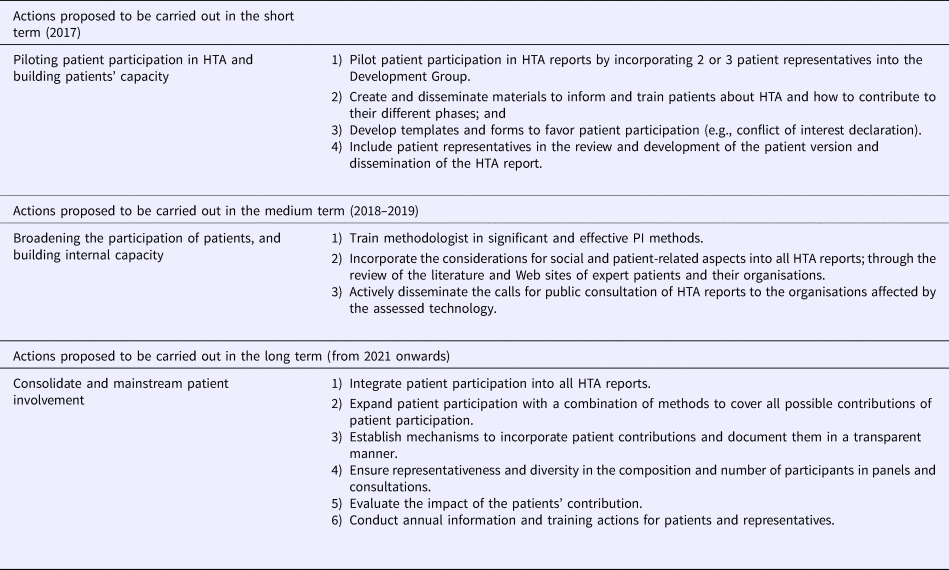
For RedETS' regional agencies and units to incorporate patient participation, and overcome barriers identified in interviews, a staged strategy for PI implementation was proposed. The strategy was divided into three phases: (i) piloting patient participation in HTA and building patient capacity with actions to be carried out in the short-term; (ii) broadening the participation of patients, and building internal capacity with medium-term actions, and (iii) consolidating and mainstreaming patient involvement on a long-term basis. See actions to be taken in each moment in Table 4.
Strategy for PI in RedETS: Short, Medium, and Long-Term Actions

HTA, Health Technology Assessment.
With respect to PI evaluation, a first qualitative evaluation of PI in RedETS that would lead to the creation of a checklist for PI impact assessment was proposed.
Discussion
The need for PI in HTA is widely recognized. An increasing number of international agencies are conducting and evaluating PI activities in HTA (Reference Weeks, Polisena, Scott, Holtorf, Staniszewska and Facey23). Some agencies have also published the process of creation of their PI frameworks (e.g., 24,25). The review of PI methodologies and techniques compiled in this article is similar to other recently published ones that present a multiplicity of options to involve patients in different phases of HTA (Reference Abelson, Wagner and DeJean24–Reference Facey, Hansen and Single26). Furthermore, in line with current international efforts, RedETS proposes a continued evaluation process of PI (Reference Weeks, Polisena, Scott, Holtorf, Staniszewska and Facey23). This field is growing and consolidating both conceptually and methodologically, even if applications in international agencies are still evolving and are very diverse, and there are few published experiences.
In Spain, the Ministry of Health and Social Services and the RedETS have recognized the need and value of PI in HTA and the active collaboration of patients to improve decision making processes in relation with health technologies. Patients have unique perspectives and experiences and can contribute in an essential manner to HTA. Knowing, understanding, and using their knowledge can facilitate providing a response to patient needs, and improve transparency, responsibility and democratization of the decision process. For these reasons, the RedETS activity is progressively incorporating PI following the strategy presented here.
A report with the findings of the three-stage sequential research process and the final strategy for PI in the RedETS was published in early 2017 (Reference Toledo-Chávarri, Perestelo-Pérez and Álvarez-Pérez27). The first step for its implementation was to make a public declaration of the interest of RedETS in the participation of patients in its activities in HTA in Spain. Short-term proposed actions were also carried out during that year, for example, a pilot experience in PI in six HTA reports in the RedETS. Materials for the patients’ capacity building in HTA are being developed and will be piloted in 2019. A periodic evaluation of PI activities is foreseen to promote impact and effective engagement from democratic and technocratic perspectives.
Some aspects act as facilitators for the implementation of the strategy. First, the commitment built around PI in RedETS. Second, the accumulation of previous experiences in CPG and other evidence based products (8–Reference Rodríguez and Espallargues11). Third, the proposal's approach allows flexibility of pace for implementation according to the different economic and human resources and capacities in the agencies and units of the RedETS and in patient organizations. In this sense, effort has been put into addressing barriers and promoting the presence of patients in HTA in an effective manner (Reference Mamzer, Dubois and Saout25).
Some forthcoming challenges still lie ahead. The strategy proposes capabilities that need to be expanded inside RedETS for PI to becomes embedded in the daily activities of the HTA process. Besides which, the strategy has not solved all the issues that emerged from the three-stage sequential research process. For example, a proposal for the process selection of the appropriate methodology for each report or for inviting and recruiting patients is still to be developed.
To face these challenges, a Task Group for PI has been created with the involvement of all the agencies and units of the RedETS with the aim of implementing the strategy, continuing with the methodological development activities and sharing experiences and capacities.
In conclusion, the strategy for PI in the HTA activities of the Spanish RedETS has been planned with short, medium, and long-term actions. It sets out a line of work that will allow the involvement of patients in a progressive and feasible way that considers the need for a capacity building process, both within and outside RedETS.
Supplementary material
The supplementary material for this article can be found at https://doi.org/10.1017/S0266462319000096.
Conflict of interest
The submitted work was cofunded by the Spanish Ministry of Health through the Network of Agencies of Health Technology Assessment (RedETS) and the Canary Foundation for Health Research (FUNCANIS).