Introduction
The benzimidazole derivatives are important molecules used in the treatment of intestinal and tissue parasitosis. The best examples of these molecules are mebendazole, thiabendazole and albendazole (ABZ) (Bansal and Silakari, Reference Bansal and Silakari2012; Salahuddin et al., Reference Salahuddin, Shaharyar and Mazumder2017). Other compounds have been synthetized from benzimidazole such as 6-chloro-5-(2,3-dichlorophenoxy)-2-(trifluoromethyl)-1H-benzimidazole (RCB15) and 6-chloro-5-(1-naphthyloxy)-2-(trifluoromethyl)-1H-benzimidazole (RCB20) showing important anthelminthic activity and considered promising as new molecules that may be used in the treatment of such neglected tropical diseases (Hernández-Luis et al., Reference Hernández-Luis, Hernández-Campos, Castillo, Navarret-Vázquez, Soria-Arteche, Hernández-Hernández and Yépez-Mulia2010).
Neurocysticercosis (NCC) is a tissue parasitosis caused by the presence of the larval stage of Taenia solium in the nervous system. It is considered a neglected disease of great epidemiologic importance as it is the main cause of acquired epilepsy in endemic regions such as Latin America, Africa and Asia (Garcia et al., Reference Garcia, Nash and Del Bruto2014). The NCC treatment is performed through the administration of ABZ and praziquantel (PZQ) isolated or in association (Valdez et al., Reference Valdez, Cedillo, Hernandez-Campos, Yepez, Hernández-Luis, Navarrete-Vázquez, Tapia, Cortés, Hernández and Castillo2002). Both ABZ and PZQ are anthelminthic drugs widely used worldwide which have induced the manifestation of some resistance reports (El-On, Reference El-On2003; van den Enden, Reference van den Enden2009; Márquez-Navarro et al., Reference Márquez-Navarro, Cornejo-Coria, Cebada-López, Sánchez-Manzano, Diaz-Chiguer and Nogueda-Torres2012; Lopes et al., Reference Lopes, Cruz, Soares, Nunes, Teixeira, Maciel, Buzzulini, Pereira, Felippelli, Soccol, Oliveira and Costa2014). Therefore, the search for alternative NCC treatment is of utmost importance (Hernández-Luis et al., Reference Hernández-Luis, Hernández-Campos, Castillo, Navarret-Vázquez, Soria-Arteche, Hernández-Hernández and Yépez-Mulia2010).
One of the validated experimental models used for cysticercosis studies is with the intraperitoneal and intracranial inoculation of Taenia crassiceps cysticerci in mice, reproducing the cysticercosis host-parasite interaction (Cardona and Teale, Reference Cardona and Teale2002; Matos-Silva et al., Reference Matos-Silva, Reciputti, Paula, Oliveira, Moura, Vinaud, Oliveira and Lino-Júnior2012; Leandro et al., Reference Leandro, Fraga, Lino Junior and Vinaud2014; Lima et al., Reference Lima, Picanço, Alves, Silva, Isac, Costa, Lino Junior and Vinaud2019). The T. crassiceps experimental NCC model has been used as to contribute in the clarifying of the biochemical impact of different drugs in the metabolic pathways of the parasite (Leandro et al., Reference Leandro, Fraga, Lino Junior and Vinaud2014; Silva et al., Reference Silva, Lima, Arrua, Salomon and Vinaud2018; Lima et al., Reference Lima, Picanço, Alves, Silva, Isac, Costa, Lino Junior and Vinaud2019).
The biochemical studies of the drugs mode of action have helped to determine their metabolic target within the parasitic cell as well as how the parasite reacts when facing a stressful environment. Such studies contribute to the development of new active compounds and improvement of the current anthelminthic drugs, i.e. development of nanosuspensions increasing the drug`s absorption by the parasitic cell as well as decreasing dosages and side-effects (Vinaud et al., Reference Vinaud, Lino Junior and Bezerra2007; Picanço et al., Reference Picanço, Lima, Fraga, Costa, Isac, Ambrosio, Castillo and Vinaud2017; Silva et al., Reference Silva, Lima, Arrua, Salomon and Vinaud2018; Lima et al., Reference Lima, Picanço, Alves, Silva, Isac, Costa, Lino Junior and Vinaud2019).
The carbohydrate fermentation pathways have been previously described in cestodes (Vinaud et al., Reference Vinaud, Lino Junior and Bezerra2007; Tielens et al., Reference Tielens, van Grinsvenm, Henze, van Hellemond and Martin2010). The main end products of these energetic pathways from glucose are lactate, acetate and propionate. The fermentation processes are increased within the cell`s metabolism when there is a decrease in the availability of oxygen in the habitat or when there is an abundance of carbohydrate sources (Meganathan et al., Reference Meganathan, Ranganathan, Reddy, Reddy, Beveridge, Breznak, Marzluff and Schmidt2007). It has been reported that cestodes, such as T. crassiceps, are able to survive in anaerobic environments and accumulate succinate and products derived from succinate, such as propionate (Saz, Reference Saz1981). The anaerobic breakdown of carbohydrates by helminths also takes in consideration the redox requirements of the environment, sources of intermediates for synthetic reactions, pH control, nitrogenous excretion, osmotic regulation, intracellular signalling and the suppression of host responses (Barrett, Reference Barrett1984).
Therefore, the aim of this study was to evaluate the metabolic response of T. crassiceps cysticerci intracranially inoculated in BALB/c mice after treatment with RCB15 and RCB20 in comparison to ABZ.
Materials and methods
The T. crassiceps cysticerci are maintained in the animal's facilities of the Tropical Pathology and Public Health Institute of the Federal University of Goias since 2002, as described previously (Vaz et al., Reference Vaz, Nunes, Piazza, Livramento, Da Silva and Nakamura1997; Fraga et al., Reference Fraga, Costa, Bezerra, Lino Junior and Vinaud2012).
Experimental infection and treatment
The BALB/c female mice, with 8–12 weeks old, used in this study were submitted to intracranial inoculation of initial stage T. crassiceps cysticerci as described previously by Matos-Silva et al. (Reference Matos-Silva, Reciputti, Paula, Oliveira, Moura, Vinaud, Oliveira and Lino-Júnior2012). After a period of 30 days post-inoculation the animals received a single dose treatment of 50 mg kg−1 of ABZ (positive control group), 50 mg kg−1 of RCB15 (test group 1), 50 mg kg−1 of RCB20 (test group 2) or 50 µL of physiologic solution (NaCl 0.9%) (negative control group). Each experimental group was composed of five animals. All the treatments were performed orally through gavage. Twenty-four hours after the treatment the animals were euthanized. This period of time was chosen due to the half-life of ABZ which is approximately 8–12 h, ensuring the metabolic effect of the drug on the parasite. The cysticerci were carefully removed, washed with physiologic solution (NaCl 0.9%) in order to remove host cells or other interferents, and then frozen in liquid nitrogen and stored in −20 °C freezer for posterior biochemical analysis (Leandro et al., Reference Leandro, Fraga, Lino Junior and Vinaud2014; Silva et al., Reference Silva, Lima, Arrua, Salomon and Vinaud2018; Lima et al., Reference Lima, Picanço, Alves, Silva, Isac, Costa, Lino Junior and Vinaud2019).
Biochemical analysis
The organic acids were extracted from the cysticerci according to the previous description (Fraga et al., Reference Fraga, Costa, Bezerra, Lino Junior and Vinaud2012). Briefly, the cysticerci were defrosted and homogenized in 500 µL of tris-HCl 0.1 M buffer supplemented with a protease inhibitor (SigmaFast protease inhibitor cocktail tablets, EDTA-free, Sigma®), pH 7.6. The extract obtained was centrifuged at 15 652 g (10 000 rpm) per 10 min at 4 °C and then the organic acids present in the vesicular fluid were extracted through an ionic exchange solid phase extraction column (Bond Elut® Agilent®). The chromatographic analysis was performed through an exclusion column BIORAD-Aminex HPX-87H®. The eluent used was sulfuric acid 5 mm, flow 0.6 mL min−1, spectrophotometric reading of 210 nm.
The results were analysed through the Star Chromatography Workstation software (Agilent®), previously calibrated for the following organic acids identification: pyruvate and lactate (glycolytic pathway), oxaloacetate, citrate, α-ketoglutarate, succinate, fumarate and malate (tricarboxylic acid cycle), fatty acids oxidation (acetate, acetoacetate, β-hydroxybutyrate).
Dosages of glucose, lactate dehydrogenase (LDH), urea and creatinine were performed through an Architec C8000 Plus device with commercial kits (Doles®) that employed the enzymatic method for quantification.
Statistical analysis
All experiments were independently repeated five times. As the amount of cysticerci removed from each mouse is not standardized, the cysticerci were weighted and the values detected by HPLC and spectrophotometry were adjusted per gram of cysticerci. The statistical analysis was performed with the adjusted values from the biochemical analysis of the cysticerci through the Sigma Stat 2.3 software. The descriptive analysis was performed to determine the normal distribution and homogenous variation as well as mean and standard deviation. As the values presented normal distribution, the analysis of variation test was performed. The differences were considered significant when P < 0.05.
Results
The analyses performed in this study allowed the determination of the metabolic pathways used by T. crassiceps cysticerci intracranially inoculated in BALB/c mice after the in vivo treatment with benzimidazole derivatives. This study focused on the cytoplasmatic energetic pathways such as the glycolytic and proteins catabolism, and on the mitochondrion energetic alternative pathway such as the fatty acids oxidation.
All treatments influenced the glycolytic and cytoplasmic anaerobic energetic pathway (Table 1). The ABZ and RCB20 induced a similar significant decrease in the concentrations of pyruvate (five and four times, respectively) and lactate (two times for both treatments) when compared to the control group. While the RCB15 treatment induced a greater decrease in this pathway, i.e. pyruvate was not detected and lactate was 15 times decreased.
Concentrations (mean ± standard error) of glucose, pyruvate, lactate dehydrogenase (LDH) and lactate per gram of cysticerci detected in Taenia crassiceps cysticerci intracranially inoculated in BALB/c mice after treatment with albendazole, RCB15 or RCB20

ND, non-detected, control group: treatment with NaCl 0.9%; ABZ, albendazole treated group; RCB15, 6-chloro-5-(2,3-dichlorophenoxy)-2-(trifluoromethyl)-1H-benzimidazole treated group; RCB20, 6-chloro-5-(1-naphthyloxy)-2-(trifluoromethyl)-1H-benzimidazole treated group. The bold marking alongside with * indicates the statistical significant difference.
*P < 0.05 when compared to the control group; a: P < 0.05 when compared to the concentrations detected in the positive control group (albendazole treated group); b: P < 0.05 when compared to the concentrations detected in the RCB15 treated group.
The RCB15 treatment induced a decrease in all mitochondrion organic acids related to the tricarboxylic acid cycle such as citrate (10 times), non-detection of α-ketoglutarate, succinate, malate and oxaloacetate (Tables 2 and 3).
Concentrations (mean ± standard error) of citrate, malate, oxaloacetate and fumarate detected per gram of cysticerci in Taenia crassiceps cysticerci intracranially inoculated in BALB/c mice after treatment with albendazole, RCB15 or RCB20

ND, non-detected, control group: treatment with NaCl 0.9%; ABZ, albendazole treated group; RCB15, 6-chloro-5-(2,3-dichlorophenoxy)-2-(trifluoromethyl)-1H-benzimidazole treated group; RCB20, 6-chloro-5-(1-naphthyloxy)-2-(trifluoromethyl)-1H-benzimidazole treated group. The bold marking alongside with * indicates the statistical significant difference.
*P < 0.05 when compared to the control group; a: P < 0.05 when compared to the concentrations detected in the positive control group (albendazole treated group); b: P < 0.05 when compared to the concentrations detected in the RCB15 treated group.
Concentrations (mean ± standard error) of urea, creatinine, propionate and β-hydroxybutyrate detected per gram of cysticerci in Taenia crassiceps cysticerci intracranially inoculated in BALB/c mice after treatment with albendazole, RCB15 or RCB20

ND, non-detected, control group: treatment with NaCl 0.9%; ABZ, albendazole treated group; RCB15, 6-chloro-5-(2,3-dichlorophenoxy)-2-(trifluoromethyl)-1H-benzimidazole treated group; RCB20, 6-chloro-5-(1-naphthyloxy)-2-(trifluoromethyl)-1H-benzimidazole treated group. The bold marking alongside with * indicates the statistical significant difference.
*P < 0.05 when compared to the control group; a: P < 0.05 when compared to the concentrations detected in the positive control group (albendazole treated group); b: P < 0.05 when compared to the concentrations detected in the RCB15 treated group.
After the RCB15 treatment, the parasite produced energy through the catabolism of proteins (fumarate, urea and creatinine detections), fatty acids oxidation (β-hydroxybutyrate detection) and propionate anaerobic fermentation (Tables 2 and 3).
The RCB20 and ABZ treatment induced similar effects on the metabolic pathways such as a decrease in tricarboxylic acid cycle intermediates (oxaloacetate, malate and fumarate) and increase in the fatty acid's oxidation (β-hydroxybutyrate) (Tables 2 and 3).
The RCB20 treatment also induced the propionate anaerobic fermentation which was not observed in the ABZ treated group or in the control group (Table 3).
It was not possible to detect in all analysed samples α-ketoglutarate, succinate nor acetate.
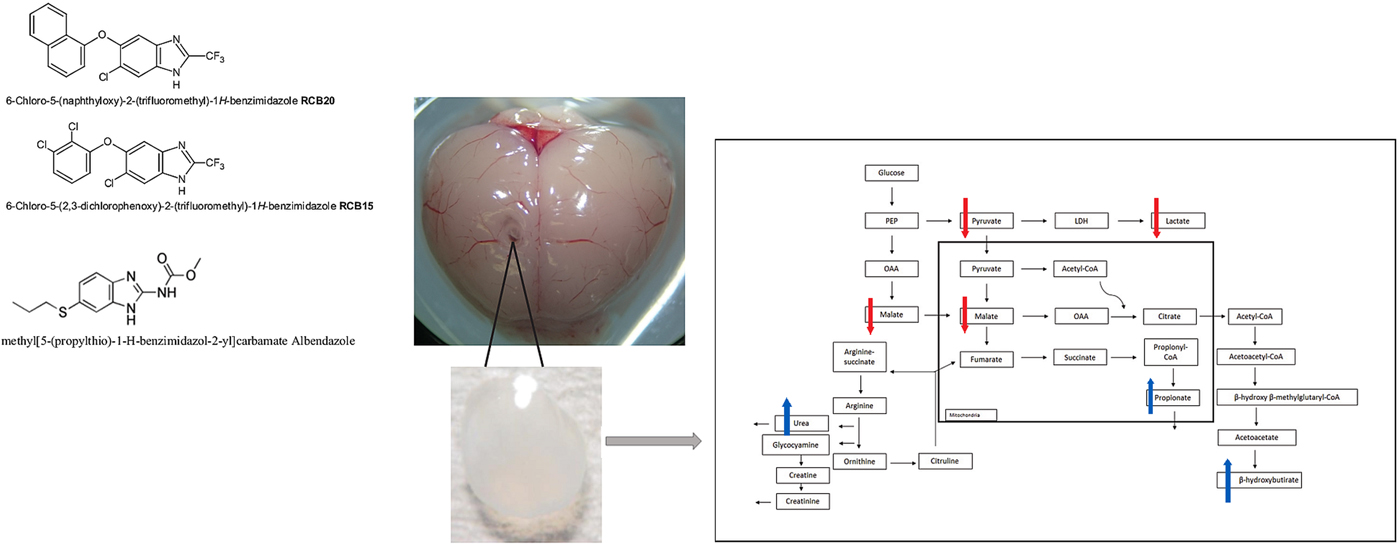
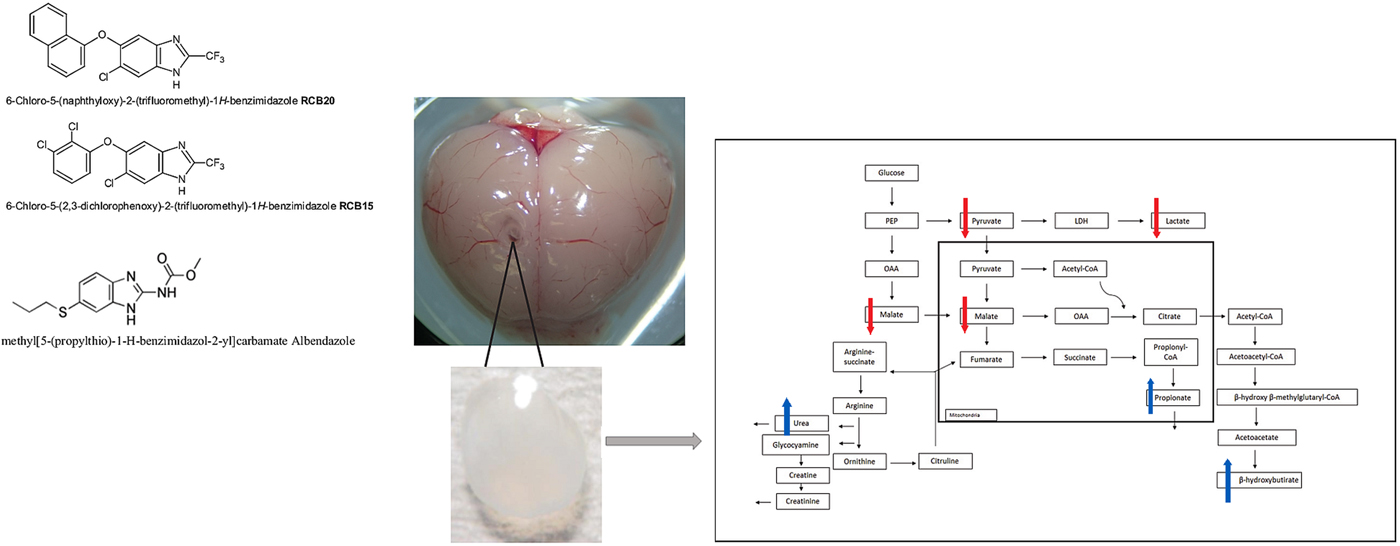
Figure 1 shows the molecular structures of ABZ, RCB15 and RCB20 and the main metabolic impact on the experimental NCC treatment.
Molecular structures of albendazole; RCB15: 6-chloro-5-(2,3-dichlorophenoxy)-2-(trifluoromethyl)-1H-benzimidazole; RCB20: 6-chloro-5-(1-naphthyloxy)-2-(trifluoromethyl)-1H-benzimidazole used in the in vivo treatment of experimental neurocysticercosis with Taenia crassiceps cysticerci. On the right the main metabolic impact of the drugs, red arrows indicate a decrease in the metabolite after treatment, blue arrows indicate an increase in the metabolite after treatment.
Discussion
This study evaluated the metabolic alterations observed in T. crassiceps cysticerci intracranially inoculated in BALB/c mice after the in vivo treatment with benzimidazole derivatives, RCB15, RCB20 and ABZ.
The main mode of action of the benzimidazole derivatives is to impair the polymerization of tubulins (α and β) into microtubules (Martin, Reference Martin1997). Microtubules are the most common component of the cytoskeleton and are involved in several intracellular processes such as mitosis, ciliary and flagellar motility, transport through vesicles and organelles (Nogales, Reference Nogales2000). The impairment of such structures alters the tegument integrity of cestodes (Marquez-Navarro et al., Reference Marquez-Navarro, Perez-Reyes, Zepeda-Rodriguez, Reynoso-Ducoing, Hernandez-Campos, Hernandez-Luiz, Castillo, Yepez-Mulia and Ambrosio2013) and metabolically leads to difficulties in glucose uptake and induces the increase of alternative energetic pathways such as anaerobic fermentative pathways, proteins catabolism, fatty acids oxidation and gluconeogenesis (Martin, Reference Martin1997; Vinaud et al., Reference Vinaud, Ferreira, Lino Junior and Bezerra2009; Fraga et al., Reference Fraga, Costa, Castro, Reynoso-Ducoing, Ambrosio, Hernández-Campos, Castillo and Vinaud2017; Picanço et al., Reference Picanço, Lima, Fraga, Costa, Isac, Ambrosio, Castillo and Vinaud2017; Vinaud and Lino Junior, Reference Vinaud and Lino Junior2017; Lima et al., Reference Lima, Picanço, Alves, Silva, Isac, Costa, Lino Junior and Vinaud2019).
In spite of the same concentrations of glucose detected in all groups, the treatments induced a significant decrease in the glycolytic and homolactic fermentation pathways, observed through the smaller amounts of pyruvate and lactate concentrations detected. The glucose uptake impairment described previously as a mode of action of benzimidazole derivatives (Martin, Reference Martin1997; Marquez-Navarro et al., Reference Marquez-Navarro, Perez-Reyes, Zepeda-Rodriguez, Reynoso-Ducoing, Hernandez-Campos, Hernandez-Luiz, Castillo, Yepez-Mulia and Ambrosio2013) was not observed in our results. However, the significant decrease in pyruvate concentrations may have happened due to the inhibition of one of the glycolytic enzymes such as glucose-6-phosphate dehydrogenase which has been reported as one of the metabolic effects of benzimidazole derivatives (Sarwal et al., Reference Sarwal, Sanyal and Khera1989). These data may also be explained by the repressing effect of benzimidazole derivatives on the Vmax of the glycolytic enzymes and also on their substrate affinity (Jasra et al., Reference Jasra, Sanyal and Khera1990).
The malate dehydrogenase complex is considered one of the most important within the parasite`s energetic pathways as it is responsible for the malate syntheses from oxaloacetate in the cytoplasm as well as in the mitochondrion. The inhibition of this enzyme by benzimidazole derivatives leads to a blockage of the glycolytic pathways and to a significant decrease in the parasite energetic reserve (Tejada et al., Reference Tejada, Sanchez-Moreno, Monteoliva and Gomez-Banqueri1987). It is interesting to highlight that in our results was possible to observe a significant decrease in malate concentrations after all treatments. Also, after the RCB15 treatment no pyruvate, oxaloacetate nor malate were detected. These data show that this particular benzimidazole derivative presents a greater metabolic effect than the other two tested in this study.
The enzymatic inhibition as a mode of action of ABZ derivatives has been reported previously. The malate dehydrogenase both cytoplasmic and mitochondrial are inhibited by ABZ (Tejada et al., Reference Tejada, Sanchez-Moreno, Monteoliva and Gomez-Banqueri1987) leading the decreases of malate concentrations and affecting the glycolytic and tricarboxylic acid cycle pathways. The fumarate reductase enzyme is inhibited by thiabendazole (Prichard, Reference Prichard1970) impairing the mitochondrial pathways. These reports show that benzimidazole derivatives may present different sites of inhibition regarding the varied enzymes of the parasites. This was probably observed in our results regarding the LDH activity when the parasite was exposed to ABZ, RCB15 and RCB20. The first drug partially inhibited the enzyme as reported previously (Veerakumari and Munuswamy, Reference Veerakumari and Munuswamy2000), while the other two derivatives presented no effect in its activity.
On the other hand, RCB15 treatment induced a significant decrease in lactate concentrations. This probably occurred due to the non-detection of pyruvate which is the precursor of lactate. It is possible that this derivative has a greater inhibition effect on the pyruvate kinase enzyme leading to a decrease in pyruvate production and, therefore, impacting the homolactic fermentation. The inhibition of pyruvate kinase by benzimidazole derivatives has been described previously by Cornish and Bryant (Reference Cornish and Bryant1976).
At this point it is interesting to observe that the parasite after the benzimidazole treatments could not perform the main energetic pathway, i.e. the glycolysis and presented an impairment in the tricarboxylic acid (TCA) cycle with significant decreases in the concentrations of oxaloacetate, malate and fumarate as well as the non-detection of α-ketoglutarate and succinate. In other words, the TCA cycle was not functioning nor the fumarate reductase pathway. These two important energetic pathways have been reported previously in T. crassiceps cysticerci intracranially inoculated in mice (Leandro et al., Reference Leandro, Fraga, Lino Junior and Vinaud2014).
In order to ensure survival and a minimum energetic production, the parasites intensified other biochemical pathways: the proteins catabolism, fatty acids oxidation and propionate fermentation. These pathways have already been described in T. crassiceps cysticerci inoculated both intracranially and intraperitoneally (Leandro et al., Reference Leandro, Fraga, Lino Junior and Vinaud2014; Fraga et al., Reference Fraga, Costa, Castro, Reynoso-Ducoing, Ambrosio, Hernández Campos, Castillo and Vinaud2016; Nasareth et al., Reference Nasareth, Fraga, Lima, Picanço, Costa, Lino-Junior and Vinaud2017; Lima et al., Reference Lima, Picanço, Alves, Silva, Isac, Costa, Lino Junior and Vinaud2019).
Regarding the protein's catabolism, the ABZ treatment did not influence this energetic pathway. While both benzimidazole derivatives, RCB15 and RCB20, showed a slight increase in the urea concentrations while there was a decrease in the fumarate ones. Again, RCB15 showed greater influence in this pathway than RCB20. These results are in accordance with the previously described effect of benzimidazole derivatives on T. crassiceps cysticerci (Fraga et al., Reference Fraga, Costa, Castro, Reynoso-Ducoing, Ambrosio, Hernández Campos, Castillo and Vinaud2016; Picanço et al., Reference Picanço, Lima, Fraga, Costa, Isac, Ambrosio, Castillo and Vinaud2017). The proteins catabolism plays an important role in several physiologic processes such as growth, differentiation and reproduction within the host (Zhang et al., Reference Zhang, Cai, Luo, Wang, Guo, Hou and Wu2018). Therefore, its impairment as a result of benzimidazole derivative exposures represents an important impact on their survival in such a significant site, the central nervous system.
On the other hand, after such important metabolic decreases, the parasite ensured survival at short term by increasing significantly the fatty acids oxidation and the propionate fermentation as energy production pathways. These two metabolic pathways were able to maintain the parasite`s survival within the analysed period of time. The increase in these alternative pathways after drugs exposure is in accordance with the previous description of the metabolic elasticity of T. crassiceps cysticerci (Vinaud et al., Reference Vinaud, Ferreira, Lino Junior and Bezerra2009; Fraga et al., Reference Fraga, Costa, Castro, Reynoso-Ducoing, Ambrosio, Hernández-Campos, Castillo and Vinaud2017; Picanço et al., Reference Picanço, Lima, Fraga, Costa, Isac, Ambrosio, Castillo and Vinaud2017).
The metabolic studies of T. crassiceps responses to benzimidazole drugs show that this parasite tends to resort to fermentative pathways such as the production of propionate from lactate or from succinate (Fraga et al., Reference Fraga, Costa, Castro, Reynoso-Ducoing, Ambrosio, Hernández-Campos, Castillo and Vinaud2017; Picanço et al., Reference Picanço, Lima, Fraga, Costa, Isac, Ambrosio, Castillo and Vinaud2017). It is important to highlight that when there is no interference in the glycolytic pathway, homolactic fermentation or in mitochondrion energy production the propionate fermentation pathway is not activated or, if present, found in small concentration, as detected in our control group. But when there is some kind of impairment of the main energetic pathways it is activated and becomes the main energetic source. These data show how this pathway is important as a survival escape used by the parasite.
When comparing both benzimidazole derivatives, RCB15 and RCB20, regarding the treatment of experimental NCC, it was possible to observe that the first one presented greater metabolic impact on the cysticerci regarding the homolactic fermentation, citric acid cycle and protein`s catabolism. Hypothetically, this probably was observed due to a greater impact on tubulins formation, since drugs of the benzimidazole group are known to affect both α and β microtubules polymerization (Martin, Reference Martin1997; Aguayo-Ortiz et al., Reference Aguayo-Ortiz, Méndez-Lucio, Romo-Mancillas, Castillo, Yépez-Mulia, Medina-Franco and Hernández-Campos2013). Further studies are needed in order to demonstrate the precise effect of each benzimidazole derivative in the cytoskeleton proteins and tegumental structures.
In conclusion, the benzimidazole derivatives are able to influence the energetic metabolism of T. crassiceps cysticerci forcing the parasite to resort to alternative energetic pathways in order to survive. Both RCB15 and RCB20 showed promising anthelminthic activity although the first one was found to present a more significant impact on the parasite`s metabolism.
Financial support
This work was supported by the National Council for Scientific and Technological Development (CNPq) (grant number 302159/2016-9).
Conflict of interest
None.
Ethical standards
This study obeyed the ethical principles in animal experimentation stipulated by the Brazilian Society of Laboratory Animals Science (SBCAL) and was approved by the Ethics Committee in Animal Use of the Federal University of Goias (CEUA/UFG), protocol number 049/17.