

I. Introduction: Visual Observation, Privacy, and Autonomy
Visual observation is not a neutral activity: social relationships are largely construed through the processes of looking and being looked at. According to Simmel, social relations are often constituted nonverbally and immediately, primarily through the sense of sight, as individuals form immediate impressions of one another through intuitively understanding facial and bodily expressions (Weinstein and Weinstein Reference Weinstein and Weinstein1984, 349). Social relations are thus constituted primordially through the “mutual glance,” when individuals look into one another's eyes, establishing an inter-subjective bond. In the very act of seeking to perceive the other, one discloses herself—her character and personality. The initial impression, according to Simmel, remains “ever the keynote of all later knowledge of him; it is the direct perception of his individuality which his appearance, and especially his face, discloses to our glance” (quoted in Weinstein and Weinstein Reference Weinstein and Weinstein1984, 352).
This is in line with Goffman's (Reference Goffman1959) observation that in social interactions, people are influenced by the information they receive about another, not only through words or actions, but also through the presentation of a particular image, and especially by the impressions that people give off, that is, that emanate from them. Someone will aim to develop interpersonal relationships “by expressing himself in such a way as to give [others] the kind of impression that will lead them to act voluntarily in accordance with his own plan” (Goffman Reference Goffman1959, 3–4). In situations where people do not expect to be observed, such impression management will often be absent vis-à-vis third parties who watch covertly—either directly or mediated through visual recordings. As a result, third parties acquire impressions the person is not able to control. Photography's capacity to record and reproduce images adds a temporal element to the threat of the gaze, subsequently affecting people's freedom to act and manage the boundaries of their private life.
Thus, looking eminently “involves relationships of power. … We engage in practices of looking to communicate, to influence and be influenced” (Sturken and Cartwright Reference Sturken and Cartwright2009, 10). In contrast to Simmel's mutually constitutive gaze, visual interaction can also be seen as separating rather than uniting individuals since, as Sartre observed, we cannot perceive the world and at the same time apprehend a look fastened upon us. Sartre was concerned with the act of “looking at” with which one subject objectifies another who is “being looked at.” Vision is thus understood as a sense of power (Brighenti Reference Brighenti2007, 328). Under the other's gaze, someone is made aware of being part of the other's visual field structured by foreign possibilities and, thus, of being an object, resulting in an anxious state and a loss of a certain degree of autonomy. Here, there is no mutuality: the one gazing is at a distance—in a position of superiority—from the object of the gaze (Brighenti Reference Brighenti2007, 326); often, this involves gendered power relations constituting a “male gaze,” with active male observers and passive female objects of observation (Mulvey Reference Mulvey1975; Brighenti Reference Brighenti2007, 330). For Sartre, vision is thus preeminently supervision, as the gazer always creates the frame in which one who is gazed at appears (Weinstein and Weinstein Reference Weinstein and Weinstein1984, 355). To be sure, being subjected to another's gaze is not necessarily detrimental: surveillance can serve both control and care (Lyon Reference Lyon2007, 13–14), and visibility can be empowering as well (e.g., Koskela Reference Koskela2004). But particularly in asymmetric situations, visual observation can easily imply a loss of autonomy in the watched.
In this article, we are concerned with this autonomy-undermining potential of visual observation. Rössler (Reference Rössler2005) suggests that autonomy should be understood in terms of what a person chooses, and how she chooses it. A person is autonomous “if her desires and the actions that result from those desires are actually her own” (Rössler Reference Rössler2005, 53); that they are authentic. The person's ability to control the circumstances in which she is observed by others is critical to her capacity to form and act on desires that are her own. When a person becomes aware that others have seen her, or could see her, in circumstances that she would rather they had not seen her, circumstances that were embarrassing or humiliating, there will be an involuntary shift in the person's perspective. Whereas before she was free to make decisions based on her own desires, she must now make them in light of the knowledge others have acquired as a result of undesired observation. In making choices, she is likely to consider what the other's perceptions of her might be and how those perceptions might influence his attitudes and behavior toward her. The result is likely to be inhibition, self-censorship, or a tendency to appease. Her choices will no longer be truly her own.
Undesired observation can also undermine agency in other ways. To be autonomous, an individual must adopt a certain attitude toward herself—to engage in self-reflection and evaluation. However, as many privacy scholars point out, the development of an autonomous way of life is not entirely self-regarding. Almost any attempt to act on one's desires will require cooperating with others. The realization of self-chosen ends will depend on one's ability to cultivate a diverse range of beneficial social relationships. A person's ability to conceal and disclose parts of herself—not least visually—and to establish certain social boundaries, determines the nature of relationships and the attitudes and dispositions that others hold toward her. To give effect to her self-determined ends, she must be able to influence such attitudes. Control over the circumstances in which she is observed will be essential to this endeavor.
The effect that undesired visual observation might have on people's capacity for autonomy provides a justification for legal protection. This article is concerned with a particular aspect of legal protection: the criminalization of nonconsensual visual observation, that is, watching (with the unaided eye or a through a device), recording, or transmitting images of others without their consent. Societies do not, and should not, criminalize all harmful behavior. The criminalization of certain privacy-invading conduct marks it out as a special form of wrong, one that should be met with a collective response and public condemnation through the criminal law. Criminalization is significant because it tells us something about the value that lawmaking institutions place on particular aspects of privacy, as well as about the circumstances in which this value is considered particularly salient. With this in mind, we address the following questions: When is nonconsensual visual observation deemed harmful enough to trigger criminal sanctions? How does the criminal law differentiate between circumstances where people can reasonably expect to remain unobserved and those where their expectations are unreasonable, at least for purposes of holding the viewer criminally liable? What can we say about these value judgments in light of individuals' underlying interests in autonomy and in view of contemporary socio-technical reality with its ubiquitous mobile cameras?
To answer these questions, we engage in a comparative analysis of the criminalization of nonconsensual visual observation in nine jurisdictions: Canada, the Czech Republic, Germany, Italy, the Netherlands, Poland, Slovenia, the United Kingdom, and the United States.Footnote 1 The combination of common law and civil law jurisdictions, with diverse histories in surveillance practices, offers interesting insights into what aspects of individuals' interests in not being observed or visually recorded are worthy of protection. Our method is not comparative law in the classic or functional sense (which involves analyzing how different systems solve a concrete case: see, e.g., Zweigert and Kötz Reference Zweigert, Hein and Weir1998), since our aim is not to solve a particular topical challenge related to visual observation. Rather, we use doctrinal legal analysis (which analyzes how and why an issue is regulated in a legal system on the basis of studying statutes and case law: see Hutchinson Reference Hutchinson, Watkins and Burton2013), applied to multiple countries. This fits the aim of finding out when nonconsensual visual observation is deemed harmful enough to trigger criminal sanctions in different socio-legal contexts. This enables us to say something about the value placed on the visual aspects of people's impression management in contemporary societies.
This exercise fills an important gap in the literature. The existing legal literature on unlawful visual observation largely focuses on portrait rights (including the right of publicity), other privacy torts, or the criminalization of voyeurism within a particular (especially common law) jurisdiction. Visual observation crimes have not yet been studied broadly, covering all forms of visual observation (including, but not limited to, voyeurism) in a wide set of jurisdictions. Thus, besides the primary aim of understanding when the power exercise in visual observation becomes so autonomy threatening as to warrant criminalization, this article also fulfills a secondary aim, namely, to open up the criminal law on visual observation in jurisdictions less accessible to English-reading audiences. Since visual observation crimes in several of our jurisdictions have not been systematically mapped in English literature, a considerable part of this article is dedicated to describing the nine jurisdictions' law in some detail, which we hope can function as a basis for more in-depth follow-up research.
To focus our findings and analysis, we discuss only primary offenses of unlawful observation. We mention and discuss accessory offenses (such as installing devices or possessing or disseminating images) only insofar as they serve as an important stopgap when observation itself is not criminalized. For federated countries, we focus on federal law, with some illustrative references to state-level legislation where it significantly adds to federal law.Footnote 2
In Section II, we provide a broad overview of visual observation offenses and identify some initial themes. We divide relevant offenses into two primary categories: voyeurism-related crimes (largely sexual in character and often containing an element of nudity) and intrusion-related crimes (where observation occurs in circumstances that imply a privacy intrusion, e.g., inside dwellings, and that do not necessarily include elements related to nudity or sex). Common law countries focus more on the former, and civil law countries on the latter. In Section III, we focus on specific criminal provisions, mapping the main factors that influence the reasonableness of remaining unobserved. Offenses in both common law and civil law jurisdictions generally require, explicitly or by implication, an examination of “reasonable expectations of privacy.” That is, they indicate circumstances in which people can reasonably expect to remain unobserved or to be protected from dissemination of images. In different ways, jurisdictions use factors such as use of devices, place of observation, subject matter, surreptitiousness, sexual purpose, and identifiability as criteria to find someone's expectation to remain unobserved to be “objectively” reasonable. We conclude in Section IV by drawing conclusions and putting our findings in the perspective of the socio-technical landscape in which the legal frameworks are operating.
II. Broad Overview: Types of Visual-Observation-Related Offenses
We suggested in the introduction that the inability to control when and by whom we are seen could undermine autonomy in various ways, but that not every instance of undesired observation should be criminalized. In what circumstances do lawmakers consider visual observation serious enough to warrant recourse to criminal law? The jurisdictions we studied can be broadly divided into those that criminalize the observation of persons who are in some state of undress or engaged in sexual activity (voyeurism-related offenses) and those that criminalize the observation of persons in circumstances that give rise to privacy expectations, without necessarily involving nudity or sex (intrusion-related offenses). These approaches inevitably overlap (the latter, being more comprehensive, will often include the former), but they indicate different emphases. Closed toilet cubicles, for instance, are generally considered spaces with high privacy expectations, but voyeurism-centric frameworks may limit criminalization to photographing toilet-visiting people showing private parts or underwear, whereas intrusion-centric frameworks will tend to also criminalize photographing people in toilet cubicles who, fully dressed, are vomiting, or smoking a cigarette. In contrast, watching someone on a public nude beach with binoculars is more likely criminal in voyeurism-centric frameworks than in intrusion-centric frameworks, which tend to use nonpublic spaces as an important proxy for privacy expectations. Thus, the distinction indicates a difference in approach to criminalization, with voyeurism-centric frameworks primarily using subject matter as their focus, and intrusion-centric frameworks primarily using privacy-indicative situational proxies as their focus.
Voyeurism-Related Offenses
The common law jurisdictions in our study tend to limit visual observation offenses to voyeurism,Footnote 3 a voyeur being “a person who derives sexual gratification from the covert observation of others as they undress or engage in sexual activities.”Footnote 4 The main elements of this definition are evident in common law visual observation offenses (although they do not all explicitly require sexual purpose or intent).
The United States criminalizes someone who “has the intent to capture an image of a private area of an individual without their consent, and knowingly does so under circumstances in which the individual has a reasonable expectation of privacy” (18 U.S.C. § 1801(a)), where “private area” is defined as “the naked or undergarment clad genitals, pubic area, buttocks, or female breast” (18 U.S.C. § 1801(b)(3)). Canada penalizes someone “who, surreptitiously, observes … or makes a visual recording of a person who is in circumstances that give rise to a reasonable expectation of privacy,” if the person is nude, exposes genital organs, anal region, or breasts, or is engaged in explicit sexual activity; if she is in a place where one of these conditions can be expected; or if the observation or recording is done for a sexual purpose (Canadian CC § 162(1)).
Similarly, in England and Wales, someone commits an offense of voyeurism if he observes another person doing a “private act” for the purpose of obtaining sexual gratification, and he knows that the other person does not consent to being observed for this purpose (Sexual Offences Act (England and Wales) § 67(1)). The person doing a “private act” is someone whose genitals, buttocks, or breasts are exposed or covered only with underwear, is using a lavatory, or “doing a sexual act that is not of a kind ordinarily done in public,” in a place that, in the circumstances, “would reasonably be expected to provide privacy” (Sexual Offences Act § 68(1)). Similar provisions exist in the Sexual Offences (Northern Ireland) Order 2008 (Arts. 71–72). Scottish law provides for similar prohibitions, but also extends criminalization to cases where the perpetrator acts for the purpose of “humiliating, distressing or alarming” the victim (and not for sexual gratification) (Sexual Offences (Scotland) Act 2009 §§ 6–7).
Of the civil law jurisdictions in our study, only Poland has a voyeurism-related offense, criminalizing someone who “records the image of a naked person or a person during a sexual act, by means of force, unlawful threat or deceit, or disseminates the image of a naked person or a person during a sexual act without permission of this person” (Polish CC Art. 191a). The provision is broader than the common law offenses, however, in that voyeuristic (sexual) intent is not required—it also covers acts such as ridiculing a person's body (Królikowski and Sakowicz Reference Królikowski, Sakowicz, Królikowski and Zawłocki2015, 556). There is some disagreement in the literature as to what constitutes a naked body: some authors consider it sufficient that some naked body parts are visible with private parts blurred or not fully exposed (Warylewski Reference Warylewski2012, 487; Królikowski and Sakowicz Reference Królikowski, Sakowicz, Królikowski and Zawłocki2015, 556), while others think that at least some private parts (genitals, buttocks, female breasts) must be clearly visible (Mozgawa Reference Mozgawa, Kozłowska-Kalisz, Mozgawa, Kulik and Budyn-Kulik2010, 391; Filek Reference Filek2012, 68–75).
Intrusion-Related Offenses
Civil law jurisdictions tend to criminalize visual observation where it substantially intrudes on someone's privacy.Footnote 5 The main form of intrusion is visual observation of someone who is in a private place. For example, Germany penalizes someone who “unlawfully creates or transfers a visual recording of another person located in a dwelling or a space especially protected from view and thereby violates their intimate privacy” (German CC § 201a(1)(1)). Italy criminalizes “whomever through use of visual or auditory recording devices unduly procures information or images pertaining to the private life taking place in [dwellings, places of private abode, and appurtenances]” (Italian CC Art. 615-bis). Similarly, the Netherlands penalizes “he who, using a technical device of which the presence has not been clearly made known, intentionally and unlawfully makes an image of a person, present in a dwelling or another place not accessible to the public” (Dutch CC Art. 139f). If the unlawful visual recording occurs in public, this is also a Dutch offense, but only if done with “a technical device mounted for this purpose of which the presence has not been clearly made known,” and with a lower penalty than unlawful visual observation in private (Dutch CC Art. 441b).
In contrast to these provisions' focus on private places, Slovenia criminalizes visual observation more generally as a privacy violation, namely, when someone “substantially interferes with another person's privacy by taking unauthorized photographs or other visual recordings of that person or his premises without his consent” (Slovenian CC Art. 138). Germany also introduced an additional offense in 2014, covering the unlawful creation or transmission of “pictures that showcase another person's helplessness, and thereby violat[e] their intimate privacy” (German CC § 201a(1)(2)).
Visual observation can also intrude on other privacy-related values, such as secrecy. Poland, in addition to the nudity offense, criminalizes “whomever aiming to obtain information to which she is not authorized, installs or uses an eavesdropping device, a visual device or another device, or software” (Polish CC Art. 267(3)). In addition, reputation can be affected by visual recordings; thus, German law includes a criminalization of the unlawful making available to another of “a visual recording that is suitable for seriously harming the reputation of the portrayed person” (German CC § 201a(2)). Italy has an additional misdemeanor, prohibiting the divulging of information or images of victims of sexual violence (Italian CC Art. 734-bis), which protects such victims' anonymity by not being identified in nonconsensual publications as victims of sexual crime (Crespi, Stella, and Zuccalà Reference Crespi, Federico and Giuseppe2008, 2177).
The only country in our study lacking a specific visual-observation-related offense is the Czech Republic. However, forms of visual observation that cause “serious detriment to another person's rights” by “misleading someone” or “exploiting someone's mistake” will fall under the broad offense of Section 181 of the Czech CC on “damaging another person's rights.” This has been used to prosecute forms of harmful visual observation, such as covert recording of people in their bathrooms or during sexual activity.Footnote 6
Criminalized Activities
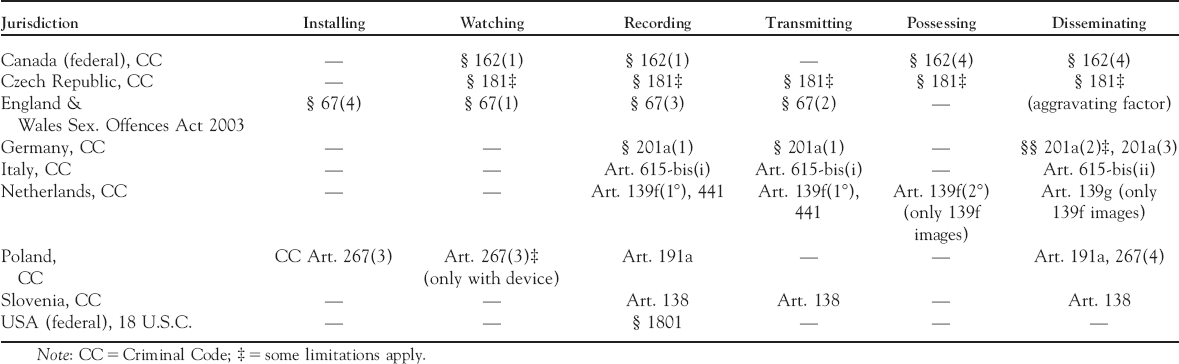
There is considerable variance in the types of behavior criminalized across the jurisdictions in our study. Overall, we find six main types of activities criminalized: three primary activities (watching, recording, and transmittingFootnote 7 ), the preparatory activity of installing equipment or adapting a structure to facilitate visual observation, and two ex-post activities, namely, possession and dissemination of captured images or information. Recording is the only form shared across all jurisdictions in our study, although unlawful dissemination of images is also widely criminalized (see Table 1).
Forms of Conduct Criminalized Under Visual-Observation-Related Offenses

| Jurisdiction | Installing | Watching | Recording | Transmitting | Possessing | Disseminating |
|---|---|---|---|---|---|---|
| Canada (federal), CC | — | § 162(1) | § 162(1) | — | § 162(4) | § 162(4) |
| Czech Republic, CC | — | § 181‡ | § 181‡ | § 181‡ | § 181‡ | § 181‡ |
| England & Wales Sex. Offences Act 2003 | § 67(4) | § 67(1) | § 67(3) | § 67(2) | — | (aggravating factor) |
| Germany, CC | — | — | § 201a(1) | § 201a(1) | — | §§ 201a(2)‡, 201a(3) |
| Italy, CC | — | — | Art. 615-bis(i) | Art. 615-bis(i) | — | Art. 615-bis(ii) |
| Netherlands, CC | — | — | Art. 139f(1°), 441 | Art. 139f(1°), 441 | Art. 139f(2°) (only 139f images) | Art. 139g (only 139f images) |
| Poland, CC | CC Art. 267(3) | Art. 267(3)‡ (only with device) | Art. 191a | — | — | Art. 191a, 267(4) |
| Slovenia, CC | — | — | Art. 138 | Art. 138 | — | Art. 138 |
| USA (federal), 18 U.S.C. | — | — | § 1801 | — | — | — |
Note: CC=Criminal Code; ‡=some limitations apply.
Within these different categories, we also find some interesting variation. For example, within watching offenses, two common law jurisdictions prohibit all forms of watching (including naked-eye observation), while Poland only prohibits watching with a visual or technical device. Most (but not all) countries that do not criminalize naked-eye observation prohibit real-time transmission of images to others. The Netherlands is the only country that explicitly criminalizes the mere possession of unlawfully created images, although Canada penalizes possession for dissemination-related purposes.
Criminalizing dissemination in addition to recording may seem superfluous (particularly since the maximum punishment is usually the same as for recording), but it covers instances where people disseminate unlawful recordings made by others (usually under the condition that the disseminator knows or should know that the image was unlawfully created), thus furthering the privacy-related harm the laws were designed to address. Canada, the Netherlands, and Slovenia limit the dissemination offense to images that were made unlawfully. In contrast, Germany and Italy also penalize dissemination of pictures that were lawfully created (e.g., because there was consent, or absence of criminal intent), but made in the manner indicated in the description of the recording-based crime (e.g., in a dwelling) (German CC § 201a(4); Italian CC Art. 615-bis(2); Crespi, Stella, and Zuccalà Reference Crespi, Federico and Giuseppe2008, 1724). Moreover, Germany penalizes the dissemination of pictures that can seriously harm someone's reputation (German CC § 201a(2)), while Poland criminalizes the nonconsensual dissemination of voluntarily made pictures of a person while naked or involved in sexual activity (Polish CC Art. 191a). The latter is particularly relevant for combating revenge porn, something that most of our jurisdictions cannot prosecute on the basis of visual-observation-related offenses alone if the published nude images have been made with consent.Footnote 8
III. Factors Affecting Reasonable Expectations of Privacy
Understanding the relative degree of protection afforded by offenses both within and across the two broad categories of offenses described in general terms above requires a more fine-grained analysis. In this section, we identify factors that appear to determine the reach of the criminal law; that is, the extent to which the criminal law recognizes a person's expectations in respect of remaining unobserved to be reasonable and, therefore, worthy of protection. Although only the common law jurisdictions tend to use the “reasonable expectation of privacy” standard explicitly, civil law jurisdictions implicitly apply a similar standard by using criteria that define when people can reasonably expect to remain unobserved. Analyzing these factors will enable us to say more about institutional conceptions of the value of privacy. Of course, none of these factors is in themselves preponderant—always, the combination of factors determines the reasonableness of remaining unobserved.
Technical Device
The use of technical devices can significantly amplify the effects of being observed on inhibitory and relational aspects of subjects' autonomy. Perhaps unsurprisingly, therefore, technical devices appear to be particularly influential in legislative notions of reasonable expectations of privacy. The fact that all jurisdictions criminalize visual recordings underlines the fact that visual-observation-related offenses assume some use of technology. Only Canada and the United Kingdom explicitly criminalize unaided watching, but this is limited to classic “peeping-tom” scenarios with sexual connotations.Footnote 9 Thus, except when nudity or certain intimate activities are being observed, criminal law normally does not protect people against being seen or watched by others. This may be due to an implicit historical assumption that people who do not want to be observed can shield themselves from observation relatively easily by withdrawing behind visual barriers (walls, curtains, clothes). Conversely, if people move beyond visual barriers, they knowingly take the risk that others can see them, and they can adapt their behavior accordingly. However, when visibility leads to records, where an exact reproduction can be made of an otherwise transient image, the situation changes. “The image after all is being recorded, it comes within the reach of others, can be multiplied or published; it can even be a tool in … blackmail.”Footnote 10 The fact that a fleeting image is captured in a potentially durable record makes people more vulnerable. In addition, the fact that recordings, as mediated images, isolate the observed from their original context and place them in a different context (Brighenti Reference Brighenti2007, 339) is a privacy-relevant concern (Nissenbaum Reference Nissenbaum2010). Thus, technology as a record-making and record-keeping tool is an important factor affecting the reasonableness of remaining unobserved.
The reproductive capacity of technology is not limited to enabling durably stored exact reproductions, however. Although Italian law uses the term “recording devices” (strumenti di ripresa), Italian doctrine interprets this extensively to include instruments that do not record but only transmit sounds or images in another's dwelling, as non-recording devices are also “endowed with an extraordinary capacity to penetrate into another's domiciliary sphere” (Palazzo Reference Palazzo1975, 131–32; see also Mantovani Reference Mantovani2013, 560). However, nontechnical forms of obtaining information, such as from servants or by reading diaries, are not punishable—the law specifically protects against indiscretions that appear particularly insidious because of the use of technological devices (Palazzo Reference Palazzo1975, 129–30). Similarly, the Dutch legislature criminalized the live streaming of images, because of the “possibility to produce authentic recordings,” without the recording being necessarily durable or reproducible (Fokkens Reference Fokkens, Noyon, Langemeijer and Remmelink2004). It therefore makes a difference whether images are created in technology-based (temporary or permanent) memory or in human memory. The temporal element (as technology enables later viewings) is very important, but not a necessary condition. Likewise, many jurisdictions cover spatial reproduction (technologically enabled instantaneous viewing from remote locations) through the inclusion of transmission-related offenses.
Another, less decisive function of technology is the enhancement of human perception, for example, through binoculars. We see this in Poland's criminalization of peeping toms who use visual or technical devices. The fact that other countries do not criminalize technology-enhanced perception as such indicates that lack of visibility at a distance is generally not considered a protection-worthy legal good. For instance, the Dutch 1971 law did not criminalize visual recordings of people in private yards because “nowadays telephoto lenses are used so frequently.”Footnote 11 Thus, because of the widespread availability of perception-enhancing technology, people should consider their gardens and yards as similar to public places, in terms of not being protected by criminal law against visual observation. (However, in 2003, Dutch law changed to criminalize covert visual observation in all places, putting more emphasis on surreptitiousness than on place, but zoom lenses were not considered an indicator of surreptitiousness as such.)
Place
Places play an important role in determining the scope of visual-observation-related offenses. There is a strong presumption that people can reasonably expect to remain unobserved in the most private places (particularly dwellings) but not in public places. However, jurisdictions vary in how they use place as a determining factor in observation crimes.
Dwellings are specifically mentioned in German and Italian law (for privacy violating images) and Dutch law (for covertly made pictures). While Italy also includes appurtenances, this is limited to spaces protected from vision of external parties: taking pictures of people on deck of a ship or in a garden or courtyard where there is nothing to impede the view does not fall under Article 615-bis (Dolcini and Marinucci Reference Dolcini and Giorgio2011, 5971). Similarly, but extending protection to nonresidential places, German law also protects against observation in spaces “especially protected from view” (German CC § 201a). Such an extension also features in the Italian and Dutch protection for people in non-publicly accessible places (e.g., workspaces or private clubs), without, however, a requirement that these places be shielded from public view. Moreover, in contrast to other jurisdictions, Dutch law also explicitly protects against observation in publicly accessible places, but this is limited to surreptitious recordings, and it is a misdemeanor with lower punishment than observation in private places.
In England and Wales, the offense of voyeurism is committed only in respect to observation of persons “in a place which, in the circumstances, would reasonably be expected to provide privacy” (Sexual Offences Act § 68). Although broader than in the original proposal (which was limited to persons in buildings or other structures), and potentially covering “open” places, closed places will more readily be reasonably assumed to provide privacy. The sentencing guidelines mention victims being “observed or recorded in their own home or residence” as a factor indicating increased harm.Footnote 12 Similarly, Canadian law covers observation of someone in a place where persons can reasonably be expected to be (partially) nude or to have sex (Canadian CC § 162(1)(a))—which will normally be private or closed places rather than public ones. Similarly, US voyeurism law covers recording under “circumstances in which a reasonable person would believe that a private area of the individual would not be visible to the public, regardless of whether that person is in a public or private place” (18 U.S.C. § 1801(5)(B)); combined with the general view under US law that reasonable expectations of privacy are greatly diminished in publicly accessible places, the provision would generally only cover observation in relatively “private” spaces. Additionally, jurisdictions that do not specifically refer to (private) places will often apply it implicitly as a relevant factor in determining whether an intrusion is unlawful. The Polish, Slovenian, and Czech provisions, for example, can also apply in public or publicly accessible places, since they are not spatially limited. However, in these jurisdictions, recordings in private places will arguably be more readily considered unlawful than those made in public.
Interestingly, some spaces accessible to the public are nevertheless associated with private acts, such as toilets, bathrooms, fitting rooms, and changing rooms. Given the heightened expectation of privacy, such places are interpreted in Dutch law as non-publicly accessible places protected under Article 139f of the Dutch CC (Ten Voorde Reference Ten Voorde, Cleiren, Crijns and Verpalen2016, 8(d)) and are also mentioned alongside dwellings in some US state legislation.Footnote 13 The German notion of “spaces especially protected from view” also covers these types of spaces (Kindhäuser, Neumann, and Paeffgen Reference Kindhäuser, Neumann and Paeffgen2013, § 5). In the English case of R. v. Bassett,Footnote 14 the defendant was convicted of voyeurism using a camera hidden in a bag in a communal male changing area at a swimming pool, filming a showering man wearing swimming trunks. The court recognized that persons could have a reasonable expectation of privacy in places where they could possibly be seen, referring to an unreported caseFootnote 15 in which marathon runners had gone into bushes to urinate. Although they were not entirely concealed from public view, the runners had entered the bushes to find a degree of privacy. Here, an expectation that they would not be followed and observed would be reasonable. However, according to the court, while the runners could reasonably expect people not to loiter near the bushes closely observing them, they could also reasonably expect “casual and innocent” encounters with passersby coming across them by accident. In such circumstances, no offense of voyeurism would be committed even if the “accidental observer” derived sexual gratification from the view. By analogy, those using a shower cubicle in a communal changing room that was not entirely enclosed from others' view might have a reasonable expectation of privacy in respect of someone who has drilled a hole in the wall to observe them, but not in respect of casual observation by other changing room users. The reasoning of the English court is similar to that used in R. v. Rudiger (Canada) in relation to sexually charged photography and video-making of young girls' private areas at a shower area by a swimming pool in a public park, which was punishable voyeurism in light of “the protean and flexible nature of a privacy interest” that may also apply in public.Footnote 16 However, nude sunbathers on a clothing-optional beach were found by a Canadian court to have no reasonable expectation of privacy not to be photographed.Footnote 17
Subject Matter
In some jurisdictions, subject matter does not seem relevant to criminal liability. In the Netherlands, any surreptitiously taken picture can be punishable. Italy restricts the criminalization to images pertaining to private life, but this is not a substantial limitation since pictures taken inside private spaces will usually depict private-life scenes. Similarly, Germany (in § 201a(1)(1)) and Slovenia limit the offenses to recordings that substantially interfere with privacy, but in these provisions, the privacy interference seems to lie more in the modus operandi than in the subject matter itself. However, in other jurisdictions, the subject matter does influence the reasonableness of remaining unobserved, relating to situations of nudity or embarrassment.
Nudity and Intimate Acts
Voyeurism-related offenses are generally limited to observation of nudity or intimate (sexual or toilet-related) behavior. The United Kingdom, United States, and Canada limit the nudity to genitals, buttocks, and (female)Footnote 18 breasts, either naked or clad in undergarments. According to the US federal law's drafters, the nudity focus in 18 U.S.C. § 1801 was designed to “criminalize the appalling practice of filming or photographing victims without their knowledge or consent under circumstances violating their privacy,” including conduct “referred to as ‘upskirting’ or ‘downshirting.’”Footnote 19 Relevantly, privacy expectations in clothing are context sensitive: the Northern Ireland Court of Appeal held that if a woman were to be filmed wearing bikini bottoms as underwear (in circumstances where she was entitled to expect privacy), an offense of voyeurism would be committed; however, if the bikini bottoms were being worn as swimwear, no offense would be committed.Footnote 20
Moreover, the Canadian and UK offenses explicitly apply to observation of sexual activity or toilet use as such, regardless of whether private parts or underwear are visible, thus protecting against observation of intimate acts done while private parts are kept shielded from view. The United Kingdom limits the sexual acts to those “not of a kind ordinarily done in public” (Sexual Offences Act § 68(1)(c)), thus presumably excluding kissing, similarly to Canada's mention of “explicit” sexual activity (Canadian CC § 162(1)(a)). In contrast to these jurisdictions' focus on people's private parts and intimate behavior, Article 191a of the Polish CC is broader, covering any part of a naked human body that allows for identification of that person (although, as observed, some authors consider that some private parts need to be visible), and also covering nonsexual purposes, such as ridicule, showing ugliness, or generally interfering with the private sphere of the person.
Embarrassing Situations
The focus on nudity in Polish Article 191a seems to be about protecting people against voyeurs, but also against embarrassing, shameful, or otherwise harmful depictions. We encounter a similar concern in Germany's criminalization of pictures that showcase another person's helplessness and thereby violate intimate privacy (§ 201a(1)(2)). Since this provision was inserted at a later stage in the legislative process, the legislative history provides little material to assist its interpretation or clarify its rationale. What is clear is that the lawmaker intended to cover a broad concept of helplessness: examples include victims of traffic accidents,Footnote 21 victims of violence lying bloodied on the ground, drunken people returning home,Footnote 22 and drunken teenagers.Footnote 23 Protection is considered especially important if it concerns situations that the persons did not cause through their own fault,Footnote 24 although the examples of drunkenness indicate that also self-caused helplessness can trigger protection. Importantly, helplessness refers to image content and not just the circumstances of its creation: helplessness must be visible in the image. In a case where a perpetrator used his cell phone to video-record an abducted man who, under threat of violence, inserted a bottle into his rectum, the German federal Supreme Court determined that the recording would only “show helplessness” if the context of the threat was also evident in the recording. Showing the act of inserting the bottle, in itself, does not sufficiently show helplessness.Footnote 25 The emphasis, thus, seems to be on situations where people are portrayed in a situation they do not control. In that sense, Section 201a(2) of the German CC protects people not so much against acts against their autonomy (in the sense that, being helpless, they cannot prevent pictures being made), but against acts that showcase their lack of autonomy. Such acts fundamentally undermine the possibility of impression management, since they take away someone's image as having agency. Especially for people in embarrassing or degrading situations, there is an interest in pictures not being transmitted to other parties.Footnote 26
A similar concern is visible in the English sentencing guidelines, which stipulate that offenses motivated by, or demonstrating, hostility to victims based on religion, race, sexual orientation, transgender identity, or disability trigger raised culpability.Footnote 27 Slovenian case law on unlawful visual recording (as a form of protection of one's own image) also includes recordings that result in ridicule and feelings of embarrassment,Footnote 28 while Italian law (Art. 734-bis) protects people from being portrayed in publications as victims of sexual violence.
Interestingly, Article 139f of the Dutch CC originally also sought to protect people against pictures made “under circumstances that are compromising or at least embarrassing for the person concerned,”Footnote 29 by requiring that the picture “could harm the legitimate interest” of the depicted person. In 2003, the lawmaker felt that this limitation was “no longer in line with contemporary views on privacy protection,” and changed the provision to ensure that taking pictures surreptitiously in private places is punishable “regardless of the nature of the picture.”Footnote 30
Privacy-Related Objects
One additional form of subject matter bears mentioning. While the jurisdictions we studied focus on observations of people, Slovenia has also penalized the unauthorized recording of a person's premises (njegovih prostorov). This generally refers to someone's dwelling, but can also include places such as one's hotel or dorm room, garage, storage room, basement, balcony, garden, courtyard, and similar spaces that one can inhabit or that reflect the person (Šugman Stubbs and Gorkič Reference Šugman Stubbs and Gorkič2011, 123). Where visual recordings of premises substantially interfere with someone's privacy, this is punishable regardless of whether the person herself was actually recorded. Here, the places most closely connected to a person seem to be regarded as an extension of that person, so that the privacy interest in remaining unobserved applies not only to the person's body but also to the person's intimate places, as both can reveal much of private life.
Surreptitiousness, Deceit, Force
Another important factor is the mode of observation, in particular whether the observed person knows about and consents to the observation that is taking place. Some jurisdictions protect people particularly in situations where they do not know (or cannot be supposed to know) that they are (or may be) observed. The Canadian voyeurism offense is limited to surreptitious observation (§ 162(1) CC). Thus, sunbathers on a public beach lack a reasonable expectation of privacy that others will not capture images of them overtly.Footnote 31 Surreptitiousness also plays a major role in the Dutch offenses, particularly since they apply regardless of subject matter (Fokkens Reference Fokkens, Noyon, Langemeijer and Remmelink2004, § 1). Taking pictures without consent is criminalized only if the device's presence has not been clearly made known (e.g., through signs announcing CCTV). In private places, this applies to any type of camera.Footnote 32 For visual observation in public, however, criminalization is limited to devices “mounted for this purpose” (daartoe aangebracht), that is, placed for the purpose of photographing or filming people. This is, in principle, limited to fixed and somewhat durably installed cameras, such as CCTV cameras operated by owners of publicly accessible places. This excludes portable, handheld cameras—a significant limitation of the criminalization of observation in public. However, if an additional step is taken so that the presence of a portable camera is no longer readily visible (e.g., it is hidden in an object or vehicle), then this counts as “mounting” the camera for the purpose of covert observation.Footnote 33 Hence, people are not protected against unlawful picture-taking by visible cameras in public, but they are against unlawful picture-taking by hidden cameras. At the same time, Dutch lawmakers have not accounted for the use of zoom lenses at large distances (which can make picture-taking covert in practice), creating the possibly inconsistent situation that observation with hidden cameras is an offense, while observation with a zoom lens at distances where the camera is practically invisible to the photographed person's naked eye is not.
By contrast, under Canadian law, the use of a zoom lens may tip the balance in the reasonable expectation of privacy test as it enables a secretive “close-up recording of [the victims'] private areas.”Footnote 34 Additionally, the surreptitiousness element of the offense applies to the act of observation itself in Canada, while in the Netherlands it refers to the presence of a recording device. Canada thus criminalizes covert use of an overtly present camera (which the Netherlands does not), while the Netherlands criminalizes overt use (e.g., by using a camera's flash) of a covertly present cameraFootnote 35 (which Canada does not).
Other jurisdictions focus less on covertness and more on consent. The English, Polish (Art. 191a), Slovenian, and US (federal) provisions only cover situations where consent is lacking. Consent is also implicitly present in Section 615-bis of the Italian CC, since lack of consent can be an important factor in deciding whether an observation was “undue.” The Polish provision further narrows the criminalization of recording nude or sex images to a subcategory of nonconsensual situations by requiring some form of force, unlawful threat, or deceit. This echoes the original Dutch provision from 1971 that, instead of use of covert devices, required that a recording took place “using an opportunity created by guile or trick.” Some form of deceit may also be necessary for Czech law to apply to observation, as this can be qualified only under the broad provision that prohibits infringing someone's rights by misleading them or exploiting their erroneous belief (CC § 181), although arguably surreptitious (but not deceitful) recording may also qualify as such if the perpetrator exploited the observed person's erroneous belief that she was in an unobserved (or unobservable) situation.
In relation to revenge porn, a relevant question is whether recording of consensual sexual activities by one partner without (explicit) consent of the other is criminalized. Under Italian law, this does not violate Article 615-bis, as long as the recording is not spread or shown to others.Footnote 36 The same conclusion has been reached in Czech case law on Section 181.Footnote 37 Under Dutch law, it depends on the visibility of the recording device; for instance, nonconsensual recordings of sexual activities in front of a webcam are not punishable, as the webcam is clearly present and the streaming person should therefore know that the recipient might store the images (Koops and de Roos Reference Koops, deRoos and Koops2007, 38).
Intent
Besides general intent requirements, some jurisdictions require particular forms of intent. In England and Wales, the voyeurism offenses are limited to behaviors done “for the purpose of obtaining sexual gratification” (Sexual Offences Act 2003 § 67(1)(a)). This is significantly narrower than the originally proposed offense, which would have criminalized observation per se of persons inside a structure in circumstances involving a reasonable privacy expectation. Some US states have similar requirements,Footnote 38 but US federal law does not explicitly limit the voyeurism offense to sexually-charged observation of nudity. Interestingly, Canadian law also includes unlawful observation or recording that is “done for a sexual purpose” (CC § 162(1)(c)), but this is an extension rather than a limitation of criminal liability. As such, Canada's voyeurism offense also covers observation of non-nude and non-love-making persons, if the observation has a sexual purpose. In comparison, English criminal law does not protect naked people in their bathrooms from observation by anthropologists studying bathing practices (even if the anthropologist does in fact derive sexual gratification when observing for academic purposes).
Intent requirements may also serve to prevent over-criminalization. In the US and Canadian laws that contain intent requirements, the intent must be focused on capturing the (partial) nudity or sexual activity of the victim. This precludes criminal liability for images that accidentally show nudity (e.g., a removal man suddenly bending down and showing his anal cleft) or sexual activity (e.g., a copulating couple in a copse in the background of a nature photograph) without this having been the photographer's focus. Similarly, the Dutch criminalization of surreptitious visual recordings in public is limited to covert cameras mounted to surveil people; cameras focused on objects, such as traffic cameras recording speeding or cars going through a red light, are excluded from the offense, even if captured images accidentally include a person.Footnote 39
Identifiability
Most criminal provisions do not require the depicted persons in an image to be identifiable, although identifiability may play a role in assessing whether visual observation violated a reasonable privacy expectation (under common law offenses) or was unlawful or constituted a privacy violation (under civil law offenses). Identifiability may also influence other factors discussed above; for instance, the Dutch exclusion of object-focused cameras saves from criminal liability a webcam mounted to record some festivity in public if pictured people are not identifiable, but if it was mounted so that “persons would be systematically pictured identifiably,” then its apparent intent is to surveil people, not objects,Footnote 40 and consequently it is covered by the criminalization.
The Polish offense in Article 191a, criminalizing the procurement of images of a naked person or a person during sexual act, requires the victim to be identifiable in the recording to qualify as an offense, suggesting that this provision is also an offense against data protection and not only against physical privacy. It should be noted that the standard of identifiability is relatively low: if at least one person other than the victim can identify her in the image (Filek Reference Filek2012, 70), based on any characteristic trait typical to the victim's body (Filek Reference Filek2012, 67), the identifiability requirement would be satisfied. Thus, a recording need not necessarily include the face of the victim or any personal data. Some state-level voyeurism provisions in the United States also only criminalize conduct when the victim is identifiable.Footnote 41 In contrast, the Slovenian Supreme Court has implicitly determined that victims do not need to be identifiable for Article 138 CC to apply, as posting a close-up photograph of the injured party's sexual organ on Facebook without her name or other data that would make her identifiable to others was already considered a clear violation of (the most intimate aspects of) one's privacy.Footnote 42 In some jurisdictions, the disclosure of intimate images becomes criminal only when the victim is identifiable.Footnote 43
Counter-Indicators
Although observation can infringe privacy, other interests may justify observation. Many jurisdictions explicitly balance other factors against privacy interests. Germany, for instance, mentions “art or science, research or education, news-provisioning on contemporary or historical events or similar purposes” as factors that can outweigh the privacy interest in not recording or transmitting pictures of helpless people or in not disseminating reputation-damaging pictures (CC § 201a(4)). Notably, the exception does not apply to visual recordings in dwellings or closed-off spaces, demonstrating Germany's strong protection of the privacy of home life.
More generally, Canada excludes criminal liability for voyeuristic acts “that serve the public good and do not extend beyond what serves the public good” (CC § 162(6)). Dutch law includes the term “unlawful” as an element of the offense to leave discretion to courts to balance privacy against other interests, such as freedom of expression (particularly where journalists take pictures without consent) (Ten Voorde Reference Ten Voorde, Cleiren, Crijns and Verpalen2016, § 8b), similar to the Italian law's inclusion of “undue.” US law excludes federal criminal liability for “any lawful law enforcement, correctional, or intelligence activity” (18 U.S.C. § 1801(c)).
Other
Some other factors may affect the determination of liability or level of punishment for visual observation, although these are more connected to the gravity of a privacy infringement than the assessment of whether privacy was infringed as such. We encounter several such factors in the English sentencing guidelines for voyeurism. Although there is no separate offense of publication of images, distribution is an aggravating factor for sentencing purposes. Also, the location and timing of the offense, the placing of images where they can be seen by many viewers, and the period over which the victim was observed—or within which the images were made or distributed—are aggravating factors under English law.Footnote 44
IV. Discussion and Conclusion
Voyeurism, Intrusion, and Autonomy
In this article, we have analyzed when nonconsensual visual observation is deemed harmful enough to trigger criminal sanctions. The common law jurisdictions we studied, with their general focus on voyeurism-related offenses, criminalize a narrower range of observation activities than most civil law jurisdictions do in their intrusion-related offenses. Apparently, the former consider the inhibitory effect of undesired observation on autonomy to be particularly salient in situations where people are (partly) nude, engaged in intimate bodily activities, or the object of sexually motivated observation. In England and Wales, for example, criminalization in 2003 was informed by the idea that “secret observation for the gratification of the watcher” was likely to engender in the observed person a sense of violation “not only of their privacy but of their sense of … integrity” (Home Office 2000, 122). The harm that the proposed offense was intended to address was the “fear and distress” that persons could suffer when it was discovered that they had been observed in circumstances presumed to be private. Criminalization reinforced, on a more explicit basis, the offenses that were used before 2003 to prosecute visual observation, such as assault (applied to entering a private garden and observing a woman in her nightdress through a gap in her sitting-room curtainsFootnote 45 ).
The (generally civil law) intrusion-centric jurisdictions seem to consider autonomous agency also to be undermined if we feel inhibited by fear of being observed in other unwanted ways or in circumstances other than during sex or in a state of undress. The focus may still be, however, on intimate life. The German heading of Section 201a of the CC referring to “intimate privacy” (höchstpersönliches Lebensbereich) positions visual observation offenses in the intimate zone of life, which primarily takes place in dwellings or other private places. The Czech Supreme Court has found violations of the general provision protecting against serious detriment to a person's rights in recording spaces where people's intimate privacy is on display.Footnote 46 However, intimate life is not limited to nudity or sex, but relates to all aspects of private life unfolding in closed spaces. The Italian offenses, for example, help protect more generally “the freedom to manifest one's personality as it expresses itself in the domestic and private sphere” (Garofoli Reference Garofoli2006, 254) or “the reservedness or privacy in the places of private abode in which private life principally unfolds” (Dolcini and Marinucci Reference Dolcini and Giorgio2011, 5969).
Some jurisdictions with intrusion-related offenses construe the privacy interest still more broadly, the rationale of criminalization consisting in fostering people's ability to present themselves in a way that is consistent with presentation of a particular image of oneself, an image that will define the relationship that one has with oneself and others. Here, the relevant privacy interest appears to be the freedom to develop oneself or to construct one's identity without unreasonable constraints (in line with Agre's [Reference Agre, Agre and Rotenberg1998, 7] privacy definition and a frequently used Dutch legal framing of privacy as “being able to be yourself uninhibitedly” [Blok Reference Blok2002, 43]), which can stretch from the personal and intimate into the public zone. For instance, the Slovenian Supreme Court found that a violation of the right to privacy causes unpleasant feelings such as sorrow, disappointment, mistrust, shame, and humiliation, so that a “substantial interference with privacy” in visual recording occurs when a person's dignity, mental integrity, and inner peace is violated.Footnote 47 The Polish protection of information against visual recording, the German provision on reputation-damaging pictures, the Slovenian provision protecting one's own image, and the Dutch criminalization of covert visual recording in public all contribute to some level of privacy that enables individuals to control the way they present themselves and how others are likely to perceive them.
Thus, overall, the main reason of criminalizing nonconsensual visual observation relates to the idea that such observation might cause embarrassment, shame, or humiliation, which can have a significant inhibiting effect on someone's decisions and behavior, and that what is revealed might change others' attitude toward the person so that they are less inclined to engage with the person in ways that will enable her to act on her desires. However, if autonomy is the underlying concern in all our jurisdictions, the question arises as to why there are two broad types of offenses, and why common law jurisdictions are generally voyeurism centric and civil law jurisdictions have a broader, intrusion-centric approach. This question cannot be answered based on the doctrinal legal analysis applied in this article, but requires further scrutiny based on, for instance, functional comparative legal or socio-legal analysis. We can, however, offer some hypotheses that might be tested in follow-up research. One hypothesis would be that lawmakers in common law countries tend to place more emphasis on freedom of expression (including on publication of images in the press), so that only the most intimate parts of private life—nudity and sex—are considered worthy to protect against image-making. This would, however, not seem to explain the voyeurism-centric approach in Canadian law, which, in terms of balancing privacy and freedom of expression interests, generally seems somewhat closer to Continental Europe than to the United States or the United Kingdom (see Liptak Reference Liptak2008). Another hypothesis, then, would be that common law jurisdictions tend to have strong tort law traditions, in which certain privacy violations are dealt with through tort law rather than through criminal law. Possibly also relevant is the stronger common law tradition of protecting privacy through property-related offenses, which contrasts with the dignity approach to privacy in civil law traditions; perhaps combinations of intrusions into closed spaces and visual observation of people will be dealt with primarily through trespass offenses (highlighting the importance of property) in common law systems and primarily through observation-related offenses (highlighting the importance of reputation and dignity) in civil law systems.
A Normative Framework for Criminalizing Nonconsensual Visual Observation
While we have highlighted the general differences between common law and civil law systems, recognizing two broad approaches to criminalizing nonconsensual visual observation, we should nuance the distinction between voyeurism-centric and intrusion-centric approaches as being less sharp than it may seem. In fact, despite a general difference in scope of criminalization between voyeurism-focused and intrusion-focused offenses, there are many commonalities between the jurisdictions we studied, particularly in the rather fine-grained combination of factors that must be fulfilled before criminal liability applies. Although the particular combinations or weight factors differ from country to country, all provisions can be interpreted as ways to assist people in their impression management, which is a vital aspect of preserving people's autonomy in the context of social relationships. The factors influencing the reasonableness of remaining unobserved all see to situations in which disruptions occur in someone's self-presentation and where normal techniques of “saving the show” (Goffman Reference Goffman1959, 239) provide insufficient redress—particularly where intrusions are intentional rather than accidental.
Thus, places in which people have a reasonable expectation of privacy protect people's “backstage” life, where, usually in places of intimacy, they relax from playing their public persona(s). Unwanted intrusions into backstage life can have a significant inhibitory effect on people's subsequent behavior onstage, especially when an observer acquires recordings. Likewise, the specific types of subject matter included in certain observation-related offenses indicate major disruptions to impression management—that is, they protect people from being observed in situations involving nudity, sexual activities, or certain embarrassing conditions where they have limited possibilities to control how others will perceive them, which may strongly affect how they will be perceived in social relationships. Provisions in which surreptitiousness or deceit play a strong role particularly address disruptions in impression management that cause people to be seen, whether offstage or onstage, by an audience they did not intend to reach.
However, none of these factors alone are sufficient to trigger criminal liability if no technology is involved, except in the common law provisions on naked-eye voyeurism (which underline the great harm to autonomy if people feel inhibited in their most intimate activities). Most disruptions in impression management do not reach the threshold of criminal law except if observation occurs with a technical device that substantially enhances observers' capacities of human perception and, particularly, enlarges the risk of other audiences watching a recorded or transmitted image. The recording, transmission, and publication of images enables a far larger audience to receive an impression than is possible through direct observation; where (the risk of) dissemination is widespread, the humiliation or embarrassment associated with undesired observation will be felt more acutely, and the inhibitory effect is likely to be far greater than when a person becomes aware of having been watched merely at a singular time and place by one or a few observers. Additionally, as technology enlarges the distance between the observer and the observed in space and time, it is more difficult for the observed to rely on traditional measures to minimize the harm from having been observed. This is where criminal law, as a last resort to fill gaps in protection, steps in by criminalizing (besides, in some countries, the most intrusive forms of naked-eye observation) technology-aided observation, in combination with factors such as place, subject matter, or surreptitiousness that create substantial disruptions in impression management. The other factors we have discussed, including intent, identifiability, and counter-indicators, serve largely to prevent over-criminalization by further limiting criminal liability to situations where the harm to autonomy through nonconsensual observations substantially outweighs the interests others may have in making or disseminating images.
Together, the factors we have distinguished can serve as a useful framework for lawmakers intending to criminalize nonconsensual visual observation, or to update existing criminalization in light of socio-technical developments. To preserve people's autonomy, the law may need to step in to redress serious disruptions of people's capacity for impression management. For those disruptions that lie outside people's control and that have (potentially) serious consequences for their freedom to choose and behave according to their own wishes, criminalization should be considered.
The most important factor is the use of a technical device, particularly to record or live stream images: the distance in time and space that visual recordings afford fundamentally disrupt the classic stage on which people present themselves, as it is far more difficult to manage the impressions one gives off to audiences far removed in space and/or time. The second most important factor is that the visual observation relates to parts of private life that people will usually not want to be visible to all and asunder. Since private life can relate to many aspects, and there is considerable variation in how people evaluate what is particularly private, lawmakers will have to find a proxy for this factor. As we have seen, one frequently used proxy is subject matter, which can be nudity and intimate acts, or embarrassing situations. Another, even more prevalent, proxy is place, which most jurisdictions use to limit criminalization of visual observation, namely, where this occurs in (usually closed) places where people traditionally have an expectation of privacy, such as dwellings or toilets. The other factors we have observed, including surreptitiousness or deceit, intent, identifiability, and certain counter-indicators, play a lesser but nevertheless relevant role, in that they function as additional factors to fine-tune the criminalization and to prevent over-criminalization.
We cannot say on the basis of our analysis whether the emerging framework is comprehensive, or whether other factors should be added. This is a useful question for follow-up research. Since the laws in our jurisdictions have developed over a considerable period, with some having been adapted recently, and given the relative breadth of the jurisdictions in our sample, we do not expect major factors to be missing in our overview; this could serve as an hypothesis that future research could seek to falsify.
Visual Observation in the Era of Social Media and Ubiquitous Cameras
While the framework emerging from our analysis seems, we hypothesize, fairly comprehensive, we do think that some rebalancing is needed in the way that legal systems weigh the different factors, in order to match contemporary socio-technical reality. Most legal frameworks we analyzed were developed throughout the 1970s to the 2000s, adapting the law to address then-topical privacy-invasive technologies (such as pocket cameras in the 1970s or camera-equipped cell phones in the 2000s). Although the Internet has been prominent since the mid-1990s, it is questionable whether laws provide sufficient protection against the potential harm to autonomy caused by online dissemination of nonconsensual images enabled by ubiquitous camera-equipped smartphones, one-click uploads, and social-media sharing buttons. Nowadays, people always run the risk that others will observe or record them whenever they enter or move about in publicly accessible places.
In contemporary society, human interactions are increasingly mediated by digital technologies, and images recorded by others' smartphones can have huge impacts on people's capacity for impression management, particularly if images are published online. More fundamentally, the mere fact that one's behavior can always be captured by someone flashing a smartphone somewhere, and that the image might somehow end up on social media, can have a significant inhibitory effect on people's freedom to behave according to their own choices. This implies that an important transformation is taking place in reciprocal visibility: the role of Simmel's uniting and trust-establishing mutual gaze is shrinking, while Sartre's asymmetrical supervisory gaze is on the rise. The potential adverse effect of this transformation of the visible is not limited to voyeuristic acts of spying on unsuspecting people during their most intimate activities, or to observing people relaxing offstage in private spaces; it is present wherever people move and act. Yet existing criminalization does not cover nonconsensual visual recordings in public spaces, except, in some jurisdictions, if they portray someone being helpless (as in Germany) or when pictures are made surreptitiously (as in the Netherlands).
What control do we have over images that simply record us in a physical state that we would not want permanently recorded and disseminated to a wide audience, for example, when we are ill, exhausted, or apparently intoxicated? When we wear a sloppy dress, have a bad hair day, or idly pick our noses? In terms of autonomy, although not as directly embarrassing as nude pictures, such images can seriously distort someone's reputation and interactions in social life, and it does not really matter whether one is recorded overtly or covertly, since in both cases there is little people can do to prevent being recorded. In contemporary society, the only way people can continue to manage the impressions they give off when moving around in publicly accessible places is always and consistently to fit their behavior in public into the straightjacket of a permanently non-embarrassing appearance. This is a very high price to pay, and one that can hardly be taxed on citizens if lawmakers value the fundamental interest of people being able to behave according to their own wishes. Yet, hardly any jurisdiction we studied criminalizes the non-covert taking of autonomy-undermining images in public. We think the time is ripe for considering criminalization of a broader range of technologically aided visual observation, also in public space, of images that show people in situations they will usually not want to be accessible to an unknown audience. Lawmakers should consider revising existing visual observation offenses in a way that puts less emphasis on intimate subject matter, private places, or covertness, and more emphasis on the role that technical devices and the Internet nowadays play in social interactions and in serious disruptions in impression management.
The recent German criminalization of privacy-infringing recordings of people in helpless situations seems a good starting point for updating legal frameworks to the socio-technical reality of ubiquitous cameras. We hope it may turn out to be the first in a new wave of visual observation offenses that address the most serious consequences of nonconsensual visual observation in the era of social media and ubiquitous mobile cameras.