A main focus of research in bilingualism has been language (non)selectivity during lexical access. A vast number of studies has explored whether the two languages of a bilingual are active even in monolingual situations, in which only one language is used (e.g., Comesaña, Ferré, Romero, Guasch, Soares & García-Chico, Reference Comesaña, Ferré, Romero, Guasch, Soares and García-Chico2015; Dijkstra, Miwa, Brummelhuis, Sappelli & Baayen, Reference Dijkstra, Miwa, Brummelhuis, Sappelli and Baayen2010; van Heuven & Dijkstra, Reference Van Heuven and Dijkstra2010). In this line of inquiry, a robust finding is the so-called cognate facilitation effect, i.e., an advantage in processing for cognate words (translation equivalents with a similar form, e.g., papel-paper, in Spanish and English, respectively) when compared to non-cognate words (i.e., translation equivalents which do not have any similarity in form, libro-book; see Dijkstra et al., Reference Dijkstra, Miwa, Brummelhuis, Sappelli and Baayen2010, for an overview).
Recent research in this field has evidenced that the amount of facilitation produced by cognate words depends on the degree of orthographic and phonological similarity between the two translation equivalents (Comesaña, Sánchez-Casas, Soares, Pinheiro, Rauber, Frade & Fraga, Reference Comesaña, Sánchez-Casas, Soares, Pinheiro, Rauber, Frade and Fraga2012; Comesaña et al., Reference Comesaña, Ferré, Romero, Guasch, Soares and García-Chico2015; Dijkstra et al., Reference Dijkstra, Miwa, Brummelhuis, Sappelli and Baayen2010; Duyck, van Assche, Drieghe & Hartsuiker, Reference Duyck, Assche, Drieghe and Hartsuiker2007). In fact, Dijkstra et al. (Reference Dijkstra, Miwa, Brummelhuis, Sappelli and Baayen2010) demonstrated that identical cognates (i.e., translation equivalents that share identical form, like piano, in both Spanish and English) showed the largest facilitative effect in a lexical decision task (i.e., the most widely used task in word recognition studies, in which participants are asked to decide whether a set of strings of letters are words). These results can be accounted for by one of the most influential models of bilingual memory, the Bilingual Interactive Activation Plus Model (BIA+, Dijkstra et al., Reference Dijkstra, Miwa, Brummelhuis, Sappelli and Baayen2010; Dijkstra & van Heuven, Reference Dijkstra and van Heuven2002). The BIA+ proposes an integrated lexicon with non-selective access for the two languages. According to the model, cognate words are preferentially processed because they share more orthographic, semantic and/or phonological features than non-cognate words. Thus, when one cognate word is presented, overlapping representations of both languages become active, leading to a facilitated recognition of cognates. Therefore, the cognate facilitation effect will depend on cross-linguistic similarity which is larger for identical cognates than for non-identical cognates. In fact, the model posits that these two types of words have a different type of orthographic representation (i.e., identical cognates, but not non-identical cognates, would share a single orthographic representation).
The studies that have addressed the role of formal similarity on the cognate facilitation effect have mainly relied on behavioral responses. The only exception is the study of Comesaña et al. (Reference Comesaña, Sánchez-Casas, Soares, Pinheiro, Rauber, Frade and Fraga2012), which reported a modulation of event related potential (ERP) components by orthographic and phonological overlap between cognates. However, in that study, only non-identical cognates were included. The aim of the present study was to test the predictions of the BIA+ model, concerning the effects of formal similarity on the cognate facilitation effect, by using, for the first time, pupillometry as a psychophysiological index of cognate processing.
We decided to rely on the pupil response because it has been proposed as an indicator of cognitive effort and processing difficulty in linguistic tasks (Guasch, Haro, Ferré & Vallès, Reference Guasch, Haro, Ferré and Vallès2015; Just & Carpenter, Reference Just and Carpenter1993; Kuchinke, Võ, Hofmann & Jacobs, Reference Kuchinke, Võ, Hofmann and Jacobs2007; Papesh & Goldinger, Reference Papesh and Goldinger2012; Schmidtke, Reference Schmidtke2014). This measure is operationalized either as the point of maximum pupil dilation in response to the presentation of a stimulus (i.e., peak dilation), or as the point in time where this peak dilation is achieved (i.e., peak latency). Thus, the larger the dilation or the longer the latency, the higher the cognitive effort. Indeed, pupil response is sensitive to variables that are known to affect word processing, such as lexical frequency (Guasch et al., Reference Guasch, Haro, Ferré and Vallès2015; Kuchinke et al., Reference Kuchinke, Võ, Hofmann and Jacobs2007; Papesh & Goldinger, Reference Papesh and Goldinger2012; Schmidtke, Reference Schmidtke2014), neighborhood density (Schmidtke, Reference Schmidtke2014), or the type of pseudowords that are used in a lexical decision task (Briesemeister, Hofmann, Tamm, Kuchinke, Braun & Jacobs, Reference Briesemeister, Hofmann, Tamm, Kuchinke, Braun and Jacobs2009). It is also sensitive to the syntactic complexity of sentences (Just & Carpenter, Reference Just and Carpenter1993). Noteworthy, behavioral and physiological data converge, as slower reaction times are commonly associated with larger pupil sizes (Kuchinke et al., Reference Kuchinke, Võ, Hofmann and Jacobs2007) or delayed pupil responses (Guasch et al., Reference Guasch, Haro, Ferré and Vallès2015; Schmidtke, Reference Schmidtke2014).
All the above research except the study by Schmidtke (Reference Schmidtke2014) has focused on monolingual word processing. To our knowledge, there are only two more studies that have used pupillometry to investigate second language processing (Duñabeitia & Costa, Reference Duñabeitia and Costa2015; Hyönä, Tommola & Alaja, Reference Hyönä, Tommola and Alaja1995). Schmidtke (Reference Schmidtke2014) showed that both lexical frequency and neighborhood density affected peak latency in a spoken word recognition task conducted in the second language (L2). Importantly, these effects were modulated by proficiency, being larger in participants with lower L2 proficiency. In a differently oriented research, Duñabeitia and Costa (Reference Duñabeitia and Costa2015) demonstrated that pupil dilation was larger when bilinguals told lies than when they told the truth and when they spoke in their second language when compared to their first language. In a similar vein, Hyönä et al. (Reference Hyönä, Tommola and Alaja1995) reported larger pupil dilations when bilinguals repeated words in L2 than in their first language. In addition, these authors observed a larger increase in pupil size with words that were difficult to translate than with words that could be easily translated.
The results of the above reviewed studies suggest that pupil response can be used to measure processing costs also in bilinguals. Furthermore, they reveal that pupil response is sensitive enough to capture differences in processing produced by the particular characteristics of words, such as lexical frequency, number of neighbors, or their ease of translation. Taking this into account, it is reasonable to expect pupil response to be also sensitive to the cognate status of words. Therefore, the aim of the present work was to test the predictions of the BIA+ model (Dijkstra et al., Reference Dijkstra, Miwa, Brummelhuis, Sappelli and Baayen2010; Dijkstra & van Heuven, Reference Dijkstra and van Heuven2002) concerning the effects of formal similarity between cognate words on participants’ behavioral and pupil responses during visual word recognition. To that end, we tested highly proficient Catalan–Spanish bilinguals in a lexical decision task conducted in Spanish in which the critical stimuli were identical cognates between the two languages, non-identical cognates, and non-cognates. If the degree of activation of orthographic and semantic representations depends on formal cross-languages overlap, cognate words should be processed more easily than non-cognate words. Furthermore, if the cognate facilitation effect depends on cross-linguistic similarity, identical cognates should be those showing the maximum facilitation. Importantly, the effects should be observed not only in behavioral measures, but also in physiological indicators of linguistic processing effort, namely pupil peak dilation and/or latency.
Method
Participants
Thirty-five Psychology students (28 women) from the University Rovira i Virgili (Tarragona, Spain) participated in the experiment as an optional course assignment. Their age ranged from 18 to 40 years old (Mage = 21.94, SD = 4.87). None of them reported a history of major visual impairment, and they had either normal (22 participants) or corrected to normal (13 participants) vision.
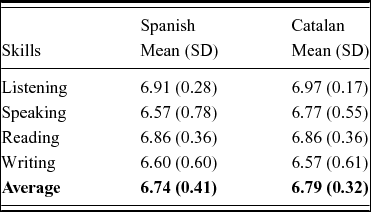
Participants were all native speakers of Catalan and Spanish (i.e., simultaneous bilinguals). All of them lived in Tarragona or in the surroundings (where both languages are spoken on a regular basis) at the time of the experiment. Furthermore, they were receiving their University education in both languages. To assess their proficiency in Spanish and Catalan, participants fulfilled a questionnaire in which they rated their ability in listening, speaking, reading, and writing by using a 7-point Likert scale (1 = “very poor” in the assessed skill, 7 = “native” in that skill; see Table 1).
Mean level of proficiency and standard deviation in the four linguistic skills in Spanish and Catalan.

Note. The anchor points for the 7-point Likert scale were 1 = “very poor”, and 7 = “native”.
Participants’ ratings did not differ between languages either in any of the four skills assessed (all ps > .05), or in the average proficiency in Spanish and Catalan, t(34) = .98, p = .33.
Materials
A set of 75 Spanish words were selected. Although participants were equally proficient in Spanish and Catalan, we chose Spanish as the language for the experiment due to the greater availability of normative data in that language. The words were divided into three experimental conditions according to the degree of formal overlap between the Spanish words and their Catalan translations. The three conditions were: identical cognates (e.g., reina, reina in both Spanish and Catalan; “queen”), non-identical cognates (e.g., escuela, escola in Spanish and Catalan, respectively; “school”), and non-cognates (e.g., hacha, destral in Spanish and Catalan, respectively; “axe”). To have an objective measure of the degree of formal overlap between the translation equivalents, we used the values obtained with two algorithms: the Orthographic Similarity (OS; van Orden, Reference Van Orden1987; Weber, Reference Weber1970), and a Normalized Levenshtein Distance (NLD; Levenshtein, Reference Levenshtein1966; Schepens, Dijkstra & Grootjen, Reference Schepens, Dijkstra and Grootjen2012). Both measures had been previously used in several studies with the same purpose (e.g., OS: Comesaña et al., Reference Comesaña, Sánchez-Casas, Soares, Pinheiro, Rauber, Frade and Fraga2012; Starreveld, de Groot, Rossmark & van Hell, Reference Starreveld, de Groot, Rossmark and van Hell2014; NLD: Comesaña et al., Reference Comesaña, Ferré, Romero, Guasch, Soares and García-Chico2015; Mulder, Dijkstra & Baayen, Reference Mulder, Dijkstra and Baayen2015). OS and NLD were computed using the online tool NIM (Guasch, Boada, Ferré & Sánchez-Casas, Reference Guasch, Boada, Ferré and Sánchez-Casas2013).
Identical cognates had a formal overlap of 100%. Non-identical cognates had a mean formal overlap of 73% and 77% (as for OS and NLD, respectively). Finally, non-cognates had a mean formal overlap of 16% and 15% (again for OS and NLD, respectively). A One-Way ANOVA showed that OS and NLD levels differed significantly across conditions: F(2,74) = 670.34, MSe = 4.62, p < .001, and F(2,74) = 874.54, MSe = 4.84, p < .001, respectively. Additional t-tests revealed significant differences between all pairs of conditions (all ps < .001). The characteristics of the experimental stimuli and the complete list of materials can be found in the Appendices S1 and S2 as supplementary materials (Supplementary Material).
A strict control across conditions of sublexical, lexical, and semantic variables that are known to affect lexical decisions was performed. We obtained the values to control for word frequency (in occurrences per million), log frequency, lemma frequency (in occurrences per million), log lemma frequency, bigram frequency, trigram frequency, contextual diversity, log contextual diversity, number of neighbors, number of higher frequency neighbors, the average Levenshtein distance of the 20 nearest neighbors (OLD20), word length, and number of syllables from EsPal (Duchon, Perea, Sebastián-Gallés, Martí & Carreiras, Reference Duchon, Perea, Sebastián-Gallés, Martí and Carreiras2013). Age-of-acquisition values were taken from Alonso, Fernandez and Díez (Reference Alonso, Fernandez and Díez2014). Finally, subjective ratings of familiarity, concreteness, imageability, context availability, emotional valence, and arousal were taken from the database of Guasch, Ferré and Fraga (in press). One-Way ANOVAs were conducted on each one of these twenty variables to ensure that there were no significant differences among the experimental conditions (all p values > .17).
Finally, 75 pseudowords were created for the purposes of the lexical decision task, by using the Wuggy pseudoword generator (Keuleers & Brysbaert, Reference Keuleers and Brysbaert2010). These pseudowords were orthographically legal in Spanish, and they were matched pairwise to the critical stimuli in length and subsyllabic structure. Six additional words and six pseudowords were selected to serve as practice trials.
Procedure
An SR Research EyeLink 1000 eye tracker at a sampling rate of 1000 Hz, with a monocular setup was used to record pupil size. Participant's right eye was chosen to keep the recording constant and because it is the dominant eye for the majority of people. Participants were seated in a comfortable chair with adjustable height. Their head was stabilized using a chinrest with forehead support. Participants looked at the screen from a constant distance of 60 cm. Stimuli were presented in a 19” display with a resolution of 1024x768 pixels using SR Research Experiment Builder. We used a 24 pixels Arial font, lowercase, drawn in black (Hex: #000000) on a grey background (Hex: #969696). Prior to the beginning of the experiment, participants received written instructions in Spanish.
In each trial, first, a fixation cross (+) appeared for 1000 ms in the center of the screen. Then, a letter string replaced the cross during 1500 ms or until participant's response. Participants were instructed to press with the right hand either the mouse button labeled as “YES” (left button) or “NO” (right button), as quickly and accurately as they could, indicating whether or not the letter string was a Spanish word. Then a new fixation cross appeared in the center of the screen for 1000 ms. A different random order of stimuli presentation was created for each participant. Preceding each trial, a self-paced display was presented in which participants were allowed to blink. This display also served as a calibration drift check. Once the experimental session had finished, participant's language proficiency was assessed with the questionnaire above described. The whole session took about forty minutes.
Data preparation
The dependent variables concerning behavioral data were Reaction Time (RT) and percentage of errors in the lexical decision task. However, as accuracy was very high and participants made very few errors in the critical conditions (M = 2.02, SD = 2.00; in percentage of errors), we did not perform accuracy analyses. Trials with response errors or without responses (3.90%) were discarded from the analyses. Trials with RTs lower than 200 ms or over 1500 ms (1.84%), and trials with RTs lower or higher than two standard deviations from the participant's mean (4.56%) were also excluded from the analyses.
Relevant pupillary variables were computed, on a trial-by-trial basis, from the time window comprised between target onset and 1500 ms after target onset. Additionally, a baseline pupil diameter was defined by averaging the pupil diameter during the 200 ms preceding the target onset (while the fixation cross was displayed). Next, pupil peak dilation and pupil peak latency were calculated. Peak dilation was the maximum percentage of change in pupil size with respect to the baseline, whereas peak latency was the point in time where peak dilation was achieved (starting from word onset).
Before performing the analyses pupillary data were trimmed. Samples with saccades (±25 ms) or eye-blinks (±50 ms) were removed (see van Rijn, Dalenberg, Borst & Sprenger, Reference Van Rijn, Dalenberg, Borst and Sprenger2012, for a similar procedure). Then, missing samples were filled in by linear interpolation and all the data were smoothed with a five-point moving-average smoothing filter. Following a procedure similar to that used by Schmidtke (Reference Schmidtke2014), we removed the trials whose baseline diameter was higher than peak dilation (7.43%).
Results
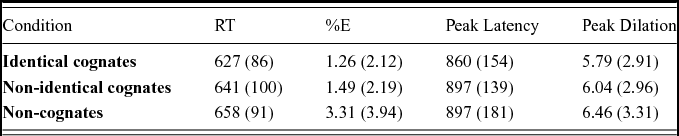
Two ANOVAs were performed on behavioral data (RTs) with the three-level factor cognate status (i.e., identical cognate words, non-identical cognate words, and non-cognate words). Cognate status was a within-subjects factor in the analysis by participants and a between-items factor in the analysis by items. Two more ANOVAS based on participants’ pupil response were carried out, one on peak dilation and the other one on peak latency. Table 2 shows the mean RTs, percentage of errors, peak latencies, and peak dilations, for the three experimental conditions.
Mean Reaction Times (RT; in ms), mean Percentage of Errors (%E), mean Peak Latencies (in ms), and mean Peak Dilations (in percentage of change from the baseline). Standard deviations are shown in parentheses.

The ANOVAs on RTs showed a main effect of the cognate status, which was significant in the analysis by participants, F 1(2,68) = 12.38, MSe = 8898.64, p < .001, ɳ2 = .27; F 2(2,74) = 2.32, MSe = 6288.33, p = .11, ɳ2 = .06. Post-hoc comparisons revealed that participants responded 14 ms faster to identical cognates than to non-identical cognates, t 1(34) = 2.00, p = .05, and 18 ms faster to non-identical cognates than to non-cognates, t 1(34) = 2.40, p = .02, showing a linear trend. Thus, the maximum difference was observed when comparing identical cognates with non-cognates: 32 ms, t 1(34) = 7.26, p < .001.
The analyses of the pupil response revealed that peak latency did not differ across experimental conditions, F(2,68) = 2.25, MSe = 15824.31, p = .11, ɳ2 = .06. In contrast, significant differences appeared when examining peak dilation, F(2,68) = 4.65, MSe = 4.01, p = .02, ɳ2 = .12. Pairwise comparisons showed that non-cognates elicited larger pupil dilations compared to identical cognates (0.67% more), t(34) = 2.86, p = .01. On the other hand, there were no significant differences either between identical cognates and non-identical cognates, t(34) = 1.48, p = .15, or between non-identical cognates and non-cognates, t(34) = 1.65, p = .11.
Discussion
The main aim of the present study was to test the predictions of the BIA+ model (Dijkstra et al., Reference Dijkstra, Miwa, Brummelhuis, Sappelli and Baayen2010; Dijkstra & van Heuven, Reference Dijkstra and van Heuven2002), by collecting behavioral and physiological evidence of the modulation of the cognate facilitation effect by the degree of orthographic similarity between translation equivalents.
The behavioral results showed a clear cognate facilitation effect with a linear trend: the effect was higher for identical cognates than for non-identical cognates. Therefore, the degree of formal overlap between translation equivalents modulated the cognate facilitation effect. Physiological data were in the same line, as pupil dilation was higher for non-cognates than for identical cognates. Regarding the modulation of the cognate effects by the degree of formal similarity, although pupillary data follow the expected linear trend, the differences in peak dilation did not reach significance when comparing non-identical cognates with either identical cognates or non-cognates. These findings converge with recent behavioral studies, showing differences between the processing of identical and non-identical cognates (Comesaña et al., Reference Comesaña, Ferré, Romero, Guasch, Soares and García-Chico2015; Dijkstra et al., Reference Dijkstra, Miwa, Brummelhuis, Sappelli and Baayen2010), and extend them in demonstrating, for the first time, that only identical cognates showed significant differences in pupil peak dilation. Hence, these results clearly support the proposal of the BIA+ model, since the psychophysiological effects of cognate processing are modulated by orthographic similarity (Dijkstra et al., Reference Dijkstra, Miwa, Brummelhuis, Sappelli and Baayen2010; Dijkstra & van Heuven, Reference Dijkstra and van Heuven2002). Of note, although the present pupillary data might be considered an evidence of the different representational status for identical and non-identical cognates, an alternative explanation of the present results is possible. Namely, it might be that pupil response is less sensitive than behavioral measures to the degree of formal overlap between translation equivalents. Further research is needed to elucidate the cause of the lack of pupillary effects with non-identical cognates.
Finally, the results of this study add to past research in bilinguals showing that pupil response is sensitive to particular characteristics of words (Hyönä et al., Reference Hyönä, Tommola and Alaja1995; Schmidtke, Reference Schmidtke2014). We have demonstrated that pupil response is also sensitive to cognate status. This result supports the potential utility of pupillometry in bilingualism research, a technique that has several advantages, such as that it is difficult to be controlled voluntarily and that it provides information about the time-course of processing difficulty in a noninvasive way.
Supplementary material
For supplementary material accompanying this paper, visit http://dx.doi.org/10.1017/S1366728916000651