Introduction
The liver fluke Opisthorchis viverrini and the minute intestinal fluke Haplorchis taichui (of the family Heterophyidae) are prevalent in many South-East Asian countries. Thus, O. viverrini- and H. taichui-endemic areas often overlap, and mixed infections are common (Radomyos et al., Reference Radomyos, Wongsaroj, Wilairatana, Radomyos, Praevanich, Meesomboon and Jongsuksuntikul1998; Chai et al., Reference Chai, Park, Han, Shin, Lin, Kim, Sohn, Yong, Eom, Min, Hwang, Phommmasack, Insisiengmay and Rim2005, Reference Chai, Han, Guk, Shin, Sohn, Yong, Eom, Lee, Jeong, Ryang, Hoang, Phommasack, Insisiengmay, Lee and Rim2007).
The standard method for diagnosing O. viverrini and minute intestinal fluke is through detection of the helminth eggs in faecal samples. However, because of the morphological similarities of the eggs, it is difficult to differentiate and identify the species (Kaewkes et al., Reference Kaewkes, Elkins, Sithithaworn and Haswell-Elkins1991). In O. viverrini-endemic areas, small fluke eggs are often identified as O. viverrini eggs during faecal examination. Therefore, the prevalence of O. viverrini infection may be overestimated in the areas where intestinal flukes are co-endemic. Similarly, minute-intestinal-fluke infections may be underestimated in these areas. Consequently, molecular approaches to the differential diagnosis of liver and intestinal flukes have been tested in several studies (Wongratanacheewin et al., Reference Wongratanacheewin, Pumidonming, Sermswan and Maleewong2001, Reference Wongratanacheewin, Pumidonming, Sermswan, Pipitgool and Maleewong2002; Le et al., Reference Le, Van De, Blair, Sithithaworn and McManus2006; Stensvold et al., Reference Stensvold, Saijuntha, Sithithaworn, Wongratanacheewin, Strandgaard, Ornbjerg and Johansen2006; Thaenkham et al., Reference Thaenkham, Visetsuk, Dung and Waikagul2007; Sato et al., Reference Sato, Thaenkham, Dekumyoy and Waikagul2009). Previous publications about O. viverrini infection may have inadvertently included other minute intestinal trematodes that produce morphologically similar eggs. The ability to discriminate between O. viverrini and other minute intestinal flukes, and knowledge of the inherent risk factors, is important for appropriate management and control. Heavy, chronic O. viverrini infections may result in cholangiocarcinoma and death (Bunnag et al., Reference Bunnag, Cross, Bunnag and Strickland2000; Sripa, Reference Sripa2003).
In this study, we determined the infection patterns of liver flukes and intestinal flukes co-existing in Lahanam and Thakhamlien villages (Savannakhet Province, Lao PDR). Two cross-sectional examinations conducted 3 years apart were performed in humans. In order to determine the factors associated with infection in people, different species of fish known to be intermediate hosts of these two trematode species were obtained from the rice fields and a local market. These were examined for the presence of metacercariae to determine infection rates per species and their potential to infect humans.
Materials and methods
Study area and human sampling procedures
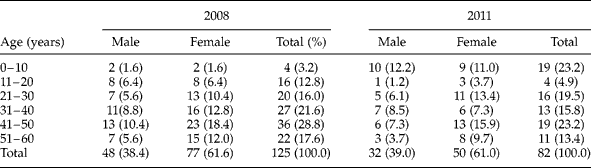
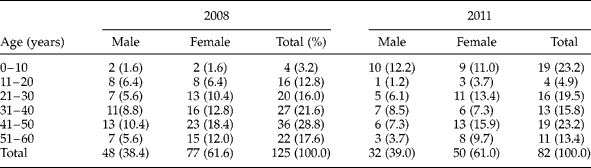
The study area is under the supervision of the Lahanam Health Centre (LHC). Procedures for the treatment and prophylaxis of human diseases are organized and completed at LHC. During the period of this study, there was no programme of mass treatment for parasitic diseases in the area. For sample collection, the LHC notified the intended population of the objectives and procedures of the study. The participants joined the study on a voluntary basis, 125 people in 2008 and 82 in 2011, from a total of 1173 persons (see table 1). After giving oral and written informed consent, they received instructions for collecting and transporting the faecal samples. On the date the faecal samples were submitted, they were interviewed about their health condition with emphasis on gastrointestinal tract conditions (feeding behaviour, diarrhoea, vomiting, abdominal pain, etc.). Faecal examinations were conducted at the village health centre by Kato–Katz modified cellophane thick smear method (KK) (Katz et al., Reference Katz, Chaves and Pellegrino1972). Each slide was examined under a microscope, helminth eggs were counted, and the number of eggs per gram of faeces (EPG) was calculated.
The number and proportion (%) of human participants studied from Lahanam and Thakhamlien villages (Savannakhet Province, Lao PDR) in 2008 and 2011, relative to age and gender.
Anthelmintic treatment and collection of expelled worms
All participants were treated with a single 40 mg/kg dose of oral praziquantel (PZQ) (Opticide-FC®, Medicpharma Co. Ltd, Thailand). Purgation was achieved with 60 ml of saturated magnesium sulphate solution. All faecal samples were collected and sediments were washed thoroughly with tap water by repeated sedimentation/decanting. Parasites which were recognizable with the naked eye were separated, identified and preserved in 70% ethanol, and all residual sediments were preserved in 70% ethanol. The samples were transferred to a laboratory in Bangkok, where small parasites were collected and identified under a light microscope.
DNA extraction and PCR analysis
During the preparation of the KK samples, approximately 2 g of faeces were passed through a wire sieve and placed in a 15 ml centrifuge tube. Then 12 ml of a washing aqueous solution containing 0.25% sodium dodecyl sulphate (SDS) was added to the faecal sample. The sample was washed several times until the supernatant was clear. The supernatant was then removed and 8 ml of 70% ethanol were added to the sediment. The samples were then brought back to the laboratory. Before DNA extraction, the sediments were washed with distilled water (DW) to remove ethanol, and resuspended in 3 ml DW. A total of 500 μl of the suspension was transferred into a 1.5 ml microtube and used for DNA extraction. To disrupt the parasite eggs, the suspension was microwaved in a microwave oven (MS-1812C, LG, Korea) at 700 W for 60 s. DNA was extracted using a Genomic DNA Mini Kit (Geneaid, Taiwan) in accordance with the manufacturer's instructions. The final DNA elution was made in 50 μl of elution buffer.
The primer set used was designed for O. viverrini-specific amplification (Wongratanacheewin et al., Reference Wongratanacheewin, Pumidonming, Sermswan and Maleewong2001). Polymerase chain reaction (PCR) was conducted using a DNA thermocycler (Eppendorf Mastercycler Personal, Germany). The reaction was carried out in a volume of 25 μl, using the PCR reagent (Roche, Germany). The final concentrations of the PCR mixture of deoxynucleoside triphosphates (dNTP), MgCl2, Taq polymerase and primers were 5 mm, 1.5 mm, 1.5 U and 1 mm, respectively. One microlitre of DNA preparation was used as a template. The DNA samples were initially denatured at 94°C for 4 min, then 30 amplification cycles consisting of denaturation at 94°C for 1 min, annealing at 60°C for 30 s, and elongation at 72°C for 2 min. Amplicons were electrophoresed in 2.0% agarose gel and the positives showed a PCR amplicon size of 330 bp.
Fish sampling
Fish were collected by the field owners from the five rice field ponds in the study villages at 2-month intervals, including January, March, May, July, September and November 2012. Cyprinid fish were purchased from the village morning market in March and November 2012. The fish were examined for Opisthorchis and Haplorchis metacercariae by compressing the fins and a thin piece of muscle placed between two glass slides. Metacercariae were removed from the muscle and identified under a light microscope (Touch et al., Reference Touch, Komalamisra, Radomyos and Waikagul2009).
Data analysis
Statistical analysis was performed using Epi Info™ (http://wwwn.cdc.gov/epiinfo/). Data were entered by year/age/gender/EPG/positivity. The analysis of variance (ANOVA) test was performed for inequality of population means. The Kruskal–Wallis test for two groups was conducted when the variances were not homogeneous. For comparison of parameters, P < 0.05 was considered statistically significant.
Results
Human infections
The volunteer population numbered 125 in the 2008 survey and 82 in 2011. Males accounted for 38.4% and 39.0%, and females 61.6% and 61.0%, in 2008 and 2011, respectively. Ages ranged between 7 and 60 years; the average age was 40 years in 2008, and 33 years in 2011 (table 1).
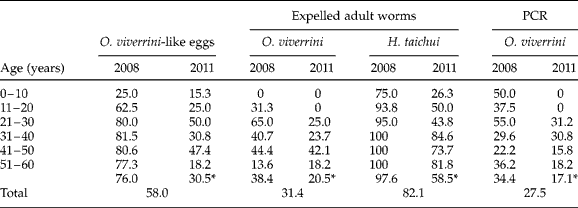
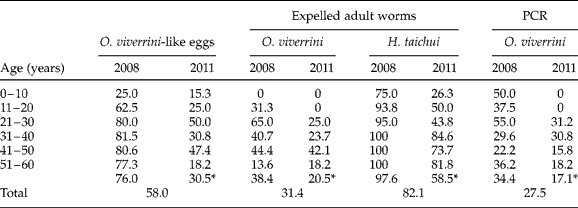
The KK faecal examinations indicated parasitic infections to be widely distributed among the study population, with 120/207 (58.0%) Opisthorchis/Haplorchis egg infections (table 2). The positive rates for parasitic infections differed between the two examinations, with those in 2011 lower than in 2008 (P < 0.05). Post-treatment worm expulsion showed the highest positive rate among the three methods used in this study, in particular for H. taichui. Among adults, worm detection after anthelminthic treatment and purgation found 97.6% (122/125) and 58.5% (48/82) positive for H. taichui, and 38.4% (48/125) and 20.5% (17/82) positive for O. viverrini, in 2008 and 2011, respectively (table 2). Combining the 2008 and 2011 results for worms expelled after praziquantel treatment, morphological identification of a total 207 participants found 170 people (82.1%) to be infected with H. taichui and 65 (31.4%) with O. viverrini (table 2). The positive rate of O. viverrini-specific PCR was 34.4% (43/125) and 17.1% (14/82) in 2008 and 2011, respectively (table 2). The combined results of morphological and molecular diagnoses for O. viverrini detected more positive cases than using a single detection method.
The prevalence of infection in human participants from Lahanam and Thakhamlien villages, Savannakhet Province, Lao PDR, infected in 2008 and 2011 with Opisthorchis viverrini-like eggs detected using the Kato–Katz method; expelled worms of O. viverrini and Haplorchis taichui following treatment; and detection of O. viverrini using PCR analysis.
*Level of significant difference given as P < 0.05.
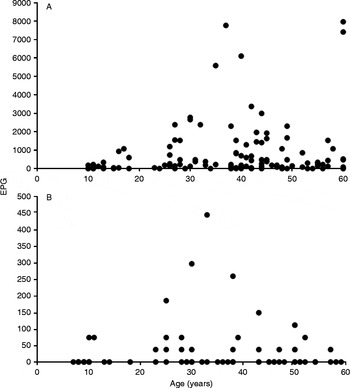
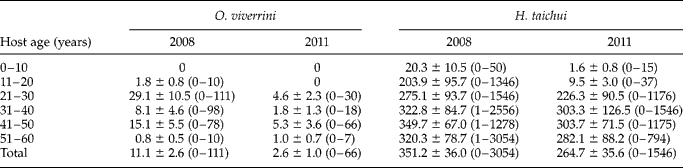
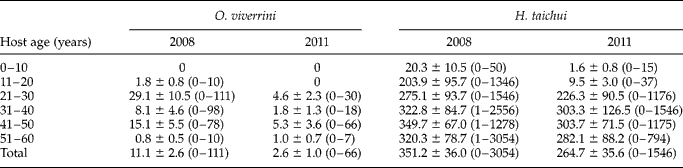
Scatter-plots of O. viverrini-like eggs depicting EPG and age groups showed an almost normal distribution, with a peak between 30 and 40 years of age; skewed towards the older age group in 2008, but a perfectly normal distribution in 2011 (fig. 1). Opisthorchid infections were found in all the age groups tested (7–60 years of age). The expelled worms showed that the distribution of H. taichui was higher than that of O. viverrini in both years of the study, and the infection rate increased with age, reaching a plateau at age 31–60 years (table 2). The combined PCR and expelled-worm results for opisthorchiasis showed that infections peaked among the age group 21–30 years in 2008, but extended into the older age group, 21–50 years (table 2). Haplorchis taichui infection without O. viverrini occurred in 24.6% (51/207) of people examined. Mean numbers of expelled O. viverrini adult worms recovered from villagers in all ages were 11.1 ± 2.6 (0–111) and 2.6 ± 1.0 (0–66) in 2008 and 2011, respectively, and for H. taichui, 351.2 ± 36.0 (0–3054) and 264.7 ± 35.6 (0–1546) in 2008 and 2011, respectively (table 3). The numbers of expelled worms recovered from villagers in all age groups showed high O. viverrini levels in the middle-aged group. These declined in the older group, but the results were not statistically significant. However, for H. taichui, worm intensity increased with age.
Opisthorchis viverrini-like eggs/g faeces (EPG) by age (years) in human participants in Lahanam and Thakhamlien villages, Savannakhet Province, Lao PDR: (A) October 2008 (n= 125); (B) September 2011 (n= 82).

The number of expelled worms (mean ± SE, and range in parentheses) of O. viverrini and H. taichui following praziquantel treatment, relative to age in 207 villagers (125 in October 2008 and 87 in September 2011) from Lahanam and Thakhmalien villages, Savannakhet Province, Lao PDR.
Trematode infections were found in all age groups. Opisthorchis viverrini was more prevalent in males than females (Odds Ratios: 3.3 in 2008; 2.4 in 2011) except in the age group 41–50 years, in 2011. The positive rates for O. viverrini infection by adult worm expulsion or/and O. viverrini specific-PCR in 2008 were higher among males than females in all age groups. Interestingly, the group aged 31-40 years showed a remarkable difference between males and females, with 72.7% and 37.5% in 2008, and 71.4% and 16.7% in 2011, for males and females, respectively (P< 0.05).
Fish infections
Up to 970 fishes from three families (Channidae, Cyprinidae and Osprenemidae) and 35 species were examined, but only fish positive for Opisthorchis and H. taichui metacercariae are summarized. Opisthorchis metacercariae were found in only 6 species of fish; 4 species from the rice field ponds and 2 species from the market. Opisthorchis metacercariae were only found in the pond fish in November, and not in other months. Fish could not be collected in September due to local flooding. In total, 970 fish were examined, and only 18 (1.9%) were positive for O. viverrini metacercariae. The positive rates for each fish species were 1/10 (10.0%) for Barbonymus altus, 3/123 (2.4%) Cyclocheilichthys armatus, 1/10 (10.0%) Esomus metallicus, 10/388 (2.6%) Hampala dispar, 2/7 (28.6%) Labiobarbus siamensis and 2/6 (33.3%) for Puntius brevis. Haplorchus taichui metacercariae were only found in three species of fish bought at the market: B. altus 2/10 (20.0%), B. gonionotus 3/5 (60.0%) and Mystacoleucus marginatus 13/17 (76.5%). The total number of fish positive for H. taichui metacercariae was also 18/970 (1.9%). Cyprinids sold in the market were caught in Sebanghien River, near the villages. The metacercarial density was higher for Haplorchis than Opisthorchis, which had only a few metacercariae per fish.
Discussion
The detection of adult worms after anthelminthic treatment and purgation revealed that 97.6% (122/125) and 58.5% (48/82) tested positive for H. taichui, and only 38.4% (48/125) and 20.5% (17/82) for O. viverrini, in 2008 and 2011, respectively. In another survey in Laos, 97 individuals with heavy ‘Opisthorchis-like’ infections were enrolled to purge the worms; 97.9% and 78.4% participants expelled O. viverrini and H. taichui, respectively (Sayasone et al., Reference Sayasone, Vonghajack, Vanmany, Rasphone, Tesana, Utzinger, Akkhavong and Odermatt2009). It has been suggested that people who customarily eat undercooked fish in Laos might have high positive rates of infection for both trematodes (Chai et al., Reference Chai, Han, Guk, Shin, Sohn, Yong, Eom, Lee, Jeong, Ryang, Hoang, Phommasack, Insisiengmay, Lee and Rim2007, Reference Chai, Yong, Eom, Min, Jeon, Kim, Jung, Sisabath, Insisiengmay, Phommasack and Rim2013; Rim et al., Reference Rim, Sohn, Yong, Eom, Chai, Min, Lee, Hoang, Phommasack and Insisiengmay2013).
Haplorchis taichui infection without O. viverrini among 24.6% (51/207) of the people examined clearly shows an overestimation of O. viverrini, if egg findings in faeces are used as the only diagnostic method. The PCR assay for O. viverrini is very specific and also more sensitive in some cases. It is possible to find more positive O. viverrini cases by combining the results of morphological and molecular-diagnostic methods. The KK alone was not an adequate method for confirming O. viverrini infection.
High rates of positivity for opisthorchid eggs were found in those aged 21 years and older, indicating that fish-borne trematode infections are particularly common among adults. This result may be related to the dietary behaviour of this group, where raw fish is an ingredient commonly consumed in southern Lao dishes, especially in rural communities (Xayaseng et al., Reference Xayaseng, Phongluxa, van Eeuwijk, Akkhavong and Odermatt2013). A majority of parents in the study area permitted their children to eat raw fish when the children were under 10, 15 and 18 years of age. It was also assumed that adults consumed more raw fish than children, and had higher rates of positivity for fish-borne trematodes. A previous study also showed that the opisthorchid-egg infection rate increases with age, and plateaus in the age group >20 years (Kobayashi et al., Reference Kobayashi, Vannachone, Sato, Manivong, Nambanya and Inthakone2000).
The average EPG and positivity rate decreased from 2008 to 2011, which may reflect anti-helminthic drug administration, and education on hygiene and food security conducted after the first field survey in 2008. In Thailand, when the opisthorchiasis-control programme was implemented, three interrelated approaches were used, including stool examinations and treatment of positive cases, health education to encourage the consumption of cooked fish, and hygienic defecation (Jongsuksuntigul & Imsomboon, Reference Jongsuksuntigul and Imsomboon2003). These activities were conducted for 2–3 consecutive years with at least 60.0% coverage per round, and hence the decreased infection rate in this study area could be a transient event.
Previous studies found the same results, i.e. that males had higher rates of O. viverrini infection than females, since males tended to eat more raw fish dishes as snacks, sometimes related to alcohol consumption (Koompirochana et al., 1978). Recently, it has been reported that alcohol and alkalosis enhance the excystation of O. viverrini metacercariae (Sriraj et al., Reference Sriraj, Aukkanimart, Boonmars, Wonkchalee, Juasook, Sudsarn, Pairojkul, Waraasawapati and Pinlaor2013). When farmers stay in their huts in the rice fields in November, their favoured dish is raw intermediate-host fish caught in the rice fields, mixed with fresh red ants (Oecophylla smargadina); this dish may be a source of O. viverrini infection. Dishes containing ants can be a route of infection for Dicrocoelium dendriticum, the lancet fluke (Jeandron et al., Reference Jeandron, Rinaldi, Abdyldaieva, Usubalieva, Steinmann, Cringoli and Utzinger2011), which would need to be verified by further studies.
In this study, the rates of O. viverrini infection were also higher in males than in females among young people who did not drink alcohol. This seems more related to dietary behaviour, which is consistent with the findings of Birch (Reference Birch1999), who observed that parents' feeding practices influenced children's food preferences, an important aspect of learning to prefer new foods. This information explains the higher O. viverrini infection rates among males aged 20–30 years, since this group more commonly works in the field and is at greater risk of infection through the ingestion of O. viverrini-infected fish.
Opisthorchis viverrini metacercariae were only found in pond fish in November, which is also the time to harvest rice. As stated above, many farmers stay in huts located in the rice fields at this time. They obtain their food, including intermediate-host fish, around the rice fields and may be at greater risk of O. viverrini infection. It would be interesting if the timing of metacercarial maturation and the best time for catching and consuming intermediate-host fish are correlated, thereby enabling O. viverrini to maintain its life cycle effectively.
The present data diagnosing opisthorchiasis (EPG, worm burden and PCR) lead us to classify O. viverrini as a potential occupational disease, due to the direct influence of work and eating behaviours of the people working in rice fields. These results should be confirmed in other O. viverrini-endemic areas. The intensity of metacercarial infections among fish exhibits seasonal variation: high infection rates occur from the late rainy season into winter (September–February) (Wang, Reference Wang2012). In Laos, the rainy season extends from May to November; our data showed infection-positive fish only in November, but not in January or March. This may be because only a few fish were collected in January and March, and the species collected were not cyprinids, the intermediate hosts of opisthorchiasis. At this time, there are few fish in the rice field ponds and the fields are not cultivated.
Using the KK method, opisthorchiid egg findings increased with age, but decreased among people aged >30 years. Haplorchis taichui infection reached its peak in the age group >20 years and O. viverrini infection showed the highest infection rates in the age group 21–30 years, with decreasing infection rates in people above 30 years of age. This may be because the fish most infected with O. viverrini metacercariae are mainly found in rice fields, usually frequented by male adults of working age. On the other hand, elderly people do not work in the rice fields, and H. taichui-infected fish are not only found in rice field fish, but mainly in fish sold in the market.
This study also found that children aged 0–10 years are already infected with H. taichui (prevalence of 75.0% (3/4) in 2008, and 26.3% (5/19) in 2011). However, O. viverrini infection at this age was rare. This means that children start to eat raw fish at a young age, though they may consume fish from the market, which involves less risk of O. viverrini infection.
Prior to the current study, there had been few reports of H. taichui infection; however, this parasite deserves greater attention since H. taichui could play a role in the aetiology of irritable bowel syndrome-like symptoms (Watthanakulpanich et al., Reference Watthanakulpanich, Waikagul, Maipanich, Nuamtanong, Sanguankiat, Pubampen, Praevanit, Mongkhonmu and Nawa2010). Also, H. taichui hyperendemic areas with very high worm loads were reported by Chai et al. (Reference Chai, Yong, Eom, Min, Jeon, Kim, Jung, Sisabath, Insisiengmay, Phommasack and Rim2013) in the riparian people in Saravane and Champasak Provinces. High infection rates of H. taichui metacercariae were found in market fish in Luang Prabang, Khammouane and Saravane Provinces (Rim et al., Reference Rim, Sohn, Yong, Eom, Chai, Min, Lee, Hoang, Phommasack and Insisiengmay2013), corroborating our findings in Lahanam, which demonstrates that H. taichui has a wide distribution in Laos.
When the prevalence of infection was examined, the morphology-based general faecal examination technique was used. Some species that produce opisthorchid-like eggs have been counted as O. viverrini. Thus, the real O. viverrini infection situation may have been overestimated in these studies, and should be confirmed. The molecular diagnostic technique (copro-PCR) is a useful complement to morphological diagnosis (Lovis et al., Reference Lovis, Mak, Phongluxa, Soukhathammavong, Sayasone, Akkhavong, Odermatt, Keiser and Felger2009; Sato et al., Reference Sato, Pongvongsa, Sanguankiat, Yoonuan, Dekumyoy, Kalambaheti, Keomoungkhoun, Phimmayoi, Boupha, Moji and Waikagul2010).
It is difficult to control food-borne parasitic diseases, since consumption and cultural behaviours are difficult to change. Based on the findings of this study, if the population limits its consumption, or avoids the raw consumption, of the common host fish species around November, it may help to decrease O. viverrini infection rates, but not eradicate them entirely.
Acknowledgements
Thanks to the inhabitants of Lahanam and Thakhamlien villages for their kind cooperation. We are thankful to Mr Nirandorn Homsuwan of the Department of Helminthology, Faculty of Tropical Medicine, Mahidol University, and Mrs Vongphaka Boutsyhalath of the Health Centre, Lahanam Village, Songkhone District, Savannakhet Province, Laos, for their generous help in the field. Thanks to Mr Glad Rotaru and Mr Paul Adams for editing the English language of the manuscript.
Financial support
This research was supported partially by the Research Institute for Humanity and Nature (RIHN) project on ‘Environmental Changes and Infectious Diseases in Tropical Asia’ (for K.M.), and the Thailand Research Fund and Faculty of Tropical Medicine, Mahidol University grant (for J.W.).
Conflict of interest
None.
Ethical standards
The authors assert that all procedures contributing to this work comply with the ethical standards of the relevant national and institutional committees on human experimentation and with the Helsinki Declaration of 1975, as revised in 2008. The study was approved by the Lao Medical Ethics Committee (172/NECHR), and Mahidol University Ethics Committee (MUTM 2008-022-01 and TMEC 10-065).