INTRODUCTION
Hope is a central concept in caring for people (Miller, Reference Miller2007). As a phenomenon, it has been defined in several ways. In their classical definition, Dufault and Martocchio (Reference Dufault and Martocchio1985, p. 380) defined hope as “a multidimensional dynamic life force characterized by a confident yet uncertain expectation of achieving future good, which, to the hoping person, is realistically possible and personally significant.” Even though the definitions vary, most of them imply something positive, for example, the idea of a positive future orientation (Raab, Reference Raab2005; Kylmä et al., Reference Kylmä, Juvakka and Nikkonen2006).
Hope has been identified as an important factor in human existence (Vellone et al., Reference Vellone, Rega and Galletti2006) closely linked with development (Turner & Stokes, Reference Turner de and Stokes2006) and especially with spirituality (Nolan et al., Reference Nolan, Hodgin and Olsen2006). Hope is also associated with trust (Langley & Klopper, Reference Langley and Klopper2005) and finding meaning in one's life (Mascaro & Rosen, Reference Mascaro and Rosen2005).
Hope is also connected to health (Miller & Happel, Reference Miller and Happell2006), especially to spiritual and mental health (Landier, Reference Landier2001) and well-being (Kendall, Reference Kendall2006). Engendering hope promotes health (Kylmä, Reference Kylmä2005a). Hope can also play a pivotal role in human life, especially during difficult times (Murray & Wright, Reference Murray and Wright2006).
Illness may have hopelessness and depression associated with it (Gardner et al., Reference Gardner, Elliott and Gill2005). Whereas aspects of illness, including uncertainty and pain, may threaten human hope (Hsu et al., Reference Hsu, Lu and Tsou2003), hope may be a positive experience when a person has become handicapped (Buran et al., Reference Buran, Sawin and Brei2004) or during illness (Gardner et al., Reference Gardner, Elliott and Gill2005). Furthermore, hope may be associated with positive outcomes in chronic illnesses like cancer (Fehring et al., Reference Fehring, Miller and Shaw1997).
Hope has been identified as one central need of sick people and their significant others (Dickerson et al., Reference Dickerson, Boehmke and Ogle2006; Kylmä & Juvakka, Reference Kylmä and Juvakka2007). It can be seen as a psychosocial need (Somjai & Chaipoom, Reference Somjai and Chaipoom2006) or a spiritual need (Galek et al., Reference Galek, Flannelly and Vane2005). Hope is a human resource (Giske & Gjengedal, Reference Giske and Gjengedal2007), and it can also be seen as a coping strategy when people are living with different kinds of illnesses: cancer (Vellone et al., Reference Vellone, Rega and Galletti2006), stroke (Arnaert et al., Reference Arnaert, Filteau and Sourial2006), amyotrophic lateral sclerosis (Hirano et al., Reference Hirano, Yamazaki and Shimizu2006), and Parkinson's disease (Bingham & Haberman, Reference Bingham and Haberman2006). Hope is also of importance to a patient's significant others (Kylmä, Reference Kylmä2005b; Kylmä & Juvakka, Reference Kylmä and Juvakka2007).
Hope is closely connected to quality of life (Hampton & Qin-Hilliard, Reference Hampton and Qin-Hilliard2004). For example, it has been noted that hope correlates positively with quality of life in people living with cancer (Vellone et al., Reference Vellone, Rega and Galletti2006) and a low level of hope predicts low level of quality of life in elderly people with cancer (Esbensen et al., Reference Esbensen, Osterlind and Rahm, Hallberg2007).
Because hope is profoundly and multidimensionally linked with life, health, and illness, it is understandable that engendering hope has been identified as a core value in health care (Davidson & Simpson, Reference Davidson and Simpson2006; Perry, Reference Perry2006; Chang & Banks, Reference Chang and Banks2007). Engendering both a patient's and his or her significant other's hope is of importance in caring (Felder, Reference Felder2004).
The importance of hope as a positive experience for patients and their families has also been discussed in the context of palliative care (Duggleby, Reference Duggleby2001; Parker-Oliver, Reference Parker-Oliver2002; Johnson, Reference Johnson2007; Holtslander, Reference Holtslander2008). In a study by Kernohan et al. (Reference Kernohan, Waldron and McAfee2007), hope was found to be a key spiritual need in dying patients. Studies also suggest that hope facilitates coping with terminal illness (Bove, Reference Bove1996). One study of the pain experience in elderly hospice patients suggests that maintaining hope is an important process in coping with pain (Duggleby, Reference Duggleby2000). Studies focusing on hopelessness in this context show that hopelessness correlates with suicidal ideation in terminally ill patients (Chochinov et al., Reference Chochinov, Wilson and Enns1998) and that lack of hope in palliative patients may contribute to wishing for euthanasia or physician-assisted suicide (Johansen et al., Reference Johansen, Holen and Stein2005).
The objective of this integrative review is to describe the current status of research on hope in palliative care. The initial problem for the review was identified (Whittemore & Knafl, Reference Whittemore and Knafl2005) in the following way: What is known about hope in the context of palliative care based on existing research? An integrative review on hope in palliative care will contribute to evidence-based practice in health care (DiCenso et al., Reference DiCenso, Guyatt and Ciliska2005; Melnyk & Fineout, Reference Melnyk and Fineout2005). Based on database searches in CINAHL and PubMed MEDLINE (April 2008) there are no previous integrative reviews on hope in a palliative context.
METHODS
Integrative Review
Integrative reviews are conducted to review and determine current knowledge on the selected topic (Burns & Grove, Reference Burns and Grove2005). As a method, it allows for the combination of diverse methodologies (Whittemore & Knafl, Reference Whittemore and Knafl2005). Integrative review has been defined as “a summary of the literature on a specific concept or content area whereby the research is summarized, analyzed and overall conclusions are drawn” (Whittemore, Reference Whittemore2005, p. 57).
Methods for data synthesis entail a process of qualitative reinterpretation and reanalysis of text-based forms of evidence (Pope et al., Reference Pope, Mays and Popay2007). The synthesis aims at new interpretation or a new level of abstraction on the phenomenon under study, a theory, stronger evidence, or a starting point for a new study (Whittemore, Reference Whittemore2005; Zimmer, Reference Zimmer2006; Kylmä et al., Reference Kylmä, Juvakka and Isola2007; Pope et al., Reference Pope, Mays and Popay2007). The use of qualitative synthesis to fuse research findings into theory can contribute significantly to the development of health care practice knowledge (Zimmer, Reference Zimmer2006). Different methods can be broadly grouped in terms of their ontological and epistemological foundations and whether the aim of synthesis is primarily interpretative or primarily aggregative (Dixon-Woods et al., Reference Dixon-Woods, Agarwal, Jones, Watson, McKenna and Cowman2008). In this integrative review, content analysis was used as a method of data synthesis, because the analysis aims to aggregate findings (Dixon-Woods et al., Reference Dixon-Woods, Agarwal, Jones, Watson, McKenna and Cowman2008). This review proceeded through the following steps: identification of the topic, search of the literature, reading and critique of the sources, analysis of the sources, and synthesis of the sources. A qualitative approach in the synthesis was used in this review as the majority of the studies focused on hope in palliative care are descriptive and exploratory in nature.
Sample
Well-defined literature search strategies are critical to enhancing the rigor of the review (Whittemore & Knafl, Reference Whittemore and Knafl2005). The criteria for sample selection in this review required that the original empirical studies described hope in the context of palliative care and had been published in English or Finnish. The keywords used in the data searches were “hope” and “palliative care” or “terminal care” or “hospice care” based on the purpose of this review. Palliative care has moved upstream in the health care system, which means that terminal care and hospice care are just parts of it. However, all these words were used to cover all the aspects of palliative care. These keywords and the word “hope” were used for the sake of conceptual clarity. Data evaluation is one stage in the integrative review process (Whittemore & Knafl, Reference Whittemore and Knafl2005). To ensure the quality of the data in this review it was required that the studies to be included were published in peer-reviewed journals.
The CINAHL database was used to find the articles that met the criteria. The searches were conducted by the first author in February 2007 using CINAHL database search terms. At the first stage, the terms “hope,” “hope instillation (IOWA NIC = Iowa Nursing Interventions Classification)” and “hope (IOWA NOC = Iowa Nursing Outcomes Classification)” were combined with the Boolean operator OR to include all references focused on hope. At the second stage, the terms “palliative care,” “hospice care,” and “terminal care” were combined with the Boolean operator OR to include all the references focused on palliative, hospice, or terminal care. At the third stage, findings from above described searches were combined with the Boolean operator AND to ensure that all the criteria were met in the search results. The findings were limited to research articles. No time limits were used in conducting searches. Altogether 35 references were found. Based on the inclusion criteria (an empirical study, abstract available in the database, hope present in the abstract, and published in English or Finnish), 19 of the references were included in this review (included references are marked with an asterisk in the reference list). In April 2008, the searches were updated with the same search terms. However, no new references were found from the CINAHL database.
The PubMed MEDLINE database was also used to find articles relevant to this review. The searches were conducted by the first author in February 2007. In this database, at the first stage, the search was conducted by searching the word “hope” from the fields “title” or “abstract.” At the second stage, the following MESH terms were combined with the Boolean operator OR: terminal care, palliative care, and hospice care. At the third stage the findings from the first and second stages were combined with the Boolean operator AND to ensure that all the criteria were met in the search results. No time limits were used in conducting searches. In all, 111 references were found. All the references were reviewed based on the information gathered from the database. Based on the inclusion criteria (an empirical study, abstract available in the database, hope present in the abstract, published in English or Finnish), 18 of the references met the inclusion criteria. Because 7 of the articles had already been found in the previous search, 11 articles from this database were included into the review (included references are marked with an asterisk in the reference list). Also, in this database the searches were updated in April 2008 using the same procedure as in the original PubMed MEDLINE search in February 2007. In all, 4 new references were added to the review.
Analysis
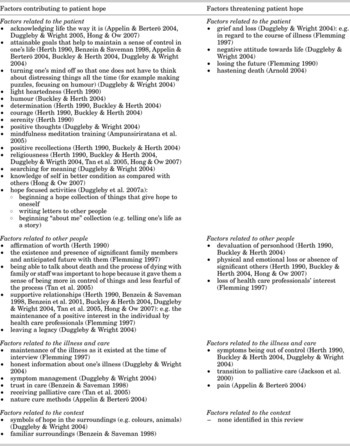
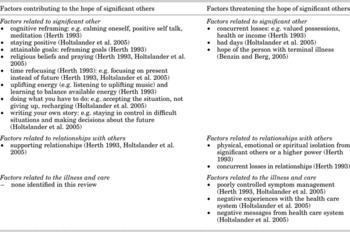
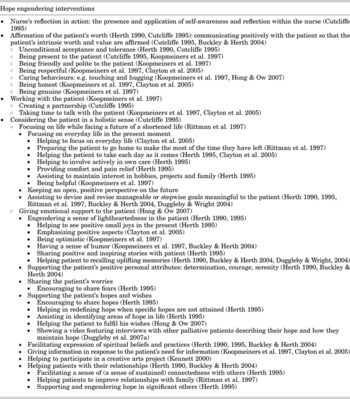
The data in this review consisted of 34 articles on hope in palliative care published in peer-reviewed journals. The data were analyzed using inductive content analysis (Graneheim & Lundman, Reference Graneheim and Lundman2004) due to the aggregative aim of this review (Dixon-Woods et al., Reference Dixon-Woods, Agarwal, Jones, Watson, McKenna and Cowman2008). First, the articles were read and the refined research questions guiding the analysis were decided based on the data: How is hope defined in patients in palliative care and what factors have been identified as associated with patient's hope? How is hope defined in significant others in palliative care and what factors have been identified as associated with significant others' hope? What hope engendering interventions have been identified in palliative care? What is known about nurses' hope in palliative care? Second, data relevant to the above mentioned research questions were inductively analyzed to generate synthesis. The analysis proceeded according to the following phases: data extraction, data reduction, and categorization (Whittemore & Knafl, Reference Whittemore and Knafl2005). Data relevant to research questions were first extracted and reduced so that the core information was maintained in reduction. After reduction, similar data were grouped into the same category (see Tables 1, 2, and 3).
Factors contributing and threatening patient hope in palliative care

Factors contributing to significant other's hope in palliative care context

Hope engendering interventions generated from the reviewed articles

RESULTS
Description of the Data
Study samples ranged in size from 4 to 410 participants. Twenty-three of the studies focused on patient hope from the perspective of patient or health care professional. Hope of a significant other was the focus in 6 of the studies. In 3 of the included studies the focus was on both patient's and significant other's hope. Only 1 of the studies focused on the hope of a health care professional. The patients suffered mainly from cancer: 27 of the studies included cancer patients or their significant others. Only 1 of the studies was solely conducted with HIV/AIDS patients. In 9 of the studies, the participants were recruited from patients with different diagnoses: In these studies the participants suffered either from cancer, pulmonary diseases, cardiovascular diseases, neurological diseases, arthritis diagnoses, or organ failure (e.g., liver failure). Of the studies, 19 were qualitative studies, 9 were quantitative studies, and in 6 of the studies both qualitative and quantitative data and methods were used.
Patients' Hope and Factors Associated with It in Palliative Care
Based on this review, hope is important both in living and dying (e.g., Hall, Reference *Hall1990; Benzein & Berg, 2003; Hong & Ow, Reference *Hong and Ow2007): Living with incurable illness does not necessarily mean living without hope (e.g., Curtis et al., Reference *Curtis, Wenrich and Carline2002). In fact, hope may imply a positive experience in spite of this incurable illness (Hong & Ow, Reference *Hong and Ow2007). Especially in palliative care, patients' hope and hopelessness may fluctuate (e.g., Ampunsiriratana et al., Reference *Ampunsiriratana, Triamchaisri and Nontasorn2005). In this section, we discuss the contents of hope, discursive properties of hope, measuring patient's hope, and factors associated with patient hope in palliative care.
Contents of Hope
Based on this review, there can be found at least two overarching themes of patients' hope in the palliative context: hope as a dynamic life force, for example, “living in hope” (Benzein et al., Reference *Benzein, Norberg and Saveman2001) and “living with hope” (Duggleby & Wright, Reference *Duggleby and Wright2005), and focus of hope, for example, “hoping for something” (Benzein et al., Reference *Benzein, Norberg and Saveman2001). Contents of hope include these both (living with hope and hoping for something). They are not separate contents because hoping for something may be the way palliative patients live with hope. However, a difference can be seen between the existential being of hope and the action of hope.
Living with hope: existential being of hope
In a grounded theory model of hope in older palliative patients, Duggleby and Wright (Reference *Duggleby and Wright2005) described the main concern of the study participants as to “live with hope” in spite of multiple losses of function, independence, relationships, and goals and a shortened life. Living with hope was essential for them to maintain relationships with others and have peace and comfort at the end of life. The process of transforming hope to achieve living with hope included the presence of spiritually and confirmative relationships.
The presence of confirmative relationships, highlighting the notion of “interconnectedness” in hope, which may include relationships with self, significant others, pets, and a transcendent relationship, was found to be important by Benzein et al. (Reference *Benzein, Norberg and Saveman2001; see also Hong & Ow, Reference *Hong and Ow2007). Interconnectedness with others was also identified in their earlier study (Benzein & Saveman, Reference *Benzein and Saveman1998). They (Benzein & Saveman, 2003) used Herth's definition of hope in their studies: Hope implies an inner sense of both temporality (being situated in space and time) and of future possibilities, inner positive readiness, and expectancy and interconnectedness with self and others. Benzein et al. (Reference *Benzein, Norberg and Saveman2001) defined living in hope as reconciliation with and comfort with life and death. In a study by Hong and Ow (Reference *Hong and Ow2007), hope was equated with God.
Hall (Reference *Hall1990) equates life and hope: She posits that life is hope and it must be maintained in every stage of life. In her study, hope involved having a future life in spite of the diagnosis, a renewed zest for life, finding a reason for living, and finding a treatment that one believes will contribute to survival. Future was defined in minutes, hours, and days.
Hoping for something: the action of hope
Hope can also be defined as a future-oriented (Flemming, Reference *Flemming1997) and goal-oriented phenomenon: Having a sense of one's future and experiencing and achieving important events or goals (Benzein et al., Reference *Benzein, Norberg and Saveman2001; Hong & Ow, Reference *Hong and Ow2007) are important in hope (e.g., Clayton et al., Reference *Clayton, Butow and Arnold2005). Hoping for something may include hope in the person's worth as an individual (e.g., Cowan et al., Reference *Cowan, Burns and Palmer2003), finding meaning (spiritual and existential) in one's own life (e.g., Tan et al., Reference *Tan, Braunack-Mayer and Beilby2005), or hope of being a model for others (Cowan et al., Reference *Cowan, Burns and Palmer2003). Hoping for something may also focus on the healing of relationships and having special time with significant others (Clayton et al., Reference *Clayton, Butow and Arnold2005). Hope may also refer to hoping to see one's children grow up (Hong & Ow, Reference *Hong and Ow2007).
Hoping for something may refer to healing (Cowan et al., Reference *Cowan, Burns and Palmer2003), being cured (e.g., Tan et al., Reference *Tan, Braunack-Mayer and Beilby2005), a miracle cure or spontaneous remission (Clayton et al., Reference *Clayton, Butow and Arnold2005), or hope for God's help (Cowan et al., Reference *Cowan, Burns and Palmer2003). In addition, hoping for something may imply the hope of living a normal life as long as possible (e.g., Benzein et al., Reference *Benzein, Norberg and Saveman2001), living to the fullest in the time left (Duggleby & Wright, Reference *Duggleby and Wright2004), living longer than expected (Clayton et al., Reference *Clayton, Butow and Arnold2005), hope for everyday living (Clayton et al., Reference *Clayton, Butow and Arnold2005), or hope for a positive change that could make it possible to stay at home for a time (Appelin & Berterö, Reference *Appelin and Berterö2004).
Hoping for something may also mean hope of good pain and symptom management (e.g., Clayton et al., Reference *Clayton, Butow and Arnold2005), hope of being well cared for and supported (Clayton et al., Reference *Clayton, Butow and Arnold2005), hope for an end to suffering (Duggleby & Wright, Reference *Duggleby and Wright2004), or hope that the final phase of life will be short if the pain is out of control (Appelin & Berterö, Reference *Appelin and Berterö2004). Hoping can also focus on hope for a peaceful death (e.g., Clayton et al., Reference *Clayton, Butow and Arnold2005) or a quick death (Cowan et al., Reference *Cowan, Burns and Palmer2003) and hope for heaven (Cowan et al., Reference *Cowan, Burns and Palmer2003) or life after death (Duggleby & Wright, Reference *Duggleby and Wright2004). Sometimes, hope is focused on others, as in Duggleby and Wright's (2004) study, where hope was focused on a better life in the future for the family.
Discursive Properties of Hope
Eliott and Olver (Reference *Eliott and Olver2002) question the usefulness of an empirico-realistic search for a definitive definition of hope. They write that hope remains elusive in part because the word itself functions both as a noun and a verb. In their study, cancer patients spoke about hope focusing on “do-not-resuscitate” decisions as a noun and as a verb, as either objective or subjective, and as a burden or resource. Their findings showed that hope represented either an evaluation of empirical states of affairs or the wish for desired outcomes. Furthermore, hope was both present and future oriented, both vulnerable and enduring (Eliott & Olver, Reference *Eliott and Olver2002).
Considering hope as a noun, hope can vary both between and within individuals. This may give rise to a discussion about realistic or false (or unrealistic) hope (see also Hall, Reference *Hall1990). People (e.g., nurse and patient) may evaluate the degree of hope differently. Also Peräkylä (Reference *Peräkylä1991, pp. 407–408) has paid attention to this in his research on hope work. Hope work, he says, “refers to a recurrent conversational activity, whereby medical identities (the manageability of the patient's condition and the possibility of its being medically controlled) of the patient and the staff are explicated in terms of the hopefulness of the situation.” In curative hope work, the patient is defined as getting better; in palliative hope work the patient is defined as feeling better, and in the work to dismantle hope, the patient is defined as being past recovery. It has been suggested (e.g., Hickey, Reference Hickey1986; Herth, Reference Herth1991; Poncar, Reference Poncar1994) that false hope should be replaced with realistic hope.
The distinction between realistic or unrealistic hope rests on an assumption of shared objective reality, which is itself epistemologically problematic. What one person would consider unrealistic hope may seem realistic to another. Hope cannot entirely be proven to be false or unrealistic until after the final outcome is known. For example, if one hopes for a cure and does not die, his hope would not be labeled as false hope (Eliott & Olver, Reference *Eliott and Olver2002). Furthermore, hope to continue living is common to all humans even though they all will someday die (Hall, Reference *Hall1990; Eliott & Olver, Reference *Eliott and Olver2002). As Hall (Reference *Hall1990) and Eliott and Olver (Reference *Eliott and Olver2002) note, someone with a terminal illness should not be expected to be different from other humans. What health care professionals may be inclined to view as a patient's or caregiver's unrealistic hope has not been proven to be detrimental to patient well-being, and, in fact, it may have some beneficial aspects (Eliott & Olver, Reference *Eliott and Olver2002).
Measuring Patients' Hope
Instruments for measuring hope in a palliative context have been produced by Herth (1992), Benzein and Berg (Reference *Benzein and Berg2003), and Nekolaichuk and Bruera (Reference *Nekolaichuk and Bruera2004). Benzein and Berg (Reference *Benzein and Berg2003) have assessed the reliability and validity of the Swedish version of the Herth Hope Index in a palliative care context both for palliative patients and their family members. Based on their evaluation, the instrument showed sound reliability and validity for use in this population. Nekolaichuk and Bruera (Reference *Nekolaichuk and Bruera2004) evaluated the Hope Differential Short instrument. They found that the instrument's psychometric properties were promising. However, both Benzein and Berg (Reference *Benzein and Berg2003) and Nekolaichuk and Bruera (Reference *Nekolaichuk and Bruera2004) conclude that future research is needed to gather further validity evidence for these instruments.
Factors Associated with Patient Hope
Factors associated with patient hope can be divided into two categories: factors contributing to and threatening patient hope in palliative care. These have been identified in several articles (e.g., Jackson et al., Reference *Jackson, Schim and Seeley2000; Duggleby & Wright, Reference *Duggleby and Wright2005). Factors associated with patient hope in palliative care include factors related to the patient (e.g., light heartedness), to other people (e.g., supportive relationships), to the illness and care (e.g., honest information about one's illness), and to the context (e.g., familiar surroundings). These factors are presented in detail in Table 1.
Significant Others' Hope and Factors Associated with It in Palliative Care
Contents of Hope
Hope in significant others was defined as an inner force. For example, Herth (Reference *Herth1993, p. 538) has defined hope “as a dynamic inner power that enables transcendence of the present situation and fosters a positive new awareness of being.”
Holtslander et al. (Reference *Holtslander, Duggleby and Williams2005) found that the main concern for caregivers was eroding hope caused by experiences with the health care system, bad days, and negative messages. In spite of this eroding hope, they tried to hang on to hope. One of the articles focused on parental hope when a child cannot be cured (DeGraves & Aranda, Reference *DeGraves and Aranda2005). This study shows that even though hope was perceived as the greatest coping mechanism for families, prognostic uncertainty and continued hope for survival in family members make it difficult for health professionals to determine the appropriate time to stop active therapy and initiate palliation.
Measuring Significant Others' Hope
The results of research into the hope of significant others in a palliative care context appear inconsistent. Findings from the studies in this review suggest that the hope of significant others was statistically significantly lower than the patients' hope (Benzein & Berg, Reference *Benzein and Berg2005). The hope of significant others was associated with age (weak negative correlation) and fatigue (moderate negative correlation), suggesting that higher age and level of fatigue may decrease hope in family members. On the other hand, in a study by Chapman and Pepler (Reference *Chapman and Pepler1998), elderly significant others reported higher levels of hope than younger ones. In this same study, women experienced more despair than men and children more than spouses.
Factors Associated with the Hope of Significant Others
Factors associated with the hope of significant others can also be divided into two categories: factors contributing to and threatening the hope of significant others. These factors have been identified in the articles included in this review (e.g., Holtslander et al., Reference *Holtslander, Duggleby and Williams2005). These factors include factors related to the significant other (e.g., staying positive), to relationships with others (e.g., supporting relationships), and to the illness and care (e.g., poorly controlled symptom management). These factors are described in more detail in Table 2.
Hope-Engendering Interventions
Engendering Hope in a Palliative Patient: Descriptive Studies
Several scholars emphasize the importance of engendering hope in spite of a noncurable illness (e.g., Clayton et al., Reference *Clayton, Butow and Arnold2005). Engendering hope is important, because it helps the patient to confront the uncertain future (Rittman et al., Reference *Rittman, Paige and Rivera1997). Nurses, in a study by Rittman et al. (Reference *Rittman, Paige and Rivera1997), described the importance of preserving hope of a remission or cure for cancer patients. They emphasized the importance of hope even when patients are entering the final phase of life. However, scholars have also identified the tension between hope and truth telling and the need to balance between them (Clayton et al., Reference *Clayton, Butow and Arnold2005). These interventions include the following main interventions: nurse's reflection in action, affirmation of patient's worth, working with the patient, and considering the patient in a holistic sense. These interventions and examples of these are described in more detail in Table 3.
Engendering Hope in a Palliative Patient: Randomized Controlled Trials
Duggleby et al. (Reference *Duggleby, Degner and Williams2007a) have developed a Living with Hope Program (LWHP) and evaluated its effectiveness in older palliative home care patients using a randomized controlled trial. This intervention consisted of viewing an international award-winning video on hope and a choice of one of three hope activities to work on over a 1-week period. Patients receiving the LWHP had statistically significant higher hope (U = 255, p = .005) and quality of life scores (U = 294, p = .027) after intervention than those in the control group.
Engendering Hope in Significant Others: Descriptive Studies
Duggleby et al. (Reference *Duggleby, Wright and Williams2007b) have underlined the importance of engendering hope in significant others of palliative patients. They have developed the LWHP also for caregivers of family members. This program is based on the “hanging on to hope” theory presented by Holtslander et al. (Reference *Holtslander, Duggleby and Williams2005). In this program the caregivers write in a journal, reflecting on their challenges as caregivers and what gave them hope that day (Stories of the Present). Furthermore, the program includes a video entitled “Living with Hope.” Journal writing makes it possible for significant others to reflect on what is happening to them now and to write their own story about what gave them hope. The video allows video modeling, which occurs when viewers identify with the individuals on the videotape and perceive themselves as capable of performing specific tasks.
Nurse's Hope in Palliative Care
Feudtner et al. (Reference *Feudtner, Santucci and Feinstein2007) have found that individual nurses' level of hope is associated with greater self-reported comfort and competence in providing pediatric palliative care.
DISCUSSION
Main Findings
Based on the findings of this review, hope is important both in living and dying (e.g., Hall, Reference *Hall1990; Hong & Ow, Reference *Hong and Ow2007). Theoretically and in clinical practice, it is important to see hope both as living with hope (e.g., Duggleby & Wright, Reference *Duggleby and Wright2005) and hoping for something (e.g., Hong & Ow, Reference *Hong and Ow2007).
Most of the studies in a palliative care context focus on adult patient hope (e.g., Benzein & Berg, 2003). Less research has been done on hope in children, adolescents, and significant others of patients in palliative care. Only one of the studies focused on the hope of nurses caring for palliative patients (Feudtner et al., Reference *Feudtner, Santucci and Feinstein2007). Considering the variety of illnesses found in palliative care, cancer has gained most of the research attention.
Factors contributing to patient hope have been thoroughly researched and are emphasized in the findings. Studies included in this review identified more factors contributing to patient hope in palliative care than factors threatening hope (e.g., Jackson et al., Reference *Jackson, Schim and Seeley2000; Duggleby & Wright, Reference *Duggleby and Wright2005). Factors contributing to hope and threatening hope in significant others have been identified in these studies (e.g., Holtslander et al., Reference *Holtslander, Duggleby and Williams2005), but more research is clearly needed in this area. On the basis of our review of these studies, factors contributing to hope and factors threatening hope were categorized for both groups. These factors include those related to the patient or significant others, those related to other people, and those related to illness and medical care. Contextual factors were found to be only a hope-engendering factor, not a hope-threatening factor. These factors can be used as a starting point when planning for hope-engendering interventions, strengthening factors that contribute to hope, and ameliorating those factors that threaten hope.
Engendering hope in a palliative patient involves a nurse's ability to be reflective in his or her work while caring for the patient (e.g., Cutcliffe, Reference *Cutcliffe1995). Affirmation of a patient's worth is crucial (e.g., Herth, Reference *Herth1990). In practice, this requires a gentle approach to the patient and a kind and respectful way of communicating with the patient about his or her hope (e.g., Koopmeiners et al., Reference *Koopmeiners, Post-White and Gutknecht1997). Hope-engendering palliative care implies taking the totality of a human being into consideration (e.g., seeing the patient as an individual in his or her own social context) not just focusing on dying but also on living with dying. Furthermore, as well as attending to the patient, it is important to give emotional support to the patient's significant others, who in their turn are important contributors to the patient's experience of hope (e.g., Hong & Ow, Reference *Hong and Ow2007). However, only one of the studies focused on hope-engendering interventions in significant others (Duggleby et al., Reference *Duggleby, Wright and Williams2007b).
During the revisions of this article, a systematic review on sustaining hope when communicating with terminally ill patients and their families was published by Clayton et al. (Reference Clayton, Hancock and Parker2008). Their focus on hope was narrower than in this current article. They focused on studies that investigated sustaining hope during prognostic and end-of-life issues discussions with terminally ill patients and their families. Their review consisted of 27 studies. Only 6 of the studies included in their review were the same as in this current review. This current review offers insights into 28 new studies that were not included in the review by Clayton et al. (Reference Clayton, Hancock and Parker2008). In that review, the findings of the review are discussed under four themes: avoidance of information as a strategy to sustain hope; patients'/caregivers' perceptions: balancing honesty with optimism and empathy; patients'/caregivers' perceptions: nurturing hope; and health professionals' perceptions: nurturing hope.
The integrative approach in the current review offers more detailed and structured information about the following questions: How is hope defined in patients in palliative care and what factors have been identified as associated with patient's hope? How is hope defined in significant others in palliative care and what factors have been identified to be associated with significant others' hope? What hope-engendering interventions have been identified in palliative care? What is known about nurses' hope in palliative care? In regard to hope-engendering interventions, this current review offers four main interventions: nurses' reflection in action, affirmation of the patient's worth, working with the patient, and considering the patient in a holistic sense. The classification of identified interventions in this review is similar to the description presented by Cutcliffe (Reference *Cutcliffe1995). However, in this review the classification is further elaborated in detail.
Credibility of the Review
The purpose of this review was to describe the current status of research on hope in palliative care. The data for this review were collected systematically using the CINAHL and PubMed MEDLINE databases. The strict criteria of the review can be evaluated as a strength but also as a limitation. Strictly defined concepts in the searches may limit the inclusion of articles conceptually close to hope, for example, coping, which may contribute significantly to our understanding of hope. In addition, reference lists in the selected articles were not reviewed, and this could be considered as a limitation of this review. In all, 34 articles were reviewed and were treated in the same way in the analysis. First, they were read thoroughly and, on the basis of inductive analysis, the main themes were identified. The data were then analyzed inductively within the main themes. The findings of this review have been discussed with the authors (Whittemore & Knafl, Reference Whittemore and Knafl2005).
Suggestions for Future Studies
More research is needed about hope in different age groups in palliative care (e.g., children, adolescents, and elderly people), in significant others, and health care professionals of patients in palliative care. More attention should be paid to other life-threatening illnesses besides cancer. Also, hope in different contexts (e.g., home care, hospital care, or hospice care) needs to be studied more. Factors threatening patient hope need to be studied in more detail. Also factors associated with nurses' hope need to be identified in the palliative context. Interventions to engender hope in palliative care have been identified; however, more research is needed on these interventions and their outcomes.
Clinical Implications
Factors identified as associated with patients' or significant others' hope can be used as a starting point when planning hope-engendering interventions. More detailed clinical implications for engendering hope in a palliative context are described in Table 3. These include nurse's reflection in action, which means the presence and application of self-awareness and reflection within the nurse. Furthermore, affirmation of a patient's worth may be used as an intervention to engender patient hope. This includes, for example, being friendly and polite to the patient and being respectful. Working with the patient is a hope-engendering intervention; in practice this means, for example, taking the time needed to talk with the patient. Considering the patient in a holistic sense is a broad category including interventions such as focusing on everyday life in the present, giving emotional support, and helping to participate in a creative arts project.