Introduction
Field-grown tomatoes are exposed to an assortment of extreme weather events and climate conditions, but the impacts of such factors are complex and difficult to assess. Fruit formation in tomato cultivars decreases when temperatures are too high and drought frequency increases (Potopová et al., Reference Potopová, Zahradníček, Štěpánek, Türkott, Farda and Soukup2017a). The combination of multiple weather and climate events is considered to be a compound event (CEs) and results from a combination of climatic variables (extreme precipitation and wind, heatwaves and drought, heatwaves and violent storms) (Zscheischler et al., Reference Zscheischler, Orth and Seneviratne2017). Thus, CEs have a huge impact on yield, speed of ripening and the presence of vitamins in the grown tomatoes (e.g. the lycopene concentrations; Potopová et al., Reference Potopová, Tűrkott, Hiřmanová, Rožnovský and Litschmann2017b).
Modelling the interactions between several competing events is more complex than modelling the drivers of individual events (Potopová et al., Reference Potopová, Lhotka, Možný and Musiolková2021). Dynamic crop simulation models can be a useful tool to simulate the wide-ranging effects of CEs on vegetable production where impacts depend on multiple dependent weather-soil variables and crop management. The crop models calculate expected growth and development based on equations that describe how a crop, as a community of plants, responds to soil and weather conditions (Hoogenboom et al., Reference Hoogenboom, Porter, Boote, Shelia, Wilkens, Singh, White, Asseng, Lizaso, Moreno, Pavan, Ogoshi, Hunt, Tsuji and Jones2019). Computer simulation models of the soil-plant-atmosphere system can make a valuable contribution to both improving crop performance and predicting environmental impacts in different management scenarios. Although crop models have a great potential for practical use, particularly in horticultural field production, their use remains limited (Gary et al., Reference Gary, Jones and Tchamitchian1998; Boote, Reference Boote, Mattoo and Handa2017). Tomato has been a pioneer vegetable species for crop modelling. In recent decades, most of the tomato modelling effort has been put on carbon fluxes and development processes related to the crop environment (Boote et al., Reference Boote, Rybak, Scholberg and Jones2012).
There are several crop growth models for tomato, some of which are adapted for greenhouse production and others for field production systems. Some examples are TOMGRO (Jones et al., Reference Jones, Dayan, Allen, Keulen and van and Challa1991), HORTISIM (Gijzen et al., Reference Gijzen, Heuvelink, Challa, Marcelis, Dayan, Cohen and Fuchs1997), TOMSIM (Heuvelink and Bertin, Reference Heuvelink and Bertin1994), TOMPOUSSE (Gary et al., Reference Gary, Baille, Navarrete and Espanet1996) and SIMULTOM (Sauviller et al., Reference Sauviller, Baets, Pien and Lemeur2002). In field production, modelling has been focused on predicting harvest date and dry matter production, as well as to estimate water and nutrient requirements. The CROPGRO-Tomato model was adopted by Scholberg et al. (Reference Scholberg, Boote, Jones, McNeal, Kropff, Teng, Aggarwal, Bouma, Bouman, Jones and van Laar1997) to simulate field-grown tomato. Boote et al. (Reference Boote, Rybak, Scholberg and Jones2012) developed a module for predicting fresh tomato weight and fruit size, which was added to the Decision Support System for Agrotechnology Transfer (DSSAT) software. DSSAT and its crop simulation models include on-farm and precision management, regional assessments of climate variability and climate change, gene-based modelling and breeding selection, water use, greenhouse gas emissions, and long-term sustainability through the soil organic carbon and nitrogen balances (Jones et al., Reference Jones, Hoogenboom, Porter, Boote, Batchelor, Hunt, Wilkens, Singh, Gijsman and Ritchie2003; Hoogenboom et al., Reference Hoogenboom, Porter, Boote, Shelia, Wilkens, Singh, White, Asseng, Lizaso, Moreno, Pavan, Ogoshi, Hunt, Tsuji and Jones2019). User-oriented simulation models greatly facilitate the task of optimizing crop growth and deriving recommendations for crop management. There are very few studies about the ability of the CROPGRO-Tomato model to simulate tomatoes under field conditions as a function of both local weather and soil conditions.
In the Czech Republic, the application of various dynamic crop models to simulate growth parameters of mainly cereals were provided by Hlavinka et al. (Reference Hlavinka, Kersebaum, Dubrovský, Fischer, Pohanková, Balek, Žalud and Trnka2015). This study mainly evaluated the possibility to use CROPGRO-Tomato for modelling the Leaf Area Index (LAI) and Above Ground Biomass (AGB) for field-grown tomato (Solanum lycopersicum L.) in changing climate conditions of the Central Bohemian region. The AGB is a critical parameter to determine the rate of photosynthesis, evapotranspiration and C:N dynamics (Van Der Sande et al., Reference Van der Sande, Claros, Ascarrunz, Arets, Licona, Toledo and Poorter2017). The tomato yield depends on the ability of plant canopy to intercept radiation and to convert the energy captured into biomass (Bailey and Leegood, Reference Bailey and Leegood2016). The ability of tomato to capture light energy can be estimate by LAI, defined as the ratio of leaf area to a given unit of land area (Heuvelink and Dorais, Reference Heuvelink and Dorais2005). LAI is related to light interception, crop water balance, crop growth, weed control, crop–weed competition and soil erosion; therefore, it is highly relevant for tomatoes (Bianculli et al., Reference Bianculli, Aguirrezábal, Pereyra Irujo and Echarte2017).
CROPGRO-Tomato was applied to identify suitable sites for extension of a new thermophilic assortment of vegetables in the Central Bohemian region (Elbe lowland) while accounting for the regional specificity of climate change (Potopová and Tűrkott, Reference Potopová and Tűrkott2014). This model is process-oriented (processes of carbon, water and N balance), and it simulates daily progress towards flowering and fruit sets as well as daily growth of leaves, stems, roots and fruits over time until maturity or final harvest. CROPGRO-Tomato can also provide management scenarios for adapting to climate variability. Productivity can be increased by extending the production period and reducing the number of limiting factors through better control of vegetables' physical and biological environment.
The main aim of this study was to calibrate the CROPGRO-Tomato model, included in the DSSAT software, for the Thomas F1 indeterminate tomato cultivar grown under open field conditions at two locations in the Czech Republic with different soil and climate conditions. There were three main objectives in this study: (1) Parameterization and calibration of the CROPGRO-Tomato model to simulate the crop growth cycle of the Thomas cultivar. (2) The analysis of the ability of CROPGRO-Tomato to simulate the respective LAI and AGB from transplanting to harvest. (3) To quantify the coupling effect of temperature and rainfall anomalies on tomato growth during the growing season (GS).
Materials and methods
Study site
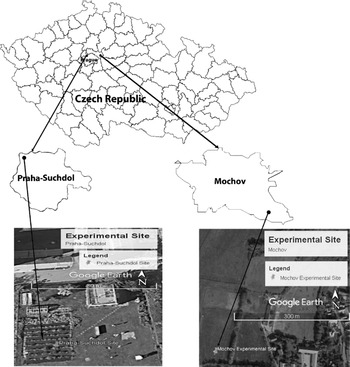
The study was conducted in the Central Bohemian region (valleys of the central parts of the Czech Republic; Fig. 1). This fruit-vegetable-producing region is characterized by the warmest and driest climatic conditions, where drought stress is often a limiting factor for crops; however, agricultural advantages of the fruiting region ensure the longest growing season and the longest frost-free period with the most productive soil conditions. The transplanting dates for fresh-market tomato cultivars grown under open field conditions correspond to the stable transition of the average daily air temperature above 15°C (resulting in over 110-day season). During 1961–2020, the mean temperature of the tomato-growing season ranged from 16.5 to 18.0°C, and the total precipitation varied from 289 to 325 mm. The average maximum and minimum temperatures were 22.1 and 11.3°C, respectively (Potopová et al., Reference Potopová, Štěpánek, Zahradníček, Farda, Türkott and Soukup2018, Reference Potopová, Zahradníček, Štěpánek, Türkott, Farda and Soukup2017a). Growers usually delay the planting date of thermophilic vegetables past 15 May to minimize the risk of frost damage (only 10% risk). In cooperation with vegetable farms, a field trial was carried out at two experimental sites (Hanka Mochov, 189 m a.s.l. and Praha-Suchdol, 287 m a.s.l) during 2014, 2015, 2016, 2017, 2018 and 2020 tomato-growing seasons, where input data for the model were collected.
Map of field locations and their geographical positions in the Czech Republic.

Field experiments
Crop management adopted in this study (cultivation, weeding, irrigation, fertilization, standard protection against diseases and pests) was based on the practices of local farmers. The soil was ploughed to a depth of 25 cm in the autumn and cultivated by spring. Nitrogen fertilization was scheduled throughout the season to deliver 200 kg/ha each season. Weeds were controlled by hand; pests and diseases were completely controlled by organic treatments. Drip irrigation (drip tube in line emitters, 2 litres/h, spaced 0.5 m) was applied according to the soil moisture once or twice per week with a dose of 15 and 20 mm. Irrigation was scheduled according to the changing needs of the plant; the young developmental stage coincided with a time with high drought frequency (mid-May and June) and the middle phase of fruit growth was a time of high water consumption (July, ~140 m2/ha per tonne yields) (Potopová et al., Reference Potopová, Štěpánek, Farda, Türkott, Zahradníček and Soukup2016, Reference Potopová, Zahradníček, Štěpánek, Türkott, Farda and Soukup2017a). During the late reproductive stages, the tomato yields were less sensitive to droughts due to the ability of tomato plants to extract water from deeper layers during soil moisture stress (70 m2/ha per tonne yields).
All the data on climate, soil, crop growth, management and yields collected in the experiments were entered in the standard DSSAT files (*.TMX, *.TMA, *.TMT, *.WTH, *.SOL) needed for execution of the CROPGRO-Tomato model. Experimental data sets and managing crop as well as weather and soil data for model evaluation were used. Measured and simulated growth and development of the fresh-market Thomas F1 indeterminate tomato cultivar grown under open field conditions at two locations with different soil and climate conditions were evaluated. The general cultivar information and experimental data on phenology and yield components have previously been described (Potopová et al., Reference Potopová, Tűrkott, Hiřmanová, Rožnovský and Litschmann2017b). Thomas F1 is early season tomato with a large red fruit (57–67 mm; weight of fruit ~120 g) which quickly ripens. Fruit does not crack even in the adverse weather conditions and is widely preferred by growers. Thomas F1 referred to as LSL (long shelf-life) with suppressed aroma formation throughout ripening. After preparing the pots, the tomato seeds were sown in the greenhouse by mid-February for each experimental year and approximately 45–55-day-old seedlings were transplanted by hand into the main field, corresponding with agrotechnical requirements, by mid-May. The spacing maintained in the main field was 1.00 and 0.50 m between rows and plants within rows, respectively. The sampled plants were collected every 14 days for analysing basic physiological parameters: LAI and RGR (Relative Growth Rate). Phenological experimental data are crucial information for calibration of a crop model and plays a central role in the portioning of assimilates. Therefore, phenology was observed weekly according to the BBCH scale (Feller et al., Reference Feller, Bleiholder, Buhr, Hack, Hess, Klose, Meier, Stauss, Boom, van den and Weber1995). Easily distinguishable visual phenological stages of the indeterminate tomato cultivars were recorded (Deligios et al., Reference Deligios, Cossu, Murgia, Sirigu, Urracci, Pazzona, Pala and Ledda2016). Site heterogeneity can cause some plants within the stand to develop at different rates, resulting in a significant time lag between individual plant's ontogenesis. Thereby, weekly phenology (%) was calculated as a ratio of plants recorded within each phenological stage and the total number of plants in the field. LAI was determined by an infrared image analysis (infrared photographs with 8 Mpx resolution). The images were processed with the analytical tool in Adobe Photoshop. The dry biomass of the sample plant was taken after drying the plant in an oven at 105°C. Parameters affecting leaf growth, dry biomass production, and dry biomass of leaves, stem and generative organs from transplanting to harvest were calibrated against the measured data.
Model input data sets
The CROPGRO-Tomato model predicts tomato growth, LAI, yield and other components in response to the soil types, weather, crop management practices and crop cultivar (Jones et al., Reference Jones, Hoogenboom, Porter, Boote, Batchelor, Hunt, Wilkens, Singh, Gijsman and Ritchie2003; Hoogenboom et al., Reference Hoogenboom, Porter, Boote, Shelia, Wilkens, Singh, White, Asseng, Lizaso, Moreno, Pavan, Ogoshi, Hunt, Tsuji and Jones2019). The algorithm used in the model is a set of differential equations representing rates of growth or development as functions of the soil-plant-atmosphere dynamics. The soil-plant-atmosphere modules include competition for light and water among the soil, plants and atmosphere. The CROPGRO-Tomato model incorporated with DSSAT was calibrated and evaluation using the field-measured data of Thomas F1 tomato variety Mochov and Praha-Suchdol sites. These simulations are conducted at a daily step. At the end of each day, the plant and soil water, nitrogen, phosphorus and carbon balances are updated, as well as the crop's vegetative and reproductive development stage. To run CROPGRO-Tomato model, we used the following four basic data set groups: (1) crop species and cultivar characteristics, (2) meteorological daily data (rainfall, global solar radiation, maximum and minimum air temperatures), (3) soil conditions and (4) cultivation technology (term of transplantation, term and dose of irrigation, fertilization and harvest).
Crop management data
Crop management data included Thomas F1 cultivar growth characteristics such as planting date, emergence date, transplanting date, plant population, plant height, leaf area measurements, anthesis date, maturity date, harvest date and yield obtained during GS of 2014, 2015, 2016, 2017, 2018 and 2020 at two experimental sites (Table 1). The seedlings were planted at 5 cm depth in the greenhouse-grown plants. The field preparation began in early-May before the transplanting of the tomato seedlings. By mid-May, Thomas F1 transplants were hardened off before transplanting to the field. The final harvest occurred from mid-September to early-October each year.
Selected crop management practices including the calibration (Mochov 2016) and evaluation (Praha-Suchdol 2017) periods

MO, Mochov; SU, Praha-Suchdol; dap, days after transplanting.
Climate data and detection of compound weather events
The DSSAT-CSM required the minimum data set of daily maximum (Tmax, °C) and minimum temperature (Tmin, °C), incoming solar radiation (R G, MJ/m−2/d) and precipitation (P, mm) to simulate crop growth and development. If the incoming solar radiation was not recorded directly, it was converted accurately for photosynthesis and potential transpiration using the Priestley–Taylor equation (Priestley and Taylor, Reference Priestley and Taylor1972). The study connected daily weather data recorded at Poděbrady and Praha-Ruzyně climatological stations (1961–2020) from the Czech Hydrometeorological Institute and daily weather variables recorded by meteorological sensors in crop canopy at field farm levels for the period 2014–2020. The RG was calculated by Ångström-Prescott formula (Angstrom, Reference Angstrom1924) based on the fraction of daily total atmospheric transmittance of the extra-terrestrial solar radiation (R A), a fraction of actual (n) and potential sunshine duration (N) during the day:

where A and B are empirical coefficients determined for the particular site (e.g. for Mochov site: A = 0.21 and B = 0.54).
The DSSAT-CSM weather module was used to arrange and incorporate all the weather data in the standard format of weatherman database. According to this data set, the CROPGRO further calculated daily potential evapotranspiration by Priestley and Taylor (Reference Priestley and Taylor1972) method.
To better understand how such impactful events may affect the filed tomato productivity, the CEs methodology was investigated (Potopová et al., Reference Potopová, Lhotka, Možný and Musiolková2021). Here, the combination of variables that lead to an extreme impact on tomato growth was referred to as a compound event. To quantify the coupling effect of temperature and rainfall anomalies on tomato growth during GS, we applied a quantile-based analysis to Tmax–P coupled data sets for the period 1961–2020. We combined the 85th percentile for daily maximum temperature (Tmax85) and 35th percentile for daily precipitation (P 35) and Tmax35 and P 85, which represented compound hot-dry events (Tmax85–P 85) and cool-wet, respectively. We combined the 85th percentile for daily Tmax and P, which represented compound hot-wet events (Tmax85–P 85). The heat stress (TS30, °C) was calculated as the Tmax excesses above the 85% quantile that met the hot day criterion. This pattern is important for tomato production because it drives canopy growth patterns.
Soil data
Specific soil parameters required for the model input, such as a lower limit, drained upper limit and saturation, drainage coefficient, and runoff curve number, were estimated from measurement of the soil profile. The soil data from the experimental sites were collected from the field based on the soil layer depths (10 cm each up to 90 cm) by using the soil standard sampling materials and kept the soil samples in air-tight zip bags and in soil cores for laboratory analysis. The physical and chemical analyses of sampled soil were performed in the soil analysis laboratory. The soil profiles for Mochov and Praha-Suchdol sites were characterized as Haplic Chernozems and Sandy Loamy Cambisol, respectively. The soil input data sets in the SBuild module included per cent of clay, silt, sand and organic carbon, pH, cation exchange capacity, slope, albedo, colour, drainage, drained upper limit (DUL), total soil nitrogen, lower limit (LL), saturated water content (SAT), hydraulic conductivity, bulk density, root growth factor (SRGF) and soil fertility factor (SLPF) (Jones et al., Reference Jones, Hoogenboom, Porter, Boote, Batchelor, Hunt, Wilkens, Singh, Gijsman and Ritchie2003). The measured soil data from both Mochov and Praha-Suchdol sites are presented in Table 2.
Selected soil parameters for CROPGRO-Tomato model from the experimental sites

MO, Mochov; SU, Praha-Suchdol; Corg, organic carbon; CEC, cation exchange capacity; Total N, total nitrogen; LL, lower limit of water availability to plant; DUL, drained upper limit or field capacity.
Model calibration and evaluation
Crop management data set for tomato (Thomas F1) from Mochov-2016 experimental site was used to perform the calibration of the DSSAT-CROPGRO-Tomato model and evaluation of the model was done in Praha-Suchdol experimental site in 2017. Experimental information such as planting date, plant population per square meter, planning depth, row spacing and harvesting date was used as crop management practices. At the same time, data on plant phenological stages such as emergence, anthesis, LAI and AGB based on days after planting, pod formation, physiological maturity and harvest maturity were also used in the calibration process. The AGB values were expressed in dry matter for the calibration and evaluation of the model. Since the Thomas F1 variety of tomato was not included in DSSAT cultivar database, it was added as a new cultivar into the database and its parameters were populated based on the field experimental data set. We applied the newly calibrated values of ecotype file and cultivar coefficients for LAI and AGB. The simulated dates and values of the LAI and AGB were compared with the observed dates. The simulated dates and values varied in different years due to the differences in planting dates, photothermal duration, precipitation and weather-related parameters during the tomato-growing seasons. Performance statistics indicators used in this study were standard error of estimate (S e), mean absolute error (MAE) and root mean square error (RMSE), which were calculated using Eqns (2)–(4), respectively. A lower RMSE value indicates fewer differences between the simulated and observed values.


where Y i = observed value, $\hat{Y}_i$ = simulated value, $\bar{Y}_i$
 = average of simulated value, $\bar{Y}$
 = average of observed value, N = number of observations and n–(k + 1) = degrees of freedom.
Results
Compound weather events during the tomato growth seasons
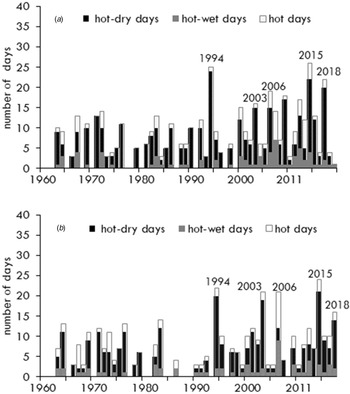
This section focuses on the quantification of CEs occurrences from transplanting to harvest of the hybrid field tomato variety Thomas F1. An overview of frequency of hot, hot-dry and hot-wet days during GS for the period 1961–2020 at two locations are shown in Fig. 2. On average, the phenological phase of flowering occurred 21 and 24 days after planting, respectively, at Mochov and Suchdol. Thomas F1 began to reach harvest maturity (the first fruits) after 44 (51) days on average, at Mochov (Suchdol) site. Whereas 120 (141) days occurred from the planting to the last harvest. The length of both vegetative and reproductive tomato phenological cycles was strongly affected by CEs (temperature and photoperiod, drought or N availability). Our experiment indicated that the first flower set (with a first open flower) in 2014 appeared 28 days after transplanting. Fruit set occurred within a few days after flowering. The earliest date of planting occurred in 2015 (May 11), and the latest date occurred in 2016 and 2017 (May 23). In 2015, strong positive temperature–precipitation anomalies in May led to an earlier planting date. The extension of the tomato-growing season in the first half of May allowed for early planting of Thomas F1. Subsequently, the extension in the fall had a positive effect on the production quality, allowing a gradual harvest. The higher number of days with heat stress in the 2015 and 2016 tomato-growing seasons caused slowing in the relative growth rate of dry matter. The high levels of global radiation and high temperatures resulted in necrosis in tomato fruit tissue. The uncharacteristically low results in the Mochov experimental field in 2016 were mainly due to hail damage.
The frequency of hot, hot-dry and hot-wet days in the heat waves during the tomato growing season for the period 1961–2020 at Mochov (a) and Praha-Suchdol (b).

The Tmax–P coupled conditions during the tomato-growing seasons of 2014, 2015, 2016 and 2018 resulted in extreme drought and heat stress (Table 3). The lowest and highest values of P and Tmax were recorded in 2018, which was the driest and warmest year in the study. The highest precipitation values were recorded in 2020, the wettest growing season. The cool and wet events during the tomato-growing season of 2014 led to high BBCH phase variability, low RGR 0.634 g/g/day and AGB 0.28 t/ha, respectively (Table 4). A beneficial effect of hot and dry events on the tomato fruit was noted during the entire GS of 2018. The CEs in 2018, compared to the other years of the study, led to the significantly higher LAImax 2.73 m2/m2 and AGB 1.013 t/ha.
Evaluation of the temperature and rainfall compound events for each month of the tomato-growing season (May–September) during each experimental year in Central Bohemian region

Δt, deviations of the mean monthly air temperature from the long-term mean; °C; P, %, percentage of monthly long-term precipitations; °C–P, %, coupling of anomalies of temperature–precipitation patterns.
Analysis of RGR, LAI and CEs (hot days, heat stress index [TS30], dry days) from transplanting to harvest of Thomas cultivar for two experimental sites

RGR, relative growth rate; LAImax, leaf area index (maximum); AGB, above ground biomass; TS30, moderate heat stress.
Estimation of calibration parameters of tomato cultivar in the CROPGRO-Tomato model
The CROPGRO-Tomato model required calibration of genetic coefficients in the cultivar file since a new cultivar was used for the experiments. These coefficients describe durations of developmental phases of a specific cultivar. The parameters of tomato cultivar were calibrated by adjusting the cultivar performance according to the field experiments. The adjusted photothermal duration between plant emergence and flower appearance (EM-FL), photothermal duration between first flower and first pod (FL-SH) and photothermal duration between first flower and first seed (FL-SD) cultivar parameters were within the range of testing for Thomas F1 cultivar. The cultivar parameters of tomato Thomas F1 cultivar, such as the FL-SH and FL-SD values, were adjusted to precisely simulate the crop yield as 2.4 and 22.0 photothermal days respectively. The EM-FL parameter was adjusted to accurately calculate the beginning of flowering and was verified within a range of 8–25 photothermal days and a value of 10.0 photothermal days accurate estimation of flowering was selected. Depending on the climatic zones, the duration between plant emergence and flower appearance varied within the given range (8–25 photothermal days). The SD-PM parameter of the cultivar was tested between 35 and 47 photothermal days and finally adjusted to 40 photothermal days to simulate the crop harvesting date accurately (Table 5). The FL-LF parameter was adjusted to 42 days to predict the end of leaf growth. The rest of the cultivar parameters that effected the maximum photosynthesis rate (LFMAX), specific leaf area (SLAVR), maximum size of full leaf (SIZLF), seed filling duration for cohort (SFDUR), time required for cultivar to final pod load (PODUR) and threshing percentage (THRSH) were adjusted accordingly to the accurate simulated results (Table 5). In case of the ecotype parameters, the relative width of the ecotype in comparison to the standard width per node (RWDTH) and the relative height of the ecotype in comparison to the standard height per node (RHGHT) were adjusted to 1.0 to properly simulate the canopy width and canopy height, respectively. The JU-R0 parameter was adjusted to 5 thermal days to simulate the acceptable timing of first true leaf to end of juvenile stage. FL-VS parameter, adjusted to near to 25 days (24.50) for end of stem elongation. After calibration, the model was able to predict phenological stages such as the emergence, anthesis and physiological maturity dates. The simulated results of the model, during the calibration stage at both Mochov and Praha-Suchdol sites, were within the observed range. The calibrated values of the cultivar and ecotype parameters for the study sites are shown in Table 5. For LAI predictions, the tomato cultivar parameters were adjusted to accurate estimation LAI after achieving reasonable prediction of crop phenological stages during the growing seasons. Parameters adjusted for Thomas F1 tomato cultivar were comparable to the DSSAT cultivar file.
Parameters adjusted of Thomas F1 variety during the CROPGRO-Tomato model calibration

Simulation of tomato LAI against field data
The leaf area is an important factor that determines crops growth and production. A comparison of the simulated LAI with the observed values of the fresh-market Thomas F1 tomato cultivar grown under open field conditions for 2014, 2015, 2016, 2017, 2018 and 2020 experimental years at Mochov is shown in Figs 3(a)–(f). A good agreement between simulated and measured LAI (Fig. 3(c)) and model performance statistic (Table 6) indicates that the LAI had been calculated accurately during the CROPGRO-Tomato model calibration. In 2016, the performance statistics for calibration showed the reliability of the data with the S e, MAE and RMSE values as 0.22, 0.15 and 0.24, respectively (Table 6). At Praha-Suchdol experimental site in 2017, the CROPGRO-Tomato model estimated a significant fit between the simulated and observed LAI during the evaluation with a decent model performance statistic (Fig. 4(d)). The performance statistics for evaluation showed the S e, MAE and RMSE values as 0.21, 0.49 and 0.18, respectively (Table 6). Among the six experimental years at the Mochov site, the model in 2020, 2018 and 2017 exhibited the highest LAI prediction accuracy with generally low RMSE value (0.21–0.36). In contrast, high RMSE values, observed from both sites in 2014 and 2015, confirmed low agreement between the simulated and measured LAI. In this study, the model overestimated the LAI for the tomato-growing years 2014 and 2015 for Mochov and 2014, 2015 and 2016 for Praha-Suchdol. The prediction of the model indicated a similar pattern to previously reported tomato in Florida (Boote et al., Reference Boote, Rybak, Scholberg and Jones2012). The higher temperature and precipitation deviations (Table 3) in early stages of crop establishment were critical issues for vegetative growth and photosynthesis. Variability in optimum plant establishment temperature and precipitation led to decline in the physiological growth of plants and reduced leaf growth. The cool (12–15°C) and wet (25–45 mm/day) events during the initial tomato-growing seasons of 2014 and 2015 led to high BBCH phase variability with a lower observed LAI in Mochov and Praha-Suchdol.
Comparison of the simulated Leaf Area Index (LAI) with the observed values of the fresh-market Thomas F1 indeterminate tomato cultivar grown under open field conditions for experimental years 2014 (a), 2015 (b), 2016 (c), 2017 (d), 2018 (e) and 2020 (f) at Mochov site.

Comparison of the simulated Leaf Area Index (LAI) with the observed values of the fresh-market Thomas F1 indeterminate tomato cultivar grown under open field conditions for experimental years 2014 (a), 2015 (b), 2016 (c), 2017 (d), 2018 (e) and 2020 (f) at Praha-Suchdol site.

Statistical indicators of the simulated LAI against the observed LAI for evaluating the performance of CROPGRO-Tomato model at Mochov (MO) and Praha-Suchdol (SU) sites

MO, Mochov; SU, Praha-Suchdol.
A comparison of the simulated LAI with the observed values of the fresh-market Thomas F1 cultivar grown under open field conditions for 2014, 2015, 2016, 2017, 2018 and 2020 experimental years at Praha-Suchdol site is shown in Figs 4(a)–(f) and Table 6. The simulated LAI in 2017, 2018 and 2020 showed comparatively better match with the observed LAI values at Mochov (Figs 3(d)–(f)) and Praha-Suchdol (Figs 4(d)–(f)), respectively. The range of 20–25°C daily mean temperature and 15–30 mm/day precipitation was observed in the early establishment stages of the crop. In case of Mochov-2017, the model underestimated the LAI value only at 70 DAP (Fig. 3(d)). The simulated and observed LAI for the modelled year Mochov-2018 and Mochov-2020 showed good correlation with overestimations at 50 DAP and 120 DAP, respectively (Figs 4(e) and (f)). Lower daily mean temperature at Mochov-2018 at 50 DAP and start of leaf senescence in Mochov-2020 resulted in lower observed LAI in both cases. However, at Praha-Suchdol, the model estimated a significant fit for the observed and simulated LAI in the experimental years 2017, 2018 and 2020 with an insignificant overestimation at 50 and 70 DAP, respectively (Figs 2(e) and (f)). In both sites, large temperature variations during the physiological growth stages reduced plant growth.
Simulation of Above Ground Biomass with the observed values of the Thomas F1
Crop AGB indicated the amount of green canopy and the leaf blade nutrient mobilization through the plants in photosynthesis by transforming the solar radiation and chemical energy. Like LAI, the CROPGRO-Tomato model calibration showed a very well agreement between modelled and measured AGB (Fig. 5(c)). In Mochov experimental site, the performance statistics for calibration of AGB indicated the accuracy of the model with the RMSE value as 0.33 (Table 7). The modelled and observed values of AGB for the experimental years 2014, 2015, 2016, 2017, 2018 and 2020 at Mochov are shown in Figs 5(a)–(f). During the CROPGRO-Tomato model evaluation at Praha-Suchdol site, the modelled AGB showed a significant fit with the observed AGB (Fig. 6(d)). The model performance statistic during evaluation showed the RMSE value as 0.28 (Table 7). The modelled and observed AGB values for experimental years 2014, 2015, 2016, 2017, 2018 and 2020 at Praha-Suchdol are presented in Figs 6(a)–(f). These values for both the experimental sites justified that the CROPGRO-Tomato model could be accurately used to evaluate AGB of tomato in different experimental conditions. In this study, the model overestimated the AGB for the tomato-growing years 2014 and 2015 for Mochov and 2014, 2015, 2016 and 2020 for Praha-Suchdol. These variabilities in AGB depend on CEs as well as plant-soil interactions. In this study, the lower observed initial AGB of the tomato plants mostly occurred due to the critical lower temperature and higher precipitation at the early growth stage of tomato plant establishment.
Multiple-sample comparison of the simulated above ground biomass (AGB, t/ha) with the observed values of the Thomas F1 during the growing seasons of 2014 (a), 2015 (b), 2016 (c), 2017 (d), 2018 (e) and 2020 (f) at Mochov site. The AGB values were expressed in dry matter for the calibration and validation of the model.

Multiple-sample comparison of the simulated above ground biomass (AGB, t/ha) with the observed values of the Thomas F1 during the growing seasons of 2014 (a), 2015 (b), 2016 (c), 2017 (d), 2018 (e) and 2020 (f) at Praha-Suchdol site. The AGB values were expressed in dry matter for the calibration and validation of the model.

RMSE of the simulated above ground biomass (AGB t/ha) with the observed values of the Thomas F1 in CROPGRO-Tomato model at Mochov (MO) and Praha-Suchdol (SU) sites. AGB used in this table is expressed as dry matter

MO, Mochov; SU, Praha-Suchdol.
Discussion
To illustrate the performance of CROPGRO-Tomato model to simulate growth parameters, LAI and AGB of Thomas F1 tomato cultivar were selected for this study. For the first time in the Czech Republic, the genetic coefficient for this specific variety of tomato, different parameters like anthesis date, crop maturity date, harvest yield, total biomass weight, maximum LAI were incorporated into the DSSAT crop model. In a recent study, Ayankojo and Morgan (Reference Ayankojo and Morgan2020) also observed similar ranges of FL-SH, EM-FL and FL-SD in cultivar file for Florida 47 cultivar of tomato. This finding was consistent with Scholberg et al. (Reference Scholberg, Boote, Jones, McNeal, Kropff, Teng, Aggarwal, Bouma, Bouman, Jones and van Laar1997) and Boote et al. (Reference Boote, Rybak, Scholberg and Jones2012), who emphasized the tomatoes growing in open field reached a maximum LAI about 11 weeks after transplanting. However, our experimental results show that fruit formation in the tomato cultivar decreased as both extreme temperature and rainfall increased. Thereby, the greatest differences between the measured and simulated LAI and AGB values were recorded in the GSs with the highest occurrences of cool and wet events. This finding is consistent with Khan et al. (Reference Khan, Fariduddin and Yusuf2015), who emphasized that the negative and irregular temperature variations in case of the tomato-growing season could affect biomass accumulation. Tomato growth at low temperature resulted in lower number of flowers per cluster, number of fruits and yield per hectare as compared to plants produce in optimum temperature. The same results were obtained by Boote (Reference Boote, Mattoo and Handa2017). Low temperature stress during vegetative growth stages significantly reduced the tomato yield (Meena et al., Reference Meena, Khurana, Kaur and Singh2018). In contrast, extreme temperatures can result in heat stress leading to reduced fruit set and higher partitioning of resources (carbon, water and nutrient) into vegetative biomass (Young et al., Reference Young, Wilen and Bonham-Smith2004; Alam et al., Reference Alam, Sultana, Ahmad, Hossain and Islam2010; Ozores-Hampton et al., Reference Ozores-Hampton, Kiran and McAvoy2012). Heuvelink and Dorais (Reference Heuvelink and Dorais2005) discussed that the single-leaf photosynthesis and plant biomass development has an optimum temperature range between 20 and 30°C at 350–410 ppm CO2 concentration. Another study conducted by Ogweno et al. (Reference Ogweno, Song, Hu, Shi, Zhou and Yu2009) found that the optimum tomato leaf photosynthesis occurred at 25°C, while it began to decline above 38°C. Although 2018 was a hot and dry growing season, it was the highest recorded yields for Thomas F1 (68.4–72.1/tha) in Central Bohemia. Thus, the tolerance of Thomas F1 to extreme temperatures and lack of precipitation, compensated by irrigation, will probably become important for farmers in the lowlands. Ventrella et al. (Reference Ventrella, Charfeddine, Giglio and Castellini2012) highlighted that irrigation and nitrogen fertilization reduced the negative impacts of climate change to the productivity of tomato cultivated in southern Italy. Swann et al. (Reference Swann, Hoffman, Koven and Randerson2016) concluded that the water savings plants experience under high CO2 conditions compensate for much of the effect of warmer temperatures. For tomato production (Boote, Reference Boote, Mattoo and Handa2017), it is necessary to (i) fulfil the water and nutritional requirements of the crop for optimal production, (ii) consider the environmental impact of production, and (iii) offer nutritious and safe tomatoes to consumers.
By using CROPGRO-Tomato to simulate the respective LAI and AGB from transplanting to harvest, we can point out the main conclusions as following.
The leaf area development was compared, and although the modelled values were higher than the measured values, they were still within a reasonable range. The model fitted the observed LAI data with an average RMSE of 0.38. During the comparison between modelled and observed AGB, the model has shown an acceptable range of variations. The model closely matched observed AGB data with an average RMSE of 0.28–0.33. The calibration statistic suggested that the model was successfully calibrated and is now ready to evaluate experimental variations under different climatic conditions.
Currently, there is limited data on the genetic coefficients of the local tomato varieties. The CROPGRO-Tomato crop model of DSSAT v4.7.5.0 has shown good skill at simulating the observed LAI and AGB development of the Thomas cultivar. Therefore, last version of this model is a reliable tool to determine the genetic coefficients of the local cultivars and assessment of their resilience to future climate change.
The outcomes and information generated through our analyses have crucial significance for assessing CE effects and can be consulted to predict tomato fruit formation in the field conditions. We demonstrated that CEs are adverse factors that usually occur irregularly during the tomato-growing season and depends on air temperature fluctuations and precipitation received. Except for 2020, the majority experimental growing seasons appear to be associated with positive high summer temperature anomalies and high deficits in the water balance throughout the experimental sites. However, Thomas F1 indeterminate tomato cultivar generates high economic returns per unit of land and thus offers promising income prospects, especially for small landholders. Use of cultivars with spring frost and rain deficit tolerance is assumed to be an important adaptation measure for tomato in lowlands of Central Europe.
As this study only focused on the growth characteristics of tomato variety (Thomas F1), the yield parameters were not included this time. We are considering further experimental plans on yield characteristics.
Finally, the calibration and evaluation of the CROPGRO-Tomato model in this study showed the ability of the model to simulate ongoing field management and climatic impacts on the growth characteristics of tomato. These results can be used for future implementation of proper strategies for crop management and climatic projections.
Acknowledgements
We thank Bc. Tatiana Luta for helping in collection experimental data sets. T. A. Reinhardt Piskáčková is kindly acknowledged for brushing up the English of the manuscript. We are grateful to agronomist (ing. Igor Potop) at Mochov farm s.r.o. for agro-technical service of field trials (cultivation, weeding, irrigation, fertilization, standard protection against diseases and pests).
Financial support
This study was supported by projects of TACR ‘Water systems and water management in the Czech Republic in conditions of the climate change’ (SS02030027). ‘Introduction of new methodologies and support of experimental work of 1st and 2nd year doctoral students grant’ (SGS SV20-16-21150).
Conflict of interest
None.
Ethical standards
Not applicable.