‘Physics ought to describe only the correlation of observations.’ (Werner Heisenberg, 1983Reference Heisenberg1)
1. Introduction
In Heisenberg’s above statement, he is calling for a minimalist approach to physics, and quantum physics in particular. Heisenberg makes two assertions. He first stresses that physics should concentrate on correlations of observations. Physicists have always been aware of the important role correlations play. Interest in them has experienced a remarkable revival during the last two decades in connection with measurements on composite quantum systems in entangled states. Quantum physics may indeed be regarded to a large extent as a physics of correlations.
Heisenberg’s second assertion is that one should restrict oneself to nothing but correlations. This self-imposed restriction has not been very successful in the past. Apart from practical problems it does not meet the desire for understanding, comprehension and intuition. How meeting these three goals while using correlations as a starting point for a deeper analysis of quantum mechanics will be shown in the following text through the use of examples.
Measurements are events in space-time. Special relativity provides a framework for the temporal order of events. This framework which is based on the idea of causation. Some interesting topics of discussion are non-relativistic quantum processes within this causal structure. Is there is an empirical indication for superluminal action at a distance and how is this theoretically represented? This is one point among many we are going to discuss in this article.
We will analyze simple and composite quantum systemsReference Audretsch2 and compare them with simple and composite classical systems respectively. This will illustrate the characteristic quantum mechanical effects as well as common structures. We use photon polarization as a representative quantum system and will first explore the phenomena without referring to a particular theory. There may be several alternative quantum theories capable of explaining the same observations that make different statements regarding causation and determinism. We use standard quantum theory as it is presented in textbooks.
Correlations of measurement results are the characteristic feature of composite systems. This is directly related to determinism and causation for entangled systems. Are the correlations due to an action at a distance? Is this a new quantum effect? What does it mean and how can it be explained? When trying to answer these questions one must decide if causality statements refer to single measurement results or to an ensemble of many results obtained in repeated measurements. We begin with classical objects, which may be treated as point masses.
2. Classical objects
2.1. Causality and determinism
The simple setup for our experiment, in which we explore the behavior of simple point masses, consists of a gun, a target, and bullets – the point masses. The position and orientation of a gun are assumed to be fixed. A bullet is shot and the trajectory of the bullet and its point of impact are measured. This procedure can be repeated many times under the same conditions, and the same trajectory is always observed. To describe this process one talks about causes (the shootings of the gun) and effects (the impacts). The cause precedes the effect. It provokes the effect. There is a temporal order. We have thus established event causality.
The word ‘cause’ can also take on an entirely different meaning. Our system is open and there is an external influence: the influence of the earth causes the bending of the bullet’s trajectory.
‘Determinism’ is also primarily relevant to observations. In our example, we observe the flight of an object of some mass near the surface of the earth and, with subsequent repetitions of the procedure, a pattern begins to emerge. If the setup is not changed, the flight of the next bullet can be predicted on the basis of the observations of the trajectories of the preceding bullets. A pattern allows an unambiguous prediction. This can be regarded as representation of an underlying determinism.
The explanation of a deterministic structure is part of a scientific theory. In this case this is Newton’s theory of gravitation. It describes all possible bullet trajectories by one scientific law, which has the form of a differential equation. Mathematically, the initial condition uniquely fixes the respective solution of the differential equation. The corresponding preparation by the experimental apparatus fixes the observed physical trajectory.
In practice, the existence of a deterministic law must not necessarily imply predictability. It may be that in some cases the preparation is not fixed precisely enough and changes with every bullet. It may even be that small variations of the preparation lead to large modifications of the trajectory, as is the case for deterministic chaos.
The game of darts offers another example. Every throw is perfectly well-determined but the preparations change in such a way that the result of a single throw cannot be predicted. Nevertheless, for a particular player a unique pattern can be observed. If the player throws many times always doing his or her best, one finds a certain distribution of the points where the darts have hit the board. Their density declines with distance from the center of the dartboard. If the player throws in a second tournament, again many times, roughly the same density distribution will be found. Another player will have a different distribution of impacts. Playing roulette is a very similar situation. The croupier throws the ball. The single result is perfectly determined by the preparation. However, because this preparation cannot be repeated, the succeeding results are different. However, for very many repetitions, the distribution of the results that emerges is fixed. It is well-determined and can be reproduced and predicted. We know many such situations in everyday life. Playing dice is an example.
2.2. Composite classical systems and correlations
We turn to ‘composite classical systems’, represented by a pair of gloves. Each individual glove is a well-defined part of the system. They are called the subsystems. We study the following scenario: Alice and Bob live together. It is winter. Alice leaves the house, Bob stays. After a while Alice wants to put on her gloves but finds in her pocket only the left-hand glove. In this case she knows immediately that when Bob finds her second glove, it will be the right-hand one. Later on when both meet, Bob confirms this. The next day, a similar situation occurs, but this time Alice finds a right-hand glove and Bob finds the corresponding left-hand glove. The same scenario happens a number of times. We assume, in addition, that Alice is not systematic in forgetting a glove. She is absentminded and leaves the right-hand or left-hand glove an equal number of days at home and there is no rule as to which one she will forget next.
This is a situation that is entirely plausible in our realm of experience. Nothing out of the ordinary is happening. Nevertheless, to be able to compare this situation – which is fully describable by classical physics – with analogous quantum physics, we first look at its structure in more detail.
Gloves are packed in pairs at the factory. The factory packs many pairs. One glove is found by Alice, the other by Bob. Both perform a local measurement, a measurement on their respective gloves. The result is either the right-hand or left-hand glove. Alice’s results are random, yet the relative frequency is  for both the right-hand and left-hand gloves. We write

Relative frequencies are another way of saying ‘probabilities’.
One can ask if Alice’s and Bob’s measurement results of individual pairs are correlated. Whenever Alice measures right (r), Bob measures left (l) and vice versa. Half the time the Alice–Bob combination is (r,l) and the other half (l,r). The combinations (r,r) and (l,l) are never found. Accordingly, the joint probabilities are

The local measurement results are perfectly correlated. On the other hand, the succession in which the combinations are found is entirely random.
Subsequent series of measurements with many pairs are performed. The local probabilities and also the joint probabilities (reflecting the correlations) are always the same: they are fully fixed.
This can all easily be understood in the framework of classical physics. All probabilities are completely determined by the procedure in which the factory combines two gloves in a package. This preparation of the single composite system acts as a common cause of the observed correlations. We note that the handedness of a glove is well-defined at all times. Alice’s and Bob’s measurements reveal properties that have always been present.
For later reference we describe the preparation process in greater detail. The two-glove systems may, in principle at least, be produced in the following way out of two independent single gloves: at the factory, one employee selects the glove that will later be found by Alice. He informs another employee about his choice and the latter adds a glove of the other type to the package. This fixes the correlation. The first employee makes his choice randomly but with fixed relative frequency. This is the typical preparation procedure for composite classical systems. This procedure is called Local Operations on each subsystem coordinated by Classical Communication (LOCC). We will return to this when discussing the less trivial correlations found in composite quantum systems.
Combined preparation in the past is a sufficient explanation for the detected correlations. The preparation fixes the joint probabilities. There is no mutual causation but one common cause of the correlations. It is not necessary to introduce an instantaneous action at a distance between the two subsystems in order to explain the measurement results. Before turning to the correlations found in composite quantum systems, we sketch the physics of uncomposed quantum systems, which we will call ‘simple.’
3. Simple quantum systems
3.1. Measurements
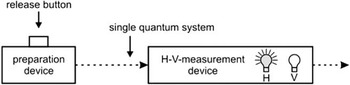
Measurements are one of the basic scenarios of quantum theory. We could use any quantum system for the following discussion – the results would be the same – but for our example we will use photons (cf. Figure 1). We use a photon source that emits linearly polarized photons one-at-a-time at the press of a button. An individual photon can be vertically polarized, and a vertically polarized light-wave is made up of many photons. What is observed? Whenever the release button is pushed, a bulb flashes immediately afterwards, indicating a completed measurement. The photon source always produces photons following the same procedure, leading to identical linear polarizations. We assume that the polarization is neither horizontal (H) nor vertical (V). The measurement instrument only measures horizontal and vertical polarizations. Preparation of a single photon and its measurement are two events. The observation demonstrates the existence of an event causation and justifies the introduction of the concept of a single photon.
The fundamental quantum scenario.

In the next step we measure a large number of single photons that are prepared by the same device in the same manner. The corresponding measurement results are either H or V, and there is no discernable pattern to them. Accordingly, it is impossible to predict the next measurement result even if all earlier results are known. If the sequence is long enough, it meets all statistical requirements for being random. (In fact, setups of this type serve in practice as random number generators.) For later use we note the relative frequency p(V) of the results V and p(H) of the results H. After this we carry out many long sequences of preparations and measurements, and work out p(H) and p(V) for each one. We find that the results p(H) and p(V) obtained for different sequences agree extremely well.
The single measurement results are entirely random but the relative frequencies are fully fixed. This is also the case for other preparation procedures and types of measurements as well as measurements of rotated orthogonal polarizations H′ and V′. Corresponding results are also obtained for different quantum systems.
3.2. Standard quantum theory
There are several alternative theories that successfully explain quantum phenomena. Standard Quantum Theory (SQT) is the theory that is taught in almost all quantum physics courses and practiced in all research laboratories. It postulates two different dynamics: measurement dynamics and transformation dynamics, which describe the effects of external influences acting on a system between preparation and measurement. Both dynamics will be sketched out below. An alternative quantum theory is, for example, the de Broglie–Bohm theory, which explains experimental data as completely and successfully as SQT. For details of this theory please refer to the literature.Reference Passon3
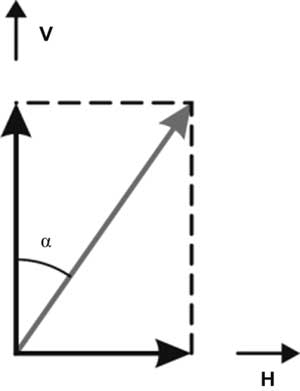
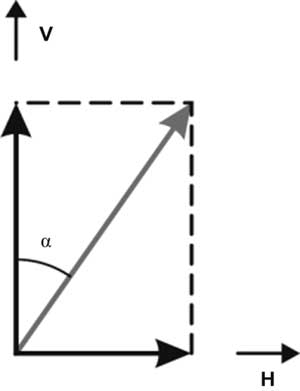
In SQT, the phenomena related to measurements are explained as follows: consider a specific procedure that prepares single photons in such a way that many of them join together to form a linearly polarized plane wave with polarization direction α. This preparation procedure is represented by a vector of length one, which is tilted by an angle α (cf. Figure 2). It is called the ‘state vector’. For particular individual photons, the theory makes no statement regarding the outcome of a measurement. For a sequence of preparations followed by measurements, the theory states that the individual measurement results are random. However, it predicts fixed relative frequencies for the results H and V. The relative frequency p(H), for example, is obtained as the square of the length of the projection of the state vector onto the horizontal direction and p(V) is obtained by projecting on the vertical direction. This projection rule applies as well to different preparations leading to different state vectors. The relative frequencies of measurements of polarizations H′ and V′ are obtained by projecting the state vector onto the rotated orthogonal directions H′ and V′.
The state vector (tilted).
It is important to stress that according to SQT a single measurement process is inherently non-deterministic: it is impossible to find an underlying deterministic structure. An improvement of the measurement apparatus or some fine-tuning of the preparation device does not change this. Randomness is not an expression of ignorance, as it is for throwing dice or playing roulette, but it enters SQT at a fundamental level.
Einstein once wanted to criticize the role of probability in SQT, a theory he disliked. He expressed his dissatisfaction in a statement that later became famous: ‘I, at any rate, am convinced that He does not throw dice.’Reference Einstein4 Indeed, in SQT there is no underlying deterministic process as is the case when throwing dice. Taken literally, Einstein is right in his characterization, but ours is not the interpretation of this statement he had in mind.
3.3. More about quantum measurements
Statements regarding causality and determinism in quantum physics often refer to the particular role the measurement process plays in quantum physics. The measuring of a system amounts to a strong interaction. This can be demonstrated on the operational level. We turn to our experimental setup.
Photons are measured one-by-one (let us assume that this is done in a non-destructive manner) by the H-V measurement device. The photon is afterwards still present. A subsequent H-V measurement with the same photon and a second apparatus is performed and the result paired up with its corresponding initial measurement. The procedure is repeated for many photons. One finds that the results of the first and second measurement are always perfectly correlated. If the first result is H then the second result is also H. The corresponding situation is true for the result V. The first result influences the photon in such a way that the next result is fully determined.
It is clear that this setup is ideal for preparing quantum systems. One only has to add a selection procedure after the first measurement, selecting, for example, H or V photons. All photons thus selected are prepared in either the H or V state, as a subsequent measurement confirms. The possibility of establishing a preparation procedure based on measurements demonstrates convincingly that quantum measurements exert a strong influence on the system.
Nevertheless, there are particular measurements of a different type that, when subsequently performed on the same photon, do not disturb each other. Two measurements are said to be compatible if the joint probabilities of the pairs of measurement results are the same, regardless of the order in which the measurement are made. Because the temporal order is irrelevant, another possibility exists: measurements can be performed simultaneously.
Turning to the theory-dependent explanation, we mention without going into technical details that in SQT compatible measurements are represented by commuting observable operators.Reference Cohen-Tannoudji, Diu and Laloe5 This mathematical property on its own is sufficient to explain the irrelevance of the temporal order of the two measurements and allows for simultaneous measurements. According to SQT there is no mediation between the two measurement devices. This means there is no action at a distance that could be regarded as an additional new ‘spooky’ causation. We will return to this when studying composite systems.
3.4. Transformation
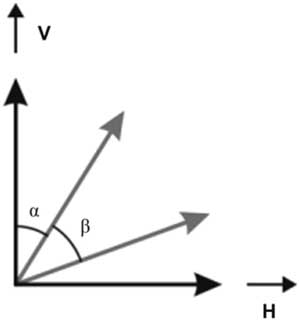
Preparation and measurement can be complemented by a third type of external influence on a quantum system. We return to our example of individual linearly polarized photons and place some medium, which rotates the polarization direction, between the two devices (cf. Figure 3). Once more, sequences of many photons are measured. The relative frequencies p(H) and p(V) are again deterministic in nature but differ from the values obtained without the medium. In changing the length of the medium, one can change the relative frequencies. This is what is measured.
Integration of a transformation device.

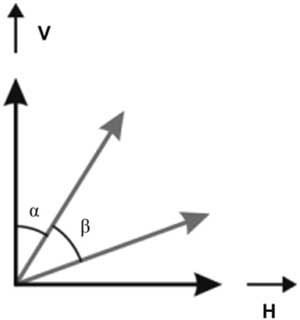
We turn to the SQT explanation of the respective values p(H) and p(V). A differential equation specifies the rotation of the state vector in time (cf. Figure 4). The result, after a certain time, depends on the initial conditions as determined by the preparation of the device. This entirely deterministic development of the state vector is called a (unitary) transformation. The resulting state vector depends on the length of the medium or, equivalently, on the duration of the external influence. The external influence acts as a cause (cf. the influence of the earth on the bullets’ trajectory in Section 2.1). The motion of the state vector describes the deterministic change in time of the relative frequencies of measurement results, if (!) these measurements were made at the respective time. This temporal development does not describe a succession of events, as does an equation of motion in classical mechanics.
Rotation of the state vector.
4. Composite quantum systems
4.1. Correlations
We now modify our photon experiment and let Alice (A) operate a device to measure H′-V′-polarization and Bob (B) operate a device to measure H-V-polarization. The measurements are called local measurements because they are obtained at different points in space-time, denoted by A and B. Alice and Bob investigate statistical correlations, as they did for pairs of gloves, between the results of measurements performed on the individual photons of a pair of photons (cf. Figure 5).
Local measurements on a composite system.

There are arbitrarily many different preparation procedures for single two-photon systems. The overall structure of the experimental results is always the same. Different sequences of measurements are always made with freshly prepared photon pairs. The individual measurement results obtained by Alice and Bob are completely random. Comparison of the different series shows that the relative frequencies p(H′) of the result H′ obtained by Alice are well determined, as is the case for p(V′) and V′, p(H) and H, and p(V) and V.
After having finished their measurements, Alice and Bob combine their results for individual photon pairs. Four combinations are possible: (H, H′), (H′,V), (V′,H) and (V′,V). Analysis shows that the pairs form a random sequence. They see that the relative frequencies p(H′, H), p(V′,H), and so on, with which a particular pair is found, are fully determined. It is important to note that these correlations are independent of the temporal order of the local measurements made by Alice and Bob. Alice’s measurement may be before, after, or at the same time as Bob’s, which would require a space-like separation instead of time-like.
This overall structure is similar to the one we found for pairs of gloves. The fundamental difference is that measurements on gloves can only answer the question ‘Is it a left-hand or is it a right-hand glove?’ With photons one can measure all orthogonal directions of linear polarizations. Obviously, correlations have more diverse details. Indeed, specially prepared composite quantum systems – which are not prepared similar to the way pairs of gloves are – show correlations that have no analogy in classical physics. The preparation makes the difference. In addition, it has to be stressed that, as compared to pairs of gloves, the properties are, in general, not fixed by the preparation but come into being via the measurement process.
4.2. Classically correlated quantum systems
A classically correlated quantum system, where one starts with independent simple quantum systems – for example two photons – can be described as follows: Alice performs an operation A1 on her photon and informs Bob about what she has done (cf. Figure 6). Then Bob performs a previously agreed upon operation B1, on his photon. They continue this process on further unique photon pairs, performing operators A2 and B2, and so on. A fixed relative frequency of the combined operations (A1,B1), (A2,B2), etc, is maintained. This is called a preparation by LOCC, as introduced above. The composite quantum systems obtained this way are called separable because they are obtained by separate influences on initially independent subsystems. We are not dealing with subsystems that can be described by classical physics. However, the preparation of composite quantum systems by LOCC is operationally the same as for classical composite systems (cf. Section 2.2), so the results of local measurements on the subsystems are said to be classically correlated.
Preparation of a composite system by local operations on each subsystem coordinated by classical communication (LOCC).

4.3. Quantum correlations and quantum holism
There are many types of preparations, starting with independent simple quantum systems, which are not obtained by LOCC and which cannot be simulated by LOCC. The resulting quantum systems are called non-local or non-separable. It is also common to call them entangled or to say they are in an entangled state. There is no internal interaction. One global process, which includes both subsystems, is one all-encompassing inseparable preparation that cannot be simulated by two local processes. The concept of quantum holism, which claims that ‘the whole is more than the sum of its parts’, for entangled systems has thus obtained a theory-independent operational meaning. The subsystems have no properties of their own, only the composite system does. One subsystem is not simply added to the other in the sense that it maintains its independence. This would imply classical correlations. Correlations observed for separable systems and entangled systems are different.
This enigmatic and inspiring concept of quantum holism has occupied the imagination of many people. If one combines quantum holism with the fact that quantum measurements are strong interventions changing the systems, yet another quantum paradox seems to emerge. One might think that Alice’s measurement on an entangled system would affect Bob’s measurement. As we have pointed out, Alice and Bob register the correlations even when measuring simultaneously. One might imagine that quantum holism therefore allows for a mutual influence between spatially separated measuring devices mediated by the entangled quantum system. Einstein called this seemingly paradoxical situation a ‘spooky action at a distance’Reference Einstein6. But is there such a ‘spooky mutual causation’ in quantum physics that forces us to think anew about causality on the quantum level?
4.4. Local interventions
If there were a ‘spooky action at a distance’ on Bob’s measurement process caused by Alice’s measurement, then Bob should be able to realize and register such an influence. We study experimental situations that could possibly reveal this. A reference to a theory is again avoided.
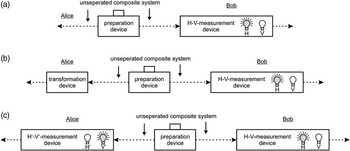
Bob observes in three different setups the measurement results H or V, which turn up randomly but with fixed relative frequencies p(H) and p(V). In all three cases the preparation device produces entangled pairs of photons. In the first type of experiment (cf. Figure 7(a)) Alice does not measure at all. Bob measures p(H) and p(V). In the second case, to apply an influence, Alice lets each photon pass through a transformation device (cf. Figure 7(b)). Bob again measures p(H) and p(V). Finally, in the third case (cf. Figure 7(c)) Alice performs H′-V′-measurements as discussed above.
(a) Alice does not intervene. (b) Alice intervenes through a transformation. (c) Alice intervenes through a measurement.

Surprisingly, the result is that Bob sees the same relative frequencies p(H) and p(V) in all three cases. From his measurements, Bob cannot determine what, if anything, Alice has done with her photons earlier, later or simultaneously. The same is true for non-entangled pairs. We turn to the conclusion.
4.5. No ‘spooky causation’
We have seen that in the experimental situation described above no empirically verifiable action at a distance appears. Is there nevertheless some sort of hidden action or causation at a distance? To give an answer we must first make sense of the question.
All experiments can be explained by SQT. They belong to the domain of application of this theory. However, one has to keep in mind: what exists depends on the theory used to describe or define it. There may be alternative quantum theories that are more or less empirically equivalent and which base explanations on different types of causation. The de Broglie–Bohm theory is an example.
SQT does not allow for an action at a distance. Instead, the correlations and the relative frequencies of the pairs of measurement results can very simply be traced back to a joint preparation of the initially separate constituents of the single entangled system. This preparation acts as a common cause. To sum up, SQT demonstrates that the experimental results do not force us to assume an action at a distance. In fact, all empirical results can be explained without it.
For completion we sketch a more technical explanation based on SQT without going into details. Every observable describing a measurement performed by Alice is represented by a local operator. Let us call these locally acting operators the A-operators. The same is the case for the measurements performed by Bob and we introduce the B-operators. Both types of operators may be formally regarded as operators acting on the composite system as a whole. Every A-operator commutes with every B-operator, because in SQT all composite systems are described by state vectors in a product Hilbert space. We have pointed out in Section 3.3 that measurements represented by commuting operators are compatible. This applies to composite systems as well. This means that for separable as well as for entangled systems the results of the local measurements do not depend on the temporal order in which they are performed (including simultaneity). This substantiates and confirms the conclusion drawn above.
Jürgen Audretsch is Professor emeritus of theoretical physics at the University of Konstanz (Germany). His dissertation (1971) was on fermion fields in curved space-time. He held a research fellowship at the University of London, and visiting professorships in Mexico-City, Zürich, and Tübingen, and served as director of the Erice-Summerschool on ‘Quantum Mechanics in Curved Space-Time.’ He organized 11 conferences on the dialogue between theology and science at the academy of the protestant church in Bad Herrenalb (Germany). While having focused on research in general relativity and quantum field theory in the past, his research interests now are in quantum optics, quantum information and, in particular, the foundations of quantum theory. He has published many articles in scientific journals, including Philosophie und Physik der Raum-Zeit (with Klaus Mainzer, 1988, 19942); Vom Anfang der Welt – Wissenschaft, Philosophie, Religion, Mythos (with Klaus Mainzer, 1989, 19902); Quantum Mechanics in Curved Space-Time (with Venco de Sabbata, 1990); Wieviele Leben hat Schrödingers Katze – Zur Physik und Philosophie der Quantenmechanik (with Klaus Mainzer, 1990, 19942); Die andere Hälfte der Wahrheit – Naturwissenschaft, Philosophie, Religion (1992); Kosmologie und Kreativität (with Hans Weder, 1999); Entangled World – The Fascination of Quantum Information and Computation (2006); Entangled Systems – New Directions in Quantum Physics (2007); Die sonderbare Welt der Quanten – eine Einführung (2008).