With the resurgence of religion as a political force shaping individual identities and political dynamics, as in the emergence of the Christian right in the United States, the return of British Red Toryism, Sarkozy's defence of France's Christian roots and Berlusconi's efforts to legislate a ban on abortion in Italy, the debate over whether religiosity may be a threat to democratic values has intensified. While some scholars argue that religion is related to prejudice and political intolerance that challenge democratic norms,Footnote 1 others stress the importance of religious social networks for the development of civic skills and norms that can have a positive effect on support for democracy.Footnote 2
Nonetheless, relatively little research has been dedicated to explaining the complex relationship between religiosity and democratic attitudes, which has been coined ‘the political ambivalence of religion’.Footnote 3 One way of reconciling the contradictory evidence lies in viewing religiosity as a multidimensional phenomenon, one that involves belief, behaviour and belonging. Footnote 4 It has recently been demonstrated that different dimensions of religiosity have differential effects on attitudes towards democracy.Footnote 5 Although religious belief, due to its association with conservative and traditional values, generates opposition to change, desire for order and intolerance, which are incompatible with democratic values,Footnote 6 involvement in social religious networks contributes to democratic attitudes due to its positive influence on civic skills and the traditional role of religious institutions as agents of mobilization.Footnote 7
While these claims suggest that different components of religiosity affect support for democracy through different mechanisms, the role of these mechanisms has not been examined empirically. This article aims to fill this lacuna by testing the argument that different dimensions of religiosity affect democratic attitudes through different mechanisms. More specifically, it demonstrates that traditional and survival values are the principle mediating mechanisms for the negative effect of religious belief on endorsement of democracy, while confidence in democratic institutions and interest in politics mediate the effect of social religious behaviour on democratic support.
The contributions of this article are fourfold. First, while empirical research on religiosity typically focuses on a single religious tradition or on case studies, we use multilevel path models to test our hypotheses with data from Wave 4 (1999–2001) and Wave 5 (2005–07) of the World Values Surveys (WVS) for a total of fifty-four world democracies that are highly diverse in terms of economic development, level of democratization, and religious and cultural traditions. Next, we test the effect of religiosity on both overt and intrinsic support for democracy.Footnote 8 Thirdly, while the vast majority of empirical studies in the field are limited to only one dimension of religiosity or pool the belief and behaviour dimensions into a single measure, we are able to show the differential effect of each dimension while controlling for the other. Fourthly, and most importantly, even those studies that encompass more than one case study or distinguish between the different dimensions of religiosity focus on the potential effects of religiosity on democratic attitudes without considering exactly how such effects are achieved. Using path models and mediation analysis, this article aims at filling this gap. In addition, we show that the mediation mechanisms are usually robust among adherents of major religious traditions.
Religiosity and democratic attitudes: Differential effects
Personal spiritual beliefs and norms generally have a profound effect on political behaviour, particularly on democratic attitudes.Footnote 9 While it is possible to think about religion as a single dimension, current literature usually grants religiosity three: belief, behaviour and belonging.Footnote 10Belief combines theology, ‘an understanding of the divine and humanity's relationship to it’, and ‘social theology’, which ‘connects the individual and the institutional church to the world’, and may entail belief in God, heaven and hell, or life after death, or the tendency among people to characterize themselves as religious. Behaviour consists of private practice such as prayer or reading of the holy texts, and social practice, which involves participation in organized religious communities and attendance at places of worship. Belonging consists of identification with a particular organized denomination and/or a religious movement. It includes the dynamic component of belonging as well as identification with trends within a denomination.
Recent empirical evidence suggests that different dimensions of religiosity may lead to different outcomes, with private religious beliefs, such as the belief in God and heaven, and social religious activities, such as attendance at places of worship and participation in organized religious communities, having potentially differential effects on political behaviourFootnote 11 as well as on support for democracy.Footnote 12 It has been suggested that religious belief, on the one hand, due to its association with conservative-traditional values, generates opposition to change, desire for order and intolerance, and is thus incompatible with democratic norms.Footnote 13 On the other hand, places of worship hold great potential for deliberative democracy,Footnote 14 provide organizational and philosophical bases for a wide range of social movements,Footnote 15 and aid the development of civic skills and democratic norms.Footnote 16
Thus, this article is set to test empirically the hypothesis that differential effects of the different dimensions of religiosity affect support for democracy through these different mediating mechanisms, and the extent to which the underlying mechanisms are robust across major religious traditions.
Religious belief and democratic support: Values as a mediating mechanism
The negative effect of religious belief on support for democracy is often attributed to the inherent contrast between the values underlying religiosity and democracy. Religion is based upon belief and a transcendent truth, while the democratic system encourages scepticism, and assumes that laws and establishments are contextual and are open to change. Religion emphasizes the duties of believers to God and their surroundings based on laws of behaviour, thought and faith, while democracy emphasizes the right to believe, act and think independently. Finally, democracy tends towards universality, striving for the global implementation of civil rights among all people and governments, while a religious public is thought to consider itself superior to other groups, and thus as entitled to more rights.Footnote 17
The two most widely used value theories in cross-national research were developed by Shalom Schwartz and Ronald Inglehart. Schwartz's value theory identified two conceptual value dimensions: openness to change versus conservatism, which conveys a conflict between independence and resistance to change; and self-enhancement versus self-transcendence, which refers to a conflict between concern for the self and concern for the other.Footnote 18 Similarly, Inglehart and Welzel identified two bipolar value dimensions: traditional versus rational-secular values, which represents the conflict between conservation, social conformity and respect for authority, on the one hand, and openness to change, individual autonomy and rejection of authority, on the other; and survival versus self-expression, which reflects the syndrome of material and physical insecurity (conveyed in a ‘post-materialism’ index), hierarchical authority and intolerance, as opposed to self-expression, individual choice and weakened focus on traditional hierarchies.Footnote 19
Religion is consistently found to be positively related to conservative and traditional values, ‘because these values stress transcendence, belief, and humility, preserving the social order, and protecting individuals against uncertainty’,Footnote 20 and to be negatively correlated with openness to change and individual autonomy.Footnote 21 In fact, a meta-analysis that encompasses fifteen countries and all three main monotheistic traditions verifies a positive association of religiosity with conservation (tradition and conformity) and security values, and a negative association of religiosity with openness to change and self-expression values.Footnote 22
While religious belief is associated with survival and traditional values, democratization emphasizes independent thought compatible with freedom of choice, self-expression and tolerance for outside groups. Threats to material existence and survival require that reduced priority be given to self-expression and human choice, and are thus less conducive to pro-democratic attitudes. In fact, Inglehart's post-materialism index, which indicates the degree to which individuals value self-expression and quality of life as opposed to economic and physical security, relates negatively to support for authoritarian values and positively to support for democracy.Footnote 23 At the same time, conservative values such as conformity and respect for tradition are negatively associated with pro-democratic values since they promote the existing order and represent acceptance of hierarchical authority.
Hence, theory and empirical results both indicate that the value conflict between democratic principles and religious belief is responsible for the negative relationship, suggesting that religious belief moulds a person towards more traditional and survival values, which in turn are negatively related to support for democracy. Since prior research indicates that the negative relationship holds for believers of different religious traditions, we hypothesized that rational (v. traditional) and self-expression (v. survival) values mediate the effect of religious belief on support for democracy across religious traditions.
Religious social networks and democratic support: Institutional confidence and political interest as underlying mechanisms
Religiosity is not merely a mental concept but also an institution that influences one's social network and that has significant effects on political behaviour.Footnote 24 Religious organizations and networks provide meaning to a complex world, defend the group that shares their worldview, and help solve collective action problems that underlie political participation. Religious institutions are often considered powerful mobilization forces that promote political involvement and participation.Footnote 25 Studies also point to the fact that active participation in places of worship positively affects political involvement and contributes to the development of civic skills.Footnote 26 Churches hold great potential for deliberative democracy.Footnote 27 As members of minority groups in democracies, the religious may enjoy the fruits of religious freedom and the rights and resources granted to minorities.Footnote 28 More often than not, religious elites act to politicize religious group identity and mobilize the corresponding constituency within the democratic game. To do so, they need to encourage their public to practise their democratic rights as citizens. With religious leaders advocating the democratic game and encouraging their audiences to assume an active role in it, places of worship could be expected to enhance overall support for democracy.
Since religious institutions are frequently used as mobilization venues, frequent participation in religious networks also increases a group's political salience and political awareness as well as an individual's interest in politics. As empirical evidence demonstrates, those who are more interested and engaged in politics also understand the political process, believe that their participation makes a difference and are more likely to take an optimistic view of democratic governance.Footnote 29
Participation in religious networks also increases the likelihood of political representation and resources, thus enhancing political efficacy and confidence in political institutions. In fact, frequent church attendance has been found to have a positive effect on confidence in institutions.Footnote 30 In turn, trust in institutions also suggests diffuse support for the social and political system in general, and should therefore be positively related to support for democracy.Footnote 31 Thus, more frequent religious attendance increases interest in politics and confidence in democratic institutions, which in turn relate positively to support for democracy. Accordingly, we hypothesized that political engagement and confidence in democratic institutions mediate the effect of religious social behaviour on support for democracy.
Overt democratic support versus support for specific regime principles
While support for democracy is regarded as necessary for the stability and legitimacy of democratic regimes,Footnote 32 the literature agrees that it is not a unidimensional concept but rather a family of attitudes that can be roughly grouped into overt and more substantive support.
Scholars of comparative politics have typically focused on what could be regarded as abstract or overt support for democracy, that is, citizens’ declaration of general endorsement of the democratic regime and of deeming it desirable for their country. While this family of attitudes is not necessarily a good predictor of the democratization of a country,Footnote 33 overt support is still viewed as a necessary (though not sufficient) condition for the thriving of a democratic culture and the legitimacy of democratic regimes.Footnote 34
At the same time it was agued that overt support for democratic institutions does not necessarily manifest genuine support for democratic values.Footnote 35 Since democracy has come to be equated with a normatively good regime, respondents may utter general support due to social desirability, perhaps without even being sure of its real content in terms of procedures and values.Footnote 36 Additionally, abstract support may be rooted in the hope for potentially beneficial institutional outcomes, such as redistribution, lower crime or a prosperous economy.Footnote 37 If support for democracy stems from the notion that democracy is about delivering material benefits, that is, if support is instrumental rather than intrinsic,Footnote 38 then it could be contingent on the regime's performance and thus be subject to volatility.
Therefore, the current literature distinguishes between overt support for democracy and a more substantive support for specific regime components. Intrinsic support for democracy includes a positive dimension, of endorsement for democratic procedures, values and norms, such as free elections, civil rights and freedom of speech.Footnote 39 At the same time, intrinsic support also encompasses a negative dimension, by which citizens reject autocratic principles and instrumental outcomes that are not integral to liberal democracy, such as economic prosperity, relative security and lower crime levels, and thereby accept that their endorsement of the regime is not necessarily contingent on its performance.Footnote 40
Accordingly, we tested our hypotheses about the mechanisms underlying the effect of religious belief and social behaviour on both types of support for democracy. While the underlying value conflict between religious belief and democratic values is expected to hold for both overt and intrinsic support for democracy, the process underlying religious social behaviour may differ for the two types of support. It could be argued that participation in social religious networks assists the devout in identifying democracy as beneficial for them as an interest group. If this is true, then the political involvement and institutional trust of the devout contributes to overt but instrumental support for democracy, not to endorsement of democratic procedures and values.
Furthermore, increased trust in institutions is not necessarily indicative of a healthy democratic culture. Since critical thinking is at the core of democratic values, genuine democrats may be critical of their governments and institutions, demanding that their country further implement democratic principles and values.Footnote 41 In fact, at the national level, trust in institutions is often negatively related to the level of democratization, as citizens of consolidated democracies tend to be more critical towards the functioning of institutions.Footnote 42 Therefore, while we expect religious social behaviour to generate trust in institutions, the effect of confidence may differ between overt and intrinsic support.
Identification with religious traditions and democratic attitudes
The effect of the ‘belonging’ dimension on support for democracy is hotly debated.Footnote 43 While this article does not seek to test the effects of different religious traditions on democratic attitudes, we are interested in the extent to which the mechanisms underlying religiosity emerge across religious traditions.
Notably, some theological, psychological and sociological perspectives on religion suggest that major religious traditions can all be associated with the values of tradition and conformity, requiring submission to transcendental authority, emphasizing the need for preserving prevailing social norms and structure, encouraging the acceptance of the social order and discouraging questioning and innovation.Footnote 44 Established religions also typically reduce uncertainty and anxiety by providing answers to fundamental questions such as those concerning life, death and injustice, thereby implying that religious belief is also related to security values above and beyond religious orthodoxy.Footnote 45 Indeed, previous research indicates that the effect of religious belief on democratic attitudes holds when controlling for the belonging dimension.Footnote 46 We expect the mechanism underlying the effect of religious belief on support for democracy, therefore, to be consistent between the adherents of different religious traditions, since major religious traditions all seem to be associated with the type of values that mediate the effects of religious belief.Footnote 47
However, while the belief systems of major religions share common values, the effect of social religious behaviour on democratic support is expected to show some variation across contexts, since there are diverse worldviews within each major religious tradition, and churches and religious social networks may not be homogeneous with regard to political views. In fact, research points to a great deal of variability in the theological positions, political tendencies and cohesiveness of Protestant congregations,Footnote 48 as well as some Muslim sects.Footnote 49 Some congregations may be greater contributors than others to deliberative democracy and the development of civic attitudes.
Unfortunately, studying the effect of the belonging dimension with the WVS dataset is difficult, since the surveys did not collect data on identification with congregations or sects, which are deemed the most important unit of political socialization among the devout.Footnote 50 As a result, along with other cross-national studies, we also conceptualize and operationalize this dimension as identification with major religious traditions. Unfortunately, this practice ignores diverse viewpoints within each tradition and often pools together denominations that take on different meanings in different cultural settings, which makes it impossible, therefore, to study the variance across religious denominations within a larger tradition.
The model and data
We used multilevel path modelling, a variant of Structural Equation Modelling (SEM), in order to test the argument that traditional and survival values mediate the effect of religious belief, while confidence in institutions and interest in politics mediate the effect of social religious behaviour on support for democracy. The theory-driven path model specifies the direct and indirect effects of religious belief and social religious behaviour on measures of overt and substantive support for democracy. We also modelled individual-level support for democracy as a function of three country-level predictors: communist legacy, economic development, and the extent of political rights and civil liberties.Footnote 51 The model further specifies correlations between individual-level exogenous variables as well as disturbance correlations between rational and self-expression values, on the one hand, and confidence in political institutions and interest in politics, on the other, to represent any omitted causes affecting these endogenous variables (see Figure 1).
The theory-driven path model

We used data from Waves 4 and 5 of the WVS, collected in 1999–2001 and 2005–07 respectively. Since individuals with no experience with democratic forms of governance might have unreliable evaluations of democracy and democratic institutions,Footnote 52 countries classified as ‘not free’ by Freedom House in the year in which data were collected were omitted from the analysis. Additionally, a number of countries were not included in the final analysis because necessary items were missing. Our analysis covers a total of more than 60,000 observations from fifty-four countries that are diverse in terms of economic development, level of democratization, and religious and cultural traditions.Footnote 53 MPLUS 4.1 software was used to run the path models as well as to calculate the direct, indirect and total effects and their standard errors.
Measures
To facilitate interpretation, all individual level variables were coded to vary between 0 and 1. Descriptive statistics are presented in Table S1 in the online appendix.
Overt support for democracy
Two measures that tap overt support were constructed: (1) endorsing democracy, which is a summative index of ‘Having a democratic political system’ and ‘Having a strong leader who does not have to bother with parliament and elections’ [reversed], constructed both on Wave 4 and on Wave 5 data; and (2) ‘Democracy is desirable’,Footnote 54 which includes the items ‘Democracies aren't good at maintaining order’; ‘In democracy, the economic system runs badly’; ‘Democracies are indecisive and have too much squabbling’ [all items are reversed]. Unfortunately, the second battery of items did not appear in Wave 5 and, therefore, we were able to run the analysis only for ‘endorsing democracy’ for this wave. In both measures, high values indicate more support. Footnote 55
Substantive support for democracy
Wave 5 of the WVS includes a battery of items asking respondents to rank the importance of several possible characteristics of a democracy on a 1–10 scale where 1 indicates ‘not an essential characteristic of democracy’ and 10 indicates ‘an essential characteristic of democracy’. Of these items, two additive scales were constructed that tap substantive support.Footnote 56 ‘Support for democratic procedures’ includes: ‘people choose their leaders in free elections’, ‘civil rights protect people against oppression’, ‘people can change the laws in referendums’, and ‘women have the same rights as men’. ‘Non-instrumental support for democracy’ reflects a general notion that democracy is not about delivering material benefits and is a summative scale of the items: ‘governments tax the rich and subsidize the poor’, ‘people receive state aid for unemployment’, ‘the economy is prospering’, and ‘criminals are severely punished’. All items are reversed such that higher values reflect a more liberal and non-instrumental understanding of democracy. Before forming each additive index, we centred all variables on their means by subtracting the individual mean of all items from each itemFootnote 57 to produce the relative position of the individual on a variable,Footnote 58 and isolated relative priorities in the respondents’ item ratings from the absolute levels of ratings to overcome cross-cultural response bias.Footnote 59
Religious belief
The following items were employed in Wave 4 – belief in: God, life after death, heaven; importance of God in the respondent's life; and getting comfort and strength from religion. In constructing this measure, we controlled for differential item functioning, which may obstruct the comparability of the construct across different religious groups, by using multi-group (MG) SEM.Footnote 60
Since many of these items were missing for the majority of countries in Wave 5, we constructed an additive index from the only two items available in the dataset: whether the respondent considers himself or herself a religious person (1 = yes, 0 = no), and the importance of God in the respondent's life (1–10 scale, 10 = very important). Although such an operationalization of religious belief is less than ideal, the comparison of both measures for Wave 4 data shows that their correlations are very strong (0.89), thus providing support for the validity of the measure.
Social religious behaviour
This is a summative index of the frequency of attending religious services (an eight category variable), and either belonging to a religious organization in Wave 4 or being an active/inactive member of a religious organization in Wave 5. Higher values represent greater involvement in social religious behaviour.
Values
Rational (v. traditional) values were measured with the autonomy index: abortion is not justifiable, national pride, respect for authority. Self-expression (v. survival) values were measured with the post-materialism index, level of happiness, homosexuality is not justifiable, and willingness to sign a petition.Footnote 61
Confidence in institutions
This is an additive index for confidence in the parliament, civil services, government and political parties.
Interest in politics
‘How interested would you say you are in politics?’ This is a four-category item, where 1 denotes strong and 0 no interest.
Country level controls
These were (1) Freedom House's rating of non-democracy for the year 1999–2000 (Wave 4) and 2005–06 (Wave 5), with a scale of 1–7, where 7 indicates the least amount of freedom. Countries classified as ‘not free’ (scoring 5.5–7) were not included in our data; (2) logged GDP–PPP per capita for the year 2000 (Wave 4) and 2005 (Wave 5), as published by the World Bank;Footnote 62 (3) a Communist legacy dummy.
Results
Theory-driven Models
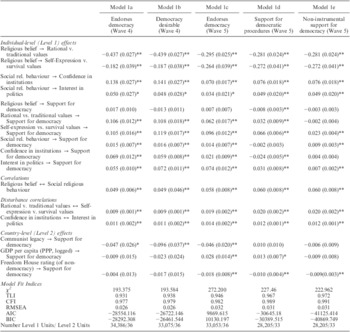
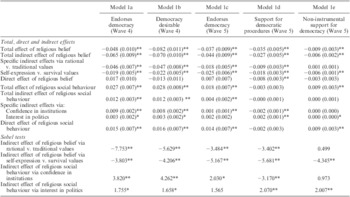
Table 1 shows the results from multilevel path analysis as well as the fit indices for the hypothesized models (see Figure 1), and Table 2 shows the decomposition of the effect of religiosity on support for democracy for total, indirect and direct effects, where total effects include the direct effect of religiosity and its indirect effects via the specified mediators. The fit of the theory-driven models is above acceptable thresholds for all five models, indicating that the data fits the theory-driven models well.Footnote 63
Multilevel Path Model for Democratic Support: Theory-driven Models

Note: Table entries are unstandardized parameter estimates with standard errors in parentheses. *p < 0.1, **p < 0.05 (2-tailed).
Total, Direct and Indirect Effects of Religiosity on Democratic Support: Theory-driven Models

Note: Table entries are unstandardized parameter estimates for the total, direct and indirect effects of religiosity variables and their standard errors in parenthesis, calculated by MPLUS 4.1 software. Sobel tests are calculated according to the formula in M. E. Sobel, ‘Asymptotic Confidence Intervals for Indirect Effects in Structural Equation Models’, in S. Leinhardt, ed., Sociological Methodology (Washington, D.C.: American Sociological Association, 1982), pp. 290–312). *p < 0.1, **p < 0.05 (2-tailed).
The total effects of religious belief and religious social behaviour (see Table 2) show that the models overall replicate past results regarding their differential effects on support for democracy.Footnote 64 The total effect of religious belief is negative and statistically significant in all five models. The magnitude of this total effect in Models 1a and 1c, which specify the same dependent variable for two different samples (Wave 4 and Wave 5), is very similar, despite the changes in the measure for religious belief, the different sample of countries, and the different time frame. This is strong evidence for the robustness of our results. The total effect of social religious behaviour, as expected, is positive and statistically significant in four of the five models, with the exception of its effect on support for democratic procedures, which is discussed in detail below.
As expected, in all five models, religious belief has a negative and statistically significant effect on rational (as opposed to traditional) and on self-expression (as opposed to survival) values (see Table 1). In turn, both rational and self-expression values are associated with greater abstract support for democracy (Models 1a, 1b and 1c) and with support for the procedural and non-instrumental characteristics of democracy (Models 1d and 1e)Footnote 65 as indicated by the positive and statistically significant path coefficients (Table 1). The indirect effects of belief via rational and self-expression values (Table 2) are all negative and statistically significant, with the exception of the indirect effect of rational values on the non-instrumental understanding of democracy (Model 1e).Footnote 66 Sobel tests (Table 2) provide additional evidence for the mediation of the effect of religious belief through rational and self-expression values – again, with the exception of mediation via rational values in Model 1e.
Parcelling out the indirect effect through values, the direct effect of religious belief is not statistically different from zero with the exception of support for democratic procedures, where religious belief retains its direct negative effect despite the fact that about 80 per cent of the effect of belief on the dependent variable is explained by the mediator variables (Table 2). Therefore, in accordance with our hypothesis, these findings suggest that the negative effect of religious belief on democratic attitudes is to a large extent mediated by rational and self-expression values, such that religious beliefs do not exert a unique influence on support for democracy once values are accounted for.
The second dimension of religiosity, social religious behaviour, increases both interest in politics and confidence in institutions in all five models (Table 1). In turn, interest in politics has a statistically significant and positive effect on all support measures. The indirect effects as well as Sobel tests (Table 2) show that interest in politics has an overall positive mediating effect on support for democracy.
As expected, the effect of trust in institutions is different for overt and substantive support for democracy. While confidence has the expected positive effect on overt support (Models 1a, 1b and 1c), its effect on the non-instrumental understanding of democracy is positive but fails to achieve statistical significance, and it is unexpectedly associated with lower levels of support for the procedural notion of democracy. Both the indirect effects and Sobel tests (Table 2) show that confidence in institutions positively mediates the effect of social religious behaviour on overt support for democracy, and negatively mediates the effect of this variable on support for democratic procedures.
When the effects of both mediators are taken into account, the total indirect effect of social religious behaviour on overt support for democracy is positive and statistically significant (Models 1a,1b and 1c), while, due to the conflicting effects of the two mediators, it is null for support for democratic procedures (1d) and for non-instrumental support for democracy (1e).
Overall, these results provide empirical evidence for the hypothesis that the effect of social religious behaviour on support for democracy is mediated by the generation of social capital in the form of political involvement and trust in institutions. There is conclusive support for the positive mediating effect of political interest, while the mediating effect of trust in institutions is positive only for overt support and negative for support for democratic procedures. Still, as opposed to the case of religious belief, the direct effect of social religious behavior – when mediators are taken into account – typically remains positive and statistically significant (in Models 1a, 1b, 1c and 1e). That is, involvement in religious social networks has an independent positive effect on pro-democratic attitudes that is not accounted for by political interest and confidence in institutions. It could be the case that additional aspects of social capital, particularly political self-efficacy, are influential in driving the effect of social religious behaviour on pro-democratic attitudes, but unfortunately a relevant measure was not available in our data to test this alternative explanation.
Finally, the path coefficients for the country-level controls partly explain support for democracy at the individual level (Table 1). Communist legacy has the expected negative effect on overt support for democracy (Models 1a, 1b and 1c), but no statistically meaningful effect on intrinsic support. Economic development, measured as the logged per capita GDP, has inconsistent effects on pro-democratic attitudes: while it is positively associated with endorsing democracy (Wave 5) and contributes to higher support for democratic procedures, these positive effects do not replicate in other models. Similarly, a country's rating of non-democracy is negatively related to democratic attitudes in all models, but reaches significance in only three of them.
Robust Analyses: Alternative Models
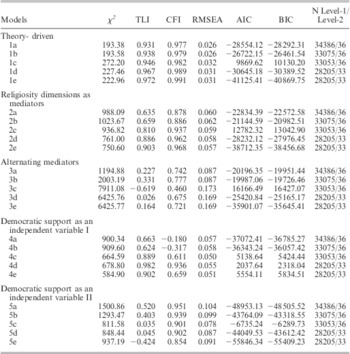
Next, we were interested in testing the extent to which the theory-driven model is supported by the data when compared to four other possible explanations.Footnote 67Table 3 details the fit indices for all four alternative models. See Tables S2–S5 in the online appendix for the full results of the alternative path models tested.Footnote 68
Fit Indices for Alternative Path Models

Note: Table entries are fit indices coming from theory-driven model and four alternative path models.
Our assumption that causality should flow from religiosity to values, trust in institutions and political engagement, and not the other way around, is based on a developmental logic. First, literature in developmental psychology suggests that political attitudes develop at a much older age than religiosity. Children readily adapt to religion at a young age, whereas political opinions, such as attitudes towards institutions and political engagement, emerge only later in life.Footnote 69 In addition, we define values as desirable, trans-situational motivational goals that vary in importance and serve as guiding principles.Footnote 70 While, given the required socialization, religiosity is adopted at a very young age, conscious cognitive constraints demand advanced cognitive skills as well as motivation. Still, we also wanted to test this assumption by empirical means and, therefore, specified a model where mediators were exchanged with the independent variables (Models 2a–2e). Secondly, we were interested in alternating the mediators such that political values mediate the effect of social religious behaviour, while confidence in institutions and political interest mediate the effect of religious belief on democratic attitudes (Models 3a–3e).
Another possible explanation suggests that democratic norms and attitudes increase the likelihood of social religious behaviour via political involvement, and not the other way around. To test for this possibility, we specified two alternative sets of models: one where democratic attitudes explain values and political involvement, which in turn explain the two dimensions of religiosity (Models 4a–4e), and the other where the two dimensions of religiosity explain democratic attitudes, which in turn explain values and political involvement (Models 5a–5e).
We find that these alternative specifications fit the data less well, based on the goodness of fit indicators (see Table 3). In all alternative path models, the chi-square values are much higher, and the Root Mean Square Error of Approximation (RMSEA) indicators are higher than the recommended threshold of <0.05. The Comparative Fit Index (CFI) tends to be lower than the hypothesized models and the Tucker–Lewis Index (TLI) values are all well below the acceptable thresholds. The Akaike Information Criterion (AIC) and Bayesian Information Criterion (BIC) indices, which indicate better fit for lower values,Footnote 71 lead to the same conclusion, with these values being much higher for alternative models relative to the theory-driven ones. Empirical evidence, therefore, joins theoretical considerations in pointing to the better fit of the theory-driven specification.
Robustness across Time Frame, Sample and Measures
The data come from two different waves of the WVS collected in different years, including different samples of countries, and using a different measure for religious belief in the two datasets. The hypothesized mediating mechanisms re-emerge across these different times, samples, selected countries and measures. This is important evidence for the robustness of our findings.
The results also largely replicate for different measures of support for democracy. Thus, in addition to overt support, the mediation mechanisms are also found to be consistent for two different measures of support for substantive democracy, which tap to what extent respondents endorse liberal and non-instrumental aspects of democracy.
Mediation Effects by Denomination
Finally, we investigated the extent to which the hypothesized mediation processes are consistent across religious traditions by running all five multilevel path models separately for mainline Protestants, Catholics, Muslims, Christian Orthodox, Evangelicals and Buddhists (Wave 5 only), resulting in a total of twenty-eight models (see Table S6 in the online appendix for the full results).Footnote 72 The results of the models are generally in line with our expectations concerning the relative similarity of mediation mechanisms across religious traditions.
Starting with religious belief, the results provide very strong empirical support for the mediating effect of values. In all the models, religious belief is negatively and significantly related to rational values, and in twenty-three models it is also negatively associated with self-expression values.Footnote 73 In turn, rational and self-expression values are statistically significant predictors of democratic support in the vast majority of the models. In addition, similar to the general model, the direct effect of religious belief, once the mediating effects of values are controlled for, turns out to be statistically null in all but two of the models. These findings provide vast evidence for values as the underlying mechanism of religious belief, above and beyond religious traditions.
Despite our inability to take into account the varied denominations or sects within each tradition, the results still provide empirical evidence for the mediating effect of confidence and political interest on support for democracy across major religious traditions. With the exception of Protestants and Buddhists, social religious behaviour is associated with higher confidence, and in the majority of the models confidence in turn has the expected significant effects on support for democracy. Frequent involvement in religious social networks also leads to increased interest among Catholics, Muslims and Buddhists, but not among mainline Protestants, Christian Orthodox and Evangelicals. Overall, in twenty of the twenty-eight models, at least one of the two hypothesized variables turns out to be a statistically significant mediator of social religious behaviour.
Still, the evidence in favour of the hypothesized mediation processes varies across religious traditions. While there is evidence for the mediating effects of both proposed variables for Catholics, it seems as though confidence rather than interest is the principal mediating mechanism for Muslims and Evangelicals. However, political interest is the main mediating variable for Buddhist identifiers. The mediation mechanisms for social religious behaviour among the Christian Orthodox are not as consistent compared to the other groups, as institutional confidence has a statistically significant effect on support for democracy for this group only in two models, and a significant mediation effect for interest only emerges in one of the overt support models. This could be a result of the varied relations of different Eastern Orthodox churches with democratic regimes.Footnote 74 Finally, mainline Protestants are the only religious group where the expected mediation process does not emerge for both mediators, possibly due to the diversity of Protestant denominations with varying views on democracy. Future work could test the processes underlying the effect of social religious behaviour among Protestants with different congregational affiliations.
Furthermore, and similar to the general model, institutional trust often holds different effects on different measures of pro-democratic orientations. While it is typically associated with overt support for democracy for the adherents of almost all major religious traditions, it is often related to decreased support for democratic procedures, and does not have a statistically meaningful effect on non-instrumental support for democracy.
Discussion
Overall, the results support the hypotheses that the negative effect of religious belief on support for democracy is to a large extent mediated by values, and that the effect of social religious behaviour is mediated by the generation of social capital in the form of political interest and trust in institutions. We also find that there are some similarities in the underlying psychological and sociological mechanisms through which religiosity in different religious traditions influences support for democracy, although their relative strength may vary.
While all measures in the models were scaled 0–1, which facilitates the comparison of the effects, a comparison of the magnitude of direct and indirect effects from the two samples should be made with great caution, since the results come from two different datasets and the measure for religious belief is different for Models 1a–1b and 1c–1e. Still, a few general trends can be reported. Ceteris paribus, the total negative effect of religious belief on support for democracy is stronger than the positive effect of religious social behaviour, with coefficients usually twice as large or more (Table 2). Combining these two dimensions in a simple averaging scale may mask the positive effect of social religious behaviour, showing an overall negative effect for religion on democratic attitudes.Footnote 75 Thus, this finding demonstrates the importance of disentangling the two dimensions of religiosity in studying democratic attitudes. In addition, the effect of religious belief on values is typically the strongest in the models, while the effect of religious social behaviour on confidence in institutions and political interest is relatively weaker.
Furthermore, the fit of the theory-driven models is superior to that for all alternative path models tested, and the results are consistent across samples and time periods, indicating the robustness of the findings. Still, some idiosyncrasies are deserving of future research.
To a large extent, the results are consistent for both abstract and substantive support measures. For both types of measures, the two dimensions of religiosity show some differential effects. While the total effect of religious belief significantly hinders both overt and intrinsic support for democracy, social religious behaviour boosts both overt and non-instrumental support for democracy. Still, the total effect of participation in religious networks on support for democratic procedures is null, because the positive effect of interest and the negative effect of confidence cancel each other out.
These results shed light on the relationship between social religious networks and the dissemination of democratic worldviews. Religious networks undoubtedly heighten overt support for democracy, and also tend to increase (in the case of non-instrumental support for democracy) – or at least not impede (in the case of support for procedural democracy) – intrinsic support for democracy.
Next, we find that while trust in institutions is associated with higher overt support for democracy, it is negatively related to support for democratic procedures.Footnote 76 This finding is highly consistent across religious traditions, with all but Muslims presenting a negative and statistically significant effect of confidence on support for democratic procedures. This result provides an opportunity to resolve the conflicting views in the literature concerning the effect of institutional confidence on democratic support. On the one hand, trust in institutions has been found to be positively related to abstract support for democracy,Footnote 77 as firm institutional confidence is thought to be essential to the establishment of civil society and to political participation.Footnote 78 On the other hand, it has also been found that democratic governance increases citizen expectations, and thus leads to a more negative assessment of a polity's institutions. The existence of ‘critical citizens’Footnote 79 or ‘dissatisfied democrats’Footnote 80 suggests that genuine commitment to democratic values manifests itself in critical scrutiny of the polity. Therefore, while confidence in institutions is not necessarily opposed to support for democratic regimes in principle, it is associated with less liberal support for democracy; since those who have a more liberal understanding of democracy also use high standards when evaluating the institutions of their country.
Our results suggest that activities that contribute to institutional trust, such as participation in religious networks, are hardly harmful for democracy. First, the increased trust translates into increased overt support for democracy, and this support is also evidently non-instrumental in nature. Secondly, while it does not increase support for democratic procedures, it also does not dampen it. And thirdly, such activities have other constructive consequences, such as increased political interest, which are shown to augment both overt and intrinsic democratic support.
Finally, we find that the proposed mediation mechanisms are generally consistent when disaggregated into major religious traditions, while there is some variation concerning the mediation effects of political interest and confidence on support for democracy. We suspect some of these effects to be due to the contextual variation within each major religious tradition that we were unable to test for.
Conclusions
Democracy is attained not simply through necessary institutional changes; its success and prosperity also depend on the democratic beliefs and behaviours of ordinary citizens. Ironically, it has been argued that through the advancement of religious freedom, the process of democratization may promote the return of religion, which, in turn, may undermine democratic political culture.Footnote 81 It is thus of utmost importance to study the extent to which the effect of religiosity on democracy is positive or negative, and specifically the processes by which religiosity affects democratic attitudes. Tracing the mechanisms responsible for the effect of religiosity makes it possible to address them directly through civic education, while wholeheartedly allowing for religious freedom.
Accordingly, this research contributes to the extant literature in several ways. First, we have verified that religiosity, depending on its dimension, has differential effects on both overt and intrinsic support for democracy. This conclusion agrees with current views of the relationship between religion and democracy as being complex and multifaceted.Footnote 82
Secondly, and most importantly, we show the mechanisms through which these differential effects occur. Using path models, we demonstrate that the effect of private devotion on support for democracy is due almost fully to the association of religious belief with traditional and survival values, while the effect of religious behaviour on democratic attitudes is due largely to the increased interest in politics and trust in democratic institutions. In addition, we find that once values are accounted for, religious belief has no direct effect on support for democracy, suggesting that specific religious teachings contribute to anti-democratic sentiments only in so far as they enshrine traditional and survival values. Social religious behaviour, however, often holds a positive direct effect on support for democracy even if the mediating effects of political interest and institutional trust are taken into consideration.
Next, our findings are impressively robust in terms of the mediating effects of values among the adherents of the world's major religious traditions. Yet, the mechanisms through which social religious behaviour affects support for democracy seem to depend more on the context. Thus, the hypothesized mediation process is mostly replicated for Catholics, Muslims, Evangelicals and Buddhists, but to a lesser extent among Orthodox Christians and not at all among mainline Protestants. Future studies could focus on the religious congregation or sect as an important unit of political socialization that affects democratic attitudes and could seek to investigate the potentially differential effects of religious networks within a religious tradition.
In addition to its contributions to theorizing the relationship between religiosity and support for democracy, this study makes a strong contribution in terms of methods and design. While most research in the field is limited to a few case studies or a single dimension of religiosity, we are able to account for individual as well as national-level variation in attitudes towards democracy and show that these mechanisms apply in different contexts by using two different datasets with representative samples from thirty-six democracies each, and multilevel path modelling. Furthermore, while research exists on the relationship between religiosity and values, religiosity and democracy, and values and democracy, to the best of our knowledge, this is the first empirical examination that studies the interrelations between these variables simultaneously.
To conclude, our findings suggest that it is not religious belief and religious behaviour in and of themselves that affect democratic attitudes, but the values and behaviour they teach to the religious individual. This is an optimistic finding in the sense that it leaves room for intervention – for educating people about democratic values and norms. These results are robust across a variety of religious traditions and contextual effects, and thus make a convincing case that the psychological mechanisms underlying the effects of religious belief and social religious behaviour on democratic attitudes extend above and beyond a specific political context.