1. Introduction
This essay intends to clarify concepts and relationships in a period in which the topic of the Hungarians living in neighbouring countries is defined by opportunistic symbolic speech and rhetoric. In such a context, public discourse is interested in the symbolic value of issues, and not in their historical, social, and economic connections. However, one could argue that the analysis of concepts and self-reflections helps in returning to interpretations based on dominant correlations. This paper intends to present the intellectual background developed in Hungarian minority communities and in Hungary, thus enabling a more meaningful interpretation of the actions, rhetoric and decisions of the various actors. First, I will offer a definition of the Hungarian minority communities involved. Then follows a presentation of the most important social changes that affected these communities during the last two decades. The next section tries to answer the following problem: why is Hungary interested in the Hungarian minority communities, and how is this connected to its images of the future, respectively to the most important expectations entertained by minority Hungarians. After an overview of the Hungarian minorities policies elaborated by the post-1989 governments, the most important principles and strategic goals of Hungarian politics will be presented. Finally, I will address the following question: how is it possible that as part of the building of a political community in Hungary, the cause of minority Hungarians was subordinated to party politics?
2. A General Presentation of the Hungarian Minority Communities
The historical image of the Hungarian minority communities is based on the assumption that they are the defensive, self-organising reactions to the challenges posed by nation-states. As a result of the political decisions taken at the peace treaty of Trianon (1920), a series of involuntary communities came into being, groups that were forcibly severed from the process of Hungarian nation building. Within a generation, these became regional communities of fate.1 The minority elites offer arguments and a framework of socialisation to these newly formed communal self-identities. The key issue is that the Hungarian minority communities are native in their regions. They deliberately stick to the maintenance of their life-worlds. Their ‘integration’ is possible exactly as far as they can feel at home in their place of residence. In the interbellum period, as against the standardising ambitions of the nation states, the representatives of the communities under consideration defined the Hungarians living in Czechoslovakia, Romania, Yugoslavia as national minorities: members of a nation (in this case the Hungarian one) living as minorities in another nation-state.2 A precondition of the integration of such separate political entities would have been communal self-government, or at least the elimination of linguistic, economic, and/or institutional discrimination. However, this did not happen.Reference Bárdi, Fedinec and Szarka3 And up to the present day, majority societies consider the Hungarian minorities of Central Europe as the remnants of historical Hungary, and treat them as imperial minorities (or residual minorities). The defence of their positions, their self-organisation, and their relations with the kin-state may evoke historical Hungary and may raise questions of security policy. Consequently, a possible definition is the following: these are native minority communities that claim the status of a national minority, and would like to build and institutionalise their own parallel societies, while in their own countries they are considered to be imperial/residual minorities, and as a result their activities in the field of self-organisation, and maintenance of cultural heritage are considered to raise problems of security.
Hungarian minorities are not ‘minority groups’, because they are not simply groups of people speaking a particular language. They are communities with the consciousness of a common cultural identity that were part of the Hungarian nation building process until 1918. Later the Hungarian minority elites, as organisers of their own societies, understood their role to be that of nation builders.Reference Kántor4 The expression ‘minority society’ is also often used, since this is essentially the expectation, the goal of the minority elites. However, the Hungarian minorities do not have a total, autonomous social institutional subsystem. Consequently, it is more precise to speak of a Hungarian minority community within each state.
Central European minorities can be divided (even if the division is not clear-cut) into three groups.Reference Szarka5 One consists of the national minorities: they have the consciousness of belonging to a national community, and this is the most important element of their national identity. One can include into this group the Hungarians of Romania, Slovakia, Ukraine and Serbia, who consider (according to research and experience) that their belonging to the Hungarian nation is primary.Reference Gereben6 Another group consists of ethnic minorities: these are communities that developed for a long time apart from their ethnocultural or national communities, to which they are connected first of all by a common origin and language. One can mention as part of this type most of the Hungarians in Croatia and Slovenia, respectively an important part of the Gypsies in Hungary.Reference Kiss7 The third group consists of regional minorities: they already switched languages, have no sense of an ethnic community, but they are conscious of an origin that is different from that of the majority of the country they live in, and their identity is primarily connected to local characteristics. This is the case with the Hungarians living in Burgenland (Austria), and the majority of the minorities living in Hungary. Last but not least, one should not forget a fourth category, consisting of the emigrants (migrant workers). Here one could think of the Hungarian diasporas of Austria and Germany (approximately 200,000 people), and an important part of the minorities in Hungary who were born in different countries.Reference Tóth and Vékás8
A concept already mentioned, the policy concerning Hungarians, is the governmental policy of Budapest, Bucharest, Belgrade, and Prague/Bratislava targeting the Hungarians who were attached to other countries in 1918. The political activity of Central European minority elites is called minority politics. The policy concerning minorities refers to the general politics of a government dealing with the national and ethnic minorities of the respective state. The three together result in an ethnopolitical system of relationships. In my view, the Hungarian minorities policy refers to the relationships between the Hungarian state and the Hungarians living in neighbouring states. It encompasses the following dimensions: international and bilateral minority protection; the institutional Hungarian-Hungarian relationships between the kin-state and the Hungarian minorities; the support of Hungarian minority communities. These policies can be further broken down into the policies regulating the relationships between the Central European governments and the respective Hungarian minorities as far as integration, language use and institutional framework is concerned.
Basically, one is considered a Hungarian according to one's self-classification. At the same time, there are people who are of Hungarian origin, but do not speak Hungarian, and people who know the language, but are not of Hungarian origin. As a result, there are ‘Hungarians’ who assume not only a Hungarian cultural and national identity, but have other ties as well. This is particularly true in the case of the ethnic and national minorities of Hungary, since in addition to the Hungarian ethno-cultural community, the totality of Hungarian citizens is considered to be part of the Hungarian nation as well. So, public opinion considers to be part of the Hungarian nation both the minorities of Hungary (who are Hungarian citizens), and the non-Hungarian citizens who feel attached to Hungarian culture. The census of 2011 showed that in Hungary 314,000 people feel that next to being Hungarians, they have other attachments as well. Also in this year, 2.1 million people declared themselves Hungarian in the neighbouring countries, and approximately 460,000 Hungarians live throughout the world.Reference Papp9 (The population of Hungary was 9.982 million – in this case, the decrease of the population common to all the area was alleviated by the immigration of Hungarians from neighbouring countries.)
In what follows, the social processes will be presented that resulted in strong uncertainties regarding the maintenance of Hungarian national identity. This can be considered a sort of a ‘narrative of losses’: the interpretation of the post-First World War losses in territory and population as a ‘story of decadence’. All this has become a major traumatic element of the Hungarian national consciousness.
3. The Most Important Social Processes of the Last Few Decades
As Table 1 shows, during the past nine decades the number of Hungarians living in the neighbouring states has decreased by 1 million. In 1910, the number of Hungarians living in the territories annexed by the neighbouring states was 3,175,000, while in 2011 it was 2,100,000. The loss of population is unequivocal, even if one considers the data of the 1910 census with the appropriate degree of criticism. This process is even more obvious if one looks at the proportion of Hungarians who are not Hungarian citizens in the Carpathian Basin: in 1910 it was 32.1%, while in 2001 it was 17.6%. According to regions, in Transcarpathia, Vojvodina and Slovakia their ratio dropped from 1/3 to approximately 1/10, while in Transylvania it diminished to 1/5 of the population. At the same time one has to mention that the Central European states have become ethnically more homogeneous, and this is true especially in the case of Hungary.Reference Kocsis, Botlik and Tátrai15
Hungarians in neighbouring countries: 1910–2011.10

The table is based on data from censuses.Reference Gyurgyík, Horváth and Kiss14
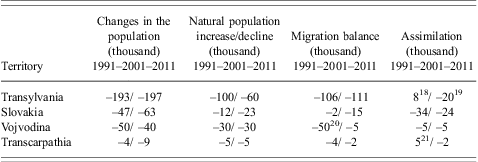
The most important process affecting minority Hungarians during the last two decades was a decrease of the population (600,000 people). The causes are presented in Table 2. But first of all one has to stress that in the history of Hungarian minorities, with the exception of the last 10 years, demographic decrease was always connected to historical cataclysms.16
The causes of the decrease of the Hungarian minority communities between 1991–2011.Reference Gyurgyík, Horváth and Kiss17

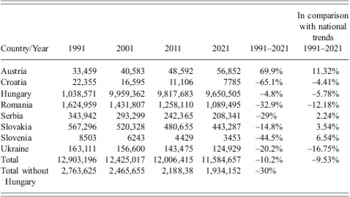
This table shows that while the decrease of Hungarians in Romania is basically due to natural causes and to migration (mostly to Hungary), in Slovakia the most important cause is inter-generational nation switch, i.e. assimilation. This is first of all the result of mixed marriages, where approximately 2/3 of the offspring, when grown up, claim to be part of the majority nation. In Serbia, the most important cause of the decline of the Hungarian population was the exodus provoked by the Balkan war. The demographic situation of the Hungarians in Ukraine is stable. The Hungarians in Austria can be divided into two groups: the aging Hungarians in Burgenland (6000 people), and immigrants from Hungary, Romania, and Serbia who settled in Vienna and surroundings. According to prognoses, it is only here that a more serious increase can be expected. The demographic decline in Hungary is alleviated by the immigration of Hungarians from the neighbouring countries. The greatest decrease will be in the two smaller Hungarian communities (Slovenia and Croatia), where more than 50–60% of the Hungarians live in mixed marriages. In the next 20 years, the reduction of the Hungarian population will be highest in Croatia, Slovenia and Serbia (60%, 50%, 31%); in Romania and Slovakia it will be more moderate (20%, 18%); in Ukraine the decrease of 4% is lower than on the national level; in Austria the number of Hungarians will increase sixfold (see Table 3).
Changes in the number of the Hungarian population in the Carpathian Basin and prognoses.Reference Csete, Papp and Setényi22

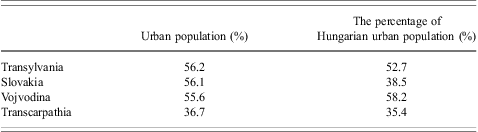
In three countries (Slovenia, Croatia, Ukraine), the aging Hungarian population lives in a mostly rural environment.Reference Gyurgyík, Horváth and Kiss23 But the other Hungarian minority communities are also characterised by a re-evaluation of small towns and a kind of re-ruralisation. The latter means that in all the regions inhabited by Hungarians outside Hungary the percentage of the urban population (living in settlements with a population over 5000) decreased drastically, and, in parallel, the population living in villages increased. Several towns, considered to be regional centres, lost their Hungarian majority (Satu-Mare/Szatmárnémeti, Târgu-Mures/Marosvásárhely in Romania, Subotica/Szabadka in Serbia). The regions with a majority Hungarian population24 are to a greater or lesser degree underdeveloped, with unemployment rates higher than the national average. The Hungarian communities of Burgenland, Prekmurje, and Croatia, are predominantly rural. In Transcarpathia and Vojvodina the role of small towns, as compared with large ones, increased. A similar resettlement of institutions from regional centres to provincial small towns can be seen in Slovakia: the role of Šamorin/Somorja Kráľovský Chlmec/Királyhelmec, Dunajska Streda/Dunaszerdahely, and Komarno/Komárom, increased, while that of Bratislava/Pozsony, and Kosice/Kassa decreased. In Romania the public role of the traditional centres Cluj/Kolozsvár, Oradea/Nagyvárad, Târgu-Mureş/Marosvásárhely was challenged by Székelyland.
The proportion of Hungarians within the urban population in 2001Reference Gyurgyík, Horváth and Kiss25
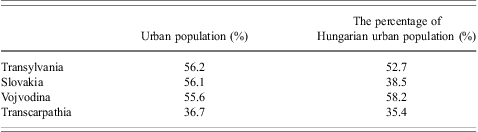
At the same time, more than half of the minority Hungarians lives in localities where Hungarians are a majority (2001: Transylvania 56.6%; Slovakia 76.1%; Vojvodina 48.8%; Transcarpathia 61.9%). However, 10% of them live in scattered communities (less than 10% of the population of the locality), where the possibilities for maintaining their ethno-cultural identity are minimal (2001: Transylvania 8.5%; Slovakia 7.5%; Vojvodina 14.7%; Transcarpathia 14.1%).Reference Gyurgyík, Horváth and Kiss26 The country's minority and Hungarian minorities policies are most effective in maintaining Hungarian identity between the two poles, where, on a local level, Hungarians are a minority, but nevertheless they are not a scattered community. Owing to the expanding sphere of competence offered to local governments, in settlements with a Hungarian majority the specific linguistic and institutional problems can be solved much easier than where the local government is mostly Romanian.
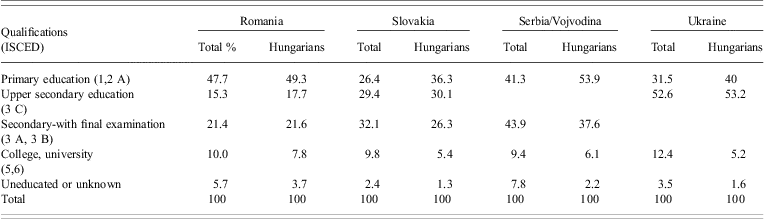
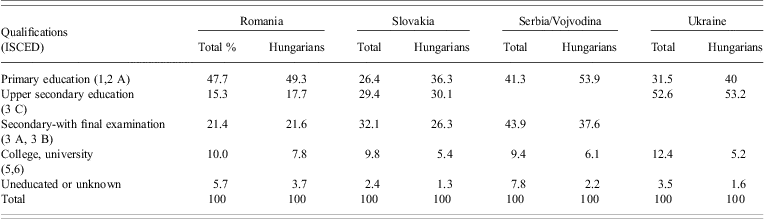
A similar loss in social position can be noticed if one looks at the Hungarian minority middle class. The Hungarian minority middle class becomes proportionally thinner, due to emigration and the handicaps built into the national educational systems. Another cause is historical: the lack of cultural, economic, and network capital before 1989 allowed only thin strata of the Hungarian minorities to enter the middle class. Many urban, young, educated people were attracted by the better conditions offered in Hungary or in Western Europe. While in secondary education the indicators referring to Hungarians are only slightly below the national averages, among the professional classes they are severely underrepresented, in spite of mass higher education. In this respect, the situation is worst in Ukraine and Slovakia.
The population of Romania, Slovakia, Serbia and Ukraine, respectively the Hungarian minorities, according to school qualifications (data of the 2001 or 2002 census).Reference Csete, Papp and Setényi27
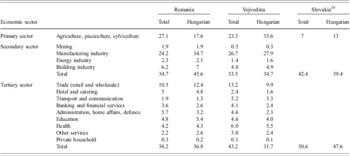
If one looks at the distribution of occupations according to economic sectors, in Slovakia and Vojvodina the Hungarians are overrepresented in agriculture and sylviculture (in Slovakia the national average is 7%, among Hungarians 13%). In industry the situation is more balanced. On the other hand, in the service sector in Romania and Voivodina the Hungarian minority is underrepresented. Especially so in the area of financial and economic services, where the proportion of Hungarians is 2/3 of their national proportion. As far as administration, home affairs and defence are concerned, it is only half of the national proportion.
The distribution of employment according to economic sectors in Romania, Slovakia and Vojvodina (2001).

Sources: census, 2001, 2002
The difficulties of ethno-cultural reproduction can be seen most clearly in the appearance of scattered communities without their own institutions, and in mixed marriages. Over the past two decades the role of multiple (linguistic, cultural, national) attachments has continually increased. A scattered community means not only a decrease in the number of Hungarians in a particular region or locality, but also that as a result people will not be able to maintain the institutions where they can use their mother tongue. This will be limited to private life, it increases the chance of a mixed marriage, and in most cases leads to the assimilation of the offspring. During the past decades the proportion of mixed marriages has somewhat increased. In Slovakia the proportion of Hungarian-Slovak mixed marriages was 15.5% in 1980, while today it is approximately 20%.Reference Csete, Papp and Setényi29 In Romania, the proportion of Hungarians living in mixed marriages was 12.5% in 2001. In the case of the Hungarians in Serbia, the proportion is much higher. In 2009 it was 29.73%.Reference Badis30
The self-identification of children from mixed marriages is the most important factor of assimilation. In Transylvania and Vojvodina approximately two thirds identify with the majority ethnic group, while in Slovakia this is approximately 80%. The high proportion of mixed marriages in Slovakia is due to the fact that – in spite of the fact that Hungarians are a majority in the area – the social and cultural distance between the two ethnic groups is the smallest here. The switch of identity can be explained by the fact that within the Hungarian minority the prestige of majority social-cultural positions is very high, and many think that identification with the ethnic-linguistic group of the majority will enhance their social mobility.Reference Gyurgyík31
In the localities and areas where the proportion of mixed marriages is around 50–60%, the long-term existence of Hungarian communities becomes problematic. In this respect, the most affected are the Hungarians who live in scattered communities, respectively larger towns. (For example in Romania Maramures, Arad, Timis county, or Croatia, Slovenia.) Socially, the most neglected groups are the Hungarians who are labourers and live in housing estates.
The problem of the Roma communities with Hungarian attachments came to the fore during the past decades. In this respect, the most important issue is the Roma preponderance in the Hungarian institutions in Eastern Slovakia, and parallel to this the appearance of regional underclass groups. In Slovakia the proportion of Roma who claim to be Hungarian is reckoned to be around 12.5%, with some 65,000 people. In Transylvania the proportion is 6.5%, almost 90,000 people. In Transcarpathia it is 9%, i.e. 14,000 people, out of a population of 32,000 Roma.Reference Gyurgyík, Horváth and Kiss32 It is an increasing problem in the Hungarian minority school system that Hungarian parents prefer to send their children to majority schools because of the Roma. On the other hand, in the areas and localities inhabited by Hungarians, some Roma groups appear that do not speak Hungarian and are not integrated into the local society. This leads to an increasing number of Hungarian-Roma conflicts.Reference Papp33
Since the middle of the 1990s, the socialisation of younger generations in the neighbouring countries takes place basically in a Hungarian media space. They watch or listen to Hungarian television and radio stations, and read web pages from Hungary.Reference Dobos34 Consequently, learning the majority language becomes increasingly difficult in primary and secondary schools, especially in areas where Hungarians form a majority. Furthermore, they are socialised in a virtual reality constructed mainly in Budapest, and from which the culture and the public life of the majority are almost absent. As a result, of consuming the Hungarian media, and due to its opinion forming influence on them, they consider Hungary their own country and expect the Hungarian institutions to treat them on a par with Hungarian citizens, although, in fact, they are treated like Romanian, Slovakian, etc, citizens. In parallel, due to the overwhelming importance of the media from Hungary, hardly any public forums have sprung up in the particular regions themselves. In most cases the political elite of the minorities tries to send its messages through media channels from Hungary. (Duna TV was established exactly in order to inform Hungarians over the border. Later, all the more important public or commercial television channels made their appearance on the Transylvanian media market.)Reference Papp and Veress35
After 1989, the Hungarian minority communities went through a huge process of revitalisation, and nowadays they have several thousand educational and cultural institutions.Reference Blénesi, Mandel and Szarka36 However, after experiencing some of the processes previously discussed, in many respects they reflect on their fate as if it were a story of decline. They are not sure how they will be able to maintain and/or develop their regional ethno-cultural communities. Therefore, based on the results achieved in the past 20 years, the project of building ‘a minority Hungarian society’ and ‘the loss narrative’ exist side by side in Hungarian public thinking. In other words, the demographic and social processes and the assimilation doctrines of the majority nations made the minority Hungarian public opinion uncertain about minority Hungarians staying in their respective homelands.
This insecurity, this existential fear, determines the self-image of minority Hungarians, their image of the future, their own and their children's life strategies. With regional differences and stresses, this image is marked by worries over the future of the community, by the relationship between the majority and the minority. All this then becomes part of public life in Hungary too, and has repercussions on inter-state relationships.
4. The Minority Problem in Hungary and the Changing Images of the Future
The main goals formulated in the programmes elaborated by the Hungarian minority communities after 1989Reference Öllős37:
(a) Hungarian should receive the status of a regionally official language.
(b) They want to organise their educational and cultural life themselves. They claim to have the right to control their educational system. In cultural life, they claim financing proportional with the institutions of the majority, and insist on free institutional development.
(c) The administrative division of the respective country or region should allow most Hungarians to live in administrative units dominated by Hungarians.
(d) The development of the regions inhabited by Hungarians should not lag behind that of the other regions. On the other hand, state development should not destroy the structure of the localities or change the ethnic proportions.
(e) The symbols of the Hungarian minority should become official. By this the state would give a symbolic sign of respect to this minority's national dignity.
(f) There should be political representation on all levels (national, regional, local). They regularly formulate the claim to be part of the government.
(g) In Hungary they expect to be considered on an equal footing with the Hungarian citizens, and claim equal, institutionally ensured opportunities in educational and cultural life.
After 1989, all these requests were supplemented by national autonomy, a concept elaborated by the Hungarian minority elites, aiming at the position of a ‘partner nation’. First, this was a vision of political integration (an ideological expectation and a political slogan) within minority communities organised on a national platform. Second, its institutionalisation has been seen as a bulwark serving a regional and ethnic equilibrium. Third, the institutional system imposed by ‘autonomy’ was supposed to alleviate the drawbacks of minority existence. The slogan encouraging people to remain in their homeland became empty by the turn of the millennium, since it turned out that Hungary was not able to provoke major changes within the social processes affecting the minority communities. In 2004, the campaign preceding the referendum on double citizenship questioned the image of a ‘virtual fatherland’ and brought to light the difficulties involved by immigration and individual emancipation in Hungary.
During the past two decades, that is since 1989, three basic strategies were developed for Hungarian minorities policy. None of them can be connected exclusively to the right or the left wing in politics.
The first strategy stressed the protection of national minorities: besides references to international norms, models, its basic statement was the following: one should first create good relations with the respective state, and only after that can one manage the problems of minority Hungarians. This defined the policy of the Basic Treaties, in which the mixed minority committees were expected to offer solutions to the problems. It is equally important in this strategy that the respective minority community should find solutions to its problems within its own state. This pertains especially if the local Hungarian party forms part of the neighbouring country government. Hungary's tools in this case are mostly diplomatic. Another aspect is the economic and social strengthening of the Hungarian minority societies: self-government should be realised by their own independent institutions. This strategy was mostly typical of the Hungarian minorities policy of the left wing governments, doubled by an anti-nationalist rhetoric (criticising symbolic politics, national rhetoric).Reference Törzsök38
The second strategy, that of the ideology of the unification of the nation, has as its starting point the unity of the Hungarian nation over the borders, and this can be institutionalised by breaking down the borders of the nation state (integration into the European Union). From this standpoint, Hungarian minority societies are part of the Hungarian nation, but living in other countries. The Hungarian Permanent Conference symbolised the political unity of the Hungarian ethno-cultural community, while the Hungarian Certificate connected the individual to the Hungarian state.Reference Németh39
The idea of the contractual nation intends to institutionalise the divergent paths of development and the representation of the specific interests of the Hungarian regional communities living in eight countries. It states that the Hungarian government should formulate its specific relationship to each regional community separately. This means that the Hungarian government should determine its relationship with each regional community, and the regional minority elites should also determine their vision and clarify what they expect/can expect from Hungary.Reference Németh40 As a continuation of the previous idea of the nation, this vision wishes to see the territories inhabited by Hungarians as a common political space. According to this view, the Hungarian elites from the neighbouring countries should put their agenda into brackets if wider geopolitical interests are at stake, or those of a European party family. In the idea of national unification without changing the borders, symbolic politics are characteristic mostly of right wing politicians.
The third strategy, based on the goal of integration into the European Union, puts the stress on regionalisation, hoping that the common regional interests will override ethnic divisions.Reference Törzsök41 Policymakers see the possibilities of minority integration in the development of regions along the borders and the regionalisation of the countries. In order to achieve this, they want to create regions of development, cross-border regions according to local needs, to historical and ethnic preconditions. Some think that these regions could give birth to the autonomous regional institutions that are necessary for maintaining national identity against the interference of the nation state.
Next to these three strategic models, there are two more points of view. One considers that after the unsuccessful attempts at autonomy during the 1990s, one should concentrate on participation in the work of the foreign government in question, since this is the most efficient way of defending minority interests.Reference Hamberger42 Another approach, never assumed openly in Hungary, says that in 50 years, due to demographic and migratory processes, the number of Hungarians in the neighbouring countries will decrease to a point when the whole issue will become irrelevant.
The most important statements of Hungarian minorities policy will be presented on the basis of the party and government programmes developed in Hungary.
(a) The principle of non-violence. Hungarian minorities have never resorted to violence in defence of their interests.
(b) The right to be part of the universal Hungarian community. Consequently, minority community Hungarians should have the right to free, unobstructed connections with this larger Hungarian community.
(c) One should change not the place, but the quality of the borders. This principle on the one hand rejects revisionism, and on the other hand reinterprets the idea of the border as such. In most cases, this is part of the idea of integration into the European Union. However, in the case of two regions (Transcarpathia and Vojvodina) the Schengen borders bring about new limitations.
(d) Equality of rights is possible through the rights of local governments.
(e) In order to maintain the identity of Hungarians living in the neighbouring states as incomplete societies and as independent political communities, they are entitled to an autonomous institutional system.
(f) The principle that the representatives of Hungarian minority politics should be treated equally.
(g) The representation of the interests of the Hungarians from the neighbouring countries in international forums, within the framework of international norms, is the duty of the current Hungarian government.
(h) The support of the Hungarians in the neighbouring states is a permanent budget item of the Hungarian budget.Reference Bárdi and Misovicz43
5. The Hungarian Governments' Strategies Regarding Hungarian Minorities
Officially, during the past 20 years, the key element in Hungarian-Hungarian relations was securing equality of opportunity for minority Hungarians, and so the stress fell on facilitating cooperation. The difficulties of such partnerships, of the actual experiences of them, and of recreating the boundaries of the communities are hardly mentioned. The image of the ‘Hungarian from Hungary’ made its way into the Hungarian minority media around the middle of the 1990s, associated with critiques of Hungarian politics, institutions, and national carelessness. (Among others, mention should here be made of the opinions of Károly D. Balla, Béla Bíró, Ágota Grendel, László Végel.) Criticism became generalised after the referendum on dual citizenship.44 However, beyond sociological and socio-linguistic investigations, the differences between Hungary and the Hungarian minority communities have not been researched. Here is not the place for such an analysis, but a few historical guidelines are necessary.
Seen from Hungary, the consequence of the treaty of Trianon is the amputation of the country and the appearance of a revisionist vision of the future and a cult trying to redress the situation. Indirectly, after 1918, Hungarian nation building enters into a mindset centred on restoration, its vantage point being again and again the investigation of the mistakes that led to the dissolution of historical Hungary. However, by now public opinion in Hungary has accepted this historical situation – the number of those who still wish a revision of borders is minimal (according to opinion polls, 1–3%).Reference Lázár45 So, the question is part of the past, but as a cultural code it has become part of the Hungarian politics of memory and identity.
On the other hand, for the Hungarian minorities Trianon means the origin of their present-day condition, since it was this decision that changed the citizenship of their ancestors.46 And this reminds them of being defenceless, subordinated to political power. This is connected to the greatest burden of the minority situation: the existential fear and insecurity concerning the future of one's community. It always depends on the feeling of familiarity, defined by historical experiences.47 Since minority communities do not experience simply political abuse of power, but the will to national supremacy, the question arises again and again whether it is possible to live a dignified human life as a minority.Reference Cseke and Molnár48 At the same time, in all seven countries concerned, the Hungarian minorities have accepted this historical situation and live their lives under these conditions. Their social communities and institutions are mostly organised on a (national) linguistic-cultural basis. Their identity is essentially defined by their belonging to the Hungarian community, while for a Hungarian in Hungary this is taken for granted. Consequently, in all programs of nation building the Hungarians from neighbouring countries can be presented as examples.
So, while for the Hungarians living in Hungary the treaty of Trianon pertains to history, to the politics of memory, for those living in the neighbouring states it is the starting point of their existence. The two approaches are connected when one tries to institutionalise the Hungarian ethno-cultural community. Both groups have accepted the present-day situation, and in this case the only possible goal is to bracket the trauma: manage the inequalities of opportunity, and introduce through education, media, the values, the knowledge of the Hungarian minority communities into a common Hungarian thesaurus. By this, the Carpathian Basin can become a common homeland in which Hungarians possess wide ranging regional information.49
Hungary is ethnically the most homogeneous state in the region. In a certain sense, it is the ideal of the nation builder of the neighbouring states, since in Hungary the nationalities do not form an independent political community, and feel attached to the Hungarian state and culture. This is to a large degree the result of the processes of assimilation after 1920 and 1944, of the slow disappearance of church and educational institutions, of exchanges of population and deportations. Still, there is a major difference between the Hungarian minority communities and the nationalities of Hungary: the nationalities of Hungary have never lived in compact areas (while more than half of the Hungarians in the neighbouring countries live in localities where they form the local majority); the most important groups, the Germans and the Slovaks do not live in areas bordering the kin-state. The minorities of Hungary have not taken part in the nation building of their kin-states. Their movements were influenced by modernisation in nineteenth- and twentieth-century Hungary. The ancestors of the Hungarians from the neighbouring countries were part of collective experiences such as the revolution of 1848, until 1918 of Hungarian nation building, and then between 1938 and 1944 a generation socialised in a minority condition became a majority again.
Contemporary Hungarian minority communities are basically bilingual. This means that for most of them cultural pluralism is an everyday experience. The population of Hungary is mostly monolingual, and does not have many experiences of cultural pluralism, and of parallel cultures living side by side. The Hungarian political elite, due to its traditionally aufklärist mentality, would like to present its own country as a homogeneous society, in spite of the fact that putting linguistic uniformity aside, there are significant regional and social inequalities. The predisposition to see society as homogeneous tends to construct Hungarian minorities, and the whole Hungarian ethno-cultural community, as a unified entity as well. The image thus formed of the ‘Hungarian from the neighbouring countries’ stresses both originality and underdevelopment.
Unification suggests that any phenomenon, any situation that does not replicate a preconceived image should be seen as a dangerous destruction of the community. While some phenomena that affect all of Hungary also receive attention when it comes to minorities, for example the publicity given to the conflicts of interests within minority political life, or to the power games of politicians, other phenomena never enter into the image created of minorities.
Another important mentality widespread in Hungary is that Hungarians can see their situation, their problems only from within, without the ability to see themselves from a wider, external perspective. While, for somebody living in a minority situation, this latter approach, due to the permanent presence of cultural difference, is taken for granted.
It is part of the vision of the future, of the expectations of Hungarians from the neighbouring countries to benefit in Hungary from the same treatment as Hungarian citizens. While being in the kin-state they step out of the minority condition, and want to be part of a majority society. However, they are still the citizens of another country. In this case, they become particularly sensitive when Hungarian citizens adopt the position of the member of a ‘majority’ towards them, or show a complete lack of knowledge about their condition (‘where did you learn Hungarian so well?’). The latter situation is less and less probable, since with every generation the number of people with Hungarian friends, relatives in neighbouring countries increases, and there are more and more people returning to Hungary with tourist experiences. Contact situations are increasingly a part of everyday life, but often this also involves conflicts: in circumstances of competition, of conflict of interests, the Hungarian from the neighbouring countries becomes an immigrant,50 an employee, an entrepreneur, etc. Then the stereotypes start to work: the ‘Romanian’, the ‘Yugo’, the ‘Slovak’, etc.
The greatest misunderstanding around dual citizenship is that while Hungarians from the neighbouring countries consider it a possibility for emancipation, in Hungary this is seen as a tool of identity, party politics, and at the same time a solution to the minority problem. And in the meantime the right to vote offered to the dual citizens from the neighbouring countries leads to heated debates in the Hungarian public sphere.51
While for most Hungarian citizens the fatherland and the borders of the country are identical, for Hungarians from the neighbouring countries the two concepts are different. For most of them, the fatherland is not the state in which they live, but their homeland (otthon: the region, area where they live their everyday lives), permeated with a strong sense of belonging to the Hungarian nation. This is a sort of virtual image of the fatherland/the Hungarian nation/Hungary. This is why the issue of Hungarians living in the neighbouring states provokes such sensitive reactions in Hungary.
Usually, within their own communities, Hungarians from the neighbouring countries are not minorities. In everyday life it is the routines, habits, local particularities that define their existence, and not the politicised, nationalised stereotypes with which they are identified in Hungary. Generally, in their countries, minority Hungarians are just ‘Hungarians’, and they become ‘Transylvanian’, ‘from Vojvodina’, or ‘from Upland’ in Hungary.
Consequently, virtualisation is mutual within the Hungarian cultural community: for Hungarians from the neighbouring countries, the common fatherland is the common Hungarian cultural space (while they are the citizens of a different country), while Hungarian citizens endow with nobility the Hungarian minorities’ life situations, stressing Hungarian language and culture (while for the minorities this is taken for granted).
As a result, the members of the two groups consider themselves much closer socially and culturally than they actually are, and this comes to the surface in concrete situations of cooperation. In the latter case, the status identities (different citizenships, socialisation in different educational systems, membership of different legal, habitual structures of national cultures, and so on.) become at least as important as representations of cultural identity.
Due to the peculiarities of the regime change in Hungary, in constructions of civic and local identity the concept of ‘national unity’ refers first of all to the communities of Hungarians from the neighbouring countries. This is due to the fact that in Hungary the two dominant communities of identity politics, the right and the left wing, are built upon discourses that try to mutually exclude each other. But within the idea of a citizens’ community, the responsibility of the Hungarian state toward the Hungarians from the neighbouring countries has a central role. That is, toward a group that is not even under the jurisdiction of the Hungarian state. In everyday practice, the nationalising symbolisations basically build on Székely, Transylvanian elements, and turning regional traditions into national ones (e.g. the Székely gate).
Then there is the problem of equality and compensation. Since 1989 all Hungarian governments have declared that in questions referring to the Hungarians from neighbouring countries they would never take decisions without them and against them. However, this principle was neglected when the basic treaties were signed. It has been a dilemma for 90 years already whether in Hungarian minorities policy and in minority policy it is the Hungarian state's general interests and experiences that should prevail, or the standpoint of the given minority community?
For example, after the fruitless debates concerning Hungarian university education in Transylvania, Slovakia, and Ukraine, the Hungarian government took the initiative. But the construction and the everyday functioning is the task of the local institutions. However, the questions remain: next to the issue of accreditation, who decides over the paths of development? Does the Hungarian government have any right to control these universities, and how?
The same problems arise in the case of the Status Law, the dual citizenship, or the reorganisation of support policies. Mostly in situations of resource allocation, a conflict appeared between the ‘taxpayer’ and the ‘victim’. These roles came into being as a reaction to asymmetric positions. The first refers to the Hungarian government, which can refer to their taxes (requesting efficient usage), or that they are responsible for spending the resources properly. The second is the minority Hungarian who may think that this support is his due, as a compensation from Hungarians to whom history was kinder.
In this case, the unequal position is even more pronounced than in the majority-minority relationship. Probably an important step in this direction would be the de-politicisation of support from Hungary.
The crucial question is whether one can reflect on the changes that occurred in Hungarian-Hungarian relationships during the past decades. This present paper tried to analyse these problems in a discourse that did not focus on the nation or the politics of history. Instead, it focused on processes, interests and functionality.
Nándor Bárdi is a historian, research fellow in the Centre for Social Sciences, Hungarian Academy of Sciences, Institute for Minority Studies. He mainly focuses on the interwar history of the Hungarian minority in Romania. His central research questions are what organizes the minority society, how it functions, what features it has and how the minority elites construct their own society. He has authored two books and edited 15 others. He is the content developer of the scientific web portal adatbank.ro. His main publications in English are case studies and comparative studies in Minority Hungarian Communities in the Twentieth Century, co-edited with László Szarka and Csilla Fedinec (Boulder, CO; Highland Lakes, NJ: Social Science Monographs – Atlantic Research and Publications, 2011), and ‘The history of relations between Hungarian governments and ethnic Hungarians living beyond the borders of Hungary,’ in: Zoltán, Kántor et al. (eds), The Hungarian Status Law: Nation Building and/or Minority Protection (Sapporo: Slavic Research Center, Hokkaido University, 2004, pp. 58–86).