


Introduction
There is good evidence for the efficacy of cognitive behavioural therapy (CBT) in the treatment of anxiety disorders (Roth & Fonagy, Reference Roth and Fonagy2005). The UK National Institute for Health and Clinical Excellence (NICE, 2004) recommend evidence-based psychological therapies, specifically mentioning CBT as an important such treatment, for many common anxiety disorders. Effect sizes for CBT for anxiety disorders in routine practice, particularly in secondary- and tertiary-care settings, tend to be in the medium range. For example, using the Beck Anxiety Inventory (BAI) as an index McEvoy & Nathan (Reference McEvoy and Nathan2007) cite effect sizes in effectiveness studies of between 0.4 and 0.8 for treatment completers with anxiety disorders, similar to those reported by Westbrook & Kirk (Reference Westbrook and Kirk2005) for treatment completers (between 0.37 and 0.80 for differing anxiety disorders). Using the Clinical Outcomes in Routine Evaluation – Outcome Measure (CORE-OM) as an index, and based on data from a number of secondary-care settings for a variety of diagnoses, Barkham et al. (Reference Barkham, Margison, Leach, Lucock, Mellor-Clark, Evans, Benson, Connell, Audin and McGrath2001) report effect sizes of 0.87.
Training and supervision has been highlighted as a vital component in the generalization of research interventions to routine clinical practice (Clark, Reference Clark2004; Roth et al. Reference Roth, Pilling and Turner2010). Achieving good outcomes implies an appropriate level of therapist competence, and this is usually based on effective models of training and supervision. Kuyken et al. (Reference Kuyken, Padesky and Dudley2009) propose that there is a need to systematically train CBT therapists in case conceptualization and describe a model of developing skills in CBT case conceptualization. There is empirical support for the notion that CBT training and ongoing targeted supervision can improve CBT-specific clinical skills (e.g. Mannix et al. Reference Mannix, Blackburn, Garland, Gracie, Moorey, Reid, Standard and Scott2006) and trainee self-perception of competence (Bennett-Levy & Beedie, Reference Bennett-Levy and Beedie2007). Zivor et al. (Reference Zivor, Salkovskis, Oldfield and Kushnir2013) showed that low-cost, time-limited training workshops in CBT formulation for Obsessive compulsive disorder (OCD) can be effective in improving CBT formulation competence for experienced clinicians.
However, there are limited studies of the effectiveness of CBT when applied by therapists in training. The impact of different training and supervision models for trainee therapists on service-user outcome has not been fully empirically established (Mason et al. Reference Mason, Grey and Veale2016). Westbrook et al. (Reference Westbrook, Sedgwick-Taylor, Bennett-Levy, Butler and McManus2008) showed that trainee CBT therapists achieved significantly better outcomes with 23 clients in a primary-care setting based on the CORE outcome measurements after a focused interactive CBT training course with case supervision than before their training. Lincoln et al. (Reference Lincoln, Winfried, Hahlweg, Frank, von Witzleben, Schroeder and Fiegenbaum2003) report an effectiveness study of 217 individuals whose main presenting problem was social phobia, treated with CBT by 57 doctoral-level trainee clinical psychologists. Mean pre-post treatment effect sizes ranged from 0.39 to 0.88 on a variety of questionnaire measures, with an effect size of 0.68 on the Beck Depression Inventory (BDI). Bados et al. (Reference Bados, Balaguer and Saldana2007) report a mean pre-post effect size of 1.09 for a completer sample of 59 clients with mixed anxiety disorders who engaged in CBT applied by trainee therapists. However, clients in the Bados et al. (Reference Bados, Balaguer and Saldana2007) study received an unusually high number of treatment sessions (a mean of 27.4), and the drop-out rate was high (33.3%). Mason et al. (Reference Mason, Grey and Veale2016) showed that there were no significant differences on outcomes for service users with anxiety disorders on mood and anxiety measures or in overall rates of reliable and clinically significant change when comparing trainee CBT therapists [14 Increasing Access to Psychological Therapy (IAPT) trainees and six trainee clinical psychologists] to qualified therapists. However, all trainees saw their cases in primary-care settings, whereas qualified therapists saw all their cases referred from secondary-care settings. That study also indicated that qualified therapists achieved better outcomes for severely anxious clients than trainees, suggesting that trainees are likely to benefit from greater clinical support when working with clients with severe anxiety. Taken together, there is less focus on training and supervision models and outcome studies of trainee therapists’ effectiveness in secondary- and tertiary-care settings, with the greater focus on primary-care settings.
This paper describes the development of a model of CBT training and ongoing supervision for trainee clinical psychologists in their first year of doctoral training, all of whom worked in an anxiety disorders clinic (ADC) located in a secondary mental health service setting. It reports on the effectiveness of the interventions conducted by the trainees.
The ADC
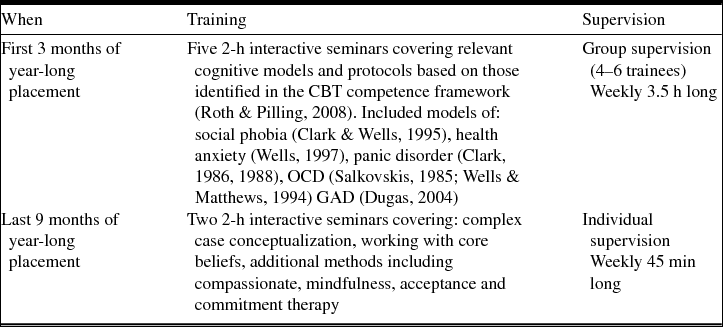
The ADC was established as a joint venture between the Doctoral Programme in Clinical Psychology at University College London and Camden and Islington NHS Foundation Trust. A distinctive feature of this clinic is that it was staffed solely by trainee clinical psychologists from three North London doctoral programmes in clinical psychology who received intensive training and supervision focused on the delivery of CBT interventions for anxiety disorders, making it well-suited to exploring the effectiveness of therapy as delivered by novice therapists. Table 1 summarizes the training and supervision model of the ADC.
Model of training and supervision for the anxiety disorders clinic

OCD, Obsessive compulsive disorder; GAD, generalized anxiety disorder.
Model of training
In addition to the training in CBT offered by the doctoral programme in clinical psychology courses of which the trainees were members, trainees in the ADC received an additional seven 2-h interactive seminars led by two senior clinical psychologists, each with post-qualification training in CBT and extensive experience of training and supervision. Seminars took place over the first 3 months of the trainees’ year-long placement in the ADC. The first five focused on panic disorder, social anxiety disorder, OCD, generalized anxiety disorder (GAD) and health anxiety and introduced relevant cognitive models and protocols, based on those identified in the CBT competence framework (Roth & Pilling, Reference Roth and Pilling2008), including models of social phobia (Clark & Wells, Reference Clark, Wells, Heimberg, Leibowitz, Hope and Schneier1995), health anxiety (Wells, Reference Wells1997), panic disorder (Clark, Reference Clark1986, Reference Clark, Rachman and Maser1988), OCD (Wells & Matthews, Reference Wells and Matthews1994; Salkovskis, Reference Salkovskis1985) and GAD (Dugas, Reference Dugas2004). Prior to each seminar, trainees were given background reading that was used as the basis for active discussion, followed by consideration of two clinical vignettes. These seminars provided trainees with the opportunity to familiarize themselves with intervention models, to practise case formulation with relevant clinical material and to troubleshoot potential difficulties. Two final seminars took place later in the placement, and aimed to support trainees’ formulations and interventions with clients with complex presentations and comorbidity (where the formulation indicated the need for work at the level of restructuring and redefining core beliefs). These seminars focused on different ways of working with core beliefs using both cognitive techniques and experiential methods, including the use of compassionate imagery (Lee, Reference Lee and Gilbert2005) and mindfulness.
Model of supervision
Throughout their time in the ADC, trainees received weekly supervision from one of the two trainers (S.W.). Supervision aimed to help trainees develop effective generic CBT competencies and to acquire problem-specific expertise in formulating and delivering treatment to clients presenting with a variety of anxiety disorders. In the early stages of supervision, trainees learnt how to work with agendas and structure sessions, use thought records, plan and conduct behavioural experiments, use a variety of cognitive and behavioural techniques for working with negative automatic thoughts, assumptions, and beliefs, and prepare for and manage therapeutic endings. Over the course of supervision, recordings of up to six complete therapy sessions per trainee were reviewed by S.W., who rated the recordings using the Cognitive Therapy Rating Scale (CTRS; Young & Beck, Reference Young and Beck1980) and gave detailed written and verbal feedback.
The style of supervision was congruent with the structure of CBT – it was largely Socratic, with the addition of a didactic component when necessary. It included agenda and goal setting, discussion of conceptualization and treatment techniques, and made use of role-play, feedback and summaries of important insights. Trainees were encouraged to think scientifically, while being curious and reflective, in generating hypotheses for testing, conducting skill-enhancing behavioural experiments, delivering CBT collaboratively with clients, in observing changes and measuring results. Supervision also highlighted trainees’ own behaviours and cognitions, particularly regarding their developing professional identity and reaction to clients. Elements of a person-centred model of supervision (Haynes et al. Reference Haynes, Corey and Moulton2003) were also used, with the idea of the supervisor facilitating the trainees to develop effectively as a clinical psychologist using their own personal resources. The supervisor is not seen as ‘expert’ but rather as a collaborator with the supervisee – and the task of supervision is to provide a safe space (a secure base) in which the trainees can remain open to the experience of their engagement with the client. The supervisor facilitates the trainee's developing autonomy by providing a safe supervision environment. Given that these were trainees, it also seemed important (as Perris, Reference Perris1994, suggests) for supervision to provide this ‘secure base’ (Bowlby, Reference Bowlby1988) – the provision of a safe and containing environment, from which trainees can internalize from the supervisor caregiving messages of developmental benefit which help them feel sufficiently confident to venture into the world of clinical practice, to experiment and learn and from which they could negotiate their journeys into unfamiliar therapeutic territory.
A further characteristic of the ADC was an emphasis on in vivo behavioural experiments and graded exposure, taking both the trainee and client out of the therapy room and into real-world settings with the aim of effecting rapid belief change (Bennett-Levy et al. Reference Bennett-Levy, Butler, Fennell, Hackmann, Mueller and Westbrook2004). The range of conceptualization-driven in vivo interventions included: exposure and response prevention in the homes of clients experiencing OCD (e.g. a trainee supervising a client with hoarding problems to cull her wardrobe); journeys on the tube or bus; visits to lifts, escalators and a phlebotomy service with clients with various phobias; modelling collapsing and fainting in public places with clients with panic disorder who catastrophized about such events; eating and drinking in cafes with clients who were fearful of doing this in public or had social anxiety.
Trainees were also supported in developing additional CBT approaches while working with some of the more complex client presentations, working with idiosyncratic case conceptualizations informed by treatment protocols. Such approaches included the use of compassion and the perfect nurturer model (Lee, Reference Lee and Gilbert2005). Similarly, trainees used techniques from mindfulness to great effect, for example, with a client presenting with OCD relating to intrusive thoughts about the possibility of being a paedophile and who also had a more general difficulty with emotion regulation and tolerance of frustration and anger.
As the trainees progressed, they developed competence and confidence. The focus of supervisory discussions centred far more on conceptualization and on therapeutic process than on content. A common feature arising in the presentations of clients referred to the ADC was that of avoidance of affect. In such situations, it was generally helpful to return to the conceptualization, which would provide clues as to why a client's apparently puzzling avoidance made sense as an over-utilized strategy for functioning. Trainees were encouraged to reflect on the potential personal meaning of any identified process issues for themselves (often through role-play) and were supported to address them transparently, curiously and empathically but also directly with their clients.
At the outset the aim was to deliver standard CBT in line with the various protocols flagged by the CBT competence framework (Roth & Pilling, Reference Roth and Pilling2008), and which trainees were taught. However, while some clients’ problems fitted neatly with these protocols, the complexity of many presentations in this inner-city secondary-care setting made it difficult to plan interventions solely in terms of a single diagnosis or a specific CBT model. In such cases, treatment was based on individual case conceptualizations informed by relevant protocols, an approach which is consistent with the notion that protocols are best seen as guiding frameworks which contain multiple decision points requiring an idiosyncratic understanding of clients’ presenting problems and their context (Kuyken et al. Reference Kuyken, Padesky and Dudley2009). Both case conceptualization and protocols had something useful to offer and in fact complemented one another. Thus, trainees conducted standard CBT according to a conceptualization shared with the client, which also followed a protocol in a manner that was responsive to the individual and sometimes complex needs of the client. Two case examples illustrate the implementation of this approach (details of both clients described below have been changed to maintain confidentiality).
Case example 1. An 18-year-old Asian Muslim male student was referred for vomit phobia. The standard treatment is usually graded exposure and challenging of unhelpful beliefs, along with a targeting of safety-seeking behaviours and avoidance around vomiting (Boschen, Reference Boschen2007; Veale & Lambrou, Reference Veale and Lambrou2006). However, it quickly became apparent, as idiosyncratic meanings emerged, that the phobia had developed as a response to the client's beliefs about his own vulnerability and lack of ability to cope with negative emotional states. Exploration revealed that his cultural and family belief system discouraged expression of uncomfortable emotions, encouraged dependency and did not emphasize coping. Culturally sensitive therapeutic work focused on psychoeducation about anxiety, targeting safety behaviours around vomiting, identifying and exploring beliefs about vulnerability, and behavioural experiments for the client to allow, tolerate and process difficult feelings rather than avoiding them. After the first four sessions, fear of vomiting ceased to be a problem for the student and was no longer the focus in therapy. Remaining sessions focused on restructuring beliefs about vulnerability and behavioural experiments to enhance coping and resilience.
Case example 2. A 62-year-old retired military veteran was referred for treatment for panic attacks and agoraphobia, and initially treated using Clark's (Reference Clark, Rachman and Maser1988) panic model. After two initial sessions, it became apparent that the client was experiencing involuntary intrusions of traumatic incidents experienced many years previously while in the military. Conceptualization was adjusted to include an understanding of post-traumatic stress disorder (Ehlers & Clark, Reference Ehlers and Clark2000). However, following psychoeducation about the nature of trauma memories, the client declined to revisit the aversive incidents in the form of a reliving, although he did understand the rationale for suggesting this form of treatment. It seemed that his willingness to engage in psychological treatment was compromised by a strongly held belief, reinforced by his anxiety symptoms, that he had become ‘soft’. This potentially represented an impasse to CBT. However, he did respond well to the introduction of a more radical behavioural approach using relaxation techniques, along with psychoeducation about anxiety and behavioural activation. Putting him back in touch with his positive reinforcers in this way led to an increased repertoire of activities together with a substantial reduction in anxiety symptoms and general improvement in mood.
Method
Effectiveness of the ADC
Clients
Outcomes are reported for 57 consecutively referred and treated clients. Most clients were referred by their general practitioner (77.2%); the majority were female (N = 39, 68.4%). Most were white British or white European (N = 45, 78.9%); the remaining clients were black African, black Caribbean, Asian or classified as ‘other’ (N = 12, 21.1%). Their ages ranged from 19 to 63 years (mean = 32.8 years, s.d. = 11.1).
Screening by qualified clinical psychologists at initial intake identified clients’ primary presenting conditions as: social phobia (N = 15, 26.3%), panic disorder (with and without agoraphobia) (N = 15, 26.3%), OCD (N = 9, 15.8%), specific phobias (N = 9, 15.8%), anxiety not otherwise specified (N = 4, 7%) and GAD (N = 3, 5.3%); health anxiety (N = 1, 1.8%); and post-traumatic stress disorder (N = 1, 1.8%). Almost half (45.6%) the clients had been prescribed and were taking psychotropic medication, predominantly selective serotonin reuptake inhibitors. Comorbid mental health problems were identified in the majority of clients (N = 37, 64.9%), with depression being the most common additional problem (N = 6, 45.6%).
Measures
The following measures were administered at the start of treatment and final treatment sessions for all service users:
Clinical Outcomes in Routine Evaluation – Outcome Measure (CORE-OM; Mellor-Clark et al. Reference Mellor-Clark, Barkham, Connell and Evans1999 ). The CORE-OM is a widely used outcome measure for psychological therapies (Barkham et al. Reference Barkham, Margison, Leach, Lucock, Mellor-Clark, Evans, Benson, Connell, Audin and McGrath2001). It comprises 34 items addressing domains of subjective well-being, symptoms, functioning and risk. Items are scored on a 5-point scale from 0 (‘not at all’) to 4 (‘all the time’). Its suitability and utility for assessing severity of presenting problems has been demonstrated in both primary- and secondary-care settings (Barkham et al. Reference Barkham, Gilbert, Connell, Marshall and Twigg2005).
Beck Anxiety Inventory (BAI; Beck & Steer, Reference Beck and Steer1990 ). The BAI is a reliable and valid 21-item self-report symptom checklist designed to measure presence and severity of anxiety symptoms over the previous week, rated on a 4-point scale (0–3) with a possible score ranging from 0 to 63. The total scores are categorized as normal (0–7), mild (8–15), moderate (16–25) and severe (26–63).
Beck Depression Inventory II (BDI-II; Beck et al. Reference Beck, Steer and Brown1996 ). The BDI is a reliable and valid 21-item self-report measure of depressive symptoms over the previous week, rated on a 4-point scale (0–3) with a possible score ranging from 0 to 63. The total scores are categorized as minimal (0–13), mild (14–19), moderate (20–28) and severe (29–63).
Work and Social Adjustment Scale (WSAS: Mundt et al. Reference Mundt, Marks, Shear and Greist2002 ). The WSAS measures the degree to which the service user's anxiety interferes with functioning at work, at home, social life, leisure time and relationships. The five items are measured on an 9-point Likert scale of 0–8, with 8 indicating severe impairment. Total scores are categorized as minimal/mild functional impairment (0–15), moderate functional impairment (16–29) and severe functional impairment (30–40).
Statistical analysis
Paired t tests were performed to compare the mean scores on outcome measures before and after intervention. To assess the magnitude of change for each outcome measure effect sizes (Cohen's d) were calculated (as the pre-treatment score minus the post-treatment score divided by the pooled standard deviation). Intention-to-treat (ITT) analyses employed the last observation carried forward method.
Criteria for change
In addition to pre- and post-intervention statistical analyses to determine statistical change in mean scores post-treatment, recovery rates on all measures and reliable clinical change on the CORE-OM were also examined. This was to allow for exploration of meaningful clinical changes observed and to explore change while minimizing measurement error (Jacobson & Truax, Reference Jacobson and Truax1991).
(a) Recovery. A client was considered ‘Recovered’ if their scores were above the clinical case level prior to treatment and below clinical case level post-treatment. Recovery was defined as an end-point score below the clinical cut-off scores on each measure (CORE-OM 1.0, Connell et al. Reference Connell, Barkham, Stiles, Twigg, Singleton, Evans and Miles2007; BAI 22.8, McEvoy & Nathan, Reference McEvoy and Nathan2007; BDI-II 13.5, McEvoy & Nathan, Reference McEvoy and Nathan2007; WSAS 10).
(b) Reliable and clinically significant improvement and deterioration. Reliable change indices (RCI) and clinically significant change cut-offs (Jacobson & Truax, Reference Jacobson and Truax1991) were used for the CORE-OM to assess clinically significant individual change in participants (CORE-OM RCI 0.5, Mullin et al. Reference Mullin, Barkham, Mothersole, Bewick and Kinder2006). For change to be considered reliable, clients’ scores needed to change by a RCI of 0.5 on the CORE-OM. For clinically significant change, clients’ scores needed to move clinical categories, such as from ‘moderate’ to ‘mild’. Clients were considered to have met the criteria for reliable and clinical significant recovery if their post-intervention scores reduced by more than the RCI and fell below the clinical cut-off of 1.0 on the CORE-OM. They were considered ‘Improved’ if their post-intervention scores were reduced by more than a RCI of 0.5 and/or moved clinical categories. They were considered ‘Deteriorated’ if their post-intervention scores increased by more than the RCI.
Results
Attrition
Clients were offered 12 appointments and attended a mean of 10.3 (s.d. = 4.3, range 1–27). Forty-seven clients completed all 12 sessions. Ten clients completed between one and eight sessions (mean = 3.6), representing a dropout rate of 17.5%. Data from the whole sample and from the ‘completer’ sample are analysed separately.
Treatment outcomes
Statistical significance and effect size
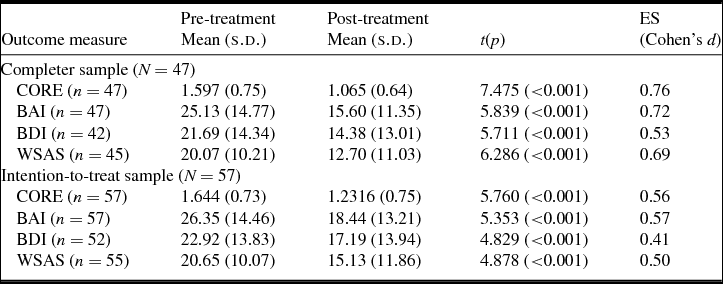
As can be seen in Table 2, service users who completed the intervention (‘Completer’ group) improved on all four outcome measures. Medium effect sizes were observed for each pre-post comparison. Statistical differences were maintained for the ITT analysis, with medium effect sizes observed for the CORE, BAI and WSAS, although unsurprisingly effect sizes were smaller for this group. The BDI pre-post comparison for the ITT analysis revealed a small effect size.
Pre- and post-intervention scores, t test comparison scores and effect sizes for completers and intention-to-treat sample

CORE, Clinical Outcomes in Routine Evaluation; BAI, Beck Anxiety Inventory; BDI, Beck Depression Inventory; WSAS, Work and Social Adjustment Scale; ES, effect size.
Recovery
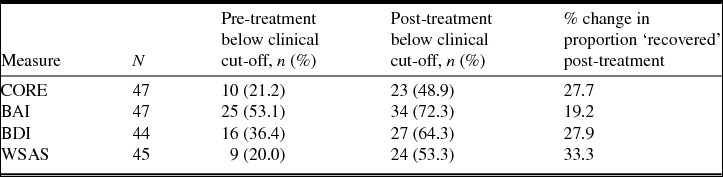
As shown in Table 3, a significant proportion of service users moved below clinical cut-off following intervention on each of the four measures. Almost half (48.9%) were below the clinical cut-off following intervention on the CORE-OM; 72.3% were below the clinical cut-off on the BAI.
Proportion of clients below the clinical cut-off before and after treatment

CORE, Clinical Outcomes in Routine Evaluation; BAI, Beck Anxiety Inventory; BDI, Beck Depression Inventory; WSAS, Work and Social Adjustment Scale.
Clinical and reliably significant change
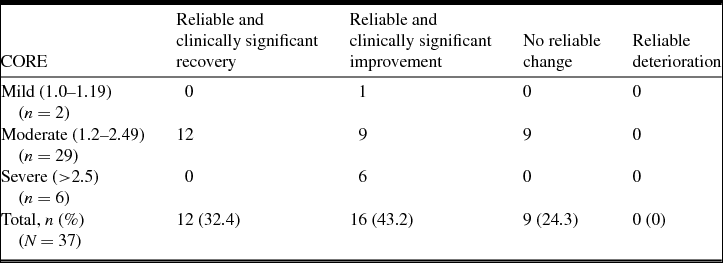
Clinical and reliable change analyses were conducted for the 37 clients whose pre-treatment scores on the CORE were above clinical cut-off level of 1.0. Of these, 12 (32.4%) service users showed reliable and clinical significant recovery post-intervention, 16 (43.2%) showed reliable and clinically signicant improvement and nine (24.3%) showed no reliable change; no clients showed reliable deterioration (see Table 4).
Reliable and clinically significant change on the CORE for clients above the clinical cut-off prior to intervention

CORE, Clinical Outcomes in Routine Evaluation.
Discussion
This paper presents a model of intensive CBT training and supervision for trainee clinical psychologists, aiming to teach CBT competences and implement high-quality CBT in routine clinical secondary-care settings.
Results indicate that on measures of anxiety, depression, general distress and work and social functioning, clients showed significant improvement following relatively brief CBT interventions. Medium pre-post effect sizes were found for completers on all measures (ranging from 0.53 to 0.76) and for the entire population sample on all but one measure (ranging from 0.41 to 0.57). These are smaller than the mean effect size (1.29) reported in a review of practice-based research (Cahill et al. Reference Cahill, Barkham and Stiles2010), although the majority of those studies reviewed referred to common mental health problems in primary-care settings. Effect sizes in the current study were within the range found in comparable effectiveness studies in non-primary-care settings with clients with more complex and chronic difficulties (e.g. Barkham et al. Reference Barkham, Margison, Leach, Lucock, Mellor-Clark, Evans, Benson, Connell, Audin and McGrath2001; Westbrook & Kirk, Reference Westbrook and Kirk2005; McEvoy & Nathan, Reference McEvoy and Nathan2007).
Between 74% and 80% of client scores indicated clinical levels of distress on the BDI, CORE-OM and WSAS pre-treatment. The BAI indicated that 47% were categorized as clinical cases pre-treatment. There was between 19.2% and 33.3% change in the proportion ‘recovered’ (i.e. moved categories to below the clinical cut-off points) post-treatment on all four measures used. It may be that the BAI was not sensitive enough to pick up the levels of distress indicated by the scores on the other measures, including the BDI, CORE-OM and WSAS for this cohort of clients. Future studies could include more disorder-specific measures of anxiety, alongside the broader measures of distress included here.
In the current study, following intervention, over 75% of clients showed either reliable and clinically significant recovery or improvement. This is a similar proportion to the combined remission and recovery rate for anxiety of 74% seen in the report on an IAPT demonstration site (Richards & Suckling, Reference Richards and Suckling2009). It is somewhat higher than rates reported by Barkham et al. (Reference Barkham, Margison, Leach, Lucock, Mellor-Clark, Evans, Benson, Connell, Audin and McGrath2001), in which 54% showed reliable and clinically significant improvement or reliable improvement.
Although set in a routine clinical secondary-care setting, there are nonetheless some obvious limitations to the study. The lack of a control group means that it is not possible to assert that outcomes are attributable to the ADC interventions alone; follow-up was not possible, meaning that it is unknown if positive outcomes were maintained over time, and the sample size was small (all common limitations in practice-based studies).
There are nonetheless some important strengths of the study, not least the evaluation of outcomes for trainee psychologists operating in routine secondary-care clinical practice with clients selected only for the presence of anxiety as a primary difficulty, resulting in the heterogenous sample typical of secondary-care NHS contexts. The statistical and clinical significance of the findings indicate that the ADC is effective for its purpose in reducing anxiety and distress in its clients. It appears that CBT administered by inexperienced trainee psychologists who are given appropriate training and supervision, as described in the present model, produces good outcomes which are comparable to those in other practice-based effectiveness studies.
The ADC model of clinical practice, training and supervision appears to be a useful way of improving access to CBT for clients. It also provides a successful low-cost way of increasing specialist CBT training for trainee clinical psychologists, as recommended by the Centre for Economic Performance (2006). The additional 14 h of training and the specialist suspervision input did appear to provide a fast route to developing CBT competences in treating anxiety disorders for the trainees placed in the ADC. This could be of particular value in preparing trainees to work in IAPT services, where they are increasingly required to provide treatment for large caseloads within a short period of completing their clinical psychology training. Furthermore, in recent years, local IAPT services have expanded and now provide treatment to patients previously seen in the ADC. In response to this, the trainee clinic has extended its work by now providing home and community-based behavioural interventions to a client group with more complex and debilitating anxiety disorders that are not seen in the standard primary-care-based IAPT service, but who do not meet the threshold for secondary care. A similar training and supervision model to the ADC appears to be successful and an evaluation is underway.
Future research could compare levels of CBT competences at the end of their placement in the ADC having received the specialist model of training with those of their equivalent peers who had not received the specialist training, supervision and supervised work in an ADC. The impact of trainee therapist competence on clinic outcomes is a further area for future research, possibly as measured by the CTRS (Young & Beck, Reference Young and Beck1980), as was used in the present study. Further studies could also explore the impact of specialist supervision on experienced and well-trained clinician's competences, skills and outcomes compared to those without specialist supervision.
In summary, given the findings presented in this paper, it would appear that the ADC model of CBT training and supervision has demonstrated the potential for enhancing the development of CBT competences in novice trainee clinical psychologists who can then deliver effective interventions. It is suggested that the ADC model could usefully be adopted by other established health services, such as the NHS, as a means of improving access to CBT while providing specialist training for trainee clinical psychologists.
Ethical standards
The authors assert that all procedures contributing to this work comply with the ethical standards of the relevant national and institutional committees on human experimentation and with the Helsinki Declaration of 1975, as revised in 2008.
Acknowledgements
The authors thank all the clients, trainee clinical psychologists, trainers and supervisors involved in the Anxiety Disorders Clinic. This research received no specific grant from any funding agency, commercial or not-for-profit sectors.
Declaration of Interest
The authors have no conflict of interest with respect to this publication.
-
(1) Gain an understanding of a training and supervision model aimed at increasing CBT compentencies in trainee clinical psychologists in a secondary care NHS setting.
-
(2) Learn about the findings of an effectiveness study of a practice-based outcome research in an anxiety disorders clinic in a secondary care NHS setting with CBT delivered by trainee clinical psychologists.
-
(3) To understand how comparable outcomes for service-users can be achieved through a focused training and supervision model with trainee clinical psychologists.



Comments
No Comments have been published for this article.