In 1783, Friedrich Gedike wondered whether the city of Berlin was growing disproportionately to the rest of the country.Footnote 1 Like any good enlightened observer of the city, Gedike praised the open vistas of newly planned suburbs over the cramped streets of the medieval city core. But, though a spacious city allowed for healthy use and recreation and Berlin remained much smaller than great capitals such as Paris and London, Gedike feared that Berlin's growth was becoming too rapid to control. Something, he worried, was out of proportion. Hundreds of buildings had been erected in place of the city's now demolished ramparts. This newly won land had not sufficed, however, and new suburbs with thousands of new buildings arose, streets irregularly placed, without adequate linkages to the inner city. This immoderate growth was evident in the failure to overcome the boundary between the city core and newly developed suburbs. The number of streets broken through the former fortifications land proved inadequate. This continued division, Gedike feared, would impede the city's ongoing development.Footnote 2
Throughout the nineteenth century concerns about Berlin's disproportionate growth were evidenced in conversations about its borders and frontiers, as they had been for Gedike. Berlin was known for its terrifying (and exhilarating) borderless growth on the one hand, and for the artificial limits placed on its expansion by administrative mismanagement of its borders on the other. This article examines the evolution of Berlin's urban frontier in the nineteenth century and focuses on how ideas about the relationship between urban and national space were expressed in depictions of the natural limits and frontiers of the capital city in the 1860s and 1870s. The first section examines the place that Berlin's eighteenth-century ring wall had in nineteenth-century understandings of Berlin's spatial development and the removal of that wall in 1865–66. This removal was a crucial moment in the development of Berlin's urban identity, as top-down city planning initiatives were complicated by the spontaneous actions of unruly Berliners who began to take down the city wall themselves before city administrators could arrange for its demolition. Popular press accounts interpreted the spontaneous disappearance of stones from the wall as evidence of the urban spirit outwitting and outpacing the stodgy and backward-looking official administration of the city.
After 1871, as is considered in the second half of the article, the urban edge continued to be an uneasy and even foreign landscape, which alternately represented what was best and what was most terrifying about the capital city. When the housing crisis of the Gründerzeit resulted in the appearance of shantytowns constructed on public land on the urban edge in 1872, the city's press alternately depicted the spontaneous appearance of these settlements, constructed by homeless Berliners, as a dystopic vision of the reversion to barbarism among the urban underclass and a utopic projection of Germany's future as a young, dynamic nation with a frontier of enterprising settlers comparable to the American West. In both the removal of the wall in 1865 and the construction of peripheral shantytowns in 1872, those residents of the city usually marginalized and excluded gained a central place in the making of the city landscape and Berlin's urban identity.
Battles over the meaning and place of the capital city in the national landscape were fought on the city edge, as much as in the city center, because it was here that questions of growth, development, and spatial form were most clearly encountered. Nineteenth-century Berliners took their city's growth and spatial development as indicative of the relationship between the nation and the city, between planned top-down development and natural, spontaneous urban growth, and between the periphery and the center. In the Gründerzeit, ideas about the new German nation and the “world city” that was its capital were overlaid in the construction of a new kind of urban frontier myth. This frontier idea invested Berlin's growth with significance for the health and vitality of the Kaiserreich, and for Germany's place in a global landscape of frontier settlement, progress, and development.Footnote 3
Growth within Limits and the Removal of Berlin's City Wall, 1808–66
In the eighteenth century, Berlin's defortification led to the construction of a new tax wall around the city's expanded municipal area.Footnote 4 In the nineteenth century, this wall came to signify the setbacks and embarrassments that plagued the city in the first years of the century—the administrative severing of the city from its environs, the passage of a tariff law that required the exaction of excise taxes at the city border, and limits placed on its right of self government—while the large size of the walled area allowed the city to preserve a partially rural character well into the nineteenth century.Footnote 5
The first significant move toward dismantling the wall did not come until the 1840s, spurred on by three factors: first, the desire to develop new transportation networks around the city; second, the petitions and complaints of those who lived near but beyond the wall; and, third, traffic holdups (though this would not become a very serious issue until the 1850s).Footnote 6 In response to a petition for the removal of the wall from residents on behalf of the fervent “desire to build” (Baulust) in 1847, the Ministry of the Interior acknowledged that taking down the city wall on the west and southeast sides of the city would be very desirable, but concluded that the project could not be realized as long as important excise taxes were still to be collected at the city's edge.Footnote 7 Nonetheless, over the following decade, the walls were removed or shifted outward in a number of places due to local exigencies.Footnote 8
In February 1848, Friedrich Wilhelm IV called for a further consideration of a possible removal of a portion of Berlin's walls in light of plans to build a tramway around the city. These plans were laid aside after the outbreak of violence in the city.Footnote 9 Following this decision, the 1850s proved a decade of dissatisfaction in the suburbs. Residents who lived beyond the wall saw themselves as unfairly burdened by the excise taxes exacted at the city gates.Footnote 10 In spite of pressure from residents of Berlin's hinterland, the specter of 1848 continued to haunt proposals to remove the wall. In the 1850s, further petitions and plans for the possible removal were rejected in part for financial reasons, but also with reference to the possibility of a second 1848. Officials feared that the absence of any available means to close the city by controlling its entrances would have serious consequences in the case of urban unrest.Footnote 11
Anxiety about revolution on the city's borders reflected the social geography of Berlin. From the 1820s on, large tenements, or Familienhäuser, sprung up outside Hamburg Gate. Here, members of the working class who could not afford to live within the city found cramped quarters beyond the walls where land was cheaper. In the 1840s, the contrast presented between the wealth within the city and the poverty beyond its gates seemed an especially stark representation of the way in which pauperism of a new kind and scale threatened to overwhelm the city's social and economic structures in the throes of early industrialization.Footnote 12 Urban growth appeared as the result of both excess luxury and abject poverty. The city wall was the border between those two worlds. The question of the city's future development was whether Berlin's character would remain that of the city within the walls, or whether instead a new Berlin would grow from those who had been expelled from the city and lived beyond the gates.Footnote 13
In the middle of the century, a greater interest in the city's past development, and especially its spatial evolution, accompanied new attempts to control and plan Berlin's future growth. City planners and reformers feared that Berlin, beginning with the initial removal of its fortifications, had never dealt properly with its borders, leaving the city haunted by their partially repressed and ghostly presence: a conflicted and confusing city of both disconcertingly rapid growth and unnaturally perpetuated restrictions on that growth. Because it had grown faster and sooner than most other German cities, Berlin had been denied the opportunity to construct a proper ring-shaped promenade. Instead, the marshy land of the former ramparts had become among the city's least attractive streets.Footnote 14 Without the visible reference point of a promenade or ring road marking the border between the old and the new, the city lost touch with the supposedly natural growth pattern of radial streets and concentric rings.Footnote 15
Then, the City Code of 1808 artificially impeded Berlin's development by disrupting its relationship to the hinterland. It effectively cut Berlin off from its suburbs by giving the city magistracy control only over the land contained within the ring wall that had replaced the city's fortifications in the eighteenth century.Footnote 16 This wall enclosed much empty land, but it seemed to many later commentators that limiting urban administration to within those walls thwarted Berlin's healthy growth.Footnote 17 This act set up Berlin's fate as a site of conflict between two systems of spatial and social order: that of the state and that of the city, with serious and long-lasting consequences for both Berlin and Germany.Footnote 18
The first half of the nineteenth century had been a period of missed opportunities for growth. While some commentators focused on the 1808 City Code, others highlighted the significance of 1848, when the removal of Berlin's ring wall was first considered.Footnote 19 The end of Berlin's traumatic separation from its hinterland could be dated to 1858, with a proposed new city plan, to 1860, when extensive areas beyond the ring wall were incorporated as city land, to 1865, when the wall was finally taken down, or to 1871 with the birth of the German Empire and Berlin's subsequent boom in growth.Footnote 20 Even after most legal and logistical restrictions on growth had been lifted, nineteenth-century commentators feared that certain habits of mind remained that placed further artificial limits on Berlin's urban development. The trauma of long-vanished fortifications manifested itself in a kind of “inherited illness,” in which the city tended to both artificial density and a too rapid, debauched form of growth.Footnote 21 This “illness” hampered attempts to remove the city wall and slowed the city's subsequent growth into the 1860s and 1870s.
On the eve of its removal, then, Berlin's city wall bore a multifold significance. It represented a superseded border and an unnatural, long outgrown restriction on the city's commerce and growth. It symbolized a conflict between city and state administration. It also evoked the emergence of new and dangerous divisions between rich and poor, included and excluded. Although the eventual removal of the city wall was welcomed on all sides (except perhaps by the tax collectors), the way in which the significance of this event was understood and described reflected the need to reconcile conflicting models of urban space. As a celebrated event, tearing down the city wall seemed both a natural consequence of urban development and a subversive victory of the periphery over the center.
After the 1860 expansion of Berlin's municipal area, attention shifted from the city border to the presence of the physical wall itself. In light of the incorporation of new land, the wall increasingly came to seem an arbitrary barrier between the city core and its suburbs. Negotiations over the wall's possible removal were complicated by confused jurisdiction and tension between the state and city governments. Although it had garnered little attention before 1860, within a few years after the municipal expansion the wall quickly became a joke, its continued presence a subject of public mockery. Artificially preserved by bureaucratic red tape, it became a seemingly permanent and embarrassing element of the urban environment.Footnote 22
On July 1, 1865, the city's tax border was moved out from the existing city wall to the new municipal boundary, though it would be a number of years before the tax was eliminated entirely. This shift divested the city wall of its most significant remaining purpose. On June 20, in anticipation of the imminent change, King Wilhelm authorized the wall's gradual removal, contingent upon the cooperation of adjacent landowners, once the transition had been made to the new tax boundary. The move had been in discussion for years, but in spite of the long preparations and negotiations between city, state, and landowners that had preceded this announcement, progress after the king's decree remained slow. The city sought to manage the wall's removal as a routine clearance project, and not as the momentous opening of a border. The most immediate result of the announcement was to bring the wall into the public eye. The planned removal quickly became a common topic in Berlin's local press. But the story told there took a very different form from the one anticipated. Officials had underestimated popular excitement over the wall's removal, as well as the impatience that the slow pace of this—admittedly large—public works project would drum up.
Shortly after the June 20 decree, local papers began to report the mysterious appearance of new openings in the city wall. As negotiations with neighboring landowners over the details of funding and construction began, “a troop of little revolutionaries” (Umstürzler) took more immediate action, setting about the wall with their own hands, and breaking through passageways of their own.Footnote 23 Most of these new “gates” were just big enough to crawl through, but some were as large as a barn door. Much of the unofficial demolition seemed to be the work of mischievous youths. “Great seriousness in children's play” declared one paper, describing how schoolchildren set upon the wall with hammers and scraps of iron.Footnote 24 A couple months later, as more and more unofficial gates appeared, the newspaper joked that if Berliners continued to be so industrious, by the time the official negotiations were finally complete, there would no longer be a wall to remove.Footnote 25 Expressing the growing disjuncture between the wall's physical state and its official status as a border, the Kladderadatsch depicted the wall as an open arcade, which was nonetheless policed by constables with futile vigilance.Footnote 26
The papers reported with evident glee how Berlin's street urchins waged battle with the stodgy and slow-witted constables who patrolled the wall. One conservative daily published a particularly jovial and detailed account of these “insurrectionists,” describing how one of the young “wall-stormers” (Stadtmauerstürmer), upon being spotted by a constable, squeezed through a hole in the city wall of his own making.Footnote 27 The constable charged with patrolling the flimsy border puffed toward him, gesticulating wildly in an attempt to prevent the escape. When he finally arrived at the scene of the crime, all he could do was stick his head through the small opening and yell at the fugitive on the other side. Adding insult to injury, when the constable pulled his head back through the hole, his helmet toppled out of reach into the city's “municipal area” (Weichbild), while he remained stuck in “wall-enclosed Berlin.” The young escapee proved unwilling to hand him his helmet, so the constable was obliged to make the long trek under the hot sun to the next gate to retrieve that important symbol of his station and restore it to his head.Footnote 28
This story, though quite probably embellished, reveals an important theme in the public discussion of Berlin's city growth and its relationship as a growing metropolis to the Prussian state. Here, the city is cast as young, healthy, and resourceful in the figure of the urchin, while Prussian authority is personified as old, fat, ineffective, and bound up by its own love of rules. The very overreach of bureaucratic power, attempting to control movement into and through urban space with the seemingly outdated city wall, crippled the constable's ability to exercise control even over the space within the walls. Berlin's city wall kept the official within its bounds, but could do nothing against that peculiarly urban animal, the street urchin; the city had transcended the wall before it was itself removed. As in the street boy Gavroche in Les Misérables, it was the small figure of the street urchin that best embodied the city's spirit.
Describing the attack on the city wall in such terms was one technique for making it seem the spontaneous result of the city's own healthy and youthful exuberance. That most of those described chipping away at the wall were young boys and adolescents recalled contemporary comparisons of the growing city itself to an adolescent and the wall to a pair of trousers grown too short.Footnote 29 These articles no doubt exaggerated the degree to which Berliners took the wall's demolition into their own hands, but they did so with a sense of humor, playing up the incongruity between the small figure of the street urchin and the largeness of the role of urban “revolutionary.” But while the press made teasing use of a vocabulary of revolution to describe the surreptitious removal of stones from the wall, speaking of “attacks” and describing the attackers as “insurrectionists,” this language hinted at a more serious theme as well.Footnote 30 In sidelong references to 1848, history seemed here to be repeating itself not quite as farce, but as a child's game.
To some observers, the popular desire to take down the wall showed natural good sense in Berlin's citizens not shared by its administrators, in their desire for an open, growing city. A playful and harmless civil disobedience, opening up unofficial city gates seemed a healthy, productive alternative to more destructive reactions to Berlin's spatial mismanagement, such as housing riots. Just a couple years before in 1863, tenants and police had violently clashed over evictions where rents were rising.Footnote 31 Economist and housing reformer Julius Faucher saw the impatience of waiting Berliners evidenced in the wall's countless new holes, even as administrators seemed unable to discard this relic of the urban past. The city's shortage of space meant a shortage of housing, particularly affordable housing for the poor and working classes. If the wall came down, Faucher thought, the city would grow more rapidly and housing would be cheaper, more abundant, and less dense.Footnote 32 Hence, the public desire to get rid of the wall as soon as possible must also be understood in the context of the emerging debate over urban housing reform.
Another way to make the fall of the wall seem natural, inevitable, and an expression of the city's collective spirit was to obscure the actors altogether. The surreptitious demolition of the city wall was described as invisible, stealthy, and “wonderfully secret.”Footnote 33 Berlin's leading financial paper reported that when an “unseen hand” opened up several new passages, locals were universally “grateful to the invisible hands that have opened up easy access from their shops to the residences on the other side of the wall.”Footnote 34 Here, the metropolitan spirit was embodied in those “invisible hands,” which conspired with the interests of business and capital. The article deployed the language of urban planning and improvement to describe these anonymous acts of civil disobedience. The street urchin and upstanding businessman made unlikely allies, but here the growth of the city “comparable to the interest on a capital investment” was enabled by those unseen and unruly Berliners who were stealthily chipping away at the wall.Footnote 35
As something hidden, unseen, and of the night, the wall's removal had traces of the strange or uncanny, as if the wall were a ghost or spirit returned from a vanished past. The sound of chisels chipping away at the wall sounded to one observer like the creaking trees of the Black Forest when the Flying Dutchman passed overhead.Footnote 36 The same article went on to describe the process by which the wall came down, again presenting this as the work of strange and unseen hands:
Below stand uncanny [unheimliche] forms who work diligently at their nightly work, sentries are placed, to warn of approaching constables . . . one stone falls, a second—finally, a joyful cry heralds the completion of the hole, though still small, and from the other side a hand stretches through and is grasped and shaken by unknown hands—a new brotherhood!Footnote 37
Another observer described the nighttime figures chipping away at the wall as “a swarm of hot-blooded little ghosts,” while the Kladderadatsch hoped the new holes in the wall were not the work of a dragon.Footnote 38 The wall itself was described as unnatural, mysterious, or even supernatural as well. It was designated an evil spell, and as a dragon or a sea serpent coiling its tail around the city.Footnote 39 In many of these metaphors, the wall's nocturnal dismantlement combined the mystical and the mundane. It was a process that seemed to be simultaneously natural and supernatural, both inevitable and revolutionary, both the simple expression of Berlin's character as a growing city and the breaking of a fairy-tale spell.
The removal of Berlin's wall at this late date, though joyful, also seemed foolish; an embarrassment for being so delayed. Since the wall was composed of thin brick only sixteen feet tall, in a number of places around the city the many-storied rental barracks that had sprung up alongside it dwarfed it in height (see Figure 1).Footnote 40 While the press celebrated the stealthy Berliners who sneaked out at night to take down the wall of their own accord, they routinely complained of the city's slow progress in undertaking the project. The papers reported on the painstaking negotiations between city, fiskus, and the abutting landowners.Footnote 41 These stories contrasted the selfishness of competing interests on the border with the “selflessness” of those Berliners who came, even from far away, to help tear down the wall themselves.Footnote 42 The Börsen-Zeitung claimed that the city's youths were forced to take on the task themselves in the face of official “obduracy” (Halsstarrigkeit).Footnote 43 The Spenersche Zeitung observed that city officials appeared incapable of responding to even the most immediate needs of traffic and safety. “In spite of numerous applications and repeated cries of pain,” the paper complained, “provisional openings have yet to be broken through even in those places where the standing wall intersects major traffic arteries.”Footnote 44
“Waiting for the Fall of Berlin's City Wall.” One panel of the comic “Warte nur, balde!” Kladderadatsch 17, no. 42 (September 11, 1864): 168.

Into early 1866, as demolition progressed only slowly, Berliners continued to break new holes in the walls for convenient passage. The press largely lost interest after the first couple of months, but in February the Ministerial Building Commission complained that in some places the wall was in danger of toppling “because the public is not only continuing to break through new passages—there are now twelve larger ones and numerous smaller ones—but has also begun to pull out the foundation stones, which lie exposed on the inner wall.”Footnote 45 Popular press accounts had highlighted the playful, or possibly anarchic, elements among those who secretly chipped away at the wall. As the Building Commission's report indicates, however, Berlin's “wall-stormers” were motivated not only by their natural desire for freedom of movement, but also by the enticement of free building materials. So weakened was the structural stability of the wall that emergency funds had to be appropriated to hurry the project along.Footnote 46 Mindful of unrest, the quickened removal was approved as a labor creation program to prevent an emergency situation among Berlin's working classes—quite probably the same ones who were plundering the wall for stones. Once the tempo of work had been increased, a final major piece of the wall was removed in October 1866.Footnote 47
The removal of Berlin's tax wall in 1865 was one of the final steps in a process that had taken well over a century in which an elaborate border apparatus that visibly and physically demarcated the urban edge had been dismantled. For the journalists and city boosters who celebrated the removal of the wall in 1865, a particular understanding of the city was at stake in forwarding this narrative of the wall's end as a spontaneous occurrence—the work, not of bureaucrats, but of invisible hands. For that brief moment in summer 1865, these reports represented an attempt to shape the story of the city's development, the story of how Berlin's wall fell, in the moment just before it disappeared; to take the initiative away from city and state officials and give it back to the city itself. Although practically of less concrete significance in the spatial development of the city, contemporaries construed this event as a compact symbol of the longer transformation by which the early modern city had become a metropolis. As elsewhere, nineteenth-century celebrations of that change sought to represent this protracted process as a single revolutionary moment—a moment of everyday and bloodless transformation.Footnote 48 In these tales, the triumphant story of urban growth combined the unconsciousness of an organic process with the explosiveness of revolutionary violence. The sense of a temporal disjunction, that the removal of the wall was an event that came “too late,” gave rise to metaphors for its removal that evoked both the unnatural and the supernatural. The intimations of the uncanny cited above arose from a tension between the city's past development, its contemporary spirit, and a future of anticipated growth.
This understanding of the city was one encapsulated by guidebook writer Robert Springer when he observed in 1866 that “the city wall of Berlin [was] falling victim to the metropolitan spirit.”Footnote 49 The starkness and absoluteness of the division between the walled and unwalled city was given dramatic form by Springer in the 1878 edition of his book describing Berlin's transformation “from fishing village to world city.” He separated the history of Berlin's growth into two eras. Before the wall came down was an era of stasis and stifled growth. This he indicates by describing the outer edge of Berlin's settlement before the 1860s as a place where life met death:
The proud royal residence strained its girdle ever further. The rows of houses stretched out to the cemeteries, and the passing generations looked out of their houses at the heaped earth of graves [die Maulwurfshügel des Todes]. The bustle of daily life [covers over] those places where the great men of Berlin's past slumber.Footnote 50
After the wall came down in the 1860s, the city gained new life. In the newest parts of the city, he wrote, “One does not hear the rolling of hearses and is not reminded of the frailty of earthly life by graveyards; in contrast train stations evoke an ever active life.”Footnote 51 Taking down the wall brought the city edge from death to life, from the great men of the past to a landscape of the new, from cemetery to train station. Fixated on the wall itself, Springer made virtually no mention of the tax boundary the wall had represented, although this was inarguably the most significant way in which the wall had actually hindered Berlin's development. The wall itself made such a powerful symbol that the border it had represented faded in its shadow. It came to seem as if the very brick and stone of this diminutive border had restrained the city's growth and development. Representing the birth of a world city in the sandy plains of the Mark, the heavy weight of this metonymic significance rather overburdened Berlin's slender wall.
Opening the Shantytown Frontier: Urban Pioneers in the Gründerzeit
A few short years after Berlin's wall was taken down, the city underwent another momentous transformation. Already growing at a rapid clip in the 1860s, Berlin's promotion from Prussian to imperial capital in 1871 drove the city's rate of growth even higher. Construction failed to keep pace, resulting in a housing shortage of catastrophic proportions. Rents skyrocketed. The mayor himself purportedly struggled to find an apartment he could afford on his bureaucrat's salary.Footnote 52 Although the crunch was widespread, the lower classes were hardest hit. Landlords evicted cheaper tenants en masse. Riots broke out in working-class neighborhoods and were forcibly quelled by soldiers and police.Footnote 53 In April 1872, there were 15,000 homeless in Berlin.Footnote 54 Observers marveled at the peculiarity of seeing whole families sitting on the curb together with their living room furniture, putting domestic interiors on display in the public space of the street.Footnote 55 Desperate but resourceful, some of the evicted transformed overturned rowboats, abandoned train cars, rafts, and omnibuses into impromptu shelters. Others sought protection from the damp, drizzly Berlin weather by digging out shelters in the sandy soil of the fields at the city's edge.
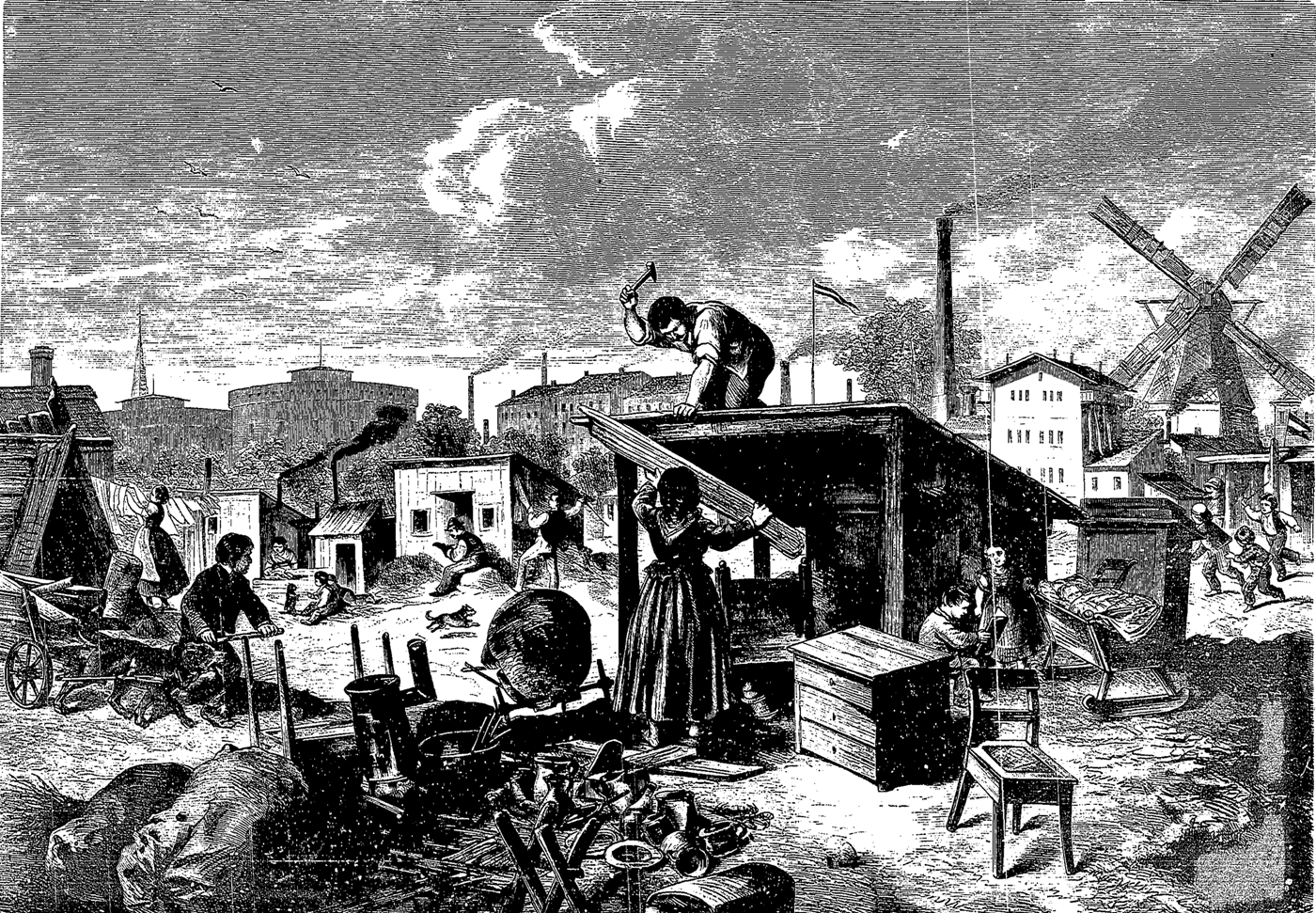
One of the most visible consequences of the crisis was the appearance in the spring of shantytowns at the city's edge, just beyond the recently removed city gates to the east and south. The shantytowns were concentrated outside the Halle and Kottbusser Gates, to the south of the city in present-day Kreuzberg, and the Frankfurter and Landsberger Gates to the east. The city had spread less quickly in this direction, so the edge of the settled city still largely coincided with the recently removed city wall. On vacant land (most of it owned by the city), evicted families constructed huts from scrap wood, straw, and old furniture.Footnote 56 In May, local papers reported that the largest of these settlements already housed ninety families in fifty-two improvised dwellings.Footnote 57 According to some estimates, the population in this settlement would approach two thousand before it was cleared in late September.Footnote 58 During their brief existence, the shantytowns became objects of fascination both in Berlin and across the nation. Artists documented their appearance for the pages of national publications such as Die Gartenlaube, Die Illustrirte Zeitung, and Über Land und Meer, printed alongside eyewitness reports of the “new city district” in Berlin (see Figure 2).Footnote 59 Local newspapers tracked their growth over the summer.Footnote 60 Encouraged by these reports, curious onlookers ventured out to view the shantytowns for themselves. One of the shantytown's enterprising inhabitants started selling beer to visiting sightseers. Benches were put up (conveniently in full, thirst-inducing sun) to allow easier viewing.Footnote 61
Having made their way beyond the old city gates by foot, coach, and omnibus, what Berliners saw reflected their preconceptions and preoccupations about both the nature of the modern industrial city and Berlin's status in particular as the center of the new Kaiserreich and of German society. The housing crisis was widely regarded as evidence of failed private/public coordination in urban development. Berlin's new official importance as the capital had overwhelmed the private housing market. Unchecked greed among housing speculators—behaving “rationally,” as press reports emphasized—resulted in an excess of expensive apartments that stood empty, waiting for the arrival of wealthy tenants drawn by Berlin's new status, while thousands lived in the streets.Footnote 62 Although clearly the result of a very particular and local set of circumstances in Berlin's housing market, the shantytowns' appearance was invested with deep significance for the state of the German character and the relationship between the nation and its capital city.Footnote 63 Treated variously as objects of disgust and evidence of the heroic German spirit, the huts and tents that sprang up on the city edge in summer 1872 became the unlikely ground for a battle over the character and health of the new nation.
Georg Koch, “Die Baracken der Obdachlosen in Berlin,” Über Land und Meer 46 (1872): 4. Reproduced by permission of Harvard Library.
The type of homelessness on display in the housing crisis of 1872 was of a new and unfamiliar type that challenged observers' ideas about how the residents of these shantytowns related to the space of the city. In the second half of the nineteenth century, there were multiple kinds of homelessness with different causes, interpretations, and geographies. The first of these types was the vagabond. The typical vagrant or vagabond was single, male, unemployed, and unconnected. He was a figure entirely external to sedentary, productive society, and he was associated not primarily with the urban landscape, but with the open country road.Footnote 64 In the public eye, vagabondage was related to self-chosen “radical homelessness”; that is, a rejection of the social demand that one keep a fixed abode and stable employment in favor of a kind of radical freedom from expectations and obligations.Footnote 65 Single male vagrants made up the largest group of occupants in Berlin's institutions that provided shelter for the homeless, and women who sought shelter with the city were also described as transient and unattached.Footnote 66 Most were from outside Berlin.Footnote 67 In the public and policy discussions of homelessness, the homeless were assumed to be single and migrant.
In the second half of the nineteenth century, mass homelessness that so visibly affected working-class families was a new phenomenon.Footnote 68 The presence of whole families in homeless shelters elicited special disgust and concern. Gustav Rasch in 1868 noted with shock that families including women and children were forced to take shelter alongside “beggars and vagabonds of every sort and every age.”Footnote 69 Indignation that newly homeless families were being treated to the same conditions as vagrants and prostitutes helped to instigate riots at a Berlin asylum in 1871. In reaction, the city added separate family accommodations in 1873.Footnote 70
In contrast to the predominantly male and unattached world of the homeless shelter, conversations about lower-class housing concerned primarily the poor quality of available housing and the transient residences of marginally housed families, who were themselves seen as being on the brink of homelessness.Footnote 71 In fact, housing reformers described life in the mass apartment buildings and tenements in Berlin's working class suburbs as itself a kind of homelessness, because leases were short term and conditions precarious. The engineer and planner Reinhard Baumeister wrote that a rented residence was no more than a “‘stone tent’ in which the nomadic family camps for an undetermined length of time.”Footnote 72 Residents were often scraping by, such that their ability to pay each month's rent, and avoid eviction, was always in question. Hence, homelessness for families routinely peaked on the quarterly dates when leases came of term.Footnote 73
The housing shortages of the early 1870s brought together these two discourses on lower-class housing and homelessness. As depicted in the popular press, the families of the shantytown were themselves practicing a kind of radical homelessness, claiming space beyond the city edge and putting their homelessness on display as a positive choice for a particular kind of life rather than allowing themselves to be at the mercy of an irrational housing market. But the form this protest took was a radical assertion of the most traditional—and traditionally “German”—form of family life: the productive, employed nuclear family living in a freestanding single-family house, rather than the insecure migratory life of the tenement dweller.
Depictions of Berlin's shantytowns as frontier settlements saw in them proof of a populist rejection of both the plagues of city living and the plans of urban reformers. Like the Berliners who took the dismantling of the city wall into their own hands in the previous decade, the shantytown residents expressed a popular good sense and understanding of urban space that thwarted urban administrators' mismanagement. These accounts engaged contemporary discourses on the character of the German nation and on liberal reform and urban planning. In the pages of popular journals and newspapers, frequent appeals to the American West in the capital city of Berlin also served both a particular understanding of Berlin's place within the German nation and of Germany's place in the world. Germany may not have had a vast open frontier, but that did not mean its citizens lacked a frontier spirit.Footnote 74
In the popular press's celebrations of these urban shantytowns, the marginalized and peripheral were made central to understandings of German national identity and urban progress, casting German shanty dwellers as unlikely local actors in a worldwide drama of frontier settlement. But both negative and positive accounts of Berlin's homeless settlements placed the shantytowns in the context of a global geography of poverty and progress. Negative descriptions mobilized familiar narratives that equated the poverty of the lower classes with the foreign and uncivilized, employed geographic metaphors and allusions that distanced the shantytowns from the essence of German civilization, and drew a sharp contrast between the splendor of the imperial capital and the primitive living conditions of Berlin's homeless. One newspaper compared the largest of the shantytowns to “a Negro city in innermost Africa.” Another evoked “the sealskin tents of the Lapps.”Footnote 75 These comparisons served to construct the shantytowns and Berlin's large population of homeless squatters as evidence of a reversion to primitivism under the pressures of urban poverty, a symptom of a dangerous and difficult-to-control city landscape. They made poverty and homelessness into something foreign and distinctly un-German.Footnote 76
Positive depictions of the squatters as pioneers were in tension with negative and racialized images such as these. The existence of both characterizations side by side indicated the degree to which the urban periphery represented a landscape of both great danger and great potential. The positive and negative were tightly intertwined, because the very virtues of independence and willingness to return to a more primitive life without access to urban amenities also threatened the status quo. The above article likening a Berlin shantytown to a “Negro city” recounted how the shanty dwellers lynched a thief caught red-handed in the settlement, seeing in it evidence not just of barbarism, but also of a native sense of justice and independence.Footnote 77 The close relationship between fears of primitivism and frontier hopes was evidenced in the images and references most commonly used in descriptions of Berlin's shantytowns.
In summer 1872, these kinds of negative depictions, long a staple of writing about the industrial city, were only a part of the picture. The foreign place most often evoked in descriptions of Berlin's shantytowns was a landscape whose very primitiveness signified not regression to an uncivilized past, but rather the rapid development of a young nation: that of the American frontier. The Illustrirte Zeitung referred to the shantytown as a “little America.”Footnote 78Die Gartenlaube compared its residents to “American frontiersmen” and compared the settlement's informal leader to American President Andrew Johnson.Footnote 79 An article that ran in the Germania (a paper aligned with the Catholic Center party) depicted the shantytown as a German San Francisco, evoking Friedrich Gerstäcker's descriptions of the gold-rush town in the heady days of its early growth.Footnote 80
Such outsized comparisons combined comic effect with genuine admiration. Although their very existence was evidence of dire hardship, contemporary accounts of the shantytowns as often celebrated them as miracles of self-organization, evidence instead of an enterprising spirit and distinctly German values of order and cleanliness. Unlike evocations of darkest Africa and darkest London, allusions to the American West made the shantytowns not just foreign spaces, but also fundamental to the character of the new German Empire as a healthy, young nation much like the United States. According to this positive story, Berlin's working poor had been compelled by the hard conditions created by the housing crisis to strike out into the “wilderness” at the city's edge to make a life for themselvess.
Observers emphasized the self-reliance of these urban pioneers, who, freed from the unnatural condition of Berlin's rental barracks, lived in houses built by their own two hands. To some, the appearance of the shantytowns even indicated a healthy instinct among the German working classes to return “to the land” from the unhealthy city. The Illustrirte Zeitung spoke of the shanty dwellers who lived in a freely chosen “state of nature” (Naturzustand).Footnote 81 A speech given to the Berlin Craftsmen's Union (Handwerkerverein) about the shantytowns celebrated the instinctive good sense Berlin's lower classes displayed by this “return to nature.”Footnote 82 The result of this apparent “return to nature” was a pattern of settlement that was more natural, and more naturally German, than that to be found in the city, precisely for being born spontaneous and unplanned from hardship. The shanty dwellers epitomized uniquely German virtues in their decency, their contentedness, and their healthy sense for nature (Natursinn).Footnote 83
In spite of the rough conditions, descriptions of the shantytowns (even some of the less sympathetic) emphasize their orderliness and surprising cleanliness. They detail the virtuous middle-class care their inhabitants took to make hut into home. The squatters took evident pride in their constructions, decorating the bare wood of their walls with bright paint and their windows with flowerboxes of gardenias. Industrious women planted vegetable gardens outside their huts. From the exterior, if one ignored the cramped quarters within, the shantytown could even appear to be an “idyll” of “peaceful coziness.”Footnote 84 Important to this picture was that these were settlements of working-class families, not prostitutes or beggars. Accounts habitually emphasized that the residents were poor, but not destitute.Footnote 85
Beyond explicit evocations of the Wild West mentioned above, the frontier myth constructed by accounts of the 1872 shantytowns shared a number of characteristics familiar from the American frontier myth itself. For one, they produced a culture of individualism, self-dependence, and democratic institutions.Footnote 86 The shantytowns were peaceful, hardworking, and governed by consent. Secondly, they served as a safety valve for metropolitan tensions—their peacefulness and conservatism contrasted with the violence of the eviction riots that also plagued the city in summer 1872. They were also “a gate of escape from the bondage of the past.”Footnote 87 Having escaped the city's exploitative real estate market, the shanty dwellers were:
as little dissatisfied as the American backwoodsman, who would certainly not want to exchange his fine though rough, comfortable, and healthy log cabin with our miserable tenements. Likewise, these poor live in their huts now better and happier than they did earlier in their woebegone attic chambers and damp basement holes.Footnote 88
Although they were within the post-1861 boundaries of the city, these reports emphasized that the shacks were outside the city limits—beyond its gates—and exaggerated the emptiness of the surrounding landscape. (They were in fact located near the former city wall, which had been removed in the 1860s.) These accounts took advantage of the nearby location of the old gates to narrate a visit to the shantytown as an exit from the city into a different kind of world.Footnote 89
Finally, the press routinely depicted Berlin's peripheral shantytowns as not only demonstrative of the German national character, but also as productive of national patriotism. Many reports emphasized that the flags that fluttered above the orderly shacks of the “new Berlin” were the red, black, and white and the imperial eagle.Footnote 90 The shantytown dwellers were complicit in constructing this particular image of their settlement, not just in the flags they flew, but also in the naming of their provisional streets: Empire Street, Citizen Street, and Colony Street.Footnote 91
In several ways these depictions represented the fulfillment of a nineteenth-century urban housing reformer's dream: individual houses, each with a garden, inhabited by single, whole families: working father, mother attending children at home. Above all, it was emphasized that in spite of all the hardships, the “settlers” were happy in their new homes. Although in fact (as the numbers of dwellings and residents demonstrated) multiple families shared shacks, accounts played up the image of the home-owning family. Private property boundaries were clear and respected. Each hut had its yard. Twine fences tidily separated single family home from single family home.Footnote 92 The more celebratory accounts implied that families built their own dwellings, emphasizing their independence and self-sufficiency, while other papers reported a thriving local business of shantytown carpenters.Footnote 93 These images clearly echoed the nineteenth-century housing reform movement in its focus on the ideal of the single-family cottage, drawing on both English models and a supposed Germanic tradition.Footnote 94
Accounts implied that the individual shantytown families were economically independent as well. Though at least some received poor relief from the city, this was never mentioned. Unlike earlier depictions of extramural and peripheral slums, descriptions of the shantytowns never mentioned anyone who worked in a factory. Wage laborers were curiously absent. The articles emphasized the spontaneous organization of “commerce and industry in its simplest forms” in the settlements.Footnote 95 Although Berlin's urban edge was increasingly an industrial landscape (industry thrived in the post-unification boom and as conditions grew cramped in the city, relocated more and more to the city's edge), the shantytowns were dominated by small-town trade and handicraft: populated by potters, shoemakers, tailors, and other small-scale craftsmen who set up shops in their self-constructed shacks.Footnote 96 Images published alongside the descriptions often depicted the shantytowns as being in, but not of, the industrial suburb.Footnote 97
Finally, the shantytowns were depicted as having escaped from the ineffective and overbearing administration of the city. They provided services for themselves with more efficiency than the city government seemed able. They constructed their own streets and built communal utilities, such as a shared stove and a fountain.Footnote 98 They provided their own security, catching and kicking out criminals.Footnote 99 The intervention of city authorities, even when it was well intentioned, was presented as a regrettable intrusion on a self-sufficient settlement. The Illustrirte Zeitung lamented that unwelcome “ambassadors of civilization” from the city would soon “make an end of this free community.”Footnote 100
These elements of independence and spontaneous self-organization resulted in a number of imaginings of the shantytown as its own city, or even an independent republic. It was referred to as “Little America” or “New Berlin” and given fanciful names such as “Republic Barackia” (derived from the German word for shanty, Baracke).Footnote 101 The Kladderadatsch printed an imagined page from the shantytown's own independent newspaper, called The Huts: An Organ for New Berlin, in which news from the city center was reported under the heading “from the provinces.”Footnote 102 Although the shantytowns' “genius for self-government” reminded one observer of 1848 precedents, accusations of dangerous radicalism were rare.Footnote 103
Contemporary accounts of Berlin's shantytowns can be understood not only in the context of writing about cities, housing reform, and urban ills, but also within that genre of popular press articles written about German settlement culture in an age of growing overseas migration. In the 1860s, articles in journals such as the Gartenlaube and the Globus developed a popular image of the “Auslandsdeutsche or ‘German abroad,’ who was part of a cultural diaspora living outside central Europe yet was connected to the imagined community of Germans ‘at home’ by bonds of language, ethnicity, and ultimately, racial heritage.”Footnote 104 This image of the German abroad existed at the intersection of colonial fantasies and anxious debates over the effects of mass migration on the character of the German nation. A number of studies on German settlement cultures around the globe in the nineteenth century have revealed both how Germans abroad recreated elements of their Heimat wherever they settled and how these communities abroad profoundly influenced the understanding of what it meant to be German back at home. A characteristically German appreciation for and care of the land revealed a natural beauty in foreign landscapes that echoed the German homeland abroad.Footnote 105
Press coverage of the shantytowns in 1872 shared a number of features with writing about Germans abroad. Descriptions of Berlin's squatter settlements echoed articles from the 1860s about Germans in the Americas in their evocations of the spirit of 1848, in their descriptions of the black-red-gold proudly fluttering above the huts, in their evocation of the German relationship to nature, and in their celebratory descriptions of the shanty dwellers as industrious homemakers turning a frontier landscape to productive use. They even shared common narrative features such as the meddlesome administrator interfering with virtuous and independent-minded German settlers.Footnote 106 Explicit references to the United States must have reinforced these structural parallels between accounts of German settlers in the Americas and the urban frontier back home.
These narratives also anticipated later descriptions of German settlers in Southwest Africa.Footnote 107 The shanties were similarly depicted as a preindustrial refuge, albeit one planted amid the smokestacks of Berlin's periphery. As was the case for German overseas colonial settlers, women and a particular vision of traditional middle-class domesticity also played an important role in the shantytown accounts, in the special attention given to the wives sweeping their shanty stoops and tending flowerboxes and vegetable patches.Footnote 108 The cleanliness and “solid domesticity” that defined the German national character were read into the shantytowns, as they were in German colonies.Footnote 109
Noting these correspondences between press articles about Berlin's shantytowns and about German settlers overseas allows us to see how the imagining of Germans abroad remade the understanding of the German landscape back at home.Footnote 110 Authors such as the Gartenlaube's Max Ring likely wrote about the shantytowns with awareness of these genres of magazine writing. When he wrote about Berlin's shantytown, he appealed not just to the familiar genre of the middle-class observer venturing into the wilds of urban poverty for the benefit of his middle-class audience (to which Ring himself was a frequent contributor), but also the genre of writing about the far-flung adventures of German settler communities for the benefit of armchair globetrotters in Berlin and Leipzig. The tension between these two genres is notable. The former makes unfamiliar something near at hand by finding the seemingly foreign and barbaric in familiar German cities. The latter rendered the distant and exotic familiar by locating elements of traditional German small-town life in Pennsylvania, Brazil, or even the wilds of the urban periphery. The idea of an uncivilized, wild landscape associated with urban poverty, then, was necessary context for accounts that emphasized the surprising homeliness and middle-class virtues of the “frontier” settlement on Berlin's outer edge.
In addition to evoking far-flung German settlers on the American frontier, shantytown coverage also engaged the domestic politics of unification. During the era of national unification, the apparently boundless growth of the capital was associated with the apparently boundless ambition of Bismarck and Prussia, combining nationalism and urban boosterism.Footnote 111 As Prussia defeated Austria, so “Berlin conquered Vienna.”Footnote 112 But amid the initial celebrations of the new Empire's founding, many Germans already felt deeply ambivalent about their capital city, known for its radicalism and dusty, monotonous streets.Footnote 113 In this context, public debates about the housing crisis became a forum for anxieties about Berlin's relationship to the German nation.
Just as some observers saw in Berlin's rapid expansion a suitable expression of growing Prussian power, housing reformers and architects in the 1870s speculated about what Berlin's rapid growth meant for the relationship between the capital and the new German Empire.Footnote 114 Some Berlin boosters so exaggerated the importance of Berlin's urban growth to the unification of the German nation that they foresaw a time when the distinction between nation and capital, city and country would disappear altogether: Berlin would grow until its borders were contiguous with those of the German nation.Footnote 115 Some urban reformers, meanwhile, feared Berlin's unbounded expansion and drew a direct link between too rapid growth in Berlin's densely populated neighborhoods and the danger that German cultural and political life would become far too concentrated in the capital.Footnote 116
These questions played a role in contemporaries' understandings of the housing crisis and of the 1872 shantytowns in particular. A story originally run in the Kölnische Zeitung and reprinted in Leipzig's Deutsche Allgemeine Zeitung asserted that Berlin's housing crisis, though an embarrassment, had some advantages: by limiting the number moving into the city, it caused “modest renters” to settle in provincial cities. This argument, also forwarded by Ernst Bruch, emphasized that the continued flourishing and independence of provincial cities distinguished the German urban landscape favorably from that of France, which was so dominated by Paris.Footnote 117 Likewise, in the shantytowns observers found a model of German urban development that emphasized independence and self-government instead of centralization. Descriptions of the shantytowns consciously recalled a German preindustrial urban past. As such, they represented an escape from the monotony of the indeterminate, partially industrial landscape for which the Berlin suburbs were known. These descriptions emphasized the shantytowns' natural development and healthy freedom from meddling administrators back in “old Berlin” and privileged the city's periphery over the center.
The significance of the frontier myth at work in positive press depictions of the 1872 shantytowns can be further deciphered from the way the romantic view broke down over the summer in some parts of the press. From the start, awareness of the human tragedy that the shantytowns represented sat uneasily with celebrations of their inhabitants as urban pioneers.Footnote 118 These descriptions contained a good deal of idealization and even outright fictionalization.Footnote 119 To construct this positive image of the shantytown, elements that did not fit the story were often left out. The Kreuzzeitung, Berlin's main conservative paper, altered stories picked up from other newspapers, initially obscuring the provisional nature of the dwellings and exaggerating the degree to which they looked like little houses. Their accounts emphasized that the settlement was composed of complete families and the huts built by the “pater familias” to protect wife and children. While other newspapers indicated that the huts were often inhabited by women and children who paid newly materialized shantytown housing developers to build shelters for them, the Kreuzzeitung supplied fathers when transcribing these accounts, transforming “unaccompanied women” into nuclear families.Footnote 120
Over the course of the summer, what had initially been an object of curiosity became more of a concern. First, it became evident that while the huts might be adequate in the summer, colder weather would render them uninhabitable.Footnote 121 Second, the shantytowns uncomfortably jumbled the usual relationships between interior and exterior, private and public.Footnote 122 Just as the city spilled over its borders, the shantytowns were places where the private interior overflowed into the open, putting interior furnishings and family life on display. The city was turned inside out as its need for private space exceeded what the city could provide.
When the conservative Kreuzzeitung's view of the shantytown settlements turned from celebration to condemnation as the summer went on, the first sour note came from the accumulation of garbage and foul odors at the settlement's edge. Although the appearance of the huts themselves remained “orderly,” the periphery was reportedly enough to turn one's stomach.Footnote 123 It is remarkable, and evidence of the romanticism with which the shantytowns were viewed, that this problem had not been anticipated sooner. It is unsurprising that such a self-contained settlement would have to expel garbage at its periphery. Celebrated as a kind of small town independent of the city itself, the shanty settlement's “outside” fell inside the city, making the “new Berlin” in this instance a competitor for limited space rather than an outer frontier of the old.
A second significant factor in the conservative paper's change of opinion was the rumor that many of the shantytown's dwellers were not in fact enterprising Berliners who, frustrated by the irrational real estate market, had staked out a pioneer's life beyond city gates, but were rather migrants newly arrived from the provinces.Footnote 124 Furthermore, they were not productive self-employed small tradesmen, but rather paupers and beggars without gainful employment.Footnote 125 To sustain the idealized image of the shantytown as a frontier settlement, it was important that it be populated by true Berliners staking out new land on the periphery. If the shanty dwellers were instead “outsiders,” then their settlement was not a safety valve for metropolitan tensions, but simply another manifestation of overcrowding in the capital as migrants from across Germany streamed into the city. Finally, the worsening of the eviction riots in nearby neighborhoods probably contributed to heightened anxiety about the political consequences of the housing crisis.
By the end of the summer, the Police President of Berlin ordered that the shanties be cleared and their inhabitants moved to the workhouse. Anxiously anticipated, the clearance of the shantytowns, which took place between the end of August and October 1, progressed smoothly and peacefully, possibly because of the use of overwhelming force.Footnote 126 Though there seems not to have been any violent resistance, this is not to say that those evicted accepted their fate passively. In fact, delegations from several of the settlements petitioned the mayor in person to delay clearance.Footnote 127
Even the shantytowns' demolition did not put an end to their celebration in the press. Press coverage of the clearances was characterized by an unresolved tension between competing interpretations of the shantytowns' inhabitants as outback adventurers and desperate families. In the aftermath of a shantytown clearance, one paper tellingly asserted, “the majority of the shanty dwellers will be hard hit by this measure, even though many of them have settled outside the gates more out of a desire for the exceptional and the adventurous than out of genuine need for housing,” though also acknowledging that the clearance meant a loss of all the materials that went into their huts' construction.Footnote 128 The Social Democratic press took a slightly different perspective, condemning the demolition without such blatant romanticization. An article in the Neuer Social-Demokrat imagined one of the expelled shanty dwellers making a passionate appeal to the authorities after having been relocated to the workhouse. Although acknowledging that the huts had been a miserable last resort, this fictional shanty dweller pleaded for recognition that the huts had nonetheless represented hard-won investments in time and material, and the best shelter available to hundreds of hardworking Berliners.Footnote 129
Popular press celebrations of the shantytowns from their construction to their demolition used existing conversations about homelessness and lower-class housing to understand this new, very visible, form of homelessness as something positive and liberating: the opening of a new urban frontier. The attempt to craft an urban frontier myth out of the spontaneous development of shantytowns served to address several sets of concerns about the German city and the German nation. First, it addressed anxieties about the industrial city and its working-class population, asserting the possibility of a model of urban expansion free from the problems of overcrowding, moral dissipation, and political radicalism generally associated with the slums and tenements of Germany's growing industrial cities, especially Berlin. Second, in celebrating the naturalness and spontaneity of the shantytowns, observers spoke to one of the principal contemporary concerns about urban development: striking the proper balance between planned and spontaneous city growth, a balance that many thought had shifted too far toward top-down planning with James Hobrecht's wide-reaching city plan. Third, it addressed concerns about the relationship between Berlin and the rest of the German nation. With comparisons to the American frontier, press celebrations of the shantytowns offered migration from the crowded city center to the urban periphery as an alternative to overseas migration. Equating domestic urban growth with expansion into the American West served to configure the German nation as young and vigorous. Allusions to faraway places from the Americas to Africa situated Berlin's peripheral shantytowns within a panorama of global frontier settlement and colonial conquest. Hence, they made these settlements of homeless Berliners into model citizens of the new German Empire.
Conclusion
Berlin's 1872 shantytowns fit into a popular imagination of national space in which urban growth, migration within Germany, and overseas migration were all part of a common landscape: moving to the suburbs, to Poland, or to the United States was an available alternative to an enterprising young German seeking to make his way in the world. Urban growth, like overseas migration, functioned as a safety valve for social tensions.Footnote 130 The novels of Gustav Freytag, both the best seller Credit and Debit (1855) and the lesser-known The Lost Manuscript (1864), gave these parallels between internal mobility and external migration popular fictional form. Popular press depictions also framed urban growth as a kind of conquest, or winning of new land, that made urban expansion into a process of frontier settlement.Footnote 131 In these accounts, empty space and newly won land at the urban edge became the tabula rasa onto which the future of Berlin, and the German nation, could be written. As in the 1865 coverage of the spontaneous removal of Berlin's city wall, celebration of peripheral shantytowns made Berlin's lower-class urban residents into the representatives of a productive, spontaneous urban spirit that was opposed to the top-down official and state-directed administration of the city.
In the 1870s, Robert Springer described Berlin as a city with two possible futures. Berlin could become the healthy youthful spirit of a dynamic German people, or it might remain the decadent and calcified capital of bureaucrats and philistines. It could, in other words, be the city of the street urchin who knocked an unofficial “gate” through Berlin's wall or the city of the constable who futilely puffed after him; of the Hobrecht Plan and its rental barracks or of the “Little America” settled on its periphery. The frontier myth constructed from the shantytowns of the 1872 housing crisis was, in a way, an attempt to manage the meaning of Berlin's growth, and to domesticate it. But in spite of attempts to make the urban edge a land of homes and homesteaders, the suburban wilds continued to evoke the disquieting and the dangerous as well. On Berlin's urban edge, the city became unsettling where it revealed an incongruity between plans for the city's future and the contours of its past, and between different models for understanding the urban environment as a natural expression of social forms and historical processes.
The architect Ernst Bruch, a contemporary of Springer, feared that Berlin's city landscape revealed too much of the past in the form of defunct borders never fully overcome, while ambitious Gründerzeit planning schemes burdened the city with futures anticipated too soon.Footnote 132 The city, he wrote, was not enough like a home.Footnote 133 Instead, Berlin's periphery was a space of nomads and barbaric regression among the poor expelled from the city center to scratch out a meager existence beyond its gates. It was a city in which the bond between center and periphery remained unsettled and unclear, both as Berlin's suburbs related to the urban center and as the city of Berlin as a capital related to the German provinces. The urban edge furthermore revealed that which should have been hidden. This included both the border itself and that which was relegated to its beyond. An experience of the uncanny on the urban border stemmed from a sense of the uneven experience of time, of past and future interfering with the present.Footnote 134 Finally, the urban border was a site of alienation, where the familiar was made unfamiliar and what was alien revealed itself close to home, a space where “the meanings of cultural and political authority [were] negotiated.”Footnote 135
At the urban periphery, the turmoil of growth revealed itself in the unplanned spaces and the churning soil of the city's own construction. Berlin was a city in a state of becoming. This process received its most memorable expression in the words of the art critic Karl Scheffler. Scheffler idealized the early preindustrial city as a time of natural balance between city and countryside and envisioned Berlin's past as a battle between Berlin as city and Berlin as state capital. Scheffler's sympathies lay clearly with the city as metropolis. Perhaps, he wrote, Berlin “had become the imperial capital against the will of nearly half the nation,” but as a metropolis Berlin fulfilled its destiny (Stadtschicksal) in its rapid growth and development.Footnote 136 This fate was one of creative destruction: the city “burst through one fortifications ring [Festungsgürtel] after another until the walls disappeared.”Footnote 137 This highlights the essential importance of overcoming limitations on growth in constructing the story of the birth of the modern city. In a city little characterized by its walls, the heart of urban development lay in a process of successive demolitions and conquests. Berlin's fate, like that of all big cities, lay in the destruction of its limits to make room for a still-open future.Footnote 138