




No CrossRef data available.
Article contents
Reduced autonomic responsiveness to gambling task losses in Huntington's disease
Published online by Cambridge University Press: 01 March 2004
Abstract
We examined the possible role of autonomic activity in Huntington's disease (HD) during a risky decision making task. Skin conductance responses (SCRs) of 15 HD participants and 16 healthy controls were measured while they performed a computerized version of the Simulated Gambling Task (SGT). The results replicated our previous finding of a performance decrement in HD, and showed that HD was associated with an altered pattern of SCRs during the risky decision task. Specifically, the healthy controls produced increased SCRs following selections from the disadvantageous decks and following losing selections. In contrast, the SCRs of the HD group did not differentiate between wins and losses. These findings indicate a reduced impact of loss on decision-making processes under risky conditions in HD. (JINS, 2004, 10, 239–245.)
Information
- Type
- Research Article
- Information
- Journal of the International Neuropsychological Society , Volume 10 , Issue 2 , March 2004 , pp. 239 - 245
- Copyright
- © 2004 The International Neuropsychological Society
INTRODUCTION
Damage to the ventromedial prefrontal cortex is associated with a pattern of impaired decision-making on a simulated gambling task (SGT), as demonstrated by a tendency to favor large, immediate rewards despite long-term negative consequences (Bechara et al., 1994, 1995, 1996, 1997, 1998, 1999; Damasio, 1996). In ventromedial patients, this damage has been associated with a failure to develop anticipatory skin conductance responses (SCRs) for losing gambles. Impaired gambling task performance has also been associated with abnormalities in SCRs in patients with bilateral amygdala damage (Bechara et al., 1999) and right hemisphere somatosensory cortex damage (Bechara et al., 2000). Our group has shown that Huntington's disease, which also affects frontal brain circuits and autonomic nervous system activity, is associated with poor performance on the SGT (Stout et al., 2001), although the link between SGT performance and SCRs in HD has not yet been characterized. As part of an ongoing effort to understand the role of the autonomic nervous system in decision-making under risk, we examined the association between SCRs and gambling task performance in HD.
According to Damasio, somatic markers are patterns of somatosensory activations that mark outcomes and experiences as either good or bad (Damasio, 1994; Tranel et al., 2000). Essentially, somatic markers can be thought of as gut reactions that guide decisions when insufficient information is available. SCRs to significant events, such as while pondering a decision or reacting to the outcome of a decision, have been used to indicate somatic markers on the SGT (Bechara et al., 1996; Tranel et al., 2000). Electrodermal activity, measured as SCRs, is part of the orienting reflex typically observed in response to potentially significant events, and serves as an index for the allocation of information processing resources and affective responses to such events (Dawson et al., 1989; Filion et al., 1991). In addition, SCRs have been used as an index of defensive responses (Hare & Blevings, 1975), associative learning (Esteves et al., 1994; Ohman & Soares, 1993), and implicit memory (Verfaellie et al., 1991).
Although the specific relationship between the psychological processes utilized during the gambling task and SCRs is unknown, a few studies have linked SCRs to specific features of the gambling task. For example, when choosing from disadvantageous decks, healthy participants generated anticipatory SCRs, an effect that began prior to explicit awareness of which decks were disadvantageous (Bechara et al., 1996). These anticipatory SCRs may have helped to bias their selections in favor of the advantageous decks (Bechara et al., 2002; see Tomb et al., 2002, for an alternate explanation). Furthermore, deficits in the ability to develop somatic markers (i.e., changes in SCRs) in anticipation of specific situations and stimuli, which occurs with damage to the ventromedial prefrontal cortex, is associated with the inability to make advantageous choices (Bechara et al., 1996).
Other neural structures are also involved in the generation of somatic markers, including the amygdala, somatosensory cortex and possibly the basal ganglia (Damasio, 1996). Individuals with bilateral damage of the amygdala were unable to generate anticipatory SCRs, and they also failed to generate SCRs following a selection that resulted in either reward or punishment (Bechara et al., 1999), indicating that they were unable to interpret the significance and consequences of their decisions. In contrast, individuals with right-sided damage to the somatosensory cortex were able to generate anticipatory SCRs, but the anticipatory SCRs did not differ for advantageous and disadvantageous selections (Bechara et al., 1999). The impact of damage to the basal ganglia on the ability to generate SCRs and employ somatic markers, however, is unknown. Based on the results from studies of damage to the ventromedial prefrontal cortex, amygdala, and somatosensory cortex, it appears that each of the structures involved in the somatic marker network provides a distinct contribution to the generation and implementation of somatic markers.
HD, which is an autosomal dominant neurodegenerative disorder that results in the loss of medium spiny neurons in the caudate and putamen (Brandt & Butters, 1996), is a naturally occurring disease associated with damage to the basal ganglia. Given the possible role of the basal ganglia in a somatic marker network, and interconnectedness of the basal ganglia and the prefrontal cortex (Alexander et al., 1986), the poor performance on the SGT in HD (Stout et al., 2001) may be related to reduced somatic marking of events. The purpose of this study was to determine if the poor performance of HD participants on the gambling task is associated with an inability to develop somatic markers.
For this study, we examined HD participants and healthy controls (CTRLs) on the SGT while collecting SCRs. Similar to previous research using SCRs, we compared both the anticipatory SCRs as well as the reactions to punishment (monetary loss) and reward (monetary win) between the HD and CTRL participants. Also, because only limited information on electrodermal activity in HD has been reported (Iacono et al., 1987; Lawson, 1981), we assessed the general responsivity of both groups to rule out the possibility of a generalized reduction in SCRs for HD participants.
METHODS
Research Participants
Fifteen individuals diagnosed with HD, and 16 healthy controls (CTRLs) participated in this study. Participants with HD were recruited through support groups, the Movement Disorders Clinic at the Indiana University School of Medicine in Indianapolis, and from our laboratory's list of previous study participants. Some of the CTRL participants were spouses and friends of those with HD; additional CTRLs were recruited by posting flyers around the community. Informed consent was obtained from all participants.
Participants were excluded from the study for (1) recent or current substance abuse; (2) neurological illness other than HD; (3) diagnosis of major psychiatric disorder (e.g., schizophrenia, bipolar disorder), except major depression because of its high comorbidity with HD; (4) less than an 8th grade education; (5) glandular disorders (e.g., lack of sweat glands, such as occurs with electrodermal dysplasia) which would interfere with the collection of skin conductance responses; or (6) prior participation in our gambling task studies. Eight of the HD participants were taking antidepressants (fluoxetine, venlafaxine HCl, buproprion, sertraline, paroxetine, trazodone, or nortriptyline), 3 were also taking anti-anxiety medication (alprazolam or clonazepam), 1 was also taking an anti-convulsant (oxcarbazepine) and another participant was also taking an antipsychotic (haloperidol). Two CTRL participants were taking anti-depressants (fluoxetine, sertraline).
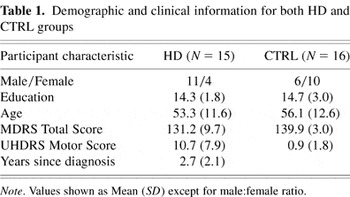
The HD and CTRL groups were of similar ages [t(29) = .63, p = .54] and education levels [t(25.19) = .40, p = .69]. As expected, the level of general cognitive functioning was significantly lower for HD participants [t(29) = 3.43, p = .002], as assessed by the Mattis Dementia Rating Scale (MDRS) (Coblentz et al., 1973; Mattis, 1988). Additionally, as expected, the groups differed significantly in their motor score ratings [t(15.39) = −4.68, p < .001] from the Unified Huntington's Disease Rating Scale (UHDRS; see Table 1) (Marder et al., 2000). Overall, the HD participants were in the early to middle stages of the disease. Thus, some participants were unable to work or drive; however, none were debilitated sufficiently to require assisted living homes.
Demographic and clinical information for both HD and CTRL groups

Materials
Simulated gambling task (SGT)
The SGT used in the current study was a computerized version of the original Bechara Gambling Task (Bechara et al., 1994). As with previous versions, there were four decks of cards, A, B, C, and D. Each selection from the decks resulted in a win of either $50 (C and D) or $100 (A and B). In addition, most cards also resulted in a loss. Overall, Decks A and B were disadvantageous, and Decks C and D were advantageous. More specifically, each selection from either Deck A or B was associated with a $100 win, but with a net loss of $250 over the course of 10 selections; whereas each selection from C and D only yielded a $50 win, but resulted in a net gain of $250 every 10 selections. Thus, some selections produced a net gain (win > loss), while others produced a net loss (loss > win).
The SGT was administered on a Pentium computer running Windows 98, Second Edition (Microsoft Corp., Seattle, WA). Stimuli were displayed on a touch screen monitor (KDS Pixel Touch, 17″ FST Capacitive PC Touch Monitor, Ontario, CA) using interface software from Microtouch (TouchWare for Windows, Version 5.4, Methuen, MA). Participants were given a loan of $2000 in fake money to start the game, as indicated by a green tally bar at the top of the computer screen, and were instructed to try to win as much money as possible. Although participants were required to wait for the computer program to instruct them to make a selection, participants were allowed to select from any deck and to freely alternate amongst decks. The collection of SCRs during task performance required an interval of at least 6 s between each card selection (Bechara et al., 1999), to allow for the natural time course of the electrodermal response.
The SGT consisted of 100 total selections, and unlike the original version of this task (Bechara et al., 1994), each deck contained 100 cards (the deck contingencies of the original version were merely repeated for a total of 100 trials). The outcome of each selection was displayed on the computer screen immediately after each card selection (e.g., “You won $100 and lost $200”). Participants received feedback about their overall performance based on a green tally bar at the top of the computer screen. At the beginning of the game, the green bar started at the $2000 tick mark. When participants lost money, the bar moved to the left, and when they won money the bar moved to the right, indicating the current amount of money the participant had following each selection. To encourage more active participation and to increase motivation, participants were awarded $10 (in real money) for the successful completion of the SGT (i.e., ending the task with $2000 or more).
Performance on the SGT was evaluated based on the total number of selections from the advantageous (C and D) and disadvantageous (A and B) decks. Furthermore, the total number of selections was divided into five equal segments of 20 selections each. Dividing the selections into equal segments or blocks allowed us to examine the pattern of selections across the entire task.
Skin conductance responses (SCR)
Skin conductance responses were measured with a Contact Precision Instruments (CPI; London, UK) psychophysiological system. Skin conductance was recorded with a CPI SC2 amplifier (constant voltage bridge), sampling at 20 Hz, using Sensor Medics large Biopotential Skin Electrodes (Ag–AgCl) placed on the medial phalanges of the first and third fingers of the non-dominant hand, using an isotonic conducting medium.
To assess the general level of electrodermal responsiveness, SCRs were measured in response to a series of tones that included a novel, mismatch tone embedded in a series of similar tones (Finn et al., 2001). The tone stimuli were presented in two sets of eight 72 db SPL tones (intertrial interval varied between 11 and 19 s). In the first set, seven standard 1000 Hz tones (one second duration) were presented, followed by the novel tone (white noise, 0.5 s duration), which was then followed by another standard 1000 Hz tone. The second set was identical to the first, except the standard tones were 800 Hz. Responsivity was assessed as the largest change in amplitude following each of the novel tone presentations, as well as to the change in tones.
For the SCR collection during the SGT, six types of responses were analyzed: anticipatory responses to advantageous and disadvantageous deck selections, reactions to advantageous and disadvantageous deck selections, reactions to a winning selection (win; no associated loss), and reactions to a losing selection (loss; a net loss). The amplitudes of reactionary SCRs were calculated as the largest change in SCR (μSeimens; μS) that was initiated in the 3 s after a selection. Anticipatory SCR values were calculated as the largest change in SCRs initiated in the 3 s prior to a selection. SCR data were averaged across all selections.
Procedure
Participants were tested individually on each of the measures. To begin, participants first completed the responsivity assessment followed by the SGT, and the measures of cognitive functioning and symptom severity (MDRS and UHDRS, respectively). Participants who won at least $2000 on the SGT were awarded $10 at the end of the testing session.
RESULTS
HD participants performed more poorly on the SGT, and showed a selective lack of SCRs associated with losing selections. What follows next is a brief description of the SGT performance results, which closely replicate our previous study (Stout et al., 2001). Next, we report on the skin conductance findings during the SGT, followed by results from the SCR responsivity assessment.
SGT Performance
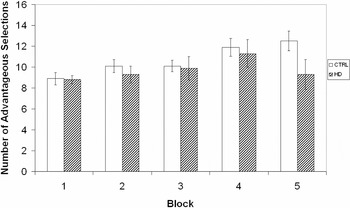
The pattern of selections was significantly different between the two groups. As can be seen in Figure 1, both groups increased their selections from the advantageous decks until the last block, in which the HD participants shifted back to the disadvantageous decks. Specifically, there was a trend for HD participants to select fewer cards from the advantageous decks during the final block of selections [t(29) = 1.92, p = .06]. A repeated measures ANOVA, which did not include the first block (because participants know little about deck values during this stage), revealed a significant difference between the two groups in the pattern of selections across the last four blocks for the advantageous decks [Block × Group: F(2.39,27) = 3.22, p = .04]. This pattern of performance for both groups replicated our previous findings (Stout et al., 2001). Also consistent with our previous findings, SGT performance showed a small to moderate degree of correlation with dementia severity in the HD group [r(13) = .41, p = .05], and moderate degree of association with the motor impairment [r(13) = −0.79, p < .001]. Despite poorer performance in the SGT by the HD group, there was no significant group difference in the total amount of money won [t(29) = .24, p = .81], in the number of participants who successfully completed the task with more than $2000 (5 HD and 5 CTRLs), or in the total number of advantageous card selections [t(29) = .96, p = .34].

Total number (M ± SEM) of advantageous selections (Decks C and D) across blocks for CTRL and HD participants.
Specificity of SCR to Deck Type
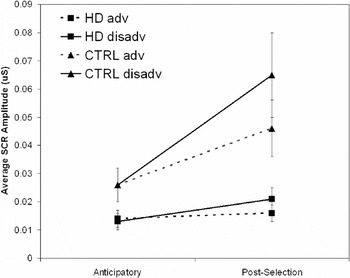
Prior to analyzing the SCR data, we computed log transformations on the average anticipatory, post-selection, and responsivity assessment SCRs for each individual, and removed all data points greater than 2 standard deviations (outliers). A mixed 2 × 2 × 2 repeated measures ANOVA, with group (CTRL vs. HD) as the between-group factor, deck type (advantageous vs. disadvantageous) and time-point (pre- vs. post-selection) as the within-group factors, revealed significant main effects of group [F(1,26) = 6.59, p = .02], deck type [F(1,26) = 5.43, p = .03], and time point [F(1,26) = 15.12, p = .001]. As can be seen in Figure 2, the SCRs of the CTRL participants were generally higher than those produced by the HD participants. Post-selection responses were higher than anticipatory SCRs. In addition, there was a significant two-way interaction between deck type × time point [F(1,24) = 9.73, p = .004], with greater SCRs following a selection from a disadvantageous deck than from an advantageous deck. The interaction between group × time point was also significant [F(1,24) = 8.51, p = .007], reflecting the greater post-selection SCR amplitudes of the CTRL participants as compared to the HD participants. The two-way interaction between group × deck type [F(1,24) = 2.94, p = .10] was only at trend level. The three-way interaction of group × deck type × time point was not significant (p = .12).

Average anticipatory and post-selection SCR amplitudes (M ± SEM) for advantageous (adv) and disadvantageous (disadv) decks for CTRL and HD participants.
The magnitudes of the post-selection SCRs of HD participants were significantly lower than those produced by CTRL participants for advantageous [F(1,26) = 7.9, p = .01] and disadvantageous decks [F(1,26) = 7.53, p = .01; see Figure 2]. In contrast, there were no significant differences between groups in pre-selection (anticipatory) SCRs for either advantageous or disadvantageous decks [F(1,26) = 2.00, p = .17 and F(1,26) = 2.41, p = .13, respectively].
Specificity of SCR to Selection Outcome
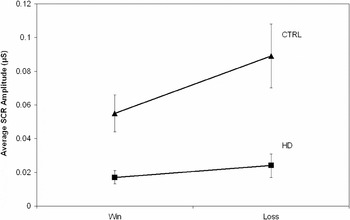
We further categorized each selection in the SGT based on whether it had a winning or losing outcome, regardless of the deck type. The SCRs of the HD participants did not differ between winning and losing selections [t(14) = −1.66, p = .12]. In contrast, the post-selection SCRs of the CTRL participants were significantly higher for the losing selections than for the winning selections [t(15) = −3.34, p = .005; see Figure 3].

Average SCR amplitudes (M ± SEM) for winning and losing selections for CTRL and HD participants.
Responsivity Assessment
As with the SCR data collected during the SGT, the SCR data for the responsivity assessment were first log transformed and the outlying data were removed. Then the groups were compared in the magnitude of their responsiveness to the two white noise conditions, as well as the change from high to low tones. Because there have only been two other studies examining the electrodermal activity in HD (Iacono et al., 1987; Lawson, 1981), and these had conflicting results, it was important for this study to assess the ability of the participants in the present study to generate SCRs. We found no significant differences between groups in the magnitude of their responses for the presentations of the white noise or for the change in tones (all ps > .18). In contrast to the lower SCR levels generated by the HD group during the SGT, the HD participants generated SCRs equally well as the CTRL participants in the SCR responsivity assessment.
DISCUSSION
Consistent with our previous study (Stout et al., 2001), HD participants performed more poorly on the SGT than did the CTRL participants. HD participants exhibited slightly higher SCRs following selections from disadvantageous decks as compared to advantageous decks. Across deck types, however, their SCRs failed to distinguish between winning and losing selections. The CTRL participants produced significantly higher SCRs following selections from disadvantageous decks, as compared to advantageous decks. Furthermore for the CTRLs, selections resulting in a loss elicited higher SCRs than those that resulted in a win. There were no differences between the groups in their anticipatory SCRs to either disadvantageous or advantageous decks, nor were there any differences between the groups in their ability to generate SCRs during the responsivity assessment. This suggests that the attenuated post-selection SCRs of HD participants, as compared to CTRL participants, were not due to a generalized deficit in the ability to generate somatic responses. Instead, the finding of poor performance on the SGT in combination with the hyporesponsiviness to losing selections may suggest that losses were less salient to the HD participants. Thus, HD participants may not encode the significance of monetary losses as readily or as reliably as CTRL participants.
Given that selections are always associated with a win (i.e., $100 or $50), the frequency and magnitude of the losses are what determine which decks are advantageous and which are disadvantageous, such that successful performance is based on avoiding losing selections. Whereas CTRL participants developed increased SCRs to losing selections, the SCRs of HD participants did not differ for winning and losing selections, which may account for their poor performance. Why do individuals with HD appear to have a reduced impact of losses on autonomic responsiveness? One possible explanation comes from research on the role of the orbitofrontal cortex in representing abstract reinforcers, such as monetary gains and losses. In an fMRI study, O'Doherty and colleagues (O'Doherty et al., 2001), found a dissociation between the lateral and medial portions of the orbitofrontal cortex in the representation of reinforcers. Specifically, they found that the medial orbitofrontal cortex was activated following reward, while the lateral orbitofrontal cortex became activated following punishment (O'Doherty et al., 2001). Given the specific connections between the lateral orbitofrontal cortex and the caudate nucleus (Alexander et al., 1986), which is affected in HD, it is not surprising that the responses to losing selections were attenuated for those with HD.
Although we did not find that the HD participants were impaired in their ability to generate anticipatory SCRs to the disadvantageous decks, which is found with ventromedial patients, we did find that the HD participants were impaired on the SGT and exhibited attenuated SCRs to losing selections. The finding in this study of group effects on SCRs following rather than preceding selections is unique in SCR studies of the SGT thus far. The only other finding of attenuated post-selection SCRs occurred in the context of a general reduction in SCRs, occurring prior to and after selections (Bechara et al., 1999). One possible mechanism for our findings is impaired implicit learning/memory. There is evidence of implicit learning in the SGT (Bechara et al., 1997) and findings that show impaired implicit learning in HD (Butters et al., 1990). The variations in patterns of SCRs associated with SGT performance suggest that the role of SCRs is more complicated than the biasing role previously suggested within the somatic marker hypothesis. Our SCR findings may suggest that losses received less cognitive or affective processing in HD, and/or losses had less impact on future selections in HD.
Our results must be considered with several issues in mind. Although we have now replicated our findings that HD is associated with poorer SGT performance, this is the first such study using SCRs. Because there is relatively little known about SCRs in HD, and because the pattern of SCRs to the SGT was unique in this study, additional work is needed to replicate our findings and to test alternative interpretations for these findings. Second, 53% of our HD participants and 12% of the controls were on psychotropic medications at the time of the study, and it is unknown whether their medications might have affected SGT performance or SCRs. Another consideration for interpreting our findings is that the SGT may not have been engaging enough to elicit strong reactions from HD participants. That is, although we did not find significant group differences in the responsivity assessment, our finding of attenuated HD SCRs may reflect attenuated task specific responsivity rather than a specific hyporesponsivity to losing selections.
In conclusion, our results are consistent with the idea that the basal ganglia provide important contributions to the networks and cortical–subcortical circuits that mediate such higher order cognitive functions as decision-making. The impaired decision-making apparent in HD appears to be associated with a reduced autonomic responsiveness to monetary loss. The finding of impaired autonomic responsivity to monetary losses may suggest that basal ganglia damage can lead to difficulty learning about risk situations because of the failure of the autonomic nervous system to sufficiently mark negative outcomes.
ACKNOWLEDGMENTS
We would like to thank all of the participants who volunteered for this study. We would also like to thank Jessica Jones, Caroline Denwood, and Katie Ginther for their assistance with data collection. This study was supported by a NIMH Training Grant MH17146-17 (MCC) and NIMH Grant R03 MH62556 (JCS). The results of this study were presented at the 31st Annual Meeting of the International Neuropsychological Society.
References
REFERENCES
Alexander, G.E.,
DeLong, M.R., &
Strick, P.L.
(1986).
Parallel organization of functionally segregated circuits linking
basal ganglia and cortex.
Annual Review of Neuroscience,
9,
357–381.Google Scholar
Bechara, A.,
Damasio, A.R.,
Damasio, H., &
Anderson, S.W.
(1995).
Insensitivity to future consequences following damage to human
prefrontal cortex.
Cognition,
50,
3–11.Google Scholar
Bechara, A.,
Damasio, H.,
Damasio, A.R., &
Lee, G.P.
(1999).
Different contributions of the human amygdala and ventromedial
prefrontal cortex to decision-making.
Journal of Neuroscience,
19,
5473–5481.Google Scholar
Bechara, A.,
Damasio, H.,
Tranel, D., &
Anderson, S.
(1994).
Insensitivity to future consequences following damage to human
prefrontal cortex.
Cognition,
50,
7–15.CrossRefGoogle Scholar
Bechara, A.,
Damasio, H.,
Tranel, D., &
Anderson, S.W.
(1998).
Dissociation of working memory from decision making within the
human prefrontal cortex.
Journal of Neuroscience,
18,
428–437.Google Scholar
Bechara, A.,
Damasio, H.,
Tranel, D., &
Damasio, A.R.
(1997).
Deciding advantageously before knowing the advantageous strategy.
Science,
275,
1293–1295.Google Scholar
Bechara, A.,
Dolan, S., &
Hindes, A.
(2002).
Decision-making and addiction (part II): Myopia for the future or
hypersensitivity to reward.
Neuropsychologia,
40,
1690–1705.Google Scholar
Bechara, A.,
Tranel, D., &
Damasio, A.R.
(2000).
Poor judgement in spite of high intellect: Neurological evidence
for emotional intelligence. In
R. Bar-On (Ed.),
The handbook of emotional intelligence: Theory, development,
assessment, and application at home, school, and in the workplace (pp.
192–214).
San Francisco:
Jossey-Bass.
Bechara, A.,
Tranel, D.,
Damasio, H., &
Damasio, A.R.
(1996).
Failure to respond autonomically to anticipated future outcomes
following damage to prefrontal cortex.
Cerebral Cortex,
6,
215–225.Google Scholar
Brandt, J. &
Butters, N.
(1996).
Neuropsychological characteristics of Huntington's disease. In
I. Grant &
K.M. Adams (Eds.),
Neuropsychological assessment of neuropsychiatric disorders (pp.
312–341).
New York:
Oxford University Press.
Butters, N.,
Heindel, W.C., &
Salmon, D.P.
(1990).
Dissociation of implicit memory in dementia: Neurological
implications.
Bulletin of the Psychonomic Society,
28,
359–366.Google Scholar
Coblentz, J.M.,
Mattis, S.,
Zingesser, L.,
Kasoff, S.S.,
Wisniewski, H.M., &
Katzman, R.
(1973).
Dementia rating scale.
Archives of Neurology,
29,
299–308.Google Scholar
Codispoti, M.,
Bradley, M.M., &
Lang, P.J.
(2001).
Affective reactions to briefly presented pictures.
Psychophysiology,
38,
474–478.Google Scholar
Damasio, A.R.
(1994).
Descartes' error: Emotion, reason, and the human brain.
New York:
Avon Books, Inc.
Damasio, A.R.
(1996).
The somatic marker hypothesis and the possible functions of the
prefrontal cortex.
Philosophical Transaction of the Royal Society of London (Biol),
1413–1420.Google Scholar
Dawson, M.E.,
Filion, D.L., &
Schell, A.M.
(1989).
Is elicitation of the autonomic orienting response associated with
allocation of processing resources?
Psychophysiology,
26,
560–572.Google Scholar
Esteves, F.,
Parra, C.,
Dimberg, U., &
Ohman, A.
(1994).
Nonconcious associative learning: Pavlovian conditioning of skin
conductance responses to masked fear-relevant facial stimuli.
Psychophysiology,
31,
375–385.Google Scholar
Filion, D.L.,
Dawson, M.E.,
Schell, A.M., &
Hazlett, E.A.
(1991).
The relationship between skin conductance orienting and the
allocation of processing resources.
Psychophysiology,
28,
410–424.Google Scholar
Finn, P.R.,
Justus, A.,
Mazas, C.,
Rorick, L., &
Steinmetz, J.E.
(2001).
Constraint, alcoholism, and electrodermal response in aversive
classical conditioning and mismatch novelty paradigms.
Integrative Physiological and Behavioral Science,
36,
154–167.CrossRefGoogle Scholar
Hare, R.D. &
Blevings, G.
(1975).
Defensive responses to phobic stimuli.
Biological Psychology,
3,
1–13.Google Scholar
Iacono, W.G.,
Roshi, D., &
LaCoste, D.
(1987).
Electrodermal activity in patients with Huntington's disease
and their progeny.
Psychophysiology,
24,
522–527.Google Scholar
Lawson, E.A.
(1981).
Skin conductance responses in Huntington's chorea progeny.
Psychophysiology,
18,
32–34.Google Scholar
Marder, K.,
Zhao, H.,
Myers, R.H.,
Cudkowicz, M.,
Kayson, E.,
Kieburtz, K.,
Orme, C.,
Paulsen, J.,
Penney, J.B.,
Siemers, E.,
Shoulson, I.,
and the Huntington Study Group
(2000).
Rate of functional decline in Huntington's disease.
Neurology,
54(2),
452–458.Google Scholar
Mattis, S.
(1988).
Dementia Rating Scale: Professional manual.
Odessa, FL:
Psychological Assessment Resources, Inc.
O'Doherty, J.,
Kringelbach, M.L.,
Rolls, E.T.,
Hornak, J., &
Andrews, C.
(2001).
Abstract reward and punishment representations in the human
orbitofrontal cortex.
Neuroscience,
4,
95–102.Google Scholar
Ohman, A. &
Soares, J.J.
(1993).
On the automatic nature of phobic fear: Conditioned electrodermal
responses to masked fear-relevant stimuli.
Journal of Abnormal Psychology,
102,
121–132.Google Scholar
Stout, J.C.,
Rodawalt, W.C., &
Siemers, E.R.
(2001).
Risky decision making in Huntington's disease.
Journal of the International Neuropsychological Society,
7,
92–101.CrossRefGoogle Scholar
Tomb, I.,
Hauser, M.,
Deldin, P., &
Caramazza, A.
(2002).
Do somatic markers mediate decisions on the gambling task.
Nature Neuroscience,
5,
1103–1104.Google Scholar
Tranel, D.,
Bechara, A., &
Damasio, A.R.
(2000).
Decision making and the somatic marker hypothesis. In
M.S. Gazzaniga (Ed.),
The new cognitive neurosciences
(2nd ed., pp.
1047–1061).
Cambridge, MA:
MIT Press.
Verfaellie, M.,
Bauer, R.M., &
Bowers, D.
(1991).
Autonomic and behavioral evidence of implicit memory in amnesia.
Brain and Cognition,
15,
10–25.Google Scholar
Demographic and clinical information for both HD and CTRL groups
Total number (M ± SEM) of advantageous selections (Decks C and D) across blocks for CTRL and HD participants.
Average anticipatory and post-selection SCR amplitudes (M ± SEM) for advantageous (adv) and disadvantageous (disadv) decks for CTRL and HD participants.
Average SCR amplitudes (M ± SEM) for winning and losing selections for CTRL and HD participants.
 You have
Access
- 44
- Cited by