INTRODUCTION
Several studies performed in the Amazon rain forest have sought to understand how bird communities are structured and what habitat features determine the distribution of species (Banks-Leite & Cintra Reference BANKS-LEITE and CINTRA2008, Barros & Cintra Reference BARROS and CINTRA2009, Blake Reference BLAKE2007, Cintra et al. Reference CINTRA, MARUOKA and NAKA2006, Cohn-Haft et al. Reference COHN-HAFT, WHITTAKER and STOUFFER1997, Robinson & Terborgh Reference ROBINSON and TERBORGH1995). However, determining the importance of habitat components has not been an easy task, due to the heterogeneity of the rain forest, and the variety of anthropogenic changes, such as different kinds of selective logging, deforestation and/or forest reduction (Asner et al. Reference ASNER, KNAPP, BROADBENT, OLIVEIRA, KELLER and SILVA2005, Holmes et al. Reference HOLMES, BLATE, ZWEEDE, PEREIRA, BARRETO, BOLTZ and BAUCH2002). These changes can affect forest structure (Costa et al. Reference COSTA, SENNA and NAKKAZONO2002) and, consequently, induce different responses from the bird assemblage (Henriques et al. Reference HENRIQUES, WUNDERLE, OREN and WILLIG2008, Johns Reference JOHNS1991, Laurance Reference LAURANCE2004).
Selective logging can affect various components of the forest such as canopy cover, light availability, plant density (Costa et al. Reference COSTA, SENNA and NAKKAZONO2002), leaf-litter production (Kartawinata et al. Reference KARTAWINATA, RISWAN, GINTINGS and PUSPITOJATI2001), food availability (Woodcock et al. Reference WOODCOCK, EDWARDS, NEWTON, KHEN, BOTTRELL and HAMER2013) and soil chemical properties (Olander et al. Reference OLANDER, BUSTAMANTE, ASNER, TELLES, PRADO and CAMARGO2005). Furthermore, effects may also depend on the interaction with time elapsed since selective logging, which changes the forest structure and floristic composition, thereby changing species richness, abundance and frequency of use by birds (Aleixo Reference ALEIXO1999, Guilherme & Cintra Reference GUILHERME and CINTRA2001, Henriques et al. Reference HENRIQUES, WUNDERLE, OREN and WILLIG2008, Jayapal et al. Reference JAYAPAL, QURESHI and CHELLAM2009). Therefore, it is essential to determine how habitat structural components interact with the bird assemblages and what mechanisms affect the bird distribution in tropical rain forests (Barros & Cintra Reference BARROS and CINTRA2009) in order to understand the dynamics of these assemblages, and their likely response to impending anthropic changes.
Insectivorous birds that inhabit the understorey of the tropical forest such as woodcreepers are one of the most sensitive groups to environmental changes caused by selective logging and fragmentation (Bierregaard & Lovejoy Reference BIERREGAARD and LOVEJOY1989, Gray et al. Reference GRAY, BALDAUF, MAYHEW and HILL2007, Owiunji & Plumptre Reference OWIUNJI and PLUMPTRE1998, Marantz et al. Reference MARANTZ, ALEIXO, BEVIER, PATTEN, Del Hoyo, Elliot and Christie2003). Selective logging reduces the abundance of older trees, affects the understorey and, consequentely, the woodcreepers that are relatively more susceptible to habitat degradation due to the fact that they require a specific habitat. However, the effects of selective logging on bird communities and woodcreepers are contradictory (Barlow et al. Reference BARLOW, PERES, HENRIQUES, STOUFFER and WUNDERLE2006, Cintra et al. Reference CINTRA, MARUOKA and NAKA2006). In the immediate years after logging, specialist bird species are less likely to survive than generalist species (Lambert Reference LAMBERT1992, Sodhi et al. Reference SODHI, SOH, DEWI, DARJONO and BROOK2005). Guilherme & Cintra (Reference GUILHERME and CINTRA2001) found no effects of intensity of selective logging on bird community in Central Amazon, however Azevedo-Ramos et al. (Reference AZEVEDO-RAMOS, CARVALHO and AMARAL2006) observed an increase in species richness of invertebrates and birds soon after disturbance. Henriques et al. (Reference HENRIQUES, WUNDERLE, OREN and WILLIG2008) found obligate army ant followers and arboreal insectivorous birds did not show differences between logged and control forest, but other species guilds were negatively influenced by logging demonstrating that disturbance affects different guilds differently.
Local microhabitat features, such as leaf-litter depth, canopy openness, topographic gradients and distance to forest streams can also influence bird species composition (Bueno et al. Reference BUENO, BRUNO, PIMENTEL, SANAIOTTI and MAGNUSSON2012, Cintra & Naka Reference CINTRA and NAKA2012, Marantz et al. Reference MARANTZ, ALEIXO, BEVIER, PATTEN, Del Hoyo, Elliot and Christie2003). For example, Cintra et al. (Reference CINTRA, MARUOKA and NAKA2006) showed that woodcreeper abundance was positively influenced by tree abundance and canopy cover in an Amazon forest. Many environmental variables are strongly affected by selective logging in tropical forest (Bueno et al. Reference BUENO, BRUNO, PIMENTEL, SANAIOTTI and MAGNUSSON2012, Jayapal et al. Reference JAYAPAL, QURESHI and CHELLAM2009, Johns Reference JOHNS1991), and as changes in forest structure are important for the establishment of understorey birds species, this guild is likely to be a good indicator of logging impacts (Owiunji & Plumptre Reference OWIUNJI and PLUMPTRE1998).
Due to the scarce knowledge about distribution patterns of birds that inhabit the understorey, as well as high rates of deforestation and/or selective logging in the Amazon forest (Asner et al. Reference ASNER, KNAPP, BROADBENT, OLIVEIRA, KELLER and SILVA2005, Fearnside Reference FEARNSIDE2005), we examined the effects of spatial variation in forest structure and some landscape features, such as canopy openness, altitude, distance to stream and exploited basal area, on the abundance and composition of woodcreeper assemblage in selectively logged tropical forests in Southern Amazonia. We hypothesized that: (1) environmental variables influence the composition of the woodcreeper assemblage within three sites with different selective logging histories; and (2) canopy cover will influence the distribution and abundance of woodcreeper species.
METHODS
Study site
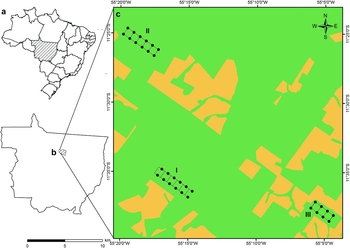
The study was undertaken in three long-term ecological research sites in the Southern Amazon (Site I: 11°35′S, 55°16′W; Site II: 11°24′S, 55°19′W and Site III: 11°38′S, 55°5′W; Figure 1) near to the transition area between Amazon forest and cerrado (Brazilian savanna), an ecoregion in Southern Amazonia referred to as the dry forests of Mato Grosso (Ferreira et al. Reference FERREIRA, LEMOS, BUSCHBACHER, BATMANIAM, SILVA, ARRUDA, MORETTI, SÁ, FALCOMER, BAMPI and Capobianco2001). The vegetation is characterized by rain forest and seasonal forest, a result of the features of the soil and local topography. The predominant soil in the area is the Red-Yellow Dystrophic Latosol (Carvalho Reference CARVALHO2006).
Map of Brazil (a) showing the state of Mato Grosso (hatched), Claudia Municipality (b) and the location of three LTER sites studied (sites I, II and III) within a managed Amazon forest (c). Soybean plantation (yellow) and forests (green).

The climate is Am (tropical moonson climate) following the Köppen classification, a transition between tropical rain-forest climate (Af) of the Amazon and the tropical wet climate (Aw) of the central highlands (Köppen Reference KÖPPEN, Köppen and Geiger1936, Peel et al. Reference PEEL, FINLAYSON and MCMAHON2007). The average annual temperature is 24°C, and relative air humidity ranges between 80–85% (Vourlitis et al. Reference VOURLITIS, PRIANTE-FILHO, HAYASHI, NOGUEIRA, CASEIRO and CAMPELO2002). The average annual rainfall is approximately 2200 mm y−1 and the dry season occurs from June to September and the rainy season from December to May (data from a meteorological tower installed at Continental Farm: 11°25′24.0′′S, 55°19′20.3′′W).
The sampling areas are located in regions with a history of selective logging, and the topography consists of relatively flat areas near first- and second-order streams rising up 5–10 m to elevated plateaux. The forest is characterized by a 30–35-m-high closed canopy, with emergents growing to 40 m (Carvalho Reference CARVALHO2006, Vourlitis et al. Reference VOURLITIS, PRIANTE-FILHO, HAYASHI, NOGUEIRA, CASEIRO and CAMPELO2002). Two study areas (sites I and II) are within Continental Farm and a third area (site III) in Iracema Farm (Figure 1). Sites I and II are within extensive native forests, while site III is within a narrow forest corridor, connecting two large native forest areas. We studied 32 one-hectare LTER plots, distributed among the three sites (Figure 1). Plots are spatially arranged in PPBio LTER sites, long-term ecological research plots, systematically spaced at 1-km intervals (Magnusson et al. Reference MAGNUSSON, BRAGA-NETO, PEZZINI, BACCARO, BERGALLO, PENHA, RODRIGUES, VERDADE, LIMA, ALBERNAZ, HERO, LAWSON, CASTILHO, DRUCKER, FRANKLIN, MENDONÇA, COSTA, GALDINO, CASTLEY, ZUANON, VALE, SANTOS, LUIZÃO, CINTRA, BARBOSA, LISBOA, KOBLITZ, CUNHA and PONTES2013). Sites I and II include 12 plots each, and site III contains eight plots. Sites I and II have a trail system covering an area of 5 × 1 km, forming a 5-km2 rectangle and containing two main parallel 5-km-long trails, separated by six perpendicular trails at 1-km intervals. Site III is smaller (3 × 1 km, 3 km2) due to the size of the forest area. Permanent 1-ha plots systematically placed at 1-km intervals, are accessed by a midline trail, 250 m in length, (following the RAPELD method, modified by Magnusson et al. Reference MAGNUSSON, LIMA, LUIZÃO, LUIZÃO, COSTA, CASTILHO and KINUPP2005).
The selective logging occurred in 1981 for site III, 1995 for site II, and 2002 for site I. The protocol used for selective logging in the areas was classified as a low-impact standard operation that is based on removing commercial trees of more than 50 cm dbh, and a maximum of 9 trees ha−1 were extracted from each site. Access is provided by a system of trails, and trees were cut using directional felling practices.
Environmental variables
We collected the following variables in each plot: number of trees (density), altitude, canopy openness, exploited basal area, soil clay content and distance of each plot to the nearest stream. To determine the canopy openness, measurements were taken from every 50 m inside the plot (total of five measurements). Canopy openness was measured using a concave spherical densiometer (Robert and Lemmon Forest Densiometer, model C). At each point, four readings were taken, one facing each of north, south, east and west and, we calculated the mean for each point multiplying by 1.04 (correction factor of the instrument) to represent the plot's canopy openness as a percentage.
To determine the altitude, measurements were obtained on the centre line of all plots with use of GPS and by a professional topographer. Measurements varied from 289 to 388 m asl (357–388 m for site I, 289–374 m for site II and 354–370 m site III).
For the number of trees, the diameter at breast height of each tree (we use dbh at 1.30 m from the ground) was measured. Three classes of dbh were created with different sampling areas: the first with dbh > 1 cm (4 × 250 m), with an area of 0.1 ha, the second with dbh > 10 cm (20 × 250 m) with an area of 0.5 ha and third with dbh > 30 cm (40 × 250 m) for 1 ha. The procedure for collecting this information followed the PPBio protocol (www.ppbio.inpa.gov.br).
The exploited basal area was used to represent the effects of selective logging impact. It was determined by measuring the basal diameter of trees cut in each plot. Soil clay content was measured at five equidistant points to a depth of 0–10 cm in each plot; data were pooled and analysed in the soil laboratory following to the methodology of EMBRAPA (1997). The distance from the plot to the nearest stream was calculated with the aid of ArcGIS 9.0 program.
Data collection
We sampled woodcreepers in 32 plots from September 2009, March/April 2010 and July/August 2010. We applied two methods simultaneously: mist nets that sampled the lower strata of the forest (understorey), and point counts as a complementary method to sample the vertical strata. For the mist-net sampling, we used nets of 10 and 12 m in length, 2.5 m in height, and mesh of 36 mm, linearly set within the 250 m, covering a sampled area of 625 m2 per plot d−1 (Roos Reference ROOS, Matter, Straube, Accordi, Piacentini and Cândido2010). Mist nets were opened at 06h00 and remained open until 11h00, checked hourly. The average sample effort was 104 h per net per plot. Captured birds were identified (using field guides) and banded. Voucher individuals were collected and added to the Zoological Collection of the Federal University of Mato Grosso (UFMT). Species identifications were confirmed at the Museum of Zoology in the University of São Paulo (MZUSP).
For the point count method, two listening points were used, one at the beginning (0 m on the plot midline) and one in the end of each plot (250 m). The method consisted of identifying the species visually (binoculars) and/or audibly within a virtual radius of 30 m from the listening point, for 10 min per point. This method was applied only once per sampling for each listening point in the field after removal of mist nets. Double counting of individuals was avoided because birds previously caught in the nets were banded.
Data analysis
Total species richness for the 32 plots was estimated using the first-order jack-knife richness estimator in the statistical software EstimateS. Using this method, the estimated richness becomes equal to that observed when all the identified species are present in more than one plot, which indicates that all species of the environment were found (Santos Reference SANTOS, Cullen, Rudran and Padua2006).
Spatial autocorrelation of bird composition in the three sites was evaluated using a permutated (n = 999) Mantel's statistic. The statistic was calculated for distance classes that reflected the spatial arrangement of PPBio sites and plots, and a significance test (P < 0.05) indicates either spatial autocorrelation with positive Mantel statistic values, or dispersion with negative statistic values (Legendre & Legendre Reference LEGENDRE and LEGENDRE2012).
The effect of environmental variables on woodcreeper species richness and abundance of the most representative species (present in more than 50% of the 32 plots) was tested using multiple linear regression analysis. Only the variables altitude, canopy openness, number of tree and exploited basal area were used in the multiple linear regression due to high collinearity. The multivariate and multiple linear regression analysis were performed using the statistical software Systat®10.
The relationship between woodcreeper composition and the environment was examined using indirect gradient analysis. Firstly, a dissimilarity half-matrix was created using the Bray–Curtis dissimilarity measure. Then the half-matrix was used in a non-metric multidimensional scaling analysis (NMDS). The number of axes used was decided when the reduction of stress stopped noticeably decreasing with increasing number of axes. The data were centred, rotated and scaled for the NMDS analysis. Smooth surfaces of the environmental variables were then fitted to the NMDS ordination. Canopy openness was transformed using an arcsine transformation before analysis. The strength of the relationship between the ordination and the fitted environmental vectors is reflected with a squared correlation coefficient.
To show effect of gradient (altitude and canopy openness) on the relative species abundance, we performed direct gradient analyses (Gauch Reference GAUCH1982). All analyses were carried out with a vegan package in the R program (R Core Team, http://www.R-project.org/).
RESULTS
Environmental characteristics
Canopy openness ranged from 19.8% to 30.1% (mean = 23.6% ± 2.7%), exploited area basal ranged from 0.170 to 11.1 m2 (mean = 2.27 ± 2.17 m2), distance to stream ranged 138 to 2880 m (mean = 1238 ± 635 m), altitude ranged from 289 to 388 m asl (mean = 357 ± 20.8 m asl), soil clay content from 22.7% to 58.3% (mean = 37.8% ± 11.4%), and total number of trees of the three classes of dbh ranged from 667 to 1034 (mean = 802 ± 100).
Woodcreeper assemblage
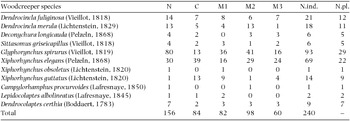
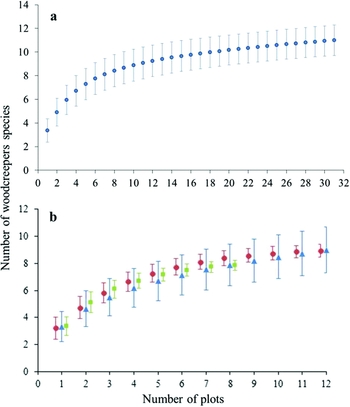
The total sampling effort was 9167 h per net, and 29 h using the point count distance method. A total of 240 individuals (captured, observed and/or heard) belonging to 11 species (Table 1) were detected, with the Dendrocincla and Xiphorhynchus represented by two and three species, respectively. The number of species expected within the study area was 13. This estimation was based on the 11 observed species, which correspond to 85% of the species expected by the jack-knife 1 estimator (Figure 2a). The proportion of the number of species, within the estimated values, were 90% in sites I and III, and 77% in site II, with an overlap in the rarefaction curves (Figure 2b). The sampling methods and the sampling effort used in this study were sufficient to describe the studied assemblage, observed by the plateau rarefaction curve. There was no significant spatial autocorrelation or dispersion of woodcreeper assemblage within or between the three sites.
List of Dendrocolaptidae species with the number of individuals of each species captured with mist-nets (N) and/or detected with point count distance (C). Abundance of each species by site (M1, M2 and M3), total number of individuals by species (N.ind.) and the total number of plots occupied by species (N.pl.) in the areas within the managed Amazon forest, located in Claudia, Mato Grosso.

Rarefaction curve for the 32 surveyed plots (a), in sites I, II and III within a managed Amazon forest, located in Claudia, Mato Grosso. Each point represents a sampled unit and vertical bars represent the confidence intervals. Rarefaction curves comparing the sample effort between areas I (red), II (blue) and III (green) (b), in a managed Amazon forest located in Claudia, Mato Grosso.

The effect of the environment on the representative species and woodcreeper species richness
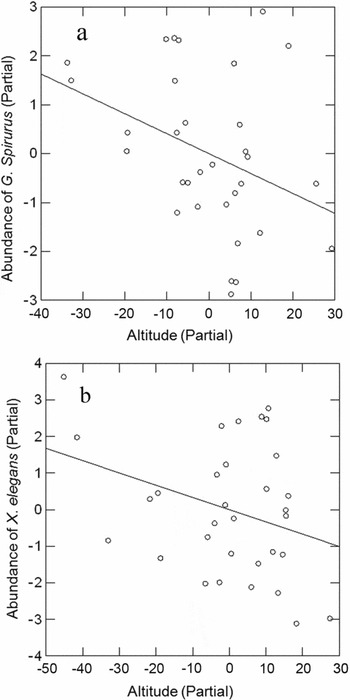
Glyphorynchus spirurus and Xiphorhynchus elegans was present in over 90% and 68.7% of the plots studied, respectively. The model used in the multiple regression analysis to evaluate the abundance of the most representative species with environmental variables was significant for G. spirurus (R2 = 0.31; N = 32; df = 27; P = 0.03) and X. elegans (R2 = 0.34, N = 32; df = 27; P = 0.02). The abundance of G. spirurus (P = 0.04; Figure 3a) and X. elegans (P = 0.02; Figure 3b) were negatively associated with altitude. No other environmental variables were associated with the abundance of these species.
Effect of altitude on the abundance of the most representative species in the 32 plots, within a managed Amazon Forest located in Claudia, Mato Grosso. Partial plots from the multiple linear regressions to Glyphorynchus spirurus (a; P = 0.04); Xiphorhynchus elegans (b; P = 0.02).

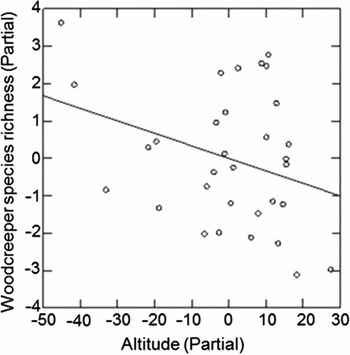
The global model used in the multiple regression analysis to evaluate the woodcreeper species richness with environmental variables was not significant (R2 = 0.22, N = 32; df = 27; P = 0.125). However, the woodcreeper species richness was negatively associated with altitude (P = 0.020; Figure 4).
Negative effect of altitude (partial) on woodcreepeer species richness (partial) within a managed Amazon Forest located in Claudia, Mato Grosso.

Environmental effects on the woodcreeper assemblage
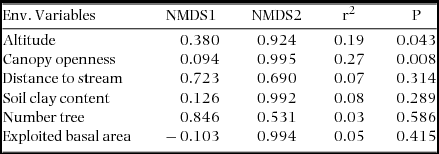
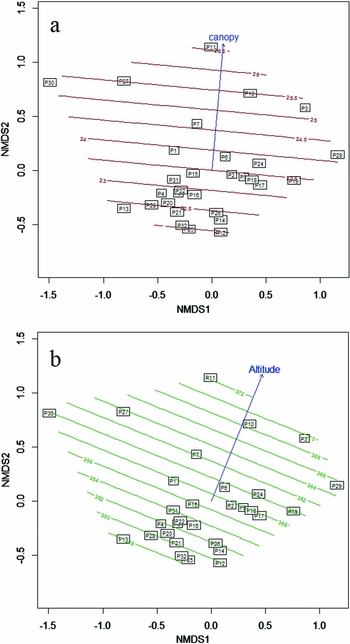
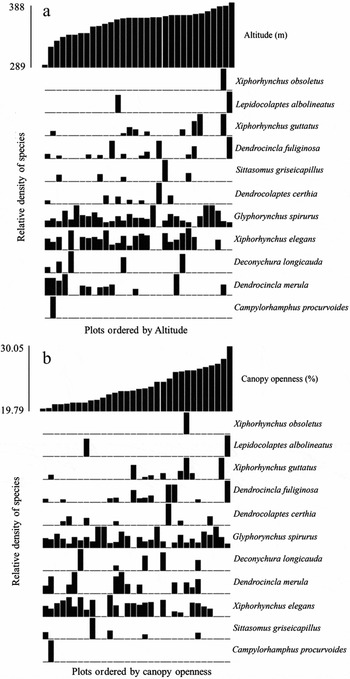
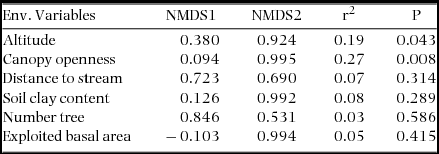
The stress value for two axes of the ordinations captured by NMDS was 0.15. Woodcreeper assemblage composition was significantly associated with altitude (r2 = 0.192; P = 0.04; Figure 5a) and canopy openness (r2 = 0.293; P = 0.006; Figure 5b) (Table 2). The remaining environmental variables were not associated with the woodcreeper assemblages (Table 2). Direct gradient analysis shows the relationship between distribution of woodcreeper species and altitude (Figure 6a) and canopy openness (Figure 6b).
Results of indirect gradient analysis showing the effects of environmental (Env.) on woodcreeper assemblages in three areas with selective logging in Southern Amazonia.
Linear representation of effects from canopy openness (a) and altitude (b) on the woodcreeper assemblage in Southern Amazonia, state of Mato Grosso, Claudia Municipality. The letter and number inside of square represent the plot number. Parallel lines are the value of canopy openness (%) and altitude (m). The site 1 is composed by P1 to P12; the site 2 from P13 to P24 and site 3 from P25 to P32.

Distribution of woodcreeper species sampled in 32 plots in Southern Amazonia, Claudia, Mato Grosso, in relation to gradients in canopy openness (a) and altitude (b). Species bars represent the quantitative value of each species in a given line.

DISCUSSION
The total number of species documented in the studied area represents about 61% of the species present in the Mato Grosso Amazon, and 33% of the Dendrocolaptidae species found in the Brazilian Amazon (Brazilian Ornithological Records Committee; http://www.cbro.org.br). The number of woodcreeper species recorded in the present study was similar to those found in other studies from the Amazon region (Novaes & Lima Reference NOVAES and LIMA1991, Oliveira et al. Reference OLIVEIRA, NOVACK, FLORÊNCIO, ASSUMPÇÃO, SILVEIRA, ALMEIDA, WEISS, Rodrigues, Izzo and Battirola2011, Zimmer et al. Reference ZIMMER, PARKER, ISLER and ISLER1997). The occurrence and spatial distribution patterns of these species in this study provides insight into the impacts of selective logging on woodcreepers in the Amazon forest.
Surprisingly, our results show that the woodcreeper assemblage at the mesoscale is affected by altitude. Altitude influences woodcreeper assemblages at much larger scales, e.g. their distribution in the mountains of North and Central America (Mexico, Honduras and Costa Rica: Marantz et al. Reference MARANTZ, ALEIXO, BEVIER, PATTEN, Del Hoyo, Elliot and Christie2003). In contrast, the altitudinal variation in the areas of this study is relatively small (tens of metres, rather than thousands of metres). The lower-elevation plots were near to the streams. These riparian areas are protected by law in Brazil and selective logging and/or other type of disturbances are not allowed within a 30-m-wide strip of riparian vegetation on either side of stream orders 1 and 2 (Bueno et al. Reference BUENO, BRUNO, PIMENTEL, SANAIOTTI and MAGNUSSON2012, Lees & Peres Reference LEES and PERES2008). We observed a positive correlation between altitude and distance to stream (r = 0.52, P = 0.02), altitude and clay content (r = 0.63; P < 0.001), although the lowest distance of plots to stream was 130 m and only five plots were less than 400 m from a stream. Clay content could indirectly change woodcreeper abundance and composition by influencing the plant and prey species composition.
Altitude affects organisms indirectly (Bueno et al. Reference BUENO, BRUNO, PIMENTEL, SANAIOTTI and MAGNUSSON2012). Characteristics of habitat, such as soil, light exposure, leaf-litter accumulation and the structure and vegetation composition change with altitude, and all of these variables can influence the occurrence and distribution of species (Costa & Magnusson Reference COSTA and MAGNUSSON2010). Riparian areas had greater canopy cover and are more productive due to the lower temperature and high humidity, which favour decomposition by micro-organisms (Martins Reference MARTINS2010). These conditions may influence the abundance of insects and other soil arthropods (Puig Reference PUIG2008, Sekercioglu et al. Reference SEKERCIOGLU, DAILY and EHRLICH2004), providing more food for woodcreeper species (Robinson & Terborgh Reference ROBINSON and TERBORGH1995). Ours results show a reduction of woodcreeper species number in higher areas where the variation in altitude is relatively small, and this effect is more likely due to canopy openness and logging history. Selective logging is prohibited near streams and hence the primary impacts on forest occur in higher and flatter areas. These impacts may be indirect by reducing food availability, reducing foraging sites (tree trunks > 30 cm), increasing exposure to light, and predators, creating uncrossable gaps or by creating a dense understorey that inhibits foraging behaviour (Thiollay Reference THIOLLAY1992). However, this effect is related indirectly to altitude and as shown in several studies, the size of the protected riparian areas is small and its width should increased to protect the diversity of species within guilds (Bueno et al. Reference BUENO, BRUNO, PIMENTEL, SANAIOTTI and MAGNUSSON2012, Palmer & Bennett Reference PALMER and BENNETT2006).
As shown in previous studies our bird assemblages changed with canopy cover (Antongiovanni & Metzger Reference ANTONGIOVANNI and METZGER2005, Banks-Leite & Cintra Reference BANKS-LEITE and CINTRA2008). The input of light caused by the natural treefall gaps or by selective logging changes the structure of forest (Banks-Leite & Cintra Reference BANKS-LEITE and CINTRA2008, Cintra et al. Reference CINTRA, MARUOKA and NAKA2006), thereby affecting the local micro-climatic conditions (Banks-Leite & Cintra Reference BANKS-LEITE and CINTRA2008, Richards & Coley Reference RICHARDS and COLEY2007). Woodcreeper species vary in their response to canopy cover (Cintra et al. Reference CINTRA, MARUOKA and NAKA2006, this study). Some insectivorous species have greater tolerance to survive in disturbed areas (Marantz et al. Reference MARANTZ, ALEIXO, BEVIER, PATTEN, Del Hoyo, Elliot and Christie2003) and increase their abundance with decreasing canopy cover, as was the case with D. fuliginosa, X. guttatus, X. obsoletus and L. albolineatus in this study. But other species such as C. procurvoides and S. griseicapillus prefer undisturbed and lower canopy openness. Therefore, the effects of canopy openness on the woodcreeper species in undisturbed and selective cutting areas were variable, because it positively affected some species and negatively influenced others. Two studies that were undertaken in the same area showed opposing results. Cintra & Naka (Reference CINTRA and NAKA2012) found no found significant effect of canopy openness on bird community composition in undisturbed forest in Central Amazonia. However as in this study, Cintra et al. (Reference CINTRA, MARUOKA and NAKA2006) found a negative relationship between canopy openness (ranging from 2.6% to 19.4%) and the abundance of one species (Dendrocincla merula), and they suggested that their results could be due to the behaviour of that species following army ants in darker environments. In our study, the canopy openness is slightly more open than undisturbed forest (mean = 23.5% ± 2.6%; E. J. Almeida, pers. comm.), and the woodcreeper distribution probably reflects their movement in search of prey that are more available to environments with more luminosity, such as spiders and other insects (Stouffer & Bierregaard Reference STOUFFER and BIERREGAARD1995). Nonetheless, our results indicate that differences among canopy openness in the plots may have a stronger influence on some species. Therefore, specific studies are needed to clarify the relationship of the woodcreeper with canopy openness, since selective logging changes the forest structure, leaf-litter production and food availability.
Our results suggest that environmental variables such as altitude and canopy openness can affect woodcreeper assemblages, and that these variables are related to landscape history (Cintra & Naka Reference CINTRA and NAKA2012), intensity of forest management (Henriques et al. Reference HENRIQUES, WUNDERLE, OREN and WILLIG2008), forest structure and plant species composition (Nur et al. Reference NUR, BALLARD and GEUPEL2008). Most bird species in Amazonia are resident and sedentary (Cintra & Naka Reference CINTRA and NAKA2012), and the variation in woodcreeper assemblage is more likely to be related to local changes than biogeographic or regional effects. Furthermore, responses are species-specific, and changes in forest structure are important for insectivorous and understorey birds. Short- and long-term studies in Amazonia with different intensity of selective logging are needed to evaluate deforestation and habitat alteration as threats to bird species.
ACKNOWLEDGEMENTS
We thank Rafael Arruda and Thiago Izzo for their valuable suggestions on this manuscript; CNPq for their financial support (Process No. 558225/2009–8, No. 569382/2008–4 and No. 556858/2009–3); CNPq for a scholarship to DJR (Science Without Borders Program Process No. 246974/2012–5) and JO, and CAPES to FPF; UFMT and Master's Program in Ecology and Biodiversity; Instituto Chico Mendes de Conservação da Biodiversidade (ICMBio) for collecting permits (no. 22923–2); and the Center for Studies on the Biodiversity of the Mato Grosso Amazon (NEBAM). This is publication No. 50 in the NEBAM technical series.