

Over the past 30 years, considerable research in developmental, social, and clinical psychology has demonstrated that infants who experience sensitive, responsive care tend to develop secure attachment representations, as indicated by their positive views of self and others (see Simpson & Rholes, Reference Simpson and Rholes2015, for a recent review). British psychiatrist John Bowlby highlighted the importance of an ‘attachment figure’ who served as a secure base from which to explore the world, and a safe haven to return to when distressed, ill or afraid (Bowlby, Reference Bowlby1982). Researchers have suggested that the lack of secure attachment relationships not only puts one at risk for personality and interpersonal difficulties, but also for health difficulties (e.g., Feeney & Ryan, Reference Feeney and Ryan1994; Hunter & Maunder, Reference Hunter and Maunder2001; Scharfe & Eldredge, Reference Scharfe and Eldredge2001). Feeney and Ryan (Reference Feeney and Ryan1994), and Scharfe and Eldredge (Reference Scharfe and Eldredge2001) demonstrated that individuals (ranging from 17 to 50 years old) who experienced sensitive, responsive parental care reported excellent mental health, a greater tendency to choose healthy lifestyles, as well as excellent physical health. In contrast, there is growing evidence that early separation and neglect adversely influence physical and neurophysiological development and immune system functioning (e.g., Gerhardt, Reference Gerhardt2015; Gunnar & Donzella, Reference Gunnar and Donzella2002). To date, however, there are few studies examining the association between individuals’ reports of their own attachment and their perception of health and illness in others (cf. Cassibba, van IJzendoorn, & Coppola, Reference Cassibba, van IJzendoorn and Coppola2012; Feeney, Reference Feeney2000). In this study, we explored the prospective association between mothers’ prenatal reports of attachment representations with close others and reports of infant illness symptoms over the first 6 months.
Scharfe and Eldredge (Reference Scharfe and Eldredge2001) outlined the reasons why early parental neglect may influence later health behaviours. In particular, individuals with positive views of themselves and others (i.e., secure representations) report engaging in health promotion activities and are less likely to report health risk behaviours, while insecure individuals (i.e., individuals with negative views of themselves and/or others) tend to make particularly unhealthy choices. Furthermore, there is growing evidence that early separation and/or neglect adversely influences physical and psychological development (see Maunder & Hunter, Reference Maunder and Hunter2015, for a review). For example, physiological differences, such as elevated daily cortisol levels, high hormone reactivity to stress and reduced left frontal brain activity, have been found in children reared in orphanages for the first year of life, but also in typical infants who experience physical discipline, neglect or daily naturalistic separations such as attending day care (e.g., Blair et al., Reference Blair, Granger, Kivlighan, Mills-Koonce, Willoughby, Greenberg, Hibel and Fortunato2008; Bugental, Martorell, & Barraza, Reference Bugental, Martorell and Barraza2003). Positive associations between attachment and physiological development in children have led researchers to propose that there may be associations between attachment and the risk of developing particular types of illness; in the past few years, associations between insecure attachment and chronic diseases such as diabetes, heart disease and cancer have been reported (Ciechanowski et al., Reference Ciechanowski, Russo, Katon, Von Korff, Ludman, Lin and Bush2004; McWilliams & Bailey, Reference McWilliams and Bailey2010; Puig, Englund, Simpson, & Collins, Reference Puig, Englund, Simpson and Collins2012; Tacón, Reference Tacón2002).
Bowlby (Reference Bowlby1982) proposed that insecure attachment negatively influenced one's interpretation of and reaction to a stressor (see also Collins, Reference Collins1996; Collins & Read, Reference Collins and Read1990). Research has demonstrated that the birth of a child is particularly stressful for insecure parents, and they are likely to react negatively to the event (e.g., Alexander, Feeney, Hohaus, & Noller, Reference Alexander, Feeney, Hohaus and Noller2001; Simpson, Rholes, Campbell, & Wilson, Reference Simpson, Rholes, Campbell and Wilson2003). During the first year of a child's life, caregivers’ adjustment to the transition to parenthood is influenced by infants’ temperament and health, inability to sooth their infant when crying, concerns about sleep, feeding and nutrition, and poor mother-infant bonding (e.g., Doss & Rhoades, Reference Doss and Rhoades2017). Insecure parents have been found to report correspondingly higher levels of infant illness (e.g., Mäntymaa et al., Reference Mäntymaa, Puura, Luoma, Salmelin, Davis, Tsiantis and Tamminen2003) and colic (e.g., Akman et al., Reference Akman, Kuscu, Ozdemir, Yurdakul, Solakoglu, Orhan, Karabekiroglu and Özek2006). Correspondingly, mothers report high anxiety and depression when their infants are ill (e.g., Humphry & Hock, Reference Humphry and Hock1989). As there is considerable evidence that attachment is associated with depression (see Dagan, Facompré, & Bernard, Reference Dagan, Facompré and Bernard2018; Scharfe, Reference Scharfe2007), in this study we tested the link between the three constructs — attachment, distress, and reports of infant illness. Furthermore, there is some evidence that insecure parental attachment is associated with perceptions of difficult infant temperament (e.g., Pesonen, Räikkönen, Keltikangas-Järvinen, Strandberg, & Järvenpää, Reference Pesonen, Räikkönen, Keltikangas-Järvinen, Strandberg and Järvenpää2003) and, as summarised by Zeanah, Boris, and Larrieu (Reference Zeanah, Boris and Larrieu1997), that attachment and temperament interact to influence physical health. Although few recent studies have tested this hypothesis, early work found that infants with difficult temperaments tended to be ill more often (e.g., Carey, Reference Carey1972, Reference Carey1974). Therefore, in a sample of new parents, insecure individuals (with negative views of self and/or others) may experience more stress related to caring for their infant and, depending on their type of insecurity, they may exaggerate problems, deny problems or be afraid to ask for help in case others reject or challenge their feelings (cf. Brennan & Shaver, Reference Brennan and Shaver1995; Scharfe & Eldredge, Reference Scharfe and Eldredge2001). Each of these reactions may limit the ability of others to help with infant illness before these concerns become serious.
Summary and Current Study
Previous research has demonstrated that insecure maternal attachment is associated with difficult or stressful experiences during the transition to parenthood (e.g., Alexander et al., Reference Alexander, Feeney, Hohaus and Noller2001; Simpson et al., Reference Simpson, Rholes, Campbell and Wilson2003). However, maternal attachment could also be a precipitating factor in the development of infant irritability, colic, and/or illness, but there is no prospective evidence to support these claims. Recently, in a study of sleep awakenings, Weinraub et al. (Reference Weinraub, Bender, Friedman, Susman, Knoke, Bradley and Williams2012) provided some evidence of the link between temperament, maternal depression, attachment and infant illness, and in this study we will test these associations directly. We assessed attachment using Bartholomew's four-category model of attachment (Bartholomew, Reference Bartholomew1990; Bartholomew & Horowitz, Reference Bartholomew and Horowitz1991). According to Bartholomew and Horowitz (Reference Bartholomew and Horowitz1991), there are three insecure attachment styles — preoccupied, fearful, and dismissing. Preoccupied individuals (negative self, positive other) are overly concerned with attachment needs and overly dependent on others for personal validation, acceptance, and approval. Fearful individuals (negative self, negative other) view others as uncaring and unavailable, and they view themselves as unlovable. Dismissing individuals (positive self, negative other) distance themselves from others, viewing themselves as self-reliant; there is some evidence that dismissing parents may even distance themselves from their own infants and consequently their infants may experience considerable neglect (cf. Strathearn, Reference Strathearn2011). We expected that each of the three insecure styles would be associated with higher reports of infant illness symptoms. We examined these associations using a longitudinal design and assessed maternal attachment prenatally — so as not to confound the effects of stressful parenthood experiences, which may result in higher levels of insecurity on a self-report questionnaire — with the reports of infant illness, while controlling for maternal depression and infant temperament. For all analyses, we expected medium effects and determined that we had sufficient statistical power to test these effects (see Cohen, Reference Cohen1992). In summary, we wished to test the association between maternal attachment representations assessed prenatally and reports of infant illness symptoms during the first 6 months of life, to explore which came first: the difficult, ill infant or the anxious parent.
Method
Participants
Four hundred and eighty-three mothers participated in a longitudinal study on postpartum mood disorders (see Scharfe, Reference Scharfe2007, Reference Scharfe2012). The women were on average 28 years (range 15–43 years), primarily Caucasian (96%), married (88%), had some post-secondary education (68%), and 55% were expecting their first child. Most of the women (83%) were recruited from the local hospital prenatal clinic, and an additional 17% were recruited by local midwives.
Procedure
We examined the effects of maternal attachment representations assessed prenatally and reports of infant health from birth to 6 months of age. Participants completed an attachment questionnaire (Griffin & Bartholomew, Reference Griffin and Bartholomew1994a, Reference Griffin, Bartholomew, Bartholomew and Perlman1994b) and a depression scale during a prenatal clinic visit. Mothers were asked about their infants’ health during telephone interviews at 3 weeks, 2 months, 4 months and 6 months of age. During each call, mothers were questioned about how their infant was feeling and whether they had any concerns about their infant. The telephone responses to this question were analysed and coded using a holistic nursing systems approach (Marieb, Reference Marieb2004). The body systems coded for in the present study were the immune, neurological, cardiovascular, respiratory, gastrointestinal, urinary, integumentary, musculoskeletal, endocrine, and psychosocial (1 = symptom reported, 0 = symptom not reported). We also recorded whether mothers reported that their infant had colic. Few mothers reported issues with the urinary (n = 6), endocrine (n = 2), and reproductive (n = 2) systems, and these data will not be presented in the analyses, but the symptom counts were used in the total score (i.e., total number of systems reported). The interview data were coded by the second author (a senior undergraduate Nursing student) and two senior undergraduate Nursing students who were blind to the study goals. Interrater reliability was calculated for 25.5% of the sample and was found to be high for each of the categories (ranging from 92–100%). Finally, when the infant was 6 months, mothers completed the depression scale and a scale to assess perception of their infant's temperament.
Measures
Maternal attachment was assessed using the Relationship Scales Questionnaire (RSQ; Griffin & Bartholomew, Reference Griffin and Bartholomew1994a, Reference Griffin, Bartholomew, Bartholomew and Perlman1994b). The RSQ is a 17-item continuous measure of attachment composed of short statements regarding the individual's feelings and behaviour towards ‘close others’. We did not ask participants to think of a particular individual but to consider all ‘close others’ when completing the scale. Participants rated how well each item described them in these relationships on a 7-point Likert scale (1 = not at all like me to 7 = very much like me). Reliability estimates for the scale scores were .43 for secure, .73 fearful, .28 preoccupied, and .54 dismissing. The four scales were standardised, and highest standardised scores were used to group participants into their predominant category: 291 (60%) were classified as predominantly secure, 41 (9%) fearful, 52 (11%) preoccupied, 99 (20%) dismissing.
Maternal depression was assessed using the Edinburgh Postnatal Depression Scale (Cox, Holden, & Sagovsky, Reference Cox, Holden and Sagovsky1987). The EPDS is a 10-item survey to assess depression symptoms specifically in mothers of infants. Scores ranged from 0 to 27 on the prenatal assessment (α = .88) and 0 to 24 at the 6-month assessment (α = .90).
At 6 months, mothers completed a condensed version of the Infant Behavior Questionnaire (IBQ-R) to assess their perception of their infants’ temperament (Gartstein & Rothbart, Reference Gartstein and Rothbart2003). The IBQ-R assesses temperament of infants between 3–12 months on several dimensions. In this study we assessed activity level (α = .78), distress to limitations (α = .80), approach (α = .84), fear (α = .90), smiling and laughter (α = .82), sadness (α = .84), cuddliness (α = .86), vocal reactivity (α = .82), and rate of recovery from distress (α = .83).
Results
We examined the association between prenatal maternal attachment to close others and her reports of infant symptoms in two ways. First, using the attachment categories, we calculated chi-square analysis between attachment group (secure, fearful, preoccupied, and dismissing) and reports of illness. Next, using the attachment continuous scales, we calculated t tests using the presence or absence of each illness as the independent variable and attachment scores as the dependent variable.
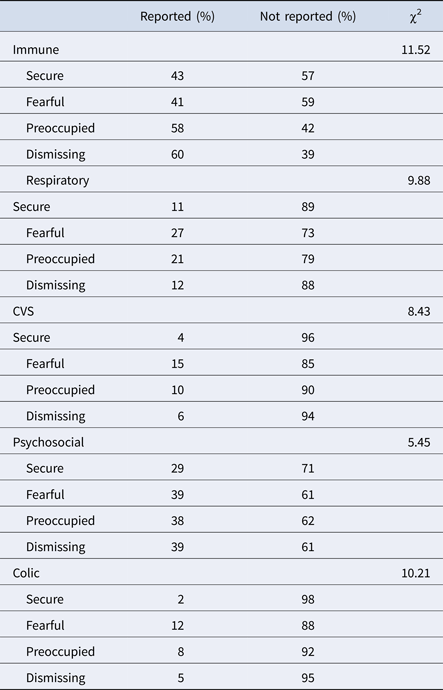
The chi-square analysis provided support for the expectation that maternal reports of attachment insecurity prenatally would be associated with reports of infant illness during the first 6 months. See Table 1 for group data. Our findings suggest a medium effect; differences between groups of .15 (or 15 points) suggest a medium effect, while a difference of .05 (or 5 points) suggests a small effect. In particular, preoccupied and dismissing mothers were more likely than secure and fearful mothers to report immune system symptoms, χ2(df = 3) = 11.52, p = .009; on average a 17-point difference: 43% secure and fearful versus 60% preoccupied and dismissing. Fearful and preoccupied mothers were more likely than secure and dismissing mothers to report respiratory symptoms, χ2(df = 3) = 9.88, p = .02; on average a 12-point difference: 12% secure and dismissing versus 24% fearful and preoccupied. Fearful mothers were more likely than secure, preoccupied and dismissing mothers to report cardiovascular symptoms, χ2(df = 3) = 8.44, p = .04; on average a 10-point difference: 15% fearful versus 5% secure, dismissing and preoccupied; and colic symptoms, χ2(df = 3) = 10.23, p = .02; on average an 8-point difference: 12% fearful versus 4% secure, dismissing and preoccupied. Finally, using the total systems score, we found that fearful, preoccupied and dismissing mothers reported more symptoms than secure mothers, χ2(df = 21) = 34.84, p = .03; on average an 18-point difference comparing participants who reported three or more symptoms: 34% secure reported three or more symptoms versus 52% fearful, dismissing and preoccupied reported three or more symptoms; in other words, insecure mothers reported more infant illness.
Proportions of Mothers Who Reported Infant Illness Symptoms and Mothers Who Did Not Report Symptoms

Note: With one exception the 4 × 2 chi-square analyses’ expected percentage for each cell would be 12.5%. Chi-square values for psychosocial are from 2 (secure/insecure) × 2 analyses. Results for CNS, gastrointestinal, integumentary, and musculoskeletal were not significant and therefore were not reported. All reported chi-square analyses were significant at p < .05
Next, t tests were conducted to assess whether maternal attachment representations differed between mothers who reported illness or not (see Table 2). The results demonstrated that mothers who reported immune system symptoms reported lower levels of security (n = 233; M = 4.54) than mothers who did not report immune system symptoms (n = 250, M = 4.71). See Table 1 for ns and means for each comparison. Mothers who reported respiratory and psychosocial symptoms reported lower levels of security and higher levels of preoccupied attachment than mothers who did not report respiratory and psychosocial symptoms. Mothers who reported cardiovascular symptoms reported higher levels of fearful and dismissing attachment than mothers who did not report cardiovascular symptoms. Mothers who reported that their infant was colicky reported lower levels of security and higher levels of fearful attachment than mothers who did not report that their infant experienced colic. Consistent with expectations, analyses using both the categorical attachment groups and the continuous attachment scales provided support for the hypotheses that mothers who reported higher levels of insecurity prenatally were more likely to report infant illness postnatally. Furthermore, our significant findings suggested medium-to-large effects (see Table 2 for Cohen's d values).
Comparison of Attachment Scores Between Mothers Who Reported Symptoms and Mothers Who Did Not Report Symptoms

Note: Means differences were tested between participants who reported a specific symptom and participants who did not report that symptom. Comparisons for reports of gastrointestinal and integumentary symptoms were not significant and therefore were not reported. For significant comparisons, Cohen's d ranged from a small to large effect (d = .20, small effect; d = .50 medium effect; d = .80, large effect).
+p < .10 *p < .05 **p < .01 ***p < .001.
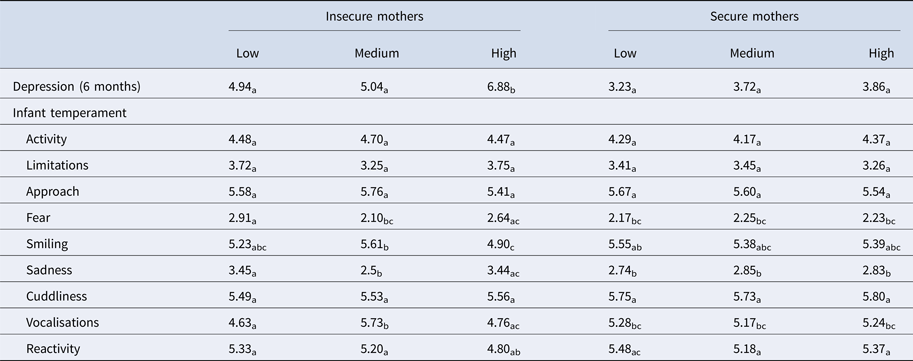
To test the hypothesis that mothers who reported more infant illness would report higher levels of depression at 6 months, we examined whether maternal attachment representations and infant illness reports over the first 6 months were associated with mothers’ reports of depression at 6 months, using an analysis of variance (ANOVA) design. To ensure that we had sufficient power, we divided mothers’ data into two attachment groups (secure vs. insecure) and three illness groups (low symptoms — reported 0 or 1 symptoms, medium symptoms — reported 2–3 symptoms, high symptoms — reported 4 or more symptoms).Footnote 1 Controlling for prenatal depression, we found that the interaction was significant; we had sufficient power (0.84) and the partial eta squared (0.02) suggested a small effect. Specifically, insecure mothers who reported high infant symptoms reported significantly higher depression at 6 months than each of the three groups of secure mothers, F(2, 440) = 5.36, p = .005, as well as the insecure mothers who reported low or medium symptoms. See Table 3.
Maternal Reports of Depression and Infant Temperament Six-Months Postpartum for Secure and Insecure Attachment and Symptom Reporting Groups

Note: Group ns are as follows: 31 insecure, low symptoms; 47 insecure, medium symptoms; 95 insecure high symptoms; 91 secure, low symptoms; 86 secure, medium symptoms; 97 secure high symptoms. Six-month depression effects control for prenatal depression scores. Omnibus F values are significant and reported in the text. With one exception, means with sharing a common subscript are not significantly different at p < .05 according to the Newman Keul's procedure. Reactivity means are different at p < .10.
Finally, we used an ANOVA to test the hypothesis that mothers who reported more infant illness would also report more difficult infant temperament at 6 months. The groups were maternal attachment (two groups as defined above) and infant illness reports (three groups as defined above) over the first 6 months, and the dependent variable was mothers’ reports of their infants’ temperament at 6 months. The overall ANOVA predicting nine infant temperament scores from the IBQ-R was significant — both main effects were significant, but more importantly, the interaction effect, which tests our hypothesis, was significant, F(18, 428) = 1.74, p = .03. We had sufficient power to test the interaction effect (0.95) and the partial eta squared (0.07) suggested a small-to-medium effect. Although post-hoc analyses revealed several significant main effects (e.g., mothers who reported high levels of symptoms were also likely to report that their infant smiled less than mother with low and medium symptom reports and secure mothers reported higher levels of cuddling and lower levels of fear than insecure mothers), we were particularly interested in the interaction effects. The interaction effects test whether maternal attachment and perception of infant's health influence perception of infant's temperament. We expected that insecure mothers who perceived their infant to have a greater number of illness symptoms would also perceive their infant to have a more difficult temperament. Post-hoc analyses revealed significant differences for fear, smiling and laughter, sadness, vocalisation and reactivity to distress (see Table 3). In particular, there was a tendency for insecure mothers who reported high symptoms to report more difficult temperaments (i.e., higher levels of sadness and fear and lower levels of vocalisations, reactivity, and smiling).
Discussion
In this study we examined how mothers’ reports of attachment representations with close others, depressed mood, and reports of infant's temperament influenced perception of infants’ illness over the first six months. Overall, our significant findings were consistent with our expectations. Our analyses had sufficient power and we found small to medium effects. The findings supported the prediction that insecure mothers (as compared to secure mothers) were more likely to report that their infants experienced illness, including immune, respiratory, cardiovascular and colic symptoms. Insecure mothers were also more likely to report a higher number of total symptoms compared to secure mothers. The findings are consistent with previous research. For example, Akman et al. (Reference Akman, Kuscu, Ozdemir, Yurdakul, Solakoglu, Orhan, Karabekiroglu and Özek2006) also reported that insecure caregivers were more likely to report colic. These findings can be interpreted in a number of ways. First, secure mothers are presumed to have an internalised sense of self-worth and an internalised sense of trust that others will be available and supportive (Bartholomew & Horowitz, Reference Bartholomew and Horowitz1991). Secure mothers would be expected to experience less anxiety associated with parenting, and in this study were consistently found to report lower levels of infant illness symptoms. Second, secure mothers are expected to provide more consistent and responsive care compared to insecure mothers, which may influence their infants’ physical health (see Gerhardt, Reference Gerhardt2015, for a discussion). Future research needs to further explore this finding — do secure mothers simply perceive their infants to be healthier or are infants of secure mothers healthier than infants of insecure mothers?
Consistent with expectations, we also found support that insecure mothers who reported high infant illness over the first 6 months were also more likely to report higher levels of depression, higher levels of infant fear and sadness, and lower levels of infant vocalisations and smiling. Insecure mothers who reported low infant illness reported higher levels of infant fear and lower levels of sadness and vocalisations. Although we did not have power to test the effects among the different types of attachment styles, future research may explore this interesting finding. In particular, although not significant, there was some suggestion that the insecure mothers who reported high infant illness and difficult temperaments were more preoccupied, whereas insecure mothers who reported low levels of infant illness and difficult temperaments were more dismissing. Future research is needed to explore the associations among maternal attachment, perceptions of infant temperament, and the infant's health.
The dynamics of how mother attachment and perceptions of infant temperament may influence infant's health are not fully understood. For example, Stifter and Bono (Reference Stifter and Bono1998) suggested that mothers who report high levels of infant colic may also hold the belief that separation had a positive effect and helped their children to develop independence. Not surprisingly, in this study, mothers who reported high infant colic were found to have high fearful-avoidant scores, thereby suggesting how maternal false belief (i.e., my infant needs time away from me) may lead to insecure infant attachment. Clearly, additional research is needed to examine the long-term effect of maternal perceptions of infant health and the development of attachment.
Limitations, Future Directions, and Implications
There are a few limitations that may be addressed in future research. First, the sample was predominantly middle-class, well educated, married, and Caucasian, and we expect that the results may be stronger in families coping with adversity (e.g., poverty, abuse, addiction). We also believe that in future research, it is important to expand to examine the effects of father-infant attachment and infant health. For example, Raiha, Lehtonen, Huhtata, Saleva, and Korvenranta (Reference Raiha, Lehtonen, Huhtata, Saleva and Korvenranta2002) found that problems in the parent-child interaction were most pronounced between the fathers and infants (rather than mother and infants) in a severe colic group. Second, although our findings were consistent with expectations and attachment theory, the low reliability of some of the RSQ scales is noteworthy. Given the strong findings, future researchers may find it productive to replicate this study using more reliable measures such as interviews (e.g., Bartholomew & Horowitz, Reference Bartholomew and Horowitz1991). In addition, infant health was solely based on what the mother reported. It cannot be known whether (or not) these claims of infant health or illness are accurate. Measurement biases may exist since parents may define health differently and health problems may have been under- or over-reported.
Conclusions
In summary, we found clear and consistent associations between prenatal maternal attachment and infant health, and these associations were found to influence mothers’ reports of depression and infant temperament. Although future work is needed to determine the effect of parental attachment on actual reports of health (i.e., as compared to parental reports, which may be biased), it is important to consider the application of these findings when supporting new parents — in particular, new parents with insecure attachment styles. We would suggest that healthcare providers could assess prenatal maternal attachment styles and provide additional support and education to parents with insecure attachment. Specifically, healthcare providers may find it beneficial to address parenting beliefs that may influence infants’ health, such as the belief that separation has a positive effect on infants (which may be characteristic of parents with avoidant representations), or suggest interventions to help manage parental anxiety.
Acknowledgments
We are grateful to Sylvia Taylor, Christina Pataky, Andrea Callaghan, Robyne Hanley-Dafoe, CarolineMachado, Rebecca Paulsen, Jennifer Cowan, and James Viaes and the members of the Peterborough Postnatal Mood Disorders Collaboration for their assistance on this project.
Author ORCIDs
Elaine Scharfe 0000-0002-8904-2244
Financial Support
This research was supported by a research grant from the Social Sciences and Humanities Research Council and a grant from the Ontario Women's Health Council, sponsored by the Ontario Ministry of Health and Long-Term Care.
Conflict of Interest
None.
Ethical Standards
The authors assert that all procedures contributing to this work comply with the ethical standards of the Tri-Council Policy Statement: Ethical Conduct for Research Involving Humans (TCPS 2 2014), Canada.