Meta-analyses conflict over support for basic emotions
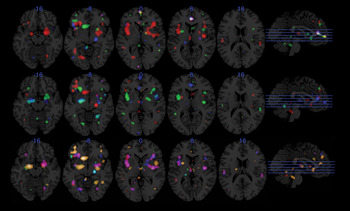
Our meta-analysis, using a different but related method (Laird et al. Reference Laird, Fox, Price, Glahn, Uecker, Lancaster and Fox2005), supported the conclusion that basic emotions have consistent and discriminable (specific) brain correlates (Vytal & Hamann Reference Vytal and Hamann2010). These findings, summarized in Figure 1 of this commentary, showed that each pair of basic emotions (e.g., happiness vs. fear`) could be distinguished by differences in regional brain activation likelihood (see Vytal & Hamann Reference Vytal and Hamann2010 for details). In marked contrast, Lindquist et al.'s meta-analysis found no evidence for specificity.
Figure 1.
Summary of brain regions whose activity discriminated between each pair of basic emotions in our previous meta-analysis. (Results adapted from Vytal & Hamann Reference Vytal and Hamann2010.) Each colored region shows brain regions where a direct statistical meta-analytic contrast of activation likelihood significantly distinguished between pairs of basic emotions. Colors are superimposed on a standard anatomical MRI brain image in Montreal Neurological Institute (MNI) space, with the right of the images showing the right hemisphere. Blue numbers indicate inferior-superior level (z). Where colors overlap they combine additively; for example, red and blue overlap to equal purple). For clarity, the 10 pairwise contrasts are displayed in three separate groupings. Top panel: Red: happiness vs. disgust; Green: happiness vs. sadness; Blue: happiness vs. anger. Middle panel: Red: sadness vs. anger; Green: fear vs. disgust; Blue: fear vs. happiness. Lower panel: Red: sadness vs. disgust; Green: fear vs. anger; Blue: anger vs. disgust; Gold: fear vs. sadness. A color version of this image can be viewed in the online version of this target article at http://www.journals.cambridge.org/bbs.
What are the implications of these discordant findings? One implication is that results of meta-analyses can be strongly influenced by initial assumptions, analysis choices, and decision criteria, and that caution should be taken when relying on only one approach. For example, to address specificity, we used a standard approach to establish discrimination ability by statistically contrasting activation maps for each possible pair of emotions. In their most comparable analysis, Lindquist et al. used a different but equally acceptable approach, contrasting individual emotions with the average of all other emotions. These different decision criteria will necessarily lead to different conclusions in some cases. Although the authors include other analyses, these derive from the same density analysis. The fact that different meta-analyses that use standard methods can lead to opposite conclusions suggests that it may be premature to conclude that CAM is supported by neuroimaging meta-analysis.
Different criteria and definitions complicate comparison of views
Beyond the issue of meta-analysis methods lies another basic problem for comparing emotion views: widely differing criteria. The criteria for supporting basic emotions are strict and highly specific, whereas those for CAM are lenient and very flexible. The authors acknowledge these issues and take steps to counter this bias where possible. Critically, however, no evidence is provided to confirm that these steps are actually effective. Without such evidence, it would again seem premature to draw firm conclusions.
A related issue concerns how basic emotion (locationist) views are defined. The target article focuses exclusively on testing the most limited version: single brain regions uniquely associated with specific basic emotions. However, the recent literature suggests that most neuroimaging researchers acknowledge that emotions arise from networks of two or more regions. For example, amygdala activity increases along with increasing emotional arousal across a wide range of emotions, both pleasant and unpleasant (Hamann et al. Reference Hamann, Ely, Hoffman and Kilts2002).
Given this well-known counterevidence, it seems unlikely that most well-informed neuroimaging researchers would contend that the amygdala is only responsive to fear, or that amygdala activation would not be associated with other emotions. The fact that Lindquist et al.'s conclusions do not apply to basic emotion views that postulate network implementations significantly limits the scope of the target article's conclusions, relative to current debates. Indeed, the target article leaves open the possibility that basic emotions may be based on brain networks.
Considering converging evidence from other methods is essential
A final consideration is that neuroimaging can only establish associations between emotions and regions of brain activation, not whether these regions are functionally essential for an emotion as opposed to being inessential, merely co-activated regions. Because the focus of the emotion debate is on the brain processes essential for generating emotions, it follows that to properly evaluate the evidence for different emotion views, it will be critical to consider converging evidence from methods that can establish whether brain regions are functionally essential for emotion. Such methods include studies of patients with brain lesions, and stimulation methods such as intracranial brain stimulation.
Summary
The foregoing points suggest that Lindquist et al.'s meta-analysis has some important limitations. These limitations raise concerns about interpreting the meta-analysis conclusions as supporting the CAM and as constituting evidence against basic emotion views. The two emotion views in the target article have been frequently cast as mutually incompatible, competing views. However, an alternative approach might be to explore how elements of both views can be combined, creating a hybrid view that would combine key advantages of both. A synthesis seems possible. If Lindquist et al.'s meta-analysis had supported the existence of one basic emotion, for example, fear, it is likely that this could be accommodated within the flexible CAM. If core affect is proposed to be an inborn ability “given by nature” (Barrett et al. Reference Barrett, Lindquist, Bliss-Moreau, Duncan, Gendron, Mize and Brennan2007a), and core affect may evolve to include other distinctions such as approach/avoidance, it is conceivable that other distinctions, perhaps some resembling basic emotions, could be encompassed within core affect.
In conclusion, the highlights of this thoughtful and intriguing article are its elaboration of the CAM and its discussion of neural mechanisms of emotion. The CAM is an important contribution to longstanding debates on the nature of emotion, independent of potential concerns about supporting evidence in the target article. The interplay between such models and other views will help spark the evolution of new neuroscientific theories about how the human brain generates emotions.





Lindquist et al. present an innovative answer to the question of how the human brain generates emotions, in the form of their conceptual act model (CAM). This model combines embodied cognition, psychological construction, and other approaches into an impressive and sweeping theoretical framework, which provides a fascinating counterpoint to more established models. The CAM offers a fresh perspective and will surely generate much-needed debate and discussion that will foster new theoretical development and empirical studies in this area.
I would like to distinguish here between the merits of the CAM and the particular meta-analytic approach taken to demonstrate support for it in the target article. In this commentary, I focus on the latter and outline how our recent meta-analysis (Vytal & Hamann Reference Vytal and Hamann2010), which found results supporting the basic emotion view, suggests important limitations for using meta-analyses as evidence to decide between emotion views. Next, I suggest that to properly evaluate different emotion views, neuroimaging evidence alone is not sufficient and needs to be supplemented by methods which can identify functionally essential regions. Finally, I suggest how these views, which are often cast as incompatible, could potentially be combined into an integrated emotion framework.
Meta-analyses conflict over support for basic emotions
Our meta-analysis, using a different but related method (Laird et al. Reference Laird, Fox, Price, Glahn, Uecker, Lancaster and Fox2005), supported the conclusion that basic emotions have consistent and discriminable (specific) brain correlates (Vytal & Hamann Reference Vytal and Hamann2010). These findings, summarized in Figure 1 of this commentary, showed that each pair of basic emotions (e.g., happiness vs. fear`) could be distinguished by differences in regional brain activation likelihood (see Vytal & Hamann Reference Vytal and Hamann2010 for details). In marked contrast, Lindquist et al.'s meta-analysis found no evidence for specificity.
Summary of brain regions whose activity discriminated between each pair of basic emotions in our previous meta-analysis. (Results adapted from Vytal & Hamann Reference Vytal and Hamann2010.) Each colored region shows brain regions where a direct statistical meta-analytic contrast of activation likelihood significantly distinguished between pairs of basic emotions. Colors are superimposed on a standard anatomical MRI brain image in Montreal Neurological Institute (MNI) space, with the right of the images showing the right hemisphere. Blue numbers indicate inferior-superior level (z). Where colors overlap they combine additively; for example, red and blue overlap to equal purple). For clarity, the 10 pairwise contrasts are displayed in three separate groupings. Top panel: Red: happiness vs. disgust; Green: happiness vs. sadness; Blue: happiness vs. anger. Middle panel: Red: sadness vs. anger; Green: fear vs. disgust; Blue: fear vs. happiness. Lower panel: Red: sadness vs. disgust; Green: fear vs. anger; Blue: anger vs. disgust; Gold: fear vs. sadness. A color version of this image can be viewed in the online version of this target article at http://www.journals.cambridge.org/bbs.
What are the implications of these discordant findings? One implication is that results of meta-analyses can be strongly influenced by initial assumptions, analysis choices, and decision criteria, and that caution should be taken when relying on only one approach. For example, to address specificity, we used a standard approach to establish discrimination ability by statistically contrasting activation maps for each possible pair of emotions. In their most comparable analysis, Lindquist et al. used a different but equally acceptable approach, contrasting individual emotions with the average of all other emotions. These different decision criteria will necessarily lead to different conclusions in some cases. Although the authors include other analyses, these derive from the same density analysis. The fact that different meta-analyses that use standard methods can lead to opposite conclusions suggests that it may be premature to conclude that CAM is supported by neuroimaging meta-analysis.
Different criteria and definitions complicate comparison of views
Beyond the issue of meta-analysis methods lies another basic problem for comparing emotion views: widely differing criteria. The criteria for supporting basic emotions are strict and highly specific, whereas those for CAM are lenient and very flexible. The authors acknowledge these issues and take steps to counter this bias where possible. Critically, however, no evidence is provided to confirm that these steps are actually effective. Without such evidence, it would again seem premature to draw firm conclusions.
A related issue concerns how basic emotion (locationist) views are defined. The target article focuses exclusively on testing the most limited version: single brain regions uniquely associated with specific basic emotions. However, the recent literature suggests that most neuroimaging researchers acknowledge that emotions arise from networks of two or more regions. For example, amygdala activity increases along with increasing emotional arousal across a wide range of emotions, both pleasant and unpleasant (Hamann et al. Reference Hamann, Ely, Hoffman and Kilts2002).
Given this well-known counterevidence, it seems unlikely that most well-informed neuroimaging researchers would contend that the amygdala is only responsive to fear, or that amygdala activation would not be associated with other emotions. The fact that Lindquist et al.'s conclusions do not apply to basic emotion views that postulate network implementations significantly limits the scope of the target article's conclusions, relative to current debates. Indeed, the target article leaves open the possibility that basic emotions may be based on brain networks.
Considering converging evidence from other methods is essential
A final consideration is that neuroimaging can only establish associations between emotions and regions of brain activation, not whether these regions are functionally essential for an emotion as opposed to being inessential, merely co-activated regions. Because the focus of the emotion debate is on the brain processes essential for generating emotions, it follows that to properly evaluate the evidence for different emotion views, it will be critical to consider converging evidence from methods that can establish whether brain regions are functionally essential for emotion. Such methods include studies of patients with brain lesions, and stimulation methods such as intracranial brain stimulation.
Summary
The foregoing points suggest that Lindquist et al.'s meta-analysis has some important limitations. These limitations raise concerns about interpreting the meta-analysis conclusions as supporting the CAM and as constituting evidence against basic emotion views. The two emotion views in the target article have been frequently cast as mutually incompatible, competing views. However, an alternative approach might be to explore how elements of both views can be combined, creating a hybrid view that would combine key advantages of both. A synthesis seems possible. If Lindquist et al.'s meta-analysis had supported the existence of one basic emotion, for example, fear, it is likely that this could be accommodated within the flexible CAM. If core affect is proposed to be an inborn ability “given by nature” (Barrett et al. Reference Barrett, Lindquist, Bliss-Moreau, Duncan, Gendron, Mize and Brennan2007a), and core affect may evolve to include other distinctions such as approach/avoidance, it is conceivable that other distinctions, perhaps some resembling basic emotions, could be encompassed within core affect.
In conclusion, the highlights of this thoughtful and intriguing article are its elaboration of the CAM and its discussion of neural mechanisms of emotion. The CAM is an important contribution to longstanding debates on the nature of emotion, independent of potential concerns about supporting evidence in the target article. The interplay between such models and other views will help spark the evolution of new neuroscientific theories about how the human brain generates emotions.