Introduction
Insect pests cause extensive damage to durable stored products throughout the world resulting in considerable qualitative and quantitative losses to cereal grains, grain legumes and other high-value crops such as cocoa beans and dried fruits (Mbata and Osuji, Reference Mbata and Osuji1983; Mbata, Reference Mbata1985, Reference Mbata1986; Markham et al., Reference Markham, Bosque-Pérez, Borgemeister and Meikle1994; Obeng-Ofori, Reference Obeng-Ofori2007; Abebe et al., Reference Abebe, Tefera, Mugo, Beyene and Vidal2009). Durable agricultural products are often stored in large storage facilities, jute bags or other packages in tropical countries. The bagged stored products are either infested from pests developing in product residues outside the bags, or from pests invading the storage building. The mode of storage affects the possibility of controlling the pests hidden within the products. In case the products are bagged, the bagging material prevents contact insecticides such as synthetic compounds or diatomaceous earths from contact with the pest organisms. For this reason, usually fumigation or freezing are the methods of choice in case the products are not unpacked.
Few studies have addressed the question whether biological control agents can be applied if packaged products are infested (Schöller et al., Reference Schöller, Flinn, Grieshop, Zdarkova and Heaps2006; Flinn & Schöller, Reference Flinn, Schöller, Hagstrum, Phillips and Cuperus2012). The fungus Beauveria bassiana was evaluated for micro-biological control by spraying bag surfaces with fungal spores. Mortality of adult Sitophilus sp. and Tribolium sp. was between 53 and 61% of insects present (Thuy et al., Reference Thuy, Dien, Van, Highley, Wright, Banks and Champ1994). Exposed bag stack surfaces were sprayed under commercial conditions in South Africa with Bacillus thuringiensis; however, this treatment did not prevent stored-product moths from infesting the bags (Viljoen et al., Reference Viljoen, Urban, Schmidt, Taylor, Randall and Viljoen1993). Several studies had evaluated parasitoid Hymenoptera for macro-biological control. Cline et al. (Reference Cline, Press and Flaherty1985) showed that Anisopteromalus calandrae invaded burlap and woven polypropylene bags, but not cotton bags. Sitophilus oryzae populations inside small bags containing infested wheat were suppressed by 13 and 19% in burlap bags and polypropylene bags, respectively. Press & Mullen (Reference Press and Mullen1992) studied whether A. calandrae could control S. oryzae infestation inside commercial paper bags of wheat containing S. oryzae infested grain. They observed 99.4% suppression of S. oryzae exposed to parasitoids compared to the untreated control after 4 months of storage period. Adarkwah et al. (Reference Adarkwah, Büttner, Reichmuth, Obeng-Ofori, Prozell and Schöller2010, Reference Adarkwah, Obeng-Ofori, Büttner, Reichmuth and Schöller2012) showed in a semi-field trial a mean reduction of Sitophilus zeamais in jute bags by 81% when Lariophagus distinguendus were released outside the bags.
Biological control of stored-product moths was studied by Cline et al. (Reference Cline, Press and Flaherty1984) who exposed small kraft paper bags containing corn meal in 45 m3 rooms. There were significantly fewer bags infested by the almond moth Cadra cautella (Walker), when Habrobracon hebetor (Say, 1836) were introduced into the test rooms five times at semi-weekly intervals. In depots in South Africa with bagged maize, sunflower and grain sorghum, release of H. hebetor for 3 years at an average rate of about 1 wasp per week per ton of stored product (average of 982 wasps per week) prevented re-infestation of the product by stored-product moths after fumigation (Viljoen et al., Reference Viljoen, Urban, Schmidt, Taylor, Randall and Viljoen1993). The infestation of packaged cornmeal by Plodia interpunctella was reduced by 71% due to parasitism of moth eggs attached to the packages by Trichogramma deion (Grieshop et al., Reference Grieshop, Flinn and Nechols2006; Reference Grieshop, Flinn, Nechols and Schöller2007).
Bagged stored products are either infested from pests developing in product residues outside the bags, or from pests invading the storage building, or from already infested products that were bagged. If the natural enemies occur spontaneously, they typically enter through holes gnawed by the stored-product pests into the bagging materials, i.e., in a late stage of infestation when the product loss is already high. However, the ability of natural enemies to invade the bags obviously depends on the type of bagging material. In tropical countries, durable agricultural products are often stored in jute bags e.g., maize, coffee and cocoa in Ghana. Contrary to paper bags, jute as well as synthetic fabrics have holes of various sizes allowing insects to enter or leave the bags. These holes were compared in this study in a morphometric study with the maximum width of the parasitoids, i.e., head capsule and thorax, in order to predict the invasion capability into different types of fabric.
Moreover, the ability of the following Hymenopteran parasitoids commercially applied in Central Europe to invade jute bags was tested. Trichogramma evanescens euproctidis is a polyphagous egg parasitoid of several Lepidopteran species including P. interpunctella and Ephestia kuehniella (Prozell & Schöller, Reference Prozell, Schöller, Adler and Schöller1998). Habrobracon hebetor and Venturia canescens are larval parasitoids of various stored-product moths. Venturia canescens is a solitary koinobiont endoparasitoid (Eliopoulos & Stathas, Reference Eliopoulos and Stathas2008) whereas H. hebetor a gregarious idiobiont ectoparasitoid (Morrill, Reference Morrill1942). Anisopteromalus calandrae, L. distinguendus and Theocolax elegans are solitary idiobiont larval ectoparasitoids of internally feeding stored-product beetles such as Sitophilus spp., Stegobium paniceum, Lasioderma serricorne and Rhyzopertha dominica (Ghani & Sweetman, Reference Ghani and Sweetman1955; Loosjes, Reference Loosjes1957; Steidle, Reference Steidle1998).
Finally, a semi-field trial with bags was conducted with V. canescens, the only parasitoid that was not found to enter the jute bags in order to evaluate its biological control potential against the rice moth Corcyra cephalonica.
Materials and methods
Culturing of host insects and parasitoids
The rice moth C. cephalonica, a strain originating from infested products in Berlin, was taken from the permanent rearing stock of the Department for Stored Product Protection, Federal Research Centre for Cultivated Plants – Julius Kühn-Institut, Institute for Ecological Chemistry, Plant Analysis and Stored Product Protection, Berlin, Germany. The parasitoids, V. canescens, A. calandrae, L. distinguendus, T. elegans, H. hebetor and T. evanescens euproctidis were obtained from the Biologische Beratung Ltd (BIp) Berlin, Germany. Corcyra cephalonica were reared in 1 l glass jars filled with 150 g of organic rice grain with a moisture content of 13%. About 5% organic rice germs were added and the jars were placed on a mechanical roller to mix the contents properly. Two hundred and fifty C. cephalonica eggs were added to each jar and were kept in a controlled climate chamber maintained at 65±5% relative humidity (RH), a constant temperature of 25±1 °C and 16:8 h light:dark regime. After 3–4 weeks, C. cephalonica eggs developed into larvae, which were then used to culture the wasps V. canescens and H. hebetor in 850 ml glass jars. A few drops of honey were added into the jars to enhance oviposition and development of the parasitoids. Trichogramma evanescens were reared on UV-sterilized eggs of Sitotroga cerealella. Both species were reared in a controlled climate chamber maintained at 65±5% RH, a constant temperature of 25±1 °C and 16:8 h light:dark regime. To rear L. distinguendus, A. calandrae and T. elegans, 50 newly emerged parasitoids each were placed in 1 l glass jars together with 150 g of maize kernels infested with S. zeamais. The wasps were kept in the growth cabinet for 8–14 days to enable mating and oviposition to occur. After 14–21 days, depending on species, the parasitoids that emerged from the next generation were collected and used for the different experiments.
Morphometric measurements
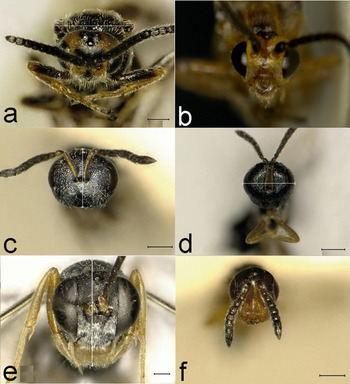
Measurements of ten males and ten females of H. hebetor (fig. 1a), A. calandrae (fig. 1c), L. distinguendus (fig. 1d) and T. elegans (fig. 1f), respectively, and ten females of V. canescens (fig. 1e) were taken, i.e., frontal view of the head capsule width between lateral margins of eyes (fig. 1d), the head capsule length from vertex to apex of labrum (fig. 1c), the thorax width between tegulae (fig. 1a), and the thorax length between dorsum of thorax and apex of coxae (fig. 1e). The parasitoids were studied using a VHX-1000 Keyence digital microscope equipped with the VH-Z20R zoom lens (Keyence Germany, Hessen, Neu-Isenburg, Siemensstrasse), and the measurements were performed with the help of the accompanying Keyence software system version 1.12, measurement software version 1.3.0.7. Mesh width of the jute bagging material was determined by measuring 30 holes with the help of the same equipment.
Parasitoids studied, frontal view and measurements taken (a) Habrobracon hebetor, female, thorax width (b) H. hebetor, male (c) Anisoptermalus calandrae head capsule length (d) Lariophagus distinguendus, head capsule width (e) Venturia canescens, thorax length and (f) Theocolax elegans, scale=200 μm.

Invasion experiment
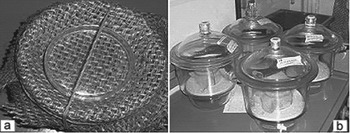
In the bio-assay with beetle parasitoids, 5 g S. zeamais-infested maize kernels were placed in a Petri-dish (diameter 7.5 cm × 5 cm). The Petri-dish was covered with a piece of jute bag material and tied with a rubber band (fig. 2a). Ten freshly emerged adults each of L. distinguendus, A. calandrae or T. elegans were introduced on top of the jute bag and then another Petri-dish (4.5 cm×1 cm) was used to cover the parasitoids. A second rubber band was used to reinforce the first and the second Petri-dishes together (fig. 2a). The confined samples were placed in a dessicator (fig. 2b). This experiment was replicated five times and the samples were placed in a controlled climate chamber maintained at 65±5% RH, a constant temperature of 25±1 °C and 16:8 h light:dark regime. The number of parasitoids that entered through the jute bag (cover) into the Petri-dish was counted daily for 7 days. The sex of the parasitoids that penetrated the bagging material was determined with the help of a stereo-microscope (AHAH 475052-9901, Zeiss Germany) after freezing them. For the moth parasitoids, H. hebetor and V. canescens, the same experimental procedure described above was used with the exception of C. cephalonica larvae infested cracked rice grain placed in the Petri-dish. For the egg parasitoids T. evanescens euproctidis, no substrate or host was placed in the Petri-dish but a piece of cardboard with adhesive glue was used to enable the egg parasitoids to be trapped. A mean ±SE of 1334±83.0 T. evanescens euproctidis individuals were released per trial from parasitized host eggs glued on cardboard, i.e., the egg parasitoids that emerged within the experimental setup. The number of T. evanescens euproctidis released was estimated by counting the parasitized host eggs showing emergence holes, while the number invading the jute was obtained by counting the adults sticking to the glue.
Jute bag material invasion experiment with the parasitoids Theocolax elegans, Anisopteromalus calandrae, Lariophagus distinguendus, Habrobracon hebetor, Venturia canescens and Trichogramma evanescens euproctidis (a) confined parasitoids on a Petri-dish containing host insect larvae separated by jute bag material, (b) desiccators containing the confined parasitoids and insect larvae, kept at 25 °C, 65% RH.

Semi-field trial with V. canescens and C. cephalonica
In the bioassay to determine the effectiveness of V. canescens parasitizing C. cephalonica in bagged rice, a total of eight small jute bags measuring 18 cm×16 cm were filled each with 5 kg organic rice grains. The grains were kept at −15 °C for 2 weeks to kill any living insects from previous infestation. After this period, the grains were removed and kept under experimental temperature and humidity conditions for 1 week before being used in the experiments. The grain moisture content was 12–13%.The variety of bio-organic rice used in this study ‘Basmati’ was obtained from Davert GmbH, Senden, Germany. The moisture content was determined using Pfeuffer Mess-Prüfgeräte HOH-Express HE 50 obtained from Pfeuffer GmbH, Kitzingen, Germany. The jute bags used were prepared from pieces of industrial bagging material originating from Côte d'Ivoire through the importation of cocoa beans to the Port of Hamburg. The original bags were cut into appropriate pieces and were re-sewed with a special needle and a rope obtained from the Ghana COCOBOD, Accra, Ghana.
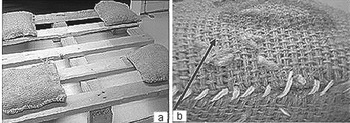
Thirty-five C. cephalonica larvae aged 2–3 weeks were introduced into each of the jute bags. For each experimental trial, four bags were used, i.e., a total of 140 C. cephalonica larvae were exposed to the parasitoids per trial. The four jute bags were placed on a pallet measuring 80 cm×120 cm (W×L) and kept in a climatized room with a surface area of 13 m2 that was kept in a controlled climate chamber maintained at 65±5% RH, a constant temperature of 25±1 °C and 16:8 h light:dark regime (fig. 3a). This temperature and humidity conditions were chosen because they are typical for many tropical areas. Another set of four bags were placed as untreated control in a second controlled climate chamber with an area of 12.3 m2 under the same climatic conditions described above. The samples were stored for 5 days for the larvae to further develop and form webbings within the bags (fig. 3b). Each room was sealed to prevent moths and parasitoids from entering and leaving. Twenty-five adult V. canescens (females only) aged 5 days were released. No parasitoids were released into the second room. The experiment was replicated five times. After 15 days, the rice from the parasitoid treated and untreated jute bags was transferred separately into 1200 ml glass jars 20 cm×11 cm. Further, the areas on the jute bags where webbings had been formed were cut out with scissors and placed in the glass jars as well. The openings of the jars were covered with a nylon mesh tied with a rubber band. The samples were placed in a growth cabinet and maintained at the same conditions as in the trial. The emergence of V. canescens and C. cephalonica was recorded every 2 days in both V. canescens treated and untreated rice samples until the 20th day after transferring the rice into the glass jars, i.e., 45 days after start of the experiment.
Semi-field trial with the parasitoid Venturia canescens (a) jute bags infested with Corcyra cephalonica larvae placed on a pallet, (b) webbings of C. cephalonica larvae on the jute bag material.

Statistical analysis of data
Statistical analyses were performed using the software package SIGMASTAT 3.1. Means obtained by the morphometric measurements were compared using one way-analysis of variance (ANOVA) on ranks and separated with the help of Dunn's method. In the invasion experiment, mean percentage of parasitoids entering the bags was transformed using square root to stabilize heteroscedastic treatment variances before being analysed with the Mann–Whitney rank sum test. In case normality test failed, Kruskal–Wallis one-way ANOVA on ranks was applied. Post hoc comparisons of means were performed with Dunn's method. Means of independent comparisons of the semi-field experiment with V. canescens and C. cephalonica were separated using the t-test (two-tailed). Mean distances obtained in the morphometric study were separated using the Mann–Whitney test. Treatments were considered significantly different at the α=0.05 level. The mean cumulative percentage of the parasitoids invading the jute material depending on time after release was analysed with the help of a two-way repeated measures ANOVA (RM ANOVA), post hoc comparisons of means were performed with the Holm–Sidak method.
Results
Morphometric study
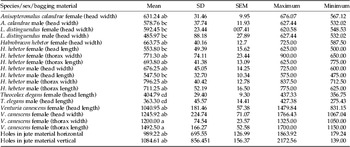
In L. distinguendus, A. calandrae and T. elegans, the head capsule is larger than the thorax in frontal view, i.e., the thorax is not visible in frontal view. In H. hebetor and V. canescens, the thorax is larger than the head capsule in frontal view, i.e., it is completely visible in frontal view. The mean maximum head capsule size (width or length) and data for thorax width or length significantly differed depending on parasitoid species (Kruskal–Wallis one way-ANOVA on ranks, H=87.31, df=18, P<0.001). However, the size of both the wasps and the holes in the jute was quite variable, and only few means differed significantly (Table 1). Thorax width and length was significantly larger compared to head capsule width of T. elegans (both sexes) and male A. calandrae and L. distinguendus (P<0.05, Dunn's test).
Mean maximum head capsule width (μm) (or length or thorax width if indicated) for males and females of five parasitoid species attacking stored-product pests, and measurement for holes in jute material. Means denoted by the same lowercase letter do not differ significantly (Dunn's test, P>0.05).

The head of the females of the Pteromalidae studied was found to be larger at average compared to that of the males, but these differences were not statistically significant. Theocolax elegans was found to be the species with the smallest head, even though it was not significantly different from e.g., male H. hebetor, A. calandrae or L. distinguendus, respectively.
Invasion experiment
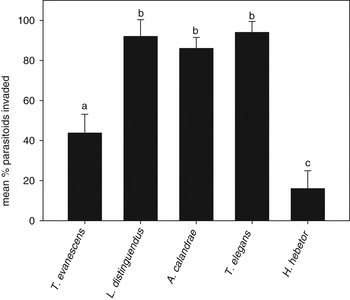
The mesh openings of the jute bagging material measured a mean around 1000 μm, with a maximum of 2172 μm. No V. canescens entered the Petri-dishes. Few H. hebetor passed through the jute material while a high percentage of L. distinguendus, A. calandrae, T. elegans and T. evanescens were able to enter the Petri-dishes (fig. 4). Significantly more L. distinguendus, A. calandrae, T. elegans and T. evanescens entered compared to H. hebetor (Mann–Whitney test, P<0.05). Significantly more L. distinguendus, A. calandrae and T. elegans entered compared to T. evanescens (Mann–Whitney test, P<0.05) (fig. 4).
Mean % (±SD) parasitoids invading the jute bag material, data are means of five replicates; bars denoted by different letter are significantly different (Dunn's method, P<0.05)

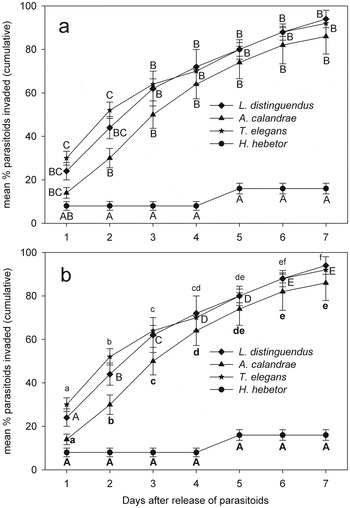
The two-way repeated measurements ANOVA revealed a significant effect of both parasitoid species (df=3, F=50.50, P<0.001) and time (df=6, F=253.34, P<0.001) on the number of parasitoids invading the jute bag material per day, and the interaction of days×species was significant, (df=18, F=11.399, P<0.001). About 50% of L. distinguendus invaded the jute after 2.36 days and 80% in the fifth day. Theocolax elegans was the fastest of all the parasitoids to invade the jute bags, i.e., 50% entered the bags within 2 days, and 80% in the fifth day, too. Similarly, 50% of A. calandrae invaded the bag in 3 days and 80% after 5.8 days, whereas H. hebetor was the slowest among the parasitoids to enter the jute bag, i.e., up to the fourth day only 8% invaded and from day 5–7 only 16% invaded. Significantly, most of all the other parasitoid species entered compared to H. hebetor from day 2 onwards (fig. 5a). The comparison of number of parasitoids invading per day after release within each parasitoid species showed a significant increase in numbers until day 6 for all species with the exception of H. hebetor (Holm–Sidak method, P<0.05), even though the highest number of parasitoids invading were recorded on day 7 for all species (fig. 5b).
Mean cumulative % (±SE) of parasitoids invading the jute bag material per day, data are means of five replicates. (a) Comparison between different parasitoid species, numbers invading followed by the same uppercase letter do not differ significantly; (b) comparison per day after release within each parasitoid species, numbers invading followed by the same normal or bold uppercase or lowercase letters do not differ significantly (two-way repeated measures ANOVA, Holm–Sidak method P>0.05).

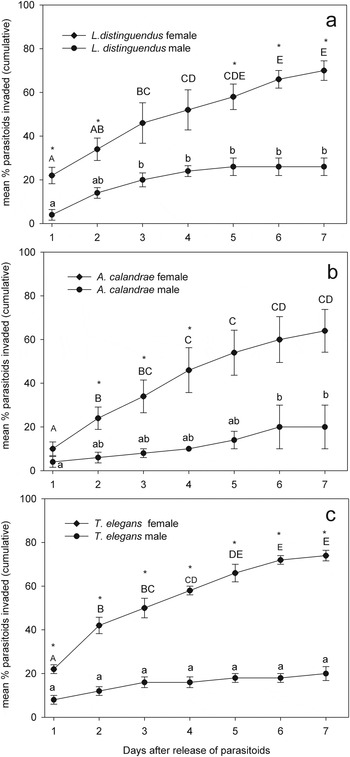
Significantly more female L. distinguendus invaded the jute bag material compared to males in the first two and the last 3 days after release. While the number of males was not significantly increasing from day 2 onwards, there was a significant increase in female L. distinguendus until day 5. At day 7, a mean of 26 and 70% of males and females, respectively, invaded the jute material (fig. 6a). Significantly more female A. calandrae invaded the jute bag material compared to males in days 2–4 after release. While the number of males was not significantly increasing from day 2 onwards, there was a significant increase in female A. calandrae until day 3. At day 7, a mean of 20 and 64% of males and females, respectively, invaded the jute material (fig. 6b). Significantly more female T. elegans invaded the jute bag material compared to males at all days after release. While the number of males was not significantly increasing during the experiment, there was a significant increase in female T. elegans until day 5.
Mean % (±SE) of female and male parasitoids invading the jute bag material depending on time after release, data are means of five replicates (cumulative), (a) Lariophagus distingendus, (b) Anisopteromalus calandrae and (c) Theocolax elegans. Significant differences in mean numbers of males or females invading per day are indicated by a star (*) (Mann–Whitney test, P<0.05); comparison per day after release within each sex, numbers invading followed by the same uppercase letter (females) or lowercase letters (males) do not differ significantly (two-way repeated measures ANOVA, Holm–Sidak method P>0.05).

Semi-field trial with V. canescens and C. cephalonica
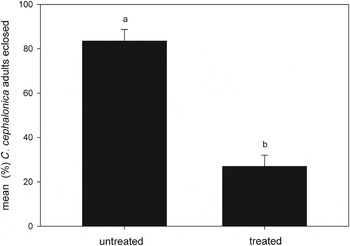
Venturia canescens were able to locate host larvae inside the jute bags to parasitize C. cephalonica and produce F1 progeny. Venturia canescens significantly reduced the number of C. cephalonica adults emerging from the bagged rice (Mann–Whitney test, P=0.008) (fig. 7). The mean±SD number of V. canescens emerging from the four jute bags treated with 25 females of V. canescens was found to be 111.0±13.7, i.e., a mean of 4.4 progeny per female. The emergence of V. canescens progeny started from the 25th through the 31st day from the start of the experiment. There was no adult emergence observed after the 31st day of exposure.
Mean % (±SD) of adult Corcyra cephalonica emerged from both Venturia canescens treated and untreated rice samples in jute bags; data are means of four replicates; bars denoted by different letter are significantly different (Mann–Whitney test, P=0.008).

Discussion
The control of stored-product insects in bagged commodities is among the most difficult control situations in stored-product protection, because the developmental stages of the moths are protected by the bag material from e.g., contact insecticides or diatomaceous earths. Consequently, the bagged products have to be unpacked in order to treat the stored product directly, or methods such as freezing or fumigation have to be applied. These techniques are either labour expensive or may require special equipment and storage rooms. Therefore, a biological control method where parasitoids are released outside the bags and are able to parasitize larvae within the bags would be a promising approach.
The maximum size of the holes in the jute material was found to be larger than the minimum size of all head capsule and thorax measurements taken from the parasitoids including the largest species, V. canescens. Consequently, individuals of all parasitoids studied could potentially enter the jute bags. In fact, this was shown experimentally for all species except for V. canescens. It remains to be studied why V. canescens did not enter the holes. This might be because of jute fibres extending into the meshes, or due to the behaviour of this parasitoid. The openings of the jute material were found to be quite variable. In practice, even much larger openings in the jute are created when the bags are handled with metal hooks.
The size of the parasitoids was also variable. Large intraspecific size ranges are known from many species of parasitoid Hymenoptera, mostly depending on host size (Cohen et al., Reference Cohen, Jonsson, Müller, Godfray and Savage2005). The smaller individuals are more likely to invade bags; however, typically in parasitoid wasps smaller individuals are males (Hurlbutt, Reference Hurlbutt1987) as confirmed by the findings of our study on the Pteromalidae. Males do not contribute directly to biological control. Small mesh sizes might favour smaller females to enter, but smaller female parasitoids typically parasitize fewer hosts (Heinz, Reference Heinz1991). The impact of mesh size on control efficiency therefore requires further studies. In case the level of control achieved by the parasitoids alone might not be enough and other control measures such as fumigation or freezing could be integrated. Obviously, the stored-products would have to be cleaned prior to processing or consumption in case of parasitoid release on jute bags.
Ambrosius et al. (Reference Ambrosius, Adler, Reichmuth, Steidle, Stengård Hansen, Enkegaard, Steenberg, Ravnskov and Larsen2006) studied the invasion of T. evanescens euproctidis (Girault, 1911) (Hymenoptera: Trichogrammatidae) into various types of leaky packages in a semi-field test and found an invasion of 13% into certain cardboard boxes. However, in plastic bags, paper bags and another type of cardboard boxes these egg parasitoids were not invaded.
In a laboratory test, the same authors found T. evanescens euproctidis to be able to invade apertures as small as 0.2 mm, but to be retained by apertures of 0.15 mm or smaller (Ambrosius et al., Reference Ambrosius, Adler, Reichmuth, Steidle, Stengård Hansen, Enkegaard, Steenberg, Ravnskov and Larsen2006). Apertures of packages were previously correlated with morphometric measurements of head capsule width of beetle and moth pest larvae to predict invasion into packages. Cline & Highland (Reference Cline and Highland1981) showed that small stored-product pests such as Cryptolestes pusillus and Cathartus quadricollis are retained by holes of 250 μm, but pass through holes of 930 μm. Most adult stored-product beetles are retained by holes of 700–1400 μm (Cline & Highland, Reference Cline and Highland1981; Khan, Reference Khan1983a ). The mean head capsule widths measured in this study for the parasitoids ranged between 400 and 800 μm (except for V. canescens). The parasitoids can therefore be expected to enter the same or even smaller openings than the adult pests. However, immature stadia of the pests can invade much smaller openings, e.g., sawtoothed grain beetle larvae infested consumer food packages that had been punctured with 0.4 mm diameter holes (Mowery et al., Reference Mowery, Mullen, Campbell and Broce2002), and P. interpunctella larvae invaded openings down to 144 μm (Khan, Reference Khan1983b ).
Because V. canescens did not enter openings in the jute material that were larger than its head-capsule and thorax width, we studied the biological control potential of this parasitoid in more detail. Our results in a semi-field trial showed the ability of V. canescens to successfully parasitize C. cephalonica larvae within the rice bags. The emergence of V. canescens progeny indicates the ability of the parasitoids to insert their ovipositors through both the meshes of the jute material and the C. cephalonica webbing, and parasitize their host. Corbet & Rotheram (Reference Corbet and Rotheram1965) found that V. canescens could reach host larvae situated under a 1 cm thick layer of flour with its ovipositor. As only one parasitoid progeny develops per host, the mean of 111 V . canescens progeny per trial with 140 host larvae exposed showed the high percentage of hosts found by the parasitoids. This can only be explained by a high percentage of last-instar C. cephalonica larvae wandering from within the bulk product towards the bagging material in order to pupate. However, the complete control of C. cephalonica was not achieved. This could be due to surviving larvae hidden deep inside the jute bag that were unaccessible to the wasps.
Our results suggest that V. canescens could be released for protection against moth infestation in storage rooms containing bagged rice. Alternatively, bags could be opened and the parasitoids introduced. Schmale et al. (Reference Schmale, Wäckers, Cardona and Dorn2006) introduced the solitary ectoparasitoid Dinarmus basalis Ashmead (Pteromalidae) into bags with Acanthoscelides obtectus (Say)-infested common beans in Colombia. At low initial infestation, the introduction resulted in a pest reduction of 88–97%. While this release technique might be suitable for small-scale farmers who store only a low proportion of their beans for family consumption, as in the case in Columbia, it is probably too labour intensive for large commercial stores.
Even though the number of parasitoids entering was presumably not adequate to control a heavy pest infestation, the release of L. distinguendus, A. calandrae, T. elegans, H. hebetor and V. canescens could be an IPM tool for prevention of mass infestation of weevil and moth pests in warehouses containing grains or seeds stored in jute bags. The use of biological control agents in suppressing stored-product insect pests in bagged commodities could therefore become a valuable supplement to the application of synthetic insecticides and modified atmospheres.
Acknowledgements
The staff of Humboldt University of Berlin, Faculty of Agriculture and Horticulture, Division Urban Plant Ecophysiology and Julius Kühn-Institut, Federal Research Centre for Cultivated Plants, Institute for Ecological Chemistry, Plant Analysis and Stored Product Protection, Berlin, Germany assisted in various ways, for which we are most grateful. Parasitoids were provided by Biologische Beratung Ltd, Berlin, Germany.