Summations
∙ Longitudinal findings on prenatal alcohol exposure (PAE) indicated lower scores on receptive or expressive communication in the PAE group in comparison to the non-alcohol exposed group, even after controlling for a wide variety of environmental factors in the first 3 years of life.
∙ Studies which followed children up beyond three years in these cohorts demonstrated no significant differences in language development when home environment and exposure to other substances were taken into account.
∙ The majority of studies measured alcohol exposure through self-report measures.
Considerations
∙ Reporting longitudinal language outcomes up to preschool age in children with PAE has resulted in only six documented studies, which stresses the general paucity of data in this area.
∙ Understanding the reasons for why some children with PAE appear to be more vulnerable to language, speech or communication delay at different time points after childbirth, and why some appear more resilient is key for developing effective prevention and intervention strategies.
∙ Additional research is needed in young children with PAE which takes into consideration the impact of relevant contextual factors and investigates the language outcome trajectories over time during these critical years.
Introduction
PAE is an important public health concern that results in increased risk for poor general health and cognitive outcomes and is a major contributing factor to the global burden of disease (Reference Whiteford, Degenhardt, Rehm, Baxter, Ferrari, Erskine, Charlson, Norman, Flaxman, Johns and Burstein1,Reference Comasco, Rangmar, Eriksson and Oreland2). Globally, about 10% of women consume alcohol during pregnancy, and one of every 67 of these women deliver a child with foetal alcohol syndrome (FAS) (Reference Popova, Lange, Probst, Gmel and Rehm3). Recent data from the World Health Organization indicate a global prevalence of FAS ranging between 2 and 7 per 1000 (4), and foetal alcohol spectrum disorders (FASD) between 0 and 176.77 per 1000 (Reference Roozen, Peters, Kok, Townend, Nijhuis and Curfs5). In South Africa, there are regional variations in prevalence rates, often linked to high risk populations with 55.42 per 1000 affected by FAS and 113.22 per 1000 affected by FASD in certain communities (Reference Olivier, Viljoen and Curfs6). Adding to this concern is the growing literature demonstrating that moderate to severe PAE is a significant risk factor for cognitive, language, speech or communication deficits, which may in turn have far-reaching effects on the subsequent cognitive, socio-emotional and educational outcomes.
The umbrella term, FASD, describes the range of effects that can occur when an individual is prenatally exposed to alcohol. This includes FAS, which is the display of the teratogenic effects of alcohol on the developing foetus, and includes growth retardation; central nervous system impairment; and facial features of short palpebral fissures (thin upper lip, and elongated, flattened mid-face) (Reference Olivier, Viljoen and Curfs6). Foetal alcohol effects (FAE), on the other hand, may be evident in infants and children with exposure to alcohol, but who have only some of the characteristics of FAS. Alcohol-related neurodevelopmental disorder and alcohol-related birth defects have also been proposed to describe conditions in which the exposed infant demonstrates some but not all features of the criteria (Reference Olivier, Viljoen and Curfs6).
Exposure to alcohol in foetal development has been associated with a range of cognitive delays, as well as language or speech deficits among children (Reference O’Leary7–Reference Gordon, Rotheram-Borus, Skeen, Perry, Bryant and Tomlinson9). As early as the 1970s, Iosub et al. (Reference Iosub, Fuchs, Bingol and Gromisch10) identified four generic communication disturbances including speech, language, voice and fluency delays. Language impairments in children with FASD which have been described to date include problems in speech discrimination, comprehension, syntax development, prosodic features, rules of dialogue poor performance in sentence combining (Reference Shaywitz, Caparulo and Hodgson11) expressive delays (Reference Carney and Chermak12), working memory deficits (Reference Glass, Graham, Akshoomoff and Mattson13) and disturbances in semantic elaboration (Reference Thorne, Coggins, Olson and Astley14). Weinberg (Reference O’Connor and Paley15) suggests that while a child with FAS/FAE may present with what appears to be adequate superficial speech skills, their impairment in pragmatic language use may result in poor peer relationships and thus significant social problems. Preschool children with FAE have been reported to exhibit social communication deficits and adverse social interactive experiences (Reference Coggins, Timler and Olswang16,Reference McGee, Bjorkquist, Riley and Mattson17). These behavioural deficits have been postulated to be due to the impact of PAE on frontal lobe development and function. For the child with FASD, speech and language disorders appear to have been reported as a part of their impairment profile commonly, while socio-communicative outcomes have been investigated and reported less frequently (Reference Coggins, Timler and Olswang16). Exposure to alcohol in the prenatal period may be associated with social communication impairments (Reference McGee, Bjorkquist, Riley and Mattson17), however, research has also shown that these children may be particularly vulnerable to language deficits as a result of both the specific effects of PAE as well as the associated impact of both intrinsic and extrinsic risk factors such as maternal depression, poor nutrition and other socio-demographic factors (Reference Shaywitz, Caparulo and Hodgson11–Reference O’Connor and Paley15,Reference Sullivan18). Studies exploring the impact of PAE on the progression of language, speech or communication, which include consideration of the impact of environmental factors remain less common. Several additional questions remain about the nature of the putative associations of PAE, risk and protective factors on language development of young children across the course of the first years of life.
Rationale
When considering the current literature on the impact of PAE on cognitive and language functioning, the majority of published studies report on cross-sectional studies and convenience samples of modest size. Although such studies have been valuable in advancing research in this area, they have an important limitation — they prevent making strong causal inferences on language development over time. Only through longitudinal designs may cause and effect be determined, whilst acknowledging any confounding factors which may exert important additional influence on outcomes in these children.
To our knowledge, only two reviews with a specific focus on PAE and child language development have been carried out (Reference Abkarian19,Reference Cone-Wesson20). Both reviews include cross-sectional studies (Reference Abkarian19,Reference Cone-Wesson20) which may provide a weaker level of evidence than that of available longitudinal studies(Reference Cone-Wesson20). Because cross-sectional studies occur at a single-point in time, this form of research is prone to potential bias. Selection bias may occur should the selection of children be restricted to a combination of retrospective accounts of alcohol and other drug exposure resulting in high or low susceptibility for developing language delay and, additionally, if the exposure differs in alcohol or other drug use, it may differ in predicting language outcomes (Reference Cone-Wesson20). Cone-Wesson (Reference Cone-Wesson20) defined areas of language impairment specific to FAS only, while Abkarian (Reference Abkarian19) focussed on the effects of FAS and FAE on the communication abilities of children. As a result of their specific focus, these reviews may have been less inclusive of the available literature than a systematic review approach would have allowed and likewise, did not include a discussion of the association of PAE with language development trajectories across time.
Aim of the study
The aim of this paper was to provide a systematic review and update on the available longitudinal studies on the impact of PAE on language, speech and communication development, as well as associated potential environmental confounders during the preschool period.
Methods
Article search strategy
Full‐text, peer‐reviewed, electronic resources for the following databases were restricted in English from the year 1970 until present: PUBMed, Scopus, Web of Science {C-e Collection, Biological Abstracts, KCI-Kean Journal Database, Russian Science Citation Index, SciELO Citation Index, Zoological Rec-d}, Academic Search Premier (Africa-Wide Information, CINAHL, MEDLINE, PsycINFO). Keywords included: Prenatal Alcohol Exposure or Fetal Alcohol Syndrome or Foetal Alcohol Syndrome or Partial Foetal Alcohol Syndrome (pFAS) or Alcohol-Related Birth Defects or Alcohol-Related Neurodevelopmental Disorder or Fetal Alcohol Effects or Foetal Alcohol Effects or FAE; speech or language or communication outcomes; neurocognitive or neurodevelopment or neurobehavioral or neurobehavioural; infant or baby or toddler or preschooler or preschooler; longitudinal or follow-up.
Titles, abstracts and articles were screened to determine if publications met the following inclusion criteria. Inclusion criteria for the review were (i) cohort studies with at least 2 time-points; (ii) association of light, moderate or heavy PAE on language, speech or communication delay, development or disorder; (iii) from infancy (birth to 2 years old) up to preschool age (6 years). Longitudinal research included data that was collected for each variable for two or more distinct periods; the subjects or cases analysed were the same, or at least comparable, and the analysis involved some comparison of data between or among periods (Reference Menard21). Articles that met the inclusion criteria were examined against a list of exclusion criteria. Studies presenting solely animal, cross-sectional analyses, clinical studies, case reports, comments, letters, and reviews were excluded. Studies reporting other cognitive or developmental outcomes were excluded, unless language, speech or communication was specifically explored as an outcome measure.
Quality assessment
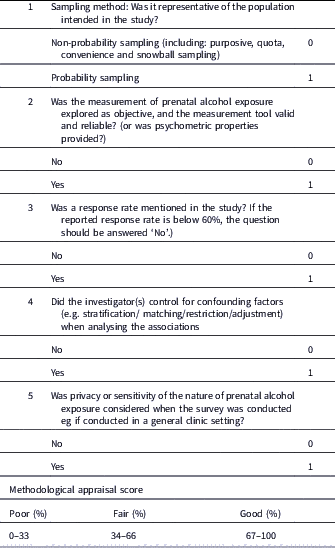
The articles included in this review were rigorously assessed using the quality assessment tool for systematic reviews of observational studies (QATSO) (Tables 1 and 2) (Reference Wong, Cheung and Hart22). The checklist was developed based on epidemiological principles, reviews of study designs, and existing checklists for the assessment of observational studies (Reference Wong, Cheung and Hart22). The QATSO covers the following aspects (1) external validity (1 item) – addresses the extent to which the findings from the study can be generalised to the population from which the study subjects are derived; (2) reporting (2 items) – assesses whether the information provided in the paper is sufficient to allow a reader to make an unbiased assessment of the findings of the study; (3) bias (1 item) – addresses bias in the measurement of the outcomes in a study; and (4) confounding (1 item) – addresses whether studies have applied adjustment for confounding in the analysis. This item is specific to studies concerning association of risk factors. Although the QATSO score consists of five items, users may select four to five items depending on the type of studies being evaluated. Studies achieving 67% or more are regarded as ‘good’ quality; 34–66% ‘fair’; and, below 33% ‘poor’. The inter-rater reliability was shown to be good (Pearson coefficient=0.86) (Reference Wong, Cheung and Hart22). This assessment is crucial in evaluating the strength of the inferences and conclusions arrived at in the studies.
Data synthesis
In this review, a narrative synthesis of the findings from the primary studies was completed to deliver a textual answer to the review question. The following steps delineated by Popay et al. (Reference Popay, Roberts, Sowden, Petticrew, Arai, Rodgers, Britten, Roen and Duffy23) include (Reference Whiteford, Degenhardt, Rehm, Baxter, Ferrari, Erskine, Charlson, Norman, Flaxman, Johns and Burstein1) preliminary analysis (Reference Comasco, Rangmar, Eriksson and Oreland2) and thematic analysis. Preliminary synthesis consisted of extracting the descriptive characteristics of the studies into a table and producing a textual summary of the results. This method synthesised the selected studies for the review according to the following: the domains of interest, sample size, context, age, method of data collection and data analysis, and main results (Reference Popay, Roberts, Sowden, Petticrew, Arai, Rodgers, Britten, Roen and Duffy23; Tables 3 and 4). Thematic analysis was then used to extract the main themes from the studies. The two themes developed in the results represent the main areas of longitudinal knowledge available on early language development in the context of PAE. Due to the heterogeneous nature of the exposure and outcomes across the studies included, it was not deemed appropriate to conduct a meta-analysis.
Results
Article search procedure
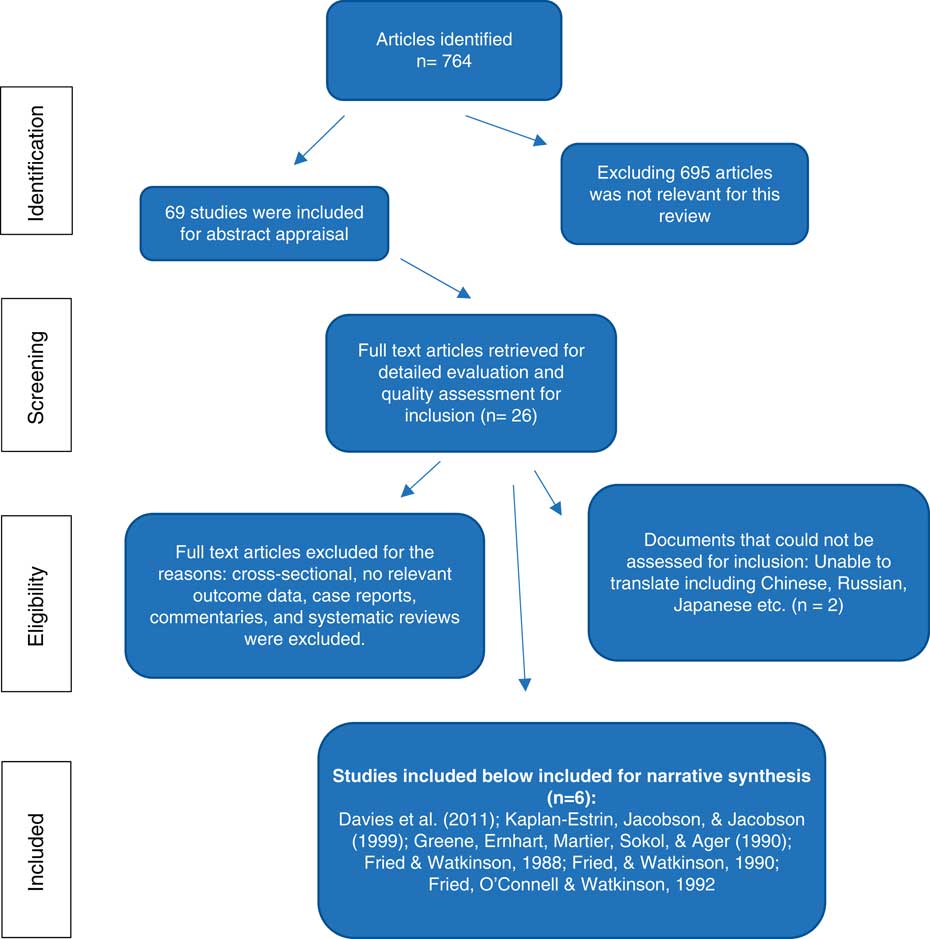
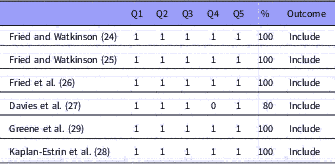
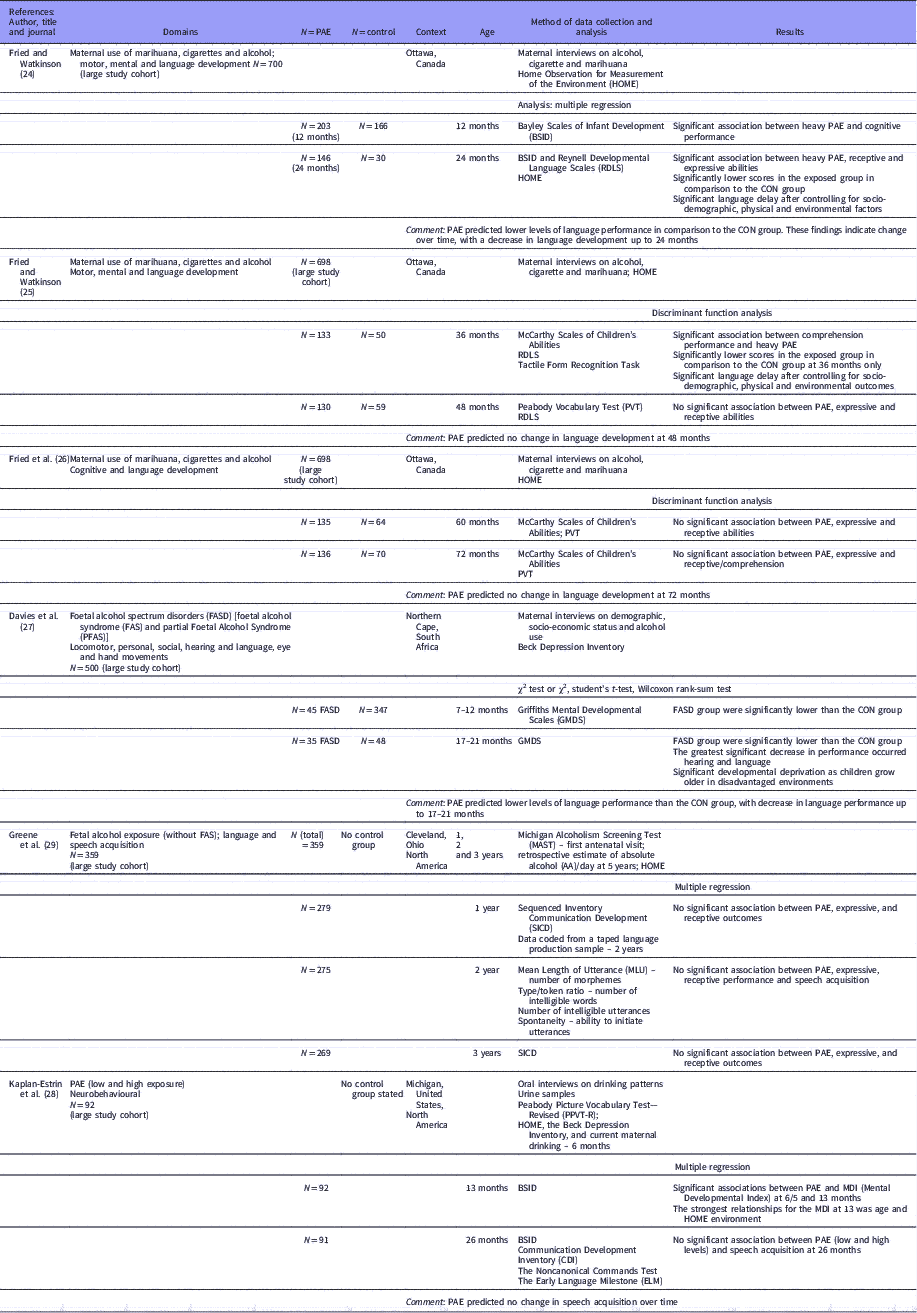
The search for the review produced a total of 764 articles from the specified databases (Fig. 1). Based on a subsequent title search, 69 studies were included for abstract appraisal, excluding 695 studies as they did not meet the inclusion criteria. Screening of titles, abstracts and articles for the inclusion and exclusion criteria produced a total of 26 relevant publications. Of the 26 studies, 20 studies did not have data on language, speech or communication outcomes on a trajectory that could be extracted and were therefore excluded. Six studies met all the eligibility criteria for the review and scored above 67% on the QATSA indicating that the studies could be considered as having adequate quality for inclusion (Fig. 1 and Table 2). The descriptive characteristics of the six studies that were selected are displayed in Table 4, including the domains of interest, sample size, context, age, method of data collection and data analysis, and main results. A systematic account of how the studies were conceptualised, their focus of research, context, method and findings are provided below.
Article search and appraisal process.

Thematic analysis
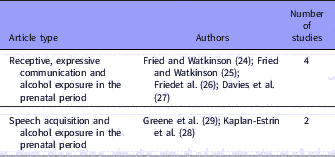
Two themes were extracted from the literature selected: (1) the effect of PAE on receptive, expressive delay and speech delay; (2) the contextual risk factors associated with PAE on early receptive, expressive communication and speech acquisition. The content of the themes from the studies was achieved by the descriptive themes that emerged from an inductive analysis of study findings to answer the review question. These themes provide an overview of the main areas of longitudinal knowledge and a comparison of data between or among periods on early language development in the context of PAE.
The themes identified in this review include (Table 4):
(1) The effect of PAE on receptive, expressive development and speech acquisition.
(2) The contextual risk factors associated with PAE on early receptive, expressive communication and speech acquisition.
Theme 1: the effect of PAE on receptive, expressive development and speech acquisition
This theme included six studies which followed receptive, expressive communication and speech acquisition of alcohol exposed children over at least two time-points in the preschool age (Table 4). Three studies from one cohort, designed to investigate the neurodevelopmental outcomes (motor, mental and language development) of children with prenatal exposure to marijuana, cigarettes or alcohol (Reference Fried and Watkinson24–Reference Fried, O’connell and Watkinson26), the impact of PAE on developmental performance (locomotor, personal, social, hearing and language, eye and hand movements) (Reference Davies, Dunn, Chersich, Urban, Chetty, Olivier and Viljoen27), the impact of PAE on neurobehavioural outcomes (including communication) (Reference Kaplan-Estrin, Jacobson and Jacobson28) and the effects of PAE on language and speech acquisition specifically (Reference Greene, Ernhart, Ager, Sokol, Martier and Boyd29).
The context of the studies primarily occurred in well-resourced countries, such as, North America in comparison to one study in South Africa. The age categories for the Ottawa Prenatal Prospective Study included 12- and 24 months (Reference Fried and Watkinson24), 36- and 48 months (Reference Fried and Watkinson25), 60- and 72 months (Reference Fried, O’connell and Watkinson26), 7–12 months and 17–21 months (Reference Davies, Dunn, Chersich, Urban, Chetty, Olivier and Viljoen27). The rest of the studies included age categories 6.5, 13 and 26 months (Reference Kaplan-Estrin, Jacobson and Jacobson28); and 12, 24 and 36 months of age (Reference Greene, Ernhart, Ager, Sokol, Martier and Boyd29). In addition, sample sizes of these studies were relatively small. Three studies recruited women from public hospitals (Reference Davies, Dunn, Chersich, Urban, Chetty, Olivier and Viljoen27–Reference Greene, Ernhart, Ager, Sokol, Martier and Boyd29), and three prospective studies recruited women through the media or at voluntary sign-up locations (Reference Fried and Watkinson24–Reference Fried, O’connell and Watkinson26). All the studies had two assessment time points at follow-up visits, with low attrition between the first and last assessment. In four studies, mothers were interviewed once in each trimester during pregnancy, and alcohol consumption was broken down into beer, wine and liquor with both the quantity and pattern of consumption recorded and then converted to average ounces of absolute alcohol (AA) per day (Reference Fried and Watkinson24–Reference Fried, O’connell and Watkinson26,Reference Greene, Ernhart, Ager, Sokol, Martier and Boyd29). None/light alcohol consumption contained less than 0.14 oz AA daily, while heavy alcohol consumption comprised more than 0.85 oz AA daily(Reference Fried and Watkinson24–Reference Fried, O’connell and Watkinson26). Control groups were categorised as having none/light to low-levels of alcohol exposure (Reference Fried and Watkinson24–Reference Fried, O’connell and Watkinson26). One study under this theme utilised two specialist clinicians with dysmorphology trained personnel to diagnose FASD (FAS and pFAS) amongst infants and children (Reference Davies, Dunn, Chersich, Urban, Chetty, Olivier and Viljoen27). In this study (Reference Davies, Dunn, Chersich, Urban, Chetty, Olivier and Viljoen27), infants who did not meet criteria for a FAS or PFAS diagnosis formed the non-FASD comparison group. Infant and child measures to evaluate outcomes included the Bayley Scales of Infant Development (Reference Fried and Watkinson24), the Griffiths Mental Developmental Scales (Reference Davies, Dunn, Chersich, Urban, Chetty, Olivier and Viljoen27), the Reynell Developmental Language Scales, the McCarthy Scales of Children’s Abilities (Reference Fried and Watkinson25,Reference Fried, O’connell and Watkinson26); and the Peabody Vocabulary Test (Reference Fried, O’connell and Watkinson26). For child speech acquisition, data was coded from a taped language production to determine the Mean Length of Utterance (Reference Kaplan-Estrin, Jacobson and Jacobson28), and the Early Language Milestone scale was used to assess the intelligibility of the child’s utterances (Reference Greene, Ernhart, Ager, Sokol, Martier and Boyd29). Three studies controlled at least for maternal age, sex and home environment (Reference Fried and Watkinson24–Reference Fried, O’connell and Watkinson26). The Home Observation for Measurement of the Environment inventory includes information collected by observation of the child’s home environment. Statistical analysis techniques varied from study to study and included Wilcoxon rank-sum test (Reference Davies, Dunn, Chersich, Urban, Chetty, Olivier and Viljoen27) and multiple linear regression (Reference Fried and Watkinson24,Reference Kaplan-Estrin, Jacobson and Jacobson28,Reference Greene, Ernhart, Ager, Sokol, Martier and Boyd29) approaches for discriminant function analysis (Reference Fried and Watkinson25,Reference Fried, O’connell and Watkinson26). The majority of the studies measured alcohol exposure using self-report measures.
Six studies investigated PAE as a predictor and language as an outcome allowing for a longitudinal assessment of the association between the variables and exploring socio-demographic and home environment as confounders up to 24 months. Three of the studies formed part of the Ottawa Prenatal Prospective Study where ~700 women were interviewed regarding their prenatal alcohol use, from which small embedded cohorts were selected for follow-up. These studies reported heavy PAE as significantly associated with language, and that the alcohol exposed group scored lower than the non-exposed group (Reference Fried and Watkinson24,Reference Fried and Watkinson25,Reference Davies, Dunn, Chersich, Urban, Chetty, Olivier and Viljoen27). According to Fried and Watkinson, there were significant associations between heavy PAE, vocalisation and the onset of words at time one (12 months) (Reference Fried and Watkinson24). By time two (24 months), heavy PAE was significantly associated with expressive abilities, with lower scores occurring in the exposed group in comparison to the control group (Reference Fried and Watkinson24). After controlling for the child’s home environment, language impairments among prenatally alcohol exposed children continue to persist, with maternal involvement also having an impact up to 24 months. While alcohol exposure had a significant impact on early language development, the authors also recommended assessing alcohol and nicotine together in subsequent studies (Reference Popay, Roberts, Sowden, Petticrew, Arai, Rodgers, Britten, Roen and Duffy23,Reference Fried and Watkinson24). Additional studies explored language development as a result of alcohol exposure up to 72 months. In the follow-up sample by Fried and Watkinson (Reference Fried and Watkinson25), heavy alcohol exposure was significantly associated with comprehension delay by time one (36 months). Lower scores on language outcomes in the alcohol exposure group than the control group were reported, even after controlling for home environmental factors and other prenatal substance exposure such as cigarette and marijuana. When heavy alcohol consumption interacted with heavy nicotine consumption, more severe delay occurred in language performance at 36 months than when looking at PAE alone. In addition, controlling for home environment, exposure to other substance use reported and parental education did not alter this relationship in that specific cohort (Reference Fried and Watkinson25). The authors concluded that although there appeared to be an association between both maternal cigarette and alcohol use during pregnancy with language performance, this did not necessarily predicate a causal connection. However, they indicated that the evidence does justify a careful assessment of the possible role of the combined effect of PAE and prenatal exposure to other substances in the prevention of a child reaching his or her full developmental potential.
Davies et al. (Reference Davies, Dunn, Chersich, Urban, Chetty, Olivier and Viljoen27) reported that the FASD (FAS and PFAS) group had significantly lower scores on language performance in comparison to non-FASD group at both time 1 (7–12 months) and time 2 (17–21 months) (Reference Davies, Dunn, Chersich, Urban, Chetty, Olivier and Viljoen27). At time one, the greatest decrease in performance was in the locomotor abilities, and by time two, the greatest decrease in performance was in the receptive and expressive communicative abilities in comparison to the other domains. While this study had the shortest-term outcome measurement, and the smallest cohort of alcohol exposed children (N=45 at time 1; N=35 at time 2), the authors evaluated the associated socio-economic factors as having a potential role in putting children with PAE at further risk for poor developmental outcomes (Reference Davies, Dunn, Chersich, Urban, Chetty, Olivier and Viljoen27). The findings indicated decrease in language performance over time in both the heavily alcohol-exposed groups.
The results of two studies (Reference Fried and Watkinson25,Reference Fried, O’connell and Watkinson26) examining the effects of heavy PAE on language abilities showed non-significant associations. Fried and Watkinson (Reference Fried and Watkinson25) found that by 48 months, no effect on language outcomes was found in their cohort despite reporting poorer language outcomes at an earlier timepoint as described above. Similarly, Fried et al. (Reference Fried, O’connell and Watkinson26) found no significant effect of PAE on comprehension at 60 and 72 months in their group. The strongest predictor for productive vocabulary development was the child’s age at testing and home environment.
Light or moderate PAE was not significantly associated with language development and speech acquisition up to 3 years of age (Reference Kaplan-Estrin, Jacobson and Jacobson28,Reference Greene, Ernhart, Ager, Sokol, Martier and Boyd29). However, neither of the studies (Reference Kaplan-Estrin, Jacobson and Jacobson28,Reference Greene, Ernhart, Ager, Sokol, Martier and Boyd29) were designed to clarify the characteristics of a control group. When control groups in a longitudinal study are not discussed, there is a potential for important confounding variables that may invalidate the study results and would require complicated statistical analysis to make effective inferences about the sample.
Theme 2: contextual risk factors associated with PAE and the effect it has on early receptive, expressive communication and speech acquisition
The studies in this thematic domain focused on a cohort exploring the risk factors associated with PAE, and the effect it has on language and speech acquisition in this group of children (Table 4). Three of the included studies explored demographic, physical and environmental factors as potential confounders in the association between PAE and language development (see Table 4). The pattern of results suggest that birth weight and quality of the caretaking environment are more sensitive indicators than PAE on subsequent language development, as well as for successful receptive and expressive communication (Reference Fried, O’connell and Watkinson26) and speech acquisition (Reference Kaplan-Estrin, Jacobson and Jacobson28,Reference Greene, Ernhart, Ager, Sokol, Martier and Boyd29) especially as children approach school age. Findings from Davies and colleagues indicated that social factors, including children from low-income families, tended to score within the normal range on language assessments during early infancy, but when they remained in low-income environments for the first 2 years of life, language proficiency became significantly impaired and that home environment had a greater impact than PAE on language outcomes in this group (Reference Davies, Dunn, Chersich, Urban, Chetty, Olivier and Viljoen27). The majority of the studies described here explored only socio-demographic and home environmental variables, and not more intrinsic psychosocial factors such as maternal depression that may have an important impact on language development.
Discussion
The aim of this review was to examine the evidence from a well-defined set of studies that have taken a longitudinal approach to the research of PAE in relation to language, speech and communication development up to preschool age. The search strategy identified a relatively small group of six studies, which highlighted the general paucity of longitudinal research in this crucial area. There were somewhat mixed results. Some groups demonstrating significant, negative associations between moderate-to-heavy levels of PAE and language development over the first three years of life. This was observed after controlling for a wide variety of socio-demographic, physiological and environmental variables. Studies reporting on language outcomes over time in slightly older children approaching school age did not demonstrate the same effects.
Data from previous studies reinforce the point that in many parts of the globe, young children face considerable language challenges in the early phases of life as a result of PAE. Longitudinal examinations on PAE demonstrate a negative effect on the trajectory of language development over the first 3 years of life. These studies revealed that there was a delay in receptive and expressive communication among heavy alcohol-exposed children in comparison to the non-exposed children after controlling for a wide variety of socio-demographic, physiological and environmental variables. In addition, as children grew older, the strongest significant predictor for productive vocabulary was the child’s age at testing and home environment. Further support for this finding is found in the work by Melhuish et al. (Reference Melhuish, Phan, Sylva, Sammons, Siraj‐Blatchford and Taggart30) on home learning as a powerful predictor of language production and reading skills. The evidence suggests that home environment supports language acquisition in a number of ways but in particular, by providing children with opportunities for communicative experiences, which further motivates the language acquisition process.
Examination of the relationship between factors such as PAE and low socio-economic factors, may be particularly important in the development of language in the early years of life. The high levels of both PAE and reported low socio-economic status (SES) observed is consistent with previous literature which demonstrates a clear link between alcohol use and poverty. Coggins et al. (Reference Coggins, Timler and Olswang16) particularly noted the impact of negative caregiving environments and heavy PAE on the evolving social-communication abilities in children. Studies such as these highlight the complex cumulative model of risk according to which a single factor may not be influential by itself, whereas its predictive value might be moderated by the association with other risk factors. The effects of PAE on the developing language trajectory argues for the prioritisation of studies which include an extensive longitudinal approach to understanding potential risk and protective factors. Additional inclusion of factors such as, SES, maternal psychopathology, parenting styles and conversational patterns are also likely to be relevant.
It is also important to note that the amount of alcohol consumed in the Ottawa Prenatal Prospective study was relatively low. The average amount of alcohol consumed by pregnant mothers in this sample was 0.14 oz (alcohol per day) and of the 70 women who drank alcohol, only four drank three times a day. There is a considerable body of literature that alcohol exposure effects are potentiated in a high-risk environment such as those found in many low- and middle-income countries, including South Africa, and one must be cautious in extrapolating the results of these studies to other populations.
Assessment of quality
Prior publications provide a solid base for conclusions concerning some of the more general effects of PAE on developmental performance in young children. Only one study explicitly explored the effects of PAE on the language outcomes in their original design (Reference Greene, Ernhart, Ager, Sokol, Martier and Boyd29). This meant that the other five studies included language as one of the many variables of interest for the outcomes examined.
Methodological limitations within some of the longitudinal studies included lack of control groups (Reference Kaplan-Estrin, Jacobson and Jacobson28,Reference Greene, Ernhart, Ager, Sokol, Martier and Boyd29), use of small sample sizes and skewed selections of socio-economically advantaged families (Reference Fried and Watkinson24–Reference Fried, O’connell and Watkinson26), and self-report tools (Reference Fried and Watkinson24–Reference Kaplan-Estrin, Jacobson and Jacobson28). The lack of unexposed control groups in some of the studies meant that researchers were not fully able to examine the differing trajectories of language performance between groups over time. Second, the use of small, socio-economically advantaged samples may not be generalisable to disadvantaged communities or countries. Third, the majority of studies measured alcohol exposure using self-report questionnaires rather than diagnostic assessments. The criteria for PAE in these studies include women who meet the criteria for alcohol abuse and dependence, with a lack of information on the spectrum of alcohol exposure effects in the children. Further, while there is a large amount of self-report maternal measures on language development in the children and there is a paucity of investigation of the additional contextual risk and protective factors in the mother–child dyad.
Despite the small number of studies, the longitudinal association between PAE and language outcomes described in this review may highlight important factors to consider in future studies investigating this area: (a) including adequate unexposed control groups from similar community backgrounds, (b) larger sample sizes, (c) samples to include children from socio-economically disadvantaged communities and from low- and middle-income countries, (d) diagnostic assessments of FASD’s where possible, (e) additional data collection on risk and protective factors which may additionally impact developmental outcomes in this high-risk group of children.
Limitations of the study
The current study was not without limitations. Only studies published in English were included in the review, possibly biasing results. Moreover, three of the reviewed studies were conducted in Canada (on the same cohort of children), two in the United States of America and one in South Africa (potentially reducing the relevance to other countries). The strategies identified by the current review hope to provide other researchers with guidance for fully exploring the impact of PAE on language development in very young children.
Conclusion
The findings of this review indicate that (i) children with PAE experienced language delay up to 3 years of age (ii) additional contextual risk factors played a significant role in the language development over time and especially as children approached school age. Further research on longitudinal language development in children with PAE, as well as the risk or protective factors with language development in alcohol exposed children, are needed and may be important for designing more effective and preventive interventions for language development in young children (Tables 1–4).
Quality appraisal tool

Quality appraisal of included studies

Type of research articles

Prenatal alcohol exposure (PAE), receptive, expressive communication and speech acquisition

Acknowledgement
Authors’ Contributions: G.H. and K.A.M.D. conceived the presented idea. G.H. gathered the data, analysed and interpreted the findings with input from all co-authors. Overall while G.H. drafted the article, all the authors were involved in revising the article, contributed to intellectual content and provided approval of the final version to be published.
Financial support
G.H. was supported by the Centre of Excellence (CoE/D20160042) – National Research Foundation (NRF). Additional support for Prof. Stein was by the Medical Research Council (MRC) of South Africa. K.A.M.D. is additionally supported in this work by the South African NRF and MRC, by an Academy of Medical Sciences Newton Advanced Fellowship (NAF002\1001), funded by the UK Government’s Newton Fund and by NIAAA via (R21AA023887).
Statement of interest
None.
Supplementary material
To view supplementary material for this article, please visit https://doi.org/10.1017/neu.2018.28