Introduction
Sepsis is a common and serious time-critical condition, Reference Mellhammar, Wullt, Lindberg, Lanbeck, Christensson and Linder1–Reference Vincent, Marshall and Namendys-Silva3 and the incidence of Sepsis-3 (Third International Consensus Definitions for Sepsis and Septic Shock) is 780/100,000 inhabitants/year in Sweden. Reference Mellhammar, Wullt, Lindberg, Lanbeck, Christensson and Linder1 Approximately 2.1 per 100 ambulance missions/year are cared for due to Sepsis-3. Reference Lane, Wunsch and Saskin4 The identification of patients with time-critical conditions in the ambulance service (AS) setting has also developed. Reference Jansson, Josse Eklund, Larsson and Nilsson5 However, although sepsis is a time-critical condition, few patients (6% to 36%) are recognized as having sepsis by ambulance clinicians (ACs). Reference Studnek, Artho, Garner and Jones6–Reference Sjosten, Nilsson, Herlitz, Axelsson, Jiménez-Herrera and Andersson Hagiwara8
Prehospital emergency care plays an important role in the care of patients with sepsis since the majority of these patients arrive to the hospital by ambulance. Reference Axelsson, Herlitz and Karlsson7–Reference Groenewoudt, Roest, Leijten and Stassen10 The early identification and initial care and treatment of patients with sepsis by ACs is important for reducing adverse outcomes due to inadequate assessment or delayed medical interventions in the emergency department (ED). Reference Studnek, Artho, Garner and Jones6 Previous studies have demonstrated that screening tools increase the identification of patients with sepsis in the AS setting. Reference Wallgren, Castrén, Svensson and Kurland11–Reference Bayer, Schwarzkopf and Stumme13 However, despite the development of prehospital screening tools, there is still extensive patient morbidity and mortality due to sepsis. Reference Singer, Deutschman and Seymour14 This result could be related to screening tools mainly being based on vital signs, Reference Wallgren, Castrén, Svensson and Kurland11,Reference Bayer, Schwarzkopf and Stumme13–Reference Hunter, Silvestri, Ralls, Stone, Walker and Papa18 which tend to vary and are sometimes normal in patients with sepsis. For example, a previous study indicated that only a small percentage of patients with sepsis and septic shock were hypotensive in the prehospital phase (14% had a systolic blood pressure of <90mmHg). Reference Dorsett, Kroll, Smith, Asaro, Liang and Moy19 Another confounding vital sign is body temperature, which is not increased in all patients with sepsis, making its recognition even more difficult. Reference Olander, Andersson, Sundler, Bremer, Ljungström and Andersson Hagiwara20,Reference Kaukonen, Bailey, Pilcher, Cooper and Bellomo21
Biomarkers such as glucose and lactate have long been evaluated in the hospital setting to help identify sepsis. Studies have indicated that higher levels of serum glucose are associated with a risk of sepsis Reference Kushimoto, Gando and Saitoh22 and a higher risk of death, especially in nondiabetic septic patients. Reference Schuetz, Kennedy and Lucas23,Reference Chao, Liu and Lin24 The results from the Surviving Sepsis Campaign showed that patients with a lactate level >4.0mmol/l identifies patients with sepsis who had an increased risk of death. Reference Casserly, Phillips and Schorr25 Point-of-care (POC) blood tests do not require a laboratory setting for analysis and make testing outside the hospital (ie, in the ambulance) possible. The POC glucose levels are currently measured by the Swedish AS, 26 and an increased level of POC glucose was incorporated into a previous prehospital sepsis screening tool to identify sepsis. Reference Robson, Nutbeam and Daniels16 This method has been shown to have the highest sensitivity of all prehospital screening tools to identify sepsis. Reference Wallgren, Castrén, Svensson and Kurland11 However, studies in the AS have shown varied results for POC glucose tests to predict sepsis and outcomes, Reference Olander, Andersson, Sundler, Bremer, Ljungström and Andersson Hagiwara20,Reference Wallgren, Sjölin, Järnbert-Pettersson and Kurland27 and the predictive value of increased POC glucose levels with respect to the Sepsis-3 criteria needs to be studied further. Lactate measurement is a standard procedure in Swedish EDs, but not yet within the AS setting. Elevated lactate levels have been shown to be more sensitive than both deviations of systolic blood pressure and heart rate in identifying patients at risk of death due to sepsis. Reference Wenzel28 Few studies have evaluated POC lactate tests to predict sepsis in the AS setting. However, previous studies have indicated that a high lactate level was significantly associated with sepsis in the AS setting. Reference Wallgren, Sjölin, Järnbert-Pettersson and Kurland27,Reference Báez, López, Martínez, Libell, Cochón and Nicolás29 Although not specific for sepsis, these two biomarkers may work as predictors of the disease, since they reflect disturbed metabolism (lactate levels) Reference Robson, Nutbeam and Daniels16 and increased levels of stress hormones that decrease insulin sensitivity (glucose levels). Reference Hirasawa, Oda and Nakamura30
The early recognition of patients with sepsis is challenging for ACs, and patient assessments are often performed under time pressure with limited resources. To support ACs in recognizing patients with sepsis, objective measures to assess signs related to sepsis would be beneficial. There is limited knowledge regarding whether high levels of POC plasma glucose and serum lactate could help to predict sepsis when measured in the AS setting. Based on the authors’ knowledge, there are no studies evaluating these biomarkers among unselected patients in the AS setting (ie, not simply among patients with Sepsis-3 and a suspected infection). The results of POC blood tests could indicate whether this could help ACs recognize patients with Sepsis-3. Therefore, the aim of the present study was to test the hypothesis that the elevation of POC plasma glucose and serum lactate levels may help to predict sepsis according to the Sepsis-3 criteria in the AS setting.
Methods
Study Design
This study had a prospective observational design and was part of a multicenter project that included patients who called the Swedish emergency number (112) and were assessed at the scene by ACs from the beginning of March 2018 through the end of September 2019.
Study Setting
Patients in this study were recruited from one AS in an urban area, the city of Gothenburg, Sweden. The catchment area is approximately 930m Reference Fleischmann, Scherag and Adhikari2 with 690,000 inhabitants. The AS comprises seven ambulance stations and responds to over 80,000 missions annually, of which 59,000 are considered primary missions with initial patient assessments. According to the national requirements, each ambulance unit consists of at least one AC who is a registered nurse (RN) and one emergency medical technician, or alternatively, two RNs. Reference Lindström, Bohm and Kurland31,Reference Suserud32 In Sweden, ACs most commonly assess patients with the aid of a decision support system called the Rapid Triage and Treatment System (RETTS) for adults. This system is based on vital signs (blood pressure, heart rate, respiratory rate, oxygen saturation, degree of consciousness, and body temperature) and Emergency Symptoms and Signs (ESS; assessment of a patient’s condition and medical severity based on anamnesis, symptoms experienced, and signs of illness or injury). A patient’s level of severity is determined as one of four different priority colors used in the AS setting. Red indicates a life-threatening status, orange indicates a potentially life-threatening status, and yellow and green indicate that a patient’s care can wait. Yellow is considered more urgent than green. The priority color is determined based on deviations in either vital signs or ESS. Reference Widgren and Jourak33
Study Population
In the database of the multicenter project, POC serum lactate was measured in 4,775 patients by the ACs during a 14-month period. During this period, ACs were urged to measure POC serum lactate in all patients who fulfilled the following inclusion criteria: (1) patients aged ≥16 years; and (2) patients assessed by the RETTS as having red, orange, yellow, or green levels if their respiratory rate >22 breaths/minute.
Red, orange, and yellow RETTS were included because they were considered to need more urgent emergency medical care. Respiratory rate >22 breaths/minute was used to identify patients who were considered having a potential need for emergency hospital care. A respiratory rate >22 breaths/minute is one of the criteria in the instrument Quick Sequential Sepsis Related Organ Failure Assessment. Reference Song, Sin, Park, Shim and Lee34
From the database, 3,603 patients were excluded in the primary analysis for the following reasons: (1) received care at another AS organization; (2) incorrect registration in the database; (3) missing social security number; (4) cardiac arrest/death on arrival; (5) plasma glucose not recorded by the AS; (6) admitted to another hospital where data were not retrievable; and (6) not admitted for in-patient care and remained at the scene.
After exclusion, data from a total of 1,172 patients who were admitted for in-patient care by an ED physician were manually reviewed in the hospital records. Of these patients, 115 were further excluded for the following reasons: patients for whom the same patient assignment had been evaluated twice, and patients with status epilepticus for whom the physician in the ED did not suspect an infection. Patients with status epilepticus for whom an infection was not suspected were excluded because serum lactate levels from these patients could be very high and give misleading results. Reference Magnusson, Herlitz and Höglind35 A total sample of 1,057 patients was included in the primary analysis (Figure 1). Of these, 253 patients were retrospectively classified by the first author as having sepsis based on the Sepsis-3 criteria. Reference Singer, Deutschman and Seymour14
Flow Chart of Inclusion and Exclusion.
Abbreviations: AS, ambulance service; POC, point-of-care; ED, emergency department.

In the secondary analysis, patients who remained at the scene and were not admitted to in-patient care were added (n = 907). Of these, 123 patients were excluded for the following reasons: POC plasma glucose missing (n = 13), and patient with status epilepticus in the AS (n = 110) setting. A total sample of 784 was further included. These patients were classified as not having Sepsis-3, based on that certain blood tests required to be classified as having Sepsis-3 were missing. This leads to a high risk of uncertainty whether the patients fulfil the criteria for Sepsis-3 or not.
Data Collection
Biomarkers and Vital Signs—Biomarkers and vital signs were prospectively collected by ACs and registered in the AS electronic medical register (Ambulink; 10Bitdevelopment Co.; Irving, Texas USA). The first measured levels of POC plasma glucose and serum lactate, and the vital signs respiratory rate, oxygen saturation, heart rate, systolic blood pressure, and temperature, measured by the AC on site, were included. Serum lactate was measured with the StatStrip Xpress (SSX) POC device (Nova Biomedical; Waltham, Massachusetts USA). The SSX measures whole blood lactate levels within a range of 0.3 to 20.0mmol/l. The feasibility of the device has been examined in the AS setting, with acceptable concentrations compared to those measured by standard laboratory devices. Reference Léguillier, Jouffroy and Boisson36–Reference Colon-Franco, Lo, Tarima, Gourlay, Drendel and Brook Lerner38 Plasma glucose was measured with the POC Precision Xtra (Abbott Medical; Abbott Park, Illinois USA). Plasma glucose measurements are part of standard practice in the AS setting and were in use before the start of this study. The device measures glucose in the plasma within a range of 1.1 to 28.7mmol/l.
Demographic Information—Information on age, sex, and comorbidities was retrospectively collected from the hospital medical record system (Melior; Oracle Cerner Sweden; Gothenburg, Sweden).
Evaluation of Sepsis-3 Criteria According to the SOFA Score—Data for the evaluation of the Sepsis-3 criteria were retrospectively collected from the AS electronic medical record database (Ambulink) and hospital medical records (Melior). Sepsis-3 was defined within 48 hours from the arrival of the patient by AS in accordance with the Sepsis-3 criteria Reference Singer, Deutschman and Seymour14 (ie, suspected infection in combination with an increased Sequential Organ Failure Assessment [SOFA] score of two points or higher compared with the patient’s baseline status and based on a review of their medical records). The baseline SOFA score was assumed to be zero unless the patient was known to have pre-existing (acute or chronic) organ dysfunction before the onset of infection. Reference Singer, Deutschman and Seymour14 According to the Swedish guidelines, Sepsis-3 should be defined within 36 hours of arrival at the hospital, 39 and according to Seymour, et al, Reference Seymour, Liu and Iwashyna40 a change in the Sepsis-3 criteria can be calculated from 48 hours before to 24 hours after the onset of infection. Since Sepsis-3 was also defined based on vital signs from the AS setting, Sepsis-3 was chosen to be defined within 48 hours of the arrival of the AS. A suspected infection was defined from the physician’s final note in the ED medical record, for example, suspected pneumonia, a urinary tract infection, or erysipelas. The included patients were also verified to have been diagnosed and treated for an infection during the hospital stay by the discharge note in their medical record. To calculate the SOFA score, the Strama Nationell (Softwerk; Växjö, Sweden) app was used. This app converted the oxygen saturation level to the partial pressure of oxygen (PaO2)/fraction of inspired oxygen (FiO2) and the reaction level scale (RLS) score to the Glasgow Coma Scale (GCS) score, Reference Nationell41,Reference Walther, Jonasson and Gill42 since the RLS and not the GCS is most commonly used to measure mental status in the included organization. Patients who did not meet the Sepsis-3 criteria as described were classified as having “other diagnoses.” To ensure the reliability of the classification of the Sepsis-3 criteria, a total of 100 patients were reclassified, and inter-reliability was tested with Cohen’s kappa. Reference McHugh43 The result of the analysis showed an accuracy of 0.857.
Statistical Analysis
For the primary study population, two-group comparisons were analyzed. The Mann-Whitney U test was used for the continuous variables (age, biomarkers, and vital signs) because the continuous variables were non-normally distributed. Data were checked for normality using histograms and the Kolmogorov–Smirnov test. For two-group comparisons of categorical variables, chi-square was used for gender and Fisher’s exact test was used for comorbidity. Results are presented as numbers (percentages) or medians (25th and 75th percentiles).
For both the primary and secondary study populations, the prognostic value of prehospital lactate and glucose levels for Sepsis-3 was evaluated using receiver operating characteristic (ROC) analysis. The values of the areas under the ROC curve (AUC) were evaluated. The optimal cut-off values for plasma glucose and serum lactate were determined using the Youden index. For both the primary and secondary study populations, sensitivity, specificity, and positive and negative predictive values (PPV and NPV) for plasma glucose and serum lactate levels for optimal cut-offs were also calculated. An AUC of 0.5 to <0.7 for plasma glucose and serum lactate levels was considered to indicate poor accuracy, an AUC ≥0.7-0.8 was considered to indicate acceptable accuracy, an AUC ≥0.8-0.9 was considered to indicate excellent accuracy, and an AUC ≥0.9 was considered to indicate outstanding accuracy. Reference Hosmer, Lemeshow, Sturdivant, Hosmer, Lemeshow and Sturdivant44 A P value of <.05 was considered to indicate a significant difference between groups. MedCalc for Windows, version 20.014 (MedCalc Statistical Software; Ostend, Belgium) was used to calculate the sensitivity, specificity, PPV, and NPV, and SPSS version 20.0 (IBM SPSS Statistics for Windows, Version 20.0; Armonk, New York USA) was used for other statistical analyses.
Ethics Approval and Consent to Participate
The study was approved by the regional ethical review board in Gothenburg (No: 2019-000808/1173-18), and the methods procedures followed the Declaration of Helsinki. 45 In this study, data were prospectively recorded in the ambulance by the ACs. All patients and/or their relatives were asked whether their identity should remain confidential before being reported in the ambulance patient data records. The patients who asked for their data to remain confidential were not included in the retrospective analysis. However, informed consent was not obtained from the patients for the retrospective analysis of their data. The ethical review board in Gothenburg (No: 2019-000808/1173-18) waived the need for informed consent for the following reasons: (1) lactate levels are already measured in the ED, and thus, the test is only brought forward in the AS phase; (2) the study was a quality evaluation by a health care provider; (3) patients with serious conditions could never be contacted retrospectively, as they either had died or were in poor clinical condition, which would increase the risk of selection bias and the reliability of the results - an approach to patients or their relatives with issues such as these may create anxiety and thus be regarded as unethical; and (4) all patients under the care of the AS have the right to refuse tests based on Swedish legislation.
Results
Primary Analysis
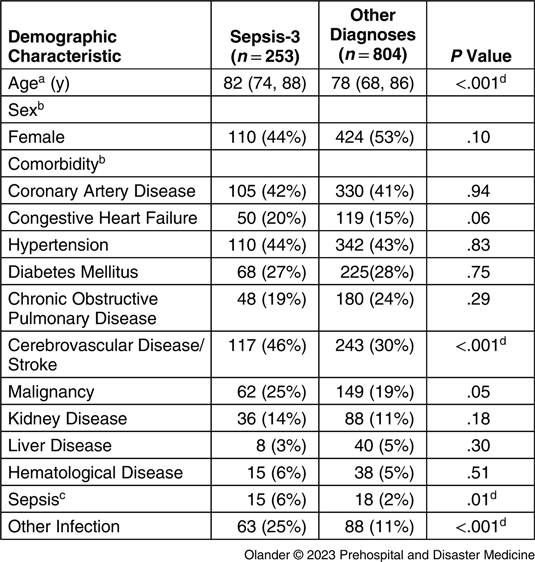
In the primary analysis, 1,057 patients were included. The mean age of the patients was 75 years, and 534 (51%) were female. Among the patients, 804 (76%) did not meet the Sepsis-3 criteria, while 253 (24%) met the Sepsis-3 criteria. The patients who met the Sepsis-3 criteria were significantly older and more frequently experienced previous sepsis or infection and cerebrovascular disease/stroke (Table 1). Of the patients who met the Sepsis-3 criteria, only 67 (26%) were suspected of having an infection in the AS according to the decision support system RETTS, ESS 47. Of the patients who met the Sepsis-3 criteria, 35 patients had sepsis according to the physician’s International Classification of Diseases (ICD) diagnosis code in the medical record.
Patient Demographic Characteristics

a Presented as the median (25th, 75th percentile).
b Presented as n (%).
c Previous history of sepsis.
d Significant (<.05).
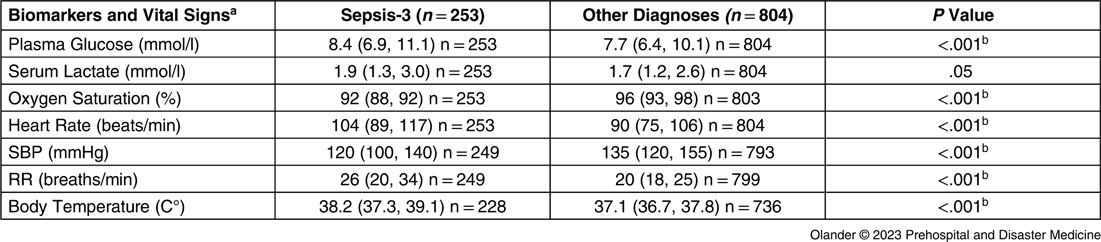
Plasma glucose, heart rate, respiratory rate, and body temperature were significantly higher (all P <.01) in patients with Sepsis-3. Oxygen saturation and systolic blood pressure were significantly lower (all P <.01) in patients with Sepsis-3. The median POC test values for patients with Sepsis-3 and patients with other diagnoses were 8.4 and 7.7mmol/l for plasma glucose levels and 1.9 and 1.7mmol/l for serum lactate levels, respectively (Table 2).
Biomarkers and Vital Signs Measured by the AS

Abbreviations: AS, ambulance service; SBP, systolic blood pressure; RR, respiratory rate.
a Presented as the median (25th, 75th percentile) n.
b Significant (<.05).
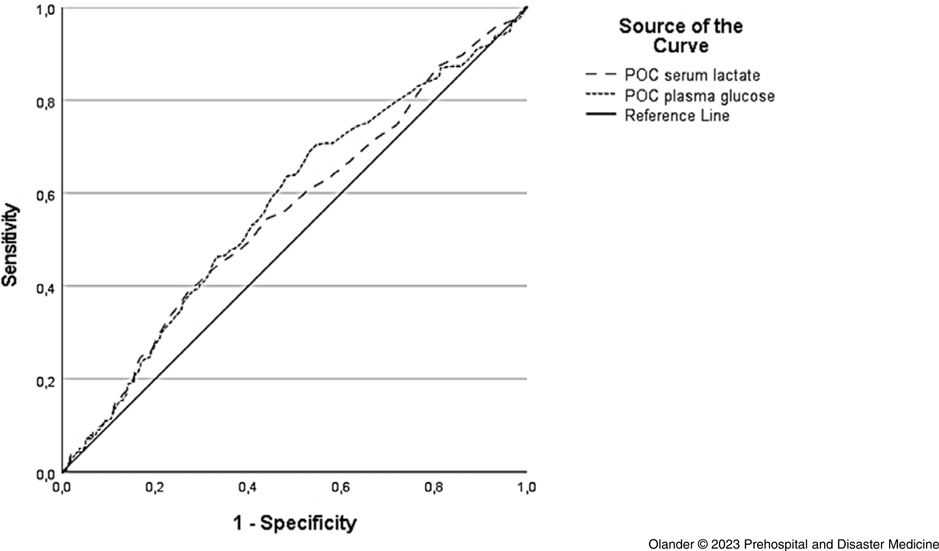
Predictive performance was assessed by ROC analysis (Figure 2). The AUCs for POC plasma glucose and serum lactate levels were 0.573 (95% CI, 0.533–0.614) and 0.558 (95% CI, 0.517–0.599), respectively, for predicting Sepsis-3. The best cut-off for plasma glucose according to the Youden index was >7.35mmol/l, with 70% sensitivity (95% CI, 64.3–75.9) and 45% specificity (95% CI, 41.9–48.9). For plasma glucose levels >7.35mmol/l, the PPV was 29% (95% CI, 26.8–31.0) and the NPV was 83% (95% CI, 79.9–85.6). According to univariate analysis, the relationship between Sepsis-3 and POC serum glucose levels was in line with the ROC curve (OR 1.03; 95% CI, 1.00–1.07; P <.03), and when adjusting the analysis to exclude patients with diabetes mellitus, no major differences were demonstrated (OR 1.04; 95% CI, 1.00–1.08; P <.03). The optimal cut-off for serum lactate levels was >2.0mmol/l, with 47% sensitivity (95% CI, 41.1–53.8) and 62% specificity (95% CI, 58.5–65.5). For serum lactate levels >2.0mmol/l, the PPV was 28% (95% CI, 25.2–31.6) and the NPV was 79% (95% CI, 76.8–81). A total of 70% of the patients with Sepsis-3 and 55% of the patients without Sepsis-3 had plasma glucose levels >7.35mmol/l. A total of 47% of the patients with Sepsis-3 and 38% of the patients without Sepsis-3 had serum lactate levels >2.0mmol/l.
ROC Curves Comparing POC Plasma Glucose and Serum Lactate Levels in Terms of Sepsis-3 Criteria in Hospitalized Patients.
Abbreviations: ROC, receiver operating characteristic; POC, point-of-care.

Secondary Analysis
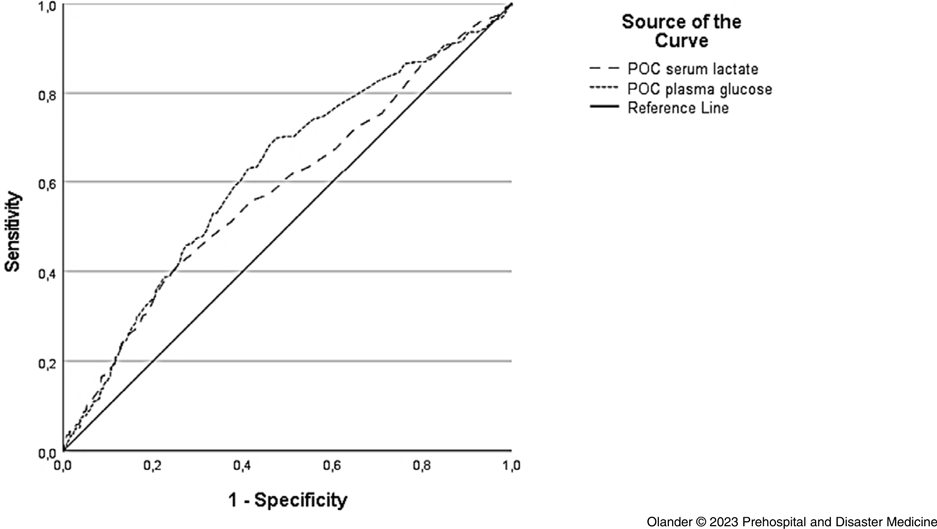
In the secondary analysis, patients who were cared for by ACs but not admitted to a hospital ward were included. The mean age of patients was 70 years, and 951 (52%) were females. Predictive performance was assessed by ROC analysis (Figure 3). The AUCs for POC plasma glucose and serum lactate levels were 0.620 (95% CI, 0.582–0.675) and 0.584 (95% CI, 0.545–0.624), respectively, for predicting Sepsis-3. The best cut-off for plasma glucose according to the Youden index was >7.15mmol/l, with 70% sensitivity (95% CI, 64.3–75.9) and 49% specificity (95% CI, 41.1–51.0). For plasma glucose levels >7.15mmol/l, the PPV was 17.9% (95% CI, 16.6–19.3) and the NPV was 91% (95% CI, 89.4–92.6). The optimal cut-off for serum lactate levels was >1.85mmol/l, with 56% sensitivity (95% CI, 49.4–61.9) and 58% specificity (95% CI, 55.6–60.5). For serum lactate levels >1.85mmol/l, the PPV was 17.5 (95% CI, 15.7–19.3) and the NPV was 89% (95% CI, 88.7–90.5).
ROC Curves Comparing POC Plasma Glucose and Serum Lactate Levels in Terms of the Sepsis-3 Criteria in All Patients Cared for in the AS.
Abbreviations: ROC, receiver operating characteristic; POC, point-of-care; AS, ambulance service.

Discussion
According to the results, none of the biomarkers analyzed in this study were found to be efficient in predicting Sepsis-3 in the AS setting separately. The findings for plasma glucose are in line with a previous study, where POC glucose (>6.6mmol/l) levels in the AS setting were not significantly associated with sepsis. Reference Wallgren, Sjölin, Järnbert-Pettersson and Kurland27 However, an increase in POC glucose levels (>11.0mmol/l) in the AS setting was found to be associated with a higher risk of death or requirement for care in the intensive care unit/ICU within 48 hours, Reference Olander, Andersson, Sundler, Bremer, Ljungström and Andersson Hagiwara20 and a high glucose level was found to be associated with a higher SOFA score in patients diagnosed with sepsis who did not have diabetes. Reference Kushimoto, Gando and Saitoh22 Questions remain if high POC plasma glucose level measured in the AS setting would help ACs to predict those at risk of worse outcomes, but not patients with a less sever sepsis. For example, hyperglycemia in time-critical conditions, such as sepsis, has been shown to predict poor outcomes in patients admitted to the hospital by the AS. Reference Kushimoto, Gando and Saitoh22,Reference van Vught, Wiewel and Klein Klouwenberg46 Furthermore, a high POC lactate levels (>4.0mmol/l) measured by the AS has shown to be significantly associated with sepsis. Reference Wallgren, Sjölin, Järnbert-Pettersson and Kurland27 However, although lactate >4.0mmol/l had the ability to predict patients with sepsis in the AS, the predictive ability to identify the disease did not decrease when lactate was removed in an assessment tool that also includes vital signs and symptoms. Reference Wallgren, Sjölin, Järnbert-Pettersson and Kurland27 This may indicate that an elevated serum lactate in the AS setting does not predict patients with sepsis. For plasma glucose, the ability to predict sepsis in a screening tool seems differently. The Robson’s prehospital screening tool used to identify severe sepsis includes vital signs, symptoms, and glucose measurements (>6.6mmol/l) has shown high sensitivity (95%) for predicting sepsis but at the cost of low specificity (43%). Reference Bayer, Schwarzkopf and Stumme13 However, this is based on the old criteria for sepsis diagnosis, which can make it difficult to use in relation to the Sepsis-3 criteria. Consequently, further studies are needed to evaluate the use of plasma glucose combined with patients’ narrative of subjective symptoms and vital signs to help predict sepsis in the AS setting.
The observation in the primary analysis also indicates that a high proportion of patients among those who did not fulfil the Sepsis-3 criteria had elevated POC plasma glucose and serum lactate levels. This may raise the hypothesis that these biomarkers may detect patients with time-sensitive conditions other than sepsis already in the AS setting. Further analyses will confirm or reject such a hypothesis.
A major finding in this study was that nearly one out of four patients (23%) who were transported to hospital by the AS and required hospitalization fulfilled the criteria for Sepsis-3. This is a higher figure than previously reported. Reference Mellhammar, Wullt, Lindberg, Lanbeck, Christensson and Linder1 However, only a minor proportion of the hospitalized patients had a final diagnosis of sepsis according to the ICD code. This finding highlights that the introduction of the Sepsis-3 criteria will change the understanding of the epidemiology of sepsis. If only ICD diagnosis codes had been used to identify patients with sepsis in this study, a lower percentage of patients would have been included. This finding is in line with a study by Henriksen, et al Reference Henriksen, Laursen, Jensen, Hallas, Pedersen and Lassen47 that demonstrated a seven-fold increase in the incidence of community-acquired sepsis when the incidence rate identified by assessing symptoms and clinical findings upon arrival at the hospital was compared with the incidence rate according to the ICD diagnosis codes. Another major finding in this study was that only 26% of those who fulfilled the criteria for Sepsis-3 were suspected of having an infection by the ACs. This result is in line with a previous study, Reference Lane, Wunsch and Saskin4 which indicates ACs needs more knowledge and tools to recognize patients with sepsis.
Limitations
This study was limited to a single data collector for the Sepsis-3 criteria. However, by re-examining selected cases, reliability tests could determine whether the data were interpreted and recorded in the same way. Based on Cohen’s kappa coefficient, an accuracy of 0.857 was demonstrated, which is considered to indicate very good accuracy for the collection of data. Reference McHugh43 In this study, patients with diabetes mellitus were not excluded, and almost one-quarter had the diagnosis, which could have influenced the findings. However, according to the univariable analyses, there was no significant difference in the relationship between glucose levels and patients with Sepsis-3 when adjusting for patients with diabetes mellitus. Another limitation is that only patients who were admitted to the hospital were selected to be examined, whether they fulfilled the Sepsis-3 criteria or not. This was done because some blood tests used as criteria to identify Sepsis-3 were completely or largely missing in non-hospital patients, which would lead to a high risk of missing data and risk of bias. However, there is a risk that a few of these patients had sepsis, and therefore, the secondary analysis must be interpreted with caution. Finally, the data collection took place in a single urban setting, which could limit the generalizability of the findings.
Conclusion
The POC plasma glucose and serum lactate, when measured in the AS setting, were not associated with an increased likelihood to predict Sepsis-3. This indicates that serum lactate and plasma glucose do not help ACs in the AS setting to recognize patients with sepsis. However, in the primary analysis, a high proportion of patients among those who did not fulfil the Sepsis-3 criteria had elevated POC plasma glucose and serum lactate levels, which may indicate that these biomarkers may detect patients with time-sensitive conditions other than sepsis in the AS setting. Therefore, the role of these biomarkers in clinical decision making before arrival at the hospital needs further evaluation of recognizing sepsis patients with worse outcomes or other time-critical conditions.
Conflicts of interest
The authors declare that they have no competing interests.