Jones' proposal, that kinship systems can be insightfully handled by recent linguistic framework of Optimality Theory (OT), is laudable for modernizing the structuralist hypothesis of kinship-language homology. Both phonological and kinship systems clearly share a number of formal properties (e.g., a finite set of elements chosen from a larger contrast space; symmetric organization; differential treatment of marked categories), and kinship terms, being linguistic items, must arguably form part of any broad theory of language structure. Jones' effort falls within the program of Cross-Modular Structural Parallelism (see, e.g., Anderson Reference Anderson1992; Nevins Reference Nevins2010), a hypothesis which seeks to minimize differences between levels or domains of linguistic structure that are not specifically required from a difference in representational “alphabet.” In effect, both the organization of a single existing system and a theory of universals and impossible systems should use the same cognitive architecture, so vowels and kinship terms will exploit the same formal mechanisms of contrast and neutralization while differing in the particular alphabet of representations, for example, referring to features such as [+/-collateral] and [+/-cross] rather than [+/-rounded].
With the parallelism hypothesis in mind, the question becomes how to deploy the same architecture in different cognitive domains, and what that architecture specifically is. To this end, let us consider three different approaches to paradigmatic contrast and markedness, drawn from morphology and phonology. In doing so, I wish to make the main point that, despite its name, Optimality “Theory” is not in itself a specific theory of such relations or their constituent parts; it is a procedure for expressing conflict among different formal constraints. As a result, Jones' endorsement of OT as the right model from phonology for representing kinship is arguably a choice at the wrong level, similar to saying that the best word-processor for typesetting mathematical formulae is a battery-powered laptop. OT is more like a hardware into which many particular constraint software applications can be loaded.
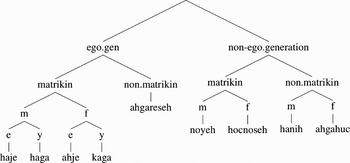
Figure 1.
Seneca kinship contrasts under a successive division algorithm.
For example, OT does not determine a phonological analysis of, say, Bulgarian unstressed vowel reduction: The “heavy lifting” of falsifiable predictions includes OT-independent decisions such as whether stress is represented in terms of metrical feet or grids; whether mid-vowels form a natural class with high-vowels to the exclusion of low-vowels, and so forth. Whether to implement these analytical claims in a monostratal, declarative, and parallel model of processing versus a serialist and procedural architecture depends on the application to particular data structures. As Jones himself says, “OT doesn't say what the rules of language are – rules differ among linguistic domains – instead, it describes how rules interact” (sect. 1).
With this in mind, recall the key phenomena Jones sets out to capture in the article: (1) markedness relations between categories – the system of contrasts expressed in one language but not another – and (2) a range of cross-linguistic variation. The example of Seneca kinship as explored in the article shows three differences from the English system:
-
(A) A distinction between cross cousins and parallel cousins, and a syncretism of parents and their parallel siblings. (M=MZ≠MB; F=FB≠FZ, as opposed to English, where M≠MZ=MB; F≠FB=FZ).
-
(B) An elder versus younger distinction in siblings (cf. English, where both are “brother”).
-
(C) Sibling/parallel-cousin syncretism.
We turn to three frameworks developed for vowel systems and/or inventories of inflectional contrasts and their application to Seneca versus English kinship:
-
1.
Dispersion Theory (e.g., Flemming Reference Flemming1995; see also Lindblom Reference Lindblom, Ohala and Jaeger1986) views contrasts and inventories as the result of system-wide pressures to minimize the number of categories crowding the vowel space, while maximizing certain important distinctions where possible. This is effectively Jones' approach to Seneca, capturing the three properties (A–C) in terms of the pairwise constraint rankings below. Cross-linguistic variation is derived by re-ranking the same universal set of constraints, which are either of the Distinguish-Category or Minimize-Terms types:
-
A. Distinguish matrikin > Minimize Parents' sibling Terms;
-
B. Distinguish grade > Minimize sibling Terms;
-
C. Minimize cousin Terms > Distinguish distance.
-
2.
Hierarchical Contrast (e.g., Dresher Reference Dresher2009; see also Goodenough Reference Goodenough1967 for kinship) derives an inventory from a pre-existing set of binary or privative/unary distinctions, through a successive division algorithm that halts when all terms constitute their own terminal nodes. In this approach, crosslinguistic variation emerges from the order in which features combine, or in which successive divisions are made. Seneca is captured as in the tree below.
-
3.
Feature-cooccurrence constraints start with universal bans on marked categories and combinations that can be “turned off” in certain languages (Calabrese Reference Calabrese2005; Noyer Reference Noyer1997; see also Archangeli & Pulleyblank Reference Archangeli and Pulleyblank1994, and see Greenberg Reference Greenberg1966 for kinship). Markedness is directly encoded in the definition of a feature. Crosslinguistic variation results from the options to turn on/off a universal set of neutralization rules. Assuming binary features in which the positive value represents the marked value, Seneca versus English results from certain features being “disallowed”:
-
Seneca: neutralize [+collateral] with [-collateral] throughout
-
English: neutralize [+cross] with [-cross] throughout
-
English: neutralize [+elder] with [-elder] throughout
Much work in phonology and morphology is devoted to comparing theories in terms of predictions for typology of possible languages, order of the acquisition of elements, and diachronic changes. These approaches differ in the data structures assumed and the corresponding discovery procedures for contrast. For example, Dispersion Theory assumes no componential features (and thus has less commitment to representational structure); Hierarchical contrast highlights the relations of contrast versus noncontrast in categories, rather than markedness; Feature-cooccurrence invokes no ranking procedure, unlike the other two. Deciding among such theories applied to kinship includes evaluating their success in expressing impossible syncretisms (e.g., F=MB≠FB), as well as necessary implicational relations (e.g., a gender contrast among cousins implies one among siblings, but not vice versa). The choice among these frameworks is largely independent from implementation within an OT or other architecture. Just as OpenOffice is the same software when running on a laptop or a desktop, the theories discussed above can be plugged into OT or into a serial and derivational framework. Enthusiasm for OT does not inextricably commit one to a Dispersion approach to contrast, and nor, importantly, vice versa.
Further dialogue and research in the area of applying theories of contrast and markedness to kinship, therefore, can disentangle which predictive components are attributable to architectural principles, such as a system of ranked violable constraints and which are attributable to specific analytic components, such as systemic tension between minimizing terms and maximizing certain distinctions, or the choices involving the particular set of distinctive features defining the “alphabet” of kinship terms.





Jones' proposal, that kinship systems can be insightfully handled by recent linguistic framework of Optimality Theory (OT), is laudable for modernizing the structuralist hypothesis of kinship-language homology. Both phonological and kinship systems clearly share a number of formal properties (e.g., a finite set of elements chosen from a larger contrast space; symmetric organization; differential treatment of marked categories), and kinship terms, being linguistic items, must arguably form part of any broad theory of language structure. Jones' effort falls within the program of Cross-Modular Structural Parallelism (see, e.g., Anderson Reference Anderson1992; Nevins Reference Nevins2010), a hypothesis which seeks to minimize differences between levels or domains of linguistic structure that are not specifically required from a difference in representational “alphabet.” In effect, both the organization of a single existing system and a theory of universals and impossible systems should use the same cognitive architecture, so vowels and kinship terms will exploit the same formal mechanisms of contrast and neutralization while differing in the particular alphabet of representations, for example, referring to features such as [+/-collateral] and [+/-cross] rather than [+/-rounded].
With the parallelism hypothesis in mind, the question becomes how to deploy the same architecture in different cognitive domains, and what that architecture specifically is. To this end, let us consider three different approaches to paradigmatic contrast and markedness, drawn from morphology and phonology. In doing so, I wish to make the main point that, despite its name, Optimality “Theory” is not in itself a specific theory of such relations or their constituent parts; it is a procedure for expressing conflict among different formal constraints. As a result, Jones' endorsement of OT as the right model from phonology for representing kinship is arguably a choice at the wrong level, similar to saying that the best word-processor for typesetting mathematical formulae is a battery-powered laptop. OT is more like a hardware into which many particular constraint software applications can be loaded.
Seneca kinship contrasts under a successive division algorithm.
For example, OT does not determine a phonological analysis of, say, Bulgarian unstressed vowel reduction: The “heavy lifting” of falsifiable predictions includes OT-independent decisions such as whether stress is represented in terms of metrical feet or grids; whether mid-vowels form a natural class with high-vowels to the exclusion of low-vowels, and so forth. Whether to implement these analytical claims in a monostratal, declarative, and parallel model of processing versus a serialist and procedural architecture depends on the application to particular data structures. As Jones himself says, “OT doesn't say what the rules of language are – rules differ among linguistic domains – instead, it describes how rules interact” (sect. 1).
With this in mind, recall the key phenomena Jones sets out to capture in the article: (1) markedness relations between categories – the system of contrasts expressed in one language but not another – and (2) a range of cross-linguistic variation. The example of Seneca kinship as explored in the article shows three differences from the English system:
(A) A distinction between cross cousins and parallel cousins, and a syncretism of parents and their parallel siblings. (M=MZ≠MB; F=FB≠FZ, as opposed to English, where M≠MZ=MB; F≠FB=FZ).
(B) An elder versus younger distinction in siblings (cf. English, where both are “brother”).
(C) Sibling/parallel-cousin syncretism.
We turn to three frameworks developed for vowel systems and/or inventories of inflectional contrasts and their application to Seneca versus English kinship:
1. Dispersion Theory (e.g., Flemming Reference Flemming1995; see also Lindblom Reference Lindblom, Ohala and Jaeger1986) views contrasts and inventories as the result of system-wide pressures to minimize the number of categories crowding the vowel space, while maximizing certain important distinctions where possible. This is effectively Jones' approach to Seneca, capturing the three properties (A–C) in terms of the pairwise constraint rankings below. Cross-linguistic variation is derived by re-ranking the same universal set of constraints, which are either of the Distinguish-Category or Minimize-Terms types:
A. Distinguish matrikin > Minimize Parents' sibling Terms;
B. Distinguish grade > Minimize sibling Terms;
C. Minimize cousin Terms > Distinguish distance.
2. Hierarchical Contrast (e.g., Dresher Reference Dresher2009; see also Goodenough Reference Goodenough1967 for kinship) derives an inventory from a pre-existing set of binary or privative/unary distinctions, through a successive division algorithm that halts when all terms constitute their own terminal nodes. In this approach, crosslinguistic variation emerges from the order in which features combine, or in which successive divisions are made. Seneca is captured as in the tree below.
3. Feature-cooccurrence constraints start with universal bans on marked categories and combinations that can be “turned off” in certain languages (Calabrese Reference Calabrese2005; Noyer Reference Noyer1997; see also Archangeli & Pulleyblank Reference Archangeli and Pulleyblank1994, and see Greenberg Reference Greenberg1966 for kinship). Markedness is directly encoded in the definition of a feature. Crosslinguistic variation results from the options to turn on/off a universal set of neutralization rules. Assuming binary features in which the positive value represents the marked value, Seneca versus English results from certain features being “disallowed”:
Seneca: neutralize [+collateral] with [-collateral] throughout
English: neutralize [+cross] with [-cross] throughout
English: neutralize [+elder] with [-elder] throughout
Much work in phonology and morphology is devoted to comparing theories in terms of predictions for typology of possible languages, order of the acquisition of elements, and diachronic changes. These approaches differ in the data structures assumed and the corresponding discovery procedures for contrast. For example, Dispersion Theory assumes no componential features (and thus has less commitment to representational structure); Hierarchical contrast highlights the relations of contrast versus noncontrast in categories, rather than markedness; Feature-cooccurrence invokes no ranking procedure, unlike the other two. Deciding among such theories applied to kinship includes evaluating their success in expressing impossible syncretisms (e.g., F=MB≠FB), as well as necessary implicational relations (e.g., a gender contrast among cousins implies one among siblings, but not vice versa). The choice among these frameworks is largely independent from implementation within an OT or other architecture. Just as OpenOffice is the same software when running on a laptop or a desktop, the theories discussed above can be plugged into OT or into a serial and derivational framework. Enthusiasm for OT does not inextricably commit one to a Dispersion approach to contrast, and nor, importantly, vice versa.
Further dialogue and research in the area of applying theories of contrast and markedness to kinship, therefore, can disentangle which predictive components are attributable to architectural principles, such as a system of ranked violable constraints and which are attributable to specific analytic components, such as systemic tension between minimizing terms and maximizing certain distinctions, or the choices involving the particular set of distinctive features defining the “alphabet” of kinship terms.