India, will you not listen to me? [. . .] I beg you to adopt our program. It is the natural growth of your own ancient culture. It is the fulfillment of Mahatma Gandhi's great scheme of life. I say, realize yourself as Aryan, Arya which was once the source of all common culture on this earth. From Iran to Assam, including Afghanistan and Nepal let us have a sense of common unity. Then, fraternize with the rest of Asia.Footnote 1
Introduction
Interwar internationalism
Sometimes, sites of Asianist engagement can be connected through the life and travels of a single man. Raja Mahendra Pratap (1886–1979) was convinced that the struggle for India's freedom could not be fought from within the country. This resulted in three turbulent decades of travel, with a view to seeking outside help to overthrow British rule in India. The majority of his life in exile was spent in various parts of Asia, over the course of which he interacted with people and groups who occupied themselves with the future of the Asian continent in various ways, ranging from Lenin to the Dalai Lama and from the University of the Toilers of the East in Tashkent to the Pan-Asiatic Society in Japan. While his plans seemed unrealistic at times, even to contemporaries, this paper maintains that his choice to work towards a unified Asia—which would, in his view, inevitably lead to an independent India—was not at all uncommon. Therefore, his ideas should be viewed in the context of the internationalist enthusiasm prevailing in the interwar period.
Histories of South Asia during the 1920s and 1930s have focused on local, communal, and national narratives, a tendency which has led to international dimensions and translocal solidarities in this period being largely overlooked. However, recent years have seen a new focus on Indian ‘transnational nationalists’ or ‘expatriate patriots’ and their myriad political agendas. It is assumed here that transnational forms of solidarity and the pursuit of national sovereignty are not mutually exclusive, but inextricably entwined.Footnote 2 The life and career of Mahendra Pratap as a revolutionary-in-exile demonstrates that his Pan-Asianist projects were strongly wedded to the struggle against imperialism and embedded in an international community of radical politics.
How does a ‘raja’ from the minor princely state of Hathras in the United Provinces come to formulate a Utopian vision of world federation, with the assumption that this new order was to start in Asia? In answering this question, this paper seeks to contribute to the ongoing exploration of the internationalist revolutionary climate in Asia during the interwar years. It hypothesizes that the life and thought of Mahendra Pratap, however quixotic, can be used to map a network of Asian revolutionary interaction. Through the very act of travelling, he became one of the threads that tied together a web of contacts that functioned as a civil society. In the course of his nomadic life, he sought out other revolutionary exiles as well as Indian expatriate communities, especially in places that were significant to his larger plan of uniting ‘Pan-Asia’, notably Moscow, Kabul, Peking, and Tokyo. These cities acted as nodal points in individual transit routes, affording a space where both exiled Indian activists and local intellectuals exchanged ideas and expressed solidarity. This is not to say they were necessarily spaces of unity and agreement. Rather, they offered opportunities to expatriates whose ideas ranged from a vague sense of anti-colonialism to the radical establishment of a new world order that would subvert empire beyond the subcontinent. It is proposed that two things were crucial to the formation of his ideas: the people and groups he interacted with and the physical routes he travelled.
To assert that Mahendra Pratap was not the only travelling revolutionary with an integrative function between disparate Asian anti-imperialist networks would be an understatement. The lives of South Asian actors such as Har Dayal, Muhammad Barakatullah or Southeast Asians such as Tan Malaka and E. F. E. Douwes Dekker, with their (sometimes overlapping) narratives of travel, activism, surveillance, and imprisonment, are well documented.Footnote 3 Even so, there are several reasons for taking Pratap's life as a tool to map interwar Pan-Asianism. His travels were unusually extensive and his contacts particularly diverse. Moreover, as yet there have been precious few attempts to look at his activities in the 1930s. Historians have tended to focus on his early years as leader of an Indo-German expedition during the Great War, which sought to instigate armed rebellion against the British in several of their Asian territories, rather than on his more eclectic projects of later years. Moreover, what little literature does exist draws heavily on his autobiography and therefore on information filtered through Pratap's own perceptions.Footnote 4 Unfortunately, contrary to what we might expect, this offers little insight into his thoughts. Pratap's autobiography is an account of his travels, detailing the trials and tribulations of life on the road, from the price of donkeys in Tibet to armed skirmishes on the steppes of Central Asia. Another impediment to a balanced account of his life is that several historians have attempted to integrate him more closely into the nationalist narrative, overemphasizing his non-communalism, his connections to the Indian National Congress, and his indebtedness to the thought of GandhiFootnote 5—who was no internationalist and no fan of Pratap's ideas. Through his secretary, Gandhi once wrote to Pratap: ‘Rather than move about from place to place doing nothing, you should take up any kind of settled job, no matter whether it is of plate-washing, or boot-blacking or hawking.’Footnote 6 And Nehru, who did share Pratap's internationalist enthusiasm, nevertheless described his first meeting with Pratap in the following way: ‘He seemed to be a character out of medieval romance, a Don Quixote who had strayed into the 20th century.’Footnote 7 This paper argues that Pratap should be viewed as an anti-imperialist rather than as a nationalist—one whose plans for India, Asia, and their place in the world included elements that were at least as important as nationalism and, indeed, frequently overshadowed it. First and foremost among these was his conviction that India's independence would materialize if Asia but stood as one. Through forging strategic alliances at various key sites in Asia, he focused primarily on the latter goal.
Mapping a life, mapping a network (1886–1929)
Mahendra Pratap was born on 1 December 1866, the third son of Raja Ghanshiam Singh Bahadur in Al-Mursan. He attended Aligarh Muslim College and married into the ruling family of Jind. He describes life at the court as a succession of dancing girls and wine.Footnote 8 Whether truth or exaggeration, this exuberance serves as a stark contrast to him attending the Indian National Congress in 1906 at Calcutta (much against the wishes of the Maharaja). This experience must have impressed him, for on his return he declared himself a Swadeshi and started to burn foreign cloth, much to the dismay of his wife who would not part with her precious dresses.Footnote 9 In 1907, still a man of considerable means, he took his wife on a trip around the world, visiting Europe, North America, and Japan. While it seems that his wife vowed never to set foot abroad again after this trip, for Pratap it marked the beginning of his years as a travelling revolutionary.
His next trip was shorter, but offers more insight into Pratap's emerging translocal solidarities. He went to Constantinople to ‘serve Turkey’ during the Balkan War. Some of his classmates from Aligarh had organized a medical mission led by Dr Muktar Ahmad Ansari which he had wanted to join.Footnote 10 By the time Pratap arrived, they had already gone to the front. He never received permission to go himself, since his host at the Turkish War Office was not only unimpressed by Pratap's devotion to the cause of Turkey, but was also highly suspicious of his non-Muslim name. Undeterred, Pratap fared better in his next attempt to meddle in a war. In 1914, he ‘began to feel decisive sympathy for the Germans who were fighting this dirty British Empire’ and wanted to see for himself ‘what it was all about’.Footnote 11 By this time the local magistrate had already begun to complain of the pro-German attitude displayed in one of the articles in Pratap's periodical, Nirbal Sewak. Pratap bade his wife and children goodbye and left for Bombay. His first stop of note was Geneva, where he met the famous revolutionary Krishnavarma,Footnote 12 Ghadar party founder Har Dayal, and later also Berlin Committee member Virendranath Chattopadhyay,Footnote 13 who travelled with him to Berlin in 1915. In that city he was received with receptions, banquets, and special tours to the front. He had an audience with the Kaiser and received the Red Eagle second class. They discussed his impending mission to Afghanistan to ask the Amir as well as several other rulers in the region to declare war on the British. A list of participants was drawn up and Pratap left for Turkey with the German diplomat appointed to the expedition, Werner Otto von Hentig.Footnote 14 Participants of note were the famous revolutionary Muhammad Barakatullah, whose language skills in Persian and Arabic were vital to the mission, and some Afghan Afridi soldiers who had been interned in Germany as prisoners of war and had volunteered their services. Before leaving for Afghanistan, they were received in Constantinople by the Sultan and his son-in-law, war minister Enver Pasha. Pratap thoroughly enjoyed the journey through the landmass of Asia, despite dysentery and high fever. They reached Kabul on 2 October 1915 and were received by King Habibullah, to whom they presented the letters from the kaiser and the sultan. Although he appeared less than enthusiastic about declaring war on the British, Barakatullah and Pratap did raise the issue of Indians interned in Afghan prisons for anti-British activities, and pressed for their release. This was a token of good faith which the king could easily provide, and Obeidullah Sindhi was among those released.Footnote 15
On 1 December 1915, Pratap, Barakatullah, and Obeidullah formally established the Provisional Government of India, with Pratap as its ‘life president’ (until government could be handed over to Congress) and the others as prime minister and home minister respectively. They dedicated themselves to the service of India: ‘When the story of the freedom of our country will be written some day this chapter of our Provisional Government of India will receive due consideration[. . .] Once, even a treaty was drawn up between us and Afghanistan.’Footnote 16 Although they received some encouragement from court factions eager for war, the amir himself seems to have interacted with the ‘provisional government’ as little as possible.
They now pinned their hopes on Russia. Pratap sent a letter to the tsar, presented on a solid gold platter, urging Russia to ‘establish her influence in Asia on a permanent basis’.Footnote 17 The tsar, however, was not minded to help them. Not much later, the Soviets proved to be more receptive, even though they seem to have been somewhat suspicious of Pratap's initial exchange of letters with the ancien regime. Nevertheless, there was more to Pratap's overtures to the Soviets than just the size and, therefore, potential political weight of the Russian landmass in Asia. Communism and the Soviet Union would play a part in Pratap's political imaginary for his whole life, which frequently got him into trouble with the British and the Japanese.Footnote 18 Pratap travelled west again and met Trotsky, who sympathized with his political views, and declared that he too wanted freedom for the oppressed Eastern nations.Footnote 19 However, news arrived that the amir had been assassinated on a hunting trip and that his son and successor Amanullah had declared war on the British. Considering this a more receptive climate for his plan—which now revolved around ‘collective action’ in Asia to oust the British—Pratap returned to Afghanistan. A mission to meet Lenin together with Barakatullah was organized on the way,Footnote 20 which inspired Barakatullah to play his own part in uniting Asia by writing ‘Bolshevism and the Islamic Nations’. This pamphlet called on the Muslims of Asia to embrace socialism, underplaying its atheism in favour of ‘the equality and brotherhood of man’ common to all beliefs.Footnote 21
On his return to Afghanistan, Pratap did indeed find the political climate at Kabul much changed, and in the spring of 1920 he was charged to deliver letters to the rulers of Tibet, China, Japan, Siam, and Turkey. By this time, Pratap had acquired Afghan citizenship.Footnote 22 He continued to present himself as an Afghan emissary throughout the 1920s. However, Afghanistan would soon denounce him, and he was forced to send back the letters after peace was made with the British in 1922 while Pratap was in Tashkent talking to Indian students at the University of the Toilers of the East. Like Moscow and Kabul, Tashkent was an important nodal point in Indian revolutionary roads through Asia, both as an important stop on the pilgrim route to Arab lands and as a site where Khilafatists and Indian communists converged. Some of the latter were trained in Moscow at the University for the Toilers of the East, which included Asian revolutionaries such as Deng Xiaoping, Tan Malaka, and Ho Chi Min among its alumni. In October 1920, Tashkent was the site of the foundation of the Communist Party of India, at which Barakatullah and Obeidullah were also present, under the leadership of prominent revolutionary Manabendra Nath Roy.Footnote 23 After his stay in Tashkent, Pratap proceeded to Moscow to be treated for typhoid, but also to meet M. N. Roy, through whom new avenues for exchange with local intellectuals and Indian expatriates were opened.
Two significant events occurred later that year: Pratap revisited Japan and met Rashbehari Bose,Footnote 24 who was to become a lifelong friend and ally. Pratap was well received and spoke regularly to his Japanese hosts on the subject of the unity of Asia and of changing tides: ‘New opinions of King Amanuallah, Comrade Lenin and Dr. Sun Yat-sen were prevailing in the East. Mahatma Gandhi was just entering on the stage of the world with his new philosophy.’Footnote 25 He stayed at a Buddhist temple in Kobe, a city with a sizeable Indian community, though few Indian émigrés would support him publicly as a result of his cooperation with Germany during the Great War, visiting him after dark instead. These clandestine visits would provide vital introductions into the Indian community on his next visit.
Nevertheless, finding the political climate in Japan only moderately supportive of his views for the moment, Pratap returned to Kabul; the Afghan foreign office still paid his salary. He wanted to embark on another trip around the world to raise money and proselytize for his cause of a united Asia. Permission for this trip was granted, together with 400 gold pounds, and Pratap was dispatched with the parting message: ‘It is not now time for Pan-Islamism, we should all work for Asian unity.’Footnote 26 He travelled to California with a view to raising money and volunteers for the Ghadar Party for a mission to Tibet. His choice of California was far from arbitrary: the road from Japan to California was a well-travelled route for Indian revolutionaries. Because of Tokyo's reputation as a host site for international radicalism, the city attracted many Indian students and several prolific and influential Ghadrites such as Taraknath Das; Barakatullah himself had spent time in Tokyo before continuing to Germany and the United States. Pratap's appeal for funds indeed succeeded beyond expectation and he sailed for Japan with 10,000 dollars and seven volunteers.Footnote 27 His Tibet mission was facilitated by Japanese and Chinese contacts, but he never managed to reach Lhasa. He wrote to the Dalai Lama from Chamdo in February 1926, but in the return letter, sent in April, the Dalai Lama, although full of praise for Pratap's mission, would not allow him to proceed to Lhasa.Footnote 28 Now stuck in the Himalayas, the seven volunteers grew disaffected with Pratap and proceeded to China, forming new Ghadar nuclei in Hankow and Shanghai.Footnote 29 Ironically, and rather unfairly, Pratap would later boast of their success in inducing Sikhs to desert from the Indian Brigade in Shanghai.Footnote 30 With money running out after the lengthy stay in Tibet, Pratap himself decided to return to China and received an invitation to attend the first Pan-Asiatic Conference at Nagasaki in the summer of 1926.
Pratap did not manage to reach Nagasaki either: on the way to Japan his passport was stolen, which, with the Japanese already nervous and somewhat unwilling to host the conference, was a much more convenient pretext to prevent Pratap from landing in Japan than charges of political radicalism.Footnote 31 It took an intervention from his Japanese friends for him to be allowed a few days’ leave to visit Osaka and meet some of the conference participants there, as well as locally resident Indians. However, he did make it to the Second Pan-Asiatic Conference in Shanghai in 1927, dodging a British search party with a warrant for his arrest, and was thereafter ‘more carefully guarded than a treasure’.Footnote 32 The Japan Advertiser published a long interview with him on 21 October 1927, and the Osaka Mainichi in Japan and the China Press in China followed his movements with interest.
The publicity surrounding Pratap, which almost exceeded that of the conference itself, fed the ongoing, behind-the-scenes British debate on the amount of harm Pratap could possibly do, and whether things would be made worse by his arrest. On the one hand, Pratap seemed to be taken seriously in the Far East. That he had support among the Indian diaspora too, was evident: an illustrative example is the arrest of three illiterate migrant workers in their thirties from Hoshiarpur, who declared that Pratap had ‘inspired confidence’ that he could raise an insurrection with the help of Nepal, Afghanistan, and Russia.Footnote 33 On the other hand, British intelligence found comfort in reports that, ‘Mahendra Pratap is receiving little encouragement from official circles in Japan’Footnote 34 and that the Afghan minister at Moscow regarded Pratap as a ‘tiresome and unbalanced individual’.Footnote 35 The best evidence of conflicting reports comes from China, where Pratap interacted with both Chinese and Indians from various local organizations and set up an ‘Asiatic Culture League’ in Hankow, even though it was reported that the local Indians were traders who had little patience for ‘Mahendra Pratap's vague and sentimental internationalist schemes’.Footnote 36 On balance, the British stood by their former conclusion that Mahendra Pratap's ‘power for mischief has been steadily dwindling’ and that his communications contain ‘clear evidence of a certain softening of the brain’.Footnote 37
The last remark probably referred to Pratap's newest mission. Around this time his plan to form a ‘province of Pan-Asia’ (which he alternatively called ‘Province of Buddha’, with South and Southeast Asia as ‘Aryan’) is first encountered: ‘I just want to see our Aryan developed into a free, powerful State, as a part of an autonomous Asia, in our World Federation. My services will go [. . .] to arouse the peoples of Aryan to carve out their destiny!’Footnote 38 His plans to further this end by organizing a Third Pan-Asiatic Conference in either Tehran or Kabul fell through for lack of interest there, but he was undeterred. The ‘World Federation Movement’ was born in 1929 with the start of his periodical of that name. Apparently, though, the ‘softening of the brain’ was spreading, as Rashbehari Bose and prominent Pan-Asianists Imazato Juntaro, Shumei Okawa, and Yonezo Fujiwara declared themselves directors of the Pan-Asiatic League alongside Pratap, and sent their declaration to the New Forward in Calcutta.Footnote 39 Pratap would spend the best part of the next decade working towards creating ‘the province of Pan-Asia’ with the Far East as his base. The next section of this paper is concerned with his ideas and their reception and is presented in three parts: his plans for Asia; the formation of an Asian army; and the place of Japan in bringing about a new Asian order.
World Federation 1929–1939
Pan-Asia, province of Buddha
The first issue of World Federation provides a glimpse into Pratap's plans for Asia. He writes about the ‘Eastern Oppressed People's Society’ of Nanking, and lets his readers know that Sadhu Singh, an Indian in China, is involved in this cause, and that Pratap's own ‘heart is in their midst’.Footnote 40 This idea in itself had some currency: through Pratap, Nehru too expressed interest in this society, and said that with some more information he would try and affiliate the organization to the Indian National Congress.Footnote 41 Pratap also published Rashbehari Bose's recommendations for the Indian National Congress in this issue, thus providing a platform for linking the Indian community in Japan, who maintained a local branch of the Indian National Congress, to India. He adds that, ‘Congress should kindly adopt the principle of the World Federation as its creed and agree to support the movement of Pan-Asia as a part of world federation.’ Though never adopted, this was not as far-fetched a recommendation as it may seem at first sight—a world federation was a popular ideal at the time, and in the thick of transnational-nationalist contacts.Footnote 42
There were several reasons why Pratap felt that a world federation, in any shape or form, should start in Asia. One was his conviction that all world religions were born on that continent, that they were all inherently peaceful, and contained elements of Buddhism in some form or other.Footnote 43 The message of the Buddha, moreover, was a potential unifier for all of Asia.Footnote 44 The watchwords were ‘renunciation and service’, versatile terms which would also appeal to Muslims, Hindus, and Buddhists as well as socialists. His call to arms: ‘Enough of the great Napoleons! [. . .] We need men and women who will take a vow of renunciation and shall work for the unity and welfare of the Golden District of the Far East in the Province of Pan-Asia of the World Federation.’Footnote 45 However, aside from this positive definition of Asian unity, he also discerned a more negative understanding of it, which was the anti-Westernism prevalent in Asia at the time. This he considered to have potential, provided it was carefully guided into a softer form. In the November 1930 issue of World Federation (published from Tokyo) he explains: ‘The conception of a vague Asian unity has been brought about more by non-Asiatic endeavour than by the Asiatics themselves. [. . .] Many people having Asiatic consciousness well nigh hate Europe and Europeans. We endeavour, however, to correct the attitude of Asiatics and Europeans to one another. We explain that all the peoples of Europe are the children of the early Asiatic colonizers who colonized the north-west peninsula of the old world.’Footnote 46 In other words, Asia was to be a cradle once more.
It must be mentioned that certain circles in Japan were not wholly opposed to Pratap's ideas. The year 1930 saw the formation of the Koagakuji-Ku or the school for the generation of Asia. Pratap lectured its students on Japan's duty to Asia, a topic which was well received and led to the establishment of a branch of the World Federation Movement at this school. Asianist associations of many colours found fertile ground in Japan at this stage, and Pratap was always invited to applaud their existence: ‘Chinese students had arranged a meeting to formulate a program of a certain Asiatic Society [. . .] At the end of a very elaborate Chinese dinner a photograph was taken. Dr. Sun Yat-sen and Mahatma Gandhi's photographs were held over the group.’Footnote 47 There were many similar meetings, but this photograph illustrates the overlapping of Asian nationalist networks with Asianist associations in this period.
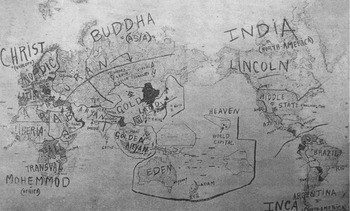
In his speeches, Mahendra Pratap seems to have consciously tried to be as vague as possible in order to broaden his support base. However, his plans for the physical layout of Asia were far from ambiguous. In the November–December 1933 issue of World Federation, he even published a world map detailing his plans for the new order. The Province of Buddha was to have five districts: ‘Golden Land’ (Japan, Korea, Manchukuo, Tibet, and China); ‘Aryan’ (Persia, Afghanistan, and India up to Assam); ‘Golden Aryan’ (Burma, Siam, Anam, Cambodia, Malaya, the Philippines, and Indonesia); ‘Turan’ (a proposed union of Turkish- and Russian-speaking peoples); and ‘Arab’ (including North Africa). Since the holy places of Islam were situated in ‘Arab’, this district was to be common to Mohemmod (Africa) and Buddha. Shanghai was to be Sun-Ching (‘Sun’ because of Sun Yat-sen), and Moscow was to be rechristened ‘Carl Marx’. The world federation capital was to be in ‘Heaven’ (Hawaii) (see Figure 1).Footnote 48
World federation map. Source: Published in World Federation, VII (4), 1935.

A modern readership cannot help but wonder how these Utopian ideals connected with the realities of Asian peoples at the time. Moreover, considering his travels through Asia and his encounters there, this map seems more of a landscape of Pratap's own experiences than a serious plan. However, it is important to realize that ‘Asia’ was still an unformed entity in the minds of Pratap and many others. No conception of Asia was barred as long as it could weave separate strands into a single Asian braid. Pratap's talks on Pan-Asia and its districts were well attended by his followers and supporters, notably Indians in China (Peking, Hankow, and Shanghai) and Japan (Kobe and Tokyo). His inclusion of Soviet Asia, too, found support in several circles.
Asian army
By far the most difficult and most controversial of Pratap's Pan-Asian projects was the formation of an Asian army. Considering Pratap's espousal of Buddhist pacifism and his declarations of support for Gandhi's non-violence movement, it is probably the hardest to reconcile with his other views. Furthermore, the idea of his Asian army emerged from the Pan-Asiatic Conference at Dairen in March 1934, which convinced all non-Japanese in Asia that it was not Pratap's brainchild at all, and that the Japanese just needed ‘an Afghan’ to carry this bellicose resolution. The choice of Asian army directors exacerbated the issue: they were all Japanese. The China Press, for one, was puzzled: ‘If this outline is regarded not as a work of the imagination of a broken-down adventurer and propagandist, but as one that has been carefully thought out by imperialistic dreamers, it may be read with great interest.’Footnote 49 The newspaper found it ‘symptomatic of the megalomania that seems to afflict so many Japanese in all ranks of society today’, but that does not suffice as an explanation—for how can a ‘highly practical people like the Japanese really interest themselves in a movement so fantastic, so fatuous and futile as that of an Asiatic Army?’Footnote 50 The British intelligence services were even less generous: ‘The manifesto, it will be observed, is signed amongst others by Pratap and its wording [. . .] reveals a very strong resemblance to the latter's usual dithyrambic style.’Footnote 51
Pratap, too, did not see his Asian army as a purely Japanese project. He set out to find additional directors: ‘one Manchu, one Mongol, one Tibetan and three Chinese’.Footnote 52 He speaks of a ‘volunteer corps throughout Japan, Korea, Manchukuo, China, Tibet and Mongolia to unite these family members of one great cultural house’.Footnote 53 But then Pratap lost the crucial support of the Indian expatriates in China. In their eyes, this latest plan disqualified all his other ideas. The China Press tells us in April 1934: ‘The Indians in China are particularly bitter towards the so-called Raja Mahendra Pratap [. . .] Pratap is accused specifically of deceiving his countrymen for the last 15 years by his occasional anti-British outbursts and patriotic phrases which concealed his real object of working for his Japanese masters. [They] vehemently criticize a certain “treacherous handbill” that Pratap has circulated among both Indians and Chinese calling for the formation of a powerful Asiatic army to fight for Japan if necessary.’Footnote 54
But was this indeed Pratap's vision of an Asian army? And was it Japan's? In 1932, Pratap still only had vague ideas of helping to fight the oppressors of India. In 1933, he pitched his plan to Japanese army general Kuniaki Koiso, but was told that ‘the Japanese army would realize all the freedom necessary’.Footnote 55 However, after the idea was approved at the Dairen Conference, he reported having enlisted over 300 volunteers for the Asiatic army. But even Pratap himself doubted those numbers: ‘Some of these names do not count for anything. They simply put down their names at our mere request. But on the other hand, many more are ardent supporters.’Footnote 56 Three ‘recruiting centres’ were opened at Tokyo, Dairen, and Tsingtao.Footnote 57
It seems that after 1935, Pratap distanced himself from the idea of an actual Asian army. In his diary for that period, he implies that the word ‘army’ had been a bone of contention all along, but that it should not be taken literally: ‘we work to humanize all walks of life. We hope to create new sense for the old barbarous terms.’Footnote 58 For Pratap, the Asian army ended here. He disengaged himself from the movement, claiming that his vision of the army as a purely ‘moral force’ had been abused. But his name remained attached to the idea, and by the Second World War, the Peking Chronicle for one had tied these earlier initiatives to the future core of the Indian National Army: ‘In Indo-China there are about 6,000 Indians, 30,000 in Thailand and 60,000 in the Federated Malay States. Raja Mahendra Pratap is looking to these national groups in particular to form the native army which will finally overthrow British rule in India.’Footnote 59 However, the establishment of the Indian National Army was never part of Pratap's vision—his army was to be international, and composed of international leadership, a crucial point which was agreeable to neither the Japanese, nor to the later Indian National Army leadership.
Japan and the creation of Pan-Asia
It is clear that at some point in the 1930s, Pratap's name became inextricably attached to Japan. The most important result of this was that he had less space to forge strategic (and temporary) alliances throughout Asia. In order to understand how this happened, three interlinked questions need to be asked: What was Japan's role to be in his project of unifying Asia? How did his network and his travels contribute to a climate of collaboration? And in what way was Pratap useful to the Japanese?
First, Pratap was always quick to say that he was not one of those who believed Japan to be the only leader in Asia. Leadership was a question to be decided by ‘all the lands of Asia’, but, added Pratap, he preferred ‘comradeship’ as it was more fitting to the times. Nevertheless, he had a clear recommendation: ‘Let us all be co-workers for our common welfare [. . .] we can then all admire the great achievements of the Japanese people as we unhesitatingly pour out praises for the lovely scenes of these flower beds of the sea.’Footnote 60 His master plan for the ‘Golden district’ was a board of ‘enlightened human beings’ from both Japan and China who would draw up a plan of mutual cooperation among the peoples of the Far East.Footnote 61 Moreover, he had faith in the good intentions of Japan, and the fact that ‘Tokyo is rich in internationalism.’Footnote 62
This feeds into the second question. The internationalist circles in Japan, both inside and outside of the Indian community, kept Pratap in Japan for most of the 1930s and also encouraged his faith in Japan as the site from which Asian unity was to emerge. The existence of the Pan-Pacific Good Relations Club, the Oriental Women's Association, the Oriental Cultural Society, the Asiatic Lodge, the Asiatic League, and many others fed this belief. The Indian community, especially in Kobe, did not lag far behind with Indo-Japanese youth associations, Indo-Japanese Buddhist associations, and Indo-Japanese student associations.Footnote 63 The bridge between Indian and Japanese Asianist societies was built by an unlikely trio of friends: Anand Mohan Sahay, leader of the Indian National Congress branch in Japan; Rashbehari Bose, a noted revolutionary who was firmly entrenched in Japanese society in terms of citizenship, language, and contacts; and Pratap himself. Together, they held places on the boards of many of these societies, attended dinners and gave lectures, thus forging an extensive network that fused together Pan-Asianism and India's struggle for independence. Of course, World Federation as a publication had an integrative function all of its own, with subscriptions high enough in the early 1930s to warrant both an Urdu-Gurmukhi and a Chinese-Japanese edition. This led the British to finally ban the publication, which initially they had not seen as a threat.Footnote 64
How was the entry of Indian revolutionary elements into Japanese Pan-Asianism received by the Japanese themselves? If the British intelligence records of the early 1930s are to be believed, it would be easy to conclude that Japan regarded Pratap and his colleagues as a collection of overzealous incompetents who had no Japanese political backing.Footnote 65 But it has to be taken into account that, in the interest of good relations between Japan and Britain in the interwar period, the chances were slim that Japan would publicly support Indian seditionists on the government of India's ‘most wanted’ list. Moreover, the critical attitude of Indian political leaders towards Japan's policy in China was a disappointment to the militarist school in Tokyo.Footnote 66 But actions speak louder than words, and from 1933 onwards Pratap was regularly paid to travel to Manchukuo and speak at Chinese schools about the blessings of Japan's leadership in Asia. His visits and his (inevitable) reports that the Pan-Asianist spirit in those parts was growing, were widely publicized in Japan.Footnote 67 Pratap himself did not feel he was being used by the Japanese. Optimistic right to the brink of war, he felt the Japanese were helping him to realize his goals: ‘I must confess that this hopeful spirit is especially created by the great victories of the Imperial Army and the Imperial Navy [. . .] With the help of these victorious forces I can build our free Aryan in no time.’Footnote 68
Eclipse of Pan-Asia and the war years
When war broke out, the province of Buddha no longer offered the possibilities it once had. Pratap's corresponding loss of faith in Japan as the leading force of Asian unity is a notable break in his thinking. He now had to prevent his vision of Asian unity from clashing with Japan's imperialist conception of a Pan-Asian union under Japanese leadership. But however much Mahendra Pratap had been deliberately ambiguous about his plans for Asia in terms of the crucial points of armed struggle, and the form and future of Asian leadership, by the time war broke out it had become clear that his vision clashed with that of Japan's Greater East-Asia. As a result, Mahendra Pratap was forced to lead a quiet life during the war years and did not involve himself with the emerging plans for the Indian National Army—even though the idea was largely his. He spent most of his time alone, reminiscing in a World Federation with dwindling subscription numbers, revisiting the interwar years in which Asia had still been a blank canvas with unlimited potential for sketching the unified continent of his dreams. Nevertheless, Pratap was briefly interned as a war criminal at the notorious Sugamo prison during the American occupation of Japan. He was later allowed to return to India, where he was received with all the enthusiasm due a true patriot.Footnote 69 While this might seem strange, given that most of Pratap's activities were both physically and mentally far removed from the purview of Gandhian nationalism, this was part of a larger context in which exiled revolutionaries were welcomed back—regardless of their politics—in recognition of their personal sacrifices and as ‘forgotten men’ of the struggle for independence.Footnote 70 This was most evident at the All-India Old Revolutionaries’ Conference, held in New Delhi on 13 and 14 December 1958, in which 300 revolutionaries took part. Bhupendranath Dutta, conference President and younger brother of Swami Vivekananda, proposed in his opening speech that the revolutionaries had extended the struggle to foreign countries and that therein lay their contribution.Footnote 71 India's President Rajendra Prasad was a little less generous but tried to reconcile the most obvious contradiction by sending a message to the Old Revolutionaries’ Conference that though the nation was wedded to non-violence, ‘the contribution of the revolutionaries to the movement for independence was no less valuable’.Footnote 72 Prime Minister Nehru, finally, entertained all the delegates to tea. But there were dissenting voices. Some of the delegates were still quite vocal in their dislike of Gandhian thought, even to the press; and Pratap, who took an active part in the proceedings, made a public speech in front of the Jama Masjid criticizing the government and reiterating once more his plans for world federation. If the world had changed, Pratap had not. Dismissing ‘pious sermons of nationalism’ and democracy, as well as Nehru's concept of Afro-Asian unity, he called upon the government and the people to finally realize a federated ‘Aryan’ as a province of Asia in a federated world.Footnote 73
Pratap served as an MP from 1957 to 1962. Having survived years of travel, prison cells, armed skirmishes, fevers, and even typhoid, he finally died at home at the ripe old age of 93.
He developed a spiritually charged conception of Asian unity in which a federated Asia would in time become part of a federated world. His thought was an intricate patchwork of internationalist ideas circulating in the interwar period, some of which were so contradictory that he was both nominated for a Nobel Peace Prize and interned on charges of war crimes within the space of 15 years.Footnote 74 However quixotic his plans may have been, the strategic alliances he forged to execute them were very real. He tailored his propaganda to fit Islamists in Kabul and communists in Moscow. From the mid-1920s onwards, Pratap found support for his ideas, notably in China and Japan, where he raised money among Indian expatriate communities and interacted intensively with his contacts on the ground. He certainly lived his idea of a Pan-Asia through his travels, demonstrating the physical connectedness of the continent by showing that no part of Asia was so remote that it could not be reached by train, camel, motorcar or donkey. His exploration of the relationship between the local, the regional (continental), and the global, from an Asian springboard, is one of a myriad ways in which Asian elites and non-elites have challenged the legitimacy of the world order in the interwar period. Through his travels and his contacts, he tied together a network that played an active part in the formation of a popular counter-narrative: that of a new Asian order.