Introduction
Advances in neonatal care during the past few decades resulted in increased survival of infants born preterm or with low birth weight (Fanaroff et al., Reference Fanaroff, Stoll, Wright, Carlo, Ehrenkranz, Stark and Poole2007; Stoll et al., Reference Stoll, Hansen, Bell, Shankaran, Laptook, Walsh and Higgins2010). These increases have been the most dramatic for extremely preterm/extremely low birth weight (EPT/ELBW) children – defined as those with gestational age (GA) <28 weeks and/or birth weight <1000 g. Unfortunately, survival comes at a cost as these children are at high risk for a variety of developmental problems including cognitive deficits, poor academic achievement, and behavior disorders (Anderson et al., Reference Anderson and Doyle2003; Stjernqvist & Svenningsen, Reference Stjernqvist and Svenningsen1999; Taylor, Reference Taylor2010). Studies of EPT/ELBW children recruited at middle to later school age that controlled for IQ or vocabulary ability have also demonstrated specific deficits in memory, visual-spatial and perceptual-motor skills, attention, and executive function (EF) (Bayless & Stevenson, Reference Bayless and Stevenson2007; Kulseng et al., Reference Kulseng, Jennekens-Schinkel, Naess, Romundstad, Indredavik, Vik and Brubakk2006; Taylor, Minich, Bangert, Filipek, & Hack, Reference Taylor, Minich, Bangert, Filipek and Hack2004).
Research on cognitive outcomes in EPT/ELBW children at 6 years of age or younger reveal deficits in IQ, expressive and receptive language skills, spatial reasoning, visual motor integration, and EF (Baron, Erickson, Ahronovich, Baker, & Litman, Reference Baron, Erickson, Ahronovich, Baker and Litman2011; Baron, Erickson, Ahronovich, Litman, & Brandt, Reference Baron, Erickson, Ahronovich, Litman and Brandt2010; Dewey et al., Reference Dewey, Creighton, Heath, Wilson, Anseeuw-Deeks and Crawford2011; Gidley Larson et al., Reference Gidley Larson, Baron, Erickson, Ahronovich, Baker and Litman2011; Marlow, Hennessy, Bracewell, & Wolke; Reference Marlow, Hennessy, Bracewell and Wolke2007; Mikkola et al., Reference Mikkola, Ritari, Tommiska, Salokorpi, Lehtonen, Tammela and Fellman2005; Woodward et al., Reference Woodward, Moor, Hood, Champion, Foster-Cohen, Inder and Austin2009). Studies of very preterm (GA ≤32 weeks) children at this age level reveal similar findings (Aarnoudse-Moens, Smidts, Oosterlaan, Duivenvoorden, & Weisglas-Kuperus, Reference Aarnoudse-Moens, Smidts, Oosterlaan, Duivenvoorden and Weisglas-Kuperus2009; Lind et al., Reference Lind, Korkman, Lehtonen, Lapinleimu, Parkkola, Matomake and Haataja2011). Several of these studies document selective cognitive deficits. For example, Marlow et al. (Reference Marlow, Hennessy, Bracewell and Wolke2007) found that 6-year-olds with GA ≤25 weeks had lower scores than term-born normal birth weight (NBW) classmate controls on measures of visuospatial skills, motor and sensorimotor abilities, and attention and EF, even when controlling for global cognitive ability. Similarly, Lind et al. (Reference Lind, Korkman, Lehtonen, Lapinleimu, Parkkola, Matomake and Haataja2011) and Mikkola et al. (Reference Mikkola, Ritari, Tommiska, Salokorpi, Lehtonen, Tammela and Fellman2005) found more adverse effects on Performance IQ than on Verbal IQ. However, other studies document language delays in young preterm children, suggesting that this cognitive domain may not be selectively spared and raising the possibility of more generalized deficits in younger than in older children (Foster-Cohen, Friesen, Champion, & Woodward, Reference Foster-Cohen, Friesen, Champion and Woodward2010; Luoma, Herrgard, Martikainen, & Ahonen, Reference Luoma, Herrgard, Martikainen and Ahonen1998; Ment et al., Reference Ment, Vohr, Allan, Katz, Schneider, Westerveld and Makuch2003; Mikkola et al., Reference Mikkola, Ritari, Tommiska, Salokorpi, Lehtonen, Tammela and Fellman2005; Wolke, Samara, Bracewell, & Marlow, Reference Wolke, Samara, Bracewell and Marlow2008; Woodward et al., Reference Woodward, Moor, Hood, Champion, Foster-Cohen, Inder and Austin2009).
Further studies using comprehensive assessments of neuropsychological skills are needed to establish the pattern of cognitive deficits exhibited by EPT/ELBW children at school entry. Assessments targeted specifically to children enrolled in kindergarten would help specify the nature of their difficulties as they begin to take on the challenges of formal education and are in a setting in which special interventions may be available for the first time, at least for children from less advantaged backgrounds. No studies of which we are aware have selected EPT/ELBW children for assessment based on enrollment in kindergarten and few have conducted in-depth evaluations at this age level of skill domains that are especially vulnerable to extreme degrees of preterm birth and low birth weight, such as EF. Recognition of types of cognitive weaknesses to which EPT/ELBW children are prone at school entry would also useful determining how best to identify those needing special educational assistance (Mulder, Pitchford, & Marlow, Reference Mulder, Pitchford and Marlow2010). Early identification is especially critical in view of evidence that learning problems frequently go unrecognized for several years after school entry (Avchen, Scott, & Mason, Reference Avchen, Scott and Mason2001). Determining a child's need for special education at or soon after school entry, followed by appropriate interventions, has the potential to diminish long-term educational and social problems that occur in EPT/ELBW adolescents and young adults (Belsky & Mackinnon, Reference Belsky and Mackinnon1994; Espy, Fang, Charak, Minich, & Taylor, Reference Espy, Fang, Charak, Minich and Taylor2009; Johnson et al., Reference Johnson, Hennessy, Smith, Trikic, Wolke and Marlow2009; Rimm-Kaufmann et al., Reference Rimm-Kaufmann, Pianta and Cox2000).
Another reason to focus on kindergarten outcomes is to determine which children are most in need of neuropsychological evaluations at the time of school entry. Previous research indicates that risks for more adverse cognitive outcomes include lower birth weight, lower GA, and neonatal complications such as brain abnormalities evident on neonatal cranial ultrasound, bronchopulmonary dysplasia (BPD), and infection (Aarnoudse-Moens et al., Reference Aarnoudse-Moens, Smidts, Oosterlaan, Duivenvoorden and Weisglas-Kuperus2009; Bohm & Katz-Salamon, Reference Bohm and Katz-Salamon2003; Bohm, Katz-Salamon, Smedler, & Forssberg, Reference Bohm, Katz-Salamon, Smedler and Forssberg2002; Bohm, Smedler, & Forssberg, Reference Bohm, Smedler and Forssberg2004; Larroque et al., Reference Larroque, Ancel, Marret, Marchand, Andre, Arnaud and Kaminski2008; Leonard et al., Reference Leonard, Clyman, Piecuch, Juster, Ballard and Behle1990; Ment et al., Reference Ment, Vohr, Allan, Katz, Schneider, Westerveld and Makuch2003; Patrianakos-Hoobler, Msall, Marks, Huo, & Schreiber, Reference Patrianakos-Hoobler, Msall, Marks, Huo and Schreiber2009; Taylor, Klein, Drotar, Schluchter, & Hack, Reference Taylor, Klein, Drotar, Schluchter and Hack2006). Neurodevelopmental impairment (NDI) in early childhood is also related to cognitive deficits at school age (Dewey, Crawford, Creighton, & Sauve, Reference Dewey, Crawford, Creighton and Sauve1999; Marlow, Reference Marlow2004; Patrianakos-Hoobler, Msall, Huo et al., Reference Patrianakos-Hoobler, Msall, Huo, Marks, Plesha-Troyke and Schreiber2009; Roberts, Anderson, & Doyle, Reference Roberts, Anderson and Doyle2010; Sullivan & McGrath, Reference Sullivan and McGrath2003).
The objective of this study was to assess the neuropsychological skills of a recent birth cohort of EPT/ELBW children in kindergarten relative to NBW controls and to identify factors related to poorer cognitive outcomes. Our primary hypothesis was that EPT/ELBW children would have deficits across multiple ability domains relative to term-born NBW controls but that impairment in EF and spatial and perceptual-motor skills would be evident even when controlling for a measure of crystallized verbal intelligence. A secondary hypothesis was that cognitive deficits in the EPT/ELBW group would be more prevalent in children with extreme degrees of preterm birth or low birth weight, neonatal complications, early childhood NDI, and lower socioeconomic status (SES).
Methods
Participants and Recruitment
The EPT/ELBW sample included 148 children with GA <28 weeks and/or birth weight <1000 g admitted to the Neonatal Intensive Care Unit at Rainbow Babies and Children's Hospital between 2001 and 2003, comprising 75% of the 198 surviving infants treated during this period. Children with congenital infections and malformations were excluded. Ten of these children (7%) were born in other hospitals (i.e., outborn) and transferred to the neonatal center for treatment. Reasons for non-participation included failure to locate families (n = 21), moves out of the area (n = 16), and refusals to participate or failure to keep appointments (n = 5). Eight other children who were non-English speakers or for whom custody could not be established were also excluded. Comparison of the participants with the 50 non-participating survivors failed to reveal differences in sex, race, GA, birth weight, cranial ultrasound abnormality, BPD, infection, or retinopathy of prematurity.
A term-born NBW control group of 111 children with GA >36 weeks and birth weight >2500 g was recruited by enrolling classmates of the EPT/ELBW children attending regular kindergarten classrooms. Parents of NBW controls were not asked if their children were born post-term. However, as obstetrical practice dictates delivery before 42 weeks, few if any of the controls were likely to have been born at a GA >41 weeks. We recruited the closest available NBW classmate match based on age at assessment, sex, and race from among those children whose parents granted permission for us to contact them. If we were unable to enroll a match from the EPT/ELBW child's classroom, we recruited one from another classroom at the same school or a demographically similar one. As suitable controls for some EPT/ELBW children were unavailable and some schools refused participation, we were unable to recruit controls for 18 of the 129 EPT/ELBW children in regular classrooms.
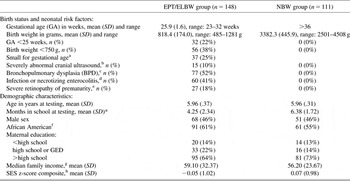
The birth status and demographic characteristics of the two groups are summarized in Table 1. Comparisons of the EPT/ELBW and NBW groups failed to reveal significant differences in sex, race, or socioeconomic status (SES) as measured by a composite of the sample z scores for maternal education, caregiver occupation as assessed by a socioeconomic index and averaged for two-parent households (Hauser & Warren, Reference Hauser and Warren1997), and census-based median family income for the neighborhood in which the family resided (Taylor et al., Reference Taylor, Klein, Drotar, Schluchter and Hack2006).
Birth status and demographic characteristics of EPT/ELBW and NBW groups

Note. The majority of the sample (112, 76%) had GA <28 weeks and birth weight <1000 g, whereas 21 (14%) had GA <28 weeks with birth weight ≥1000 g and 15 (10%) had birth weight <1000 g birth weight with GA ≥28 weeks. EPT/ELBW = extremely preterm; NBW = term-born normal birth weight; GED = General Education Diploma; SES = socioeconomic status, with z-score defined as mean of sample z-scores for maternal education, caregiver occupation, and census-based median family income.
aSmall for GA as defined by birth weight >2 SDs below expectation for GA based on standard reported by Yudkin, Aboualfa, Eyre, Redman, and Wilkinson (Reference Yudkin, Aboualfa, Eyre, Redman and Wilkinson1987). The high rate reported here partially reflects selection of children who were ≥28 weeks GA but who had birth weight <1000 g, all of whom were small for GA. The rate was lower for children with GA <28 weeks (17%) and consistent with rates reported in other studies (Fanaroff et al., Reference Fanaroff, Stoll, Wright, Carlo, Ehrenkranz, Stark and Poole2007; Stoll et al., Reference Stoll, Hansen, Bell, Shankaran, Laptook, Walsh and Higgins2010).
bSeverely abnormal ultrasound defined as clinician-identified Grade III/IV intraventricular hemorrhage, periventricular leukomalacia, or ventricular dilatation at discharge.
cBPD defined as supplemental oxygen at 36 weeks corrected age.
dIncludes 9 cases of necrotizing enterocolitis (6% of sample), 56 of septicemia (38%), and 2 of meningitis (1%). Five children had both septicemia and necrotizing enterocolitis and 1 had all three conditions.
eSevere retinopathy defined as Stage 4 or 5 retinopathy or treatment with cryotherapy or laser therapy (Schmidt et al., Reference Schmidt, Asztalos, Roberts, Robertson, Sauve and Whitfield2003).
fAll others Caucasian except for 4 Asian (2 in each group).
gBased on data on the neighborhood tract of the family residence from the 2000 US Census (Federal Financial Institutions Examinations Council Geocoding System, 2010). Family income is in thousands of dollars.
hSES was measured by a composite of the sample z scores for maternal education, caregiver education, and census-based family income.
*Significant group difference, p < .01; group differences in birth/neonatal status by definition. All other differences non-significant.
Procedure and Measures
Each child was assessed by a research assistant in a single half-day session while a second assistant interviewed the child's caregiver regarding family characteristics. Children were assessed during their initial year in kindergarten. Tests were administered by examiners who were blind to the child's birth status in a fixed order with breaks provided to reduce fatigue. Although child assessments also included measures of academic achievement and behavior, the present study focused on results from cognitive testing. Measures of neonatal medical status for the EPT/ELBW children were extracted from neonatal hospital records at the time of neonatal discharge. The children were prospectively followed and the Bayley Scales of Infant Development, 2nd Edition (BSID; Bayley, Reference Bayley1993) and a neurological examination were administered at 20 months corrected age. Findings revealed a Mental Development Index (MDI) <70 in 57 (39%), cerebral palsy in 13 (9%), blindness in 4 (3%), and deafness in 2 (1%). The study was approved by the University Hospitals Case Medical Center Institutional Review Board and signed parental informed consent was obtained before participation.
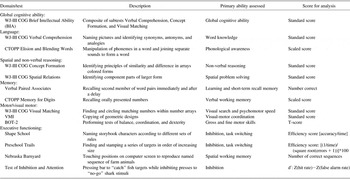
Table 2 describes the test domains and measures included in the neuropsychological battery. Global cognitive functioning was assessed using the Brief Intellectual Ability (BIA) from the Woodcock Johnson Tests of Cognitive Abilities, 3rd Edition (WJ-III-COG, Woodcock, McGrew, & Mather, Reference Woodcock, McGrew and Mather2001). The BIA is a composite of scores from the WJ-III-COG subtests Verbal Comprehension, Concept Formation, and Visual Matching. Verbal Comprehension was also used to assess language and as a measure of crystallized verbal ability, and Visual Matching as a measure of visual-motor skill. Other standardized tests included subtests from the Comprehensive Test of Phonological Processing (CTOPP, Wagner, Torgesen, & Rashotte, Reference Wagner, Torgesen and Rashotte1999), the Developmental Test of Visual Motor Integration (VMI, Beery & Beery, Reference Beery and Beery2004), and the short-form of the Bruininks-Oseretsky Test of Motor Proficiency, 2nd edition (BOT-2, Bruininks & Bruininks, Reference Bruininks and Bruininks2005).
Neuropsychological test battery

Note. WJ-III COG = Woodcock Johnson Tests of Cognitive Abilities, 3rd ed. (Woodcock et al., Reference Woodcock, McGrew and Mather2001); CTOPP = Comprehensive Tests of Phonological Processing; VMI = Developmental Tests of Visual Motor Integration; BOT-2 = Bruininks Oseretsky Test of Motor Proficiency, 2nd ed. Z(p) in computing d′ for Test of Inhibition and Attention is the inverse of the cumulative Gaussian distribution.
Memory was assessed using Verbal Paired Associates from the Wechsler Memory Scale-Revised (Wechsler, Reference Wechsler1987) as modified for children by Gonzalez, Anderson, Wood, Mitchell, and Harvey (Reference Gonzalez, Anderson, Wood, Mitchell and Harvey2007). The test consists of four easy word pairs and four difficult word pairs. After the pairs are read to the child, the examiner presents each stimulus word and the child is asked to provide the other member of the word pair. After completion of three immediate recall trials and following a delay of approximately 30 min during which the child is given tests of non-verbal skills, the stimulus words are presented again to assess delayed memory. The scores for this test were the total correct for both immediate and delayed recall.
EF was assessed using four experimental tasks developed to assess the constructs of inhibition, cognitive set shifting, and working memory described by Wiebe et al. (Reference Wiebe, Sheffield, Nelson, Clark, Chevalier and Espy2011). The Shape School task provided measures of inhibitory control and set shifting (Espy, Bull, Martin, & Stroup, Reference Espy, Bull, Martin and Stroup2006). This task follows a storybook format with drawings of cartoon-faced, colored shapes arranged on the page in rows. The child names the color or shape of the cartoon figures as fast as possible for each of several conditions. Administered to familiarize the child with task demands, the control conditions include naming of colors (Color Naming) and shapes (Shape Naming). The test conditions include the naming of the color of the figures with happy faces while inhibiting responses to those with sad faces (Inhibition); and naming of either the figure's color or shape depending on whether it is wearing a hat (Switching). An efficiency score is computed for each task to take into account both accuracy and naming speed (see Table 2).
The Trails-Preschool Test--Revised (adapted from Espy & Cwik, Reference Espy and Cwik2004) provided an additional measure of inhibitory control and set switching. This task follows a storybook format in which the child is presented with a story book showing a family of dogs and their bones. The child is required to push down on the stimuli according to different rules using a non-permanent ink stamp. The control condition for this task requires stamping the dogs in order of increasing size. The “inhibit” condition requires the child to ignore the previously salient dogs and stamp only their bones in order of increasing size. The “switch” condition involves the alternative stamping the dogs and then their bones in order of increasing size. An efficiency score is computed for each task using a formula to take into account both accuracy and naming speed (see Table 2).
Working memory was measured by the Nebraska Barnyard task (adapted from the Noisy Book task; Hughes, Dunn & White, Reference Hughes, Dunn and White1998), a computerized span task requiring the child to remember a sequence of animal names and press corresponding buttons on a touch screen in the correct order. The task begins with sequences of two animal names and progresses to increasingly longer sequences. The score is the total number of sequences correctly reproduced.
Inhibition was further assessed using a computerized Test of Inhibition and Attention (adapted from the Cat-Mouse task; Simpson & Riggs, Reference Simpson and Riggs2006). In this task, the child observes a series of pictures of colored fish presented for 1500 ms each with a 1000 ms inter-stimulus interval. The child is asked to “catch” these fish by pressing a button on the keyboard. On “no-go” trials, an image of a shark appears, signaling the child to inhibit responding. In the first condition, Go No-Go (GNG), 75% of stimuli are “go” fish trials and 25% are “no-go” shark trials, placing special demands on response inhibition. In the second condition, the Continuous Performance Task (CPT), 75% of stimuli are “no go” shark trials and 25% are “go” fish trials, placing lesser demands on inhibition and more on selective attention. The measure of performance on these tasks was d′ (signal detectability in signal detection theory) for each of the two conditions (see Table 2).
Past research supports the use of these experimental tasks as measures of executive function in young children. Espy et al. (Reference Espy, Bull, Martin and Stroup2006) found moderate reliability levels for the Shape School conditions and documented their associations with other tests of EF. Simpson and Riggs (Reference Simpson and Riggs2006) found that performance on the original version of the Test of Inhibition and Attention and Inhibition was associated with other measures of this test construct. Espy and Cwik (Reference Espy and Cwik2004) and Wiebe et al. (Reference Wiebe, Sheffield, Nelson, Clark, Chevalier and Espy2011) found similar support for earlier versions of the Trails-Preschool Test—Revised and Nebraska Barnyard task.
Data Analysis
So that results would reflect outcomes for as many of the children as possible and thus more accurately represent outcomes for the EPT/ELBW cohort as a whole, children who were too low functioning to understand or follow basic test demands were assigned either the lowest possible raw score (for unstandardized tests) or a standard score that corresponded to the lowest possible raw score (for age-normed tests). Children who were too low functioning to comply with test demands on WJ-III-COG tests were assigned a standard score of 40 (Mather & Jaffe, Reference Mather and Jaffe2002). The number of children receiving estimated scores ranged from 3 to 13 for all measures except CTOPP Elision on which 48 children received estimated scores. For many tests, estimated scores were assigned to significantly more children in the EPT/ELBW group than in the NBW group, documenting the greater difficulty that EPT/ELBW group had in understanding and complying with test demands. A smaller number of additional test scores were missing due to child noncompliance, equipment failure, or lack of opportunity to complete the assessments. Scores that were missing for these reasons were most common for the Verbal Paired Associates test, BOT-2, Shape School, Trails-Preschool Test—Revised, and Nebraska Barnyard. Standard or raw scores were normally distributed for most measures and thus suitable for parametric analysis. Because of the skewed distributions of scores on the Inhibition and Switching conditions of the Trails-Preschool Test—Revised, these measures were log transformed before analysis.
Group differences on the cognitive measures were assessed using analysis of covariance (ANCOVA) controlling for SES, sex, and race. Standard scores for chronological age were used in analysis of standardized measures. Unstandardized measures of memory and EF were examined using raw scores covarying for age at assessment. Because each NBW control was recruited after the EPT/ELBW child had been assessed, length of schooling was significantly longer for the NBW group than for the EPT/ELBW group. For this reason and given past evidence for effects of length of early schooling on cognitive skills (Cahan & Cohen, Reference Cahan and Cohen1989), the number of weeks the child had been in kindergarten was also included as a covariate. Inclusion of the covariates was justified by lack of evidence for group × covariate interactions for any of the measures.
A parallel set of logistic regressions was conducted to determine if the EPT/ELBW group had more cognitive deficits than the NBW controls. Deficits were defined by scores below the 10th percentile relative to either norms (standardized measures) or the performance of the NBW controls (unstandardized measures). Use of the 10th percentile as a cutoff for clinically significant deficits is justified by previous research and clinical practice (Fay et al., Reference Fay, Yeates, Wade, Drotar, Stancin and Taylor2009).
To investigate the possibility of selective cognitive impairments, group comparisons were repeated in secondary analyses that controlled for WJ-III-COG Verbal Comprehension as a measure of crystallized intelligence (Woodcock et al., Reference Woodcock, McGrew and Mather2001). The BIA was not considered as Verbal Comprehension is a component of this score. Group comparisons were also repeated in further secondary analyses that: (a) excluded the scores of children with a BIA <70 and/or neurosensory impairment as defined by cerebral palsy, blindness, or deafness requiring hearing aids at 20 months corrected age (39 EPT/ELBW children and 2 NBW controls); (b) excluded estimated scores for children who were untestable due to inability to understand and follow basic test demands; and (c) based scores on corrected rather than chronological age. The aims of these analyses were to determine if group differences were evident even among children with less severe impairments and if findings would be similar when missing scores were not estimated or when performance was evaluated relative to the post-conceptual age. To determine if increased rates of deficits in some skills would be evident even among the subset of EPT/ELBW children without handicapping conditions and with at least broadly average global cognitive ability, logistic regressions were repeated after excluding the 61 EPT/ELBW children and 12 NBW controls with either neurosensory impairment or BIA <85.
Associations of cognitive deficits within the EPT/ELBW group with the neonatal risk factors listed in Table 1, early childhood NDI, and SES were examined using logistic regression. NDI was defined as a neurosensory disorder and/or Mental Development Index <70 on the BSID at 20 months corrected age (n = 60; 41%). These risk factors predicted developmental outcomes in previous studies of children with low birth weight (Schmidt et al., Reference Schmidt, Asztalos, Roberts, Robertson, Sauve and Whitfield2003; Taylor et al., Reference Taylor, Klein, Drotar, Schluchter and Hack2006; Wilson-Costello et al., Reference Wilson-Costello, Friedman, Minich, Siner, Taylor, Schluchter and Hack2007). The NDI and each neonatal predictor were examined separately, with SES, sex, race, and time in school included as covariates. SES was examined after adjusting for time in school. Age at assessment was included as an additional covariate in analyses of unstandardized measures.
An alpha level of .01 was used to adjust for multiple comparisons in all analyses. Effect sizes were computed using Cohen's d (Cohen, Reference Cohen1992) for continuous measures and odds ratios with 95% confidence intervals for binary outcomes.
Results
Group Differences in Neuropsychological Performance
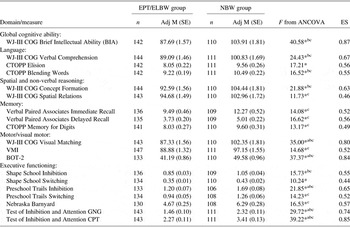
ANCOVAs revealed that the EPT/ELBW group scored more poorly than NBW controls on nearly all measures (Table 3), with large effect sizes (Cohen's d's ≥.80) for the BIA, BOT-2, WJ-III-COG Visual Matching, and CPT condition of the Test of Inhibition and Attention. The findings were similar when the 10 outborn EPT/ELBW children were excluded from analysis, suggesting that results are representative of infants born at the treating medical center. Lower SES and minority race were associated with lower scores on most of the measures; boys scored more poorly than girls on the BOT-2, F(1,237) = 17.97, p < .001; and less time in school was associated with lower scores on CTOPP Elision, F(1,147) = 7.39, p = .007.
Comparison of EPT/ELBW and NBW groups in mean scores on cognitive measures

Note. EPT/ELBW = extremely preterm; NBW = term-born normal birth weight; Adj M (SE) = adjusted mean (standard error); ANCOVA = analyses of covariance, controlling for socioeconomic status, race, sex, time in school, and (for unstandardized measures only) age at assessment; ES = effect size as defined by Cohen's d = mean difference/pooled standard deviation; WJ-III-COG = Woodcock Johnson Tests of Cognitive Abilities, 3rd Edition; CTOPP = Comprehensive Test of Phonological Processing; VMI = Developmental Test of Visual-Motor Integration; BOT-2 = Bruininks Oseretsky Test of Motor Proficiency, 2nd Edition; GNG = Go No-Go condition; CPT = Continuous Performance Test condition.
aSignificant controlling for WJ-III-COG Verbal Comprehension.
bSignificant excluding children with BIA < 70 and/or neurosensory impairment.
cSignificant excluding estimated scores for children who were not testable.
*Adjusted p < .01.
Group differences for all measures remained significant or marginally significant (p < .05) when scores were adjusted for corrected rather than chronological age. Differences on WJ-III-COG Visual Matching, BOT-2, Trails-Preschool Test—Revised Inhibition, and CPT and GNG conditions of the Test of Inhibition and Attention remained significant when controlling for WJ-III-COG Verbal Comprehension. Many of the differences also remained significant when excluding children with BIA <70 and/or neurosensory impairment or when excluding estimated scores for children who were untestable due to low functioning (see Table 3 notations).
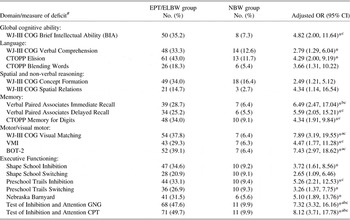
As shown in Table 4, the EPT/ELBW group had significantly higher rates of cognitive deficits on most of the measures, with rates for the EPT/ELBW group 3 to 6 times higher than those for the NBW group. As further documentation of pervasive deficits, 94 EPT/ELBW children (65%) versus 21 NBW controls (19%) had 3 or more deficits on the test battery, χ2 (1, N = 256) = 53.56, p < .01. All group differences remained significant when scores were based on corrected rather than chronological age. The EPT/ELBW group had higher rates of deficits in WJ-III Visual Matching, BOT-2, and the GNG and CPT conditions of the Test of Inhibition and Attention even when controlling for WJ-III-COG Verbal Comprehension. The EPT/ELBW group also had significantly higher rates of some deficits when excluding children with BIA < 70 and/or neurosensory impairment and when excluding estimated scores for children too low functioning to be tested (see Table 4 notations). When children with neurosensory disorders and BIA < 85 were excluded, group differences remained significant for Verbal Paired Associates Immediate Recall, Trails-Preschool Test—Revised Inhibition, and GNG and CPT conditions of the Test of Inhibition and Attention.
Comparison of EPT/ELBW and NBW group in rates of cognitive deficits

Note. EPT/ELBW = extremely preterm; NBW = term-born normal birth weight; OR (95% CI) = odds ratio (95% confidence interval), adjusting for socioeconomic status, race, sex, time in school, and (for unstandardized measures only) age at assessment and reflecting an increase in the odds of the deficit in the EPT/ELBW versus NBW group; WJ-III-COG = Woodcock Johnson Tests of Cognitive Abilities, 3rd Edition; CTOPP = Comprehensive Test of Phonological Processing; VMI = Developmental Test of Visual-Motor Integration; BOT-2 = Bruininks Oseretsky Test of Motor Proficiency, 2nd Edition; GNG = Go No-Go condition; CPT = Continuous Performance Test condition.
Deficit is defined as score at <10th percentile for age on standardized tests or <10th percentile relative to performance of the term-born normal birth weight group for unstandardized tests.
aSignificant controlling for WJ-III-COG Verbal Comprehension.
bSignificant excluding children with BIA < 70 and/or neurosensory impairment.
cSignificant excluding estimated scores for children who were not testable.
*Adjusted p < .01.
Factors Associated With Outcomes in EPT/ELBW Children
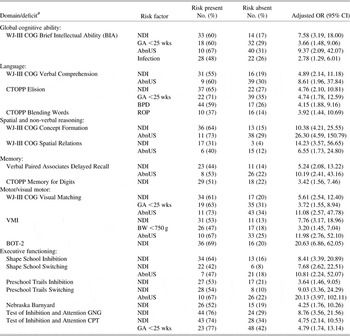
Neonatal risk factors and NDI at 20 months corrected age were associated with higher rates of cognitive deficits within the EPT/ELBW group (Table 5). These factors were related to a wide range of cognitive deficits in kindergarten. Lower SES was also significantly associated with higher rates of deficits on the BIA, WJ-III-COG Verbal Comprehension, CTOPP Elision, Shape School Inhibition, and Test of Inhibition and Attention GNG and CPT conditions. The most consistent predictors of cognitive deficits were NDI and ultrasound abnormalities. However, even when excluding children with NDI, lower birth weight (<750 g) and GA (<25 weeks) were significantly associated with higher rates of deficits on Shape School Inhibition, OR (CI) = 7.69 (1.81, 32.68), p = .006, and OR (CI) = 8.61 (1.97, 37.57), p = .004, respectively; and GA <25 weeks with higher rates of deficits on CTOPP Elision, OR (CI) = 6.62 (1.65, 26.53), p = .008.
Neonatal and early neurodevelopmental risk factors significantly (p < .01) associated with cognitive deficits within the EPT/ELBW group

Note that the “risk present” column lists the number of children with a given deficit who had the specified risk factor out of the total number of children with that risk factor, whereas the “risk absent” column lists the number of children with a deficit who did not have the specified risk factor out of the total number of children without that risk factor. The odds ratio reflects the increase in the odds of EPT/ELBW children having a deficit given that the specified risk factor is present compared to when that risk factor is absent. EPT/ELBW = extremely preterm; OR (95% CI) = odds ratio (95% confidence interval), adjusting for socioeconomic status, race, sex, time in school, and (for unstandardized measures only) age at assessment; WJ-III-COG = Woodcock Johnson Tests of Cognitive Abilities, 3rd Edition; NDI = neurodevelopmental impairment as defined by a neurosensory disorder and/or Mental Development Index < 70 on the Bayley Scales of Infant Development, 2nd Edition at 20 months; GA = gestational age; AbnUS = abnormal cranial ultrasound; Infection = neonatal infection as defined by sepsis, necrotizing entercolitis, or meningitis; SES = socioeconomic status; CTOPP = Comprehensive Test of Phonological Processing; BPD = bronchopulmonary dysplasia; ROP = retinopathy of prematurity; VMI = Developmental Test of Visual-Motor Integration; BOT-2 = Bruininks Oseretsky Test of Motor Proficiency, 2nd Edition; GNG = Go No-Go condition; CPT = Continuous Performance Test condition.
Deficit is defined as score at <10th percentile for age on standardized tests or <10th percentile relative to performance of the term-born normal birth weight group for unstandardized tests.
Discussion
The findings of this study demonstrate cognitive deficits in EPT/ELBW children at school entry in a broad range of domains, including language, spatial and non-verbal reasoning, motor and perceptual-motor skills, memory, and EF. Group differences were largely unchanged when scores were based on corrected rather than chronological age, indicating that the differences were not artifacts of the lowered post-conceptual ages of the EPT/ELBW group. Despite these pervasive deficits and evidence that the EPT/ELBW had higher rates of multiple deficits than their NBW classmates, results also revealed that some cognitive skills were more adversely affected than others. The EPT/ELBW group's weaknesses in motor skills, visual-motor proficiency, inhibition, and selective attention remained even when controlling for acquired verbal knowledge. Similarly, the EPT/ELBW group had higher rates of deficits in verbal memory, inhibition, and selective attention even when excluding children with neurosensory disorders or lower global cognitive ability (BIA <85).
To examine deficits in EF in EPT/ELBW children in detail, we administered tests of inhibitory control and selective attention, mental set shifting, and working memory. The EPT/ELBW group performed at lower levels and had higher rates of deficits in each of these areas compared to NBW controls. However, specific impairments in EF were found only for inhibitory control and selective attention. These and other specific cognitive deficits help to explain the high rates of learning disabilities in the EPT/ELBW population and provide a rationale for including measures of these abilities as part of early cognitive assessments (Bull, Espy, & Wiebe, Reference Bull, Espy and Wiebe2008; Clark, Pritchard, & Woodward, Reference Clark, Pritchard and Woodward2010; Johnson et al., Reference Johnson, Hennessy, Smith, Trikic, Wolke and Marlow2009; Litt, Taylor, Klein, & Hack, Reference Litt, Taylor, Klein and Hack2005; Mulder et al., Reference Mulder, Pitchford and Marlow2010; Pritchard et al., Reference Pritchard, Clark, Liberty, Champion, Wilson and Woodward2009; Taylor et al., in press; Taylor et al., Reference Taylor, Klein, Drotar, Schluchter and Hack2006). Our results also suggest that measures of inhibition and selective attention are more useful than tests of set switching and working memory in identifying selective impairments in EF in young EPT/ELBW children. One interpretation of this finding is that the set shifting conditions of Shape School and Trails-Preschool Test—Revised were more difficult for both groups than the inhibition conditions or the Test of Inhibition and Attention, and that the greater difficulty of these tasks diminished their sensitivity to the effects of birth status (Pritchard & Woodward, Reference Pritchard and Woodward2011). A possible explanation for the failure of the Nebraska Barnyard task to detect selective deficits is the demand this task places on multiple skills in addition to working memory, including knowledge of animal names and sounds and the ability to associate these stimuli with corresponding locations and colors on the computer screen.
The results agree with those of past studies of very preterm or EPT/ELBW samples showing generalized cognitive weaknesses with more pronounced deficits in visual-motor proficiency, memory, and EF than in measures of IQ or verbal skills (Bohm et al., Reference Bohm, Smedler and Forssberg2004; Lind et al., Reference Lind, Korkman, Lehtonen, Lapinleimu, Parkkola, Matomake and Haataja2011; Marlow et al., Reference Marlow, Hennessy, Bracewell and Wolke2007; Mikkola et al., Reference Mikkola, Ritari, Tommiska, Salokorpi, Lehtonen, Tammela and Fellman2005; Mulder et al., Reference Mulder, Pitchford and Marlow2010; Taylor et al., Reference Taylor, Minich, Bangert, Filipek and Hack2004, Reference Taylor, Klein, Drotar, Schluchter and Hack2006). Our observations of pervasive effects on EF for the sample as a whole are also in accord with other recent findings (Aarnoudse-Moens et al., Reference Aarnoudse-Moens, Smidts, Oosterlaan, Duivenvoorden and Weisglas-Kuperus2009; Anderson et al., Reference Anderson, De Luca, Hutchinson, Spencer-Smith, Roberts and Doyle2011; Woodward, Clark, Pritchard, Anderson, & Inder, Reference Woodward, Clark, Pritchard, Anderson and Inder2011).
The types of brain insults sustained by EPT/ELBW children help to explain the pattern of cognitive deficits observed in this study. Diffuse white matter abnormalities and the possibility of widespread effects of periventricular insults on brain development may account for vulnerability of EPT/ELBW children to pervasive cognitive deficits, whereas regionally specific insults to periventricular white matter, frontal-striatal circuits, temporal and parietal regions, and the cerebellum may account for their selective impairments in perceptual-motor skills, memory, and EF (Lawrence et al., Reference Lawrence, Rubia, Murray, McGuire, Walshe, Allin and Nosarti2009; Narberhaus et al., Reference Narberhaus, Segarra, Caldu, Gimenez, Pueyo, Botet and Junque2008; Nosarti et al., Reference Nosarti, Giouroukou, Healy, Rifkin, Walshe, Reichenberg and Murray2008; Taylor et al., Reference Taylor, Filipek, Juranek, Bangert, Minich and Hack2011; Volpe, Reference Volpe2009; Woodward et al., Reference Woodward, Moor, Hood, Champion, Foster-Cohen, Inder and Austin2009, Reference Woodward, Clark, Pritchard, Anderson and Inder2011). Evidence for deficits in response inhibition and attention allocation is also consistent with disrupted frontostriatal connectivity (Casey, Galvan, & Hare, Reference Casey, Galvan and Hare2005). These disruptions may be accompanied by compensatory neural reorganization at later ages (Lawrence et al., Reference Lawrence, Rubia, Murray, McGuire, Walshe, Allin and Nosarti2009; Nosarti et al., Reference Nosarti, Rubia, Smith, Frearson, Williams, Rifkin and Murray2006) but we know little about the extent of such plasticity, the biological and environmental mechanisms that support it, or when it occurs.
Because the EPT/ELBW and NBW groups were well matched for age, sex, race, and SES, results suggest that the group differences were more related to biological than to environmental factors. As further evidence for the biological basis of group differences, poorer cognitive outcomes for children in the EPT/ELBW group were associated with early childhood NDI and several neonatal risk factors, including GA <25 weeks, birth weight <750 g, cranial ultrasound abnormality, BPD, infection, and retinopathy of prematurity. Previous studies have shown similar relations of these neonatal risk factors with cognitive outcomes in older school-age children (Bohm & Katz-Salamon, Reference Bohm and Katz-Salamon2003; Bohm et al., Reference Bohm, Katz-Salamon, Smedler and Forssberg2002, Reference Bohm, Smedler and Forssberg2004; Dewey et al., Reference Dewey, Crawford, Creighton and Sauve1999; Lind et al., Reference Lind, Korkman, Lehtonen, Lapinleimu, Parkkola, Matomake and Haataja2011; Patrianakos-Hoobler, Msall, Marks et al., Reference Patrianakos-Hoobler, Msall, Marks, Huo and Schreiber2009; Roberts et al., Reference Roberts, Anderson and Doyle2010; Sullivan & McGrath, Reference Sullivan and McGrath2003; Taylor et al., Reference Taylor, Klein, Drotar, Schluchter and Hack2006). The likely basis for these associations is the greater probability of neuropathology in children born at higher neonatal risk (Taylor et al., Reference Taylor, Filipek, Juranek, Bangert, Minich and Hack2011). Lower SES was also associated with higher rates of deficits in the EPT/ELBW group, confirming the importance of taking this factor into account in predicting cognitive outcomes at school entry (Aylward, Reference Aylward1992). The association of increased time in school with higher scores on a test of phonological processing highlights the role of learning opportunities as an additional contributor to cognitive development during this period of transition to formal schooling (Cahan & Cohen, Reference Cahan and Cohen1989).
To our knowledge this study is the first to target children for assessment based on their enrollment as first-time kindergarten students. Assessing the sample during the first year in school provided at least limited control over children's experience with formal education. An additional benefit of this procedure is that findings are applicable to children at this stage in their schooling, which is the first time that many children with more subtle cognitive deficits may have access to formal cognitive assessments and special education assistance. A related virtue of the study design is that NBW controls were from the same classrooms and neighborhoods as the EPT/ELBW children, which insured that the two groups had similar educational experiences during their first year in school. Administration of a comprehensive test battery also allowed us to investigate cognitive impairment in EPT/ELBW children across multiple ability domains, establish the relative risks for different types of deficits, and examine EF in greater depth than most previous studies of this age group.
An important clinical implication of the findings is that, while EPT/ELBW children are vulnerable to a wide range of cognitive impairments in kindergarten, some have more selective deficits. The nature of these deficits suggests that even children with more subtle weaknesses may benefit from extra time to complete tasks, repeated exposures to new information, and highly structured approaches to learning (Litt et al., Reference Litt, Taylor, Klein and Hack2005; Taylor et al., Reference Taylor, Klein, Drotar, Schluchter and Hack2006). The findings also support recommendations to facilitate the early development of EF in this population (Woodward et al., Reference Woodward, Clark, Pritchard, Anderson and Inder2011) and to arrange for especially close monitoring of cognitive development at early school age in children who had earlier NDI or extreme degrees of preterm birth or low birth weight.
A limitation of the study is that some children were unable to comply with test demands due to child non-compliance, incomplete testing, or low cognitive functioning. Inclusion of estimated scores for children who were untestable due to limited cognitive functioning allowed us to take these children into account in our primary analyses of group differences. Results were similar when these estimated scores were excluded from consideration, indicating that our procedures for assigning missing values did not alter the pattern of results. Nevertheless, scores that were missing for other reasons, such as child noncompliance or lack of opportunity to complete the testing, could not be estimated and the magnitude of group differences must be interpreted with caution. A further limitation is that NBW controls were selected from among classmates of EPT/ELBW children whose parents granted permission for study contact, which limited our ability to find the closest possible match and may have biased selection of the control group. Questions can also be raised with regard to the representativeness of our sample as we were unable to recruit 25% of the original EPT/ELBW birth cohort and the children were recruited from a single perinatal center in a large urban area. The levels of cognitive ability and rates of deficits may differ from those for EPT/ELBW children born in other regions of the country. However, our cohort of EPT/ELBW children did not differ significantly in sociodemographic characteristics from either non-participating EPT/ELBW children or from the NBW group, suggesting that our group differences have internal validity. Additionally, the findings may provide information relevant to other urban centers, where many participating children are from lower SES backgrounds and where risks of premature births are high relative to other regions (Kaufman, Dole, Savitz, & Herring, Reference Kaufman, Dole, Savitz and Herring2003; Stoll et al., Reference Stoll, Hansen, Bell, Shankaran, Laptook, Walsh and Higgins2010).
Longitudinal follow-up of our sample will be useful in investigating age-related changes in the cognitive deficits revealed in this study. For example, follow-up of the children into later grades in school may reveal selective deficits in aspects of EF that were obscured in the present study by young children's difficulties in comprehending more complex instructional sets. Efforts to elucidate the neuropathology of selective deficits in EF and other cognitive skills are also needed to understand why some skills are more affected than others and help account the considerable variability in outcomes within samples of EPT/ELBW children. Study of associations of cognitive assessments in kindergarten with children's subsequent learning progress and behavior adjustment will be of additional value in determining the precursors of longer-term achievement and behavior problems and in identifying children most in need of early interventions.
Acknowledgements
This work was funded by grant HD050309 from the National Institutes of Health. We gratefully acknowledge the assistance of Anne Birnbaum, Dr. Elizabeth Roth, Dan Maier, Andrea Barkoukis Gefteas, Michelle R. Jacobs, Alice Costiuc, and Ketrin Lengu in recruitment, data collection, and coding. The findings presented in this study have not been published previously either in print or electronically. No conflicts of interests exist for any of the authors.
 years of age in very-low-birthweight children