


The idea of the United States as an immigrant nation is a powerful component of American identity, featuring prominently in elite and popular discourse across the ideological spectrum (e.g., Schildkraut Reference Schildkraut2007; Shiffman Reference Shiffman1996). Nonetheless, opposition to immigration also pervades American public opinion and has polarized in recent years (Wong Reference Wong2016). In this context, a growing experimental literature evaluates strategies for increasing inclusive attitudes toward immigrants (e.g., Adida, Lo, and Platas Reference Adida, Lo and Platas2018; Hopkins, Sides, and Citrin Reference Hopkins, Sides and Citrin2019).
Our paper evaluates whether the immigrant histories of American families can generate more favorable views of immigration. We argue that reminding Americans of their families’ immigration history increases empathy for current migrants to the United States by inducing perspective-taking indirectly.Footnote 1 In turn, this heightened empathy improves views of immigrants as people and increases acceptance of open immigration policies. While far from capturing the full social inclusion of migrantsFootnote 2 , inclusionary attitudes represent important first steps, with meaningful policy implications. We follow Okamoto and Ebert’s (Reference Okamoto and Ebert2016) characterization of migrant inclusion as host support for migrants.
We test this argument using three survey experiments in which respondents were reminded about their immigrant pasts either before or after answering questions about their views of immigration. Across three online samples between 2017 and 2019, we find that the treatment increased support for open immigration policies and improved favorability toward immigrants. These effects occurred among Republicans and Democrats, among supporters and opponents of Republican President Trump, and regardless of when respondents’ families came to the United States. In the third study, we investigate and find evidence that increased empathy is one mechanism driving our results.
Our paper makes empirical contributions to three strands of literature. First, much research showing that perspective-taking induces empathy relies on resource- and time-intensive interventions (e.g., Broockman and Kalla Reference Broockman and Kalla2016; Simonovits, Kezdi, and Kardos Reference Simonovits, Kezdi and Kardos2018) and uses explicit instructions to consider the other person’s perspective (Todd and Galinksy Reference Todd and Galinsky2014). We show that a light-touch intervention embedded in an online survey with no explicit perspective-taking instruction can increase empathy as well.
Second, we build on insights from social psychology that perspective-taking can be induced indirectly via shared experience or personal attachment (Batson and Shaw Reference Batson and Shaw1991), and we add to the empirical evidence that family connections shape political attitudes (Glynn and Sen Reference Glynn and Sen2015). Existing work suggests that family effects may be mediated by their ability to raise empathy for another group—for example, women—but do not provide evidence that speaks directly to this claim. Our analysis indicates that empathy constitutes at least one mechanism through which family connections can have important political implications.
Third, we extend a growing literature on increasing migrant inclusion (Adida, Lo, and Platas Reference Adida, Lo and Platas2018; Dinas, Fouka, and Schlapfer Reference Dinas, Fouka and SchlapferForthcoming), which has real-world implications. The strategy of emphasizing Americans’ immigrant roots has often been used by politicians and NGOs seeking to increase popular support for immigration in the United States, and this narrative is found in the curricula of America’s public schools. Our results provide empirical evidence that this approach can be successful at shaping Americans’ immigration attitudes and is worth pursuing further in advocacy and educational work.
Family History and American Support for Immigration
Nearly all Americans descend from people who came from elsewhere, whether by force or by choice. This history is an important component of American identity: narratives of an American “melting pot,” in which individuals of various nations and creeds all become Americans, have existed since the 1700s (Fraga and Segura Reference Fraga and Segura2006). While emphasis on the melting pot has at times meant prioritizing white and Protestant cultural norms, advocacy for a more explicitly multicultural American identity gained strength in the mid-twentieth century (Vecoli Reference Vecoli1996). Today, large majorities of Americans perceive “incorporationism”—respect for cultural difference—as a key component of American identity (Schildkraut Reference Schildkraut2007). This idea of the United States as an immigrant nation is commonly reflected in the rhetoric of politicians and immigration advocates (Shiffman Reference Shiffman1996), in addition to school curricula (Hilburn, Journell, and Buchanan Reference Hilburn, Journell and Buchanan2016).
However, the importance of immigration to American identity also coexists with anti-immigrant attitudes (Wong Reference Wong2016), which are motivated by perceived threats to the economy (Dancygier Reference Dancygier2010) and cultural identity (Hainmueller and Hopkins Reference Hainmueller and Hopkins2014). Scholars interested in understanding how to reduce migrant exclusion have evaluated the effects of providing information to weaken perceptions of such threats, with mixed results (e.g., Hopkins, Sides, and Citrin Reference Hopkins, Sides and Citrin2019).
An alternative strategy to reduce anti-migrant sentiment involves leveraging emotions—especially empathy, the ability to feel another’s mental state and/or concern for their plight (Todd and Galinsky Reference Todd and Galinsky2014). Research indicates that individuals displaying more empathy hold more positive attitudes toward immigrants (Hartman and Morse Reference Hartman and Morse2020). Additionally, an individual is most likely to feel empathy for another when they are capable of reflecting on that person’s perspective (Batson and Shaw Reference Batson and Shaw1991); indeed, interventions that actively encourage perspective-taking reduce out-group prejudice (Simonovits, Kezdi, and Kardos Reference Simonovits, Kezdi and Kardos2018).
Many perspective-taking studies explicitly instruct research subjects to reflect on others’ experiences, whether by imagining themselves in their shoes or imagining their feelings.Footnote 3 However, perspective-taking can also be induced indirectly via shared experience or personal attachment to someone like a family member (Batson and Shaw Reference Batson and Shaw1991). Individuals are more likely to engage in perspective-taking when they have personal experience with a similar situation or share a bond with that person (Galinsky and Mosowitz Reference Galinsky and Moskowitz2000).
We suggest that priming family experiences indirectly stimulates perspective-taking and may therefore induce empathy toward the out-group. Several studies demonstrate that familial relationships affect individuals’ decision making and attitudes. Washington (Reference Washington2008) finds that having a daughter increases a congressperson’s likelihood of voting liberally. Glynn and Sen (Reference Glynn and Sen2015, 37) show that U.S. Courts of Appeals judges who have daughters “consistently vote in a more feminist fashion on gender issues than judges who have only sons,” and Sharrow et al. (Reference Sharrow, Rhodes, Nteta and Greenlee2018) demonstrate that men become more supportive of sex-equity policies when their first child is female.
We argue that the immigrant stories within many American families can generate empathy—and thus more inclusive attitudes—toward migrants. When Americans are encouraged to remember how their families came to the United States, and the hardships they may have faced when doing so, this shared family experience with contemporary immigrants makes it easier to take their perspective and empathize with them. Likewise, when Americans are reminded of their personal attachment to previous immigrants, they should feel closer to contemporary migrants, facilitating perspective-taking and strengthening empathy. This heightened empathy can lead to more inclusive attitudes toward today’s migrants.
Research Design
We designed an experiment to test whether priming Americans on their own immigrant histories increases support for open immigration policies and improves views of immigrants. The experiment was implemented in three separate studies using online surveys between 2017 and 2019 (SI-B). While the first two studies were not preregistered, they consistently showed an effect of priming family history. We therefore developed and preregistered a third study to explicitly test this effect and the role of empathy as a mediator. The third study was longer than the first two and focused squarely on refugees and immigration.Footnote 4 Research design details, summary statistics, balance tests, tests of heterogeneous treatment effects, IRB approval, and the preanalysis plan are in the SI.
In each survey, respondents were randomly assigned with equal probability to receive a question about their family history (Which was the first generation in your family to arrive in America? Footnote 5 ) either before or after the outcome questions. The first outcome question—Do you agree or disagree that the United States should limit the number of immigrants entering the country?—gauges respondent support for more open immigration policies. On the second and third surveys, we included an additional outcome question: On a scale from 0 to 100, how do you feel about immigrants in the United States? For the third survey, we also ask—prior to the outcome questions—to what extent respondents agree with the statement: I empathize with the reasons people want to immigrate to the United States, as well as the hardships they face when coming to this country. We use these responses to conduct a mediation analysis of empathy with the methods proposed in Baron and Kenny (Reference Baron and Kenny1986) and Imai, Keele, and Tingley (Reference Imai, Keele and Tingley2010).
Results
We estimate main effects using difference in means with two-sample t-tests. The results are consistent when using OLS regression with control variables and robust standard errors.Footnote 6
Figure 1 presents the difference in means for the open immigration outcome. Across all studies, the family history treatment increased support for more open immigration from an average of 2.93 in the control group to 3.03 in the treatment group (p = 0.025), a change of 0.06 standard deviations. This treatment effect is statistically significantly different from zero in Studies 1 and 2 but not in Study 3.
Priming Family History Increases Support for Open Immigration
Note: Displays mean responses by treatment group for the following question: Do you agree or disagree that the United States should limit the number of immigrants entering the country? Scale ranges from 1 to 7, with 7 indicating support for more open immigration (95% confidence interval).

Figure 2 displays the difference in means for the feeling thermometer outcome included in the second and third studies. For the pooled data, the average response increased from 56.74 in the control group to 59.15 in the treatment group (p = 0.003), a 2.40 point increase equivalent to 0.08 standard deviations. This result holds in both individual studies.
Priming Family History Improves Favorability of Immigrants
Note: Displays mean responses by treatment group for the following question: On a scale from 0 to 100, where 0 means “completely unfavorable” and 100 means “completely favorable,” how would you describe your views of immigrants in the United States? (95% confidence interval).
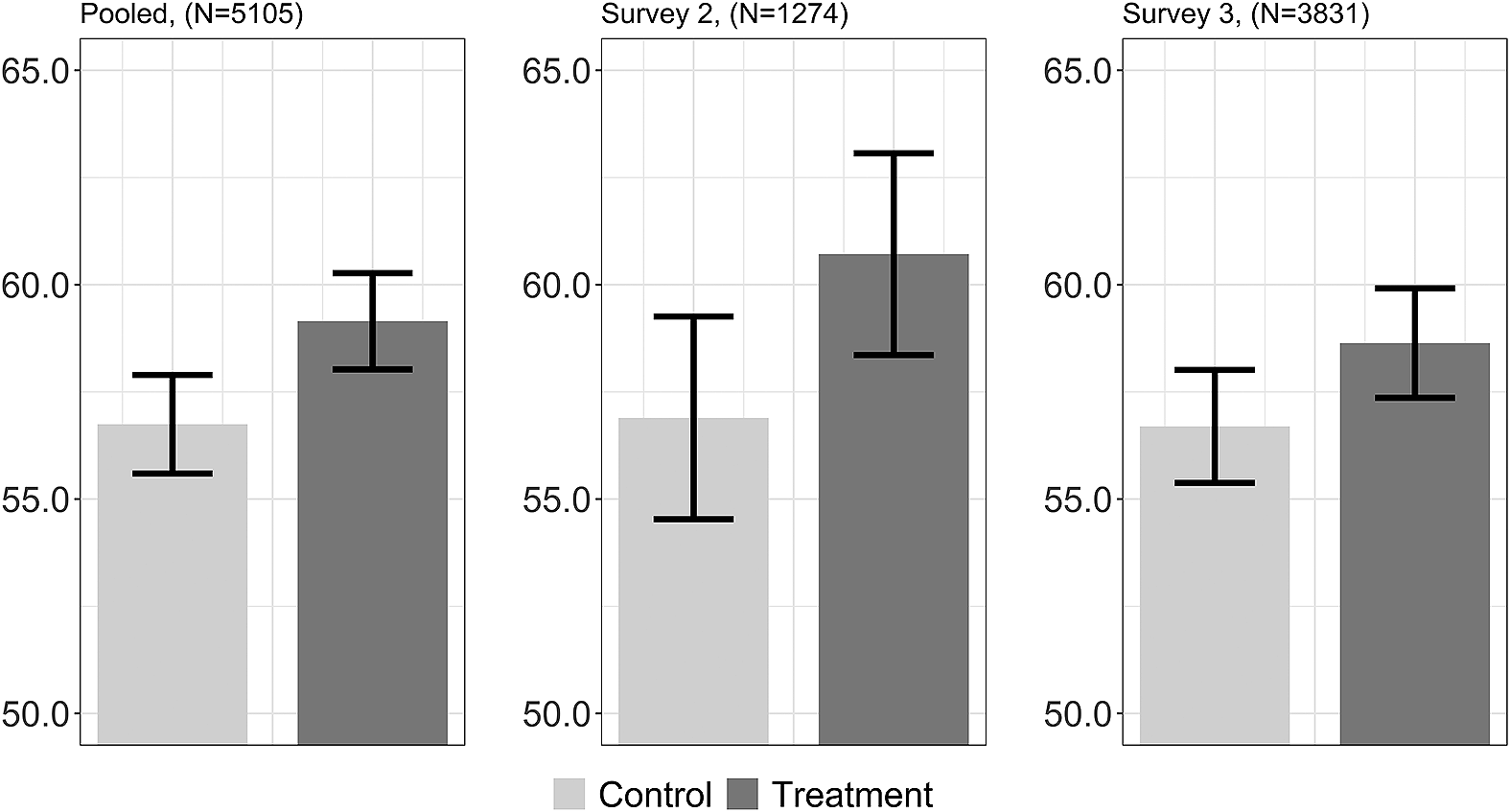
The effects are relatively small, but similar in magnitude to those in related experiments, particularly in the first and second studies (e.g., Dinas, Fouka, and Schlapfer Reference Dinas, Fouka and SchlapferForthcoming; Kalla and Broockman Reference Kalla and Broockman2020). Kalla and Broockman, for example, report effect sizes of 0.07 to 0.11 standard deviations in their study on attitudes toward unauthorized immigrants.
Our treatment was less effective in the third study. This difference may have occurred because the survey was significantly longer than the other two, and entirely about attitudes toward migrants: answering prior questions about migrants may have anchored respondent attitudes.Footnote 7 But it could also be a function of the fact that perspective-taking treatments are less likely to influence policy preferences and more likely to shape explicit evaluations of the “specific person whose perspective is taken” (Todd and Galinsky Reference Todd and Galinsky2014, 375), which is precisely what we capture with our thermometer outcome.
Finally, the average treatment effect is not driven by specific subgroups, but rather it seems to be general and shared. Indeed, the effect on attitudes toward immigration or the feeling thermometer is not conditional on Republican partisan identity or support for Republican President Trump (as shown in Figure 3), nor is it conditional on racial identity, dispositional levels of empathy, or immigrant generation (SI-E).
Family History Treatment Effects by Partisanship and Trump Approval
Note: Each coefficient is the treatment effect within the specified subgroup. OLS regression models (95% confidence interval).

Testing The Empathy Mechanism
Perspective-taking can reduce exclusion through several mechanisms including generating empathy, shaping attributional thinking, or increasing self-out-group merging (Todd and Galinsky Reference Todd and Galinsky2014). Since the relevant mechanisms have implications for understanding how prejudiced attitudes change and how our treatment may be applied in the real world, we test whether one of these mechanisms, heightened empathy, mediated our treatment effect.
First, we analyzed open-ended responses to our question from the third survey in which respondents were asked to explain why their families came to the United States.Footnote 8 Recall that perspective-taking can be induced through shared prior experience and attachment with the other (Batson and Shaw Reference Batson and Shaw1991). If so, we might expect that respondents would be able and willing to describe the specific motives behind this migration and that many of them would mention specific family members who migrated.
More than 40% of respondents were willing to answer the open-ended question,Footnote 9 with frequent responses including seeking “a better life” and “opportunity,” in addition to “escaping” situations such as “persecution.” Likewise, many respondents mentioned family-oriented terms such as “grandfather” and “children,” especially if they reported more favorable attitudes toward migrants on the feeling thermometer. By priming Americans to think about their family history, our treatment reminded respondents of shared familial experiences and attachments with immigrants (SI-J).
Second, we systematically tested the empathy mechanism. To our knowledge, no other study has explicitly tested whether empathy mediates the relationship between a perspective-taking treatment and attitudes toward migrants.Footnote 10 Our third study does just that. This section reports on our mediation analysis, relying on Baron and Kenny’s (Reference Baron and Kenny1986) analytical approach as well as the method designed by Imai, Keele, and Tingley (Reference Imai, Keele and Tingley2010). While the latter analysis was not preregistered, it constitutes a more generalized version of Baron and Kenny and allows us to conduct sensitivity analyses.Footnote 11
The Baron and Kenny approach requires that three conditions be met: (1) The treatment (T) must have a statistically significant effect on the outcome (Y); (2) the treatment (T) must have a statistically significant effect on the mediator (M); and (3) the effect of the treatment (T) on the outcome (Y) has to be significantly reduced when the mediator (M) is included. The first condition is met for the thermometer outcome. Table 1 shows that the second and third conditions are met as well: treatment (T) increases empathy for immigrants (M), and this empathy eliminates the treatment effect on the thermometer (Y).
Empathy for Immigrants Mediates Family History Treatment Effect

Note: OLS regressions with robust standard errors.***p
 $ < $
0.001, **p
 $ < $
0.01, *p
 $ < $
0.05, †
p < 0.10.
This approach also requires that two assumptions hold: there must be no omitted variable bias in either column (2) or (3) in Table 1. We know that this is the case for column (2), since our family history treatment is randomly assigned. But for column (3), the sequential ignorability assumption is not directly testable. Instead, we offer two solutions. First, we control for all observable confounds, including gender, partisanship, age, education, and baseline empathy (Davis Reference Davis1980), the last of which might most reasonably affect both mediator and outcome. Second, we implement the more generalized method proposed in Imai, Keele, and Tingley (Reference Imai, Keele and Tingley2010) allowing us to assess how large the omitted variable bias would have to be to erase our average causal mediation effect.
Figure 4 shows a statistically significant average causal mediation effect for the immigration thermometer outcome, indicating that the treatment effect on favorability of immigrants is mediated by empathy.Footnote 12 Our sensitivity analyses suggest that confounders as strong as baseline empathy are not sufficient to explain away the observed estimate.Footnote 13
Empathy Mediation of Family History Treatment

Conclusion
This paper presents evidence that priming Americans on their family histories can increase support for open immigration policies and improve favorability of immigrants, pushing the needle towards greater inclusion. These effects occur across a range of subgroups, including supporters of President Trump. We also provide evidence that the treatment changes attitudes in part by increasing empathy for immigrants.
These results contribute to a nascent body of research suggesting that individuals who possess a shared connection to the migrant experience are more likely to hold positive attitudes toward migrants. We show across three studies conducted over two years that even a light-touch treatment can meaningfully shift attitudes. These results align with prejudice reduction studies highlighting the effect of drawing attention to shared experiences between different communities (Motyl et al. Reference Motyl, Hart, Pyszczynski, Weise, Maxfield and Siedel2011).
While our studies show compelling evidence that a family history narrative can shape attitudes toward migrants—suggesting that the power of perspective-taking can extend via family relationships—they cannot adjudicate between the various mechanisms identified in the social psychology literature (Todd and Galinsky Reference Todd and Galinsky2014). Indeed, we find evidence for one mechanism: empathy. But we do not test alternative mechanisms, such as shifting attributional thinking or self-out-group merging. Future studies should directly test the full menu of mechanisms in a real-world setting. Additionally, our treatment is unlikely to produce longer-term effects, given that it was designed to remind respondents temporarily about their own immigration histories.
Nonetheless, even relatively small and short-term effects could be relevant for practitioners prior to an election or an important vote in Congress, and high-profile politicians who emphasize this message in their rhetoric may be capable of prompting modest shifts for a large number of Americans. Furthermore, the evidence in this paper can inform efforts to create larger-scale interventions capable of generating more lasting changes. Combining our findings with those of Feigenbaum, Palmer, and Schneer (Reference Feigenbaum, Palmer and Schneer2019), this type of priming may influence legislation by shaping the voting behavior of legislators themselves.
Finally, our findings have implications for the comparative study of migrant exclusion. Despite the polarization in public opinion toward migrants in the United States, Americans tend to hold more favorable attitudes than do citizens of many other countries (e.g., Gonzalez-Barrera and Connor Reference Gonzalez-Barrera and Connor2019). The commonality of immigrant family histories in the United States may partially explain this pattern.
Supplementary Materials
To view supplementary material for this article, please visit http://dx.doi.org/10.1017/S0003055420001057.
Replication materials can be found on Dataverse at: https://doi.org/10.7910/DVN/5UEEU2.


 Open access


Comments
No Comments have been published for this article.