Introduction
In the United Kingdom in 2006, almost everywhere one went it seemed that new housing was being built. A small but distinctive component of the construction boom was an increasing number of purpose-built developments for older people. Retirement communities are a relatively new long-term accommodation and care option in the United Kingdom, but policy makers and providers have enthusiastically promoted these developments as appropriate for both ‘fit’ and ‘frail’ older people (Office of the Deputy Prime Minister (ODPM) 2003). As yet, however, there is scant evidence about life in retirement villages (or indeed in other new and emerging models of housing-with-care for older people), or, more specifically, about what it is like to live in such communities; whether they cater adequately for older people with a wide spectrum of needs and abilities; and if they provide acceptable solutions to older people's housing and care needs.
This paper addresses these questions by discussing the findings of an independently funded three-year study of the Berryhill Retirement Village in Stoke-on-Trent, Staffordshire, that was carried out during 2000–03 (see Bernard et al. Reference Bernard, Bartlam, Biggs and Sim2004). Opened in May 1998 and developed by the ExtraCare Charitable Trust and Touchstone Housing Association, Berryhill was the first of a series of villages that the Trust is developing in England. This paper examines the background to these developments, presents the methodology of the study, and explores the residents' experiences of life in the village, with particular attention to the level of housing satisfaction and the provision of care. The study was designed to draw out the wider lessons for those who are considering developing similar schemes, and the paper concludes with an assessment of whether or not these new models of accommodation and care are appropriate for both fit and frail older people.
Retirement communities: the context
British social-housing and social-care policy makers and providers are increasingly aware that housing and care-services for older people have, for many decades, been provided in a framework that fosters dependency, and which has also been ageist in conception and execution (Fisk Reference Fisk1999). Today, more flexible, innovative and inclusive approaches designed to empower, to provide choices for, and to promote the autonomy of older people are being explored and encouraged (Department of Health 2001; Peace and Holland Reference Peace and Holland2001; Sumner Reference Sumner2002). Guidance, fact sheets, networks and other resources have proliferated, and policy and research interest in the broad arena of ‘housing with care’ for older people has rapidly expanded.Footnote 1
The development of purpose-built retirement villages similar to those that have existed for some time in North America and Europe is one manifestation of the broader interest. Yet whilst the number of purpose-built UK retirement communities is growing, statistics about them are not collated nationally. There have been a few recent evaluations of particular communities like our own (Bernard et al. Reference Bernard, Bartlam, Biggs and Sim2004), and others that have been independently commissioned or undertaken by specialist housing providers, including the Joseph Rowntree Housing Trust (Croucher, Pleace and Bevan Reference Croucher, Pleace and Bevan2003), the Hanover Housing Association (Baker Reference Baker2002) and Housing 21 (Phillips and Williams Reference Phillips and Williams2001). The diverse literature from North America, Europe and Australasia suggests that specialist housing developments for older people share certain characteristics but differ in certain respects, and that no single model dominates (Croucher Reference Croucher2006; Croucher, Hicks and Jackson Reference Croucher, Hicks and Jackson2005).
The extensive literature on North American purpose-built retirement communities indicates that they tend to be provided by the private sector rather than the public or voluntary (non-profit) sectors, and that their residents are principally white and relatively affluent (Sherwood et al. Reference Sherwood, Ruchlin, Sherwood and Morris1997; Streib Reference Streib2002). Other research, including British studies, shows that the residents of such communities generally come from a wide geographical area, have good incomes, are home owners, have been well educated and are mostly in good or reasonable health when they move (Bayley Reference Bayley1996; Croucher, Pleace and Bevan Reference Croucher, Pleace and Bevan2003; Oldman Reference Oldman2000). The North American and European literature also tells us much about why people move to these communities. Often the reasons are a combination of health and housing-related concerns, with security and independence being key attractions (see Longino, Perzynski and Stoller Reference Longino, Perzynski and Stoller2002). Among the residents, women outnumber men by as many as 10-to-one – a ratio analogous to that among the residents of residential and nursing homes (Resnick Reference Resnick2001). Many women who have never married or who are widowed report that retirement communities provide opportunities for making new friends and sharing interests (Kupke Reference Kupke2000; Madigan, Mise and Maynard Reference Madigan, Mise and Maynard1996; Siegenthaler and Vaughan Reference Siegenthaler and Vaughan1998), and other studies have suggested that retirement-community living helps to combat loneliness, improve morale and encourage the development of healthy life-styles (Hochschild Reference Hochschild1973; Laws Reference Laws1995; Lucksinger Reference Lucksinger1994; Osgood Reference Osgood1982).
Although retirement communities and their residents clearly share certain features, the North America and Australasian developments have been tailored specifically to the leisure and lifestyle requirements of retired people (Streib Reference Streib2002). By contrast, in continental Northern Europe, where there are different systems of welfare provision, there has been more interest in the role of self-directed communities and continued collective participation (Brenton Reference Brenton1998; Rodabough Reference Rodabough, Folts and Yeatts1994). Interestingly, many of the new retirement communities in the United Kingdom have some features of both the North American and European schemes. Like their American counterparts, British developments emphasise the leisure and activity dimensions, but they also stress the importance of participation, involvement and activity as a means of maintaining individual health, identity and well-being (Bernard et al. Reference Bernard, Bartlam, Biggs and Sim2004; Croucher, Pleace and Bevan Reference Croucher, Pleace and Bevan2003). Over the years, such features have been incorporated in increasingly complex definitions and typologies (Folts and Muir Reference Folts and Muir2002; King Reference King2004), but there is no universally agreed or shared definition (Riseborough, Fletcher and Mullins Reference Riseborough, Fletcher and Mullins1999), not least because no one community is exactly like another even among those developed by one organisation (Baker Reference Baker2002). For the purposes of this study, the defining elements of purpose-built retirement communities specified by Phillips et al. (Reference Phillips, Bernard, Biggs, Kingston, Peace and Holland2001: 190) were adopted. They are distinctive in having:
● A retirement element – the residents are no longer in full-time employment and this affects their use of time and space.
● A community element – they accommodate an age-specified population that lives in the same area.
● A degree of collectivity – with which residents identify and which may include shared activities, interests and facilities.
● A sense of autonomy with security.
Linked with these definitions and typologies, it is important to note the service goals and principles adopted by the developers. In the United Kingdom, these often refer to developing, supporting and managing what has come to be called ‘positive ageing’, ‘active ageing’, ‘ageing well’ or ‘successful ageing’. Although very little research has examined these normative prescriptions, the use of such rhetoric may put pressure on the residents to conform, although their actual circumstances and experience are diverse (Biggs et al. Reference Biggs, Bernard, Kingston and Nettleton2000). Indeed, far from enhancing opportunities for ‘ageing well’, retirement communities have for long been criticised as being ‘playpens for the old’ (Kuhn Reference Kuhn1977: 43), as sanctioning the disengagement of older people from wider society, and for encouraging the development of aggressively age-conscious identities (Kastenbaum Reference Kastenbaum, Cole, Achenbaum, Jakobi and Kastenbaum1993; Laws Reference Laws1995).
It should also be remembered that the vast majority of older people do not live in specialist retirement housing and wish to remain in their current homes if at all possible (Boaz, Hayden and Bernard Reference Boaz, Hayden and Bernard1999; Forrest, Leather and Pantazis Reference Forrest, Leather and Pantazis2000; Tinker et al. Reference Tinker, Wright, McCreadie, Askham, Hancock and Holmans1999). Purpose-built retirement communities are nonetheless an important development for at least two reasons: they are being widely promoted in the United Kingdom as an alternative to traditional forms of residential-home and nursing-home care (Riseborough and Fletcher Reference Riseborough and Fletcher2003), and they are seen as suitable for both fit and frail older people, at least by the British government through its ‘Supporting People’ funding for local authority purchased housing-related support and care (ODPM 2003). It was against this background that the study reported here set out to explore whether Berryhill Retirement Village, a new retirement community near Stoke-on-Trent in the northwest midlands of England, catered adequately for both the housing and care needs of older people, and to consider what might be learnt from this pioneering development. The study began in June 2000, two years after the Village opened in May 1998. It was framed by four overarching research questions:
1. What effect does the environment of the retirement village have on residents' wellbeing?
2. What is the self-reported health status of residents in the retirement village?
3. How do retirement communities influence ageing identities and what strategies do residents adopt towards significant others?
4. How do family members, staff and various age groups in the surrounding community, and professionals from housing, social and health-care services, view life at the retirement village?
Design and methodology
A multi-method, participative action research design was adopted, with several different but related approaches to the collection of data and information, including: informal participant observation for three years; diary-keeping by certain residents; a series of participation groups and annual community conferences; individual and group interviews with key people; three waves of structured questionnaires to residents (administered every Spring), and self-completion questionnaires to family, friends and some staff. Full details of all the methods and instruments are available in Bernard et al. (Reference Bernard, Bartlam, Biggs and Sim2004). A number of established and well-validated tools were used, a ‘social masking’ scale was developed (see Biggs Reference Biggs1997; Biggs et al. Reference Biggs, Bernard, Bartlam and Sim2002), and Öberg and Tornstam's (Reference Öberg and Tornstam1999, Reference Öberg and Tornstam2001) ‘age satisfaction’ questions were used to examine identity issues.Footnote 2 This paper draws on both the quantitative and qualitative data that were gathered during the three years of the study. Unless otherwise specified, the quantitative reports are from Wave 2 of the data collection in the second year of the study. Where quotations are used, pseudonyms are employed in order to protect the identity of participants in the study.
Berryhill Retirement Village: a profile
Berryhill is a purpose-built retirement community; although called a ‘village’, it is in fact a single, three-storey, T-shaped building with 148 rented flats along a series of internal corridors decorated and named as ‘streets’. The residents either live independently or receive one of four different levels of packages of support. Depending on individual circumstances, some receive financial help with both housing and personal support or care costs in the form of social-security benefits. At the time of our study, Berryhill had a social club, an activities programme, various on-site facilities, monthly ‘street’ meetings, a monthly Village news-sheet, and an in-house television service. Residents also volunteered their services for various roles within and beyond the Village. A staff team of 38 worked variable hours but covered the duties for 24 hours every day of the year. A key worker system operated for all residents.
At the start of the study, the Village accommodated 159 people aged 55 or more years (the total subsequently increased to 176). The population was entirely white, had a mean age of 75.3 years, and women outnumbered men by two-to-one. Eight-in-10 women lived alone, compared with five-in-10 men. One-half of the men were married or co-habiting and one-half were widowed. Three-in-five women were widowed, one-quarter were married, one-in-10 were divorced, and two women had never married. This socio-demographic profile broadly corresponds to the characteristics of the residents in other retirement communities, as reported by the studies reviewed above, but Berryhill Village differs in one important respect: the residents are predominantly working-class, in contrast to the middle-class profile of most American schemes. The Village is in a working-class suburb of Stoke-on-Trent, the ‘Potteries’ city with a population that is relatively settled but has above-average social and cultural deprivation. According to The English Indices of Deprivation (ODPM 2004), among the country's main metropolitan areas, Stoke-on-Trent has a high concentration of severely deprived neighbourhoods. In 2001, the city's percentage of people aged 50 or more years with ‘limiting long-standing illness’ (LLI) was 10 per cent higher than the national figure (Office of National Statistics 2001), which has implications for the involvement of people in their local communities. These features were reflected amongst the respondents, for nine-in-10 had left school at or before the age of 15 years, three-quarters had been employed in manual occupations, as in the coal-mining, steel and pottery industries, and three-in-four suffered from at least one LLI.
The housing needs of Berryhill's residents
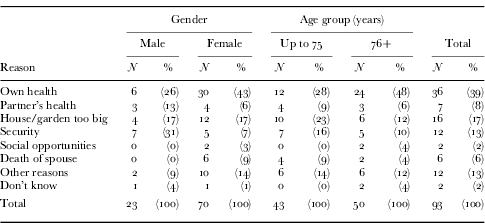
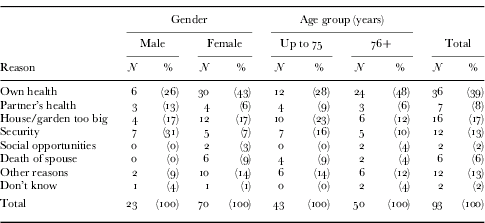
All those who responded to the Wave 1 questionnaire (88 out of 159) had moved no more than 10 miles from the Village, including 31 (35%) from the immediately surrounding housing estates. The majority (at different times 52 or 59%) of the residents were formerly in accommodation rented from the local council, including five (6%) who had been in sheltered housing, and nearly one-third (27 or 31%) who had moved from their own property. Four people (5%) did not specify their previous place of residence. The principal reasons that people gave for moving to the Village are shown in Table 1. Moving decisions are often complex, and nearly one-third of the respondents (27 or 29%) gave more than one reason. Whilst their own or their partner's health was by far the most important factor (examined in more detail below), housing-related needs and the sense of personal insecurity in the former residence and neighbourhood were both cited by nearly one-third (28 or 30%). For example, one respondent, Rachel, had moved into Berryhill from the local area because she was fearful of crime. She said, ‘when I lived outside in a bungalow, at 11.55 at night a big house-brick came through my window’. For another respondent, Mary, health reasons were the prime motive:
You wouldn't have entertained the idea if you'd of been in perfect health, you wouldn't of thought about coming in here, would you? But having come in here, you like it. Yes, but if you'd of been fit, you wouldn't of thought about it.
During the interviews and group discussions, the respondents elaborated on these issues and related their experiences before they moved to the Village. Reflecting on their previous homes and neighbourhoods, they described their worries about maintenance and upkeep, their concerns about criminal damage to property and general issues of safety, and the ways in which these issues undermined their confidence. These factors combined to ‘push’ people towards a housing solution that removed them from these environmental and physical problems. As Kate observed, ‘when you've lived on your own in a bungalow or in your own house, there's always the fear of being broken into, kids throwing stones and all sorts of things outside. … [here] you feel secure’. The need for greater security and an improved quality of life was also noted by the professionals with an interest in the scheme, such as the local Assistant Director for Housing, who explained:
I can think of several [housing] schemes that we've got, where we've got a set of bungalows, perhaps 50 bungalows next to a field, and the small kids are annoying the old people, teenage kids are knocking on the door, older teenagers are riding motorbikes, and the police are chasing after them. And you think to yourself that the quality of life for those old people is absolutely abysmal. You compare that to [the Village] … they're totally insulated from that; they don't have kids knocking on the door; they don't have that problem. Their interaction with the younger generation is with their grandchildren, that type of thing, so it's a much more controlled and happy environment.
Principal reasons for moving to Berryhill by gender and age
The accommodation
Most of the 148 flats (or apartments) in the Village are similar in size and layout and have one bedroom, although there are four two-bedroom flats. Each flat is accessed by its own front door from an internal corridor, which is designed to simulate a street and so named. Inside the door is an entrance hall, to one side of which there is a small kitchen (with a window onto the ‘street’) and to the other side, a bathroom. A (double) bedroom (approximately 3.4 metres square) and a living/dining room (2.9 by 4.1 metres), each with exterior windows, complete the living accommodation. The flats are relatively small even by British standards, especially for two people, and some residents saw the lack of space as a drawback. Some also complained about too much heating, to the extent that they avoided cooking so as not to increase the temperature in the flat. General upkeep was also seen as problematic from time to time, and dissatisfaction with the response of the management to maintenance requests made some residents feel unheard.
Despite these occasional complaints, most respondents said that they were extremely satisfied with both their flat and the Village as a whole. They found the flats easy to manage and gave them very high median satisfaction scores of between ‘9’ and ‘10’ at all three waves of the questionnaire (on a ‘0’ to ‘10’ scale). The Village as a whole was given a median satisfaction score of ‘9’ at all three waves. In addition, many residents felt secure in the sense that they did not have to worry about money or paying for their accommodation, although others expressed concerns about the cost of living in the Village and about increases in the Council Tax (the UK property tax which varies by both local authority and type of property). As Margaret explained, ‘the only moan or grumble that I've got is the amount that they've put the rent and the amenities up. I mean, I know every year rents go up but I think they've put it up too much, so we're trying to get it sorted out. If we ever will, I don't know’. For some residents these concerns fed into real worries about managing financially now and in the future: worries which were exacerbated by bureaucratic delays.
The amenities and the sense of personal security
The Village has several on-site facilities that are not routinely found in other forms of specialist accommodation and care for older people in the United Kingdom, including a gym, a library, craft, woodwork and computer rooms, a large greenhouse, a shop, a hairdresser's, a restaurant and a bar. A visitors’ flat and a ‘Dreamscape’ (relaxation) room are also available. The respondents that used the various amenities rated them all very highly (the median satisfaction scores at all three waves were at least 8.0), with no differences between men and women. The hairdresser's, restaurant, shop and bar were the most well known amenities and were used by between one-half and two-thirds of the respondents consistently over the three years. These amenities are all along the main ‘street’ that runs from the entrance on the ground floor of the Village, and are consequently visible and accessible settings in which people meet and mix spontaneously.
Most of the other facilities were used by only a few residents even if they were known. For example, about one-in-five respondents used the gym, while the proportion using the craft room decreased from two-in-five to one-in-five over the three years. Fewer than one-in-10 used the woodwork, the Dreamscape or the computer rooms. On the other hand, use of the library and the gardens increased over the study period, to respectively one-third and three-fifths of the respondents. The refurbishment of the garden and the relocation of a vegetable plot probably encouraged greater use. Although every resident received details of all the amenities in a ‘Welcome Pack’, several claimed ignorance of some, most often the Dreamscape room and the visitors' flat.
At all three waves of the questionnaire survey, with few exceptions the respondents said that they felt safe while out and about in the Village (Wave 1, 97%; Wave 2, 100%; Wave 3, 99%). This too was a welcome contrast with the lives that many had led previously, as participants in an early group discussion explained:
Facilitator: Would you be doing those sorts of things if you didn't live here?
All: No.
Kathleen: Definitely not.
Margaret: I would never go out at night when I hadn't come in here.
Patricia: Inside at four o'clock and the doors and windows locked up tight; that was how it was, wasn't it?
Margaret: You might join a pensioners’ club like they have at the school.
Patricia: But you would go one afternoon but not at night … but here you are sort of going out but you haven't got to go outside the building, have you? You come down for entertainment. It's like you are going out but you haven't got to go out in the cold or [take] a taxi, and you're alright.
The on-site amenities and communal spaces enhanced the opportunities for social interaction. As Sarah told us, ‘you can come down any time, there is always somebody that you can call over. Whereas if it was winter time, a wet day outside, you can't … here you can come downstairs, there is somebody you can go and have a word with, something going on’. Although the residents expressed some concerns about certain amenities, in general they were very happy with them and found the communal spaces in the building very good, for example the communal sitting areas and the gym. The layout of the building did pose challenges for some residents, however, in that the distance from some flats to the centrally-located lifts was an obstacle. For some residents in wheelchairs, the weight of the doors, both those to individual flats and those along the corridors, was also problematic. Alice, a wheelchair user, described her dependence on the help of others: ‘I've got very good neighbours and they keep an eye out for me. So if I am having a struggle getting into my flat, getting the door open, and they are coming by, they will say “I will do that for you”’.
Others, like Ros and her husband, Tom, had had to move from the first flat they had occupied to another on the ground floor. Ros's respiratory problems greatly restricted her mobility, and they both felt that moving from the second floor to a flat with immediate access to the car park had greatly improved their quality of life. It was also clear from the observational data and informal discussions with other residents that those with sensory impairments found the size of the building problematic. One woman with very poor sight said that she found it difficult when people greeted her, because it gave her very little time to recognise the person who had spoken to her before they passed by. For those with hearing problems, the acoustics and ambient noise in the communal areas, particularly the lounge, dining room and main entrance, often interfered with hearing aids.
Despite the few drawbacks of the flats and the Village, the majority of the residents were highly satisfied. Whilst an element of post-hoc rationalisation of the decision to move into the Village is possible, it was clearly meeting most respondents' immediate housing needs. The high level of satisfaction partly reflected the residents' previous circumstances, as well as their generally low expectations and the poor alternative housing provision for low-income older people. On the whole, Berryhill offers the opportunity to live in an environment that is both physically and psychologically secure, and the residents particularly appreciated being able to take part in activities on site rather than having to go out, especially at night.
The care needs of the residents
As Table 1 shows, for the majority of the respondents, concerns about their own or their partner's health was a major factor in the decision to move into the Village. Reg explained how his wife's ill health had necessitated their move:
She was in hospital before she came here and they said then, if we wanted to be together, this was the only place to be. So we came here. … I was worrying about whether the house was too big to carry on. Where were we going to go? What is going to happen to her? Are we going to be split up? … Things like that, but here … we can get on with living.
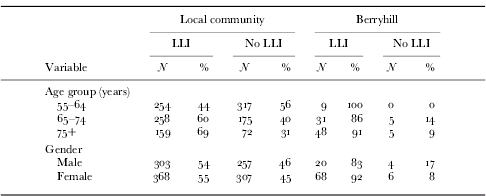
Care and support professionals also saw ill-health as a major reason for moving in. One doctor remarked, ‘if you're independent and you're healthy, most elderly people seem to really like to stay in their houses and don't want to move there’. This view was shared by the residents in a nearby sheltered-housing complex, many of whom regarded the Village as somewhere to go when they could no longer manage. Some local community-dwelling residents also voiced the opinion that one would choose to live in Berryhill only at a particular age, and only then if one had health-care needs. As one said, ‘I'd say [at] about 65, and even then only if they're not able-bodied’. Consistent with these views, nearly three-quarters (115 or 72%) of all the men and women living in the Village at the beginning of the study had a limiting long-standing illness (LLI), a much higher proportion than in a comparative sample of older people living in the area surrounding the Village (see Table 2).
Prevalence of limiting long-standing illness in Berryhill and the local community
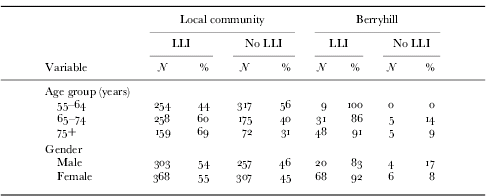
Notes: LLI: limiting long-standing illness. Figures for the ‘local community’ (five surrounding wards) from Jordan and related to data in Jordan, Ong and Croft (Reference Jordan, Ong and Croft2000).
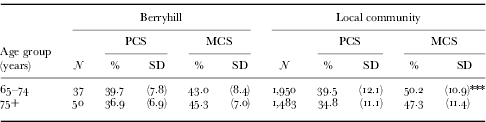
Moreover, as noted earlier, the prevalence of LLI among those aged 50 or over in the area surrounding the Village is 10 per cent higher than the national figure. Beyond this, the self-reports of health status suggested that the residents of Berryhill were not especially well for their age and had above-average care and support needs. Among the younger age group, there was a higher prevalence of mental health problems than among their community counterparts (Table 3). Some comments during the in-depth interviews reinforced the impression that reduced mental wellbeing (whether through bereavement, social isolation or health issues) was a factor in the decision of a number of the younger residents to move into the Village. The respondents nonetheless made remarkably consistent assessments of their health, and those who were surveyed at all three waves generally claimed that it had not changed. Petra, a participant at the second community conference, even claimed that, ‘[in] this environment, people seem to feel better than other people that are living out in the community’. In summary, the residents at Berryhill had a high prevalence of poor health, particularly limiting long-standing illnesses and mental health problems, and they reported a slightly lower quality of life than their counterparts in the wider community. In contrast, those with LLI reported better physical functioning in the Village and said that they felt better than those living in the surrounding community.
Self-rated health in Berryhill and the local community by age, c. 2000
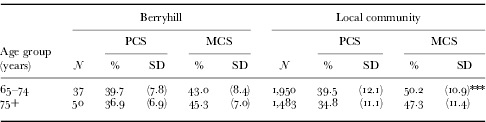
Notes: SD: standard deviation. PCS: physical component summary of the Medical Outcome Trust Short Form (12 item) health status questionnaire (Ware, Kosinski and Keller Reference Ware, Kosinski and Keller1996). MCS: mental component summary of the MOT SF-12.
Significance level: *** MCS score in this age group differs significantly between Berryhill and local community (p<0.0005).
Care and support
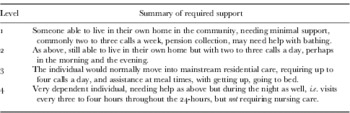
As noted earlier, the residents at Berryhill either live independently or are assessed by staff as requiring one of four ‘support packages’ as defined by the managing organisation (Table 4). These packages stop short of nursing care, but residents receiving support at Levels 3 and 4 had care and support needs similar to people admitted to long-term residential care. Indeed, at the time of the study, the Social Services Department of the City of Stoke-on-Trent funded a number of places for such people in Berryhill. Regardless of whether or not people were receiving a formal support package, the residents could also opt to purchase help with house keeping, shopping, pension collection and laundry.
Levels of support provided to the residents

All the support staff at Berryhill, except the newest recruits, are required to complete a National Vocational Qualification in Care at Level 2 (NVQ2) and, at the time of the study, two were qualified nurses. The staff worked in teams with a leader and four or five ‘resident support workers’. A key worker system applied to all residents, not just those receiving support, and each key worker was responsible for approximately 10 residents. At night, three members of staff cover the Village: one sleeps in, and two are awake and carry out housekeeping duties. During the period of the study, there were only two male ‘resident support workers’. In keeping with the service ethos of the managing organisation, staff are explicitly termed ‘support workers’, but the residents, and indeed the staff themselves, commonly referred to the formal help as ‘care’, and to those who provided it as ‘carers’. Requiring ‘care’ from staff appeared to connote need and dependency, rather than ‘supported independence’, and the residents were frequently described by each other as being either ‘on’ or ‘off’ care. At the first community conference, one man voiced a common concern: ‘I keep on wondering when I will go on care. When I can't manage, I shall go on care: (that's) when I can't manage shopping and bathing, you know’. In fact, at all three waves only about one-third of the residents received support packages (Wave 1, 28%; Wave 2, 34%; Wave 3, 31%). The modal category was Level 2 (needing two to three calls per day).
Most residents were very positive about the support they received, and gave an average satisfaction score of ‘9’ (out of 10). Alice, who received Level 2 support, felt there had been a big improvement in her life since moving to the Village from a nursing home, but nonetheless acutely observed that no matter how good the support might be, there was an almost inevitable indignity in requiring someone else to provide intimate personal care. She said, ‘Oh yes, but here the caring staff make it so much easier. It's very good. It is so much easier but the indignity is still there’. Among the residents who did not have a ‘support package’, there was still a sense of being supported by the staff. Mary said, ‘As I say, I've always found that you can talk to them [the staff]. If there is something that you are not happy about you can talk to them, just ask their advice: what about this? What should I do about this?’ Other residents described the differences between help in the wider community and that available in the Village. Georgina recollected her experience:
When I had falls in my other house, I used to have a lifeline. They had to shout and come in over the intercom to ask you if you were bleeding first. Then they had to ring my daughter, and she can't drive now because of her back. She had to get her husband off work to come up and see to me. But if you're bleeding, like I did cut my head open once, the ambulance will come first, or else you're lying there, sort of thing. When I fell in here, they were there in a few minutes. It's sort of different.
This difference – having support and care on hand – was also important for the residents’ family members. One respondent to the ‘family and friends questionnaire’ expressed the views of many when s(he) wrote: ‘when my parents were able to move into the Village, as a family we were extremely grateful: it gave them safety and care and us peace of mind’. Moreover, almost three-quarters of the respondents (65 to 71%) said that they still looked to their family as their main source of help, whereas fewer than one-in-six (14 to 15%) said that their most important source of help was the staff. The support of peers was also highly valued, although in contrast to a smaller retirement community, where peer-support characterised the whole community (Biggs et al. Reference Biggs, Bernard, Kingston and Nettleton1999), at Berryhill there was more emphasis on the support that particular friends and friendship-groups gave at particular times of illness or incapacity. Milly contrasted her life in Berryhill with where she had lived previously:
I lived in a two-bedroomed house on my own, very lonely … but here … there is someone there for you. You haven't got to phone somebody; they are only a few doors away from your home. ‘Are you going out?’ ‘Can you do this for me?’ ‘Can you call up there?’ ‘Go to the chemist for me?’ You haven't got to go outside, [you] just knock on the door.
Many and various health-care and social-care professionals had contact with the Village, and viewed it as an accommodation and care option that suited certain older people and provided support in ways unavailable in more traditional settings. Whilst the general care and support needs of many residents were adequately met, there were concerns about certain health conditions and circumstances. People with physical disabilities, or with mental-health needs, and the impact of death and bereavement, emerged as important challenges in the community.
Physical disabilities: visible frailty
Over one-half of the respondents had sight problems (51 or 52%) and over one-third had hearing problems (38 or 39%). Not surprisingly, some sensory impairments significantly affected the ability to participate in Village life. Margaret noted the difficulties faced by some fellow residents:
There's one lady I know that's blind and deaf, so she can't come. Well there's two of them; neither of them can join in, but they would love to, you know. Edith would like to play bingo, for a start. Mary is – she can't communicate unless it's one-to-one because she can't hear because of background noise – she can't join in much at all.
Other physical health problems, particularly those that affected mobility, worked against independence and participation. Tilly described her disability and the way in which it increased her sense of isolation, which was reinforced by being reliant on the staff:
The only people I've seen since I've been here [are] the cleaners … nobody knows. I am living on my own most of the time because I can't walk. Physically, it is my balance. You see I'm not safe now because I lose my balance, so I am more or less tied to my flat. … I do [go to the street meetings] but I have to be fetched and taken down.
Needing such help worked directly against some residents' desire to be independent and, in a few cases, meant withdrawal from community life and significant loneliness. It was also apparent, from the observations and the interviews, that the attitudes of some residents to visible disability excluded people from participation in the communal life. For example, those who used physical aids, such as wheelchairs, were often assumed by the other residents to have ‘support packages’, regardless of whether or not this was the case. Physical disability and the use of aids were in some cases mistakenly associated with mental frailty. As Douglas eloquently observed:
Some people seem to think that, because you're in a wheelchair, you've gone up there [pointing to his forehead], you know, and you haven't. A lot of people are very active up in their mind. Because the body doesn't work, it doesn't mean to say that your mind's not working; but that's what you get, I've noticed that. They can be very hurtful at times, can't they? … Being ‘wheelchair friendly’ doesn't mean what it says. It's not all for the buildings – a lot more people need to be wheelchair-friendly as well, I think; it needs some education.
Mental health and wellbeing
Berryhill's environment challenged some residents with physical disabilities, but it could also create difficulties in relation to social integration and mental wellbeing. The sheer size of the building could, for example, intensify feelings of isolation, as a newly-arrived resident who had mobility problems explained: ‘[There is] nobody coming and going at all, it is just like living in a great building on your own, the only thing you hear is the lifts’. According to the health-care professionals, dementia-type illnesses and anxiety and depression were the most common mental health disorders amongst their patients in the Village. The professionals believed that the residents with complex conditions, typically involving both mental health issues and physical dependency, ‘did not do so well’. One doctor reasoned that, ‘going into somewhere large like that can actually be a bit overwhelming for one person on their own, unless they've got really good social skills’. The size of the building and the similarity of its various corridors could be disorientating and confusing. In particular, it was noted that the habit of ‘wandering’ of some people with a dementia was not acceptable in the Village, because other residents and staff found it difficult to cope with. This clearly raises issues about the mixing of ‘fit’ and (mentally) ‘frail’ older people in the one community.
For some residents with affective mental health problems, such as anxiety or depression, the size of the building, the large number of residents and the consequent prevalence of cliques were also problematic. New residents reported being told ‘you can't sit in that chair, it is so-and-so's’. This kind of attitude might be uncomfortable for any new resident, but some found it extremely alienating. Some staff also believed that the size of the building was problematic. As Maureen, one of the support workers, noted:
I think as well that the environment doesn't lend itself to supporting people with mental-health problems, particularly because the building is so big. Sometimes they can be so far away that it's hard to support somebody if you're not there, or within easy reach of them – and that's a problem.
Death and bereavement
If the staff were aware of the difficulties of meeting the care needs of some residents with mental-health problems and recognised that they were not well equipped or trained to do this, they had comparable concerns about their ability to provide comfort and support following death and bereavement. In Berryhill as a whole, between January 2001 and June 2003, 13 men and 24 women residents died. This frequency – more than one a month – was seen by the residents' family members and friends as a major disadvantage of the age-clustered living environment. The residents shared these concerns and spoke about the Village in ways that revealed the sense that death, although veiled, was pervasive. As Margaret explained, ‘the problem is [that] when somebody dies in here, we all know. Now, if we lived in a street, or “round the block”, as we used to call it, you wouldn't notice it so much’. On the other hand, the residents also identified some advantages of being in the Village at a time of bereavement, as the following exchange between Maura and Kathleen revealed:
Maura: [Berryhill Village gives] much more [support] than I would have got if I'd have lived on my own [outside]. I don't think I could have coped on my own, but because I was in here, and I had got Kathleen next door to me, who came into me every day, and loads of other people, I had a lot of support.
Kathleen: And I think also when it happens to you, you know what it's like, don't you? You know what other people are going through, if it happens to you.
Whilst peer support was available, the residents said that it was also important to acknowledge the effects of grief, both on themselves and on the community as a whole. Petra put it like this:
You get a lowering of the morale in the Village when this happens, particularly with two or three people [dying around the same time]. Particularly with the people that they've been close to, those that have been in longer, that came in with them. The atmosphere changes … following a death in the Village.
Others coped with the prominence of death by distancing themselves, some taking the view that death was something that happened to ‘others’ and that it happened everywhere, not just in the Village. Patricia explained:
You felt terrible in here when they first started dying. I used to think, ‘Ooh’, you know? You do care when you've been in here so long, and people outside used to say, ‘there's another man died in the Village, isn't there?’, or ‘there's another lady died, there was one last week’. So people outside were counting up the people who were dying in here. But I said, ‘well, they are all elderly people, they're all pensioners, they would have died anyway if they'd have lived out in the community, wouldn't they?’
So while many residents felt that coping with bereavement was aided by having supportive peers, at the same time the concentration of many older people produced an intense awareness of others' deaths. As with their concerns about meeting mental health-care needs, it was found that in both the questionnaires and the interviews, the staff identified their need for further training in counselling skills and particularly in bereavement counselling.
‘Home for life’?
Many of the residents' expressed concerns were about their future health and care needs and whether Berryhill would provide a ‘home for life’ (as it claims). Although nine-in-ten said they were confident that more help would be available in the Village should they need it, one-in-five envisaged circumstances that might compromise the suitability of the Village as their home. These concerns were entirely about their health. Mary, a resident with worsening sight, voiced these concerns well:
Up to now, I mean, I am so far fine, but with my sight gone … I would have to go in a residential home, if my sight went. I'm comfortable at the moment, but just how far it will go, I don't know, but I'd rather be here than there as things are. I'd rather be here than there, in any case.
Others wondered about the potential for becoming isolated in one's own flat and being solely dependent on staff for support, and contrasted the Village environment with what they saw as the more positive features of a nursing home:
Brenda: I don't want to be shut away. … I don't want to wait for them to bring me down and come for me. I feel that I want something different, because I went into Silverton, the nursing home there. My sister's mother-in-law is in there and I thought the set-up was ideal. She's in a small ward with about four beds with their own wash-hand basin. She could see what was going on, and a hand was there if she wanted to go back to her bed. She wasn't shut away. They'd got a lot more facilities like bathrooms and all that, whereas here, the carers are a bit limited, aren't they really, with the washing?
Janet: That's what I feel, because I've been in a lot of places and what is the point of me having a kitchen if I can't use the cooker, and things like that? Or a bathroom that I can't use, just to be pushed into my living room, and then them [the staff] come and take me out or put me to bed.
That said, in many ways retirement communities like Berryhill provide new opportunities and environments for older people to age well and develop new lifestyles. We have seen that, despite certain drawbacks and limitations, Berryhill suits many of its residents and has helped them overcome illnesses, bereavements and loneliness, and to enjoy a good quality of life – especially in comparison with their previous circumstances and experience.
Conclusions
This case study of Berryhill Village strongly suggests that the appropriateness of providing ‘accommodation and care’ for a mix of ‘fit’ and ‘frail’ residents in extra-care environments requires concerted research and analysis before the model is embraced wholeheartedly. The phrase ‘accommodation and care’ is now commonplace in the policy, practice and research documents about British retirement community developments. It is clear, however, that the residents at Berryhill receive support – not care – packages. The difference is much more than semantic, for integral components of the managing organisation's service ethos are to promote ‘supported independence’ and a ‘positive retirement-community lifestyle’ (Appleton and Shreeve Reference Appleton and Shreeve2003). The language used in Berryhill about health-care and social-care services and their clients is important, because it connotes requiring ‘care’ and indicates need and dependency, which are associated with more custodial forms of accommodation and care, particularly residential-care and nursing homes. This is clearly at variance with an ethos of, and aspiration for, ‘active retirement’.
The mix of frail and fit older people in a community of Berryhill's size led, on occasion, to tensions and to people feeling excluded from certain activities and being socially isolated. There was some evidence that a few residents were very lonely despite living in a village ‘community’. For some who regarded themselves as fit, one tension was that their highly visible frailties challenged their attempts to maintain a ‘positive ageing’ identity. In this respect, and notwithstanding its unique features, the findings from Berryhill replicate those from many other studies of British and American retirement communities and ‘housing-with-care’ schemes (e.g. Croucher, Pleace and Bevan Reference Croucher, Pleace and Bevan2003; Krout and Wethington Reference Krout and Wethington2003; Peace and Holland Reference Peace and Holland2001; Peace, Holland and Kellaher Reference Peace, Holland and Kellaher2006), and indeed of British ‘sheltered housing’ schemes (Tinker, Wright and Zeilig Reference Tinker, Wright and Zeilig1995).
This study has also shown that the diversity and complexity of the ageing experience can readily be underplayed when the dichotomous categories ‘fit’ and ‘frail’ are applied to the capabilities of the residents of older people's accommodation. In fact, of course, we see in such environments a spectrum of fitness and frailty. Berryhill's residents, like older people elsewhere (and indeed younger people), experience periods when they are fitter or frailer than usual, and there is no simple linear trajectory or chronology between fitness and frailty. Some residents, like Mary, had moved into Berryhill from nursing homes, had been in very poor health, and had then improved considerably. Others, like Douglas, were physically frail and needed aids like wheelchairs to get around, but were not mentally frail. It is important therefore to go beyond the ‘fit’ and ‘frail’ duality. What most distinguishes Berryhill and other retirement communities from more traditional forms of accommodation and care, is the diversity of both the residents and their needs. For developers, policy makers and providers, the challenges are to recognise and to respond appropriately to the ever-changing characteristics and needs of the residents.
To argue that the success of these kinds of developments is principally a matter of achieving the ‘right’ balance between ‘fit’ and ‘frail’ residents is not only simplistic but also essentially erroneous. Effective management is not simply a matter of achieving a target ratio, but rather, we argue strongly, such communities should be concerned with developing, supporting and managing a process of what has been termed ‘optimal ageing’, both individually and collectively (Minkler and Fadem Reference Minkler and Fadem2002). Wholly subscribing to the ‘positive’, ‘active’ or ‘successful’ ageing models developed in North America, and then trying also to accommodate frail residents (however defined), will be fraught with practical and philosophical problems. By contrast, the goal of ‘optimal ageing’ recognises that people age, and want to age, in different ways. This needs to be recognised both in United Kingdom policy and practice formulations and by the developers of new types of specialised accommodation for older people. All providers need to articulate clearly what they are trying to achieve, and should not downplay the inevitable tensions and challenges of meeting diverse needs. If older people are to be accommodated, supported and cared for flexibly and appropriately, particularly as their needs change, simple models are inadequate for the task and unrealistic.
Acknowledgments
The ‘New Lifestyles in Old Age: Health, Identity and Well-being in Retirement Communities’ study was supported by a grant from the UK National Lottery Charities Board (now the Big Lottery). We acknowledge the support and co-operation of the ExtraCare Charitable Trust and of the residents of Berryhill Retirement Village, its management and staff, and others who provided care and support to its residents.