INTRODUCTION
The Angkorian state dominated much of mainland Southeast Asia from the 9th to 15th century CE. It is best known for elaborate, monumental urban and temple architecture and associated large scale hydrological works (e.g. Evans et al. Reference Evans, Pottier, Fletcher, Hensley, Tapley, Milne and Barbetti2007, Reference Evans, Fletcher, Pottier, Chevance, Soutif, Tan, Im, Ea, Tin, Kim, Cromarty, De Greef, Hanus, Baty, Kuszinger, Shimoda and Boornazian2013; Fletcher et al. Reference Fletcher, Penny, Evans, Christophe, Barbetti, Kummu and Lustig2015; Feneley et al. Reference Feneley, Penny and Fletcher2016). In order to support and supply these centers, the Khmer developed multiple industries, including iron (Hendrickson et al. Reference Hendrickson, Penny, Pryce, Kaseka and Malay2009; Pryce et al. Reference Pryce, Hendrickson, Phon, Chan, Charlton, Leroy, Dillmann and Hua2014; Hendrickson and Evans Reference Hendrickson and Evans2015), stone (Polkinghorne Reference Polkinghorne2012; Uchida and Shimoda Reference Uchida and Shimoda2013; Polkinghorne et al. Reference Polkinghorne, Douglas and Carò2015) and bronze (Polkinghorne et al. Reference Polkinghorne, Vincent, Thomas and Bourgarit2014). Archaeological focus has recently moved away from previous artistic, epigraphic and architectural approaches (e.g. Aymonier Reference Aymonier1900, Reference Aymonier1901, Reference Aymonier1904; Parmentier Reference Parmentier1927, Reference Parmentier1935; Stern Reference Stern1927; Coral Rémusat Reference Coral Rémusat1940; Cœdès 1937–Reference Cœdès1966) towards an understanding of the relationship between craft specialization and political authority in the Angkorian Empire.
Evidence of high-fired Khmer stoneware ceramics at 9th to 15th century Angkorian sites within and beyond the urban epicenter suggests that stoneware ceramics signalled participation in the Angkorian state. This ubiquity, and the archaeological investigation of multiple intact production facilities, offers an opportunity to use ceramics to study Angkorian state economics. Following the recognition of an indigenous Angkorian-period Khmer high temperature ceramic (stoneware) tradition both in Cambodia (Aymonier Reference Aymonier1901) and Thailand (Graham Reference Graham1922) detailed study of Khmer ceramics and associated production centers commenced in the 1970s with the discovery of kiln sites in Buriram and nearby provinces in eastern Thailand (Brown Reference Brown1981). Within Cambodia, research into ceramic production began with the discovery of the Tani kiln site in 1995 (Aoyagi and Sasaki Reference Aoyagi and Sasaki2007; Nakamura et al. Reference Nakamura, Ikeda, Hirooka, Sugiyama, Mitsuji, Ea, Sato, Sovannara and Aki2011) with subsequent work undertaken at various sites to the east of Angkor (Miksic and Chhay Reference Miksic and Chhay2010), along the East Road to Preah Khan of Kompong Svay (Hendrickson Reference Hendrickson2008; Ea Reference Ea2013), and south of Phnom Penh at Cheung Ek (Ea Reference Ea2009; Phon et al. Reference Phon, Rachna, Vuthy, Vicheata, Savon and Dega2013).
Collectively, this recent work shows that the production of stoneware ceramics occurred on a large scale across a substantial part of the Angkorian State. Each production complex consisted of multiple kilns ranging from as little as two (e.g. Veal Svay, Banteay Srei District, Cambodia; Tabata et al. Reference Tabata, Sato, Sok and Sugiyama2015b) to in excess of 100 (e.g. Baranae, Buriram Province, Thailand; Chanthawanit et al. Reference Chanthawanit, Chanthawanit, PrachāBan and Sinlapakon1989) constructed on either purpose built artificial mounds or pre-existing earthworks such as the dykes of barays (above-ground water reservoirs). Within each complex, individual kilns were often repaired, modified and in some cases completely reconstructed immediately above older kilns, frequently reusing more refractory elements such as the firebox.
Khmer stoneware ceramics were produced in great quantities and producers had ready access to key infrastructure systems facilitating trade and exchange. To understand the relationships within and between individual production complexes, on one hand, and the wider pattern of Angkorian domestic consumption, on the other, requires a reliable stoneware chronology. The existing typological sequence has limited anchoring in absolute chronologies (Desbat Reference Desbat2011: 30).
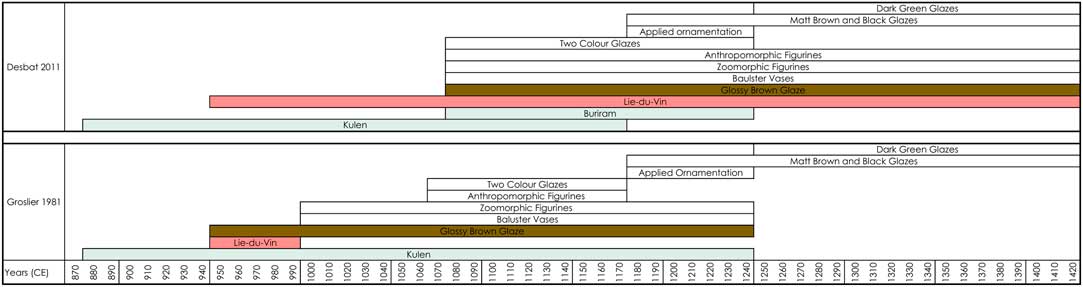
Currently, the most widely accepted chronological framework is built on typologies derived from largely unprovenanced museum assemblages and private collections, supplemented by a few excavations (Groslier Reference Groslier1957, Reference Groslier1981, Reference Groslier1995). The sequence involves the appearance and subsequent disappearance of glaze coloration (green, lie-du-vin, brown, and two-color), the introduction of certain diagnostic forms (baluster vases, zoomorphic and anthropomorphic figurines), and the use of applied decoration (Figure 1). Recognition of the expansive nature of stoneware production (Ea Reference Ea2009) has also led to the creation of a two-phase model of manufacture: Stage one (ca. 800–1100 CE) features kiln complexes based around the Angkorian core, producing large unglazed wares and smaller finely made green-glazed wares; Stage two (1100 CE onwards) sees a shift in production away from the core, the continued production of unglazed wares, the introduction of brown-glazed wares, and the subsequent decline in the manufacturing of green-glazed wares.
Summary of the Groslier and Desbat chronological sequences for Angkorian period Stoneware ceramics.

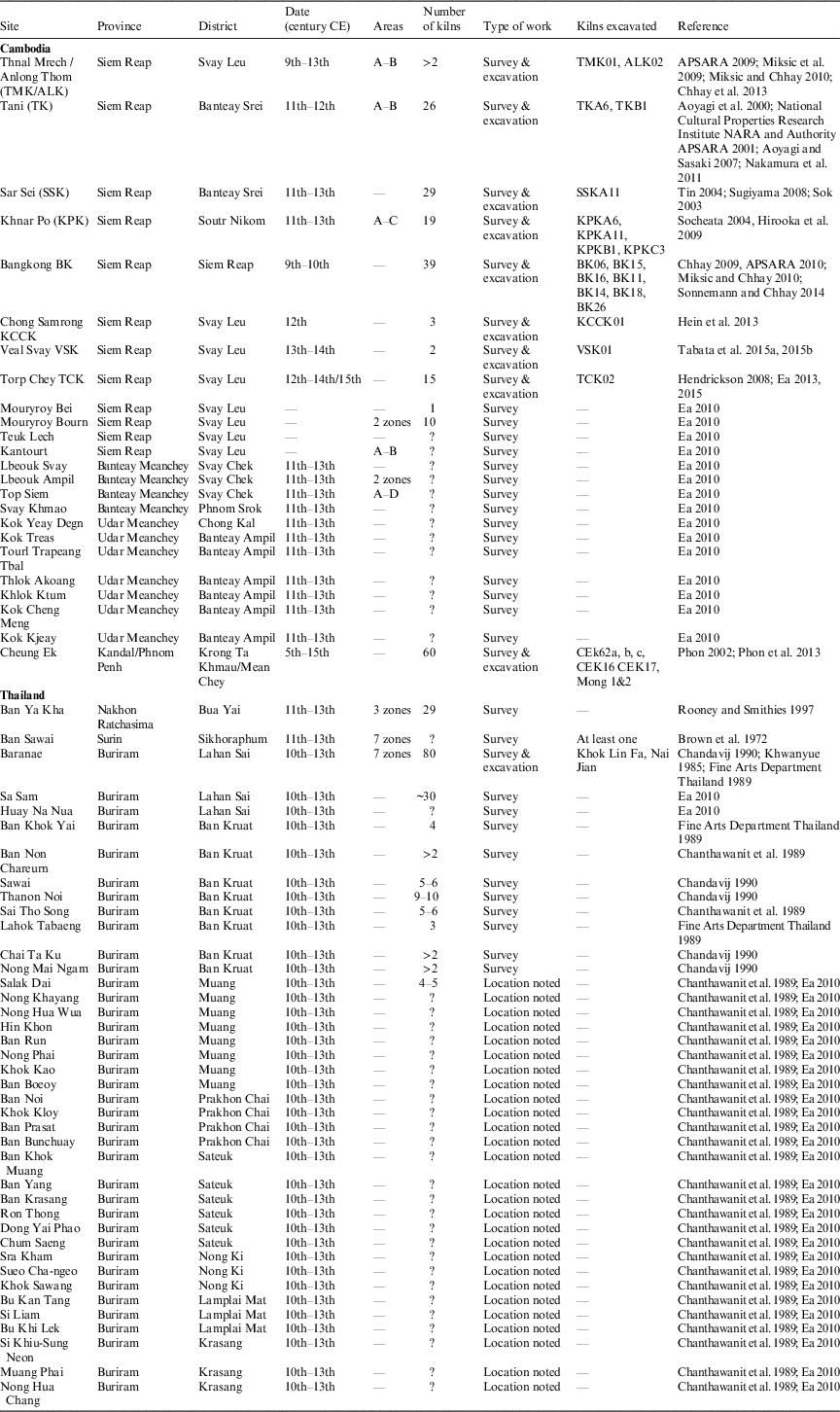
Desbat’s (Reference Desbat2011) recent refinement of the chronological sequence focuses on glaze coloration and specific forms, using samples from well dated excavations, e.g. Prasat Ta Muong (Pottier and Chhem Reference Pottier and Chhem2010), Prei Monti (Desbat Reference Desbat2008), Trapeang Phong and Bakong (Desbat Reference Desbat2009), Preah Ko (Desbat and Vierstraete Reference Desbat and Vierstraete2009) and others. It begins to synthesize the growing body of radiometric dates and excavated ceramics from kiln complexes, including Tani (Aoyagi and Sasaki Reference Aoyagi and Sasaki2007), Thnal Mrech (Miksic et al. Reference Miksic, Rachna, Piphal and Chhay2009), Sar Sei (Tabata Reference Tabata2005) and others (Table 1). However, the chronology’s dependence on ceramics recovered from consumption sites offers more insights on patterns of usage/disposal than on production date ranges. While typological and analytical comparisons between consumption and production sites can show where wares were produced, an independent dating framework is required to more accurately establish when wares were produced.
Summary of all known Angkorian period Khmer kiln sites in Cambodia and Thailand.

Previous kiln excavations have generated a limited number of radiocarbon (14C) determinations for single kilns, but are inadequate for framing production histories of large, multi-kiln sites. Recognizing this limitation and seeking to expand our understanding of the timing of production and the rate and range of technological development, new excavations were undertaken at multiple kilns from three different Angkorian period kiln complexes in Cambodia: Bangkong and Khnar Po in 2015 and Cheung Ek in 2016. These excavations focused on three issues: (1) the impact of dating multiple kilns from the same complexes on existing chronological sequences, (2) the prospect of multiple intra- and inter-site complexes operating at the same time, and (3) the evidence for change and variation in production technology over time. Addressing these issues required dating of samples from secure archaeological contexts within multiple individual kilns in a complex.
To contextualize these new 14C dates, we assembled and recalibrated all previously published radiometric dates for Angkorian Khmer kiln complexes. This revised and substantially expanded chronology highlights a geographic and chronological division in production that has been previously recognized (Ea Reference Ea2009: 24) but can now be significantly refined. As a result, we are able to present the most current and comprehensive chronology of Angkorian stoneware production to date. This revised chronology substantially alters our understanding of both the timing and development of Khmer ceramic production and the underlying political economy of the Angkorian State.
BACKGROUND
Our understanding of the nature and organization of production has typically been framed in terms of dichotomies (e.g. attached/independent, domestic/workshop, full time/part time), with a primary emphasis on defining production in terms of specialization (Costin Reference Costin2001b). While using dichotomous terms to categorize certain aspects of a production system still has merit, a more recent trend towards less universalized and more context specific analyses has proven a highly productive alternative (Halperin and Foias Reference Halperin and Foias2010; Pullen Reference Pullen2013). For example, moving beyond discussions of full and part-time production, or generalized and specialized, has enabled recognition of characteristics such as intermittent production and multi-crafting (Hirth Reference Hirth2009), community and individual differences, and the existence of attached nucleated corvée (Costin Reference Costin2001a). These approaches understand production systems as part of an economically, socially and politically integrated system from material procurement through to consumption.
All forms of production are embedded in social, political, economic, and environmental systems that Costin (Reference Costin1991) characterizes using four parameters (Brumfiel and Earle Reference Brumfiel and Earle1987; Flad Reference Flad2011); context of production (the extent of elite control of an industry), concentration of production (the geographical distribution of production), constitution of production units (the size of complexes and the principles of their organization), and intensity of production (whether it occurs as a full or part time industry). These parameters can be seen in the archaeological record by examining the location, size and configuration of production complexes; and by recognizing variation, or lack of, in the form and production methods of the ceramics.
Studies that have used ceramics as effective proxies of social and political formation and development are now numerous and wide ranging [e.g. for economic studies see Grave et al. (Reference Grave, Kealhofer, Marsh and Gates2008), Greene (Reference Greene2005), for a discussion on their utility in populations studies see Chapman (Reference Chapman1999), for the development of hierarchical societies see Elson and Sherman (Reference Elson and Sherman2007)]. For Angkorian Cambodia, the substantial labor requirements and skills required for stoneware production technology, and its distribution exclusively within the political reach of the state, flags the potential to evaluate the role of stonewares in the social functioning and political economy of the state (e.g. the role of a centralized elite in controlling the production of material culture, either in the form of direct control as administrators or indirectly as controllers of trade), and the related nature of production as attached, independent or other. Several studies (Elson and Sherman Reference Elson and Sherman2007; Halperin and Foias Reference Halperin and Foias2010) have shown that direct elite control of production can configure ceramic distribution and production in characteristic ways: through the increased scale of production, through standardization that reflects a routinization of manufacture, and through the reduction in either vessel form variety, production center number, or both. Establishing a relatively high-resolution ceramic typo-chronology is a prerequisite to studying any of these trends and is the focus of this paper.
Trajectories of research on Angkorian stoneware kiln complexes reflect various factors, including national politics and the different pace of development in adjoining Southeast Asian countries (Table 1). In Thailand, research has been undertaken at multiple kiln complexes (Rooney Reference Rooney1984) including; Ban Kruat (Chandavij Reference Chandavij1990) ~mid-11th to early 12th century CE and Ban Ya Kha (Rooney and Smithies Reference Rooney and Smithies1997) ~11th to 13th century CE. Further sites have since been identified across eastern Thailand, with at least 39 complexes identified in Buriram Province alone, all of which have multiple kilns (Table 1) (Chanthawanit et al. Reference Chanthawanit, Chanthawanit, PrachāBan and Sinlapakon1989).
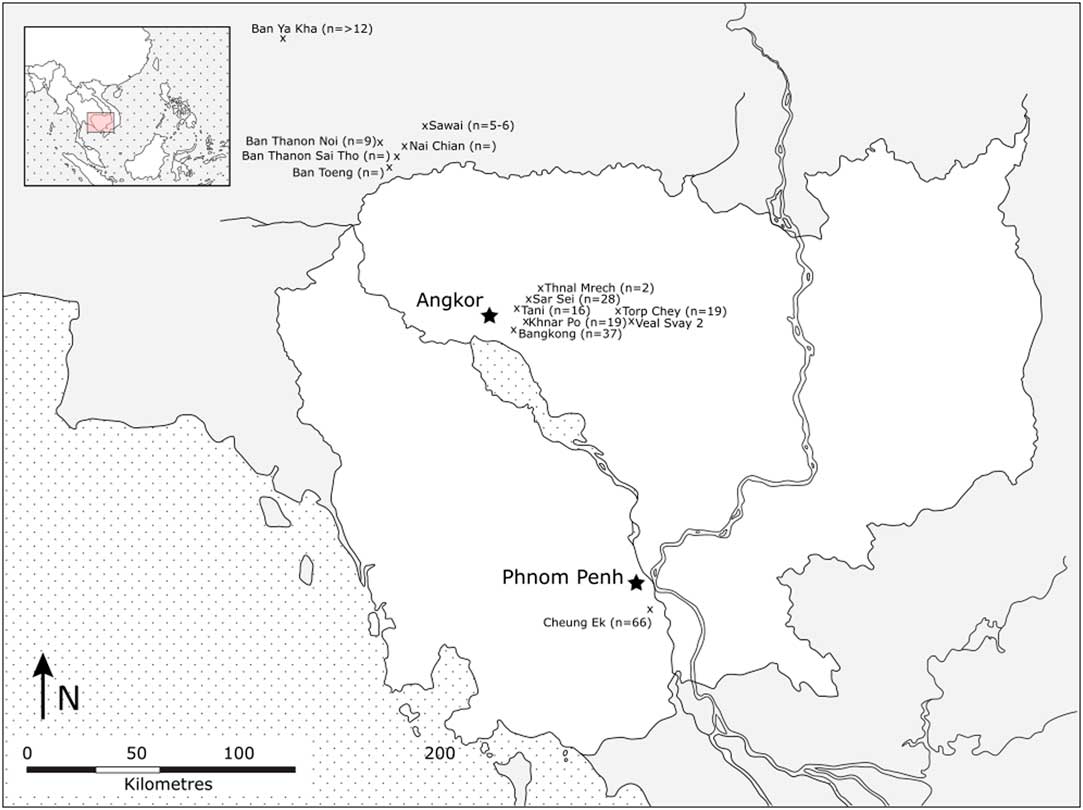
Research on Khmer stoneware production in Cambodia began more recently with the chance discovery of the Tani kiln complex in 1995, in connection with road construction activities in the Angkor Archaeological Park (Aoyagi et al. Reference Aoyagi, Saski, Tanaka, Nogami, Marui and Sumida2001). Subsequently at least 15 Angkorian period kiln complexes have been recorded in Cambodia (Table 1). Of these, excavations have been previously carried out on the wide flat plans northeast of the Tonle Sap lake at Bangkong ( Miksic and Chhay Reference Miksic and Chhay2010; Nakamura et al. Reference Nakamura, Ikeda, Hirooka, Sugiyama, Mitsuji, Ea, Sato, Sovannara and Aki2011), Torp Chey (Hendrickson Reference Hendrickson2008; Ea Reference Ea2013, Reference Ea2015), Chong Samrong (Hein et al. Reference Hein, Cort and Ea2013), Sar Sei (Sugiyama Reference Sugiyama2008), Khnar Po (Hirooka et al. Reference Hirooka, Nakamura, Inoue, Ikeda and Sugiyama2009), Veal Svay (Tabata et al. Reference Tabata, Sato, Sok and Sugiyama2015a, Reference Tabata, Sato, Sok and Sugiyama2015b) and Tani (Sugiyama et al. Reference Sugiyama, Nishimura, Hanatani and Ea2005; Aoyagi and Sasaki Reference Aoyagi and Sasaki2007; Tabata Reference Tabata2007). Further excavations have also taken place at sites on the neighboring Kulen mountain at localities called Thnal Mrech (Miksic et al. Reference Miksic, Rachna, Piphal and Chhay2009), and Anlong Thom (Tabata Reference Tabata2008; Chhay et al. Reference Chhay, Chhay, Kosal, Ly and Yukitsugu2009), and south of Phnom Penh at Cheung Ek (Phon Reference Phon2002; Phon et al. Reference Phon, Rachna, Vuthy, Vicheata, Savon and Dega2013)
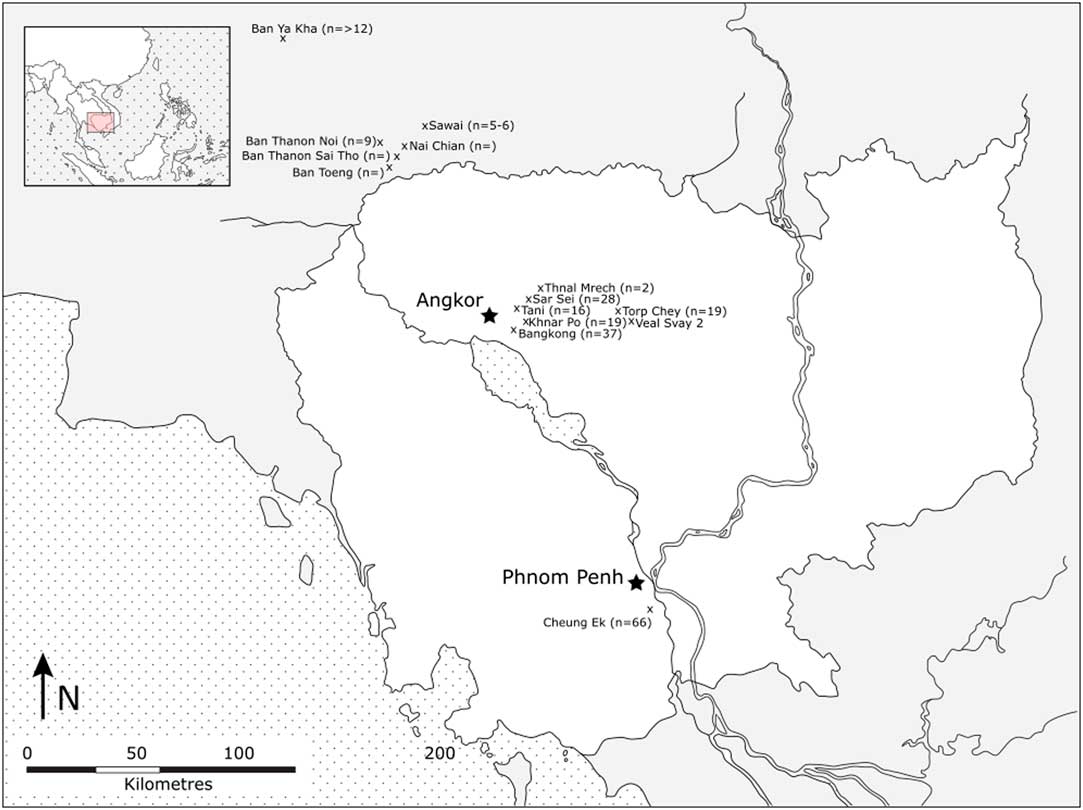
Excavations at complexes within Cambodia focused primarily on evaluating kiln technology, with the intention of understanding its origins. Excavations have been limited to only one or two kilns at each complex (Figure 2), initially due to the hazardous environments around some complexes and in part due to limited resources. Generalizing production patterns at a complex which includes multiple kilns from examination of a single kiln cannot address issues such as scale of production or temporal differences within a single complex. To address these types of questions, our collaborative research examined multiple kilns at previously investigated complexes to broaden the understanding of the complexities of production and gain internal site chronologies. Our goal was not only to contribute to the refinement of the wider ceramic typo-chronological sequence but to advance understanding of the relationships between production spheres and the Angkorian political economy.
Location of Angkorian period kiln complexes in Cambodia and eastern Thailand discussed in the text, with total number of kilns at the site in parenthesis. Sites italicized have new dates.
Production Complexes
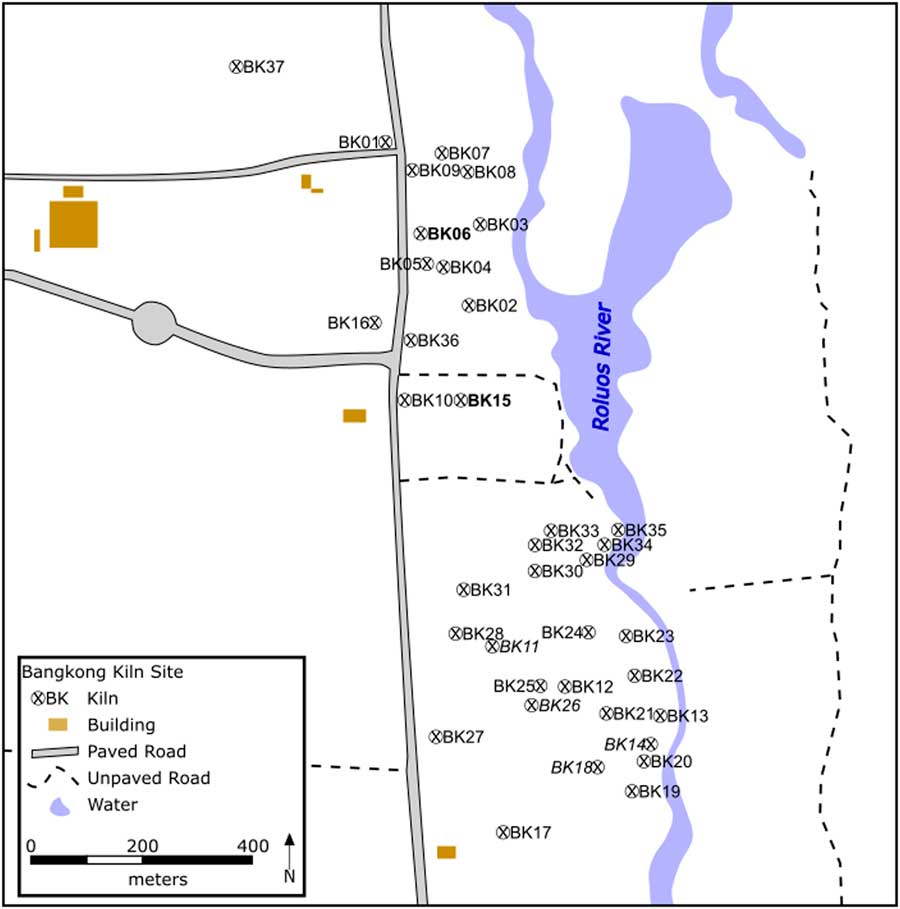
Kilns at three production complexes were excavated (Figure 3 Bangkong, Figure 4 Khnar Po, Figure 5 Cheung Ek). Two of the complexes are adjacent to the Angkorian core/Siem Reap, and the third, Cheung Ek is near Phnom Penh. Two geographically separate locations were selected for this study to broaden the assessment of the timing of production and technological development, and enable inter-site comparisons between two locations to assess production variability at locations away from the centralized core of Angkor. Individual kilns at each site provided preliminary dates ranging from the 5th to 15th century CE at Cheung Ek (Phon Reference Phon2002, Reference Phon2007), and between the 9th and 13th centuries at Bangkong (Miksic and Chhay Reference Miksic and Chhay2010) and Khnar Po (Hirooka et al. Reference Hirooka, Nakamura, Inoue, Ikeda and Sugiyama2009). Below we review each complex to explain previous work undertaken and provide context for our kiln selection and sampling rationale.
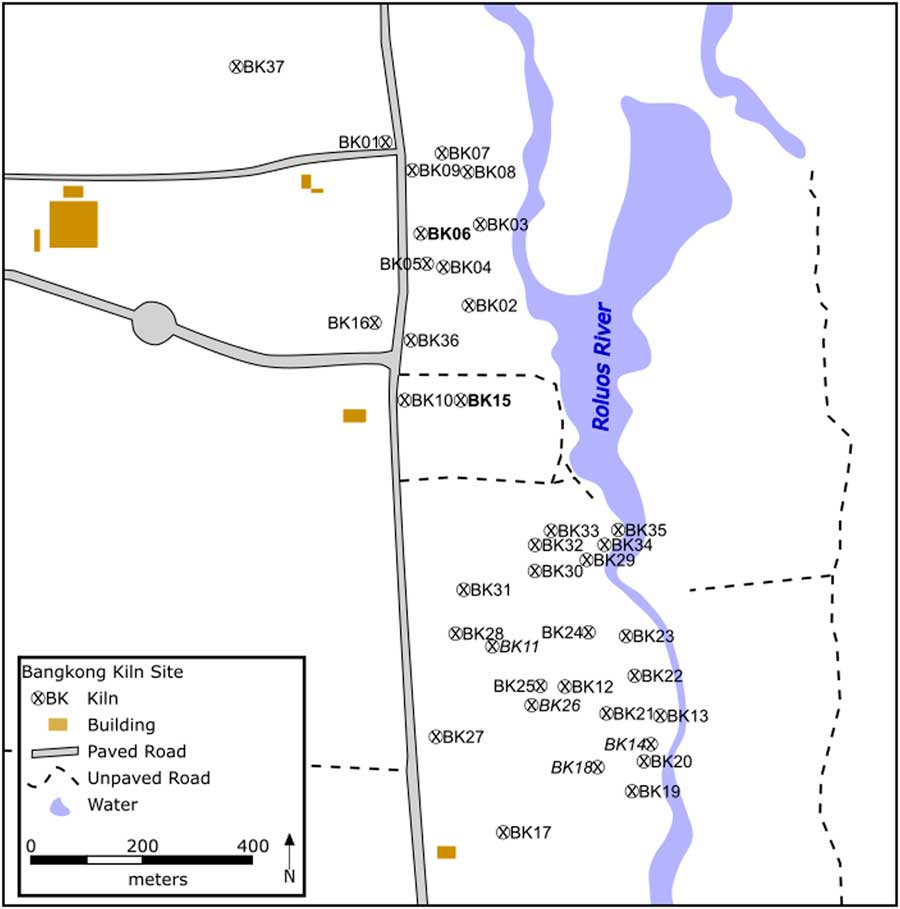
Site map of Bangkong Kiln complex, with newly excavated kilns in italics, and previously excavated kilns in bold.
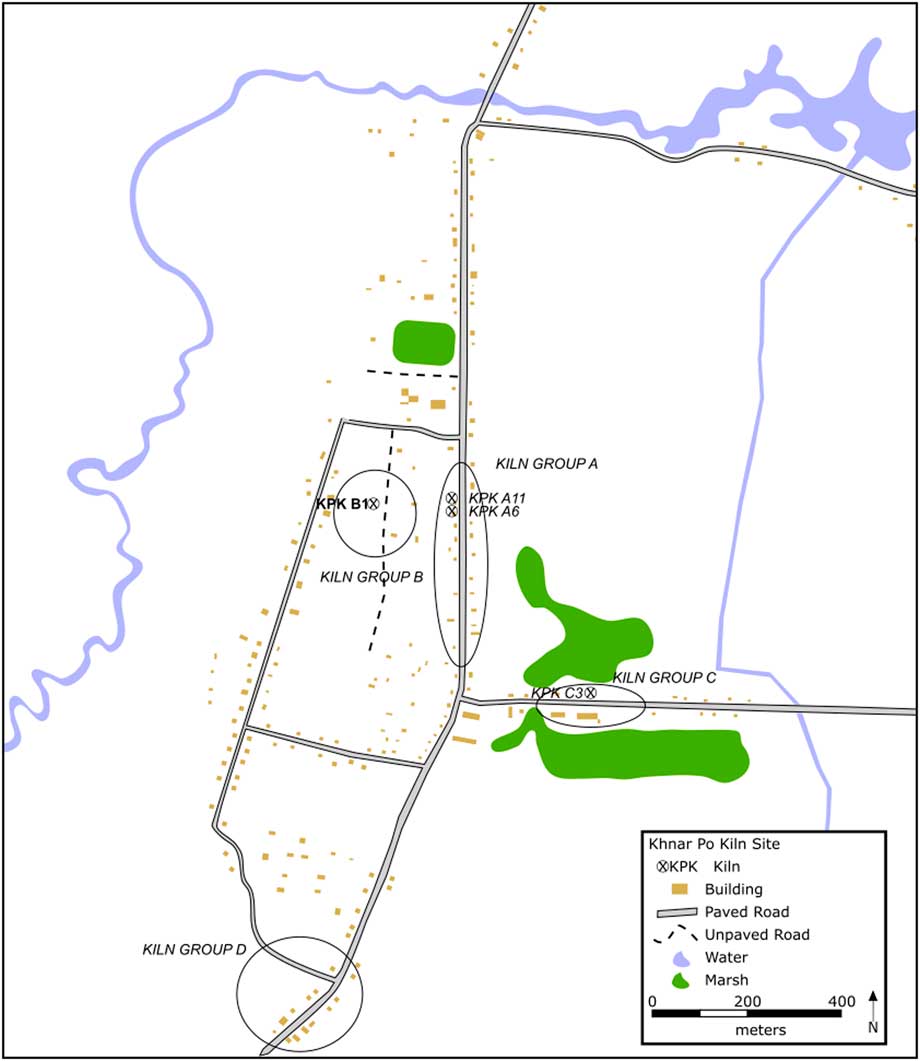
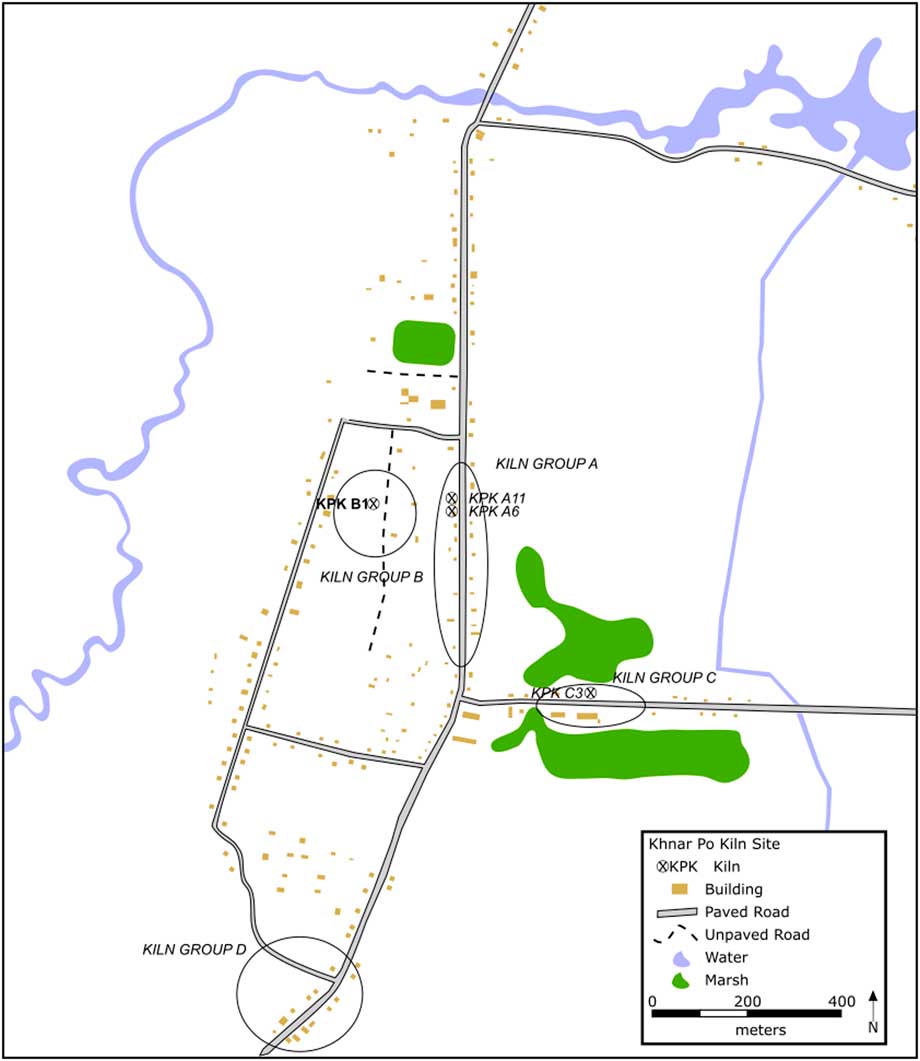
Site map of Khnar Po Kiln complex with groups highlighted with newly excavated kilns in italics, and previously excavated kilns in bold.
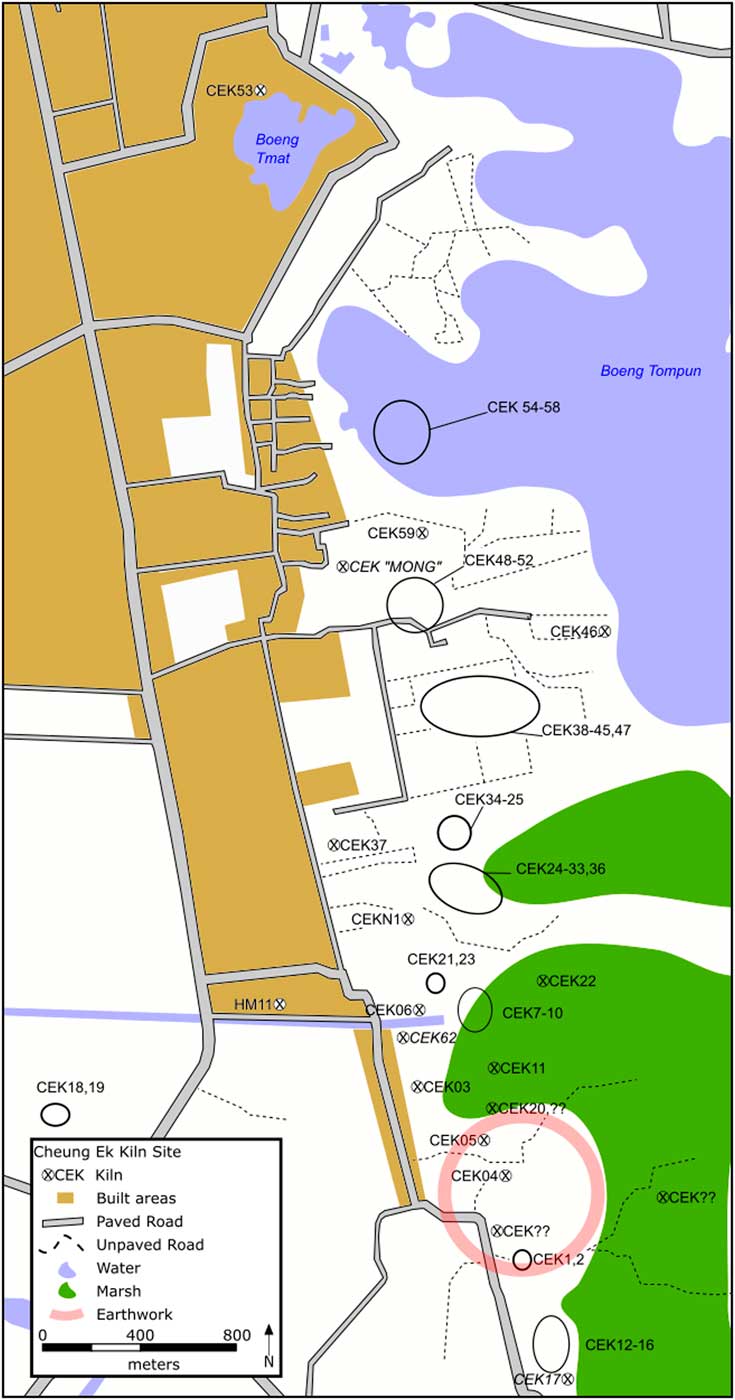
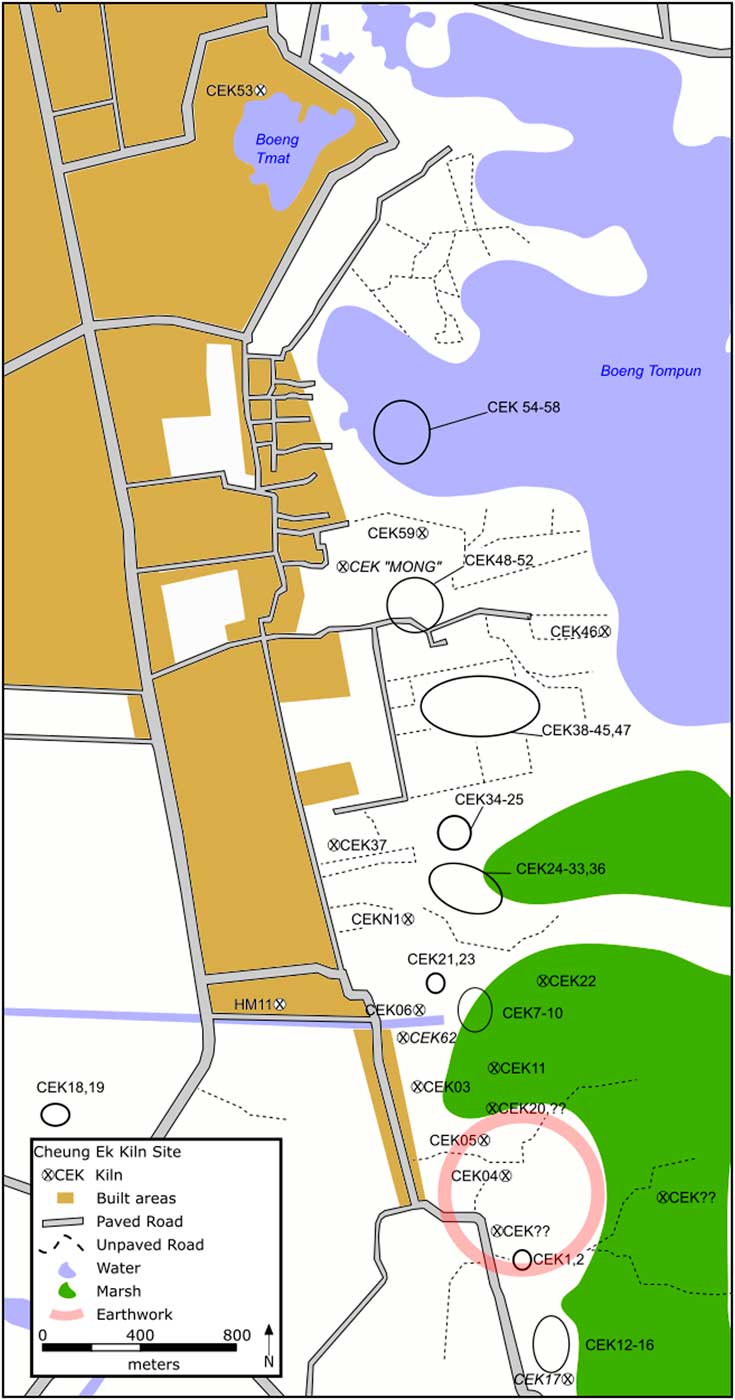
Site map of Cheung Ek Kiln complex and related archaeological features with newly excavated kilns in italics.
Bangkong
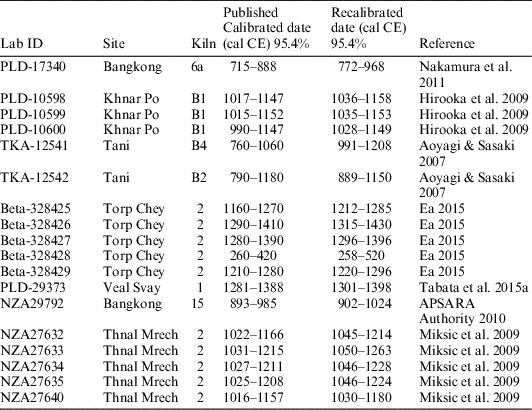
Bangkong (site code BK, Figure 3) is ca. 4.5 km north of the oldest Angkorian capital at the Roluos group. The complex today consists of a linear spread of 37 kilns on an approximate north-south alignment spanning 1.5 km along the west bank of the Roluos River. Without systematic survey the full extent of this complex remains uncertain, a situation further complicated by historic and recent land development. Following the initial identification of the site in 2007, a series of excavations at kilns BK15 and BK16 characterized the dimensions and features of kiln design and recovered associated ceramics (APSARA 2010; Miksic and Chhay Reference Miksic and Chhay2010). An additional kiln (BK06a) was excavated in 2009 to examine kiln structure and ceramics (Nakamura et al. Reference Nakamura, Ikeda, Hirooka, Sugiyama, Mitsuji, Ea, Sato, Sovannara and Aki2011). Subsequently, a ground-penetrating radar (GPR) survey was undertaken to further explore this complex non-destructively (Sonnemann and Chhay Reference Sonnemann and Chhay2014). Radiocarbon dates from the excavations suggest that the kilns were not used contemporaneously: BK6a dated from the early 8th to late 9th century CE and BK15 dated from the late 9th to late 10th century CE (Table 2). Several have suggested that it may represent the earliest Angkorian stoneware production complex (Miksic Reference Miksic2009; Nakamura et al. Reference Nakamura, Ikeda, Hirooka, Sugiyama, Mitsuji, Ea, Sato, Sovannara and Aki2011). However, the relatively small number of dates do not allow a sufficiently coherent chronological framework to characterize the production sequence for this complex.
Recalibration of all previously published radiocarbon dates from Angkorian period kiln complexes in Cambodia. Samples calibrated using OxCal v4.3.2 (Bronk Ramsey Reference Bronk Ramsey2009) using SHCal13 (Hogg et al. Reference Hogg, Hua, Blackwell, Niu, Buck, Guilderson, Heaton, Palmer, Reimer, Reimer, Turney and Zimmerman2013) with an offset of –21±6 yr (Hua et al. Reference Hua, Barbetti, Levchenko, D’arrigo, Buckley and Smith2012).

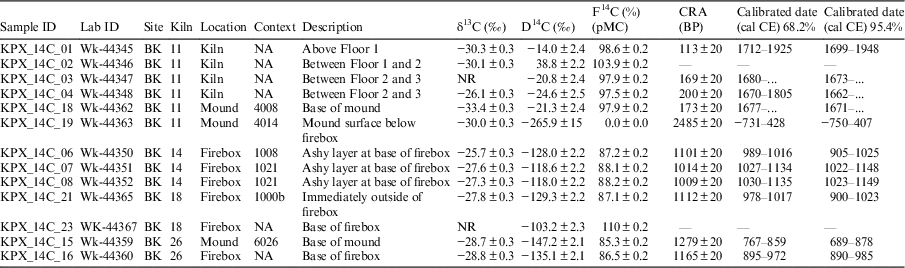
Four kilns were selected for excavations as part of this research under the APSARA Authority: BK11, BK14, BK18, and BK26. Kilns BK11, BK14, and BK18 were selected as they had already been extensively damaged; BK11 by looting, and BK14 and BK18 by large-scale earth moving. The extensive damage at BK11 required excavations that involved the complete removal of walls and floors. Conversely, the 2008 GPR survey suggested that BK26 may be in a good state of repair and therefore, could provide a more complete picture of the kiln technology through more limited excavation (Figure 3).
Khnar Po
Khnar Po (site code KPK, Figure 4) is located approximately ca. 11.5 km north-east of the Roluos Group, and ca. 8.5 km east of Bangkong. Currently, the site consists of 19 kilns in 4 groups. Two kiln groups (A and C) are located on the dykes of a pre-existing baray. The site was surveyed in 2002 and part of one kiln excavated in 2006 [KPKB1 half sectioned (Hirooka et al. Reference Hirooka, Nakamura, Inoue, Ikeda and Sugiyama2009)]. Dates suggest that the complex was in use from the mid-11th to late 12th (Table 2) (Hirooka et al. Reference Hirooka, Nakamura, Inoue, Ikeda and Sugiyama2009). In 2015, excavations were undertaken at three kilns: KPKA6, KPKA11, and KPKC3.
Kilns KPKA6 and KPKA11, both constructed on the west dyke of the baray and located in ‘A’ group (Figure 4), were damaged during road construction. This damage, the removal of the upper section of the kiln chamber, revealed the profile of multiple floor surfaces in good repair. These were selected for excavation to enable a direct comparison between two closely related kilns and due to the potential for good preservation. KPKC3, on the southern dyke of the baray in ‘C’ group was selected to provide a point of comparison between the two kilns from A group.
Cheung Ek
Cheung Ek (site code CEK, Figure 5) is located ca. 250 km south of the central Angkor region on the southern outskirts of Phnom Penh and 50 km north of the Pre-Angkorian city of Angkor Borei. Sixty-seven kilns have been identified in the area, however many have been extensively damaged or destroyed by development. The kilns are in an approximate north-south alignment covering 5 km. In addition to the kilns, 11 temple foundations, and 26 habitation mounds occur in the same area. Angkorian-period architectural features were first noted by early French explorations in the 1920s (Parmentier Reference Parmentier1927; Phon Reference Phon2002), with inscription K.426 coming from the site (Cœdès 1937–Reference Cœdès1966). Between 2001 and 2007 Phon excavated, mapped and surveyed the site. Radiocarbon dates from an earthenware kiln excavated in 2007 suggest the complex was in use potentially from the 5th century CE (Phon Reference Phon2002; Phon et al. Reference Phon, Rachna, Vuthy, Vicheata, Savon and Dega2013). Therefore, work resumed in 2012 with excavations at Kiln 16 and 17 both of which had been partially destroyed, as well as rescue excavations at “Kiln Mong”. Conversely, Kiln 62 excavated in 2016, was identified as a sufficiently well preserved site for comparing CEK production methods and products with complexes closer to the Angkorian core (Figure 5).
METHODS
Chhay Rachna (APSARA Authority) directed excavations at Bangkong and Khnar Por from June to September 2015, and Phon Kaseka (Royal Academy of Cambodia) directed excavations at Cheung Ek in June 2016. Dating was undertaken at the University of Waikato Radiocarbon Dating Laboratory, following standard AMS protocols (Tables 3–5).
Radiocarbon and stable isotope results from Bangkong kiln complex. NR = no result provided. Samples calibrated using OxCal v4.3.2 (Bronk Ramsey Reference Bronk Ramsey2009) using SHCal13 (Hogg et al. Reference Hogg, Hua, Blackwell, Niu, Buck, Guilderson, Heaton, Palmer, Reimer, Reimer, Turney and Zimmerman2013) with an offset of –21±6 yr (Hua et al. Reference Hua, Barbetti, Levchenko, D’arrigo, Buckley and Smith2012).

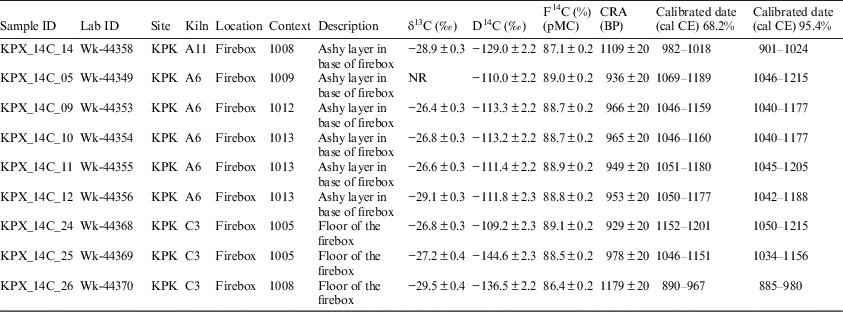
Radiocarbon and stable isotope results from Khnar Po kiln complex. NR = no result provided. Samples calibrated using OxCal v4.3.2 (Bronk Ramsey Reference Bronk Ramsey2009) using SHCal13 (Hogg et al. Reference Hogg, Hua, Blackwell, Niu, Buck, Guilderson, Heaton, Palmer, Reimer, Reimer, Turney and Zimmerman2013) with an offset of –21±6 yr (Hua et al. Reference Hua, Barbetti, Levchenko, D’arrigo, Buckley and Smith2012).

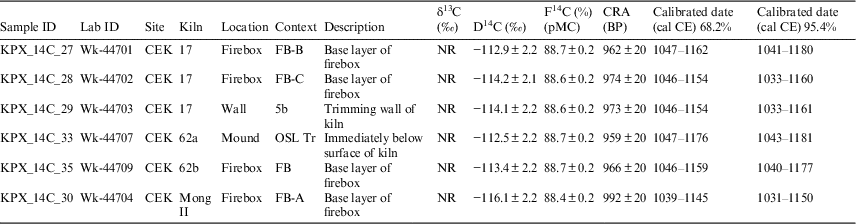
Radiocarbon and stable isotope results from Cheung Ek kiln complex. NR = no result provided. Samples calibrated using OxCal v4.3.2 (Bronk Ramsey Reference Bronk Ramsey2009) using SHCal13 (Hogg et al. Reference Hogg, Hua, Blackwell, Niu, Buck, Guilderson, Heaton, Palmer, Reimer, Reimer, Turney and Zimmerman2013) with an offset of –21±6 yr (Hua et al. Reference Hua, Barbetti, Levchenko, D’arrigo, Buckley and Smith2012).

Dating Sample Selection
All charcoal discovered at excavated kilns was recovered in the field and stored wrapped in aluminum foil inside sealed UV stabilized PE-LD bags. Most samples were obtained from the fireboxes of kilns with the assumption that they would more reliably correspond to a terminal firing of the kiln. When charcoal was not found inside of the firebox, samples were selected from the most closely associated stratigraphic layers outside of the firebox. All kilns excavated were built on either purposefully constructed mounds (at Bangkong and Cheung Ek) or on pre-existing earthworks (at Khnar Po). All featured at least one, and up to nine (at BK11) superimposed kilns, representing successive constructions. Samples were also selected from between successive kiln floors where available, and from inside the mound construction beneath the kilns to provide individual kiln construction and production history. Following selection, all samples were re-wrapped in aluminum foil, stored in low-density polyethylene bags, and exported to the University of New England where they were subsampled and sent for analysis.
Sample Calibration
Currently various iterations of both the Northern Hemisphere (IntCal) and Southern Hemisphere (SHCal) calibration curves are used in Cambodia, despite the difference in atmospheric carbon that has been established between the two hemispheres (Hua et al. Reference Hua, Barbetti, Zoppi, Fink, Watanasak and Jacobsen2004). More recently, use of the Southern Hemisphere curve has been justified by a northward shift of the Intertropical Convergence Zone (ITCZ) during the late Angkorian period (Sachs et al. Reference Sachs, Sachse, Smittenberg, Zhang, Battisti and Golubic2009). When dating organic material recovered from the tropics however, the shifting nature of the ITCZ means that it is not always clear which curve to use. Recent work (Hua et al. Reference Hua, Barbetti, Zoppi, Fink, Watanasak and Jacobsen2004, Reference Hua, Barbetti, Levchenko, D’arrigo, Buckley and Smith2012; Hua and Barbetti Reference Hua and Barbetti2007) has shown that the mixing of Southern Hemisphere and Northern Hemisphere 14C over the tropics during the period CE 1620–1750 has led to a discrepancy of around –20 yr±6. It is possible that this same variation, or indeed a greater variation exists for older samples. Only a limited number of published dates have as yet made use of this tropical mixing offset (e.g. Beavan et al. Reference Beavan, Halcrow, McFadgen, Hamilton, Buckley, Tep, Shewan, Sokha, Fallon, Miksic, Armstrong, O’Reilly, Domett and Chhem2012, Reference Beavan, Hamilton, Tep and Sayle2015; Hendrickson et al. Reference Hendrickson, Hua and Pryce2013). This offset of –20 yr±6 has been applied to all calibrated samples here. Previously published dates have been also recalibrated with the offset using SHCal13 to ensure appropriate comparison and the differences between the originally published and recalibrated dates are discussed.
RESULTS
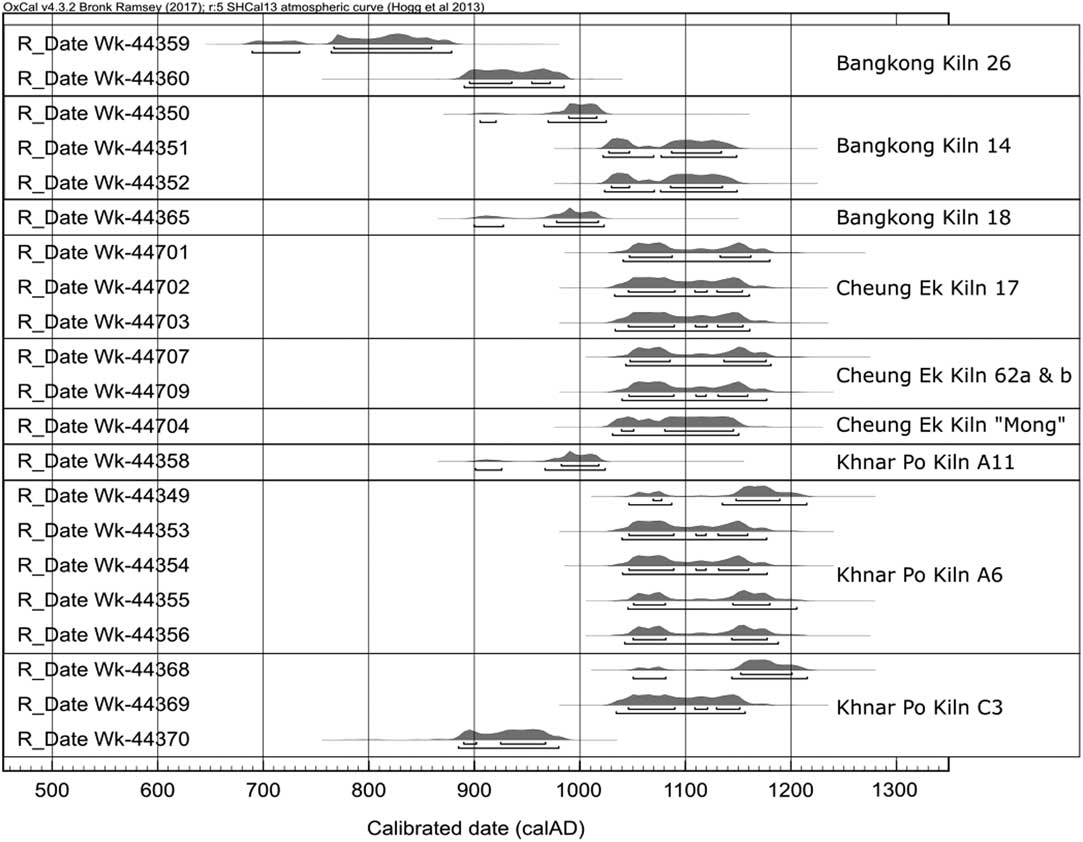
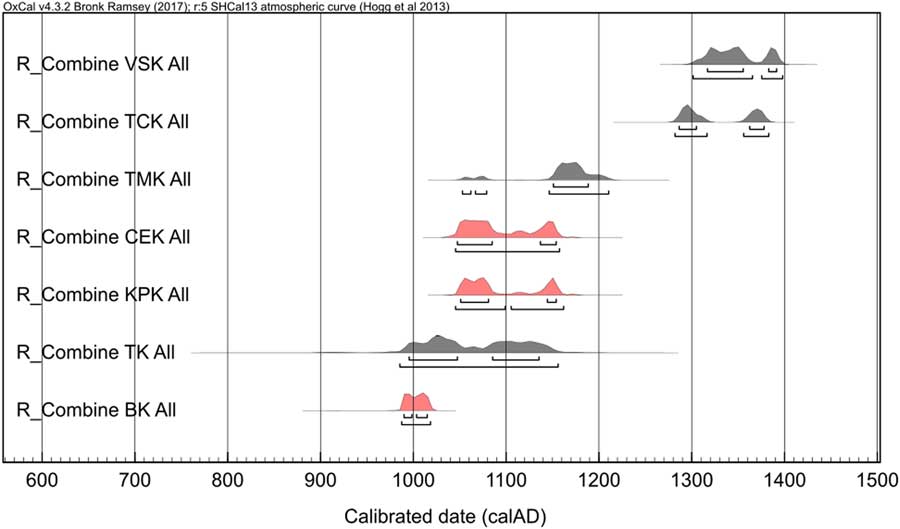
Of the 28 samples sent for analysis 20 proved viable for AMS 14C determinations (Table 3; Bangkong, Table 4; Khnar Po, Table 5; Cheung Ek, and Figure 6). Results are presented as 14C ages (Stuiver and Polach Reference Stuiver and Polach1977) reported as “cal CE/BCE” conforming to the Trondheim convention (Stuiver and Kra Reference Stuiver and Kra1986), and calibrated using the offset of –20±6 yr with SHCal13 (Hogg et al. Reference Hogg, Hua, Blackwell, Niu, Buck, Guilderson, Heaton, Palmer, Reimer, Reimer, Turney and Zimmerman2013) in OxCal v4.3.2 (Bronk Ramsey Reference Bronk Ramsey2009) (Reimer et al. Reference Reimer, Baillie, Bard, Bayliss, Beck, Blackwell, Bronk Ramsey, Buck, Burr, Edwards, Friedrich, Grootes, Guilderson, Hajdas, Heaton, Hogg, Hughen, Kaiser, Kromer, McCormac, Manning, Reimer, Richards, Southon, Talamo, Turney, van der Plicht and Weyhenmeyer2009). After removing anomalous “old wood” results, the 14C combination model in OxCal v4.3.2 was used to integrate new and recalibrated published dates from each kiln complex to generate a chronological framework for production (Figure 7).
Plot of new radiocarbon dates for kilns excavated as part of this study. Calibrated in OxCal v4.3.2 (Bronk Ramsey Reference Bronk Ramsey2009) using SHCal13 (Hogg et al. Reference Hogg, Hua, Blackwell, Niu, Buck, Guilderson, Heaton, Palmer, Reimer, Reimer, Turney and Zimmerman2013) with an offset of −21±6 years (Hua et al. Reference Hua, Barbetti, Levchenko, D’arrigo, Buckley and Smith2012).

14C combination model of all published dates from Angkorian Stoneware kilns with new dates from this paper highlighted in red. Calibrated in OxCal v4.3.2 (Bronk Ramsey Reference Bronk Ramsey2009) using SHcal13 (Hogg et al. Reference Hogg, Hua, Blackwell, Niu, Buck, Guilderson, Heaton, Palmer, Reimer, Reimer, Turney and Zimmerman2013) with an offset of −21±6 years (Hua et al. Reference Hua, Barbetti, Levchenko, D’arrigo, Buckley and Smith2012).
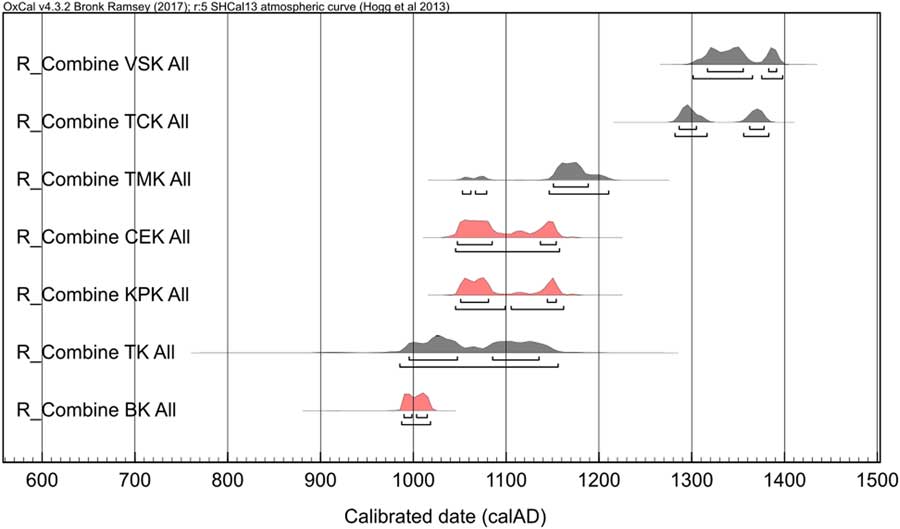
Calibrated date ranges from the new excavations, at 2σ confidence, extend from the late 7th century CE (BK26 Wk-44359) to early 13th century CE (KPKA6 Wk-44349 and KPKC3 Wk-44368). The majority (n= 12, 60%) have broad ranges from the 11th to 12th century CE. Following removal of dates considered anomalously old or as more recent contaminants, and incorporation of recalibrated published dates, the 14C combination model highlights two phases of production: the first from the late 9th century CE to the late 12th century CE; a second from the late 13th century CE to the late 14th century.
At Bangkong, three of the kilns (BK14, BK18, and BK26) produced dates from firebox samples that relate to the last use of these kilns. BK26 along with BK 11 also produced materials for dating from within the mound construction. While the BK26 mound dates are consistent with the firebox results, BK11 samples returned widely varying dates well outside the range for the other kilns in this complex. The BK11 samples were evidently not contemporary with the excavated contexts they were found in and have therefore been removed from the subsequent modelling. Kiln BK26 was in use potentially from the 8th century, with the remaining kilns in use contemporaneously from the early 10th century CE. Production at BK14 possibly continued as late as the mid-12th century.
All Khnar Po samples were associated with the firebox and relate to the terminal use of the kiln. The Khnar Po dates confirm an expected age range based on the ceramics recovered. All Cheung Ek samples were associated with the firebox and therefore correspond to the final use of the kiln. The dates show that the Cheung Ek complex was active from the late 9th to the mid-12th centuries.
DISCUSSION
The results presented above substantially shift our understanding of the scale of production of Angkorian period stoneware ceramics and have implications for the methodology of kiln excavations. In combination with the collation and recalibration of previous dates, these data confirm the existence of two temporally and spatially separate production phases (Ea Reference Ea2013, Ea Reference Ea2009). We are now able to anchor these phases chronologically; Phase 1: late 9th to late 12th century CE, and Phase 2: late 13th to late 14th century CE. Future analysis will demonstrate if these two phases also have a change in kiln technology and ceramics produced.
If the sample from the Bangkong Kiln 26 mound fill is contemporary with mound construction, the mound may date to the late 8th century CE (Wk-44359). If it is 8th century, then along with the early result from Kiln 6a, it is possible that production at the site began at a smaller scale around this time prior to a more intense phase from the 11th–12th century. This raises the possibility that either the mound had an initial function not related to ceramic production, or that ceramic production began in the region prior to the start of the Angkorian period (early 9th century CE).
All kilns excavated and dated from Khnar Po, including previous work at KPK B1 show contemporaneous production occurring from the mid-11th to mid-12th century. While recognizing the difficulty in categorizing a site based on limited results, if the 19 kilns at the site were in operation simultaneously this indicates substantial output (and demand). The exception to this, KPK A11, may be the result of old wood being used, or else was in use earlier from the late 9th to early 10th century. As with BK26, this may reflect an earlier smaller scale production at the site. During the 10th to 12th century CE ceramic production was centered firmly in the area immediately to the east of central Angkor.
Production at the Cheung Ek kilns, 250 km south, was contemporary with Bangkong and Khnar Po. Previous work here shows the likelihood of a relatively long production history (Phon et al. Reference Phon, Rachna, Vuthy, Vicheata, Savon and Dega2013). The new dates suggest that the site remained an important ceramic production center during the Angkorian period, likely supplying the region between the lower Tonle Sap Lake and the Mekong Delta, but also supplying the Angkorian core (Bâty et al. Reference Bâty, Desbart, Sellami and Marquié2014).
The recalibration of extant dates for kiln sites consistently shifts the dates slightly later. For the most part, these shifts are minor and do not meaningfully impact on the understanding of ceramic production. The exception to this is at Tani, where the 2σ date range for both samples places the site firmly contemporary with Bangkong and changes our understanding of the site and historical relationships of production. This demonstrates the merit of recalibrating previously published dates.
This aggregate set of dates suggests that Angkorian potters engaged in contemporary stoneware production at multiple complexes, rather than the sequential use of kiln complexes over time. If true, this significantly alters our understanding of the volume of production and presents evidence for a much larger scale of production than previously believed which appears to be directly tied into the socio-political system, although the exact nature of this relationship requires further investigation.
As shown in Table 1, many kilns to the West of Angkor and in eastern Thailand remain unexamined. Likewise, there have been no surveys for ceramic production complexes at other Angkorian provincial centers in southern Laos (e.g. Vat Phou) or elsewhere within Cambodia (e.g. Banteay Chhmar). Therefore, while these data reveal a geographical shift in production, future work is likely to further improve our understanding.
IMPLICATIONS
The development of the typo-chronological sequence proposed by Groslier (Reference Groslier1981) (Ea Reference Ea2009; Desbat Reference Desbat2011) has continued to incorporate the growing body of ceramics recovered from radiocarbon dated contexts. However, by targeting secure contexts from multiple kilns within individual production complexes, we are able to provide a higher resolution sequence of production to strengthen the model of a two-phase manufacture and identify a potential production gap between the end of production in the Angkorian Core and the initiation of production on the periphery. The combination of all published dates from Angkorian kilns also supports the scenario of two key periods of production within Cambodia. The exception to this scenario is the extended date range for the production complex at Cheung Ek, which may reflect the co-option of a phase 1 (or earlier) production complex by a new phase 2 political center, a fruitful line of enquiry for future research.
Each phase is also currently spatially patterned: late 9th to 12th century CE kiln complexes are restricted to East Angkor (and Cheung Ek); 14th century CE kiln complexes restricted to an area along the east road. The current lack of evidence of local production post 14th century fits into a wider regional pattern of shifting centers of ceramic production, with the next major center established at Sisatchanalai in northern Thailand, where production may have existed from the 10th century CE but is characterized by surface kilns from the 13th to 15th century CE (Barbetti and Hein Reference Barbetti and Hein1989). This coincides with the end of production at Angkorian kilns in the northeast of Thailand around the 13th century CE (see Table 1 and Wong Reference Wong2010).
When characterizing production using established parameters (Costin Reference Costin1991) a difference in the concentration of production and constitution of production units between phase 1 and phase 2 is evident. During phase 1 production complexes are located close to the core and consist of multiple kilns in simultaneous operation, whereas during phase 2 production shifts to provincial settings with fewer kilns per site; their operational capacity requires further investigation. Regarding the intensity of production, the likely seasonal nature of production (Miksic et al. Reference Miksic, Rachna, Piphal and Chhay2009: 18) suggests a “part-time industry”, however following Hirth (Reference Hirth2009) a more appropriate definition would be “Intermittent Single Craft Production” (Hirth Reference Hirth2009: 23). The complexity of the technology used, in addition to the conformity and volume of ceramics produced suggests a high level of skill, a key indicator of specialization (Costin Reference Costin2001a: 281). Changes to the intensity of production between phases 1 and 2 can be seen in the number of kilns per site, however, planned further examination of both the kiln technology and ceramics produced will explore this further.
Changes in the concentration of production and the constitution of production units described by our multi-phase scenario track the historical trajectory of Angkorian rulership. From the early 10th to late 11th century CE the center of power within the Angkorian State shifted from Roluos to Angkor with a 10th century CE interregnum at Koh Ker. This was also a period of territorial expansion and contraction (Hendrickson Reference Hendrickson2010; Lustig Reference Lustig2011). At its largest extent, the Angkorian Empire including areas of Vietnam, Laos, and Thailand. Historically attested internal civil strife was common during successional shifts, especially around 1000 CE. The cessation of mass production at Bangkong, Khnar Po and other central production sites such as Tani and Thnal Mrech, by the mid-12th century CE, corresponds to the end of the reign of Suryavarman II, a period of political upheaval marked by the usurpation of his successor Yashovarman II, by Tribhuvanādityavarman, and the sack of Angkor by the Chams in 1177 CE.
The correlation between these political events and cessation of production in phase 1 suggests that they impacted the context of production. Recommencement of phase 2 production in the late 13th to early 14th century CE away from the central Angkor area and into provincial settings along the East Road (e.g. Veal Svay and Torp Chey) and in northeast Thailand (e.g. Ban Kruat and Ban Baranae), is consistent with political decentralization (Costin Reference Costin2005), following the end of the reign of Jayavarman VIII and his successors.
A production-based chronological framework provides a different and higher resolution perspective on developmental trajectories than one based solely on consumption. Here we have made a preliminary step in building this type of chronology. While clearly incomplete given the size, scale and range of Angkorian and post-Angkorian stoneware production complexes, it nevertheless demonstrates the advantages of not only resolving production sequences but also of being able to link them to wider social, economic and political dynamics.
CONCLUSION
With the dating program undertaken at the three kiln sites we are in a position to better understand the capacity of production at Angkorian period stoneware production complexes. Our two-phase model indicates that from the late 9th century until the late 12th century intensive production was focused immediately east of Angkor and at Cheung Ek, with multiple kiln sites in operation concurrently. Ceramic production at Bangkong and Khnar Po ceased no later than the mid-13th century CE. Production appears to shift to provincial areas along the East Road out of Angkor and in eastern Thailand, where production abruptly ceases at the end of the 14th century CE, however, a lack of detailed survey and excavation in other areas may shift this understanding. While this research shows the benefit of comprehensive dating programs for production complexes it can only be considered preliminary. Ongoing work will be required to expand and refine this framework.
ACKNOWLEDGMENTS
We wish to thank to the APSARA Authority, Ministry of Culture and Fine Arts and Royal Academy of Cambodia for permission to excavate at the kiln sites, assistance in the excavations, and permission to export samples. APSARA Authority and Friends of Khmer Culture, Inc. supported the 2015 Bangkong and Khnar Po fieldwork. The Royal Academy of Cambodia and National Geographic Society Research Grant (Asia 01-15) supported the 2016 Cheung Ek fieldwork. Australian Research Council DP 140103194 supported the senior author’s participation in both field projects, costs of radiometric dating and research undertaken by authors two, three and four. We also thank So Malay (Administrator, University of Sydney Greater Angkor Project) for assistance in shipping samples, Kimberlee Newman (Archaeology, University of New England) for assistance in drafting figures, and to the two reviewers for their helpful comments. We finally express gratitude to residents of Bangkong, Khnar Po and Cheung Ek for their hospitality and support, and to numerous workers for their dedicated help.