Introduction
Converging evidence from preclinical and clinical studies suggest that impulsivity is a heterogeneous construct (Dawe et al. Reference Dawe, Gullo and Loxton2004) which can broadly be subdivided into decisional and motor domains (Evenden, Reference Evenden1999). These multiple subtypes of impulsivity are associated with distinct yet overlapping neural networks and neurochemical substrates (Perry & Carroll, Reference Perry and Carroll2008; Dalley et al. Reference Dalley, Everitt and Robbins2011). Impulsivity is important to substance use disorders as these clinical entities are commonly characterized by enhanced impulsivity both as a concurrent and predictive correlate (Perry & Carroll, Reference Perry and Carroll2008). Preclinical evidence suggests some overlap between disorders of pathological food and drug use (Avena, Reference Avena2011; Ziauddeen et al. Reference Ziauddeen, Farooqi and Fletcher2012). Although elevated impulsivity has been associated with bulimia nervosa (binge eating with purging) and the bingeing-purging subtype of anorexia nervosa (Fernández-Aranda et al. Reference Fernández-Aranda, Jiménez-Murcia, Álvarez-Moya, Granero, Vallejo and Bulik2006), here we focus specifically on obese subjects without purging and assess the role of binge-eating disorder (BED). This cross-diagnostic comparison of neurocognitive profiles may strengthen understanding of current psychiatric disease classifications and could allow tailoring of treatments to specific patterns of impairments (Robbins et al. Reference Robbins, Gillan, Smith, de Wit and Ersche2012).
Laboratory-based cognitive measures of impulsivity are particularly useful as they may have better validity as predictors of state impulsivity than self-report questionnaires (Caswell et al. Reference Caswell, Morgan and Duka2013b). Recently, a range of impulsivity subtypes have been successfully characterized in Parkinson's disease, demonstrating the potential to subtype impulsivity in clinical populations (Nombela et al. Reference Nombela, Rittman, Robbins and Rowe2014).
Decisional impulsivity includes delay discounting, also known as impulsive choice, or the preference for an immediate small reward over a delayed but larger reward (Kirby et al. Reference Kirby, Petry and Bickel1999). Excessive delayed discounting is a central feature of multiple addictive and behavioural disorders and has been suggested to represent a ‘trans-disease’ process underlying choice behavior (Koffarnus et al. Reference Koffarnus, Jarmolowicz, Mueller and Bickel2013). Delay discounting may reflect multiple sub-processes that can be mapped onto neural regions including valuation of reward [ventral striatum, ventro-medial prefrontal cortex (vmPFC) and substantia nigra] cognitive control (anterior cingulate, lateral PFC) and prospection (medial temporal lobe) (Peters & Büchel, Reference Peters and Büchel2011). Reflection impulsivity involves making rapid decisions before evaluating sufficient evidence, and in a human fMRI study has been shown to involve a network including the ventral striatum, anterior insula, anterior cingulate and parietal cortex (Furl & Averbeck, Reference Furl and Averbeck2011). Preclinical evidence suggests a dissociation in measures of motor impulsivity which can be subdivided into motor response inhibition or the failure to stop a prepotent motor response (Aron et al. Reference Aron, Fletcher, Bullmore, Sahakian and Robbins2003) and anticipatory (premature) responding prior to the onset of a target. The neural regions implicated in response inhibition as tested using the stop signal task (SST) from lesional and imaging studies in rodent and human research include the right inferior frontal cortex, pre-supplementary motor area and caudate (Aron et al. Reference Aron, Fletcher, Bullmore, Sahakian and Robbins2003, Reference Aron, Behrens, Smith, Frank and Poldrack2007; Robbins, Reference Robbins2007). In premature responding, rodent studies have implicated the prelimbic cortex, nucleus accumbens and subthalamic nucleus (Risterucci et al. Reference Risterucci, Terramorsi, Nieoullon and Amalric2003; Desbonnet et al. Reference Desbonnet, Temel, Visser-Vandewalle, Blokland, Hornikx and Steinbusch2004; Pothuizen et al. Reference Pothuizen, Jongen-Rêlo, Feldon and Yee2005; Dalley et al. Reference Dalley, Fryer, Brichard, Robinson, Theobald, Lääne, Peña, Murphy, Shah and Probst2007).
Alcohol use disorders have been associated with greater decisional and motor impulsivity with greater delay discounting (Petry, Reference Petry2001; Bjork et al. Reference Bjork, Hommer, Grant and Danube2004; Bobova et al. Reference Bobova, Finn, Rickert and Lucas2009; MacKillop et al. Reference MacKillop, Miranda, Monti, Ray, Murphy, Rohsenow, McGeary, Swift, Tidey and Gwaltney2010). In rodent studies, increased premature responding has been associated with acute alcohol intake (Oliver et al. Reference Oliver, Ripley and Stephens2009), the early phase of abstinence after chronic alcohol exposure (Walker et al. Reference Walker, Peña-Oliver and Stephens2011) and has been correlated with alcohol withdrawal severity (Gubner et al. Reference Gubner, Wilhelm, Phillips and Mitchell2010). We also recently found elevated premature responding in human abstinent alcohol-dependent subjects (Voon et al. Reference Voon, Irvine, Derbyshire, Worbe, Lange, Abbott, Morein-Zamir, Dudley, Caprioli and Harrison2014b). Although some studies have shown impaired motor response inhibition (de Zwaan et al. Reference de Zwaan, Mitchell, Seim, Specker, Pyle, Raymond and Crosby1994; Lawrence et al. Reference Lawrence, Luty, Bogdan, Sahakian and Clark2009a, Reference Lawrence, Luty, Bogdan, Sahakian and Clarkb) significantly prolonged stop signal reaction times have not always been found with alcohol dependence (Li et al. Reference Li, Luo, Yan, Bergquist and Sinha2009; Schmaal et al. Reference Schmaal, Joos, Koeleman, Veltman, van den Brink and Goudriaan2013).
The relationship between impulsivity, eating disorders and alcohol misuse is complex. Correlation between obesity and addictive disorders is frequently low (Riggs et al. Reference Riggs, Spruijt-Metz, Chou and Pentz2012) and may be absent or negative (Kleiner et al. Reference Kleiner, Gold, Frostpineda, Lenzbrunsman, Perri and Jacobs2004; Mather et al. Reference Mather, Cox, Enns and Sareen2008). The prevalence of impulse control disorders have been found to be elevated in obesity and particularly high in obesity with binge eating (Schmidt et al. Reference Schmidt, Körber, Zwaan and Müller2012). In rats, binge eating of palatable food has been found to accelerate habitual control of behaviour and be dependent on dorsolateral striatal activation (Furlong et al. Reference Furlong, Jayaweera, Balleine and Corbit2014). Although impulsivity appears important to both eating disorders and addictions, it is possible that other factors such as obsessive-compulsive features may also be relevant to characterizing and differentiating the disorders (Altman & Shankman, Reference Altman and Shankman2009). For instance, in the IMAGEN study involving adolescents (Montigny et al. Reference Montigny, Castellanos-Ryan, Whelan, Banaschewski, Barker, Büchel, Gallinat, Flor, Mann, Paillère-Martinot, Nees, Lathrop, Loth, Paus, Pausova, Rietschel, Schumann, Smolka, Struve, Robbins, Garavan and Conrod2013), which assessed a broad range of eating disorders without investigating subtypes showed that eating disorders and alcohol misuse did not overlap in their relationship to externalizing constructs. Unlike binge drinking, the broad range of eating disorders showed variance best explained by a compulsivity spectrum rather than an externalizing factor suggesting that the relationship between substance misuse and eating disorders may be complex and multi-factorial. In contrast, this current study focuses on a specific subtype of pathological eating behaviour comparing obese subjects with and without BED with a disorder of drug addiction.
Preliminary evidence suggests that binge eating may represent a distinct subtype of obesity with greater similarities to disorders of addiction. In rodent studies, sugar bingeing displays addictive characteristics such as enhanced responding after abstinence, opiate-like withdrawal features, amphetamine cross-sensitization and associated dopamine release in the nucleus accumbens (Avena et al. Reference Avena, Rada and Hoebel2008). In humans, preliminary evidence suggests BED is associated with relatively higher impulsivity compared to obesity. For instance, obese subjects with BED as compared to those without BED exhibit elevated levels of questionnaire-based trait impulsiveness (de Zwaan et al. Reference de Zwaan, Mitchell, Seim, Specker, Pyle, Raymond and Crosby1994) and in a small study, greater motor impulsivity on the Barratt's Impulsiveness Scale (Nasser et al. Reference Nasser, Gluck and Geliebter2004). Both BED and obese subjects have been shown to discount delayed rewards at higher rates than normal controls (Manwaring et al. Reference Manwaring, Green, Myerson, Strube and Wilfley2011) and a study in females suggests that BED subjects may have greater delay discounting than obese subjects without BED (Manwaring et al. Reference Manwaring, Green, Myerson, Strube and Wilfley2011). Presenting food to obese human subjects with BED has been shown to result in greater striatal dopamine release than in obese subjects without BED (Wang et al. Reference Wang, Geliebter, Volkow, Telang, Logan, Jayne, Galanti, Selig, Han and Zhu2011). Evidence has also suggested BED to represent an extreme neurobehavioral phenotype of obesity with more prominent impulsivity (Carnell et al. Reference Carnell, Gibson, Benson, Ochner and Geliebter2012). However, as studies have frequently not differentiated obese subjects with and without binge eating (Schag et al. Reference Schag, Teufel, Junne, Preissl, Hautzinger, Zipfel and Giel2013b), relationships with impulsivity are yet to be firmly established. We have previously shown that premature responding is dissociable in disorders of food and drug use with greater premature responding observed in abstinent stimulant and alcohol-dependent subjects with no differences observed in obese subjects with or without BED relative to (HV) (Voon et al. Reference Voon, Irvine, Derbyshire, Worbe, Lange, Abbott, Morein-Zamir, Dudley, Caprioli and Harrison2014b).
In the current study, decisional and motor impulsivity were investigated in obese subjects with and without BED and abstinent alcohol-dependent subjects (EtOH) compared to HV. As subtypes of impulsivity may assess different neurobiological processes, we hypothesize that impulsivity may dissociate in a disease-specific manner through different tests of delay discounting, reflection impulsivity, and impaired response inhibition. Based on previous evidence and our recent findings on motor impulsivity, we hypothesize that obesity with BED and abstinent alcohol-dependent cohorts would have relatively more impulsive profiles compared to obese subjects without BED. We also predicted decision impulsivity impairment in obesity with and without BED.
Method and materials
Recruitment
Subjects were recruited via community-based advertisements in the East Anglia area. Obese subjects had a body mass index (BMI) of ⩾30 and those with BED also fulfilled DSM-IV-TR BED criteria (APA, 2000). EtOH subjects fulfilled DSM-IV criteria for alcohol dependence, and were abstinent for at least 2 weeks to 1 year prior to testing. Subjects were included if they were aged ⩾18 years. Subjects were excluded if they had a current major depressive episode or a history of a severe psychiatric disorder (e.g. bipolar affective disorder or schizophrenia) or a current substance use disorder including regular cannabis use. All diagnoses were reviewed by a psychiatrist. Subjects were excluded if they tested positive for a drug urine screen (including cannabis) or alcohol breathalyser test on the day of testing.
Procedure
Following provision of written consent subjects undertook urine drug testing and an alcohol breathalyser test on the day of testing. Subjects completed the Beck Depression Inventory-II (Beck et al. Reference Beck, Steer, Ball and Ranieri1996) to assess depressive symptoms and the UPPS-P Impulsive Behaviour Scale to assess impulsivity (Whiteside & Lynam, Reference Whiteside and Lynam2001). Subjects were screened for co-morbid psychiatric disorders with the Mini International Neuropsychiatric Inventory (MINI; Sheehan et al. Reference Sheehan, Lecrubier, Sheehan, Amorim, Janavs, Weiller, Hergueta, Baker and Dunbar1998). The National Adult Reading Test (NART; Nelson, Reference Nelson1982) was administered to obtain indices of premorbid IQ. BMI and Binge Eating Scale (BES; Gormally et al. Reference Gormally, Black, Daston and Rardin1982) scores were obtained for obese subjects and controls. The Alcohol Use Disorders Identification Test (AUDIT; Babor & Grant, Reference Babor and Grant1989), units per day, duration, and days abstinent were assessed for the EtOH group. The Monetary Choice Questionnaire was used to assess delay or temporal discounting by evaluating the indifference point between preference for a small immediate or larger delayed reward. The SST was used to assess motor response inhibition by evaluating the capacity to inhibit a prepotent motor response. The Information Sampling Task (IST) was used to assess reflection impulsivity by evaluating the amount of evidence accumulated prior to a decision. The study was approved by the University of Cambridge Research Ethics Committee. Subjects were remunerated at a rate of £7.50 per hour including travel costs, with an additional £5 contingent on task performance.
Measures
Delay discounting task (DDT)
Delay discounting refers to the tendency to discount delayed rewards and is commonly measured using the Monetary Choice Questionnaire (Kirby et al. Reference Kirby, Petry and Bickel1999). The questionnaire is a 27-item, self-administered questionnaire in which participants choose between a small immediate reward, and a larger delayed reward (e.g. Would you prefer £14 today, or £25 in 19 days?). The primary outcome measure was the slope (k) of the discounting curve calculated as follows: V = A/(1+kD) where V is the present value of delayed reward A at delay D. The higher the k value, the steeper the slope and the greater the discounting or impulsive choice. The k value of small, medium and large magnitude choices were averaged for the final k value.
Stop signal task
The SST is a task from the Cambridge Neuropsychological Test Automated Battery (CANTAB; Aron et al. Reference Aron, Fletcher, Bullmore, Sahakian and Robbins2003). Subjects viewed a computer screen and responded on a two-button response box using both index fingers. Subjects pressed the right or left button for a ‘Go’ stimulus (arrow appearing within a circle pointing either left or right on screen until the subject responded). In 20% of the trials, they were required to withhold any response when an audible ‘beep’ is sounded (Stop signal). The Stop signal starts at 250 ms after the Go signal (Stop Signal Delay, SSD). The SSD then varies in a step-wise manner dependent on the previous response, decreasing by 50 ms for a successful stop and increasing by 50 ms for unsuccessful stops. Thus, successful stopping occurred in approximately 50% of the trials. The task had five blocks of 80 trials. The primary outcome measure was the stop signal reaction time (SSRT), which was calculated as follows: SSRT = median Go reaction time – SSD (Logan et al. Reference Logan, Cowan and Davis1984) in which a higher score indicated greater impairment in response inhibition.
Information sampling task
The IST task is also from the CANTAB (Clark et al. Reference Clark, Robbins, Ersche and Sahakian2006). Subjects viewed a 5 × 5 matrix of grey boxes on a touch screen monitor. Upon being touched, boxes opened to reveal one of two colours. The objective was to decide which of the two colours was predominant in the matrix, by opening a sufficient number of boxes in order to be able to make that decision. In the no-cost condition, subjects could win 100 points for correct choices or lose 100 points for incorrect choices regardless of the number of boxes opened. In the cost condition, the possible number of points for a correct answer started at 250, and decreased by 10 with every box opened. Thus subjects could win more points for earlier decisions. The penalty for a wrong answer remained the same at 100 points. Once subjects had made a decision they touched the corresponding coloured panel below the matrix. A message appeared for 2 s – ‘Correct! You have won [x] points’ or ‘Wrong! You have lost 100 points’. There were 10 self-paced trials for each condition. An inter-trial interval (minimum 1 s) was adjusted so that each trial lasted at least 30 s to counteract delay-averse responding. The primary outcome measure was the average number of boxes opened. Secondary measures included total points and sampling errors (incorrect choices).
Statistics
Subject characteristics were compared using independent t tests and χ 2 tests as appropriate. The data were inspected for normality of distribution using the Shapiro–Wilk test and square root transformation was used on variables that were not normally distributed. The DDT k value score was compared using independent t test. The IST boxes opened, sampling errors and total points for both no-cost and cost conditions were analysed as multivariate analyses to control for multiple comparisons. The go-trial reaction time (GoRT) and SSRT were also analysed as multivariate analyses to control for multiple comparisons. The effects of cost on sampling errors and total points in the IST task were also analysed using a mixed measures ANOVA with group as a between-subjects factor and cost as a within-subjects factor. p < 0.05 was considered significant for hypothesized outcomes. To assess the relationship with symptom severity and significant outcome measures, Pearson correlation was used to assess BMI, BES and AUDIT scores with significant outcome measures in EtOH subjects and obese subjects without and without BED.
Results
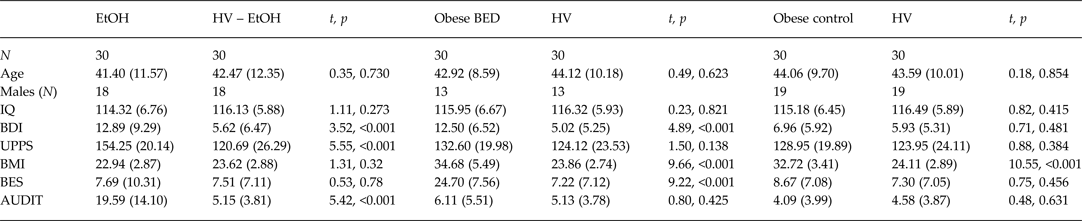
Thirty obese BED and 30 obese controls were compared to their own age- and gender-matched HV (Table 1). Thirty EtOH subjects [reported in mean (s.d.): weeks abstinent 15.60 (16.89); years heavy use: 12.78 (8.27); units/day: 28.36 (14.58); total units (= units/day × years heavy use × 365 × percent drinking days): 128 573 (124 490)] were compared with age- and gender-matched HV. EtOH subjects were on the following medications (acamprosate, 2; disulfiram, 1). The three index groups were compared with their own age- and gender-matched HV [1:2 (60 healthy volunteers) ratio for DDT; 1:1 (30 healthy volunteers) ratio for IST and SST].
Subject characteristics and behavioural measures in alcohol-dependent subjects and obese subjects with and without BED

Values given are mean (s.d.)
BED, Binge-eating disorder; EtOH, abstinent alcohol-dependent subjects; HV, healthy volunteers; N, number of subjects; BDI, Beck Depression Inventory; UPPS, UPPS Impulsive Behaviour Scale; BMI, body mass index; BES, Binge Eating Scale; AUDIT, Alcohol Use Disorders Identification Test; RT, reaction time.
Delay discounting
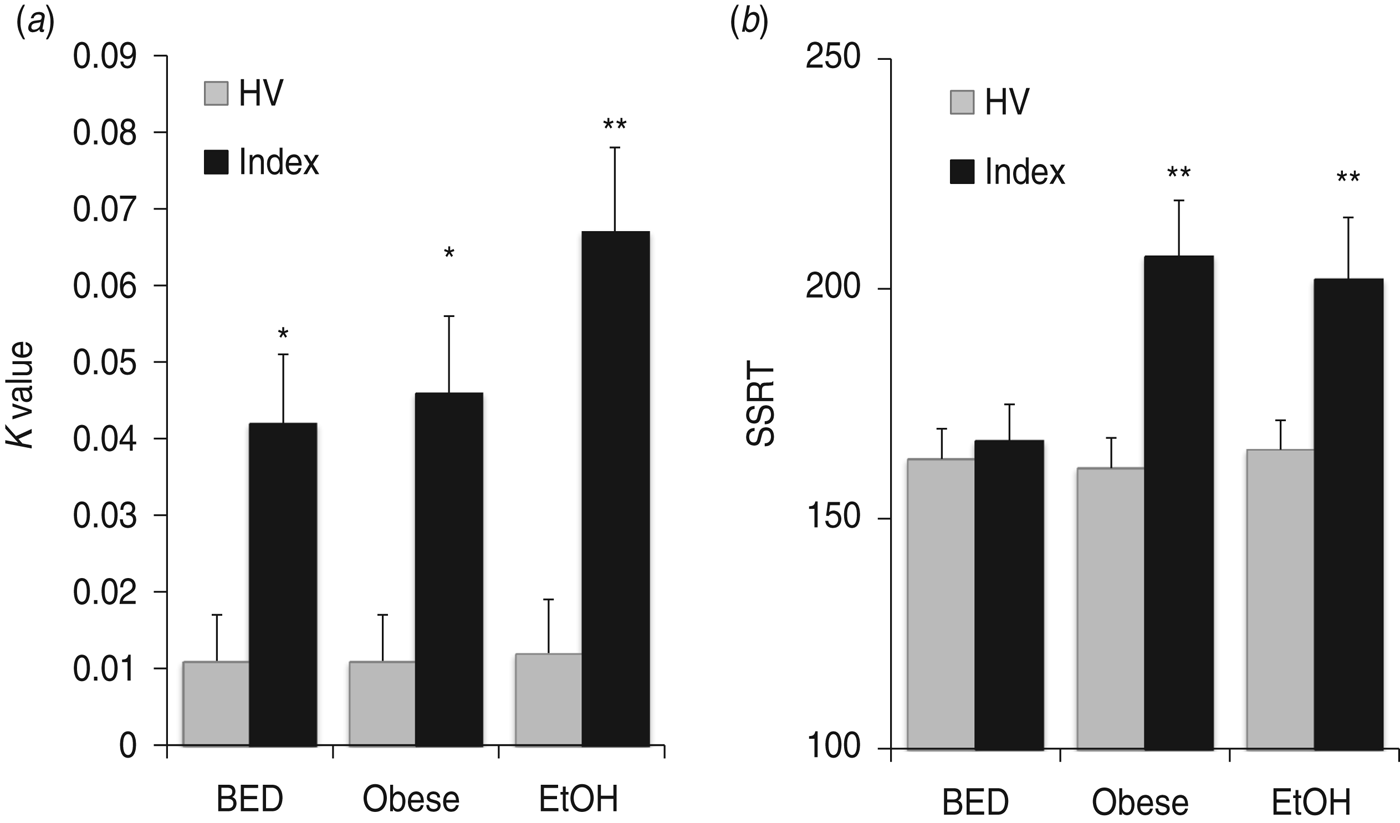
The k value was square root transformed. Obese subjects with BED (t = 2.59, df = 58, p = 0.012), without BED (t = 2.52, df = 58, p = 0.015) and EtOH subjects (t = 3.34, df = 58, p = 0.002) had greater delay discounting compared to HV (Fig. 1). The number of units per day positively correlated with the k value (Pearson correlation coefficient: R = 0.53, p = 0.004) in EtOH subjects. There was no correlation between BMI (R = −0.01, p = 0.93) or BES (R = 0.05, p = 0.68) and k value in obese subjects with or without BED. There was no correlation between BDI (R = 0.16, p = 0.42) and k value.
Delay discounting and stop signal task. (a) k values of delay discounting task. (b) Stop Signal Reaction Time (SSRT) values. ** p < 0.005, * p < 0.05 of index group compared to their own healthy volunteer controls. Error bars represent s.e.m. HV, Healthy volunteers; BED, obese subjects with binge-eating disorder; obese, obese subjects without BED; EtOH, abstinent alcohol-dependent subjects.

Stop signal task
GoRT and SSRT were assessed as multivariate analyses for each index group and their age- and gender-matched healthy volunteers. In all groups, the percentage of successful stops was at approximately 50% suggesting efficacy of the staircase SSD adjustment [HV: 49.13% (s.d. = 5.54); BED: 50.79% (s.d. = 5.91); obese: 50.59% (s.d. = 7.08); EtOH: 51.64% (s.d. = 6.99)]. Obese subjects without BED had impaired motor response inhibition (F = 9.39, p = 0.003) with no differences in GoRT [HV: 432.32 (s.d. = 104.17); obese: 449.85 (s.d. = 89.57); F = 1.36, p = 0.247] compared to HV (Fig. 1). EtOH subjects had impaired motor response inhibition (F = 8.26, p = 0.005) and slower GoRT [HV: 429.12 (s.d. = 108.21); EtOH: 494.62 (s.d. = 162.90); F = 4.09, p = 0.047]. In BED subjects, there were no significant differences in GoRT [HV: 435.82 (s.d. = 106.11); BED: 483.69 (s.d. = 137.59); F = 0.009, p = 0.923] or SSRT (F = 0.024, p = 0.878) compared to HV. On an exploratory basis, we compared the same variables in obese subjects with and without BED covarying for age and gender using multivariate analyses. Obese subjects without BED compared to those with BED also had greater impairments in motor response inhibition (F = 9.657, p = 0.003) with no differences in GoRT (F = 1.240, p = 0.270).
There was a trend towards a positive correlation between BMI (R = 0.25, p = 0.061) but not BES (R = −0.22, p = 0.119) with SSRT for obese subjects with and without BED. There was no correlation between the number of units per day and SSRT for EtOH subjects (R = −0.09, p = 0.631). There was no association between BDI and SSRT for EtOH or obese subjects (R = 0.02–0.20, p > 0.05).
Information sampling task
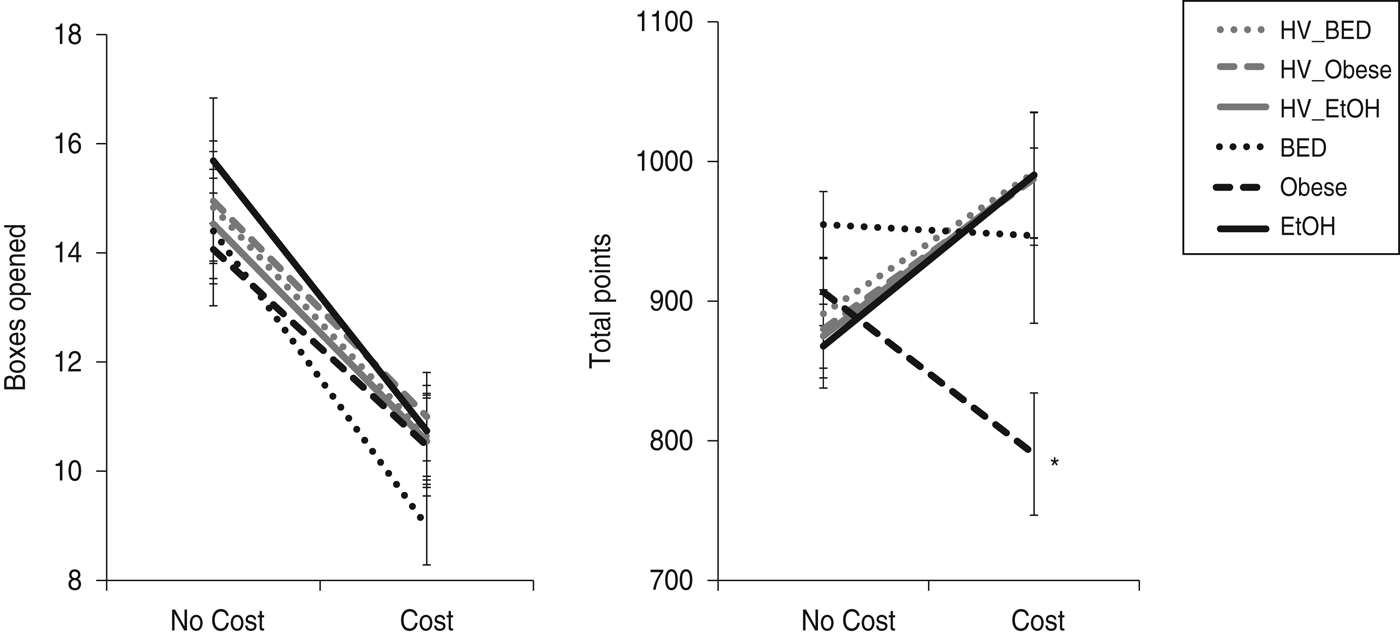
Boxes opened, sampling errors, and total points for both cost and no-cost conditions were assessed using multivariate analyses (Fig. 2). Obese subjects without BED made more sampling errors in the no-cost condition (F = 4.397, p = 0.040) and accumulated fewer total points (F = 7.109, p = 0.009) as independent associated factors compared to HV. There were no other significant differences between obese subjects without BED and HV (F = 0.020–0.724, p > 0.05). There were no significant differences between HV and BED subjects (F = 0.012–2.994, p > 0.05) or EtOH subjects (F = 0.028–0.530, p > 0.05). To assess the impact of cost on sampling errors and total points, we also conducted a mixed measures ANOVA comparing obese subjects without BED and HV. For total points, there was a main effect of group (F 1,58 = 5.630, p = 0.021) in which obese subjects scored fewer points compared to HV. There was an interaction between group × cost (F 1,58 = 8.343, p = 0.005) in which obese subjects performed worse with cost relative to no-cost compared to HV. There was no main effect of cost (F 1,58 = 0.083, p = 0.967) For sampling errors, there was no main effect of group or cost or interaction effect (p > 0.05).
Information sampling task. Information sampling task outcomes for number of boxes opened, sampling error and total points accumulated. * p < 0.05 in obese subjects without binge-eating disorder compared to healthy volunteers on multivariate analysis. Error bars represent s.e.m. HV_BED, Healthy volunteers that were age- and gender-matched to the binge-eating disorder group; HV_Obese, healthy volunteers that were age- and gender-matched to the obese group; HV_EtOH, healthy volunteers that were age- and gender-matched to the alcohol-dependent group; BED, obese subjects with binge-eating disorder; obese, obese subjects without BED; EtOH, abstinent alcohol-dependent subjects.

In obese subjects with and without BED, there was a negative correlation between BES and sampling error (R = −0.341, p = 0.008) and a positive correlation between BES and total points (R = 0.415, p = 0.001). Thus, those with lower BES scores or those less likely to have BED, had greater sampling errors and accumulated fewer total points. There were no significant correlations between BMI and errors or points (p > 0.05). There were no significant correlations in EtOH subjects between AUDIT scores and sampling errors or total points (R = −0.326 to 0.177, p > 0.05).
Discussion
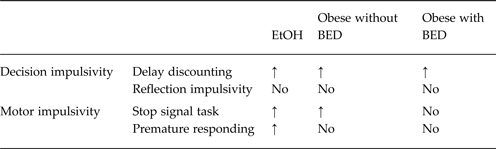
We show a dissociation in contrasting subtypes of impulsivity between disorders of food and drug use. Our results reveal novel similarities and differences between neurocognitive endophenotypes of the three disorders. Obese subjects without BED were dissociated from those with BED.
Delay discounting
Delay discounting was elevated across all groups corroborating that this form of impulsivity is a core abnormality across these disorders. We showed that obese subjects either with or without BED as well as EtOH subjects discounted delayed hypothetical monetary rewards to a greater extent than HV. Our finding of an association between alcohol dependence and increased delay discounting is in line with other studies (Petry, Reference Petry2001; Koffarnus et al. Reference Koffarnus, Jarmolowicz, Mueller and Bickel2013). Similarly, obese subjects with and without BED have been shown to have greater delay discounting (Weller et al. Reference Weller, Cook, Avsar and Cox2008; Davis et al. Reference Davis, Patte, Curtis and Reid2010; Manwaring et al. Reference Manwaring, Green, Myerson, Strube and Wilfley2011). These findings converge with a body of literature demonstrating greater delay discounting in multiple substance use disorders including those at risk for the development of substance use disorders (Bickel et al. Reference Bickel, Koffarnus, Moody and Wilson2013). Thus, delay discounting may be a behavioural marker for pathological disorders across both food and drug use. Further work on identifying specific impairments in obesity with and without BED including salience of the immediate reward, uncertainty tolerance, delay aversion or diminishing marginal utility would be indicated.
Discounting deficits may reflect changes in the delayed discounting subprocesses and their neural correlates that include reward valuation, cognitive control and prospection (Peters & Büchel, Reference Peters and Büchel2011). We have also recently shown that obese subjects with BED as compared to those without BED have lower volumes in bilateral medial orbitofrontal cortices extending into ventromedial prefrontal cortices (Voon et al. Reference Voon, Derbyshire, Rück, Irvine, Worbe, Enander, Schreiber, Gillan, Fineberg and Sahakian2014a), regions implicated in the representation of reward.
Reflection impulsivity
Reflection impulsivity has been relatively under-investigated compared to other impulsivity subtypes (Clark et al. Reference Clark, Robbins, Ersche and Sahakian2006), and can be tested using the IST which has less visual and memory demands than previous Iowa Gambling Task and Matching Familiar Figures Task (MFFT) (Solowij et al. Reference Solowij, Jones, Rozman, Davis, Ciarrochi, Heaven, Pesa, Lubman and Yücel2012). In this study, no impairment in reflection impulsivity as measured by the number of boxes opened (evidence sampled) in any of the index groups relative to HV was found. Alcohol-dependent subjects have not been shown to exhibit significant differences in information sampled on either the IST or MFFT compared to HV (Weijers et al. Reference Weijers, Wiesbeck and Boning2001; Lawrence et al. Reference Lawrence, Luty, Bogdan, Sahakian and Clark2009b). In early compared to later-onset alcohol dependence, a non-significant increase in reflection impulsivity has been detected (Joos et al. Reference Joos, Schmaal, Goudriaan, Fransen, den Brink, Sabbe and Dom2013b). However, after acute alcohol healthy participants have shown increased reflection impulsivity, which has been attributed to alcohol expectancies (Caswell et al. Reference Caswell, Morgan and Duka2013a). Impairments in reflection impulsivity have been shown using the MFFT in obese children (Braet et al. Reference Braet, Claus, Verbeken and Van Vlierberghe2007) although we did not demonstrate this in obese adults. Reflection impulsivity has also been found in opiate, amphetamine (Clark et al. Reference Clark, Robbins, Ersche and Sahakian2006) and cannabis (Clark et al. Reference Clark, Robbins, Ersche and Sahakian2006; Solowij et al. Reference Solowij, Jones, Rozman, Davis, Ciarrochi, Heaven, Pesa, Lubman and Yücel2012) users.
Although in this study there were no differences in evidence sampled, we show that relative to HV, obese subjects without BED accumulated fewer total points and more specifically performed worse in the later cost condition when penalized for the amount of evidence accumulated. BES scores similarly reflected the same association with sampling errors and total points accumulated. This is in line with findings that increased sampling errors may be found in addiction disorders including alcohol dependence and problem gamblers (Lawrence et al. Reference Lawrence, Luty, Bogdan, Sahakian and Clark2009b). Overall, our findings suggest that obese subjects without BED may be more impaired at integrating information after multiple trials to optimize outcomes despite evaluating the same amount of evidence. Reduced performance after the subsequent introduction of cost could also be a result of fatigue effects as the cost condition was introduced after the no-cost condition. This could indicate poorer sustained vigilance or effort effects in obese subjects. Task performance deterioration after multiple trials has similarly been seen in increased BMI in women (Nederkoorn et al. Reference Nederkoorn, Smulders, Havermans, Roefs and Jansen2006) and children (Guerrieri et al. Reference Guerrieri, Nederkoorn and Jansen2007a).
Motor impulsivity: response inhibition
We demonstrate impaired motor response inhibition in both EtOH subjects and obese subjects without BED as measured using the SST, which assesses motor cancellation or inhibition of ongoing motor responses. Alcohol dependence has been associated with significantly impaired motor response inhibition with prolonged SSRTs in some (Lawrence et al. Reference Lawrence, Luty, Bogdan, Sahakian and Clark2009b) but not all (Li et al. Reference Li, Luo, Yan, Bergquist and Sinha2009; Schmaal et al. Reference Schmaal, Joos, Koeleman, Veltman, van den Brink and Goudriaan2013) studies. Further, in non-dependent light and heavy adult drinkers, no SSRT differences were observed (Yan & Li, Reference Yan and Li2009). Several lines of evidence have linked SSRT with alcohol. SSRTs are particularly prolonged in alcohol dependence when go-stimuli are changed to an alcohol cues rather than a neutral stimuli indicating approach behaviours towards certain cues may be more difficult to inhibit (Zack et al. Reference Zack, Woodford, Tremblay, Steinberg, Zawertailo and Busto2011). After acute alcohol, SSRT in moderate drinkers has been shown to also increase (Loeber & Duka, Reference Loeber and Duka2009; Ramaekers et al. Reference Ramaekers, Theunissen, de Brouwer, Toennes, Moeller and Kauert2011; McCarthy et al. Reference McCarthy, Niculete, Treloar, Morris and Bartholow2012). Non-dependent, heavy-drinking subjects with a family history of alcoholism may be less sensitive to the effects of alcohol on the SST (Kareken et al. Reference Kareken, Dzemidzic, Wetherill, Eiler Ii, Oberlin, Harezlak, Wang and O'Connor2013) suggesting that family history may also be relevant to motor impulsivity.
The link between alcohol dependence and impaired action cancellation has been further shown by pharmacological manipulation. Trials of quetiapine (Moallem & Ray, Reference Moallem and Ray2012), topiramate (Rubio et al. Reference Rubio, Martínez-Gras and Manzanares2009) but not modafiniil (Joos et al. Reference Joos, Goudriaan, Schmaal, Fransen, van den Brink, Sabbe and Dom2013a) have improved SSRTs in alcohol-dependent subjects. Impaired motor response inhibition with the SST has been shown in both subjects with cocaine dependence and their unaffected family members demonstrating a role for this form of impulsivity in predicting cocaine use disorders (Ersche et al. Reference Ersche, Jones, Williams, Turton, Robbins and Bullmore2012).
Our findings suggest greater similarities in the domain of motor impulsivity in obese subjects without BED and substance use disorders. Other studies have shown greater motor impulsivity in obesity with BED compared to without BED on the SST (Svaldi et al. Reference Svaldi, Naumann, Trentowska and Schmitz2014) and on a go/no-go task (Mobbs et al. Reference Mobbs, Iglesias, Golay and Van der Linden2011) which tests action cancellation and action restraint, respectively. As with our findings, the overall relevance of motor impulsivity to obesity has been shown through associations with increased BMI (Nederkoorn et al. Reference Nederkoorn, Smulders, Havermans, Roefs and Jansen2006; Guerrieri et al. Reference Guerrieri, Nederkoorn and Jansen2007a; Verbeken et al. Reference Verbeken, Braet, Claus, Nederkoorn and Oosterlaan2009) and food consumption (Guerrieri et al. Reference Guerrieri, Nederkoorn, Stankiewicz, Alberts, Geschwind, Martijn and Jansen2007b). As well as being a potential maintaining factor for obesity, poorer SST performance has predicted poorer treatment outcomes with reduced weight loss (Nederkoorn et al. Reference Nederkoorn, Jansen, Mulkens and Jansen2007). During a weight reduction treatment camp, progressive reductions in SSRT have also been demonstrated (Kulendran et al. Reference Kulendran, Vlaev, Sugden, King, Ashrafian, Gately and Darzi2013). However, significantly increased motor impulsivity associated with elevated BMI has not always been observed (Hendrick et al. Reference Hendrick, Luo, Zhang and Li2012). The shared findings of SSRT deficits in both EtOH and obesity without BED suggest there may be an overlap in neural substrates involving structural (Tabibnia et al. Reference Tabibnia, Monterosso, Baicy, Aron, Poldrack, Chakrapani, Lee and London2011) or functional (Ray Li et al. Reference Ray Li, Yan, Sinha and Lee2008) regions required in the SSRT such as the right inferior frontal cortex, pre-supplementary motor area and caudate. Whether our results represent a state factor or may represent a predictive risk factor for the development for obesity remains to be established.
Summary of impulsivity findings

EtOH, Abstinent alcohol-dependent subjects; BED, binge-eating disorder.
The relationship between motor response inhibition and behavioural addictions is unclear. Pathological gambling has been associated with behavioural impairments in the SST in some (Odlaug et al. Reference Odlaug, Chamberlain, Kim, Schreiber and Grant2011; Wu et al. Reference Wu, Giel, Skunde, Schag, Rudofsky, Zwaan, Zipfel, Herzog and Friederich2013), but not all (Lipszyc & Schachar, Reference Lipszyc and Schachar2010; Grant et al. Reference Grant, Chamberlain, Schreiber, Odlaug and Kim2011; de Ruiter et al. Reference de Ruiter, Oosterlaan, Veltman, van den Brink and Goudriaan2012) studies. These studies and a meta-analysis (Lipszyc & Schachar, Reference Lipszyc and Schachar2010) suggest that motor response inhibition is not always impaired in other forms of behavioural addictions. That obese subjects with BED were impaired predominantly on decisional impulsivity but not on motor response inhibition dovetails with a recent study on another form of a behavioural addiction, gaming use disorder (Irvine et al. Reference Irvine, Worbe, Bolton, Harrison, Bullmore and Voon2013). Here the authors suggest that the lack of impairment in motor inhibition may be related in part to practise effects from videogaming. Although we did not show that obese subjects with BED were impaired in motor response inhibition as hypothesized, this does not exclude other patterns of impairment that may fit with a disorder of addiction. Although our findings are compatible with both a conceptualization of BED as an extreme neurobehavioural subtype of obesity, we note that there were no differences in BMI between the two subject groups. Here we are interested in both similarities and differences in neurocognitive profiles to better characterize mechanistic differences that might underlie different subtypes of behavioural and substance addictions. Our findings are compatible with both a conceptualization of BED as an extreme neurobehavioural subtype of obesity and BED having similarities with other behavioural and substance addictions.
Motor impulsivity: premature responding
In a previous study, we demonstrated that EtOH subjects had elevated premature responding, a form of motor impulsivity characterized by anticipatory responses, whereas obese subjects with and without BED did not differ in this measure from HV (Voon et al. Reference Voon, Irvine, Derbyshire, Worbe, Lange, Abbott, Morein-Zamir, Dudley, Caprioli and Harrison2014b). Although the five-choice serial reaction time task (5-CSRTT) and SST both measure motor impulsivity, the two forms of impulsivity can be dissociated in their neural networks and underlying neurochemistry. In a previous study, we also did not observe any correlations between premature responding and measures including SSRT or delay discounting (Voon et al. Reference Voon, Irvine, Derbyshire, Worbe, Lange, Abbott, Morein-Zamir, Dudley, Caprioli and Harrison2014b). Dissociated performance on premature responding and SSRT may thus implicate different mechanisms involved in the two tasks. The SST involves inhibition of an already initiated motor response whereas the 5-CSRTT requires ‘waiting’ before responding. Serotonin depletion increases 5-CSRTT premature responding in rodents and healthy humans (Harrison et al. Reference Harrison, Everitt and Robbins1997; Worbe et al. Reference Worbe, Savulich, Voon, Fernandez-Egea and Robbins2014) without affecting SSRT (Eagle et al. Reference Eagle, Lehmann, Theobald, Pena, Zakaria, Ghosh, Dalley and Robbins2009) or delay discounting (Worbe et al. Reference Worbe, Savulich, Voon, Fernandez-Egea and Robbins2014). Moreover, lesions of the nucleus accumbens core increases impulsivity on 5-CSRTT (Christakou et al. Reference Christakou, Robbins and Everitt2004) but may not influence SRTTs (Eagle & Robbins, Reference Eagle and Robbins2003).
Limitations
There were several limitations in our study. As the alcohol-dependent subjects were in recovery while the obese subjects with and without BED were not, it is possible that abstinence may contribute to group differences. In the obese subjects with and without BED, testing subjects who are dieting, under food restriction or using food as an outcome may influence results (Schag et al. Reference Schag, Schonleber, Teufel, Zipfel and Giel2013a). We are currently addressing the question of whether testing under food restriction may influence premature responding. Similarly subjects with more severe forms of obesity may also respond differently. Further studies in obese subjects who are dieting are indicated. As monetary outcomes used in the DDT were similarly impaired across groups, money may act as a common conditioned reinforcer. Using the same outcome as a conditioned reinforcer across different disorders also allows for comparisons across groups without the confounder of motivation. In addition, how closely eating disorders are related to impulsivity as compared to an obsessive-compulsive spectrum further remains to be seen. When considering impulsivity and obesity, other mediators of energy balance including energy expenditure, appetite and satiety and environmental influences should also be taken into consideration (Ziauddeen et al. Reference Ziauddeen, Farooqi and Fletcher2012). Gathering further clinical details on duration of binge eating, number of vomiting episodes would also be informative.
Conclusions
Through different pathogenic mechanisms, alcohol and eating disorders may differentially influence neurocognitive systems subserving impulsivity. Our findings highlight the variability and dissociability in impulsivity. Delay discounting is impaired in alcohol use disorders and obesity irrespective of binge eating emphasizing its role as a core impairment across disorders whereas motor response inhibition is impaired as a function of BMI but not of binge eating. The differential role of impulsivity subtypes in disorders of food rewards may have implications for tailoring therapeutic strategies in obesity and addiction disorders.
Acknowledgements
V.V. is a Wellcome Trust Intermediate Fellow in Clinical Neurosciences (Wellcome Trust grant no. WT093705MA). Y.W. is supported by the Fyssen Fondation. N.A.H. is a Wellcome Trust Intermediate Fellow in Clinical Neurosciences. The BCNI is supported by both the Wellcome Trust and Medical Research Council.
Declaration of Interest
E.T.B. is employed part-time by the University of Cambridge and part-time by GSK PLC and is a shareholder of GSK. T.W.R. is a consultant for Cambridge Cognition, Eli Lilly, GSK, Merck, Sharpe and Dohme, Lundbeck, Teva and Shire Pharmaceuticals. He is or has been in receipt of research grants from Lundbeck, Eli Lilly and GSK and is an editor for Springer-Verlag (Psychopharmacology).