The growth of the internet and the possibilities presented for the delivery of mental health services have been recognised since the mid-1990s (Sampson, Kolodinsky, & Greeno, Reference Sampson, Kolodinsky and Greeno1997). The last decade has seen online counselling rapidly become an important mode of providing mental health services, particularly to young people (Perle, Langsam, & Nierenberg, Reference Perle, Langsam and Nierenberg2011). Online counselling can be understood to mean the provision of psychological interventions delivered over the internet, either synchronously (e.g., chat, webcam) or asynchronously (e.g., email, forum), and in either an individual or group setting (Barak, Klein, & Proudfoot, Reference Barak, Klein and Proudfoot2009). While it appears that face-to-face counselling remains the favoured modality for most clients, a growing proportion express a relative preference for online treatment (Bradford & Rickwood, Reference Bradford and Rickwood2012a; Tsan & Day, Reference Tsan and Day2007; Young, Reference Young2005). Individual chat is one of the most frequently used modalities for providing online treatment and the emerging evidence for its effectiveness is encouraging (Dowling & Rickwood, Reference Dowling and Rickwood2013; Heinlen, Welfel, Richmond, & O'Donnell, Reference Heinlen, Welfel, Richmond and O'Donnell2003). However, there remain significant questions regarding the place of online counselling within the wider mental health system, which require understanding of the types of clients accessing online counselling and their presenting problems, the types of therapeutic approaches that are best suited to the online environment, and how online counselling is actually being delivered in terms of current practice.
Compared with clients accessing telephone counselling, the limited research describing online counselling clients shows that more females and those with higher pre-counselling levels of distress are likely to be clients. Approximately 80% of young people accessing online chat services are female (Callahan & Inckle, Reference Callahan and Inckle2012; Fukkink & Hermanns, Reference Fukkink and Hermanns2009; King et al., Reference King, Bambling, Reid and Thomas2006), whereas approximately 70% of telephone counselling clients are female (Fukkink & Hermanns, Reference Fukkink and Hermanns2009; King et al., Reference King, Bambling, Reid and Thomas2006). There is also evidence to suggest that online clients present with higher levels of distress, with a naturalistic comparison of online chat and telephone services confirming this (King et al., Reference King, Bambling, Lloyd, Gomurra, Smith, Reid and Wegner2006). Fukkink and Hermanns’ (Reference Fukkink and Hermanns2009) naturalistic comparison was less definitive, however, reporting that while the perceived burden of the problem was higher for online clients, there were no differences in wellbeing between online chat and telephone clients.
The emerging evidence suggests that the most common presenting problems for young online clients are relationships, followed by mental health issues and requests for information (Callahan & Inckle, Reference Callahan and Inckle2012; DuBois, Reference DuBois2004; Fukkink & Hermanns, Reference Fukkink and Hermanns2009; Murphy, Mitchell, & Hallett, Reference Murphy, Mitchell and Hallett2011). A small but important proportion of online conversations are related to abuse and violence (Callahan & Inckle, Reference Callahan and Inckle2012; Fukkink & Hermanns, Reference Fukkink and Hermanns2009). However, the lack of evidence regarding the effectiveness of treatment for specific presenting problems has led some to suggest that issues with a high risk of harm, such as severe depression or suicidal thoughts, may not be suitable for the online chat format (Haberstroh, Parr, Bradley, Morgan-Fleming, & Gee, Reference Haberstroh, Parr, Bradley, Morgan-Fleming and Gee2008; Murphy et al., Reference Murphy, Mitchell and Hallett2011).
The types of therapeutic approaches that are effective online are only starting to be determined, and there is emerging evidence that supportive counselling and cognitive-behavioural interventions are effectively applied in an online chat format (Dowling & Rickwood, Reference Dowling and Rickwood2013). However, only the processes of traditional counselling as an approach applied to online chat have been investigated in any depth, and clear differences from face-to-face counselling have emerged (Chardon, Bagraith, & King, Reference Chardon, Bagraith and King2011; Mallen, Jenkins, Vogel, & Day, Reference Mallen, Jenkins, Vogel and Day2011; Williams, Bambling, King, & Abbott, Reference Williams, Bambling, King and Abbott2009). During an online chat session, counsellors appear to spend more time building rapport and gathering information than on goal-setting and task-accomplishment (Chardon et al., Reference Chardon, Bagraith and King2011; Mallen et al., Reference Mallen, Jenkins, Vogel and Day2011). This focus on rapport building and information gathering may be due to the slow pace of online chat (Chardon et al., Reference Chardon, Bagraith and King2011; Williams et al., Reference Williams, Bambling, King and Abbott2009). Despite this focus on gathering information, it appears that online counsellors still have difficulties assessing complex cases, where symptoms may be indicative of multiple disorders (Mallen et al., Reference Mallen, Jenkins, Vogel and Day2011).
Due to its increasing availability, but lagging evidence base, there is an imperative to further investigate chat as a mode of online counselling, particularly regarding the types of interventions that can be used online. The aim of this study was to examine the experiences of online counsellors providing mental health interventions to young people over the internet. The study aimed to determine counsellor perceptions of their online clients, including presenting problems and if they felt online clients differed from those they would expect to see face to face. The study also sought to find out online counsellors’ perceptions of their own role and how they applied psychotherapeutic theory and techniques when working within the online environment. By investigating online counsellors’ views and experiences, unique aspects of the online therapeutic environment could be further described, thereby increasing understanding of the role of this modality in providing mental health services.
Method
A qualitative focus group format was considered appropriate in this area of investigation. Using focus groups is an effective way to capture communication between research participants as their interactive nature enables participants to compare attitudes, values, and understanding in a particular area, while also maximising resources (Patton, Reference Patton2002). It is also important for the reader of qualitative research to be aware of the researcher's role, position, and potential biases (Patton, Reference Patton2002). This study was conducted as part of a doctoral thesis being undertaken by the first author (MD). MD conducted the focus groups and was independent from the mental health service that was providing the participants. The first author's assumptions were informed by the research outlined above, leading to the creation of questions perceived to have been unanswered.
Participants
Participants were 19 experienced online mental health clinicians (16 females and 3 males) employed by an online mental health service. The service provides clinically supervised, youth friendly, confidential and free online mental health support and information for young people aged from 12 to 25 years, and offers support relating to psychological, psychosocial, vocational, and educational issues. It also provides information about and referrals to face-to-face services. There are two treatment pathways within the service, ‘esupport’ and ‘etherapy’. esupport includes screening and assessment, and offers supportive counselling, psychoeducation, self-help strategies, and provides information on seeking face-to-face help. Following screening and assessment, it may be deemed appropriate to offer a more structured, goal-oriented service through etherapy. This involves working on mutually agreed upon treatment goals using structured, evidence-based therapies, such as problem-solving therapy, motivational interviewing, and cognitive-behavioural therapy. These services are provided by youth mental health clinicians who have recognised qualifications in psychology, occupational therapy, mental health nursing or social work. All clinicians are registered and aligned with the requirements for professions that provide services under the Better Access initiative.
The participants were recruited using a convenience sampling technique. Clinicians were informed about the study and asked to participate during a scheduled training day. At the time of the study, 35 part-time mental health clinicians were employed, 19 of whom were present on the training day. The online clinicians had professional mental health training and comprised psychologists, social workers, and mental health nurses. All of the online clinicians were fully qualified, had previous experience working face to face, had undertaken additional in-service training in online counselling, and received regular supervision.
Procedure
Prior to the study commencing, ethical approval was obtained from the University of Canberra Committee for Ethics in Human Research. Participant consent was obtained before the focus groups were conducted. All data were obtained from three semi-structured focus groups of approximately 60 minutes duration. Participation in the focus groups was voluntary and the clinicians were invited to attend during an in-house staff training day. All three groups were audio recorded and transcribed, with names changed to ensure anonymity. Based upon the research aims outline above, the following questions were used to structure the discussion:
1. In your experience, what types of young people are presenting online?
2. What do you see as being your main role during an online chat session?
3. During an online chat session, do you find yourself using any particular therapeutic model or theory during online chat sessions?
4. Are there any specific therapeutic techniques that you use during an online chat session?
5. How does online chat differ from the work you would do face to face?
Data Analysis
Thematic analysis served as our analytic approach for understanding the participants’ experiences of online counselling (Braun & Clarke, Reference Braun and Clarke2006). A combined inductive and deductive approach was taken, meaning that themes were allowed to emerge directly from the participants’ responses using inductive coding, while the research questions were used to conceptually deduce the emerging themes (Fereday & Muir-Cochrane, Reference Fereday and Muir-Cochrane2006). Focus group data were analysed using NVivo 10 qualitative data analysis software (Bazeley, Reference Bazeley2007). A thematic analysis approach was used to identify patterns or themes within the data. Procedurally, thematic analysis entails: (1) becoming familiar with the data, (2) generating initial codes, (3) searching for themes, (4) reviewing themes, (5) defining and naming themes, and 6) reporting the final thematic concepts (Braun & Clarke, Reference Braun and Clarke2006). The transcriptions were checked against the recordings to ensure accuracy. Transcripts were systematically coded line by line using NVivo, identifying examples and repeated patterns across the data. The primary analyst (MD) independently identified and defined a number of emerging themes. Interrater reliability was assessed through a second independent researcher (SB) coding all three transcripts. Using NVivo, a coding comparison between analysts resulted in a Kappa coefficient of .76, which is generally considered to be excellent agreement (Robson, Reference Robson2002). The coding discrepancies were reviewed in consultation with DR until consensus was achieved. The final stages of the analysis involved the authors reviewing the themes and subthemes in relation to the coded extracts, and ensuring that the analysis was reasoned, logical, and valid.
Results
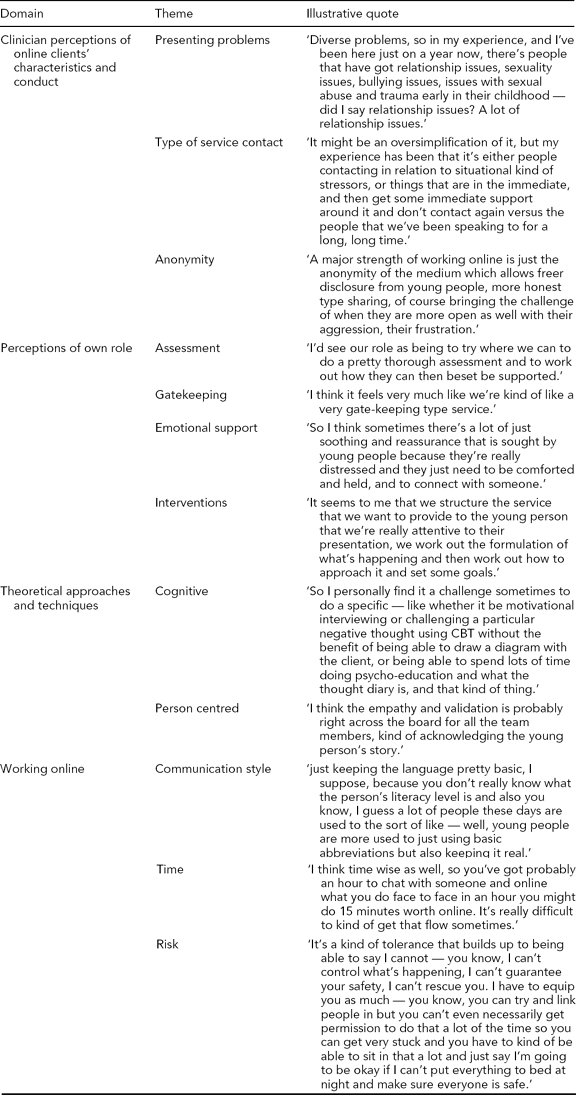
Consistent with the nature of the questions, participants discussed domains relating to perceptions of online clients, perceptions of clinician roles, theoretical approaches and techniques, and working online. These domains, their themes and illustrative quotes are provided in Table 1.
Domain, Themes, and Illustrative Quotes

Clinician Perceptions of Clients’ Characteristics and Conduct
Within this broad domain, participant perceptions of online chat clients fell into three categories, as outlined in Table 1: the types of problems clients were presenting with, client characteristics and service contact, and the effect of client anonymity.
All of the focus group participants were in full agreement that there was a wide range of presenting problems for online clients, including clinically diagnosable problems as well as psychosocial and environmental problems. The most commonly cited clinical problems were depression, anxiety, self-harm and suicidal ideation, depression, and anxiety; although some participants disagreed as to whether the majority of clients would meet diagnostic criteria, noting that most clients were ‘not going to meet the criteria of having a mental disorder’. Psychosocial and environmental problems were most frequently cited as being related to relationship problems with family, peers, or partners. It was agreed by all groups that online clients presented with complex multiple stressors and that the clinical, psychosocial, and environmental problems were interrelated.
In terms of client characteristics and type of service contact, participants agreed that there were generally two types of clients — short-term immediate support and long-term support. The majority of young people who contacted the online service did so requiring immediate support, and would only access the service once or twice. The participants also pointed out that there were clients who used online counselling as an adjunct to their face-to-face counselling. One participant commented on the development of integrating face-to-face and online counselling: ‘Now we're much more active in that, if you have face-to-face involvement, we want to have contact with them so we know that we're working collaboratively and not just doing our own thing, or working on different information or anything like that.’
The focus group participants agreed that the sense of anonymity and control that clients attained through the online medium allowed them to act in a more disinhibited fashion. Participants from two groups noted that this extended to clients being more likely to act aggressively online — for example, by swearing at clinicians. Clients were perceived to have more control within the online compared to a face-to-face therapy environment, being able to sign in or leave and share or withhold information at their discretion. Some participants noted that they were at times unable to collect the information they wanted, such as personal and family contact details, due to the high level of client anonymity and control.
Perceptions of Own Role
Four online clinician roles were extracted from participant responses, and include: conducting assessments, acting as system gatekeepers, providing emotional support, and providing goal-oriented interventions.
Assessment was reported by all three focus groups as being a major focus and an important part of determining the clients’ needs and formulating an appropriate course of action. Participants within two of the focus groups noted the challenge of having a balance between keeping the client engaged and conducting a thorough assessment; it was noted that a complete assessment could take an entire session, which could be problematic as many clients would only attend a single session. One participant described this as ‘kind of just holding this tension between — Do I assess? Do I interview? You know, what's the focus?’
Gatekeeping activities include making referrals to other services and encouraging further help-seeking. Participants in all three focus groups agreed that a major role for them was to help young people link in with face-to-face services, as they perceived these services to be better able to provide longer-term therapeutic interventions. One participant described the referral process as: ‘I see it as wanting to link them in with some more long-term or face-to-face support. In my mind it's always about assessing what's going to be best for them later.’ The second aspect of gatekeeping was to provide clients with a positive experience of help-seeking, which would then promote future help-seeking. Participants reported that part of their role was to build ‘trust for young people in services’.
Emotional support involves listening to a client tell their story and providing empathy and validation. Participants in two of the focus groups perceived validation as a way of soothing and reassuring young people in distress, to create a safe environment in which they felt safe enough to disclose. One participant noted that ‘just working with wherever they're at is the aim of making them feel validated, feeling what they feel’. Providing emotional support was perceived as being an important part of keeping clients engaged with the service.
Types of interventions varied and included directive activities designed to achieve a specific goal with long-term clients. The most frequent directive interventions mentioned by participants included Cognitive Behavioural Therapy (CBT), Cognitive Analytic Therapy (CAT), and Motivational Interviewing (MI). Participants in two of the focus groups agreed that interventions were directed towards clients requiring ongoing support, rather than clients who were attending their first session. As one participant described this situation: ‘If they log on in a more ongoing fashion, we'd develop the management plan and work with them in accordance to what they're bringing.’
Application of Theoretical Models and Techniques
Two types of theoretical techniques were most commonly applied: cognitive and person-centred, although there was no favoured method of working online; rather, ‘it's more a whole grab bag of things depending on what they bring up’. Notably, the participants reported that while they were able to apply cognitive interventions online, they were restricted by time factors. As such, the participants generally agreed that person-centred interventions were more appropriate for the brief interventions they were mostly providing, and that these were especially helpful to keep the client engaged.
Participants cited a number of influencing cognitive theories, including CBT, CAT and MI. The general consensus among participants was that cognitive theories were useful in providing a framework for looking at barriers and opportunities, and developing session goals. The most frequently reported cognitive technique was psycho-education, which participants in all three focus groups agreed was a technique used ‘across the board’. Less frequently reported were techniques such as challenging negative thoughts, Socratic questioning, mood diaries, and decisional balancing. The participants agreed that many of the cognitive techniques, such as Socratic questioning, took up too much time to be applied easily online, whereas psycho-education could be done quite easily by cutting and pasting in a link to relevant fact sheets.
Person-centred theories and techniques were frequently reported within all three focus groups as being widely used in order to create a therapeutic environment. While most participants found it harder to create a working alliance online, they agreed it could be done and was essential in order to keep the clients engaged and make them feel validated. One participant commented that it was important to do ‘a lot of checking in to make sure that what you're trying to communicate has been communicated well’. The participants agreed that being able to engage a client and make them feel validated was a key skill for working online. As one participant noted, ‘validation of their emotions, and their circumstances, can be quite a significant contribution to their situation even if it doesn't feel like you've given them a kind of therapeutic program’.
How Working Online Differs From Face to Face
According to the participants, working online differs significantly from face-to-face practice in terms of communication style, time, and risk. Participants raised several points about how communicating online via text differed from face to face. Participants in two of the focus groups mentioned the need to keep the language relatively basic because it was difficult to judge a client's literacy level. Participants reported that the use of more complex language during an online session could cause a client to disengage from the session. Acronyms and emoticons were also noted as being frequently used during online chat. One participant described using emoticons with a client as: ‘I think just that mirroring of you know, “I'm having such a bad day” — sad face. And it's like “I'm sorry you feel that way” ‑ sad face.’
Time appeared as a significant issue for all participants, as working online via text was noted to be considerably slower than talking in person. One participant maintained that an hour of online chat would achieve the equivalent of a quarter of an hour of face-to-face work. This could leave participants feeling like the flow of their sessions was disjointed and the manner in which they collected information was “sporadic”. Furthermore, participants in one of the focus groups mentioned that online clients are often multitasking while online — they may be watching television, visiting other websites, or even leave the computer entirely. There was a general feeling among the participants that although there was a lot of work that they could do online, there was not necessarily the time to do it in. Other participants noted, however, that the slow pace of online chat had some advantages, in that it gave them time to craft their replies and to seek help from a supervisor if they felt the need for support.
Participants in all three focus groups reported that they have to manage significant risks when working online because they regularly engaged with highly distressed clients reporting self-harming behaviours and suicidal thoughts. Due to the potential anonymity of the online environment they frequently lacked information, such as family support and emergency contact details, that would help them manage such risks. As one participant described this situation: ‘Often we're working with very little information; we may not actually know their address or their telephone number. So we have to sit with risk and so it's quite profound at times and just let go whereas otherwise you'd have them in the room or you'd know where they lived and you would act accordingly.’ The participants appeared to be quite concerned about how to manage client risk, both in terms of providing support to the clients and coping with the feelings of helplessness engendered by the online environment. As one participant noted: ‘The fact that we cannot have all the information makes us appealing (to online clients) and we have to sit with that and feel like it's okay.’
Discussion
The aim of this research was to explore the experiences of online clinicians providing interventions to young people over the internet to better understand the role of such interventions within the mental health care system, particularly for young people who are generally less likely to seek face-to-face care. It adds to our understanding of clinicians’ perceptions of the types of young people presenting online and their patterns of service use, the complexity of online client problems and the risks this presents, the various roles of online clinicians, and how clinicians are applying their theoretical approaches and techniques to online chat.
According to participants, they were working primarily with clients who generally only access the online service once or twice. This could be interpreted as meaning most online clients are either receiving the help they need during only one or two sessions, or are disengaging from the service after only one or two sessions due to dissatisfaction. However, the current evidence regarding the effectiveness of single sessions of online chat would suggest that these clients are receiving the help they need (Fukkink & Hermanns, Reference Fukkink and Hermanns2009; King, Bambling, Reid, & Thomas, Reference King, Bambling, Lloyd, Gomurra, Smith, Reid and Wegner2006). This would be consistent with Barkham et al.'s (Reference Barkham, Connell, Stiles, Miles, Margison, Evans and Mellor-Clark2006) assertion that clients who attend fewer sessions often improve to a ‘good enough level’ and then terminate counselling.
Unique to this study is the revelation that young clients will use online chat as an adjunct to face-to-face counselling. Currently, there is no research relating to the combination of online and face-to-face counselling and how this can work as good practice. This combination of services could potentially be beneficial for clients, as more frequent sessions enabled by the online component may speed up improvement (Reese, Toland, & Hopkins, Reference Reese, Toland and Hopkins2011). However, it could also be argued that clients who are ‘double dipping’ may potentially be taking resources away from clients who do not have access to face-to-face services.
The participants noted that online clients presented with complex psychological and social problems. Furthermore, there was a particular emphasis upon highly distressed young people seeking crisis support. The complexity of online client presenting problems, the difficulty of gathering relevant background information, the relatively slow speed of online chat, and the lack of non-verbal cues, may all add to the difficulty of correctly assessing clients’ problems (Bambling, King, Reid, & Wegner, Reference Bambling, King, Reid and Wegner2008; Mallen et al., Reference Mallen, Jenkins, Vogel and Day2011). Risk emerged as a significant issue in the current study, more so than in previous investigations of this medium. As noted by Taylor and Furlonger (Reference Taylor and Furlonger2011), online counsellors may be particularly at risk of vicarious traumatisation, and this study highlights online clinicians’ awareness of the risks involved in working online. The significance of risk in this study may be because the clients who the current sample worked with were older than those clients accessing Kids Helpline (Bambling et al., Reference Bambling, King, Reid and Wegner2008) and more distressed than graduate students who were seeking help for personal growth (Haberstroh et al., Reference Haberstroh, Parr, Bradley, Morgan-Fleming and Gee2008). It may also be a reflection of the higher levels of distress reported by online clients compared with telephone clients (King et al., Reference King, Bambling, Lloyd, Gomurra, Smith, Reid and Wegner2006).
The variety of clients presenting online also means that the online clinicians have to fulfil many roles, as assessors, gatekeepers, providers of emotional support, and acting as counsellors and therapists. According to the online clinicians, their role during the initial engagement is to conduct an assessment of the clients’ needs and engage them with the service. However, as noted by Bambling et al. (Reference Bambling, King, Reid and Wegner2008) significantly less is achieved during an hour of online counselling when compared with an equivalent time of face-to-face counselling, and it was clear that the online clinicians felt there were difficulties conducting assessments and keeping clients engaged at the same time.
The wide range of roles required of online clinicians may account for the ‘grab bag’ approach to online counselling techniques. Congruent with other studies, non-directive techniques such as empathy and validation were considered the best ways to engage a client online and develop a therapeutic relationship (Chardon et al., Reference Chardon, Bagraith and King2011; Haberstroh et al., Reference Haberstroh, Parr, Bradley, Morgan-Fleming and Gee2008). Furthermore, with the knowledge that clients are only likely to stay for one or two sessions, clinicians show a preference for referral rather than more time consuming directive interventions.
The online clinicians appeared to be evenly divided in their opinions of long-term online chat — while some were happy to engage with clients long term, others felt that these clients, particularly if they had severe problems, would benefit more from face-to-face therapy. Some of the clinicians viewed online chat as a stepping stone to face-to-face services, despite evidence suggesting that long-term structured interventions can be effective using online chat (Kessler et al., Reference Kessler, Lewis, Kaur, Wiles, King, Weich and Peters2009). This may be related to the online clinicians’ preference for non-directive, person-centred interventions over directive interventions such as CBT. According to the online clinicians, they face two problems when trying to implement directive interventions: the slow pace of the activities and the difficulty of keeping clients engaged while doing these activities. This may create a tension between what online clinicians believe their clients expect from a mental health service and what they may consider to be best practice. Considering this, it may be important to research clients’ expectations of seeking help online, and whether or not this coincides with what the clinicians aim to provide.
Implications for Practice
There are several implications for practitioners to be gained from this study. The first is to maintain awareness that young people are difficult to keep engaged online, and that this may affect the intervention they receive. Assessment and case formulation may be problematic due to the difficulty of gathering the relevant information, while some interventions, such as Socratic questioning, may be too time consuming and slow to keep the young person engaged. Second, it appears likely that working online will expose clinicians to highly distressed clients who they do not have access to or contact information for. As such, it is important for online clinicians to have easily accessible supervision and high-quality support in order to avoid vicarious traumatisation. Finally, online counsellors, particularly those working for youth helplines, should be aware that online clients may be using them in combination with face-to-face counselling, and need to ensure their approach is complementary.
Limitations
Several limitations to the current study should be noted. First, there was a relatively small sample size, although this included the majority of online clinicians who worked for the service, and common themes emerged. Second, the clinicians in this study were all from one type of online counselling service working with clients aged from 12 to 25 years and, as such, the responses may not be applicable to all online chat services and other age groups.
Future Research
Online counselling is a rapidly growing field and is increasingly seen as a viable option for providing mental health interventions. Online interventions are even being proposed as being the standard response for first presentations of mental health problems (Hickie, Scott, & McGorry, Reference Hickie, Scott and McGorry2013). As such, there is a considerable amount of future research that needs to be done. Research should examine clients’ expectations of seeking help online and determine how this matches the services that online clinicians provide. There is need to research the processes of online counselling. The current study suggests that a significant portion of an online chat session is spent assessing clients and keeping them engaged using person-centred techniques such as empathy and validation. This needs to be empirically verified, and we also need to understand what therapies are effectively translated into practice in the online environment. Future research also needs to examine the relationship between client engagement activities and session outcome, particularly with regard to highly distressed clients. It would be worth investigating whether some of the time spent in assessment could be reduced through self-directed assessment, as the online environment lends itself to the integration of self- and counsellor assessment (Bradford & Rickwood, Reference Bradford and Rickwood2012b). Finally, there is an important need to identify the effectiveness of combining face-to-face and online chat counselling, as this has significant practice implications for online services.
Acknowledgments
The authors would like to thank the staff at eheadspace for participating in this study and Sally Bradford from University of Canberra, who provided assistance with coding the data. This research received no specific grant from any funding agency, commercial or not-for-profit sectors.
Declaration of Interest
The second author, Debra Rickwood, is employed by headspace National Youth Mental Health Foundation.