Surveying the controversies surrounding judicial selection from the fourth century until the twentieth, Haynes (Reference Haynes1944) claimed “whole shelves could be filled with the speeches, debates, books and articles that have been produced … dealing with the choice and tenure of judges” (4–5). Even today, these debates revolve around two key issues: guaranteeing the system will select qualified judges, and ensuring that those judges will be sufficiently independent once they reach office. The institutional remedies to these concerns vary widely across constitutional systems. To guarantee a sufficient level of legal expertise among national jurists, many constitutions stipulate eligibility requirements for judicial candidates’ age, legal training, previous professional experience, or tenure within the justice system (Elkins, Ginsberg, and Melton Reference Elkins2014). Institutional solutions to the question of independence often turn on judicial selection procedures, which regulate the political actors involved in judicial selection processes. Historically, constitutions placed responsibility for the selection and confirmation of judges in the hands of the executive and/or legislative branches of government (Haynes Reference Haynes1944). However, the latter half of the 20th century has seen the dramatic expansion and decentralization of judicial selection processes, opening the door for direct citizen participation in the nomination, evaluation, and selection of national judicial authorities (Garoupa and Ginsburg Reference Garoupa2009; Rios-Figueroa Reference Rios-Figueroa2011).
With the ratification of its new constitution in 2009, Bolivia extended this populist logic to become the first country in the modern world to select judges with national jurisdiction via universal and direct popular vote.Footnote 1 On October 16, 2011, Bolivian voters selected 56 judges to the Bolivian Supreme Court (Tribunal Supremo de Justicia), the Plurinational Constitutional Tribunal (Tribunal Constitucional Plurinacional), the Bolivian Agro-ambient Tribunal (Tribunal Agroambiental), and the Bolivian Judicial Council (Consejo de Magistratura), in a highly divisive electoral contest (Driscoll and Nelson Reference Driscoll2012).
Though initial support for the adoption of judicial elections was widespread, the reformation process was controversial (Driscoll and Nelson Reference Driscoll2013), and the implementation of this inaugural contest was undeniably contentious (Driscoll and Nelson Reference Driscoll2014). Still, many aspects of this election have not been subjected to systematic empirical scrutiny. We take this opportunity to evaluate the Bolivian elections based on the arguments made by proponents and opponents of this institutional reform, considering their impact on the judges selected for office and on public confidence for the national judiciary. Though the elections were ostensibly adopted as a means to ensure the nomination of a depoliticized, professionally expert panel of judges, our analysis reveals that the most successful candidates were those whose demographic and political characteristics mirrored those of voters, irrespective of the judicial candidates’ professional qualifications. Additionally, we show that public confidence in the courts and justice system has increased since the election among government supporters, though it has decreased overall.
Independence from Whom? The Evolving Logic of Judicial Selection Procedures
A noted commonality of constitutions the world over is the shared assumption that judicial authorities ought to be politically independent. However, the constitutional history of judicial selection systems reveals evolving assumptions about which authorities or institutions pose the greatest threat to the political independence of high courts and judges. Whereas judicial authority was originally conceived as an extension of administrative power, the selection of judges in the seventeenth century centralized judicial selection exclusively in the hands of European monarchs (Haynes Reference Haynes1944; North and Weingast Reference North1989). By the time of the American and French Revolutions, the instrument of independent judicial review emerged as a widely accepted constitutional tool of executive constraint, leading many constitutional assemblies to adopt separation of powers systems, wherein judicial selection would require the joint assent of both elected branches of government, often with supermajority approval.
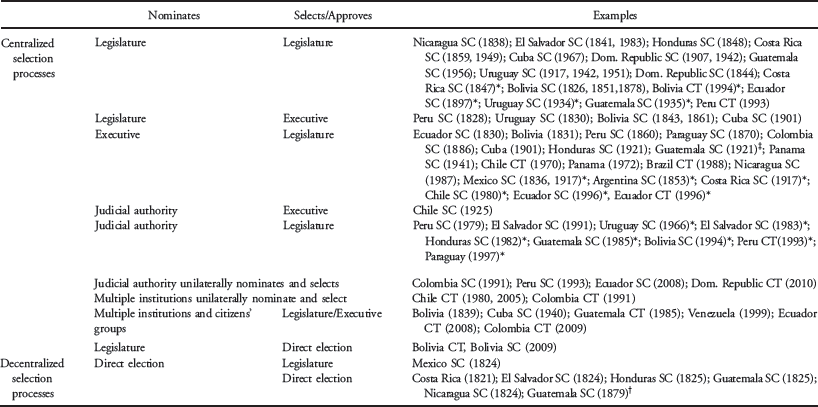
Table 1 describes the constitutional changes to judicial selection processes across Latin America from the time of independence until today. Though all of these countries originally adopted separation of powers systems with formally independent courts, there has been considerable variation in the placement of the judicial selection authority both cross-sectionally and over time. The most centralized of these judicial selection processes (seen at the top of table 1) concentrates both the nomination and selection powers in the hands of a single legislative authority, typically a unicameral legislature or in a joint legislative session requiring multiple chambers. Much like the early constitutions of continental Europe and the judicial nominations of eighteenth-century England, this centralization of judicial selection in the legislative branch appears to have been common in the smaller Central American countries in the 1840s and 1850s. Still, the majority of the early Latin American constitutions utilized arrangements similar to that of the US Constitution, dividing the power to nominate and select judges across multiple legislative chambers or between the legislative and executive branches of government. Even given this variation, one clear lesson from table 1 is that the business of selecting judges has historically been the exclusive domain of political elites.
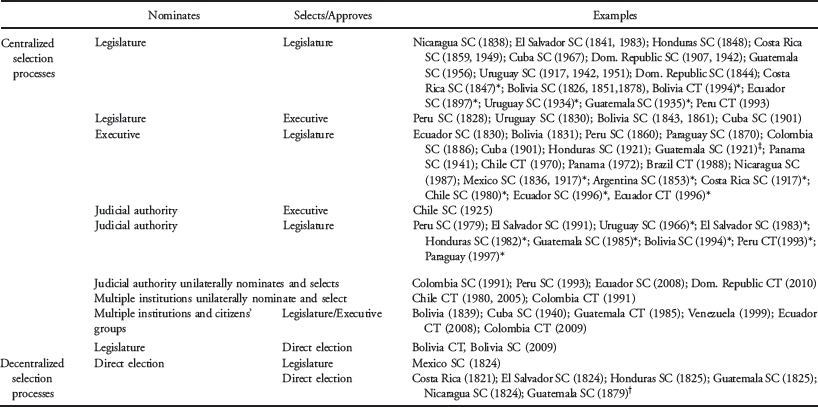
Source.—Original data compilation by the authors.
Note.—CT denotes constitutional tribunal and SC denotes Supreme Court, which may or may not have constitutional authority.
* Supermajority required for approval.
† The Guatemalan Constitution of 1879 enabled the president to nominate Supreme Court judges who were subject to approval by the National Assembly and would serve a 4-year term, though all future judicial selections would be via popular election.
‡ The constitutional reforms in 1921 maintained the direct election of the president of the Supreme Court, though the remaining judges were nominated by the president and subject to approval by the assembly.
Scholars document a recent trend towards the “opening” of judicial selection processes, as judicial selection procedures increasingly involve judicial authorities, the legal academy, or even the public (e.g., Garoupa and Ginsburg Reference Garoupa2009; Rios-Figueroa Reference Rios-Figueroa2011). Rios-Figueroa (Reference Rios-Figueroa2011) notes that the average number of actors participating in the process of appointing judges of the constitutional courts has steadily increased in Latin America since the 1970s, with the average now beyond the traditional two (the executive and legislative branches), a shift which is clearly seen in table 1. Capitalizing on the reputational and professional pressures of the judicial system itself, several contemporary Latin American constitutions grant substantial influence to judicial councils in the process of judicial selection (Colombia 1991; Ecuador SC 2008), or even the Supreme Court itself (Peru 1993), a practice that is now common the world over (Garoupa and Ginsburg 2009). Rios-Figueroa (2011) notes that these more open systems may change the type of candidate who is selected; the participation of civil society in the appointment process widens the pool of potential candidates, leading to the selection of judges with less traditional backgrounds. At the same time, the introduction of civil society into these processes is thought to lessen the grip of the legislative and executive branches on the process, perhaps emboldening judges to participate more actively in the policy-making process (Ferreres Comella 2004; Malleson and Russell 2006).
The most dramatic manifestation of this trend has been the direct election of judges, a phenomenon which is widely considered unique to the US states (e.g., O’Connor Reference O’Connor2009). Though Bolivia is the only country worldwide to elect its national jurists in the modern era, it is not the first country to adopt this institutional convention. Haynes (Reference Haynes1944) reports that national judicial elections were adopted in France in 1790, owing to “the democratic fervor that inspired the Revolution” (158).Footnote 2 Judicial elections were also adopted across most of Central America following independence from Spain in the early 1820s.Footnote 3 As with France, these countries soon abandoned direct elections in favor of a centralized and elite-based process in which the legislature both nominated and selected national judges.Footnote 4 As a point of comparison, while many US states contemplated the direct election of some of their judges, France opted to directly elect its national judicial authorities nearly 40 years before Mississippi—the first state to elect all of its judges—adopted the institution in 1832 (Shugerman 2012).
As with the French Revolutionaries, the Central American independence movements, and the populists in the US states, widespread dissatisfaction with representative government and the disintegration of traditional party systems led reformers in both Venezuela (1999), Ecuador (2008, with 2011 modifications), and Bolivia (2009) to prioritize the participation of a broad base of citizens in their judicial selection processes. The stated goal of these reforms is to “democratize” the justice system, ensuring citizen participation in the judicial selection process so as to expand public confidence in national courts. The 2009 Bolivian Constitution took this logic to a relative extreme by requiring all national judges to be subject to direct popular elections.Footnote 5 To better understand the motives and consequences of this change, we now discuss the constitutional adoption and implementation of the Bolivian judicial elections of 2011.
Judicial Elections in Bolivia: Adoption and Implementation
The Plurinational Bolivian State is a landlocked country in the heart of South America. With more than 30 indigenous nations claiming Bolivia as its ancestral home, it is among the most ethnically diverse countries in South America. It is also the poorest and most unequal of its neighbors (Fearon Reference Fearon2003). Until the turn of the twenty-first century, Bolivian democracy was noted for its relatively stable, albeit elite-driven and largely exclusionary, constitutional democracy (Gamarra Reference Gamarra1997). By the close of the twentieth century, the traditional party system on which this “pacted” democracy hinged gave way to a new era of national politics marked with compelling political newcomers, institutional gridlock and periodic bouts of political protests and violence (Centellas Reference Centellas2009; Boulding Reference Boulding2010). While traditional parties struggled to maintain political relevance, mestizo President Evo Morales Ayma and his Movimiento al Socialismo (Movement to Socialism, or MAS) party have channeled the widespread dissatisfaction, converting the long-marginalized indigenous majority into a potent electoral machine (Alpert et al. 2010). This dramatic transformation of the electoral geography has aligned political ideologies with regional, ethnic, and economic cleavages, posing serious threats to democratic stability on multiple occasions. Far from a temporary political enigma, Morales and the MAS stand ready to shape the landscape of Bolivian politics for a foreseeable future (Singer 2007; Alpert et al. 2010).Footnote 6
Against this backdrop of political flux and institutional turbulence stood a long maligned judiciary. Under the 1967 constitution, national judges were selected in a congressional procedure requiring a two-thirds majority vote in a joint session of the National Congress. In practice, this supermajoritarian requirement was often achieved by dividing judicial posts among national political parties according to a system of political patronage, or cuoteo (Mesa 2008, 2010). With the dissolution of the traditional party system, the process of judicial nominations became increasingly contentious and polarized, frequently resulting in inquorate national courts (Castagnola and Peréz-Liñán 2010).
In August 2006, a MAS-dominated constitutional assembly convened to draft a constitution that would better reflect the new realities of the Bolivian political system. Along with devolved political power to prioritize indigenous and local interests, the 2009 Constitution provided for the direct election of judges to each of the four national judicial institutions.Footnote 7 To balance the need to inform voters regarding candidates’ merits while ensuring a depoliticized electoral process, the constitutional reformers opted for a nonpartisan electoral process, in which all party affiliations, campaigns, or formal endorsements were explicitly prohibited. In addition to baseline education and age requirements, candidates are subject to a candidate preselection process by the bicameral Plurinational Legislative Assembly, which requires the approval of two-thirds of its members in a joint legislative session.
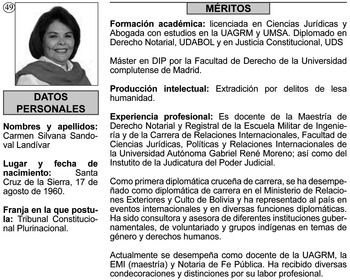
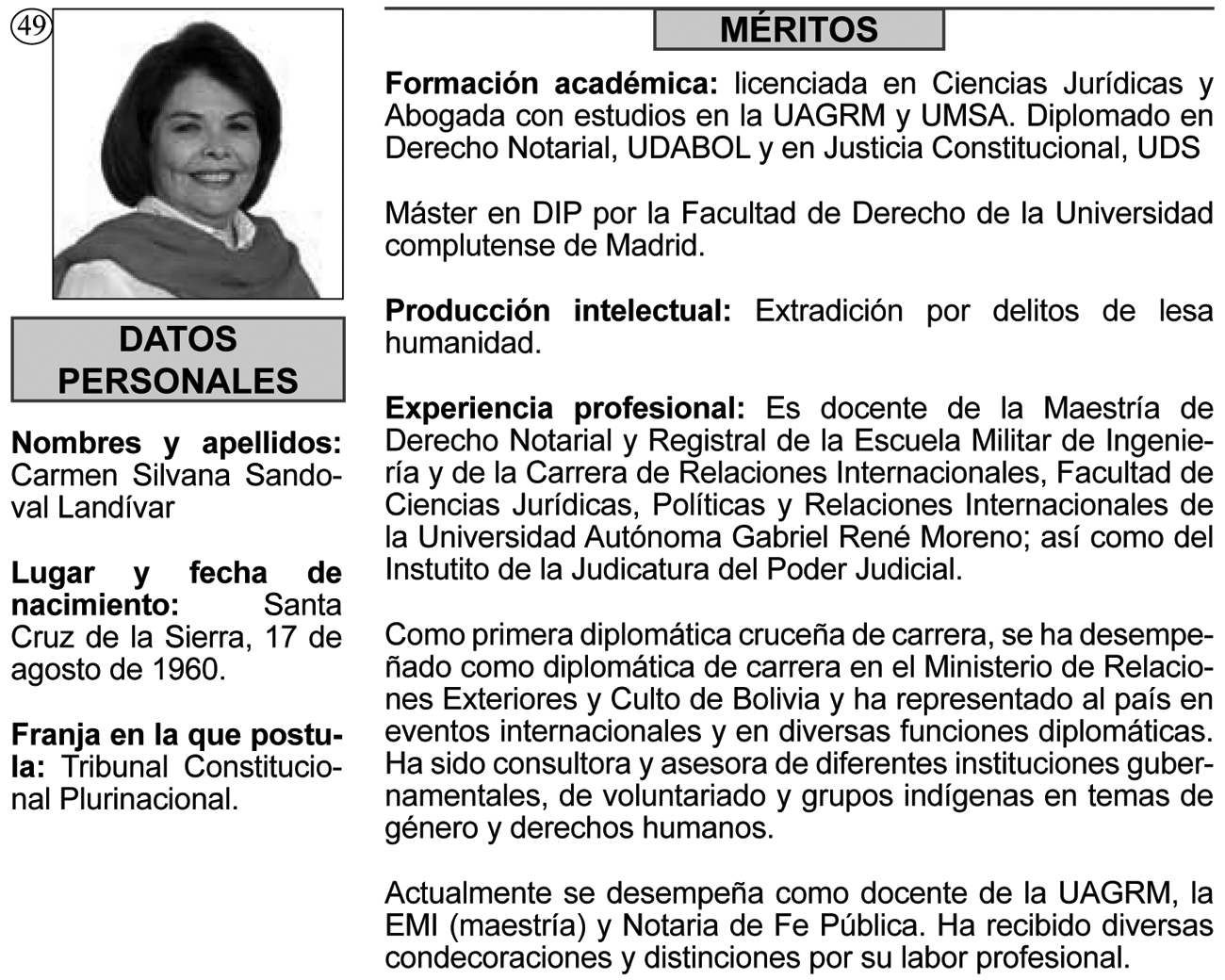
The Constitution situates the national electoral court (the Órgano Electoral Plurinacional, or OEP) as the clearinghouse for all information pertaining to the election process and the dissemination of all candidates’ qualifications. To facilitate voters’ considerations of the candidates’ professional merits in the inaugural contest, the OEP provided standardized voter information guides that documented the professional experience and biographical information of each candidate, including their name, department of origin, and indigenous identification as well as candidates’ academic, professional, and intellectual achievements. Finally, a randomly assigned number and picture were provided, identical to those listed on the ballot. Figure 1 shows an example of a candidate profile, the rest of which are available at the authors’ websites.
Example candidate profile. The profile includes information on the candidate’s date and location of birth, their picture, and their academic, intellectual, and professional experience. The number of the profile (#49) corresponds to candidate’s ballot position and was randomly preassigned by the OEP.
Though protracted and conflictual legislative negotiations characterized many previous judicial nomination processes, the two-thirds control of the bicameral legislature the MAS enjoyed greatly facilitated the candidate preselection process. Still, many distinguished jurists declined to submit their candidacies, and MAS insiders lamented a lack of quality applicants (“El registro ampliado” 2011; “Profesionales no se postularán” 2011). Observers claimed that the legislative vetting committee prioritized ethnic identification over professional qualifications and experience (“Un postrado” 2011), and the OAS condemned the process for lack of transparency and opposition involvement. In spite of the formal ban on party affiliation, several candidates were outed for their ties to the government party, having previously served as party organizers, legislative aides, or legal advisors (“Disputado del MAS” 2011). Indeed, not only was the candidate selection process negotiated largely out of the public view, MAS party insiders later confirmed that many legislative backbenchers knew little about the candidates, but simply voted in accordance with party leaders’ instructions (“Masistas admiten” 2011; “Disputado del MAS” 2011).
In the 45 days leading up to the election, the OEP coordinated the distribution of voter information guides via national media outlets, aided by the national youth corps who distributed voter information packets door to door in rural provinces. Nevertheless, attempts to reach voters in the most remote areas proved futile, with the information campaign failing to reach up to 30% of rural areas (“TSE admite” 2011; “OEA recomienda” 2011). Many voters claimed they remained ignorant of the electoral process and candidates in advance of the elections, a sentiment echoed by President Morales in the hours following the close of the polls (“Lamentablemente” 2011).
Though the Constitution prohibited campaigns for or against individual candidates, the opposition instead lobbied voters to boycott the elections entirely (Driscoll and Nelson 2014).Footnote 8 Though voting was compulsory, nearly 60% of voters’ ballots were deliberately spoiled or left blank. The government faulted voter inexperience, though it accepted blank and spoiled ballots as legitimate forms of electoral participation. The seats on the four national courts were allocated based on candidates’ national valid vote totals, with newly elected jurists claiming their seats in the first weeks of 2012.
Partisanship, Descriptive Representation, and Professional Experience
The adoption and implementation of the Bolivian elections were fraught with controversy, with both proponents and opponents of elected judges raising arguments about the ability of voters to make informed choices on election day given the lack of information caused by the ban on campaigning. Though the constitutional prohibition on campaigning was originally viewed as necessary to ensure a depoliticized election and the meritocratic evaluation of candidates (Órgano Electoral Plurinacional 2011a), critics faulted the candidate preselection process for prioritizing indigenous affiliation over meritocracy and claimed the OEP’s informational efforts were fundamentally deficient. Here we provide an overview of these arguments and assess them using data on judicial candidate success from the 2011 election to the Constitutional Tribunal. Our empirical analysis combines municipal-level election returns, candidate characteristics, and municipal-level census data to evaluate the combined effects of district level electoral composition and candidates’ ethnicity, gender, political commitments, and professional experience on candidate success in the inaugural contest.
Party Affiliation
To avoid the overt politicization of the judicial elections, the Bolivian Constitution prohibited all party affiliations and campaigning in the judicial elections, on penalty of candidate disqualification (Bolivian Constitution, art. 181, sec. 9). Candidate partisan affiliation was not listed on the ballot or voter information guide, and candidates were prohibited from publicizing any political affiliation. Moreover, to ensure that the elections would remain apolitical, media coverage of the judicial candidates was strictly censured, prohibiting interviews that might construe favor or confer any candidate free publicity. Despite these formal prohibitions, some candidates were singled out by the national press for their direct affiliations with the government party as MAS party organizers, legislative aides, or legal advisors (“30 candidatos” 2011). We evaluate the possibility this would have conferred an advantage to these MAS-affiliated candidates, perhaps by increasing their name recognition in an otherwise nonpartisan race (Baum 1987). We assess whether candidates who were publicly identified as government affiliates garnered higher vote shares.
Beyond any direct effect that increased media coverage may have provided, we also investigate the extent to which partisan voting occurred in this ostensibly nonpartisan election. If the increased media coverage informed voters about candidates’ party affiliations, then we expect that majority party candidates would be especially successful in those districts where the MAS party had previously been successful in formally partisan races. To this end, we also expect a conditional effect between a candidate’s publicized governmental affiliation and the historical success of the government party in the district.
Of the 28 candidates who sought election to the Constitutional Tribunal, national media sources identified 12 candidates with previous experience as aides or candidates of the MAS party, whom we coded as government affiliates (“30 candidatos” 2011). To explore the possibility of partisan voting, we collected the percentage of each municipality that voted for the MAS mayoral candidate in the most recent (2010) municipal elections (Órgano Electoral Plurinacional 2010). This variable ranged from 1.4% to 100%, with the modal values approximating 50%. Taking this as a measure of government stronghold, we interact this measure with government affiliate to explore the extent to which partisan voting may have benefited candidates ostensibly affiliated with the governing party.
Demographic Characteristics
A consideration for judicial diversity weighed heavily in the Bolivian debates to justify the adoption of judicial elections. The direct election of judges in Bolivia was described as a “democratization” of the Bolivian judiciary, and the adoption of judicial elections coincided with the larger transformation of the Bolivian national identity toward increased representation for local and indigenous interests in all levels of government. The Plurinational Bolivian Constitution of 2009 confers overt priority to candidates of indigenous descent, while a gender quota ensures parity among the candidates. Given this stated priority of diversity promotion, we evaluate whether women and indigenous candidates benefited on election day.
Yet our interest in descriptive representation leads us to examine the possibility of a conditional relationship between the concentration of pro-female voters or minorities in a district and the success of female or minority candidates in that district. If concerns for descriptive representation also weighed heavily in the minds of voters as they cast their ballots, we anticipate that indigenous candidates received a boost in districts with a high proportion of indigenous voters, and that female candidates were favored in districts where women had been previously elected to local executive office.
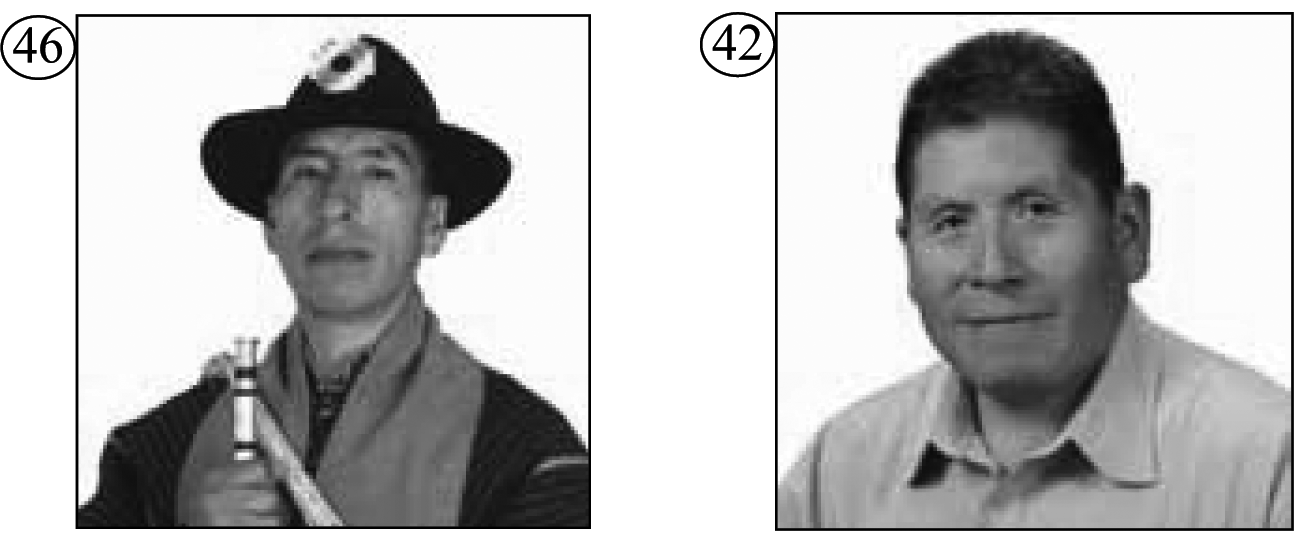
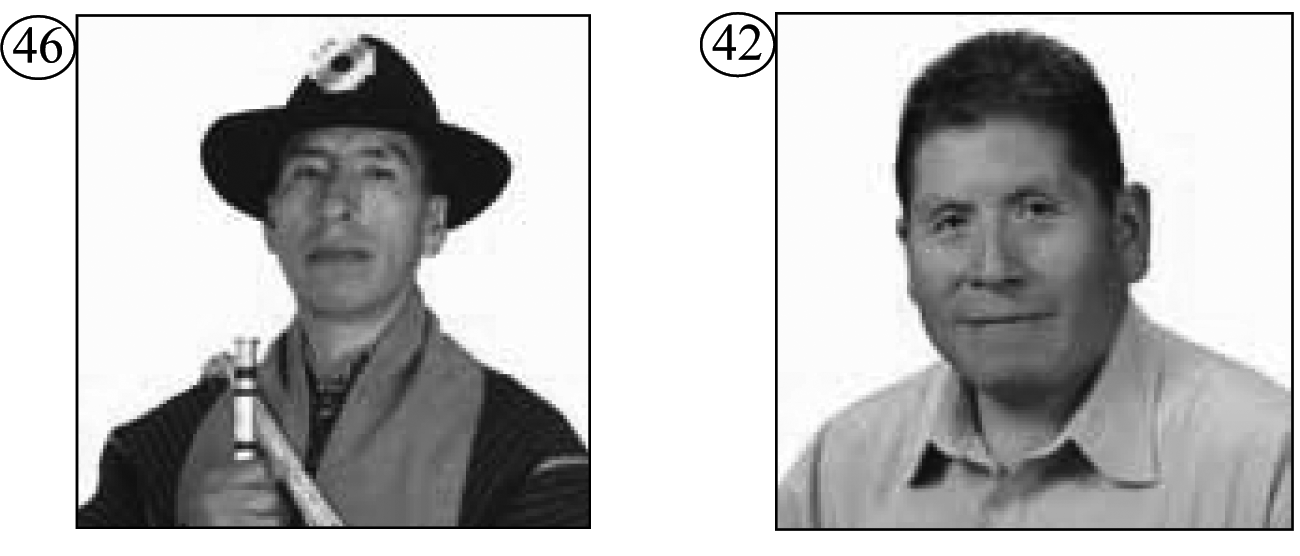
Though the voter information guide listed candidates’ self-reported indigenous affiliation, the ballots also advertised candidates’ ethnicity and gender based on the pictures on the ballots. In practice, every other candidate listed on the ballot was female, seven of whom were listed to be of indigenous descent in their candidate profiles and four of whom our coders identified as overtly indigenous.Footnote 9 Exemplary profiles of overtly indigenous and self-identified indigenous are pictured in figure 2.
Comparison of candidate profiles for candidates who were classified as overtly indigenous as opposed to self-identified indigenous (though not overtly indigenous in appearance). Both of the candidates listed above self-identified as indigenous in the candidate profile, though only the candidate on the left was coded as appearing to be so.
From the 2001 Bolivian census we collected municipal-level data on the percent indigenous, which was the percentage of the municipal population who self-identified as being of indigenous decent.Footnote 10 This variable ranged from 1.5% to 100%, with a mean of 71% and a median of 87%.Footnote 11 The literature on the success of female candidates in legislative elections suggests that ensuring descriptive representation of women may depend on the area’s history of electing female candidates rather than the sex of the voters (Fox and Oxley 2003). To this end, we relied on the 2010 mayoral election returns to determine whether the municipality had a female mayor (Órgano Electoral Plurinacional 2010).
Professional Experience
The meritocratic selection of judges was an oft-cited motivation for adopting judicial elections into the 2009 Bolivian Constitution (Vargas 2010).Footnote 12 The constitutional regulations governing candidate selection had the dual objective of guaranteeing sufficient candidate expertise while encouraging voters to prioritize meritocracy when casting their votes. The 2009 Bolivian Constitution requires candidates be least 30 years old with at least 8 years of professional experience. Further, all nominees are subject to approval by the National Assembly; the assembly vetted all candidates by a two-thirds majority before judicial aspirants could appear on the ballot.
Tasked with the administration of the country’s first judicial contest, the OEP sought to balance concerns for the informed and meritocratic evaluation of candidates while attempting to shield candidates’ party affiliations from voters. The voter information guides distributed by the OEP documented each candidate’s professional, academic, and judicial experience with a short biographical profile. The stated purpose of the guide was to ensure that voters “could chose and vote in an informed and conscientious manner” while selecting the candidates on the basis of their merits rather than partisan or political connections (Órgano Electoral Plurinacional 2011b). An example of this information is shown in figure 1.
Coupling prior research on voters’ decisions in judicial elections the US states (e.g., Hall and Bonneau 2006; Bonneau and Hall 2009) with the procedural regulations that sought to assure meritocratic evaluations of candidates in Bolivia, we probe whether candidates with more professional experience were rewarded with higher vote shares. Candidates reported a variety of professional experiences in the voter information guide. Though only 18% of the candidates reported previous judgeships, 70% of candidates were lawyers while 72% served as legal counsel for high court judges, legislative committees, or in the Ministry of Justice. Yet another 65% of candidates reported previous leadership in nongovernmental organizations, the Bolivian Constitutional Assembly, or the Bolivian Ministry of Justice in the Prosecutor’s or Attorney General’s Office. Ninety percent of the candidates had some graduate training, several of whom studied at prestigious international institutions. Also, 65% of the candidates had some professorial experience training undergraduates and graduate students in law and social policy, while 36% listed academic publications among their previous accomplishments. In sum, the Bolivian judicial candidates brought a varied set of professional accomplishments from the judicial, legal, and academic fields.
For a variety of reasons, conventional metrics of candidates’ qualifications are ill suited for our purposes.Footnote 13 First, though several candidates had previous experience on a national court, there were no electoral incumbents in these contests. Second, all the candidates brought a myriad of professional qualifications to bear that are more common to judges in civil law systems. A high correspondence between judicial and academic career trajectories is typical of civil law systems, where judges are regarded as legal bureaucrats, and may find attractive professional opportunities and resources in private practice or academic pursuits (Peréz-Liñán et al. 2006; Merryman and Peréz Perdomo 2007; Couso 2010). For these reasons, conventional measures of candidates’ qualifications would systematically understate the professional experience of the Bolivian judicial candidates.
To create a measure that encapsulates the varied experiences of the Bolivian judicial candidates, we first coded the information presented in the voter information guide, recording all mentions of candidates’ professional experiences, formal education, evidence of academic productivity, and areas of expertise.Footnote 14 We constructed a measure of candidates’ professional experience using a logistic item-response model, akin to the ideal point models used to estimate legislators’ or judges’ ideal points from roll call or case voting.Footnote 15 We took candidates’ professional qualifications as an outcome to be measured.Footnote 16
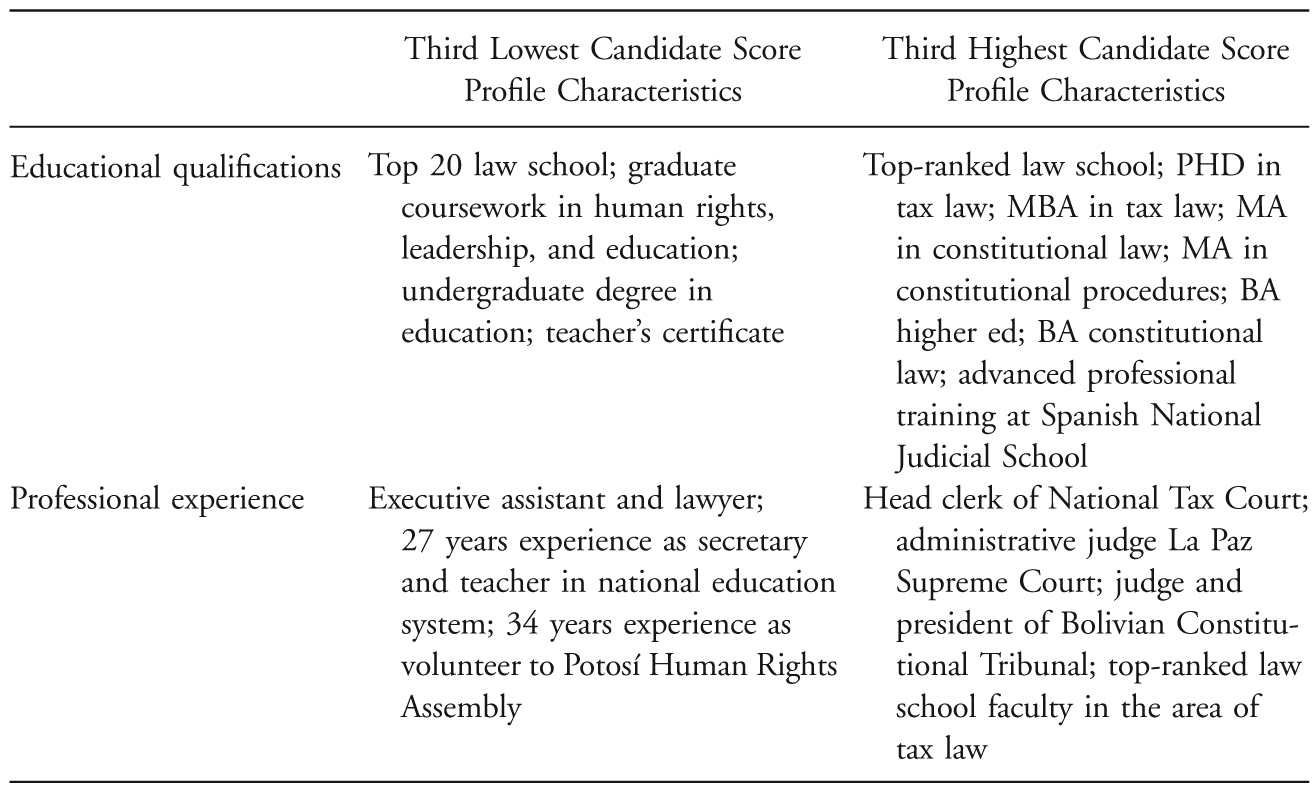
Our measure of candidates’ professional qualifications has a minimum of −1.92 and a maximum of 1.22. The mean of the data is −.28 and the median is −.14, and the data have a slight negative skew. Table 2 presents the full list of the educational and professional experiences for candidates who were rated relatively low and relatively high, providing face validity to our measure. At one end of the spectrum, a candidate was a legal secretary with extensive professional experience, only some of which pertained to law or legal training. At the high end of our qualifications measure, the candidate had completed multiple graduate or doctoral degrees, some of which were acquired at international institutions, and had experience as a departmental and national judge. This same candidate reported multiple academic works pertaining to constitutional and tax law. These profiles were the third highest and the third lowest of our IRT ranking, and are similar to the candidates with similarly low or high scores.

Empirical Model of Candidate Success
Our data come from official election returns released by the Bolivian government in the days following the 2011 elections. For the purposes of this analysis, we consider candidate success in the Plurinational Constitutional Tribunal contest given its position at the apex of the Bolivian constitutional system. The unit of analysis is the candidate municipality; there is one observation for each candidate in each municipal district in the country.Footnote 17 Our data and all replication files are available at the authors’ websites.
The outcome variable in our analysis is the proportion of valid votes received by each candidate in the race. Because the outcome variable is continuous along the 0–1 interval, we estimate a hierarchical logistic regression model. Logistic regression on a proportion, like our outcome variable, has the effect of “unbounding” our outcome beyond the 0–1 interval. To account for the fact that the vote shares are grouped by candidate, the model includes random intercepts for each candidate.Footnote 18 The appendix provides a thorough examination of the robustness of our results using alternative measurement strategies.
Notably, in addition to our covariates of theoretical interest, we include a control for Ballot Position based on the order in which the candidates appeared on the ballot. Studies show that candidates who appear at the top of the list of candidates tend to receive more votes than candidates who appear at the bottom of the list (Miller and Krosnick 1998; Ho and Imai 2008). Candidates in the Bolivian judicial elections were randomly assigned their ballot positions, and the number for the voter information guide corresponded with the candidate’s ballot position.
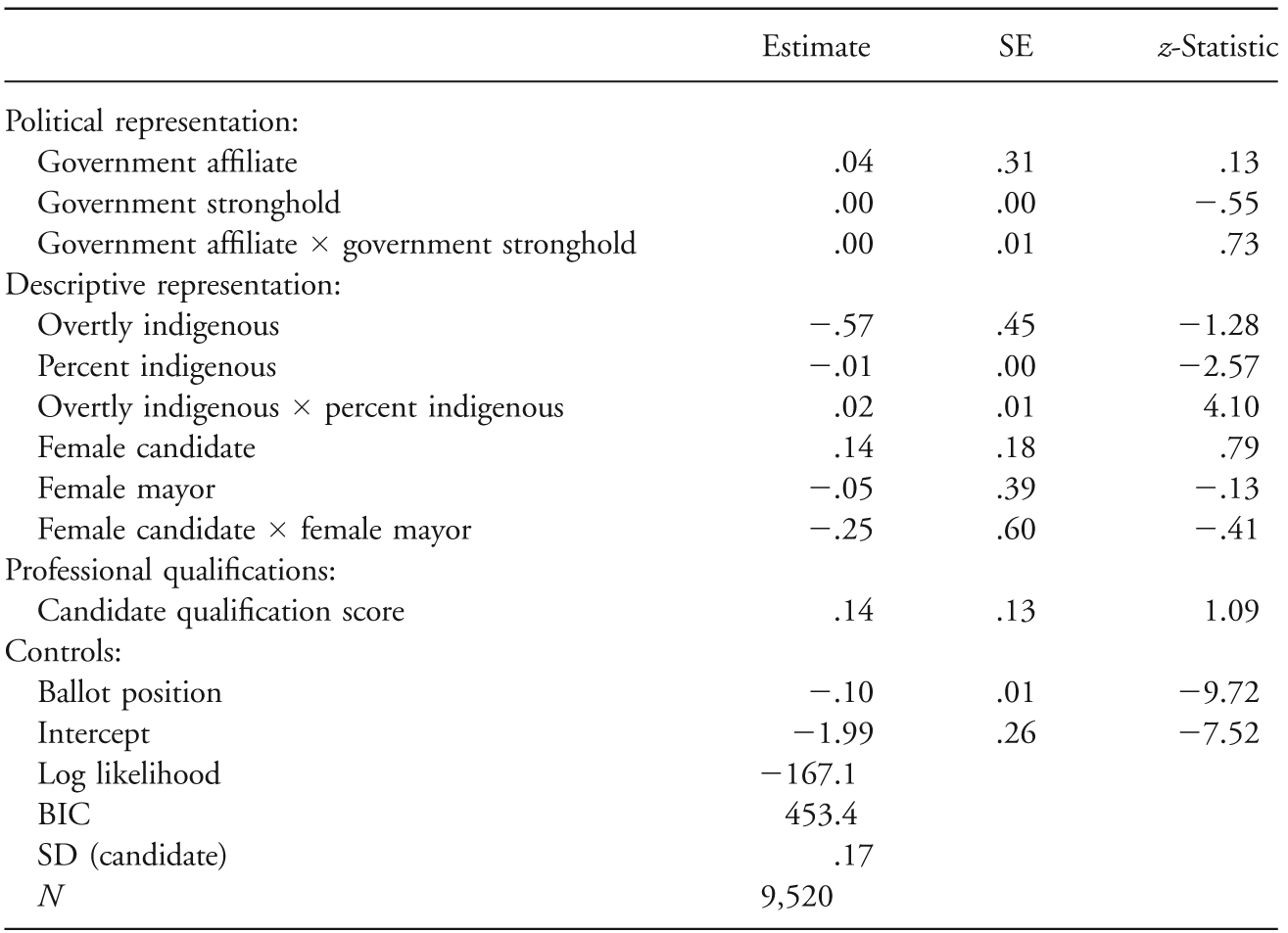
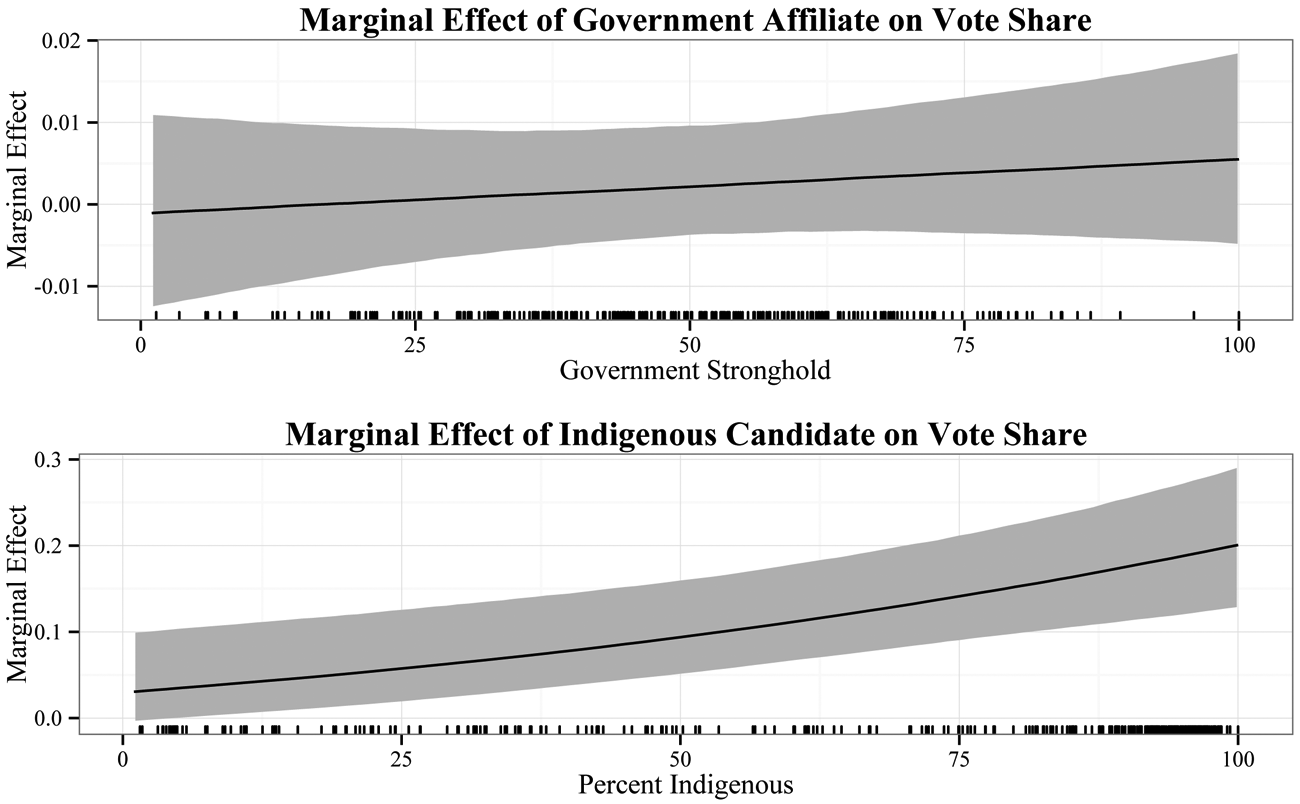
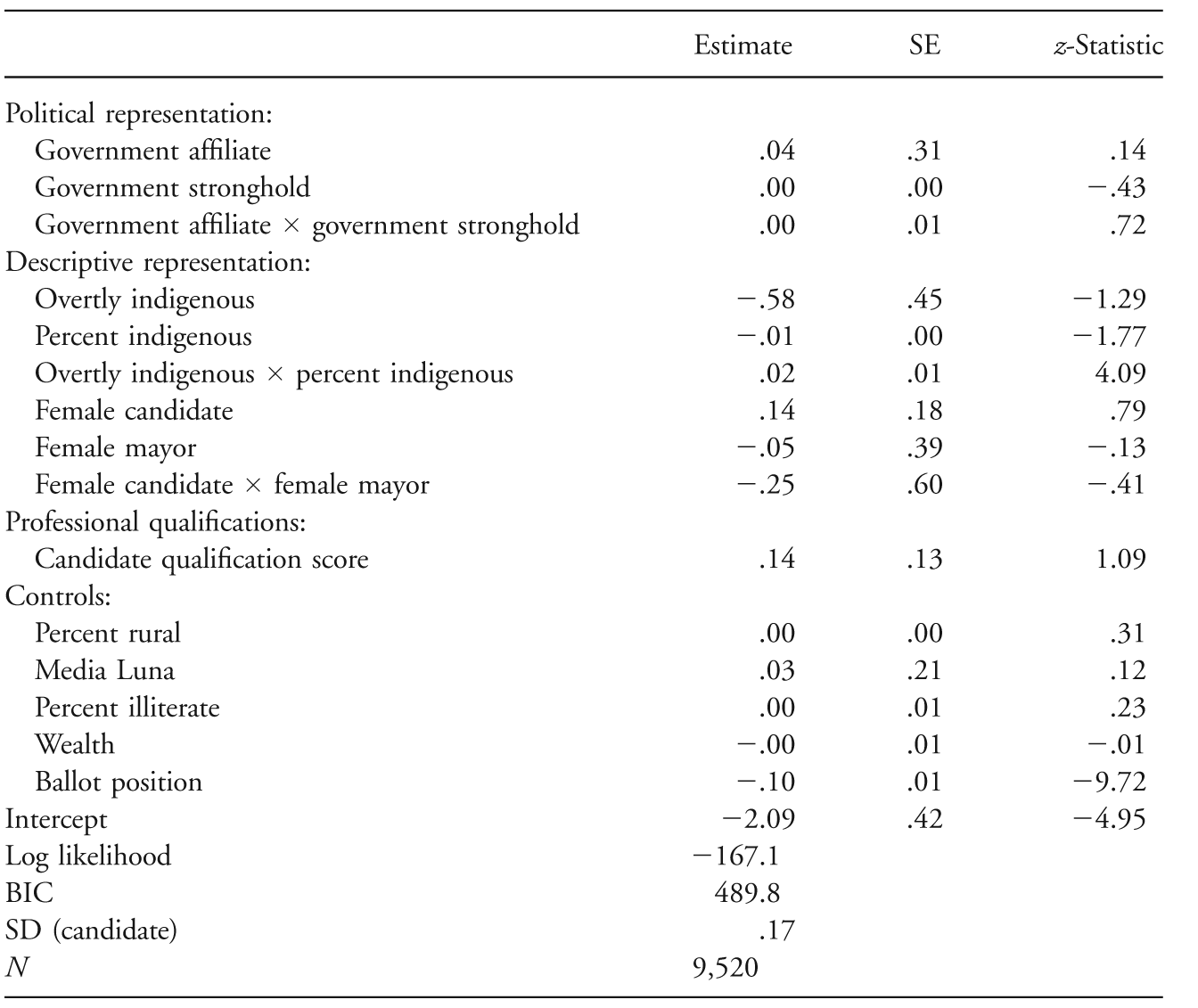
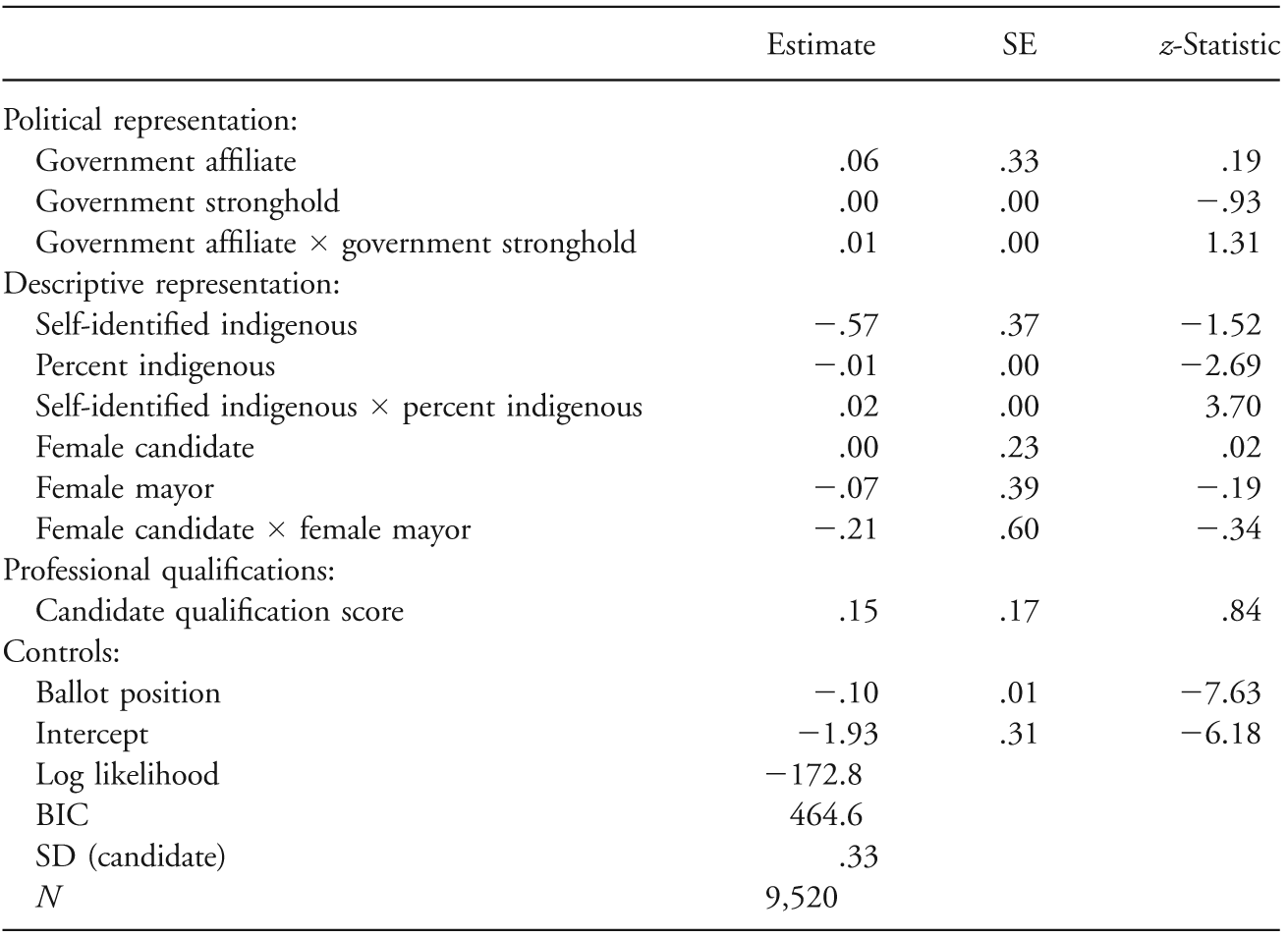
Table 3 shows the results of the hierarchical logistic regression model. We find some support for the contention that candidates’ sociodemographic characteristics impacted candidate vote shares, particularly as those characteristics reflected the demographic and partisan composition of the municipality. To better understand the effects of these characteristics on the candidates’ expected vote shares, figure 3 plots the marginal effects of government affiliate and overtly indigenous across the range of demographic characteristics present in the Bolivian municipalities.

Note.—The model includes random intercepts for each candidate.
Marginal effects of candidate characteristics on the candidate’s vote share in the 2011 Bolivian judicial elections. The gray bands are confidence intervals at the p < .05 level using two-tailed tests. The rug shows the distribution of government stronghold and percent indigenous in the data. All other covariates are held at their median or modal values.
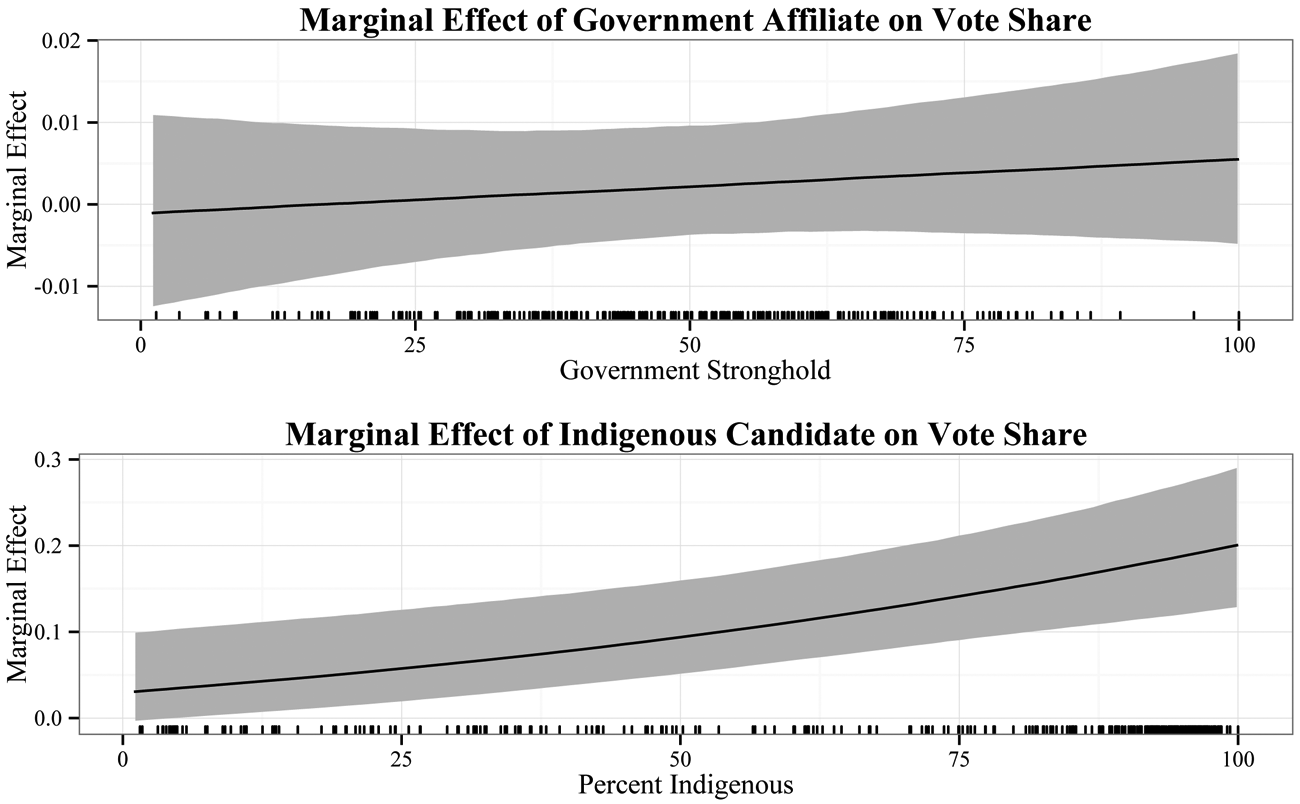
The top panel of figure 3 shows the effects of a candidate’s affiliation with the MAS party on her received vote share. Again, candidate partisanship was not present on the ballot or the voter guide, though the national press publicized the identities of ostensibly MAS-affiliated candidates. The graph suggests that, across all observed levels of government stronghold, MAS candidates did not receive any benefit or penalty at the polls.
However, the effect of ballot position masks the presence of partisan voting.Footnote 19 The marginal effect of government affiliate becomes statistically significant for those candidates at the seventeenth ballot position and below for those districts where the MAS-affiliated mayoral candidate received a majority of the vote in 2010. In these districts, a MAS-affiliated judicial candidate listed toward the bottom of the ballot received about a 1%–2% boost in vote share. While these effects may seem small, recall that 28 candidates appeared on the ballot, so effects of this magnitude would have meaningfully differentiated between candidates. Indeed, had the third-place winner and previous Morales appointee (listed seventh on the ballot) Ligia Velásquez Castaños’s vote share been reduced by 2% in all of the MAS strongholds, her national vote total would have been reduced by nearly one half, dropping her to thirteenth place in the overall race.
The second panel of figure 3 shows the effect of being overtly indigenous on a candidate’s vote share. The graph clearly shows that as the concentration of indigenous citizens increases, overtly indigenous candidates received a noted boost at the polls. This effect is statistically significant irrespective of ballot position, and substantively important. Assuming the candidate is positioned at the middle of the ballot, an easily identifiable indigenous candidate competing in a municipality that is 50% indigenous can expect to receive about a 10% increase in vote share; as the concentration of indigenous residents increases to 100%, the effect of being an indigenous candidate approaches a 20% expected increase in vote share. Macario Cortez Chavez, the candidate pictured on the right in figure 2, provides an example of the substantive importance of this effect. Chavez self-identified as indigenous in the voter information guide but was not classified by our coders as appearing to be overtly indigenous. Though his candidacy fared quite well, his national vote total placed him about 16,000 votes shy of winning a seat on the tribunal. Our results suggest that, had he overtly advertised his indigenous identity, he would have easily secured a place on the court.
Neither constituent term nor their interaction for female candidate or female mayor is statistically significant, providing no evidence that women were either advantaged or disadvantaged at the polls. Also, examining the effects of the candidate qualification score, the estimated coefficient is not statistically significant in any of the models we examined. The model also provides no evidence that voters differentiated among candidates on the basis of professional qualifications.
Finally, the effect of ballot position deserves mention. The estimated coefficient is negative and statistically different from zero, indicating that candidates who were listed toward the bottom of the ballot (e.g., high ballot position) received systematically lower expected vote shares. Again, Macario Cortez Chavez, the candidate pictured on the right in figure 2, provides an example of this effect’s importance. Chavez, who was the second candidate listed on the ballot, received a 4% increase in vote share in every district compared to what he would have received if he had been the second-to-last candidate on the ballot. This effect is huge, especially considering the very large number of candidates and the fact that candidate ordering was random.
What can we take from these empirical results? First, though partisanship was officially prohibited and the voters were provided with no information on candidates’ party affiliation on the voter information guide or the ballot, our results suggest there was partisan voting among MAS supporters, which improved the electoral performance of candidates whom the national media had identified as government (MAS) affiliates. This is perhaps surprising given the limited informational environment in which the election took place.Footnote 20 Second, the direct election of the national judges expanded the diversity of the high courts dramatically in terms of ethnic composition of the bench. Though more than 60% of Bolivians auto-identify as indigenous or mestizo, the first high court justice of indigenous decent in the country’s history was only nominated to office by President Morales in 2010. In the elections, by contrast, three of seven seats were won by candidates of indigenous background, thanks in large part to indigenous voters.Footnote 21 Finally, there is no evidence that the candidates with higher levels of professional qualifications received a boost at the polls. Politically speaking, the effect of the closed nomination process and partisan voting on behalf of MAS voters was evident: candidates with previous affiliations with the MAS were the majority on both the Constitutional Tribunal and the Agro-ambient Tribunal, with a single seat on the Supreme Court and the Judicial Council being filled by previous MAS affiliates. Yet these were also the most diverse courts in the nation’s history, with roughly equal numbers of men and women on each court, and an unprecedented number of judges of indigenous decent elected to office.
After the Elections: The Short-Term Effects
The 56 popularly elected magistrates were officially sworn into office by President Morales on January 3, 2012. How have the new courts and elected judges fared? Just 2 years later, President Morales described the justice system as one of the major failings of his administration of 2013 (Morales Reference Morales2014). Being careful so as to not directly implicate the elected authorities, he acknowledged that corruption is prevalent, trials and sentencing are frequently delayed, and the Bolivian justice system has remained in a state of general malaise and crisis. Speaking directly to the increased representation of indigenous interests in the national courts, Morales described the change as insufficient: “In vain we have incorporated poncho y pollera (traditional indigenous garb) in the justice system; it hasn’t changed anything” (Cuiza Reference Cuiza2014). Several days later, the newly nominated minister of justice, Elizabeth Gutiérrez, described the selection of authorities by direct election as a “miscalculation.” Directly faulting the magistrates of the Judicial Council (Consejo de Magistratura), the administrative body charged with the administration of all subnational courts and judicial careers, Gutiérrez underscored the importance of professional experience and legal expertise in the administration of justice, something she said the judges elected to the council lacked (Ministra 2014).
This is not to say the courts have not made their impact felt, occasionally showing demonstrable independence from the government. During its short tenure, the Constitutional Tribunal ruled against the government in several high-profile political cases, including the construction of a highway that would cross indigenous lands, and moving to protect a former president who faces charges by the government for maladministration. At the same time, in April of 2013, the Constitutional Tribunal handed down a ruling that cleared the way for President Morales to seek reelection in 2014, which would extend his mandate until the year 2020. More recently, one constitutional magistrate accused the government of institutional interference, claiming the president of the tribunal managed cases in direct behest of the executive, allegations which the tribunal’s president inadvertently confirmed (El presidente del TCP 2014).
Has the direct election of judges changed the Bolivian public’s perceptions of the courts? Indeed, weak public confidence was an oft-cited motivation for reforming the judiciary, with supporters touting judicial elections as the best way to restore prestige and institutional legitimacy to the national judiciary. These supporters argued that the creation of a direct electoral connection would render legitimacy to these institutions that would, in turn, bolster the public’s confidence in its judicial institutions (Òrgano Electoral Plurnacional 2011a). Opponents of judicial elections argued the opposite: that the implementation of direct elections would lead voters to see judges as “normal politicians” rather than learned jurists and that this shift in perception would undermine public confidence in their judicial institutions (Romero et al. Reference Romero2009; Veltzé Reference Veltzé2010).
The ideal data to assess these competing views about the effects of judicial elections on public confidence in the Bolivian courts would require both panel data, with waves before and after the election, and a reliable measure of the legitimacy of judicial institutions, such as those suggested by Gibson and Caldeira (1992). Unfortunately, neither is available. Thus, we are confined to an analysis of cross-sectional survey data and the analysis of self-reported public confidence in the judiciary, rather than diffuse support for the courts.Footnote 22
Our data on public confidence in the Bolivian Supreme Court come from the 2008 and 2012 Americas Barometer data.Footnote 23 The outcome variables of interest are the questions pertaining to citizen trust in the Supreme Court in 2008 (1 year preceding the adoption of the new Constitution) and in 2012, approximately 6 months following the judicial electoral contest. For the purposes of the analysis here, we consider the question “To what extent do you trust/have confidence in the Supreme Court?”Footnote 24 which prompted respondents to rank their confidence according to an ordinal scale from 1 (not at all) to 7 (a lot).
The data reveal a marked decline in citizen confidence between 2008 and 2012. Whereas the average response regarding confidence in the Supreme Court is 3.68 in 2008, this average confidence declined to 3.42 in 2012, a difference which is statistically significant at the p < .05 level. Notably, though the distribution of the opinion in the 2008 survey approximates a normal distribution, the distribution in the 2012 survey appears quite negatively skewed, prompting us to explore the correlates of public opinion in a multivariate setting.
Given widespread reports of protest voting in the election (Driscoll and Nelson 2014) and the stated goal of the institutional reform as one that could restore public confidence in the judiciary, the most basic question we explore concerns the relationship between support for the Morales administration and confidence in the judiciary. To this end, our model includes a five-point scale assessing support for the Morales administration (presidential approval), with higher values indicating more support. Given reports of protest voting, we also include indicators for self-reported blank and null voting in the 2012 regression, to assess the possibility that voters who self-reported spoiling their ballots were also more distrustful of judicial institutions after the fact.Footnote 25
We also control for multiple alternative explanations of both empirical and theoretical import. First, it is widely acknowledged that indigenous voters are an important electoral base for the MAS party, who appeared to spoil their ballots with less frequency in the judicial elections (Alpert et al. Reference Alpert2010; Boulding Reference Boulding2010; Driscoll and Nelson Reference Driscoll2014). At the same time, voters in the eastern departments of Beni, Pando, Santa Cruz, and Tarija (collectively known as the Media Luna) were much more likely to spoil their ballots, owing to the concentration of opposition voters in these departments. For these reasons, we included dummy variables for both of these predictors based on respondents’ self-identification as indigenous (auto-ID indigenous as opposed to mestizo, white, or black), and whether the respondent lives in the Media Luna.
Next, extant literature on public support for judicial institutions (e.g., Gibson and Caldeira Reference Gibson1992; Gibson et al. Reference Gibson1998; Gibson and Nelson Reference Gibson2014b) advances a host of theoretical explanations for which we also control. We include two measures of political sophistication, on the theory that awareness of current events makes respondents more aware of courts and judicial elections.Footnote 26 Additionally, extant literature on public support for the judiciary (Gibson and Caldeira Reference Gibson1992; Gibson and Nelson Reference Gibson2014a) suggests that respondents’ basic political beliefs structure their support for judicial institutions, so we include a measure of democratic values and beliefs about procedural justice.Footnote 27 Finally, we also control for a number of demographic characteristics, including whether the respondent lives in a rural area (a dichotomous indicator), and their wealth (whether the respondent owns a cell phone), as well as the respondent’s age and gender.
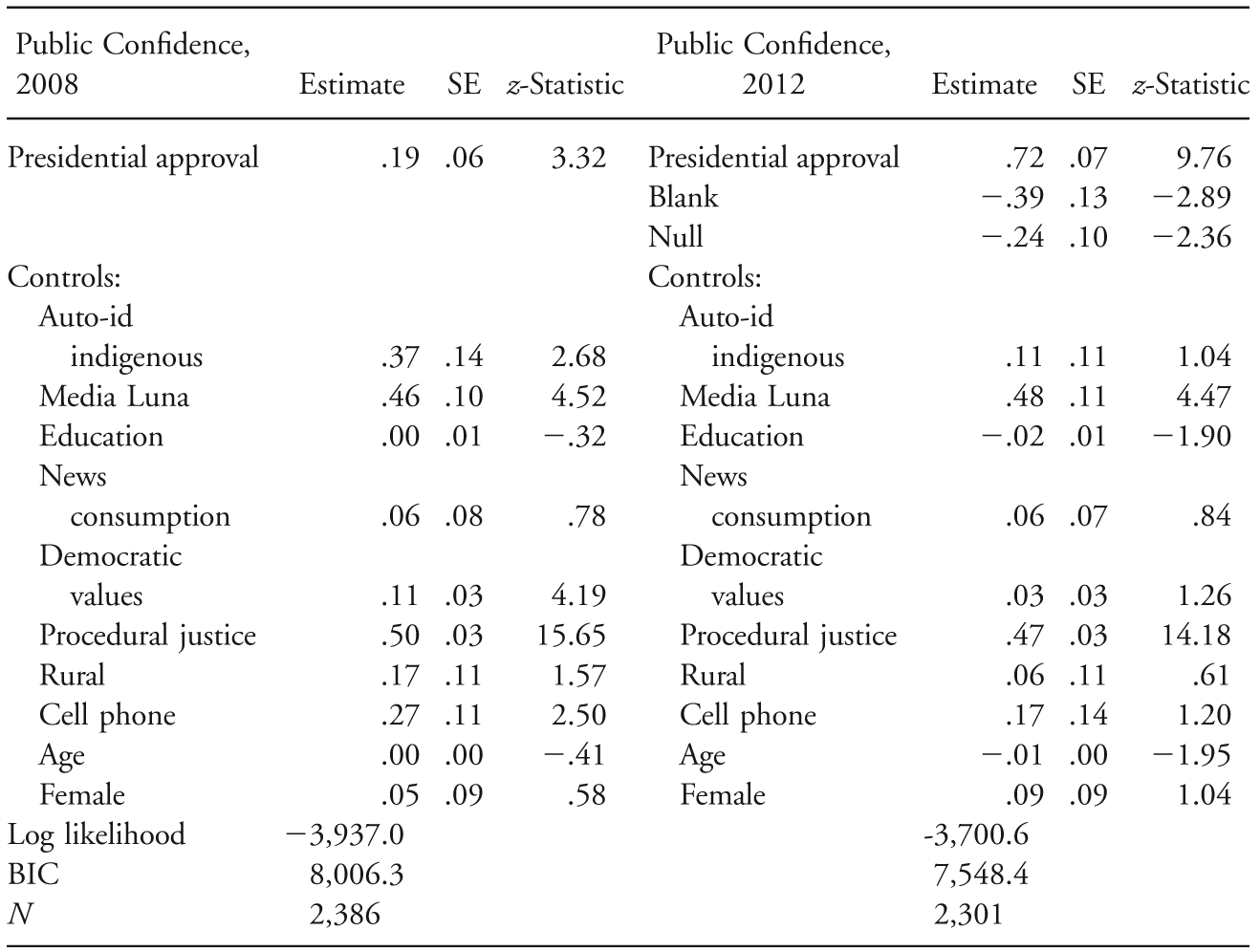
Because the outcome variables in both regressions are ordinal rankings of public confidence in the Supreme Court, we estimated two separate ordinal logistic models for public esteem in the Supreme Court in 2008 and 2012. The model estimates are reported in table 4.Footnote 28 Here, political correlates appear strong and statistically significant predictors of confidence in the Supreme Court, illustrating the polarized environment that characterizes judicial elections and Bolivian politics more generally. Though high presidential approval before the elections was associated with increased levels of judicial confidence in 2008, the magnitude of this coefficient increases threefold following the 2011 judicial elections. While a supporter of Morales was 15% more likely to exhibit high levelsFootnote 29 of confidence in the Supreme Court in 2008 (as compared to strong Morales opponents), that same Morales supporter was 37% more likely to have high confidence in the Supreme Court in 2012, assuming she cast a valid vote for a candidate. Insofar as the MAS and President Morales sought to represent the majority of Bolivians who brought them to office, the institutional reforms and the inaugural contest appear to have successfully realized their intended results amongst their core supporters.

Note.—Cut points are not reported in the interest of space, though are available from the authors on request.
Yet while the direct election of judges was associated with increased public confidence in the Supreme Court among MAS supporters, confidence in the Supreme Court declined across the country as a whole, an effect which was exacerbated among supporters of the opposition. Indeed, the probability that the modal voter—even assuming he cast a valid vote in the judicial elections—has a high level of confidence in the Supreme Court dropped by half (from 30% in 2008 to 16% in 2012) after the elections. If that voter happened to have been a strong opponent of President Morales, his probability of a high level of confidence in the Supreme Court dropped by over 500%, from 22% to 4%. Also evident are the correlates of self-reported blank and null voting on citizens’ confidence in the Supreme Court. Confidence in the Supreme Court was systematically lower among those respondents who self-reported spoiling their vote or casting a blank ballot, who were roughly 40% less likely to express a high level of confidence in the newly elected judicial branch of government.
These patterns suggest that the objective of improving citizens’ confidence in judicial institutions was partially realized: supporters of the current administration who participated in the election were more likely to express confidence in the Supreme Court following the election, as opposed to before. Yet the opposite is true for all citizens outside of that subset: supporters of the opposition, non-MAS partisans, those who reportedly did not cast a valid ballot were systematically less supportive of the Supreme Court and other judicial institutions. In light of the fact that an absolute majority of voters cast blank and spoiled ballots, this decline in public confidence is troubling indeed.
We acknowledge that the causal story underlying this effect is difficult to parse. On the one hand, voters with lower confidence in political institutions and the Supreme Court may have been more likely to spoil their ballots in the first place; it is also possible that voters who were otherwise supportive of the courts were turned off by the electoral process itself and opted to cast a blank or spoiled ballot as a result. If this is the case, then the elections themselves may have played a role in the decline of public confidence in the Supreme Court. Disentangling these countervailing explanations is impossible with the data we have available, and we leave these interesting and undeniably important questions for future research.
Discussion
The 2011 Bolivian judicial elections were unquestionably a historic event, providing for the first time in recent history the opportunity for a country’s citizens to play a role in the selection of its country’s national judges. The adoption of this electoral institution was surrounded by polarizing political debate between those who saw the adoption of judicial elections as a panacea to the institution’s chronically low public esteem and those who felt that the adoption of popular elections would only cause further harm to the judicial branch. In the end, one Bolivian constitutional scholar describes the decision to adopt judicial elections this way: “There is a powerful reason why the Constituent Assembly arrived at its decision and that is that there was no other way: the only way to stop the carnival of party and judicial patronage for once and for all was the direct designation of judges by direct and universal popular vote. ‘The greater the popular sovereignty in the election of judges, the greater the independence, quality and impartiality in the administration of justice’” (Vargas 2010, quoting Rebeca Delgado, chairwoman of the justice committee of the Bolivian Constitutional Assembly).
In this article, we attempted to shed some empirical light on several of these assertions, examining the correlates of candidate success and public confidence in the judiciary before and after the initial election. While we are appropriately cautious about our ability to generalize about the long-term effects of these elections, we close by reiterating four conclusions about which our data are clear as well as some broader thoughts about the Bolivian experience which might inform future research on judicial elections elsewhere.
First, one major argument given for the adoption of judicial elections in Bolivia was a desire to improve the representation of minorities on the bench. Such arguments fit well with scholarly views that “the more open the appointment procedure, the more likely it is that less traditional judges will arrive at the constitutional court. This is the case because the participation of these organizations would tend to widen the pool of candidates because they prefer judges who represent them better, who do not come from predominantly affluent and conservative backgrounds, and whose views are more expansive and in favor of enforcing social and economic collective rights” (Rios-Figueroa 2011, 38).Footnote 30 The election was unquestionably successful at diversifying the benches of the national Bolivian courts, with the Bolivian judiciary now containing historically high numbers of female and minority jurists. Not only were an unprecedented number of indigenous candidates elected to national judicial office, but our results suggest they have largely indigenous voters to thank for their electoral success. Not only was the current Constitutional Tribunal the most diverse in Bolivian history, but it is the most diverse constitutional court in all of the Western Hemisphere. This is all the more important in light of the fact that the national judicial institutions were largely foreign to many Bolivians, and indigenous Bolivians have long been marginalized from the national political scene. If we take this dramatic increase in indigenous peoples’ participation in selecting descriptive representatives on the high courts as evidence of “democratizing justice,” then the objectives of the judicial elections were not only achieved, but were a resounding success.
Second, the 2009 Constitution laid out a procedure to ensure the meritocratic evaluation of candidates, subject to the approval of a supermajority of the bicameral National Assembly. There is little evidence to suggest that these institutional requirements were efficacious in practice. The highly politicized candidate preselection process was criticized widely as lacking transparency, opposition involvement or serious meritocratic criteria, allegations which cast a long shadow on the legitimacy of the elections more generally. Instead, the government emphasized the meritocratic evaluation of candidates by providing voters with standardized information about candidate qualifications and investing considerable resources to ensure a depoliticized electoral contest. Though the judicial candidates brought a myriad of professional experiences with them to office, we found no evidence this information was decisive in structuring voters’ choices. To the extent that reformers argued that the most qualified candidates would be advantaged under this system, the initial contest illustrates a number of ways in which this ideal can break down.
Third, our analysis of public opinion documents a polarization of public sentiment toward the Supreme Court before and after the judicial elections. Government supporters appear more confident in the Supreme Court following the election, with majority party support becoming a stronger predictor of confidence after the election than it was before. At the same time, open opponents of the elections—especially those respondents who self-reported casting blank or null votes—exhibited systematically lower levels of support for the Supreme Court than government supporters. These results are mixed and difficult to interpret. Insofar as the reformers aimed to bolster public confidence among the emergent, MAS-led majority, confidence appears to have improved among this section of society. On the other hand, the fact that an absolute majority of voters declined to choose a candidate in the judicial elections would imply the lack of public confidence in the judicial institutions is widespread. Indeed, as shown above, the average public confidence in the Supreme Court declined between 2008 and 2012.
Finally, the Bolivian experience provides a clear example of how electoral populism can overwhelm and undermine institutional separation of powers. The Bolivian Constitution of 2009 required each of the judicial candidates receive the approval of two-thirds of the bicameral national assembly, a clause which was added as a concession to the political opposition to ensure future influence and consultation in judicial nomination processes (see Driscoll and Nelson 2013). What was unforeseen to the Constitution writers at that time was that a single party could win, via free and fair elections, the supermajority control that was necessary to unilaterally sidestep this constitutional requirement meant to institutionalize opposition involvement. In this sense, it is wholly unsurprising that the MAS would summarily dismiss the criticisms of the political opposition during the candidate preselection process, as it was within their constitutionally defined right to do so.
It is too soon to tell if the changes in the composition of the judiciary and this initial decline in public confidence will have meaningful long-term effects, either on the level of substantive representation minority and female Bolivians receive from their national judiciary or on the legitimacy of judicial institutions overall. Per the admission of President Morales himself (Morales 2014), this dramatic transformation of the Bolivian judiciary has failed to solve many of the enduring problems of the Bolivian justice system. Future work ought to look beyond the ballot box to assess how the implementation of national-level judicial elections impacts the behavior of national jurists, the legitimacy of the judiciary, and the development of national constitutional law.
In short, Bolivians’ comparatively short experience with judicial elections provides an invitation to scholars to explore the processes of information transmission and voter learning in judicial elections. Additionally, now that the elected Bolivian courts have been in office for enough time to build a judicial record, the time is ripe for scholars to examine the effects of these elections on judicial decision making in Bolivia, particularly with respect to substantive representation of women and minorities as well as deference to the legislative and executive branches of government.
Appendix
Indigenous Identity: Alternative Measure
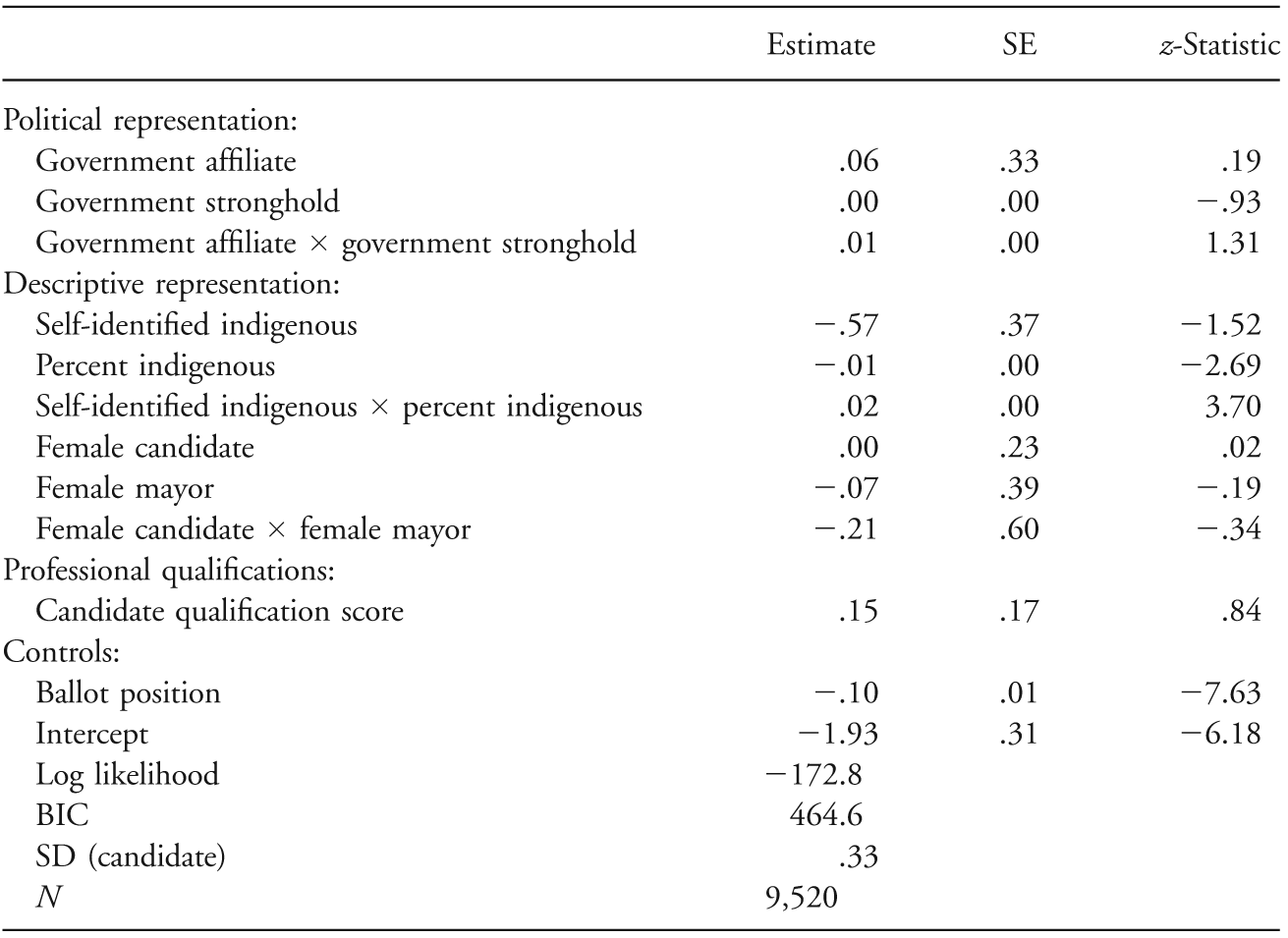
The results presented in the main text rely on subjective evaluations of candidates’ indigenous status using the candidate photographs in the voter information guide and the ballot itself. We chose to rely on the picture to identify candidates as overtly indigenous for a number of reasons. First, the candidate photo was a source of information to which all voters were exposed, irrespective of whether the voter carefully scrutinized the voter information guides. Second, the photo may have been used by candidates to signal their ideological priorities or intensity of indigenous identity. Nevertheless, as discussed and shown in figure 2 in the body of the paper, not all candidates who self-identified as indigenous were easily identified as such based on their photographs.Footnote 31 Four candidates self-identified as indigenous but did not overtly signal their indigenous identification in the picture of themselves that they submitted. In order to ascertain the robustness of the model presented in the paper, we reestimated the model replacing the measure of overtly indigenous with a dichotomous variable indicating if the candidate was self-identified indigenous in the voter information guide.
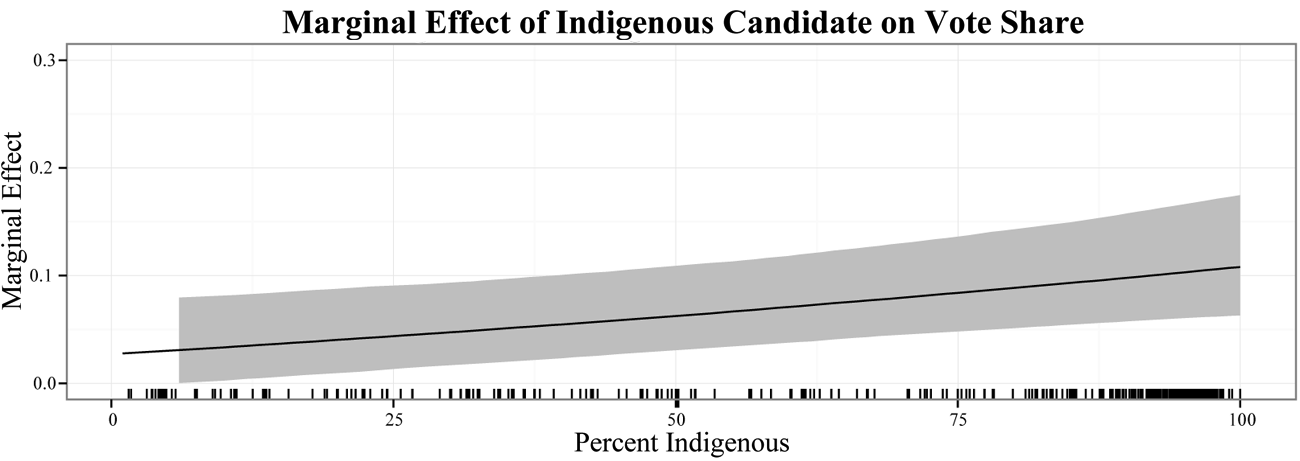
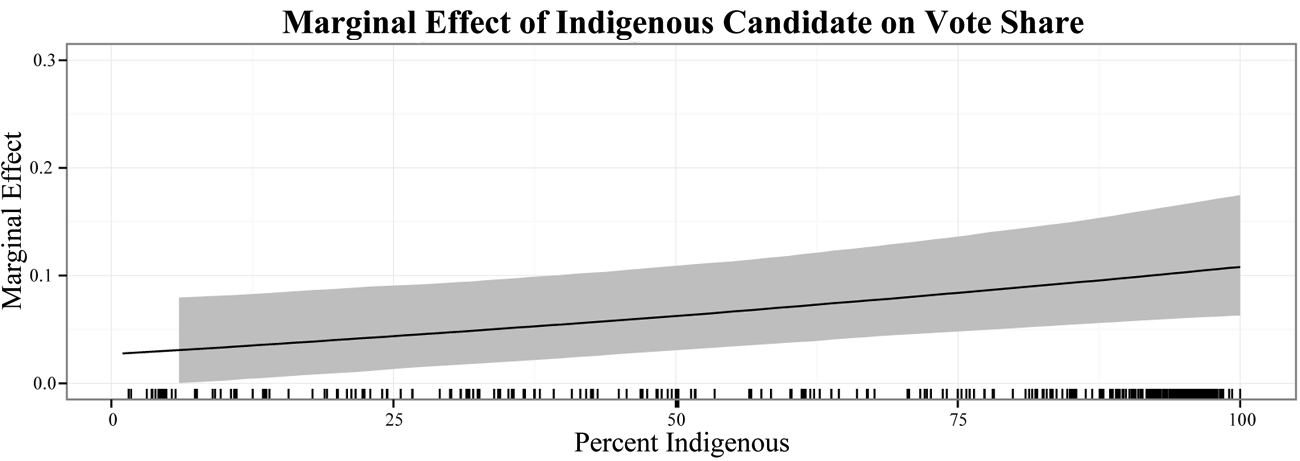
Table A1 presents the model estimates, the results of which are consistent with the effects reported in the main body of the paper. Figure A1 shows the interactive effect between a candidate’s indigenous status and the percentage of the municipality that identifies as indigenous, plotting of the marginal effect of self-identified indigenous status on vote share. As before, indigenous candidates receive a boost at the polls in heavily indigenous areas; an indigenous candidate in a district that is 25% indigenous can expect to receive about a 4% boost in vote share; in a district that is 75% indigenous, that effect doubles to an 8% increase in vote share.
Note.—The model includes random intercepts for each candidate.
Marginal effects of a candidate’s indigenous status on the candidate’s vote share in the 2011 Bolivian judicial elections using candidate self-identified indigenous status. The gray bands are confidence intervals at the p < .05 level using two-tailed tests. The rug shows the distribution of percent indigenous in the data. All other covariates are held at their median or modal values.
Qualifications Candidate: Alternative Measures
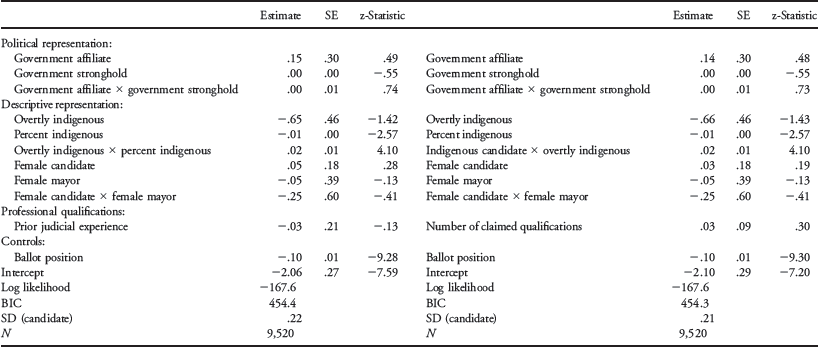
To further probe our null finding with respect to candidates’ professional qualifications, we reestimated the model using two alternative measures of candidate qualifications. Following Bonneau and Hall (2009), our first alternative measure indicates whether the candidate had any prior judicial experience. The left panel of table A2 shows the results of the reestimated model using prior judicial experience as the measure of candidate qualifications. Our conclusions are robust to this measure; the estimated coefficient is not statistically significant and therefore provides no evidence that Bolivians selected candidates on the basis of candidates’ prior judicial experience. All other substantive effects discussed in the article hold.
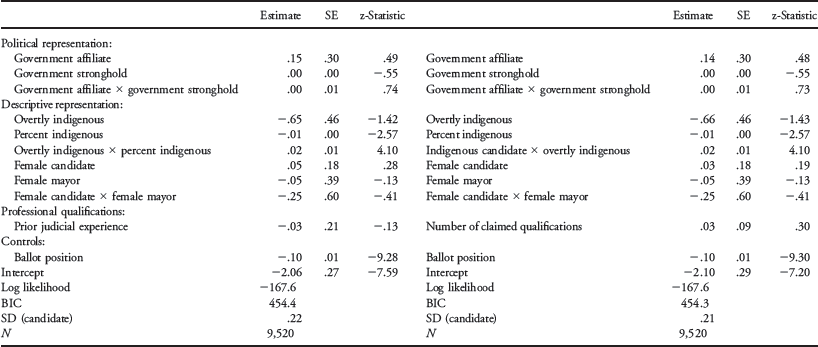
Note.—The models include random intercepts for each candidate.
Next, the candidate profiles explicitly indicated separate sets of qualifications for each candidate: their educational background, their academic publications, their past professional history, and other relevant experience. The presence of each of these areas of expertise varied for each candidate. Our second measure of candidate qualifications is a five-point scale indicating the number of claimed qualifications by each candidate in their profile. Even if voters do not carefully read the entries, the presence or absence of more or less information on the candidate profile may have served as an informational shortcut by which candidate quality could be objectively assessed. The results of the model are shown in the right-hand columns of table A2. As with the other measure of candidate quality, we find no evidence of substantive effect, and all other results reported in the main body of the paper hold.
Alternative Explanations Pertaining to Information, Partisanship, and Voter Sophistication
Even though the institutional rules surrounding the Bolivian elections hold constant a number of potentially alternative explanations, readers may be concerned that our empirical analysis fails to control for an influence that may be highly correlated with one of our key independent variables and the dependent variable and therefore may cause omitted variable bias. As such, we reestimated our model, this time including a variety of control variables for potentially confounding effects.
First, to assess the potential nonrandom distribution of campaign information to rural areas (“TSE admite” 2011; “OEA recomienda” 2011), our model includes a measure of the percentage of citizens who have access to electricity (percent rural). Second, deeply held political cleavages divide the eastern and western halves of the country, which have the potential to confound our results pertaining to voters’ affinity (or antipathy) for the MAS party (Alpert et al. 2010; Centellas 2009). To assess the extent to which these cleavages influence our results, we include a dichotomous variable, coded 1 if the district is in the eastern half of the country (known to Bolivians as the “half-moon” or Media Luna) (regional cleavage). Third, models of vote choice often include a measure of voters’ level of wealth. To assess the robustness of our results to the malapportionment of economic circumstances by municipality, the model includes the percentage of citizens in the municipality who own a cell phone. Finally, to counter any effects of predicted level of education on vote choice, the model includes the municipality’s illiteracy rate.
The results of the regression with these control variables are shown in table A3. Though three of the four control variables do appear to have some independent explanatory power, their substantive effect is very small and their inclusion does not change the sign or statistical significance of any of the variables that were the focus of our discussion above. Though not included here in the interest of space, the inclusion of these variables has no effect on the marginal effects of gender, indigenous status, or government affiliation reported in the main text. Additional analyses are available from the authors on request.