
Introduction
The domestication of a select number of plant and animal species has transformed human interactions with a multitude of other, non-domesticated plants and animals (Fuller & Stevens Reference Fuller and Stevens2017; Turcotte et al. Reference Turcotte, Araki, Karp, Poveda and Whitehead2017). Specifically, food-production systems have created new niches for animals, instigating commensal interactions—that is, animals benefiting from a relationship with humans, which neither benefits nor harms the latter—which, in turn, may influence faunal evolutionary trajectories. Recent research in the Levant, for example, has found that house mice (Mus musculus domesticus) that consumed the midden waste of hunter-gatherers 15 000 years ago had a competitive advantage over other mice (Weissbrod et al. Reference Weissbrod, Marshall, Valla, Khalaily, Baroz, Auffray, Vigne and Cuuchi2017). Mouse-human commensalism therefore demonstrates evolutionary effects on mice, but the evolutionary influence of agriculture-related commensalism on other smaller mammal species remains unclear. Archaeological consideration of such animals, particularly agricultural pests such as rabbits that opportunistically consume crops but generally do not enter human settlements, may provide new insights into the influence of commensalism on evolutionary pathways. Although archaeologists have found evidence for a predator-prey relationship between humans and leporids (rabbits and hares) as early as the Late Palaeolithic as part of broadening dietary practices (e.g. Hockette & Haws Reference Hockett and Haws2002; Aura et al. Reference Aura, Jordá, Morales, Pérez, Villalba and Alcover2009; Lloveras et al. Reference Lloveras, Maroto, Soler, Thomas, Moreno-García, Nadal and Soler2016), there is limited archaeological evidence for commensal or other relationships between humans and leporids.
The earliest evidence for close human-hare interactions comes from an Early Copper Age (mid fifth millennium BC) burial in Hungary, in which an adult European brown hare (Lepus europaeus) was interred with an older woman (Bartosiewicz et al. Reference Bartosiewicz, Kovács, Farkas and Starnini2013); and in Sweden, archaeologists have discovered 12 hare (Lepus timidus) metapodials from a third-millennium BC grave at Ajvide (Mannermaa Reference Mannermaa2008). Meanwhile, at Teotihuacan in the Mexico Basin c. AD 1–550, carbon and nitrogen stable isotope analysis has revealed that cottontails (Lepus sylvaticus) and jackrabbits (Lepus timidus), probably tamed, consumed some plants produced by humans (Somerville et al. Reference Somerville, Sugiyama, Manzanilla and Schoeninger2017). This suggests that isotopic analysis of hares can be used to document expansion or change in past agrarian systems and settlement structures.
Due to their wide geographic range, adaptability and frequent presence on archaeological sites, desert hares (Lepus capensis) are an ideal species to investigate the possible influence of cereal agriculture on the evolutionary trajectories of small mammals. They are widely distributed in the Eurasian Steppe and desert areas, and adapt easily to a broad range of environmental conditions. Their geographic range includes most of China's northern provinces, including Shaanxi, Shanxi, the northern part of Xinjiang, and Inner Mongolia. Desert hares feed on herbaceous plants, such as Gramineae and chenopods. When food is scarce, they will also eat the tender leaves of crops, as well as some seeds. Moreover, their skeletal remains are particularly abundant on archaeological sites in China. Archaeological evidence of a human-hare predator-prey relationship on the Loess Plateau dates to as early as the Late Pleistocene (Zhang et al. Reference Zhang, Zhang, Li and Gao2016); and in the Late Neolithic, desert hares account for a large proportion (approximately 40 per cent, based on the minimum number of individuals (MNI)) of the faunal assemblages from some sites on the northern Loess Plateau (e.g. Hu et al. Reference Hu, Sun, Yang, Kang, Yang and Li2013). This suggests that humans exploited hares for their meat and fur, and possibly kept them in captivity.
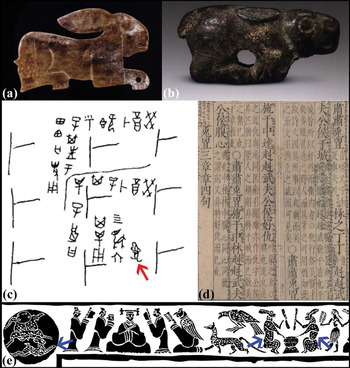
Most of the Holocene evidence for human-hare interactions reveals that humans assigned religious and spiritual significance to hares, as is also attested in art and literature. Excavations in northern China have yielded symbolic representations of leporids in the form of jade carvings and bronze decorations, from the Bronze Age onwards (Figures 1a–b) (The Institute of Archaeology, CASS 1982: 92; Gu Reference Gu2005: 68; Shaanxi Institute of Archaeology Research 2009: 735–38). Moreover, the first oracle bone texts and the Shijing (The Book of Odes, eleventh to seventh centuries BC) detail ritual practices related to hare hunting (Figure 1c–d) (Legge Reference Legge1876: 63; The Institute of Archaeology, CASS 2003: 795). From the Han Dynasty (202 BC–AD 220) onwards, leporids were regarded as an auspicious animal described in myths and depicted on stone reliefs, or represented by the moon (Figure 1e) (Li & Wang Reference Li and Wang2001: 18–20). While humans clearly had complex interactions with leporids in China from the Bronze Age onwards, there is still little evidence documenting how an increasingly agrarian landscape may have affected the diet and behaviour of hares.
a) Jade carving of a rabbit from a Western Zhou Dynasty (1046–771 BC) tomb in Shaanxi Province; b) bronze ornament for a chariot in the shape of a rabbit from Lijiapancun, a site dating to the Warring States period (475–221 BC) in Shaanxi Province; c) an oracle bone from Yinxu (c. 1300–1100 BC; the red arrow shows the character for rabbit); d) writings about rabbit hunting in the Shijing book (c. 500 BC) (https://shuge.org/ebook/shi-jing-ji-zhuan); e) stone relief with leporid symbolism related to the Moon (left, blue arrow) and female herbalists (right, blue arrows) from a Han Dynasty tomb (AD 92) in Shaanxi Province (figure by P. Sheng).

Stable carbon (δ13C) and nitrogen (δ15N) isotope ratio analysis allows us to investigate the nature and scale of long-term interactions between humans and animals (e.g. Hu et al. Reference Hu, Hu, Wang, Wu, Marshall, Chen, Hou and Wang2014; Hu Reference Hu2018). This method provides a direct reconstruction of dietary patterns, making it possible to observe diachronic changes in diet resulting from the expansion of agricultural practices (Somerville et al. Reference Somerville, Sugiyama, Manzanilla and Schoeninger2017). Although people in northern China have cultivated common millet (Panicum miliaceum) and foxtail millet (Setaria italica) since the Early Neolithic (Zhao Reference Zhao2011), human-hare co-evolutionary interactions, particularly in the context of the Late Neolithic expansion of millet agriculture, have yet to be investigated.
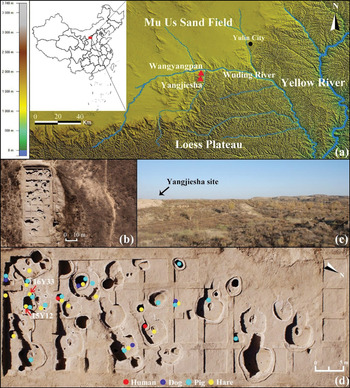
In this article, we investigate how the desert hare in northern China's Loess Plateau was affected by agricultural activities in the Neolithic, and attempt to determine how human-hare interactions broadened over time as a result of the expansion of millet agriculture. The northern Loess Plateau is located in the transitional zone from the hilly area of the Loess Plateau to the Mu Us Sand Field (106°10′–110°30′ east, 37°28′–39°23′ north; Figure 2a). In this region, we seek to identify whether some hares received special care, such as being fed on cultivated millets. To do so, we present δ13C and δ15N results for humans (n = 4), hares (n = 54) and other animals (n = 33) from two contemporaneous sites radiocarbon-dated to approximately 2800–2900 cal BC: Yangjiesha (areas A, B and C) (109°14′ east, 38°02′ north) and Wangyangpan (109°14′ east, 38°03′ north) (Figure 2b–d).
a) Map of the study area and sampled sites mentioned; b) overview of area A at Yangjiesha; c) natural landscape around Yangjiesha (arrow); d) locations of the specimens studied from the excavations at Yangjiesha; the locations of the two hare samples that were radiocarbon-dated (15Y12 and 16Y33) are indicated by red arrows (map by P. Sheng and photographs provided by Liping Yang).

Materials and methods
Isotopic measurements
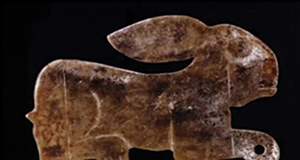
Collagen was extracted from four humans and 87 animals, including desert hares (Figure 3), at the Institute of Vertebrate Paleontology and Paleoanthropology of the Chinese Academy of Sciences, following the protocol outlined in Richards and Hedges (Reference Richards and Hedges1999), and modified to include a final ultrafiltration stage prior to lyophilisation (Brown et al. Reference Brown, Nelson, Vogel and Southon1988). Detailed information concerning the archaeological contexts of the samples is listed in Table S1 in the online supplementary material (OSM).
Skull of a desert hare (Lepus capensis) from Yangjiesha (photograph provided by S. Hu).

Purified collagen was measured at the Department of Archaeology and Anthropology at the Chinese Academy of Sciences, using an IsoPrime 100 IRMS (Elementar, UK) coupled with an Elementar Vario (Elementar, UK), with the sulfanilamides listed in the OSM as reference materials. For every 10 samples, a standard collagen sample (δ13C = −14.7±0.2‰; δ15N = 7.0±0.2‰) was inserted for calibration and to monitor stability. The results were analysed as the ratio of the heavier isotope to the lighter isotope (13C/12C or 15N/14N), and expressed as ‘δ’ in parts per 1000 (‰), relative to internationally defined standards (Lee-Thorp Reference Lee-Thorp2008) for carbon and nitrogen. We utilised two-point calibrations (Szpak et al. Reference Szpak, Metcalfe and MacDonald2017). The measurement errors were less than ±0.2‰ for both δ13C and δ15N values.
Radiocarbon dating
Bone samples were collected from two desert hares recovered from two pits at the Yangjiesha site (Figure 2d) and were dated by AMS at Beta Analytic Inc., Miami, USA. The dates were calibrated using the OxCal v4.3 programme and the IntCal13 calibration curve (Bronk Ramsey Reference Bronk Ramsey2009; Reimer et al. Reference Reimer2013).
Results
Isotopic analysis
All human and animal specimens from the sites of Yangjiesha and Wangyangpan produced good quality collagen, with C:N ratios between 2.9 and 3.6 (DeNiro Reference DeNiro1985; Ambrose Reference Ambrose1990), suggesting that the samples were well preserved and suitable for interpretation. The range of %C and %N results are 32.4–49.7% and 11.8–19.2%, respectively. The sample information and isotopic results are summarised in Table S1 and plotted in Figure 4.
Human and animal δ13C and δ15N values from Yangjiesha and Wangyangpan, with radiocarbon dates of two hares (figure by P. Sheng).

Humans
The range of human (n = 4) δ13C and δ15N values are −10.7‰ to −6.0‰ and 7.7‰ to 10.5‰, respectively. The three adults all have 13C-enriched results indicative of the consumption of C4 diets (foxtail and common millet). The δ15N values for the humans are similar to those for pigs and dogs, which suggests that they all consumed similar foods. Additionally, the single human infant analysed produced a lower δ13C value (−10.7‰) and a higher δ15N value (10.5‰) in comparison with the adults.
Domestic animals
The dog samples (n = 6) have mean ±SD δ13C and δ15N values of −7.2±0.7‰ and 7.5±0.8‰, respectively. This indicates that the dogs’ diet was heavily influenced by C4-based protein. The pigs (n = 27) show a wide range of δ13C (−19.0‰ to −6.1‰) and δ15N values (5.5‰ to 9.1‰). While the majority of pigs consumed C4-based foods, three individuals had low δ13C and δ15N values, suggesting either that they were wild, or were domestic pigs which were fed only C3-based diets (local terrestrial plants, grasses and shrubs).
Desert hares
The 54 samples of desert hare show a wide distribution of isotopic values, with δ13C ranging from −21.5‰ to −13.9‰, and δ15N ranging from 2.2‰ to 7.2‰ (see Figure 4). Previous studies have used a δ13C cut-off value of approximately −18.0‰ as the general transition between predominately C3 and mixed C3/C4 diets (Wang et al. Reference Wang, Wei, Chang, Yu, Zhang, Wang, Hu and Fuller2017). Most hares (80 per cent) have δ13C values <−18.0‰, that is, their diet was C3-based. The remaining 20 per cent (11 specimens) had a mixed C3/C4 diet. Specimen 16Y33, in particular, has the most 13C-enriched (−13.9‰) and 15N-enriched (7.2‰) values of all the desert hares analysed (Table S1). Two specimens were also selected for AMS radiocarbon measurements: 15Y12 dated to 2910–2705 cal BC and 16Y33 dated to 2900–2680 cal BC (95.4% confidence) (Table 1).
Radiocarbon dating of desert hares (Lepus capensis). Radiocarbon dates were calibrated using the OxCal v4.3 program and IntCal13 calibration curve (Bronk Ramsey Reference Bronk Ramsey2009; Reimer et al. Reference Reimer2013).

Discussion
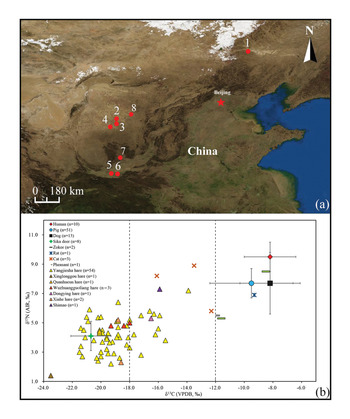
As habitats exert strong selective pressures on small mammals, human manipulation of these animals’ ecological niches can result in rapid changes in diet, behaviour and possibly even evolutionary trajectories (Wu & Drozdov Reference Wu and Drozdov2016; Fuller & Stevens Reference Fuller and Stevens2017). Archaeological evidence indicates that the wide distribution of millet farming and increased agricultural food production on the Loess Plateau during the Late Neolithic introduced a new suite of selective pressures, attracting small mammals to this newly created 13C-enriched niche in a C3 plant-based environment (Liu et al. Reference Liu, Zhou, Yu and Guo2011; Dong et al. Reference Dong, Zhang, Yang, Chen and Chen2016). In support of this, isotopic studies of mammals that lived on the Loess Plateau have found 13C-enriched values for some small mammal species (Tables 2–3 & Figure 5). A Chinese zokor (Myospalax sp., a rodent) found at Quanhucun (3500–3200 BC), for example, had a δ13C of −8.5‰ value, which was very close to that of dog and pig specimens fed on millet foods in the same archaeological contexts, suggesting that it had probably consumed millet products or prepared foods (Hu et al. Reference Hu, Hu, Wang, Wu, Marshall, Chen, Hou and Wang2014). Elevated δ13C values were also observed in a Chinese zokor (−11.6‰) and rat (Rattus norvegicus) (−9.3‰) from the Late Neolithic site of Wuzhuangguoliang (c. 3000 BC) (Guan et al. Reference Guan, Hu, Hu, Sun, Qin and Wang2008). This indicates that rodents probably consumed large quantities of millet or millet-based foods in human-controlled environments. Furthermore, cats (Felis sp.) living at the Quanhucun site were attracted by commensal small mammals in human settlements and were subsequently kept by farmers to control the rodent population (Hu et al. Reference Hu, Hu, Wang, Wu, Marshall, Chen, Hou and Wang2014). In addition to these mammals, a pheasant (Gallus sp.) from the Dongying site had relative high δ13C values of −12.0‰, suggesting a large intake of C4-based foods (such as foxtail and common millet crops) between c. 2600 and 2000 BC (Chen et al. Reference Chen, Hu, Hu, Wang, Ma, Lü and Wang2014) (Figure 5).
a) Map showing other sites near Yangjiesha; b) scatter plot of the δ13C and δ15N values of small-sized animals and mean ±SD δ13C and δ15N values of humans, domesticates and wild animals recovered from these sites: 1) Xinglonggou; 2) Wangyangpan; 3) Yangjiesha; 4) Wuzhuangguoliang; 5) Dongying; 6) Quanhucun; 7) Xiahe; 8) Shimao. For additional information and references, see Tables 2–3 (figure by P. Sheng).

Values of δ13C and δ15N for humans, domesticates, and wild animals from sites on the Loess Plateau around 3000 BC.

Extant δ13C and δ15N values of hares from sites in northern China.

The desert hares analysed here show a wide range of δ13C values, indicating that they had a varied diet (see Figure 4). The results suggest that most of the hares relied on C3 foods, supporting Liu et al.'s (Reference Liu, Zhou, Yu and Guo2011) hypothesis that C3 plants dominated the vegetation surrounding the northern part of the Loess Plateau. A possible explanation for the abundant remains of hares consuming C3 plants at Yangjiesha is that they were probably hunted at some distance from agricultural areas. This C3 feeding behaviour is similar to previously published isotopic data for hares in Neolithic northern China (Figure 5 & Table 3). The hare (Lepus sp.) recovered from Xinglonggou (6200–5400 BC), for example, shows a very low δ13C value (−23.5‰); at Quanhucun (3500–3200 BC), the value increases to −20.1‰. The desert hares discovered at Xiahe (c. 3300–2700 BC) and Wuzhuangguoliang (c. 3000 BC) have a mean ±SD δ13C value of −18.6±0.5‰ (n = 5) (Table 3).
It is notable that 11 of the 54 (20 per cent) desert hare specimens from Yangjiesha have δ13C values greater than −18.0‰, indicating that they consumed a diet rich in C4 plants. Notably, hares (Lepus cf. capensis) from the nearby sites of Dongying in the Wei River basin and Shimao, an early city on the northern Loess Plateau, also exhibit high δ13C and δ15N values, from c. 2600–1800 BC (Figures 5– 6 & Table 3). Both sites were probably surrounded by small agricultural villages that cultivated predominantly millets (Panicum miliaceum and Setaria italica, i.e. C4 plants) (Jaang et al. Reference Jaang, Sun, Shao and Li2018; Figure 6). Hence, the local ecology surrounding most ancient villages in northern China was C4-dominated (Bao et al. Reference Bao, Zhou, Liu, Hu, Zhao, Atahan, Dodson and Li2018; Sheng et al. Reference Sheng, Shang, Sun, Yang, Guo and Jones2018). We reason that the most likely explanation for this increase in the isotopic values of hares is due to the expansion of millet agriculture throughout Neolithic northern China (Dong et al. Reference Dong, Zhang, Yang, Chen and Chen2016; Bao et al. Reference Bao, Zhou, Liu, Hu, Zhao, Atahan, Dodson and Li2018; Sheng et al. Reference Sheng, Shang, Sun, Yang, Guo and Jones2018).
Box plots of the δ13C and δ15N values of hares from Neolithic to Bronze Age archaeological sites in northern China: XLG) Xinglonggou; QHC) Quanhucun; XH) Xiahe; WZGL) Wuzhuangguoliang; YJS) Yangjiesha; DY) Dongying; SM) Shimao. For additional information and references, see Table 3 (figure by P. Sheng).

While most hares on the Loess Plateau had diets consisting entirely of C3 plants (in an area that was naturally dominated by these plants) (Liu et al. Reference Liu, Zhou, Yu and Guo2011), evidence for several 13C-enriched desert hares from Yangjiesha suggests a long-term pattern of millet (C4) consumption. These hares probably lived next to or inside these ancient settlements, developing a commensal relationship with humans. People may even have encouraged or managed this relationship. This scenario appears likely for specimen 16Y33, which has the most 13C- (−13.9‰) and 15N-enriched (7.2‰) values (Figure 6). A clear outlier compared to the other hares, this individual is close to the domestic pigs at Yangjiesha plotted on Figure 5. We suggest that 16Y33 may have been kept within a domestic setting sometime between c. 2900 and 2700 BC, although further morphometric evidence is required to support this claim.
We argue that, while the changes in hare isotopic values were predominately driven by the expansion of a millet-dominated agriculture on the Loess Plateau, climate change should also be considered as a potential influence on the changing isotopic values. Located at the northern limit of the East Asian summer monsoon, the Loess Plateau is particularly sensitive to fluctuations in the strength of this phenomenon. As the climate becomes drier and the monsoon weakens on the Loess Plateau, vegetation in the area shifts towards C4 plants (e.g. Yang et al. Reference Yang, Ding, Li, Wang, Jiang and Huang2015). Such vegetation, for example, increased by approximately 15 per cent in this area from the Last Glacial Maximum (c. 19 000 BP) to the Mid to Late Holocene (c. 4000 BP) (Yang et al. Reference Yang, Ding, Li, Wang, Jiang and Huang2015). The period in question here, c. 5000–4000 BP, was one of known climatic instability (Yang et al. Reference Yang, Ding, Li, Wang, Jiang and Huang2015), which could have driven large-scale changes in local vegetation. The increasingly C4-dominated isotopic signature of the hares in this region may thus also be indicative of climate change.
Ultimately, the changes in the isotopic values of Neolithic and Bronze Age hares on the Loess Plateau strongly suggest that extensive millet agriculture was a driving factor in the development of co-evolutionary interactions between humans and animals. While the specific consequences of this process remain unclear, this study clarifies the increasingly varied interactions of hares with ancient human settlements and cultivated fields. We recommend that more research be undertaken to establish baseline isotopic values for each sub-region of the Loess Plateau, in order to determine the relative influence of climate change and agricultural activities on the isotopic values of the local fauna.
Conclusion
Our study of early commensalism in hares in northern China, beginning c. 4900 years ago, shows that the isotopic signals from desert hare bones from the Late Neolithic site of Yangjiesha indicate that a sizeable proportion of hares consumed more millet or millet-based foods over time. As millet-based agricultural systems expanded throughout the Loess Plateau, desert hares and humans developed a commensal relationship, much like other animal species associated with the increasingly abundant crop plants in and around Neolithic settlements. The presence of commensal hares at Yangjiesha, and at the nearby sites of Dongying and Shimao, reveals changing human-hare interactions in northern China dating to c. 4900–3800 BP. These findings suggest that changing land-use patterns indirectly affected the diet and behaviour of small wild mammals on the Loess Plateau during the Mid to Late Holocene, a process that may have shaped co-evolutionary trajectories. Such a process, documented here from isotopic signatures in the Neolithic, is not only indicative of the spread of agriculture but also extends back in time the significance of human relationships with hares in China, where a range of archaeological, textual and iconographic data from the Bronze Age onwards show a varied and sustained relationship between humans and leporids.
Acknowledgements
This study was supported by grants from the National Natural Science Foundation of China (41471167); the National Social Science Fund of China (18ZDA218); a China Postdoctoral Science Foundation Grant (2018M641902); the National Natural Science Foundation of China Research Fund for International Young Scientists (41550110224); and the Chinese Academy of Sciences International Visiting Scholar Fellowship (2016VBC002). We also thank Yumeng Qu in Renmin University for the line drawing, and Michael Storozum for his useful comments and text revision.
Supplementary material
To view supplementary material for this article, please visit https://doi.org/10.15184/aqy.2020.36