




No CrossRef data available.
A Sequential Theory of Decentralization: Latin American Cases in Comparative Perspective
Published online by Cambridge University Press: 02 September 2005
Abstract
Both advocates and critics of decentralization assume that decentralization invariably increases the power of subnational governments. However, a closer examination of the consequences of decentralization across countries reveals that the magnitude of such change can range from substantial to insignificant. In this article, I propose a sequential theory of decentralization that has three main characteristics: (1) it defines decentralization as a process, (2) it takes into account the territorial interests of bargaining actors, and (3) it incorporates policy feedback effects. I argue that the sequencing of different types of decentralization (fiscal, administrative, and political) is a key determinant of the evolution of intergovernmental balance of power. I measure this evolution in the four largest Latin American countries and apply the theory to the two extreme cases (Colombia and Argentina). I show that, contrary to commonly held opinion, decentralization does not necessarily increase the power of governors and mayors.
Information
- Type
- ARTICLES
- Information
- Copyright
- © 2005 by the American Political Science Association
Does decentralization always increase the power of governors and mayors? If so, what explains the different degrees of change observed in the intergovernmental balance of power? Over the last 30 years, decentralization reforms have swept across the world, changing decades of centralized political and economic practices as well as the way in which we study politics. As James Manor writes, “Nearly all countries worldwide are now experimenting with decentralization … seen as a solution to many different kinds of problems” (1999, vii). One need only look as far as the fiscal data to observe this trend. In 1980, subnational governments around the world collected on average 15% of revenues and spent 20% of expenditures. By the late 1990s, those figures had risen to 19% and 25%, respectively, and had even doubled in some regions.1
In the large Latin American countries (Argentina, Bolivia, Brazil, Chile, Colombia, Mexico, Paraguay, and Peru, for which comparable data is available) the subnational shares of revenues and expenditures increased from averages of 14% and 16% in 1980, respectively, to 29% in 2000. Source data available at: http://www1.worldbank.org/publicsector/decentralization/fiscalindicators.htm
“The waiters' revolt. State elections in Mexico,”The Economist, February 12, 2005; “Conservatives Claim to Carry German State in Close Vote,” The New York Times, February 21, 2005; among others.
A substantial body of work on the consequences of decentralization hinges on the answer to this question; nevertheless, little attention is paid in the literature to a critical assumption that could very well be unjustified. Political scientists who draw from the liberal tradition argue that decentralization helps to deepen and consolidate democracy by devolving power to local governments (Diamond and Tsalik 1999). Economists who draw from a market theory of local expenditures argue that decentralization helps to improve resource allocation through better knowledge of local preferences and competition among localities (Oates 1972). Other scholars, meanwhile, warn against the devolution of power to subnational officials and show that it can augment distributional conflicts (Treisman 1999), foster subnational authoritarianism (Cornelius, Eisenstadt, and Hindley 1999), and exacerbate patronage (Samuels 2003). Recent studies also suggest that, in the absence of proper fiscal and political mechanisms, the transfer of resources to subnational governments may lead to higher levels of inflation (Treisman 2000), larger deficits (Rodden 2002), and poorer overall macroeconomic performance (Wibbels 2000). Interestingly, despite their disagreements on the effects of decentralization for democratization and economic reform, all of the aforementioned studies share an assumption that decentralization increases the power of subnational officials. This power increase is generally used as the intervening variable connecting decentralization policies and either positive or negative outcomes, without questioning the existence of such a power increase in the first place.
If we conceive of decentralization as a multidimensional process (Montero and Samuels 2004, 8) that entails political bargaining over the content and implementation of different types of policies, we find that certain forms of decentralization in fact decrease the power of subnational officials. In order to evaluate the consequences of decentralization on broader processes of democratization and economic reform, we need to establish first when and how decentralization policies increase or decrease the power of subnational officials. This article advances a definition of decentralization that distinguishes among administrative, fiscal, and political decentralization. Unlike previous studies that have, for the most part, treated these categories separately, the definition presented here allows a distinction to be made between decentralization processes that increase the power of subnational officials and those that—contrary to the expectation—do not.3
By prioritizing different theories and methodological approaches, the literature on decentralization has divided the process into its component parts. Policy-oriented works have undertaken the study of administrative reforms, such as the transfers of education and health services (e.g., Di Gropello and Cominetti 1998). Another group of works has sought to explain the reasons behind political decentralization or why rational actors choose to give power away (Grindle 2000; O'Neill 2003). Likewise, institutional approaches have argued that differences in the political party systems explain the degrees of fiscal or political decentralization (Riker 1964; Willis, Garman, and Haggard 1999). Few studies have analyzed two or three types of decentralization at the same time (e.g., Manor 1999; Penfold-Becerra 1999), but even these studies do not analyze the interactions among the different policies and the consequences of their timing and evolution.
By drawing on recent works on path dependence and institutional change (e.g., Mahoney 2000; Pierson 1992, 2000, 2004; Thelen 2000, 2003), this article provides a dynamic analysis of decentralization. In this approach, the conditions under which decentralization is first implemented and the timing and order of the policies are important determinants of the evolution of intergovernmental balance of power. Previous studies have successfully accounted for varying degrees of fiscal decentralization at one point in time (e.g., Garman, Haggard, and Willis 2001), but have fallen short of explaining the effects of decentralization policies on the evolution of intergovernmental relations. I will not only measure the absolute level of decentralization at different points in time but also trace the effects of earlier reforms on later ones.
The article also brings subnational actors and interests to the center of the analysis. The puzzle of why national politicians choose or agree to give power away has led scholars to focus largely on the interests of national politicians toward decentralization, either in the executive branch (Grindle 2000; O'Neill 2003) or in the relations between the national executive and the legislature (Escobar-Lemmon 2003; Willis, Garman, and Haggard 1999). I show that a wide array of social and political actors, including the governors and their ministers, the mayors, the governors' and mayors' associations, the unions of the sectors to be decentralized, and other sectors of civil society are also the makers of decentralization.
Finally, the article emphasizes the territorial component of interest representation. A large part of the literature on decentralization has focused on the partisan or electoral incentives that move decentralization forward. Although very important, such emphasis on electoral incentives overlooks the territorial aspects of interest representation. In issues of decentralization, the territorial interests that derive from the choice of officials through geographic areas (Tarrow 1978, 4) are as important as electoral incentives. I show later that the feasibility and contents of decentralization reforms do not lie solely with politicians' electoral calculations, but also with their territorial interests. Thus, types of decentralization, territorial interests, and sequences of reforms are the three main components of the sequential theory advanced in the following sections. This theory will serve to explain when and why decentralization policies are likely to either increase or decrease the power of subnational officials.
SEQUENTIAL THEORY OF DECENTRALIZATION
Decentralization as a Process
Decentralization is a process of state reform composed by a set of public policies that transfer responsibilities, resources, or authority from higher to lower levels of government in the context of a specific type of state. Compared to previous definitions, this one poses four important restrictions. First, decentralization is conceived as a process of public policy reforms and not as a description of the state of being of the political or fiscal systems at a point in time. Second, lower levels of government are the recipients of the transferred responsibilities, resources, or authority. Reforms such as privatization or deregulation, which target nonstate actors, are not included in this definition (cf. Cheema and Rondinelli 1983, 24–5). Third, because decentralization is a process of state reform, a transition to a different type of state necessarily implies the commencement of a new decentralization sequence. The contents of decentralization policies and their interaction with the broader political and economic systems are highly determined by the type of state they seek to reform. Hence, in order to compare decentralization policies across countries as part of analytically equivalent processes, we must compare policies taking place within the same type of state. Finally, in studying the downward reallocation of authority, much is gained from a clear taxonomy of decentralization based on the type of authority devolved, such that three types of decentralization can be distinguished: 4
I do not distinguish among policies according to the degree of authority devolved—such as deconcentration, decentralization, or devolution (cf. Cheema and Rondinelli 1983)—because degree of authority devolved is part of what I seek to explain.
- Administrative decentralization comprises the set of policies that transfer the administration and delivery of social services such as education, health, social welfare, or housing to subnational governments. Administrative decentralization may entail the devolution of decision-making authority over these policies, but this is not a necessary condition. If revenues are transferred from the center to meet the costs of the administration and delivery of social services, administrative decentralization is funded and coincides with a fiscal decentralization measure. If subnational governments bear these costs with their own preexisting revenues, administrative decentralization is not funded.
- Fiscal decentralization refers to the set of policies designed to increase the revenues or fiscal autonomy of subnational governments. Fiscal decentralization policies can assume different institutional forms such as an increase of transfers from the central government, the creation of new subnational taxes, or the delegation of tax authority that was previously national.5.
Unlike other definitions of fiscal decentralization that collapse decentralization of revenues and expenditures, in this definition fiscal decentralization refers to revenues, whereas expenditures are part of administrative decentralization. This analytic separation makes it easier to evaluate the consequences of decentralization processes where the transfer of revenues and expenditures do not go hand in hand, allowing the disentanglement of seemingly contradictory outcomes such as “centralization via decentralization” (see Wibbels 2004, 220–21)
- Political decentralization is the set of constitutional amendments and electoral reforms designed to open new—or activate existing but dormant or ineffective—spaces for the representation of subnational polities. Political decentralization policies are designed to devolve political authority or electoral capacities to subnational actors. Examples of this type of reforms are the popular election of mayors and governors who in previous constitutional periods were appointed, the creation of subnational legislative assemblies, or constitutional reforms that strengthen the political autonomy of subnational governments.6.
Although political decentralization and democratization can be mutually reinforcing, the two processes need to be distinguished analytically. For example, the return to free and fair elections at all levels of government after an authoritarian regime does not necessarily constitute a political decentralization policy. The transition to democracy may simply be reinstating the electoral norms and rules of the pre-authoritarian period, with no negotiation of a policy reform that specifically targets the subnational level. Similarly, if an electoral reform that is designed to augment political competition in the political system as a whole were to have the unintended consequence of increasing the power of subnational political actors, it cannot be considered a political decentralization measure because it was not planned, designed, or negotiated with the explicit goal of empowering subnational polities. To qualify as political decentralization, the reform in question must explicitly address the devolution of political authority or capacities to subnational polities
Regarding the consequences of each type of decentralization, I expect administrative decentralization to have either a positive or a negative impact on the autonomy of subnational executives. If administrative decentralization improves local and state bureaucracies, fosters training of local officials, or facilitates learning through the practice of delivering new responsibilities, it will increase the organizational capacities of subnational governments. Nevertheless, if administrative decentralization takes place without the transfer of funds, this reform may decrease the autonomy of subnational officials, who will be more dependent on subsequent national fiscal transfers or subnational debt for the delivery of public social services. Similarly, fiscal decentralization can have either a positive or a negative impact on the degree of autonomy of the subnational level. The result will depend largely on the design of the fiscal decentralization policy implemented. Higher levels of automatic transfers increase the autonomy of subnational officials because they benefit from higher levels of resources without being responsible for the costs (political and bureaucratic) of collecting those revenues. On the contrary, the delegation of taxing authority to subnational units that lack the administrative capacity to collect new taxes can set serious constraints on the local budgets and increase the dependence of the local officials on the transfers from the center. Prosperous subnational units prefer to collect their own taxes, but poor states or municipalities are negatively affected every time the collection of taxes is decentralized and, as a consequence, the horizontal redistribution of transfers from rich to poor subnational units is affected. Finally, political decentralization, by the definition provided previously, should almost invariably increase the degree of autonomy of subnational officials from the center. The only case when political decentralization could have a negative effect on the power of governors and mayors vis-à-vis higher level authorities is when, by augmenting the separation of powers at the subnational level (such as through the creation of subnational legislatures or municipal councils), it leads to divided subnational governments. In such instances, the subnational political opposition could undermine the authority of governors and mayors vis-à-vis the national executive.
By unpacking decentralization in this way, we see that, depending on their institutional design, decentralization policies can actually decrease the power of subnational officials with regard to the national executive. As shown in the following, the institutional design of decentralization policies is highly dependent on when those policies take place within the sequence of reforms. Political and fiscal decentralization policies that take place early in the sequence tend to increase the power of governors and mayors, whereas early administrative decentralization reforms tend to negatively affect their power.
Territorial Interests of Bargaining Actors
The territorial interests of presidents, governors, and mayors are defined by the level of government (national, state, or municipal) and the characteristics of the territorial unit (e.g., rich or poor province, big city, or small town) they represent. Drawing from the literature on decentralization and in-depth interviews with national and subnational politicians and public officials,7
These are 86 in-depth interviews carried out in Argentina, Mexico, and Colombia during the summer of 1998, the spring of 1999, and between August 2000 and July 2001.
The order of preferences of national and subnational officials helps to understand their position in the bargaining over different types of decentralization. However, I do not assume that these preferences are fixed throughout the entire decentralization process. Once the first decentralization policy has been implemented, its consequences on intergovernmental relations may reshape the bargaining actors' interests for subsequent rounds of reforms.
The national executive prefers administrative decentralization (A) to fiscal decentralization (F), which in turn is preferred to political decentralization (P), or A>F>P. The rationale of this ordering is that the national government seeks to divest itself of expenditure responsibilities first and foremost. Administrative decentralization is greatly preferred over the other two types of decentralization. As Garman, Haggard, and Willis (2001) say: “[W]e would expect the president to be more inclined to transfer responsibilities than the resources to meet them” (209). If the center is forced to choose between surrendering fiscal and political authority, it will choose to give away fiscal authority and to retain political control, which may serve to influence the expenditure decisions made by subnational officials.
The same reasoning applies to explain the reverse order of preferences of the subnational governments: P>F>A. Their preference, first and foremost, is political decentralization. If the president does not control the appointment and removal of governors and mayors, they can push forward the issues and concerns of their territorial units without fear of retaliation from above. If governors and mayors have to choose between fiscal and administrative decentralization, they will choose the transfer of revenues over responsibilities, particularly if the unions representing the public sectors to be decentralized are large and strong. That is, subnational executives prefer political autonomy, money, and responsibilities, in that order.
Sequences of Decentralization: Origins, Timing, and Mechanisms
The origins of the process of decentralization are important both theoretically and methodologically. On the one hand, the main argument of this article incorporates elements of path dependence, for which the issue of origins is crucial. On the other hand, the method of process tracing requires specifying when the process starts. Scholars have adopted different approaches to answer the question of when a path-dependent process starts, such as critical junctures (Collier and Collier 1991) or contingent events (Mahoney 2000). I define the origin of the decentralization process by the state context in which it takes place. As stated earlier, the contents of decentralization policies and their interaction with the broader political and economic systems are largely determined by the type of state they seek to reform. In Latin America, for example, in the context of the oligarchic states, decentralization reforms sought to consolidate or balance power among regional elites (Ansaldi 1992, 17). In the context of the developmental states, meanwhile, decentralization policies sought to strengthen certain regions to make them more adequate for private investment (González 1990, 75); whereas in the context of market-oriented states, decentralization policies largely sought to reduce the size of central governments. Of course, these were not the exclusive goals of decentralization reforms in each of these periods. Nonetheless, it is evident that in different historical periods the policies that transferred responsibilities, resources, or authority to subnational governments were part of state reform projects that had largely different overarching political and economic objectives. For this reason, when comparing across countries, the researcher should qualify the processes or sequences of decentralization by the type of state in which they take place, in order to assure the analytic equivalence of the compared policies.
For the purposes of this article, I focus on the process of decentralization that began with the transition from a “developmental” to a “public-goods” type of state (Block 1994). In Latin America, this was the transition from a desarrollista to a market-oriented type of state. During this period, decentralization policies were part of what became known as “second-generation” reforms (Camdessus 1999). Prior examples of centralization and decentralization existed in the region (see Eaton 2001, 2004; Montero and Samuels 2004, 14) and constitute the background against which the policies analyzed in this article took place. However, because they occurred in different types of state contexts, they form part of prior sequences of intergovernmental reforms.
Regarding the origin of the sequence analyzed here, although it is difficult to pin down the exact date when the desarrollista state ended in each case (Schneider 1999, 293), it is nonetheless possible to identify the first administration in each country that applied orthodox measures of economic adjustment and moved the state away from intervention in the economy. The market-oriented sequence of decentralization reforms starts with the first decentralization policy successfully implemented by the first administration that made the transition from a developmental economy and state toward a market-oriented economy and state.9
In the countries analyzed in this article these administrations were the military governments of Jorge R. Videla in Argentina (1976–1981) and João Figueiredo in Brazil (1979–1985) and the presidencies of Belisario Betancur in Colombia (1982–1986) and Miguel de la Madrid in Mexico (1982–1988). In most of Latin America, the transition from state interventionism to free-market economies was the response to the economic troubles unleashed by the debt crisis of the early 1980s (albeit not in Argentina and Chile, where the move to free-market economies preceded the foreign debt crisis). Subsequent administrations applied both orthodox and heterodox economic policies, but the move away from developmentalism had already taken place (see Weyland 2002, 72, 77–81).
Using Skowronek's (1993, 9) terminology, we may conceive of intergovernmental relations as a layered structure of institutional action. Decentralization policies affect the fiscal, administrative, and political layers of intergovernmental relations. Rarely does a decentralization policy simultaneously affect all three intergovernmental layers (although it is possible). More often, different types of decentralization (as well as different policies within each type of decentralization) are negotiated and enacted at different points in time. Hence, the timing of each reform determines the particular sequence of decentralization that a given country undergoes. If the three types of decentralization defined previously take place (which is not theoretically necessary, but is a common occurrence), we can identify six sequences of decentralization according to the timing of the first decentralization policy within each intergovernmental layer. This does not mean that posterior decentralization policies in each layer do not happen or should be overlooked (see the analysis of empirical cases in the following section). However, the sequencing of the first decentralization policy in each layer is particularly important because it sets constraints on what is feasible in the remainder of the sequence and allows us to establish a basic model of the impact of different sequences of decentralization reforms on the intergovernmental balance of power.
The level of government whose territorial interests prevail at the origin of the decentralization process is likely to dictate the first type of decentralization. The first round of decentralization, in turn, produces policy feedback effects that account for the order and characteristics of the reforms that follow. If subnational interests prevail in the first round of negotiations, political decentralization is likely to happen first. Political decentralization is likely to produce a policy ratchet effect (Huber and Stephens 2001, 10): a group of supporters who will continue to push in the direction of further decentralization. The formation of associations of governors, mayors, or similar instances of coordination of subnational politicians is an example of such policy ratchet effect. Lobbying through these associations, governors and mayors will enhance their power and capacities for the next rounds of decentralization. Even if this coordination mechanism is not in place, governors and mayors will find themselves in a better position to advance their preferences in the second round of reforms because they will enjoy greater political autonomy from the national executive. The president, moreover, may become more dependent on elected governors and mayors for the mobilization of votes in national elections. Thus, in the second round of decentralization, governors and mayors will most likely demand fiscal decentralization and influence its terms. Administrative decentralization, which after fiscal decentralization is likely to follow to compensate for the previous decentralization of resources (Haggard 1998, 217), will be the last type of reform. Administrative decentralization will therefore be funded and will not have a negative impact on the power of governors and mayors. The final outcome of this trajectory of decentralization (P→F→A) that conforms to the preferences of the subnational officials is likely to be a high degree of autonomy for governors and mayors with respect to the president (see Table 1). I show below that Colombia followed this path from 1986 to 1994.

If, instead, national interests prevail at the beginning of the process, administrative decentralization is likely to occur first. If fiscal resources do not accompany the transfer of responsibilities, the national executive will strengthen its power vis-à-vis subnational officials, who will become more dependent on transfers from the center. If the process of decentralization continues, the president will choose fiscal over political decentralization. But due to a power reproduction mechanism (Stinchcombe 1968, 117–18), the national executive will control the timing, pace, and contents of the reform. Governors and mayors, under the fiscal strain of the first round of unfunded administrative decentralization, will be in no position to reject those terms set by the center—unless exogenous circumstances were to change their relative power vis-à-vis the president. Following this trajectory, political decentralization, if it happens, will be the third type of reform. The outcome of this trajectory of reforms (A→F→P) that conforms to the preferences of the national executive is likely to be little or no change in the redistribution of power to the subnational authorities. I show in the following that Argentina followed this path of reforms from 1978 to 1994.
It is also possible that exogenous changes (such as midterm elections, a context of fiscal expansion, fiscal crisis, or a process of democratization) could produce reversals on the distribution of power between national and subnational executives once the process of decentralization has started. This would lead to the alternative sequences P→A→F and A→P→F. In the first scenario, subnational interests prevail at the beginning of the sequence, triggering political decentralization. However, reactive mechanisms (such as a fiscal crisis that undermines subnational demands for fiscal decentralization) lead to a prevalence of national interests in the second round and, thus, to administrative decentralization. The last stage (should it happen) is fiscal decentralization. This trajectory may be disastrous for subnational officials if administrative decentralization is unfunded. If they are granted political autonomy, and soon after that they receive unfunded responsibilities, their subnational constituencies will blame them for poor performance. Most likely, this trajectory will lead to a low change in balance of power. If administrative decentralization is instead funded, this trajectory may lead to a medium degree of change in intergovernmental balance of power. In the second scenario, national interests prevail at the beginning of the sequence, but reactive mechanisms (such as a process of democratization that undermines centralized power) afford subnational executives the possibility of pushing political decentralization forward in the second round. In this situation, subnational actors (due to the political power they now have) are in a better position to set the terms of fiscal decentralization. The overall outcome of this trajectory would be a shift in the balance of power in favor of subnational authorities, but not as significant as in the first aforementioned trajectory (P→F→A).
Finally, we could also conceive of a tie between national and subnational interests at the outset of the reform process, such that no side is capable of achieving its most preferred outcome. In this situation, either the status quo will prevail or bargaining actors will compromise in their second most preferred outcome: fiscal decentralization. If this happens, the way in which the sequence continues will depend on the effects of this reform on the relative power of national and subnational executives. If the national executive prevails, administrative decentralization should follow, with political decentralization happening last (F→A→P). This trajectory should lead to a medium to low change in balance of power. The crucial issue here is the time lag between the first and second rounds of reforms. If subnational officials receive money without strings, and they can apply it to strengthen their support base and popularity for a considerable amount of time before they receive new responsibilities, this trajectory may lead to a medium increase in balance of power, even if political decentralization only takes place at the end of the trajectory. In contrast, if money and responsibilities are decentralized practically at the same time, this means that subnational officials are receiving new responsibilities without political autonomy. The impact of decentralization of funded responsibilities on balance of power will then be highly dependent on how successful the subnational governments are in efficiently delivering the newly transferred services. Considering, however, that the subnational officials are probably more accountable to the national executive than to their local constituencies (recall that political decentralization does not take place until the end of the trajectory), administrative performance will likely be poor, and the result will be small change in intergovernmental balance of power. Alternatively, if after a tie of territorial interests and a first round of fiscal decentralization subnational executives prevail, political decentralization should be next, with administrative decentralization taking place last (F→P→A). This sequence should lead to a high change in balance of power in favor of the subnational governments. In this type of trajectory, subnational governments gain fiscal capacities, then political autonomy; and last, they receive administrative responsibilities. The first two moves in this sequence should allow subnational authorities to build strongholds of supporters (because they have the resources to do so) and to win elections. Once this happens, they gain greater autonomy from the national executive, as illustrated in the bottom line of Table 1.
The assumptions thus far have been that the three types of decentralization take place and that a sequence among them can be established. Moreover, I have only taken into account the first successfully implemented policy within each type of decentralization and the first cycle of decentralization, which ends once the three types of reforms have occurred. Decentralization processes, however, could evolve differently in reality. Only one or two types of reforms could occur, the timing of policies could overlap, and successive reforms within each layer could affect those that follow. Some of these complexities will be revealed in the analysis of the cases in the following sections. Nonetheless, as long as at least two types of devolution of authority and two implementation moments can be identified, the proposed sequential reasoning could be modified accordingly and applied to cases and sequences that follow different patterns.
EVOLUTION OF INTERGOVERNMENTAL BALANCE OF POWER IN LATIN AMERICA
Intergovernmental balance of power is defined as the relative power or degree of autonomy of subnational officials with regard to national officials. Intergovernmental power is dependent on (1) economic resources, which enhance the capacity of political actors to pursue their desired courses of action; (2) legal authority, which sets the institutional limit that economic resources can reach; and (3) organizational capacities, which facilitate coordination at each level of government.
Because this article is concerned with the effects of decentralization on the evolution of balance of power, in operationalizing this concept, the focus is precisely on those dimensions of intergovernmental power susceptible to change due to the implementation of decentralization policies. Building on the works of Stepan (2004) and Samuels and Mainwaring (2004), intergovernmental balance of power is operationalized in five dimensions: (1) the subnational share of revenues, which measures the percentage of public money collected by subnational governments (provincial and municipal); (2) the subnational share of expenditures, which measures the percentage of public money allocated by subnational governments; (3) the policymaking authority, which measures the degree of autonomy of subnational officials to design, evaluate, and decide on issues concerning a specific policy area; (4) the type of appointment of subnational officials, which records whether governors and mayors are elected or appointed; and (5) the territorial representation of interests in the national legislatures, which reports the average degree of overrepresentation of the subnational units in the lower and upper chambers of congress. If decentralization reforms were always to increase the power of subnational officials, we would observe a positive change in all these indicators. If, however, it is possible for decentralization not to increase the power of subnational officials, we would expect some of these indicators to decrease in value or to remain unchanged.
The remainder of this section compares the absolute levels of decentralization before and after decentralization and analyzes the degree of change in intergovernmental balance of power in the four largest countries of Latin America—the region that took the lead in the implementation of decentralization reforms (Camdessus 1999). Several commonalities make Argentina, Brazil, Colombia, and Mexico suitable countries for comparison. First, due to their size, it is safe to assume that relationships between center and periphery are contentious and that issues of decentralization are politically relevant. Second, they all underwent similar decentralization policies, although with different impact on the intergovernmental distribution of power. Third, they all have similar structures of government, with three tiers of government and bicameral national legislatures. Finally, differences among the cases allow for controls to the main argument. Although Argentina, Brazil, and Mexico are federal countries, Colombia is a unitary country; and although Argentina, Brazil, and Colombia have decentralized party systems, Mexico has a centralized one.
In Table 2, the first two columns within each country measure the absolute level of decentralization (term used as to describe the state of being of the fiscal, administrative, and political systems), and the third column measures the relative degree of change in the intergovernmental balance of power. Along the fiscal dimensions, the subnational share of revenues (SSR) decreased in Argentina and increased in the other three countries; whereas subnational share of expenditures (SSE) increased in the four countries. At the beginning of the period, Argentina and Brazil had the highest absolute levels of fiscal decentralization, in terms of both revenues and expenditures, followed by Colombia and Mexico, in that order. By the end of the period a different pattern emerged. Brazil continued to be fiscally the most decentralized, but now Colombia was second, and in SSR Mexico surpassed Argentina, which had the lowest collection of subnational revenues and the highest fiscal vertical imbalance of the four countries. Relative to the initial conditions, Mexico was the country whose fiscal structure changed the most, followed by Colombia and Brazil. Argentina was the country that changed the least, even experiencing a negative change in SSR.

Regarding the administration of social services, the dimension policymaking authority (PMA) is applied to the educational sector. The selection of education over other policy sectors responds to several reasons. First, in most countries, education was the first public sector to be decentralized, influencing the pace and characteristics of decentralization in other areas. Second, education is the largest public sector in these countries, in terms of both fiscal and human resources. The transfer of education carries, therefore, significant fiscal and administrative consequences for states and municipalities. Finally, the education sector has often strong and large unions. This makes decentralization of education politically crucial for national and subnational executives, who have to negotiate with the teachers' unions. The six indicators taken into account within this dimension were authority over the curricula; responsibility for training teachers; responsibility for evaluation of the educational system; management of schools; authority over hiring, firing, and relocation of teachers; and authority over salaries. At the beginning of the period, the countries can be paired in terms of the distribution of responsibilities among levels of government: Argentina and Brazil were the most decentralized, and Mexico and Colombia were the most centralized. By the end of the period, the ordering of the countries is similar, but Brazil experienced a greater degree of devolution of authority to subnational authorities than Argentina. Whereas in 1982 the Brazilian states and the federal government shared responsibilities along all of the educational indicators considered (Tavares de Almeida 1995, 20, 27), by the mid-1990s all of these issues lay in the hands of governors, mayors, or school directors (Burki, Perry, and Dillinger 1999, 71). Mexico and Colombia follow Brazil in the degree of change in PMA. In Mexico, all issues of public education management were in the hands of the federal government in 1978 (with the sole exception of the management of school buildings). In 1992, after the signing of a decentralization agreement, authority over the curricula and evaluation of the system remained at the federal level, but all other issues were decided on by the subnational level or jointly by both levels of government. The situation in the education sector in Colombia by the early 1980s was similar to that in Mexico: all responsibilities resting with the national government, with the exception of the maintenance of schools. But after the decentralization of education in 1992 and 1993, all educational issues became matters of state authority (with the sole exception of the design of the curricula, which remained in the hands of the central government). In Argentina, the situation was different. By the mid-1970s the Argentine provinces managed half of the public primary and secondary schools, which meant that all responsibilities concerning the public educational system had historically been shared by the federal and provincial governments. Decentralization of primary and secondary schools (in 1978 and 1992, respectively) did not change the distribution of formal authority among levels of government. This change only came about when a new federal education law was passed in 1993 and some educational issues became the sole domain of the provinces (Corrales 2004). As can be seen in Table 2, in terms of PMA, Brazil experienced the most change, followed by Mexico, Colombia, and Argentina, in that order.
Two dimensions account for the distribution of power in the political arena. The first one is the appointment of subnational officials (ASO). Along this dimension, and because of its starting point, Colombia is the country that changed the most. Prior to decentralization, mayors and governors were appointed; their offices became popularly elected in 1988 and 1991, respectively. Mexico follows Colombia in degree of ASO change. In Mexico there were elections for subnational offices (with the exception of Mexico City's mayor), but they were not competitive. It was not until the mid-1990s that elections for mayors and governors became (by and large) competitive in Mexico. Next is Argentina. The office of the mayor of the city of Buenos Aires was politically decentralized in 1994, but the other mayors and governors had historically been popularly elected. Finally, ASO remained constant in Brazil throughout the period of reforms.
The second political dimension is the territorial representation of interests (TRI). In this dimension, overrepresentation coefficients report the degree of deviation from the principle “one citizen, one vote.” A coefficient value of 1 indicates proportionality between seats and population. If the overrepresentation coefficient is higher than 1, it means that in some subnational units the “cost” of electing a deputy or a senator is lower than in others. In Stepan's (2000) words, the higher the coefficient the more “demos-constraining” these Senates or Houses are. The higher the overrepresentation coefficients, the easier it is for some of the deputies and senators to represent the territorial interests of their subnational units and constituencies, instead of the interests of the political majority. Brazil and Colombia are the countries that experienced the highest degrees of change in overrepresentation in either one or both of their chambers. In Brazil, the creation of two new states (Mato Grosso do Sul and Tocantins) and changes introduced in the 1988 constitutional reform meant that between 1962 and 1995, the degree of overrepresentation in the lower chamber increased from an average of 1.51 to 1.92. The changes were even more drastic in the Senate, where the allocation of seats to previously unrepresented and relatively small subnational units meant that the average degree of overrepresentation increased from 2.66 in 1978 to 3.94 in 1995. In Colombia, as a consequence of the changes introduced in the 1991 constitutional reform and the allocation of seats to 7 previously unrepresented departments, the average degree of overrepresentation of subnational units in the lower chamber increased from 1.17 in 1982 to 2.73 in 1994. The Senate, whose seats where distributed among 23 departments according to population prior to 1991, was transformed after the constitutional reform into a proportionally representative chamber of 100 members chosen from a single national district. In Argentina and Mexico, the degrees of overrepresentation in the lower and upper chambers practically did not change. Argentina had a high degree of overrepresentation of subnational units in the Senate throughout the period of decentralization reforms (3.15 in 1983 and 3.40 in 1995 after the incorporation of Tierra del Fuego) and had a moderately high degree of overrepresentation in the lower chamber (1.94 in 1983 and 1.85 in 1995). Mexico had a similar degree of overrepresentation in the Senate as had Argentina in its lower chamber (1.96)—and this stayed the same throughout the period. In the Mexican lower chamber representation was proportional (1.00). Hence, in terms of degree of change in TRI, Brazil experienced the most, followed in decreasing order by Colombia, Argentina, and Mexico.
In summary, an overview of the position of each country along each one of the five variables reveals that prior to decentralization reforms Argentina and Brazil had the highest absolute levels of decentralization, whereas Mexico and Colombia had the lowest. This corresponds to what we know about how federalism and intergovernmental relations have historically evolved in these countries (Gibson and Calvo 2000, Gibson and Falleti 2004, Samuels 2003). Nevertheless, if we look at the overall change in balance of power that occurred after decentralization policies were implemented, we find that although Colombia, Brazil, and Mexico experienced significant shifts in balance of power in favor of the subnational authorities, the intergovernmental balance of power in Argentina stayed practically the same throughout the period. At one extreme, Colombia saw its subnational share of revenues and expenditures increase by a ratio of 0.56 and 0.43, respectively, its governors and mayors gain significant authority in the administration of public education, its president lose the authority to appoint subnational officials, and the territorial overrepresentation in its chamber of deputies over double. At the other extreme, Argentina saw virtually no change in intergovernmental balance of power. The share of revenues decreased whereas the share of expenditures increased, augmenting the fiscal vertical imbalance in subnational accounts. Administrative decentralization did not confer new capacities to subnational executives until 1993. Political decentralization, although beneficial to the city of Buenos Aires, did not have an impact on the rest of the provinces. As described in a World Bank report, “Argentina is arguably one of the most decentralized countries in [Latin America] but has essentially the same political and fiscal structure it had before the military intervened in 1976. In contrast, Colombia has radically increased the power and responsibilities of subnational units of government” (Burki, Perry, and Dillinger 1999, 11). Why, despite the implementation of decentralization reforms, did Argentina's fiscal and political intergovernmental structure remain unchanged, while Colombia's fiscal and political intergovernmental relations changed so radically?
ALTERNATIVE EXPLANATIONS
One possible explanation is that Argentina did not devolve more power to governors and mayors because of its high initial level of absolute decentralization. In other words, it could be argued that there is an upper limit on the degree of change that decentralization can bring about in intergovernmental relations, or a threshold of devolution of power below which a country cannot fall. However, the evolution of intergovernmental balance of power in Brazil challenges this interpretation. Brazil started the period with a fiscal, administrative, and political structure as decentralized as that one of Argentina. However, by the end of the period, decentralization policies in Brazil (in the fiscal, administrative, and political spheres) had produced significant changes to the intergovernmental structure such that more power was devolved to governors and mayors. This was evident along the subnational share of expenditures and revenues, the distribution of policy-making authority, and the political reforms introduced in the 1988 constitution. Interestingly, Argentina underwent similar policies in the administrative, fiscal, and political arenas, but their impact in augmenting the power of governors and mayors was far more limited.
The second explanation draws from Riker's (1964) theory of federalism and argues that the degree of autonomy of subnational officials after the implementation of decentralization reforms can be explained by reference to the internal structure of the political parties (Garman, Haggard, and Willis 2001). This argument states that if—given certain electoral and nomination procedures—national legislators are more accountable to the national executive, they will tend to push for more centralization of authority in the design of and bargaining over decentralization reforms. If instead the national legislators are accountable to subnational officials, they will press for further decentralization of power in designing these policies. This explanation successfully accounts for the absolute levels of decentralization before and after the reforms. However, it cannot account for the degree of change in intergovernmental relations. Argentina has a decentralized political party system, with national legislators accountable (mostly) to subnational authorities (Eaton 2002; Jones et al. 2002). Nonetheless, Argentina is the country where intergovernmental balance of power evolved the least. Mexico, on the other hand, has a centralized party system, but its intergovernmental balance of power changed considerably once decentralization measures were undertaken.
Finally, it could also be argued that the degree of change in intergovernmental relations that decentralization brings about is dependent on the constitutional type of government. Because federal constitutions confer autonomy to subnational units, this guarantee should lead to higher levels of devolution of power than experienced in unitary countries (Dahl 1986). My cases show the opposite to be true. In Colombia, a unitary country, decentralization had the most significant impact on the evolution of intergovernmental balance of power. In Argentina, a federal republic, decentralization had the least significant impact on intergovernmental balance of power.10
As Escobar-Lemmon (2001, 27) writes: “while state structure may explain the initial level of decentralization in a country, with federal cases being more decentralized, it does little to explain changes within a country over time.”
THE SEQUENTIAL THEORY OF DECENTRALIZATION APPLIED
To illustrate the range of the proposed theory, this section traces the trajectories of decentralization in the two extreme cases: Colombia and Argentina. From the late 1970s to the mid-1990s, Colombia and Argentina both underwent processes of decentralization that accompanied the movement from state-led to free-market economies. In both cases, fiscal, administrative, and political decentralization reforms took place, and decentralization was pursued under the pretense of strengthening the subnational units. In spite of these similarities, the processes of decentralization and the consequences they brought about for intergovernmental relations were radically different, as described previously. These differences can be appreciated more fully by analyzing the evolution of the first cycle of political, fiscal, and administrative reforms. In what follows, I argue that the different outcomes for intergovernmental balance of power are less a result of the particulars of individual policy reforms than a product of the evolution of such reforms and of the type of actors they empower along the way.
Colombia: The Subnational Path to Decentralization
In 1986, by initiative of Conservative President Belisario Betancur (1982–1986), the younger and less entrenched factions of the two traditional parties in congress (Liberal and Conservative) passed a constitutional amendment for the popular election of mayors. This law changed one hundred years of intergovernmental relations. Since 1886, the president had appointed the governors, who in turn appointed the mayors. President Betancur explained in the following terms his support for this measure:
I had the conviction; I had the obsession that the community should be closer to their representatives. I knew that as long as the community was closer to the rulers, those rulers would feel more stimulated, with greater support to govern … If popularly elected, mayors would be freer and more efficient. (Betancur, Belisario, interview by author, Bogotá, March 28, 2001)
During the 1960s and 1970s, the planning and implementation of developmental policies had been transferred to parastatal institutions, relatively autonomous agencies attached to central offices and ministries. They were equipped with significant financial resources and were designed to operate in a cost-recovery basis and on a nationwide scale. These agencies supplanted the role of local government in areas such as urban planning, housing, health, education, and the provision of services such as electricity, water, and sewage. The coverage was not uniform, however. Large municipalities kept the management of more responsibilities, and peripheral, poorer regions were left largely unattended. The parastatal agencies tended to focus more heavily on the regions prone to private investment, which created profound regional inequalities (Collins 1988, 426–27; Maldonado 2000, 72). Moreover, local government expenditures had dropped from 18% of total expenditures in 1967 to 14% in 1978 and were concentrated in the largest cities. In 1979, the three largest municipalities (Bogotá, Medellín, and Cali) absorbed 72% of the total local government expenditures, even though they accounted for 26% of the population. After the rest of the departmental capitals were considered, only 13% was left to be spent in more than nine hundred remaining municipalities, where over 35% of the population lived (Collins 1988, 426; DNP and PNUD 1998, 39; Nickson 1995, 146). This created ample discontent among the inhabitants of the poorer regions.
Between 1971 and 1985, over two hundred civic strikes (paros cívicos) took place. These strikes “involved the total or partial paralysis of social and economic activity in urban centers and/or regions as a means of pressing the state to accede to demands” (Collins 1988, 425). Sixty percent of the strikes were related to problems in the delivery of electricity, water, and sewage; 9%, to problems with roads; 6%, to problems in education; and 5%, to ecological problems (Velásquez 1995, 246). The majority of these strikes occurred in midsized municipalities (with 10 to 50 thousand people) in the country's peripheral regions, particularly in the departments of the Atlantic coast (Maldonado 2000, 73). Broad sectors of the population participated in these strikes, voicing the territorial interests of the underdeveloped regions. As Jaime Castro, former mayor and member of the 1991 constitutional convention, said:
The civic strikes had become the mechanisms of protest of la provincia [the interior] in relation to the central government. The civic strikes brought to the forefront the fact that it was necessary to strengthen the municipalities and departments…. They continued to happen after the popular election of mayors, but I would say that thanks to decentralization civic strikes have now disappeared. (Castro, Jaime, interview by author, Bogotá, March 29, 2001)
What were the consequences of the direct election of mayors? The immediate result was a decline in the number of civic strikes. There were 51 strikes in 1987, 35 in 1988, and only 19 in 1989 (Correa Henao 1994, 48–54). Former guerrilla members were incorporated into the legal political system. In some cities and regions, the grip of traditional caciques and local bosses loosened, and competition for public office presented them with new challenges they had never had to face in the past (Angell, Lowden, and Thorp 2001; Velásquez 1995). The direct election of mayors also produced two major policy ratchet effects: (1) incrementalism in the political sphere and (2) coordination among subnational authorities.
The 1986 decentralization reform created an impulse to further develop political decentralization, and this impulse would prove difficult to reverse. At the beginning of 1991, a constitutional assembly convened in Bogotá. The assembly, in session from February to July 1991, was organized into five committees. The second committee was responsible for territorial organization. Two of the main issues discussed in this committee were the popular election of governors and the degree of autonomy to be conferred to the intermediate level of government. The assembly was split between the so-called departamentalistas, who were in favor of the popular election of governors, and the municipalistas, who opposed it. However, against a backdrop of popularly elected mayors, the election of governors came to be seen as an inevitable next reform, even by the municipalistas. As one of them said, “The popular election of governors appeared to be a complement to the popular election of mayors. It was the next step” (Castro, Jaime, interview by author, Bogotá, March 29, 2001).
Political decentralization in 1986 also fostered coordination among the beneficiaries of the reform. It created a group of followers interested in deepening decentralization. The clearest manifestation of such an effect was the creation of an association of mayors. In 1988, the first cohort of elected mayors created the Colombian Federation of Municipalities (Federación Colombiana de Municipios, or FCM). As expressed in its statutes, the mission of the association is: “[T]o represent the collective interests of the municipalities, to lead and support the development of the municipal management, and to promote the deepening of decentralization” (FCM 1991). In 1991, FCM was very active in lobbying conventionalists for the extension of the mayors' tenure from 2 to 3 years, for the recognition of municipal autonomy in the constitution, and for the transfer of more fiscal resources to municipalities (El Tiempo, Bogotá, 23 February and 23 March 1991). Despite the reluctance of the national executive, all these reforms were approved and political and fiscal decentralization were deepened as a result.
Although previous measures in the direction of transfer of revenues and expenditures to subnational governments had been taken, their impact in the distribution of resources between levels of government was negligible.11
For this reason, they do not count as prior instances of decentralization. These reforms were Law 14 of 1983—described earlier—, Law 12 of 1986, Law 29 of 1989, and Law 10 of 1990 (for a complete list and description of measures, see Gaitán Pavía and Moreno Ospina 1992, 283–94).
The administrative counterpart to fiscal decentralization came about in 1993. The initial impetus to pass this reform came from the national executive, which was eager to establish a new distribution of responsibilities among levels of government as a means to cut the double spending and the deficit that fiscal decentralization had introduced in 1991. The national executive sent the administrative decentralization bill proposal to congress in mid-1992. It took 1 year from the presentation of the bill proposal until the final approval of Law 60 in August 1993. Law 60 became to be known as the “framework law” of administrative decentralization. It ruled on the distribution of responsibilities among levels of government regarding education, health, housing, and water and sewage. It was the result of compromises made by the national executive, the representatives of states and municipalities, and the national teachers' union. The national minister of education mediated between the interests of the ministry of economy and the department of national planning, who wanted to take decentralization of education to the municipal level, and those of the union, which was opposed to decentralization, particularly toward the municipal level. With the agreement of subnational representatives, the compromise reached between the union and the national government was that decentralization of education would take place toward the intermediate level of government, with funds guaranteed from the national level (Angell, Lowden, and Thorp 2001, 178). The departments thereby became responsible for paying and training teachers. They could also give vouchers to students with special needs. The municipalities were responsible for investing in the construction and maintenance of school buildings. Together, departments and municipalities were responsible for managing the educational services of preschool, primary school, secondary school, and high school. The national level retained jurisdiction over curricula and general educational guidelines, and the three levels shared responsibility for the evaluation of the educational system. Apart from the distribution of responsibilities among levels of government, the law also established the distribution of resources among the subnational units and the creation of committees (comisiones veedoras) at both the departmental and the municipal levels to ensure that the transfers were properly allocated according to the law. It also granted FCM 0.01% of the total transfers to the municipalities “for the promotion and representation of all its members…the districts and municipalities” (Article 37, Law 60). Administrative decentralization was thus favorable to subnational authorities, regarding both policymaking and fiscal capacities. This was largely due to the fact that political and fiscal decentralization had already taken place and subnational interests were effectively represented by the time administrative decentralization came about.
The process of decentralization in Colombia followed a sequence of reforms that conformed to the preferences of subnational actors. Political autonomy was devolved first, followed by resources, and finally by responsibilities. The decision to popularly elect mayors in Colombia had self-reinforcing effects on the next rounds of political, fiscal, and administrative reforms. It produced coordination among subnational authorities that led to fiscal decentralization and deepened political decentralization through the extension of the mayor's mandate and the recognition of municipal autonomy in the national constitution. It also produced a sense of incrementalism in the political elite that allowed for the approval of the popular election of governors. Administrative decentralization was the last, almost residual, type of reform. It was pushed through by the national executive. However, owing to the sequence of previous decentralization reforms, subnational actors and the teachers' union were able to get the guarantee that the fiscal resources necessary to afford the costs of the transferred services would also be transferred. As a result, this measure did not have a negative effect on the degree of autonomy of subnational executives with regard to the national government. As is evident in Table 2, this first cycle of political, fiscal, and administrative decentralization in Colombia empowered subnational executives.
Argentina: The National Path to Decentralization
Unlike the case of Colombia, Argentina's path of decentralization conformed to the preferences of the national executive. After the move away from developmentalism, the process of decentralization started with an administrative reform in 1978. It was followed by fiscal decentralization in 1988, and finally by political decentralization in 1994.12
Other decentralizing and centralizing reforms followed (see Eaton and Dickovick 2004). I focus here on the first cycle of decentralization, which ends once the three types of decentralization (fiscal, administrative, and political) have taken place.
On June 5, 1978, the national military junta passed two decrees transferring all national preschools and primary schools to the provinces, the city of Buenos Aires, and the territory of Tierra del Fuego. Retroactive to January 1, approximately 6,500 schools, 65,000 public employees, and 900,000 students (about one third of the primary public education system) were transferred to the provincial administrations. No revenues or fiscal capacities were transferred with the schools, and yet the transfer had a cost of 207 billion pesos—equivalent to 20% of the total national transfers (FIEL 1993, 148).
National interests prevailed in this first round of decentralization. In the context of an authoritarian regime, the national executive was able to impose on the provinces its most preferred outcome: administrative decentralization. The central government was interested in administrative decentralization for several reasons. First, they saw the provinces as enclaves of conservatism, in which future right wing political parties could develop. Second, the central government was interested in cutting the size of the federal bureaucracy and the national deficit, in the spirit of a neoliberal program of government (Novick de Senén González 1995, 138). Third, an increase in provincial revenues—which rose from 0.88% in 1976 to 1.56% of the GDP in 1977 (Kisilevsky 1998, 55)—established a favorable environment to transfer expenditures without resources. A report by the national ministry of education gave the following account of conditions before the 1978 transfer:
At the end of 1977, the national minister of economy [José Martínez de Hoz] considered that there had been an increase in provincial revenues; therefore, he decided to initiate a policy of transfer of social services, among which was education. (Ministerio de Cultura y Educación 1980, 1, 151)
Unfunded administrative decentralization had four important policy effects: (1) it reshaped the preferences of governors toward political and fiscal decentralization; (2) it contributed to the reproduction of power of the national executive; (3) it produced a demonstration effect by providing an example that future policymakers could follow; and (4) it produced incrementalism within the educational sector toward further decentralization of responsibilities.
During the electoral campaign of 1983, at least six political parties (including the two main parties: Unión Cívica Radical, UCR; and Partido Justicialista, PJ) advocated for a constitutional reform (Leiva and Abásalo 2000). The common concern was to strengthen political institutions and to avoid future disruptions to democratic rule. Several proposals to reform the constitution were introduced in congress in the first 2 years of the democratic transition. At the end of 1985, President Raúl Alfonsín (1983–1989) ordered the creation of a council to study the matter. The council's recommendation for a constitutional reform included the creation of a mixed presidential system (with a prime minister), the strengthening of federalism, decentralization of the state, municipal autonomy, provincial control over natural resources, and limits on the president's authority to intervene in the affairs of the provinces (Consejo para la Consolidación de la Democracia 1986). The council's proposal was highly decentralizing, from both political and fiscal perspectives. Had it been implemented, it would have granted mayors constitutional autonomy, a prerogative they lack to this day. Governors would have had total control over natural resources (including oil) and more autonomy from the national executive in situations leading to federal interventions. Had this reform materialized, its political effects would have likely been similar to those of Brazil's 1988 constitution (on such effects, see Stepan 2000). Interestingly, the debate over the constitutional reform in Argentina became structured along partisan (rather than territorial) lines (Botana and Mustapic 1991; Smulovitz 1987), and the governors did not endorse this political decentralization reform. Instead, with the return to democracy, governors focused on a fiscal reform, exhibiting a shift in their expected preferences.
Given the design of the prior round of administrative decentralization, governors were eager to negotiate an increase in fiscal transfers. When the revenue-sharing law of 1973 expired at the end of 1984, governors pushed to have a new revenue-sharing law in place. Carlos Menem, who at the time was the governor of La Rioja, proposed that the interior provinces rebel and cut the supply of energy to the city of Buenos Aires until an agreement on fiscal transfers was reached with the president (Pírez 1986, 68). But President Alfonsín controlled the timing of the reform and was successful in delaying its approval. Meanwhile, he used discretionary transfers to buy the political support of opposition governors. Discretionary transfers amounted to 59% of the total transfers in 1985 and 54% in 1986 (Ministerio de Economía 1989, 177–79). Thus, from 1984 to 1987, Alfonsín gained bargaining power vis-à-vis the governors by using the fiscal transfers to the provinces—which they desperately needed after unfunded administrative decentralization—in exchange for political support (mainly in the Senate).
Only after the 1987 midterm elections, when the ruling party lost its majority in the House (passing from 51% to 46% of the seats) and five governorships to the PJ, President Alfonsín agreed to the governors' demand for redistribution of revenue-shared taxes. On January 7, 1988, congress passed a new revenue-sharing law (Ley de Coparticipación, or Law 23,548) by which the provinces were granted 57.66% and the national government 42.34% of all revenue-shared taxes, and the discretionary transfers were cut to 1% of the shared taxes. By all accounts, this fiscal decentralization law was a victory for the governors, which came about when an exogenous change (the midterm elections of 1987) altered the balance of power between the president and the governors inherited from the first round of reforms. But the reform was also instrumental to the national executive. By that point, mounting economic problems and adverse midterm electoral results had made it clear that the ruling party would not retain the presidency after 1989. If the PJ were to win the 1989 presidential election, the new co-participation law would guarantee resources to UCR governors.13
I thank one of the anonymous reviewers for this interpretation.
The provincial fiscal recovery did not last long, however. Soon after the new revenue-sharing law was passed, the national executive (now in the hands of the PJ) was able to push forward a second round of unfunded administrative decentralization, which neutralized the effects of fiscal decentralization. On December 6, 1991, the Argentine congress passed Law 24,049 according to which the administration of all national secondary and adult schools and the supervision of private schools were transferred to the provinces and the city of Buenos Aires. Two food programs and the few remaining national hospitals were also transferred. The estimated cost of the transfer was 1.2 billion dollars per year, the equivalent of almost 10% of the total provincial expenditures and 15% of the total national transfers. Over 2,000 national schools, 72,000 teachers, and 700,000 students were incorporated into the provincial systems of education, which also had to supervise more than 2,500 private schools. Article 14 of the law established that the cost of the transferred services would be paid with provincial resources, whereas Article 15 stated that whenever the revenues collected in a given month were below the average of the April–December 1991 period, the national government would transfer 1.2 billion pesos or the difference required to match that amount. Government documents and interviews with national and subnational officials suggest that such guarantee was not enacted and the transfer of responsibilities was largely unfunded (see Falleti 2003, 136–55).
The first round of administrative decentralization of 1978 had a demonstration effect for the second round of administrative decentralization. In 1991, as a result of the convertibility law, the absolute amount of revenues in the provinces had doubled—the automatic transfers passed from 4,810 million dollars in 1990 to 8,846 million in 1992 (Subsecretaría de Relaciones Fiscales y Económicas con las Provincias 1994, 15). In this context, as in 1978, it was easier to pass an unfunded administrative decentralization reform. Minister of Economy Domingo Cavallo appealed to the same arguments used in 1978 by Minister of Economy Martínez de Hoz to justify the transfer of responsibilities. In meetings with the governors, Cavallo argued that the increase in revenues would allow the provinces to afford the expenditures generated by the transfer of social services.
Finally, the 1978 decentralization reform also produced incrementalism. Although the national secondary schools were administered de jure by the national government until 1992, a process of decentralization of responsibilities was already under way. In the words of the governor of Mendoza from 1987 to 1991:
… the truth is that a de facto transfer [of national schools] was already taking place, without recognition in the distribution of revenues. In practice … every time there was a problem in a national school, [people] came to the provincial government to ask for a solution. (Bordón, José Octavio, interview by author, Buenos Aires, February 8, 2001)
There were [national] schools that for ten years had not had any supervision. They were managed by phone [from Buenos Aires] or … by mail. The link was formal, epistolary, but not efficient. (X National Seminar on National Budget, Buenos Aires, Public Administrators Association)
Political decentralization came last in the first cycle of market-oriented decentralization reforms in Argentina. It occurred in 1994, when President Menem (1989–1995 and 1995–1999) exchanged constitutional reforms as a bargaining chip for his reelection. Political autonomy was granted to the city of Buenos Aires, but various decentralization reforms proposed in the constitutional assembly by provincial representatives (and also included in the 1986 report of the Council for Democratic Consolidation) failed to pass. Reforms such as a higher share of subnational revenues, provincial control of natural resources, and constitutionally guaranteed municipal autonomy were all proposed in the constituent assembly; but due to the political pressure of the national executive all these fiscal and political decentralization proposals did not pass. In other words, the national executive was able to control the timing as well as the main contents of the political decentralization reform of 1994.
In sum, as a consequence of the first round of administrative decentralization, the preferences of the governors were reshaped. Because the 1978 transfer of schools was unfunded, governors were more concerned, after the return to democracy, with revenues than with a constitutional reform that would have granted them more political autonomy (e.g., by protecting them against federal interventions or granting them control of natural resources). Arguably, governors could have pursued both types of reforms at the same time, but they did not. Instead, between 1984 and 1987, they focused on fiscal decentralization and did not endorse the project of political decentralization. The 1978 reform also had demonstration and incremental effects in that additional unfunded administrative decentralization measures were made possible. Finally, the first round of administrative decentralization initiated a reproduction of the bargaining power of presidents, who were then able to control not only the timing of fiscal and political decentralization but also the contents and extent of these reforms.
The sequence of administrative, fiscal, and political reforms followed by Argentina resulted in a small change in the relative power of the governors and mayors. The share of expenditures increased, but by a lower amount than the changes experienced by Colombia, Mexico, or Brazil. The subnational share of revenues decreased. This was in spite of the fact that, from 1978, the Argentine provinces were allocated responsibilities whose cost amounted to approximately 35% of the total transfers they received from the center. Regarding policy-making authority in the educational sector, it remained unchanged until 1993, when the new federal law of education was passed. The appointment of subnational officials remained the same with the exception of the mayor of Buenos Aires, who became popularly elected in 1996. Finally, the territorial representation of interests in congress stayed more or less constant throughout the period. Despite the introduction of decentralization policies that transferred responsibilities, resources, and authority to subnational governments, the sequence in which the reforms took place meant that the intergovernmental balance of power remained unchanged in Argentina. Compared to their situation prior to 1976, governors had acquired more responsibilities and fewer fiscal resources, with no change in their political authority.
CONCLUSION
Decentralization policies have the potential to reverse long-standing, deeply embedded features of intergovernmental relations. In a relatively short time span, reforms such as the direct election of governors and mayors, the transfer of national schools to states and municipalities, or the devolution of fiscal authority to the subnational units can undo the “skillful organization of authority” or the “complicated administrative machine” once described by Alexis de Tocqueville (in Schleifer 1980, 137–38). However, the impact of these reforms on the power of governors and mayors is not always the same.
The first conclusion drawn from this article is that decentralization does not always transfer power to governors and mayors. The unpacking of the concept of decentralization in its administrative, fiscal, and political dimensions reveals that certain types of reforms decrease the power of subnational officials. Policies such as unfunded administrative decentralization make subnational executives more dependent on the national government for fiscal resources. The three-dimensional definition advanced in this article also allows one to distinguish between the interests of national and subnational executives regarding types of decentralization.
The second conclusion is that the degree of change in intergovernmental balance of power is largely dependent on the sequence in which administrative, fiscal, and political decentralization reforms take place. I have shown that if subnational interests prevail in the first round of reforms, political decentralization is likely to occur first. This first reform enhances the power and capacities of subnational politicians and public officials for the negotiations over the next rounds of reforms. The devolution of political power early in the sequence is likely to produce coordination among the beneficiaries of this policy who will push forward in the direction of further decentralization. As O'Neill writes: “the most formidable obstacle to recentralization comes from the newly enfranchised; once passed, [political] decentralization builds a constituency for itself, making it difficult—but not impossible—to reverse within a democracy” (2003, 1076). Thus, according to the preferences of subnational actors, fiscal and administrative decentralization are likely to follow in that order. This sequence of decentralization that devolves political autonomy first, fiscal resources next, and administrative responsibilities third, is likely to produce a significant change in the degree of autonomy of subnational officials—as the Colombian case has illustrated.
In contrast, if national interests prevail at the beginning of the process, administrative decentralization is likely to occur first. If, through administrative decentralization, the center is able to offload responsibilities without transferring the fiscal resources to meet those responsibilities, the central government strengthens its dominance over subnational governments for the next rounds of reforms. The devolution of responsibilities at the beginning of the sequence is likely to set constraints on what subnational officials are politically capable of doing and fiscally able to afford. Under fiscal strain, subnational governments are more likely to agree to the terms set by the central level when fiscal decentralization follows. In this situation, the national executive also prevails in setting the terms for the final round of political reforms, if they were to happen. The outcome of this sequence is likely to be a low degree of change in the autonomy of subnational officials, despite the implementation of the reforms—as the case of Argentina has shown. Moreover, because in this type of sequence decentralization does not create a constituency for itself, reversals (or recentralization) seem more likely to occur in this type of cases than when political decentralization takes place at the beginning of the process.
Once we unpack the process of decentralization into its component policies, examine carefully the territorial preferences of national and subnational politicians toward different types of decentralization, and analyze the effects of each policy on the intergovernmental balance of power and subsequent rounds of reforms, we find that decentralization processes conform to path-dependent sequences. Like in other path-dependent processes, “earlier events matter much more than later ones” (Pierson 2000, 253), or “when things happen within a sequence affects how they happen” (Tilly 1984, 14). I have shown how two opposing decentralization sequences unfolded in two Latin American countries. I have also identified the self-reinforcing mechanisms (incrementalism, coordination, reshaping of preferences, reproduction of power, and demonstration effects) through which these two sequences brought about the intergovernmental balance of power outcomes expected according to the sequential theory of decentralization.
However, there are areas where more research is necessary. First, it is necessary to confirm whether the other four sequences of decentralization presented in this article lead to the expected results. Catherine Hirbour (2003) applied this framework to the case of Peru. She found that although the movement toward decentralization was initiated from below and political decentralization took place first, reactive mechanisms led to the predominance of the national level in the second and third rounds of reforms. A sequence of political, administrative, and fiscal decentralization, taking place in that order, led to a low degree of change in the intergovernmental balance of power, consistent with the theoretical expectation. I also expect analyses of the processes of decentralization in Mexico and Brazil to show that these countries have followed sequences that lead to medium or high level of degrees of change in intergovernmental balance of power. Previous works point in this direction (Falleti 2003; Montero 2001; Samuels 2004), but further in-depth comparative research is needed.
Second, national and subnational actors have different preferences not only with regard to the type of decentralization (which was analyzed here) but also with regard to the level of government targeted by decentralization (i.e., intermediate versus local levels). If presidents have to choose between decentralization to the state and decentralization to the local level, they will probably choose decentralization toward the municipal level. This is because mayors pose less of an electoral and financial threat to presidents than governors do. Governors and mayors, on the other hand, will prefer decentralization toward their own levels of government. These preferences may affect the composition of the coalitions behind decentralization policies, as presidents may choose to ally with mayors against governors. Future research should elucidate the political circumstances under which this is likely to happen and what the consequences of such coalitions are.
Third, I have focused on the first cycle of post-developmental decentralization reforms, which ends once the three types of decentralization (administrative, fiscal, and political) have all occurred. Nonetheless, further decentralization and centralization reforms are likely to occur after the first cycle of reforms. The importance of the first cycle of decentralization is that it sets the tone for what is likely to follow. For example, both Argentina and Brazil have recently undergone re-centralization reforms (Eaton and Dickovick 2004), but in Brazil the negotiations incorporated the governors' and mayors' proposals to a larger extent than they did in Argentina. Future research will have to specify the degree to which the consequences of the first cycle of decentralization constrain future rounds of reforms and the degree to which exogenous political and economic changes could contribute to relax those constraints.
A final word is merited on the applicability of the sequential theory of decentralization to other cases and areas of study. I have focused on the bargaining between national officials on the one hand and subnational officials (both of the intermediate and local levels of government) on the other. Increasingly, however, local or municipal governments are the focus of policy reforms and are being granted larger amounts of resources and responsibilities. The preferences of bargaining actors and the sequential logic presented here could prove useful in analyzing negotiations between governors and mayors. This would allow us to account for within-country differences in the level of power devolved from state to local governments. Finally, can the sequential theory of decentralization be applied to other countries and regions of the world? The domain of this theory are those countries that have at least two levels of government (even if the subnational level is not politically autonomous from the central level) and have seen at least two types of decentralization reforms occur at different points in time. In such cases, we should expect the type of interests that prevail in the first round of decentralization and the sequence of policy reforms that follows to be the main determinants of the resulting degree of change in the intergovernmental balance of power.
The author thanks Isabella Alcañiz, Dawn Brancati, Ruth Ben-Artzi, Ernesto Calvo, Maxwell Cameron, Edward Gibson, Gerald McDermott, Richard O. Moore, Ben R. Schneider, Rogers Smith, Kathleen Thelen, and the editor of the American Political Science Review and three anonymous reviewers for very helpful comments on previous drafts. The author is also grateful to Daniel Brinks, Katrina Burgess, Barbara Geddes, John Gerring, Merilee Grindle, Wendy Hunter, José Itzigsohn, James Mahoney, Paul Pierson, Dietrich Rueschemeyer, Theda Skocpol, Benjamin Smith, Martin Tanaka, and the seminar participants at Northwestern University, Brown University, the Central European University in Budapest, the David Rockefeller Center for Latin American Studies at Harvard University, the Kellogg Institute at the University of Notre Dame, and the migration of authority conference at the University of Michigan-Ann Arbor for their comments at earlier stages of the project; and to David Samuels and Matthew Shugart for sharing their congressional data on Brazil and Colombia. The Social Science Research Council, the United States Institute of Peace, the Center for International and Comparative Studies and the Alumnae Association at Northwestern University supported the fieldwork on which this article is based. The Kellogg Institute for International Studies at the University of Notre Dame and the Centre of International Relations at the University of British Columbia provided financial support and outstanding environments to write this article.
References
Angell Alan,
Pamela Lowden, and
Rosemary Thorp.
2001.
Decentralizing Development.
Oxford and New York:
Oxford University Press.
Ansaldi Waldo.
1992.
“Frivolous and Empty-headed, Iron Hand in Silky Glove. A Proposal to Conceptualize the Term Oligarchy in Latin America”
[in Spanish].
In América Latina: Planteos, Problemas, Preguntas,
ed. P. Funes.
Buenos Aires:
Manuel Suárez,
13–
20.
Artana Daniel, et al.
1995.
“Argentina.”
In Fiscal Decentralization in Latin America,
ed. R. López Murphy.
Washington, DC:
Inter-American Development Bank,
59–
136.
Block Fred.
1994.
“The Roles of the State in the Economy.”
In Handbook of Economic Sociology,
ed. N. Smelser and
R. Swedberg.
Princeton:
Princeton University Press,
691–
710.
Botana Natalio, and
Ana María Mustapic.
1991.
“Constitutional Reform and Political Regime in Argentina”
[in Spanish].
In Reforma institucional y cambio político,
ed. D. Nohlen and
L. De Riz.
Buenos Aires:
CEDES, Legasa,
45–
92.
Burki Shahid J.,
Guillermo E. Perry, and
William R. Dillinger.
1999.
Beyond the Center: Decentralizing the State.
Washington, DC:
The World Bank.
Camdessus Michel.
1999.
“Second Generation Reforms: Reflections and New Challenges.”
Presented at IMF Conference on Second Generation Reforms, November 8, at Washington, DC.Google Scholar
Cheema Shabbir G., and
Dennis A. Rondinelli, eds.
1983.
Decentralization and development: policy implementation in developing countries.
Beverly Hills:
Sage.
Collier Ruth Berins, and
David Collier.
1991.
Shaping the Political Arena. Critical Junctures, the Labor Movement, and Regime Dynamics in Latin America.
Princeton, NJ:
Princeton University Press.
Collins Charles David.
1988.
“Local government and Urban protest in Colombia.”
Public Administration and Development
8
(4):
421–
36.Google Scholar
Consejo para la Consolidación de la Democracia.
1986.
Constitutional Reform: Preliminary Report of the Council for Democratic Consolidation
[in Spanish].
Buenos Aires:
EUDEBA.
Cornelius Wayne A.,
Todd A. Eisenstadt, and
Jane Hindley,
eds.
1999.
Subnational Politics and Democratization in Mexico.
La Jolla, CA:
Center for U.S.-Mexican Studies, UCSD.
Corrales Javier.
2004.
“Multiple Preferences, Variable Strengths: The Politics of Education Reform in Argentina.”
In Crucial Needs, Weak Incentives: Social Sector Reform, Democratization, and Globalization in Latin America,
ed. J. Nelson and
R. Kaufman.
Washington, DC and Baltimore, MD:
Woodrow Wilson Center Press and Johns Hopkins University Press,
315–
49.
Correa Henao Néstor Raúl.
1994.
“Decentralization and Public Order”
[in Spanish].
In Diez años de descentralización. Resultados y Perspectivas,
ed. A. Noyes et al.
Bogotá:
FESCOL,
9–
61.
Dahl Robert.
1986.
“Federalism and the Democratic Processs.”
In Democracy, Liberty, and Equality.
Oslo, Denmark:
Norwegian University Press,
114–
26.
Di Gropello Emanuela, and
Rossella Cominetti, eds.
1998.
Decentralization of Education and Health: A Comparative Analysis of Latin American Experiences
[in Spanish].
Santiago de Chile:
UN-ECLAC.
Diamond Larry, and
Svetlana Tsalik.
1999.
“Size and Democracy. The Case for Decentralization.”
In Developing Democracy. Toward Consolidation,
ed. L. Diamond.
Baltimore and London:
The Johns Hopkins University Press,
117–
60.
Dillinger William R., and
Steven Webb.
1999.
“Decentralization and Fiscal Management in Colombia.”
Washington, DC:
World Bank.
DNP and PNUD.
1998.
Human Development Report for Colombia
[in Spanish].
Santafé de Bogotá:
Departamento Nacional de Planeación, Misión Social y PNUD.
Eaton Kent.
2001.
“Decentralisation, Democratisation and Liberalisation: The History of Revenue Sharing in Argentina, 1934–1999.”
Journal of Latin American Studies
33
(1):
1–
28.Google Scholar
Eaton Kent.
2002.
“Fiscal Policy Making in the Argentine Legislature.”
In Legislative Politics in Latin America,
ed. S. Morgenstern and
B. Nacif.
Cambridge, UK, New York, NY:
Cambridge University Press,
287–
314.
Eaton Kent.
2004.
Politics Beyond the Capital: The Design of Subnational Institutions in South America.
Stanford, CA:
Stanford University Press.
Eaton Kent, and
J. Tyler Dickovick.
2004.
“The Politics of Re-centralization in Argentina and Brazil.”
Latin American Research Review
39
(1):
90–
122.Google Scholar
Escobar-Lemmon Maria.
2001.
“Fiscal Decentralization and Federalism in Latin America.”
Publius: The Journal of Federalism
31
(4):
23–
41.Google Scholar
Escobar-Lemmon Maria.
2003.
“Political Support for Decentralization: An Analysis of the Colombian and Venezuelan Legislatures.”
American Journal of Political Science
47
(4):
683–
97.Google Scholar
FCM.
2004.
Mandate of the Federation of Colombian Municipalities
1991 [in Spanish. Cited 11/8 2004]. Available at http://www.fcm.org.co/es/load.php/uid=0/leng=es/0/Misionvision.htm.
Falleti Tulia G.
2003.
“Governing Governors: Coalitions and Sequences of Decentralization in Argentina, Colombia, and Mexico.”
Ph.D. diss.
Northwestern University.
FIEL, Fundación de Investigaciones Económicas Latinoamericanas.
1993.
Toward a New Organization of Fiscal Federalism in Argentina
[in Spanish].
Buenos Aires:
FIEL.
Gaitán Pavía Pilar, and
Carlos Moreno Ospina.
1992.
Local Power. The Reality and Utopia of Decentralization in Colombia
[in Spanish].
Bogotá:
Tercer Mundo Editores—Instituto de Estudios Políticos y Relaciones Internacionales, Universidad Nacional de Colombia.
Garman Christopher,
Stephan Haggard, and
Eliza Willis.
2001.
“Fiscal Decentralization. A Political Theory with Latin American Cases.”
World Politics
53
(January):
205–
36.Google Scholar
Gibson Edward L., ed.
2004.
Federalism and Democracy in Latin America.
Baltimore and London:
The Johns Hopkins University Press.
Gibson Edward L., and
Ernesto Calvo.
2000.
“Federalism and low-maintenance constituencies: Territorial dimensions of economic reform in Argentina.”
Studies in Comparative International Development
35
(3):
32–
55.Google Scholar
Gibson Edward L., and
Tulia Falleti.
2004.
“Unity by the Stick: Regional Conflict and the Origins of Argentine Federalism.”
In Federalism and Democracy in Latin America,
ed. E. Gibson.
Baltimore and London:
The Johns Hopkins University Press,
226–
54.
González Fernán E.
1990.
“The End of the DESARROLLISTA State: State and Capital Accumulation in Colombia, 1958–84.”
In The State and Capital Accumulation in Latin America. Volume 2,
eds. C. Anglade and
C. Fortin.
Pittsburgh, PA:
University of Pittsburgh Press,
54–
87.
Grindle Merilee.
2000.
Audacious Reforms: Institutional Invention and Democracy in Latin America.
Baltimore and London:
The John Hopkins University Press.
Haggard Stephan.
1998.
“The Reform of the State in Latin America”
[in Spanish].
Reforma y Democracia
11:
189–
230.Google Scholar
Hirbour Catherine.
2003.
“Sequences of Reform and the Dynamic Decentralization Process in Peru.”
Masters thesis.
University of British Columbia.
Huber Evelyne, and
John D. Stephens.
2001.
Development and Crisis of the Welfare State. Parties and Policies in Global Markets.
Chicago and London:
University of Chicago Press.
IMF, International Monetary Fund. Various Years.
Government Finance Statistics Yearbook.
Washington, DC:
IMF.
INDEC.
1997.
Statistics Yearbook.
1997 [in Spanish].
Buenos Aires, Argentina:
Instituto Nacional de Estadísticas y Censo, Ministerio de Economía y Obras y Servicios Públicos.
INEGI.
1995.
Statistics Yearbook of the United States of Mexico
[in Spanish]. Mexico:
Instituto Nacional de Estadística, Geografía e Informática.
Jones Mark, et al.
2002.
“Amateur Legislators-Professional Politicians: The Consequences of Party-Centered Electoral Rules in a Federal System.”
American Journal of Political Science
46
(3):
656–
69.Google Scholar
Kisilevsky Marta.
1990.
Nation and Provinces since the 1978 Transfer of Educational Services
[in Spanish].
Buenos Aires:
Consejo Federal de Inversiones.
Kisilevsky Marta.
1998.
“Federalism and Education: a historical space for distributive conflicts”
[in Spanish].
Masters thesis.
Facultad Latinamericana de Ciencias Sociales.
Leiva Alberto David, and
Ezequiel Abásalo.
2000.
Argentine Constitutionalism in the Twentieth Century
[in Spanish].
Buenos Aires:
Ed. Dunken.
Lujambio Alonso.
2000.
Shared Power. An Essay on Mexico's Democratization
[in Spanish].
Mexico:
Editorial Oceano de Mexico.
Mahoney James.
2000.
“Path dependence in historical sociology.”
Theory and Society
29
(4):
507–
48.Google Scholar
Maldonado Alberto.
2000.
The Effects of Political Decentralization in Colombia
[in Spanish].
Bogotá:
Departamento de Investigaciones Fundación Universidad Central.
Manor James.
1999.
The Political Economy of Democratic Decentralization.
Washington, DC:
The World Bank.
Ministerio de Cultura y Educación.
1980.
Evaluation of the Transfer
[in Spanish].
Buenos Aires:
Secretaría de Estado de Educación, Dirección Nacional de Investigación, Experimentación y Perfeccionamiento Educativo.
Ministerio de Economía.
1989.
Politics for Structural Change in the Public Sector. Speeches on National Budget Proposals 1986–1989
[in Spanish].
Buenos Aires:
Poder Ejecutivo Nacional, Ministerio de Economía, Secretaria de Hacienda.
Misión de Finanzas Intergubernamentales.
1981.
Intergovernmental Finances in Colombia
[in Spanish].
Bogotá:
DNP, Departamento Nacional de Planeación.
Montero Alfred P.
2001.
“After Decentralization: Patterns of Intergovernmental Conflict in Argentina, Brazil, Spain, and Mexico.”
Publius: The Journal of Federalism
31
(4):
43–
64.Google Scholar
Montero Alfred P., and
David J. Samuels.
2004.
“The Political Determinants of Decentralization in Latin America. Causes and Consequences.”
In Decentralization and Democracy in Latin America,
ed. A. P. Montero and
D. J. Samuels.
Notre Dame, IN:
University of Notre Dame Press,
3–
32.
Nickson R. Andrew.
1995.
Local Government in Latin America.
Boulder and London:
Lynne Rienner.
Novick de Senén González Silvia.
1995.
“Argentina.”
In Decentralization and Planning of Education: Recent Experiences in Five Latin American Countries,
ed. C. N. Maplica Faustor.
Paris:
UNESCO: International Institute for Educational Planning,
121–
168.
Oates Wallace.
1972.
Fiscal Federalism.
New York:
Harcourt Brace Jovanovich.
Ocampo Gaviria,
José Antonio, and
Guillermo Perry Rubio.
1983.
“The Fiscal Reform, 1982–1983”
[in Spanish].
Coyuntura Económica:
215–
64.Google Scholar
O'Neill Kathleen.
1999.
“Decentralization in the Andes: Power to the People or Party Politics?”
Ph.D. diss.
Government, Harvard University.
O'Neill Kathleen.
2003.
“Decentralization as an Electoral Strategy.”
Comparative Political Studies
36
(9):
1068–
91.Google Scholar
Penfold-Becerra Michael.
1999.
“Institutional Electoral Incentives and Decentralization Outcomes: Comparing Colombia and Venezuela.”
Ph.D. diss.
Political Science, Columbia University.
Pierson Paul.
1992.
“Policy Feedbacks and Political Change: Contrasting Reagan and Thatcher's Pension-Reform Initiatives.”
Studies in American Political Development
6
(Fall):
359–
90.Google Scholar
Pierson Paul.
2000.
“Increasing Returns, Path Dependence, and the Study of Politics.”
American Political Science Review
94
(2):
251–
67.Google Scholar
Pierson Paul.
2004.
Politics in Time. History, Institutions, and Social Analysis.
Princeton and Oxford:
Princeton University Press.
Pírez Pedro.
1986.
Federal Coparticipation and Decentralization of the State
[in Spanish].
Buenos Aires:
Centro Editor de América Latina.
Registraduría Nacional del Estado Civil. Various Years.
Electoral Statistics
[in Spanish].
Bogotá,
Colombia.
Riker William H.
1964.
Federalism. Origin, Operation, Significance.
3rd ed,
Boston and Toronto:
Little, Brown and Co.
Rodden Jonathan.
2002.
“The Dilemma of Fiscal Federalism: Grants and Fiscal Performance around the World.”
American Journal of Political Science
46
(3):
670–
87.Google Scholar
Samuels David.
2003.
Ambition, Federalism, and Legislative Politics in Brazil.
New York:
Cambridge University Press.
Samuels David J.
2004.
“The Political Logic of Decentralization in Brazil.”
In Decentralization and Democracy in Latin America,
ed. A. P. Montero and
D. J. Samuels.
Notre Dame, IN:
University of Notre Dame Press,
67–
93.
Samuels David, and
Scott Mainwaring.
2004.
“Strong Federalism, Constraints on the Central Government, and Economic Reform in Brazil.”
In Federalism and Democracy in Latin America,
ed. E. Gibson.
Baltimore:
Johns Hopkins University Press,
85–
130.
Schleifer James.
1980.
The making of Tocqueville's “Democracy in America.”
Chapel Hill:
The University of North Carolina Press.
Schneider Ben Ross.
1999.
“The Desarrollista State in Brazil and Mexico.”
In The Developmental State,
ed. M. Woo-Cumings.
Ithaca and London:
Cornell University Press,
276–
305.
Skowronek Stephen.
1993.
The Politics Presidents Make. Leadership from John Adams to George Bush.
Cambridge, MA and London:
The Belknap Press of Harvard University Press.
Smulovitz Catalina.
1987.
“Constitutional Reform and Democratic Consolidation in Argentina. A new game or back to the instability of rules?”
[in Spanish].
Cuadernos del CLAEH
43
(2da serie, Año 12):
69–
76.Google Scholar
Snyder Richard.
2001.
“Scaling Down: The Subnational Comparative Method.”
Studies in Comparative International Development
36
(1):
93–
110.Google Scholar
Stepan Alfred.
2000.
“Brazil's Decentralized Federalism: Bringing Government Closer to the Citizens?”
Daedalus
129
(2):
145–
69.Google Scholar
Stepan Alfred.
2004.
“Toward a New Comparative Politics of Federalism, Multinationalism and Democracy: Beyond Rikerian Federalism.”
In Federalism and Democracy in Latin America,
ed. E. L. Gibson.
Baltimore and London:
The John Hopkins University Press,
29–
84.
Stinchcombe Arthur L.
1968.
Constructing Social Theories.
New York, Chicago, San Francisco, Atlanta:
Harcourt, Brace & World, Inc.
Subsecretaría de Relaciones Fiscales y Económicas con las Provincias.
1994.
Structural Changes in the relation between Nation and Provinces
[in Spanish].
Buenos Aires:
Secretaría de Hacienda. Ministerio de Economía y Obras y Servicios Públicos.
Tarrow Sidney.
1978.
“Introduction.”
In Territorial Politics in Industrial Nations,
eds. S. Tarrow,
P. J. Katzenstein and
L. Graziano.
New York and London:
Praeger Publishers,
1–
27.
Tavares de Almeida Maria Hermínia.
1995.
Federalism and Social Policies
[in Spanish].
Santiago de Chile:
Naciones Unidas. CEPAL.
Thelen Kathleen.
2000.
“Timing and Temporality in the Analysis of Institutional Evolution and Change.”
Studies in American Political Development
14
(Spring):
101–
8.Google Scholar
Thelen Kathleen.
2003.
“How Institutions Evolve: Insights from Comparative-Historical Analysis.”
In Comparative Historical Analysis in the Social Sciences,
ed. J.
Mahoney and D. Rueschemeyer. New York:
Cambridge University Press,
208–
40.
Tilly Charles.
1984.
Big Structures, Large Processes, Huge Comparisons.
New York:
Russell Sage Foundation.
Treisman Daniel.
1999.
After the Deluge: Regional Crises and Political Consolidation in Russia.
Ann Arbor, MI:
University of Michigan Press.
Treisman Daniel.
2000.
“Decentralization and Inflation: Commitment, Collective Action, or Continuity?”
American Political Science Review
94
(4):
837–
57.Google Scholar
Vargas González Jorge Enrique, and
Alfredo Sarmiento Gómez.
1997.
Characteristics of Colombia's Decentralization
[in Spanish].
Santiago de Chile:
Naciones Unidas. Comisión Económica para América Latina y el Caribe.
Velásquez Fabio.
1995.
“Decentralization in Colombia: antecedents, developments, and perspectives”
[in Spanish].
In Descentralizar en América Latina? Gestión Urbana, Vol. 3,
ed. J. Werner Hass and
A. Rosenfeld.
Quito, Ecuador:
GTZ/PGU—Sociedad Alemana de Cooperación Técnica/Programa de Gestión Urbana,
237–
310.
Weyland Kurt.
2002.
The Politics of Market Reforms in Fragile Democracies. Argentina, Brazil, Peru, and Venezuela.
Princeton and Oxford:
Princeton University Press.
Wibbels Erik.
2000.
“Federalism and the Politics of Macroeconomic Policy and Performance.”
American Journal of Political Science
44
(4):
687–
702.Google Scholar
Wibbels Erik.
2004.
“Decentralization, Democracy, and Market Reform. On the Difficulties of Killing Two Birds with One Stone.”
In Decentralization and Democracy in Latin America,
ed. A. P. Montero and
D. J. Samuels.
Notre Dame, IN:
University of Notre Dame Press,
203–
34.
Wiesner Durán Eduardo.
1992.
Colombia: Decentralization and Fiscal Federalism. Final Report of the Decentralization Team
[in Spanish].
Bogotá:
Departamento Nacional de Planeación.
Willis Eliza,
Christopher Garman, and
Stephan Haggard.
1999.
“The politics of decentralization in Latin America.”
Latin American Research Review
34
(1):
7–
56.Google Scholar
Wright Deil S.
1978.
Understanding Intergovernmental Relations.
North Scituate, MA:
Duxbury Press.

Sequences of Decentralization and Their Effects on the Intergovernmental Balance of Power
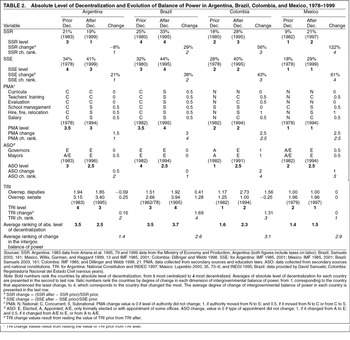
Absolute Level of Decentralization and Evolution of Balance of Power in Argentina, Brazil, Colombia, and Mexico, 1978–1999
 You have Access
- 324
- Cited by
Comments
No Comments have been published for this article.