SEVERE HYPERCHOLESTEROLEMIA
Severe hypercholesterolemia is a major cause of death in coronary heart disease. Treatment options for patients with severe hypercholesterolemia have improved in recent years. But despite a variety of treatment options, there is a considerable number of patients for whom the available options are not sufficient. Recently launched injectable PCSK9-inhibitors have shown efficacy in lowering LDL-C while demonstrating a favorable side effects profile (Reference Robinson, Farnier and Krempf1). To date, lipoprotein apheresis (LDL-C apheresis) is the last option for severe cases of hypercholesterolemia.
The cause of highly elevated levels of low density lipoprotein cholesterol (LDL-C) in the blood is often a genetic defect of the LDL receptor that can be heterozygous or homozygous inherited. Homozygous familial hypercholesterolemia (hoFH) is among the most severe forms of this metabolic disorder, which cannot be treated by diet and/or medication only. Usually apheresis is required. Furthermore, homozygous familial hypercholesterolemia is a very rare condition and current estimations assume that up to 150 people are affected in Germany. HoFH is characterised by greatly increased lipid levels in the blood just after birth with untreated levels of LDL-C in the range of 500–1,000 mg/dl and is associated with severe and early onset cardiovascular diseases as well as a significantly reduced life expectancy (Reference Bruckert, Saheb, Bonté and Coudray-Omnès2;Reference Goldberg, Hopkins and Toth3).
Standard therapies for severe hypercholesterolemia use dietary intervention in the first stage. If the effect thus achieved on the LDL-C level is not sufficient, drug therapies, for example, statins or other lipid-lowering agents must be added. For therapy-resistant patients or patients with insufficient therapeutic success, the last option for reducing the LDL-C concentration in the blood to the recommended target value before the availability of PCSK9-inhibitors was LDL-C apheresis (Reference Robinson, Farnier and Krempf1). LDL-C apheresis is a 3- to 4-hour procedure which can reduce the LDL-C level by approximately 60 percent on average. Following the procedure, LDL-C levels will typically return to pre-apheresis levels in approximately 2 weeks. Depending on local practice and severity of disease LDL-C apheresis is performed weekly or biweekly (Reference Stefanutti and Julius4;Reference Wang, Richhariya and Gandra5).
New lipid-lowering therapies were approved by regulatory authorities in 2015 and have been launched recently (Reference Stein, Gipe and Bergeron6;Reference Roth, Bujas-Bobanovic, Louie and Cariou7). These therapies use an injectable monoclonal antibody to PCSK9 to reduce the LDL-C concentration in the circulation and are an option in severe cases of hypercholesterolemia with high cardiovascular risk for patients currently undergoing LDL-C apheresis with a view to reducing LDL-C apheresis frequency and improving quality of life (Reference Robinson, Farnier and Krempf1;Reference Roth, Bujas-Bobanovic, Louie and Cariou7–Reference Roth, Taskinen and Ginsberg9). But so far, it is not known which properties generate the highest perceived benefit for patients. The aim of this study is to evaluate patient priorities in the field of adjunctive drug therapy in LDL-C apheresis-treated patients versus LDL-C apheresis alone.
Decision-Making Context
The question of the optimal drug therapy in apheresis treated patients with familial hypercholesterolemia is at present mainly assessed from the perspective of experts. Decisions on the authorization, benefit and reimbursement of healthcare technologies are made on the basis of these expert opinions based on evidence of clinical efficacy from (randomized) clinical trials. So far the question which decision-making criteria are important from the patient's point of view and how they are weighted against each other has largely been disregarded. However, according to various preference studies, the judgments of the experts do not correlate with the subjective preferences of patients (Reference Mühlbacher and Juhnke10;Reference Mühlbacher, Bridges and Bethge11). The criteria of the patients do not necessarily have to be identical with the endpoints defined by the experts.
Through the analysis of patient priorities in the treatment options for a lipid-lowering therapy it is possible to analyse patient benefit alongside clinical effectiveness. Thereby, attributes of new treatments can be identified, and estimates made as to which of them generate added value for patients. Thus, these data can create a new source of information (evidence) (Reference Mühlbacher, Bridges and Bethge11). In this way, the additional value of innovative treatment options can be complemented by the patient-perceived benefit based on clinical trial data (Reference Mühlbacher and Johnson12). The identification and weighting of patient-relevant endpoints has gained attention in medical innovation, particularly in the pharmaceutical market (early benefit assessment by the Institute for Quality and Efficiency in Health Care [IQWiG]) (13) as well as the assessment of medical devices by the U.S. Food and Drug Administration (FDA) (14;Reference Ho, Saha and McCleary15). Moreover, regulatory and pricing decisions require explicit or implicit trade-offs between potential efficacy, side effects, mode of administration, and costs. IQWiG proposed the analytic hierarchy process (AHP) in the context of multi-criteria decision making (MCDA) for use in medical research to display patient priorities (13). Therefore, the AHP method was considered to answer the present research question (Reference Sloane, Liberatore and Nydick16).
Aim of the Study
The aim of this study was to identify, rank, and document the importance of patient-relevant criteria in injectable drug treatment adjunct to LDL-C apheresis in patients with severe hypercholesterolemia. This was intended to yield a ranking of the main criteria—according to their significance from the viewpoint of patients. The central question of this study was: “What specific criteria of a LDL-C lowering therapy are important to patients, and among these, how are the various aspects ranked relative to one another?” Furthermore, the influence of participants’ sociodemographic factors on variations in the weighting vectors, and hence the priorities, was examined.
For this purpose, the patient-relevant endpoints, which are essential for therapy success, are identified, analyzed and weighted The patient-relevant treatment criteria will be placed in a ranking at the end of the study. The results can be used as a basis for the representation of the patient benefit of individual endpoints in the treatment of (therapy-refractory) familial hypercholesterolemia. Finally, this study aims to extend the clinical findings in the indication of familial hypercholesterolemia in form of patient priorities data.
METHODS
Systematic Literature Review and Patient Interviews
First, a systematic literature review on treatment options for severe hypercholesterolemia was conducted to document the available state-of-the-art treatment options (PubMed, Medline, and Cochrane Library). The aim of the search was to identify potential properties and characteristics of lipid-lowering treatments, especially in patients with hypercholesterolemia, from the patient perspective. Of 654 articles, 172 full texts were included and analyzed after abstract review.
Before the main survey, a preliminary qualitative study was conducted. Within interviews with a total of N = 10 patients in two apheresis centers, fifteen treatment characteristics extracted from the literature were tested to see if they were relevant to patients in decisions on potential treatments. This was evaluated within the semi-structured interviews with the patients and card sorting games to identify treatment-relevant characteristics as well as to determine the weighting or importance of each attribute. The content of the cards was established by the previous literature review and discussions with experts. In the card game, participants were asked to rate the characteristics as important or unimportant. To address the potential limitation of missing patient-relevant aspects, blank cards were presented which were used for any necessary additions. In a final step the participants were asked to rank the “important” characteristics (cards). The most important criteria for a potential treatment decision had to be ranked 1. This was intended to confirm the therapy characteristics identified in the literature review and gain a first impression of their relevance from the patient's viewpoint.
Quantitative Data Collection
Analytic Hierarchy Process
The analytic hierarchy process (AHP) was developed by mathematician Thomas Saaty in the 1970s and is a multi-criteria decision-making procedure for the weighting of alternatives (Reference Saaty17). AHP is a process which can help create a hierarchic structure for complex and unstructured decision-making problems to enable a systematic and optimal decision to be reached (Reference Dolan18).
In general, the AHP follows the basic steps used in all Multi-Criteria Decision Analysis (MCDA) as described by the ISPOR MCDA Task Force (Reference Thokala, Devlin and Marsh19;Reference Marsh, IJzerman and Thokala20).
Based on the results of the interviews, a final decision model was designed with seven criteria and 3 sub-criteria each. The level ranges of the seven characteristics were based on clinical studies. This means that within the literature review all relevant and available RCT results were collected and all maxima and minima of the included attributes were documented in effects tables. This approach enables use of the estimated priorities for regulatory assessments because the levels are derived from clinical trial data.
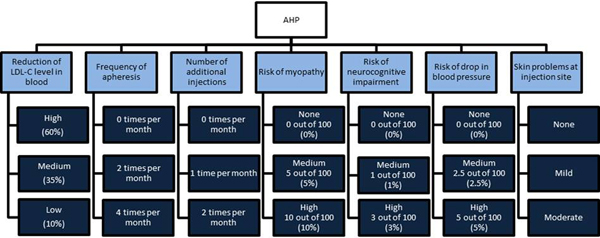
For the formation and composition of all necessary pair comparisons, a matrix is prepared for each unit of the hierarchy from which all required pair comparisons are derived. This survey is based upon a complete design which required a total of forty-two pair comparisons (twenty-one attribute comparisons and seven comparisons of the 3three levels of each attribute). For the decision problem in this study the following AHP hierarchy was used (Figure 1).
AHP hierarchy.

The therapy characteristics (attributes) shown in Figure 1, which were ascertained on the basis of the literature review and pretest interviews, were used for construction of the analytic hierarchy process. All attributes represent relevant characteristics of lipid-lowering therapy in patients with severe hypercholesterolemia and who are exposed to apheresis. Aspects of efficacy, side effects, and mode of administration were taken into consideration.
Data Collection
The quantitative data were collected within specialized apheresis clinics or dialysis centers all over Germany, and this was done between July 5 and July 29 2015 using computer-assisted personal interviews. The computer-assisted interviews were conducted by specially trained interviewers whilst the patients were undergoing an LDL-C apheresis session. Participants answered the survey questions on a tablet placed in front of them, either by themselves or assisted by the interviewer. All patients gave informed consent before starting the survey and thus agreed to participate in the project. The participants were given detailed information on the research aims in advance. The survey participants could terminate the interview at any time. The study and all its materials were approved by the ethics commission of the Medical Faculty of the University of Greifswald.
The AHP questionnaire consisted of four parts: (i) sociodemographic data, (ii) indication-specific questions, (iii) introduction to the attributes with AHP levels (characteristic levels), (iv) AHP on the basis of the attributes (characteristics).
RESULTS
Literature Analysis and Personal Interviews
Based on the results of N = 10 semi-structured patient interviews, a ranking of the previously identified fifteen criteria was achieved. The ranking enabled identification of the most important patient-relevant criteria for adjunctive drug therapy to LDL-C apheresis in high risk patients suffering from hypercholesterinemia. Finally, during the interviews, seven criteria were elicited that were considered most important by the patients. Furthermore, patients specified no additional, as yet unidentified, treatment attributes that would be relevant. (This allowed for reflection of the subjective views of the patients interviewed.) Moreover, the interviews were used to evaluate the clarity of the draft questionnaire; the quality of the scales used; and the understandability of the attributes, levels, and questions included. After content validation, these seven attributes were used for the quantitative survey. For the questionnaire, the final attributes and levels were described using patient friendly terminology (grade 8 reading level).
The criteria and sub-criteria presented in Figure 1 were inserted into the final questionnaire. In addition to the AHP specific forty-five pair comparisons, several disease-specific questions were integrated into the survey.
Results of the Analytic Hierarchy Process
The AHP main survey was conducted in July 2015. A total of N = 70 complete questionnaires was collected. After analyzing the individual consistency ratios (CRs), N = 9 participants were to be excluded due to CRs of up to 1.1. The overall CR was thereby improved from CR = 0.057 to CR = 0.055 in the final dataset. The boundary value of CR = 0.1 set by Saaty was undershot and the results meet the quality requirements for AHP analysis (Reference Saaty21).
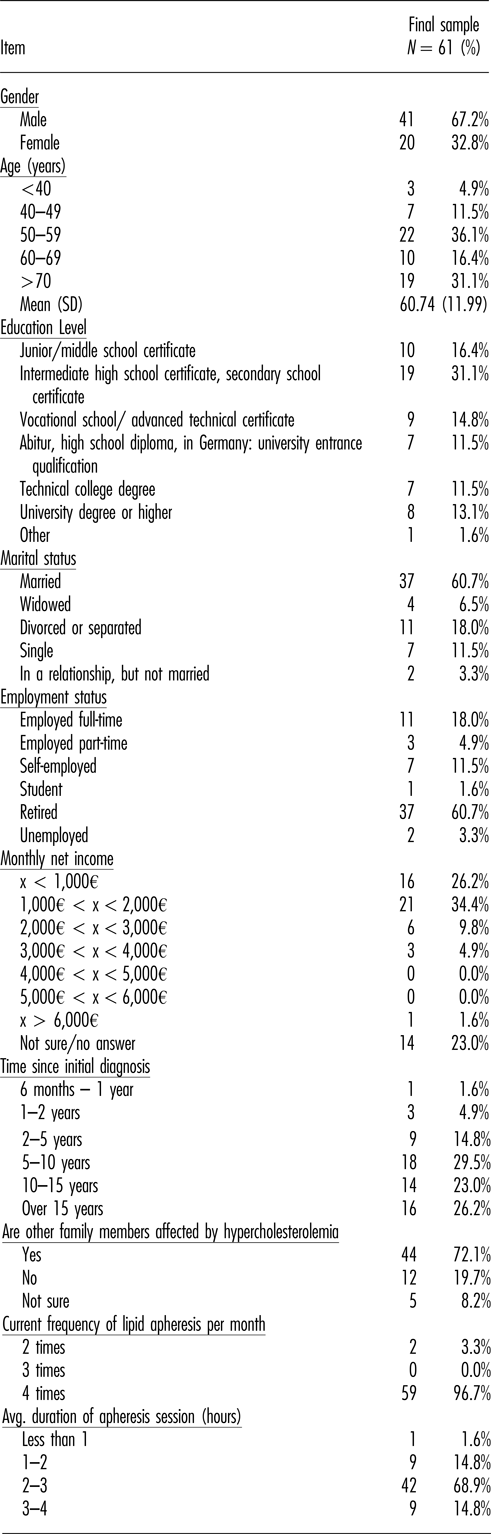
The sociodemographic analysis is shown in the table (Table 1) below. In the final sample, more than two thirds of the participants are male (67.2 percent) and the average age of participants is 60.7 years with a standard deviation of 12 years. Approximately 60 percent of respondents indicated they were retired. In addition, indication-specific variables were also collected. Table 1 illustrates the respective results for the final sample.
Study Sample Characteristics and Indication-Specific Variables of the Study Participants

At the time of the survey, 78.6 percent of participants in the sample indicated that their initial hypercholesterolemia diagnosis was made more than 5 years previously. A total of four of the participants said their hypercholesterolemia diagnosis was determined less than 2 years before the survey.
Of the sixty-one patients included, a total of 96.7 percent reported receiving LDL-C apheresis weekly. A total of 3.3 percent of respondents indicated that LDL-C apheresis was performed twice a month. The most common duration of an LDL-C apheresis session was 2–3 hours indicated by 68.9 percent of respondents (without travel time, which was explicitly excluded in the question). A total of 70.5 percent of the patients stated that their quality of life would be improved by a reduction of LDL-C apheresis sessions; 16.4 percent of respondents were not sure whether their quality of life would be improved by reducing the necessary number of LDL-C apheresis sessions.
Analytic Hierarchy Process
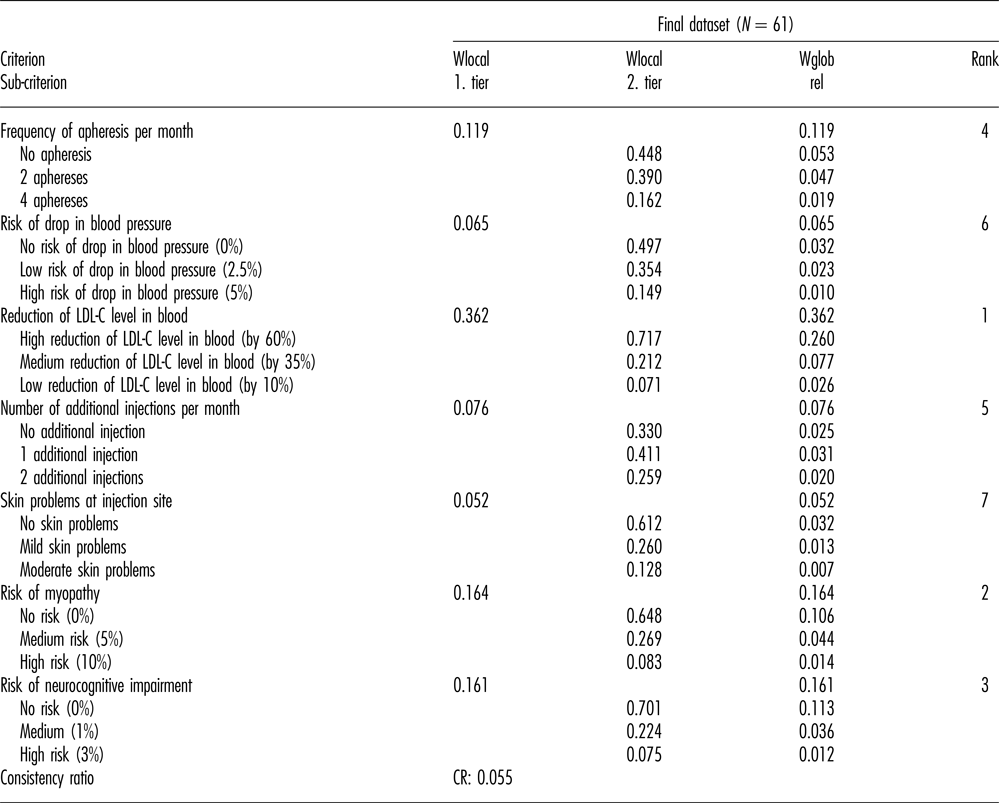
The individual judgments obtained using the pair comparisons were compiled into a group decision, transferred to evaluation matrices and the relative weightings or priority values of the (sub-) criteria were ascertained. The weightings of the individual criteria and the associated sub-criteria are presented in Table 2.
Results of the AHP (Weightings of the Criteria and Sub-criteria)

The overall estimation revealed that “reduction of LDL-C level in blood” (Wglobal: 0.362) is of highest relevance with the “risk of myopathy” (Wglobal: 0.164), “risk of neurocognitive impairment” (Wglobal: 0.161), and “frequency of apheresis” (Wglobal: 0.119) following on places two to four, respectively. In fifth place was the “number of additional injections” (Wglobal: 0.076), while the penultimate place was taken by the “risk of drop in blood pressure” (Wglobal: 0.065) and “skin problems at injection site” (Wglobal: 0.052) was ranked last.
The global weightings presented in Table 2 show the significance of each hierarchy element in the context of the overall hierarchy (Reference Saaty17). Thus, a global significance weighting is understood as the relative importance of an element in comparison to all other elements of the hierarchy. The local weightings on the other hand show the relative importance of an element in comparison to the two elements within the same hierarchic unit (attribute).
Patient Priorities in AHP by Subgroup
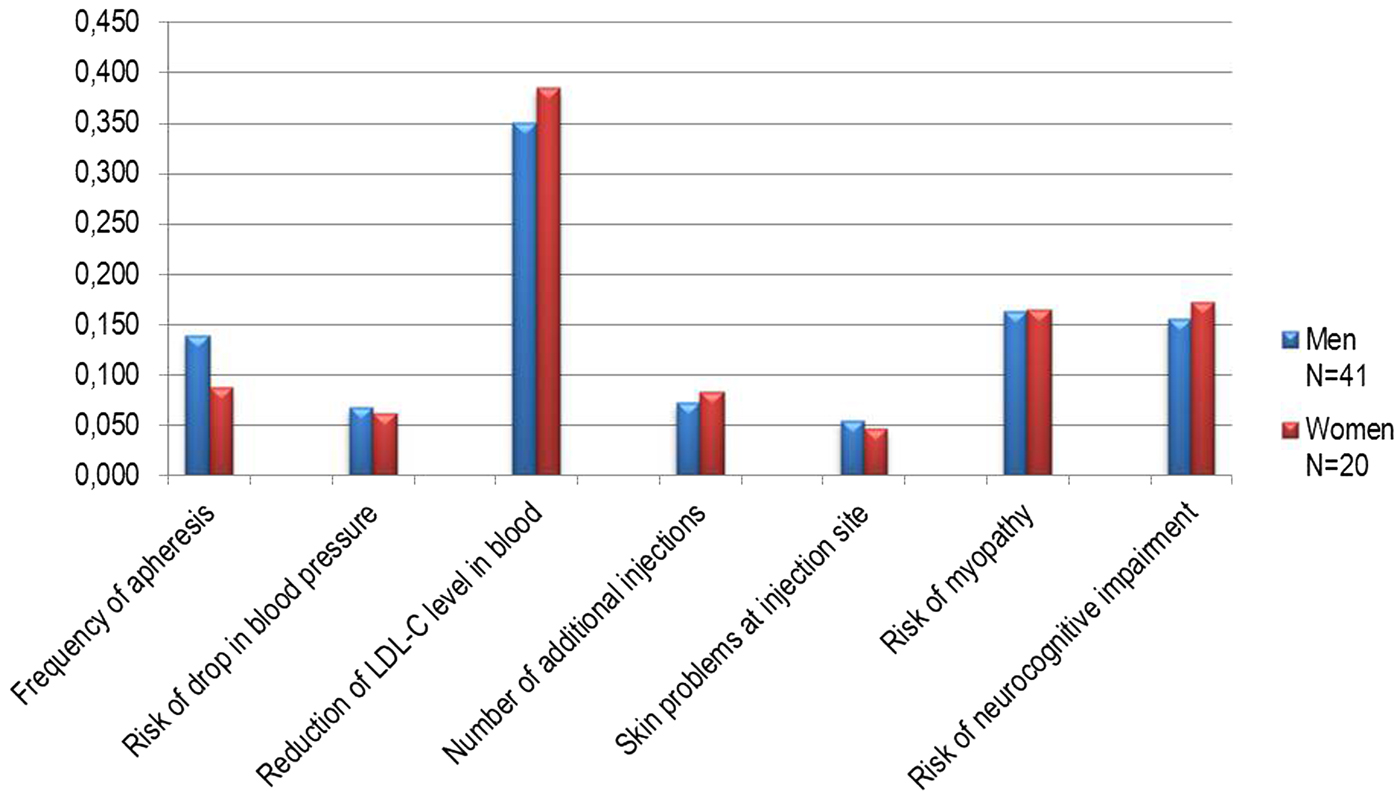
To analyze possible heterogeneities within patients’ priorities, different subgroup estimations were carried out. First, a possible relationship between the sociodemographic variable gender and the respective evaluation behavior of the participant was tested (see Figure 2 and Supplementary Table 1).
Global weightings of the criteria (eigenvalues), stratified by gender.

Another subgroup was estimated based on the answer to the question: “Would your quality of life improve if the number (frequency) of apheresis sessions needed was reduced?”
DISCUSSION
Study Sample
The average age (60.74 years) as well as the male–female distribution (67.2 percent male) in the overall AHP study is comparable to other publications. For example, Cannon et al. 2015 (ODYSSEY COMBO II) reported average ages of 61.7 and 61.3 years, respectively, with the majority being male (75.2 percent and 70.5 percent, respectively) (Reference Cannon, Cariou and Blom8). The study by Roth et al. observed an average age of 60.8 years and most participants were male (53.8 percent) (Reference Roth, Taskinen and Ginsberg9).
A familial predisposition to hypercholesterolemia is often reported in the clinical literature (Reference Cuchel, Bruckert and Ginsberg22). This can also be seen in the specifications of the adjusted study population. Eight patients specified that both parents are/were affected and 25 of the included subjects reported that one parent also suffers or has suffered from high blood lipid levels. Twenty-eight patients reported that they were not sure or did not know this. This coincides with the results of the qualitative interviews. One participant reported that both parents died very young due to heart disease and (s)he can only guess that hypercholesterolemia was the cause.
The study sample is highly comparable to the patient samples included in studies on hypercholesterolemia and LDL-C reduction in patients at high risk of CV disease. With regard to employment status, comparable European surveys reported proportionally more full-time employees, for example, Bruckert et al. (Reference Bruckert, Saheb, Bonté and Coudray-Omnès2). Here, however, the age range of patients included was 18–54 years and thereby significantly lower, which can be seen as a reason for the increase in employment. However, it is also reported that due to the physical and temporal burdens of the disease and LDL-C apheresis, respectively, full-time employment is hardly possible (Reference Bruckert, Saheb, Bonté and Coudray-Omnès2).
Evaluation of Individual Therapy Characteristics
General Assessment of the AHP
The AHP showed that all respondents had clear priorities for all included attributes and the attribute “reduction in blood lipid levels” was the most significant characteristic of the treatment of familial hypercholesterolemia. Based on the results of the qualitative interviews it was already apparent that the attribute “reduction of LDL-C level in blood” dominates the included “side effects” and the attributes of the “mode of administration” in importance. (Figures 2, Table 2, and Supplementary Materials).
Frequency of Apheresis
The number of LDL-C aphereses is weighted fourth by the participating respondents and is thus of importance. Reducing the frequency of LDL-C apheresis with simultaneous and equally effective reduction of LDL-C can improve quality of life (Reference Rosada, Kassner and Banisch23). However, the question of whether quality of life would be improved by reducing the number of LDL-C apheresis sessions required yields mixed results. As shown in the results section and the subgroup analysis, there seem to be two groups in respect to improvement in quality of life by reducing the frequency of LDL-C apheresis. One group would concede an improvement in quality of life due to less time spent in apheresis centers, etc. The other group fears that a reduction of LDL-C apheresis would lead to higher blood lipid levels and these patients are, therefore, not willing to risk worse outcomes.
Reduction of LDL-C Level in Blood
As reported in all studies, the goal of any treatment for severe hypercholesterolemia is the establishment of optimal LDL-C levels in patients to prevent cardiovascular complications, long-term effects, and early mortality (e.g., Baigent et al. (Reference Baigent, Blackwell and Emberson24)). Patients are aware of the essential and dominant significance of the attribute, which is reflected both in the overall evaluation of the AHP and the subgroup analysis. In all evaluations, “reduction of blood lipid levels” ranked by far the most important. This also coincides with the results of the individual interviews in which the reduction of blood lipid levels was stated to be of greatest importance.
Side Effect: Risk of Myopathy
In RCTs myopathies are reported as a side effect of various drug treatments for LDL-C reduction (Reference Robinson, Farnier and Krempf1;Reference Roth, Taskinen and Ginsberg9;Reference Blom, Hala and Bolognese25–Reference Raal, Honarpour and Blom27). In the interviews, patients reported that they were already constrained in their daily lives by the LDL-C apheresis and existing co-morbidities without this side effect. If additional muscle pain were to occur, performing activities of daily life may be further limited.
Patients do not want to endure this side effect. This is also reflected in the AHP results. The 2nd rank in the overall evaluation, in the subgroup of men as well as the subgroup of participants answering “yes” when asked whether quality of life was affected by LDL-C apheresis, confirms this. Even in the subgroup of women and the group of those answering “no” in terms of affected quality of life, the possible muscle pain is still in third place.
Side Effect: Risk of Neurocognitive Impairment
In the AHP, the potential for neurocognitive impairments is ranked third. Patients, therefore, gave a high weighting for or against this side effect. Patients seemed very frightened by this side effect of the new drugs. Accordingly, in the interviews patients imagined the most severe forms of neurocognitive impairment, for example, Alzheimer's, when asked about this item.
Subgroup Evaluations
Gender-specific subgroup analyses yielded only small differences between the importance of the different treatment characteristics. Only two attributes shifted rankings (while the rest remained the same among men and women): “risk of myopathy” and “risk of neurocognitive impairment” (ranks 2 and 3 in the overall analysis). According to the results of this analysis, it would appear that women attribute higher importance to the “risk of neurocognitive impairment,” whereas men put more weight on the “risk of myopathy.”
While the observed rank for the following attribute was the same regardless of gender, the relevance of the “frequency of the aphereses” (as expressed by the estimates) was higher among men than among women.
Of note are the results of the subgroups compared for evaluation of a possible quality of life improvement. The majority of subjects (70.5 percent) rated a reduction in the number of LDL-C apheresis sessions as an improvement in quality of life. However, when a reduction in the number of necessary LDL-C aphereses is considered as “quality of life improving,” the attributes are weighted in a different order. Here the “number of necessary aphereses” is ranked 3rd. The increasing relevance of apheresis frequency may be connected to the heterogeneity in the patient population. The subpopulation attaching a comparatively high priority to the reduction of frequency is younger (<60 years), employed (full-time, part-time, self-employed, or student), and diagnosed within the last 10 years.
In the group that does not expect any quality of life improvement from reducing the frequency of LDL-C apheresis, the attribute slips to 5th place in the subgroup analysis. Those patients were older, had above average levels of unemployment, had been receiving apheresis for a longer period of time, and rated the frequency of apheresis at a lesser importance.
LIMITATIONS
The method of analytic hierarchy process is able to generate information from the subjective viewpoint of the patient in a statistically objective evaluable form for physicians, and political and regulatory decision makers. Nevertheless, the present study does contain some limitations that must be considered when interpreting the results.
Interviews
Despite the attempt to recruit a wide range of interviewees, the sample of the personal interviews does not adequately fulfil representativity requirements with regard to German sociodemographic factors with its mean age of 63.5 years and a 70 percent proportion of male participants. Due to this study limitation the results cannot be generalized. Thus, the acquired priorities may not apply to the general population.
Representativenesss
The subgroup analysis demonstrates that different personal circumstances are connected with different ratings. One possible explanation could be what is known as the response shift effect, which has been documented in quality of life research elsewhere. Experiences might impact priorities. Here, it may manifest itself in the fact that the person who experienced apheresis accept their treatment and adjusts their norms and values. Patients no longer compare themselves with healthy people and might have changed perceptions and compares with other patients. Thus, the reference point changes accordingly (Reference Schwartz, Bode and Repucci28). Patients not experienced with the treatment might have different priorities.
Limitation in AHP
A typical critique of AHP results is that they are only seemingly objective, because they are based on subjective assessments by the patients. The importance weightings are derived mathematically from the values which the respondents attach to each alternative to achieve the overall objective. Furthermore, it is noted that by means of the nine-point assessment scale proposed by Saaty, not all possible valuations of an item can be covered. Due to the limited feasibility, inconsistent answers can occur. N = 9 patients had to be excluded from the dataset due to inconsistent answers. Thereby, the overall CR = 0.055 in the final dataset and the results meet the quality requirements for AHP analysis.
Rank reversals are one of the biggest methodological weaknesses of AHP (Reference Belton and Gear29;Reference Triantaphyllou and Mann30). The rank reversal problem in AHP is mainly caused by the fact that the relationship between the scale of local priorities at any stage and the judgments on a next higher level are insufficiently connected (Reference Dyer31;Reference Schmidt, Aumann, Hollander, Damm and von der Schulenburg32).
In general, the AHP can contribute to the promotion of shared decisions by different stakeholders because it creates a framework for definition of a decision model and the prioritization of information, as well as yielding an initial insight into decision-making behavior. However, further research is needed to verify the adequacy and effectiveness of this method in practice. The study design of the AHP used in the first phase of the project served as the basis for a preferences study using the choice-based method of a discrete choice experiment (trade-off). The method used here and the results generated cannot be used in cost-benefit assessment (e.g., calculating a weighting within the efficiency frontier) due to the lack of a theoretical economic basis.
Based on the ascertained significance structure of the therapy characteristics and the assessment of patients’ priorities, further investigation is required to show patient preferences with respect to the treatment of severe hypercholesterolemia.
SUMMARY
This study describes and analyses in an exploratory manner the priorities of patients with familial hypercholesterolemia, based on their current situation, perception, and experiences. This study suggests that the attribute “reduction of LDL-C level in blood” has the highest relevance to patients. By contrast, tolerability aspects such as the “risk of myopathy,” the “risk of neurocognitive impairment,” and the mode of administration represented by the “frequency of apheresis” have lower priority for the patients, ranking second, third, and fourth, respectively.
In fifth place comes the “number of additional injections.” The attribute in penultimate place is the “risk of drop in blood pressure” followed in last place by “skin problems at injection site.” The subgroup analysis showed that a substantial part of the patient population feels impaired in their quality of life by LDL-C apheresis frequency and, therefore, pays considerably more attention to this attribute. These patients are younger (<60 years), in full-time, part-time, or self-employment and/or were diagnosed up to 10 years before the survey.
To establish and maintain patient-centered care, identifying patient expectations and needs and evaluating the relevance of different therapeutic characteristics are essential not only to physicians but also to regulatory and political decision makers. The results obtained and the combination of qualitative and quantitative study contents provide an initial insight into patients’ experiences in the treatment of familial hypercholesterolemia. This study made it possible to show the importance of individual target criteria which patients consider relevant in lipid-lowering therapy, to identify the patient-relevant properties and rank them by priority.
SUPPLEMENTARY MATERIAL
Supplementary Table 1: https://doi.org/10.1017/S0266462318000247
Supplementary Table 2: https://doi.org/10.1017/S0266462318000247
Supplementary Figure 1: https://doi.org/10.1017/S0266462318000247
Supplementary Figure 2: https://doi.org/10.1017/S0266462318000247
CONFLICTS OF INTEREST
Dr. Mühlbacher reports grants and consulting fees from Sanofi Deutschland GmbH during the conduct of the study; grants and consulting fees from Abbott, Amgen, AstraZeneca, Baxter, Bayer, Boehringer Ingelheim, BPI, Bristol-Myers Squibb, Credopard GmbH, Daiichi Sankyo, Eli Lilly, Genentech, Gilead Sciences, GlaxoSmithKline, Grünenthal, Insight Health, Janssen-Cilag, Johnson & Johnson, Merck, Merck KGaA, Novartis, Pfizer, Roche, Sanofi-Aventis, Stallergenes, VFA, ViiV Healthcare GmbH, Wyeth outside the submitted work. Anika Kaczynski has nothing to disclose. Franz-Werner Dippel is an employee of Sanofi Deutschland GmbH. Dr. Susanne Bethge has nothing to disclose.