Introduction
Foreign words which have been borrowed into the Japanese language, especially in the last few centuries, are commonly labelled as 外来語, gairaigo, meaning words (語, go) coming in (来, rai) from outside (外, gai). This umbrella term encompasses lexical items from numerous foreign languages, including Russian, French, Spanish, Italian, Korean, German, and English. As they undergo the borrowing process into the Japanese linguistic system, the words are likely to undergo modification, particularly in terms of their phonology, orthography, semantics, and syntax. The overwhelming majority of gairaigo have their roots in the English language; estimates put their number at around 10% of the Japanese lexicon (Daulton, Reference Daulton2008; Stanlaw, Reference Stanlaw2004). They include borrowings in the daily Japanese vocabulary (ニュース, nyūsu, news); ones used primarily in specialist fields, (コーパス, kōpasu, corpus), and others recorded in dictionaries but that play very little part in actual language usage (インディビデュアル, indibijyuaru, individual)Footnote 1.
English loanwords in Japan find a particularly accommodating home in advertising. They appear in a variety of scripts throughout many aspects of society, such as on shop signs, restaurant menus, and product packaging. A noticeable stylistic technique is to write English words in the English alphabet, as can be seen on the Japanese shopping bag shown in Figure 1. In this way, the alphabet adds a form of marked visual decoration to words that would otherwise be written in the native katakana script. These words may be lifted directly from the English language, or may undergo a process of back-transliteration from their gairaigo form. When the latter process is employed, changing the words back into the English alphabet after being initially converted into a Japanese script, a specific type of error can occur that is concerned with phonological and orthographical changes that the English words undergo. The outcome of this process can be an incorrect spelling or the incorrect selection of a word from a set of lexical items that are similar in sound and/or spelling. This can cause unintended and entertaining uses of English that become inscribed into the Japanese linguistic landscape. A casual observance of these errors in the linguistic landscape can lead to the assumption that English is simply being used carelessly in Japan. The aim of this article, however, is to show that rather than being careless mistakes, many of the errors are a result of linguistic factors related to the processes of introducing and integrating English loanwords into the Japanese language.
A Japanese shopping bag with English words written in the English alphabet

Phonological and orthographical inventories of Japanese and English
The Japanese phonological system has a smaller and less distributed phonemic inventory than that of English. At the most fundamental level, Standard Japanese (Tokyo dialect) has five vowel sounds compared to twenty in Standard English (Received Pronunciation dialect); and with consonant phonemes, Japanese has seventeen in comparison to twenty four in English (Irwin, Reference Irwin2011). Accordingly, when words are borrowed from English it may be necessary to adapt English sounds in order that they fit Japanese phonotactics (Kay, Reference Kay1995). This is what gives English words in Japanese their characteristic Japanese-English pronunciation. As an example, the English word blend is modified to a gairaigo form of burendo. An epenthetic vowel is inserted between the consonant cluster of [bl], and also after the final consonant of [d]. Also, the English sound [l] is realised differently in Japanese, with a liquid consonant that is a single substitution for both English [l] and [r]. This latter change leads to a well-known English pronunciation issue in Japan, the difficulty of distinguishing between the phonemes /l/ and /r/ in such word pairs as [right] and [light], [correct] and [collect] (Preston & Yamagata, Reference Preston and Yamagata2004; Thompson, Reference Thompson, Swan and Smith2001, p. 298).
Spelling errors in the linguistic landscape
English words in Japanese are most commonly written in the native, phonetic script of katakana (Barrs, Reference Barrs2011). As there is an almost total one-to-one correspondence between phonemes and the graphemes of katakana (i.e. a shallow orthography), the phonological modifications that are made to English words are mirrored in their katakana transliterations. When these words are then returned (back-transliterated) to their original alphabet form, the modifications that were made can persist and result in orthographic spelling errors. Figure 2 shows an example of an <l> and <r> spelling mistake in the English word original which has been written in the English alphabet on a Japanese shop signboard. Sometimes problems with this <l> and <r> graphemic distinction can lead to more amusing mistakes. Figure 3 shows a situation where the graphemic mix-up in the Flying Jaws movie title (renamed in Japan from the English title of Swamp Shark) has resulted in a critical spelling error that entirely changes the intended meaning. The carelessness of this error is proved by the fact that the correct choice between <l> and <r> was made for the spine of the DVD (i.e. Flying Jaws), but not the front.
A shop advertising board with a misspelling of original
A DVD cover with a misspelling of flying
Word choice errors in the linguistic landscape
The phonological and orthographical differences between Japanese and English can also cause incorrect word selections when English words are used in Japan. In this context, the problem is rooted in four different categories of how words with different meanings sound and are spelt. Homographic homophones are words that sound and are spelt the same. For example in English, rose (the flower) and rose (the past form of rise); and in the Japanese phonetic script of hiragana, かく, kaku (to write) and かく, kaku (to carry on one's shoulders). Heterographic homophones are words that sound the same but are spelt differently. For example in English, court (the place of law) and caught (the past form of the verb to catch); and in the logographic Japanese script of kanji, 回転, kaiten (revolution) and 開店, kaiten (opening of a shop). Homographic heterophones are words that are spelt the same but sound different: for example in English, minute (60 seconds) and minute (very small); and in Japanese hiragana, はし, hashi which with different intonations can mean chopsticks, an edge or a bridge. The fourth category is heterographic heterophones, which is basically another way of saying ‘different words’. These are words that are spelt differently and sound different. For example unrelated words in English such as bus (a mode of transport) and bath (a place to wash); and in Japanese such as 準備, jyunbi (preparation), and 警備, keibi (security).
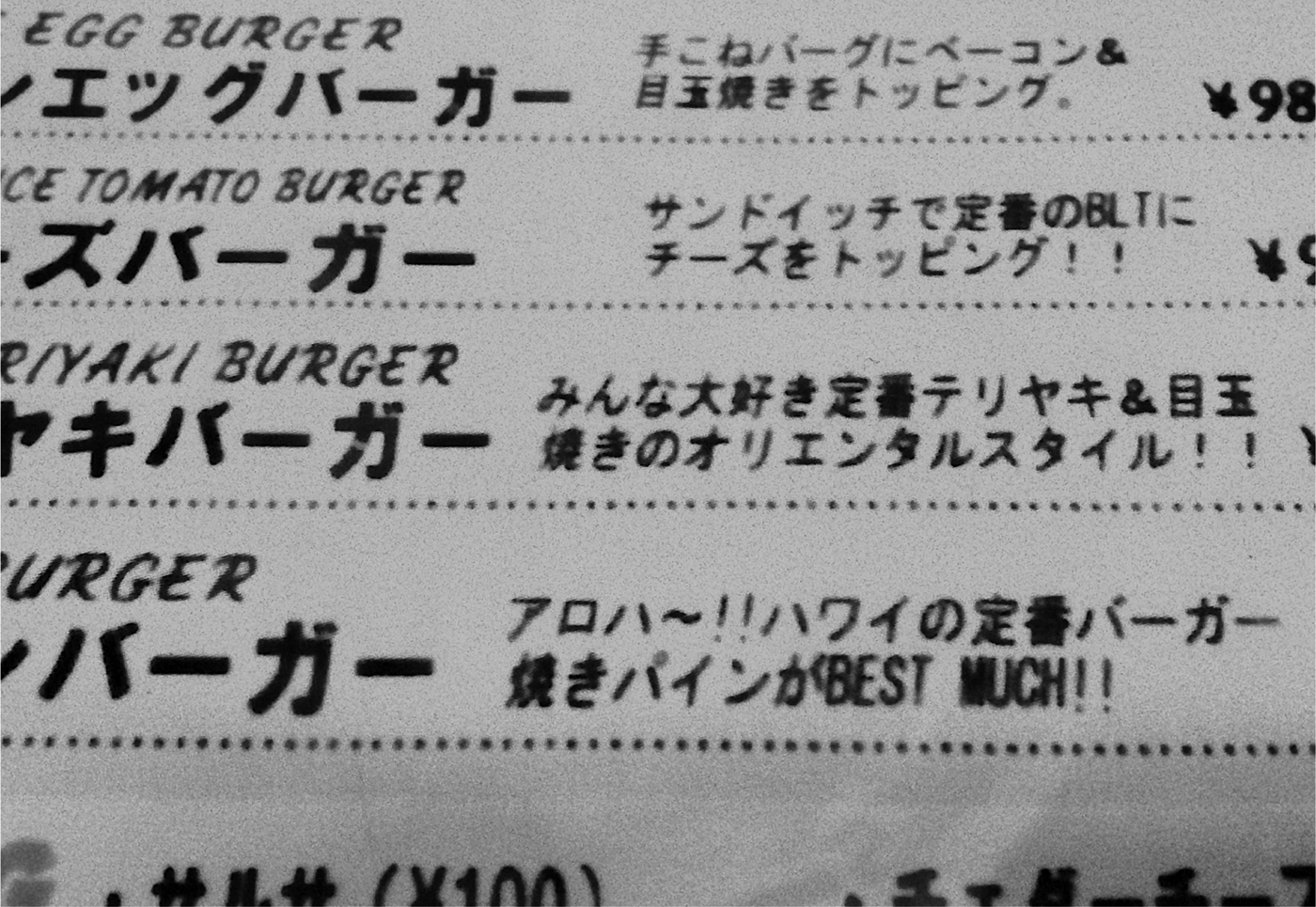
Some of the errors that appear in the use of alphabetic English in the Japanese linguistic landscape seem to be caused by the fact that English words can change their category when integrated into Japanese. This change of category is caused by the restricted phonemic and graphemic inventories of Japanese. As an example, the heterographic heterophones of match and much in English are commonly transliterated with the single homographic homophone of マッチ, macchi in katakana. This conversion is not especially problematic when the loanwords stay in their gairaigo form, because in most cases the context will disambiguate the intended meaning. For example, the expression グッドマッチ, guddomacchi is relatively common in Japanese and is used to explain the appropriate matching of two items such as two people in a relationship, and two foods that complement each other. In its katakana form, this phrase is unambiguous. However, when グッドマッチ, guddomacchi is back-transliterated into the English alphabet, there are two possible alternatives for the word マッチ, macchi. Without sufficient due care and attention, an incorrect word might be selected for the transliteration, as is clear in the restaurant menu shown in Figure 4. It is fair to assume in this context that best much, referring to the pairing of a burger with grilled pineapple, was more likely to be best match, a back-transliteration error seemingly caused by a lack of phonemic and graphemic distinction between these English words in their gairaigo form.
A restaurant menu showing the incorrect selection of much instead of match
A more amusing example of a related type of error can be seen on the restaurant signboard shown in Figure 5. The English heterographic homophones of pear and pair are subsumed under the same katakana homographic homophone ペア, pea. Like the example of バス , basu above, when ペア, pea is written in katakana the context would help disambiguate the intended meaning. But the process of back-transliteration introduces the potential for erroneous word selection to occur. Searching for ペア, pea in a Japanese-English dictionary brings up several heterographic homophone options; namely the words pair and pear. It would be fair to assume that the intended meaning for the example in Figure 5 was ‘Premium Pair Dinner’ (a luxurious meal for two) rather than ‘Premium Pear Dinner’ (a meal with a luxurious pear as the main course), particularly considering there is no further reference to a pear, or the Japanese equivalent of 梨, nashi, in any of the advert's remaining text or images.
A restaurant signboard showing the incorrect selection of pear instead of pair
Conclusion
Unfortunately for the image of English in Japan, when these and other kinds of mistakes are noticed in the Japanese linguistic landscape by the global community they are recorded and ridiculed on blogs and websites such as <http://www.engrish.com>. And because they occur relatively frequently, in places like clothing, signs, and packaging, Japanese English gets tarnished with a reputation that it is something more for visual decoration than linguistic communication (Dougill, Reference Dougill2008; Hyde, Reference Hyde2002). This precludes serious, academic discussions of English in Japan as a valid variety of World English, something that is lamentable considering the social importance of the English language in Japanese society (Seargeant, Reference Seargeant2009). In order to replace casual observations of error-laden Japlish with academic discussions of a fully-fledged Japanese variety of English, it is necessary for both producers and consumers of English in Japan to take the small but vital step of introducing final proofreads of English usage. This is especially necessary before the English becomes permanently inscribed into the Japanese linguistic landscape.
KEITH BARRS is an associate professor in the English language and literature department of Hiroshima Shudo University, Japan. He is also a PhD candidate in the School of Education in the University of Leicester, England. His research focuses on understanding the behaviour of English loanwords in contemporary Japanese, through corpus-based investigations of lexical semantics and pragmatics. Email: keithbarrs@hotmail.com