Introduction
Along with the development of the economy and communication technology, virtual teams have become a popular alternative to replacing traditional face-to-face teams or units in the organizations. Indeed, these developments in information technology mean that individual virtual team members do not need to work together in a physical space. In fact, in the United States, half of large multinational companies (MNCs) use virtual teams (Dekker, Reference Dekker2008). This trend requires employees to be involved in teams that feature some level of virtuality (Kanawattanachai & Yoo, Reference Kanawattanachai and Yoo2002). Literature has shown that virtual teams have distinctive benefits, such as reducing costs (Robbins & Judge, Reference Robbins and Judge2007) and offering a solution to globalization (Hertel, Geister, & Konradt, Reference Hertel, Geister and Konradt2005), compared to traditional teams.
In spite of the increasing popularity of virtual teams, many virtual team members appear reluctant and unwilling to cooperate in a virtual team setting. A survey report conducted by CultureWizard showed that 80% of employees in 600 MNCs were part of a virtual team (Daft, Reference Daft2011) but that among this number, 75% faced challenges due to a lack of cooperation from their teammates. Such lack of cooperation likely negatively influences members’ satisfaction and their teams’ performance (Townsend, DeMarie, & Hendrickson, Reference Townsend, DeMarie and Hendrickson1998; Hoegl, Weinkauf, & Gemuenden, Reference Hoegl, Weinkauf and Gemuenden2004).
Such distinctive characteristics of virtual teams lead us to reconsider Perlmutter’s traditional model (Perlmutter, Reference Perlmutter1969; Heenan & Perlmutter, Reference Heenan and Permutter1979) of MNC orientations (i.e., ethnocentric, polycentric, regiocentric, and geocentric). Although limitations exist in the typology (e.g., Rosenzweig & Nohria, 1994), Perlmutter’s work is considered a classic in MNC human resource management and the use of expatriate. However, virtual teams cannot be classified into any of the current typologies. First, because virtual team members work in virtual spaces, it is meaningless to divide the workforce into home-country nationals and host-country nationals. Second, the location of the employee bears no relevance to where the employee manages issues and conducts business in general. Thus, home, host, region, and global orientations are not related to the composition of the members of virtual teams. Third, although virtual teams are not likely to have locational boundaries, members in virtual teams need to adopt the unique virtual (not home or host) environment. That said, their career progress is not necessarily without boundaries since the virtual environment may not be easily transferred to either a home- or host-country environment. Considering the uniqueness of virtual teams, it is important to analyze how team and individual characteristics affect cooperation and team atmosphere.
In fact, a considerable number of empirical studies have investigated the organizational dynamics of virtual teams in regard to how these dynamics influence team members’ cooperation. While most studies have focused on the effects of virtual teams on organizational outcomes (Lurey & Raisingham, Reference Lurey and Raisingham2001; Hertel, Geister, & Konradt, Reference Hertel, Geister and Konradt2005; van Bezooijen, Reference Van Bezooijen2011), few studies have addressed the influences of virtual team members’ characteristics on their cooperation. Agarwal (Reference Agarwal2003) and Sarker and Sahay (Reference Sarker and Sahay2004) are among the few who have discussed the positive influence of specific personality characteristics, known as self-efficacy and openness, on team members’ willingness to cooperate in virtual teams. Apart from self-efficacy and openness, there is little research (Jarvenpaa, Shaw, & Staples, Reference Jarvenpaa, Shaw and Staples2004) on the effects of other specific personality characteristics, including trust and communication skills, of virtual team members on their willingness to cooperate in virtual teams.
Building on these few studies, through a cultural perspective (Perlmutter, Reference Perlmutter1969; Heenan & Perlmutter, Reference Heenan and Permutter1979; Adler & Bartholomew, Reference Adler and Bartholomew1992; Maznevski & Lane, Reference Malhotra, Majchrzak and Rosen2004), we investigate the effects of learning orientation, global mindset, and self-efficacy on team members’ willingness to cooperate in virtual teams from the goal orientation theory (Nicholls, Reference Nicholls1984; Dweck, Reference Dweck1986; Ames, Reference Ames1992).
The goal orientation theory provides an important theoretical lens on individuals’ motivational orientations that contribute to their adaptive patterns of engagement. This perspective was conceived as encompassing the experience of the person in a situation, guiding the interpretation of the events, and producing patterns of cognition, emotion, and behavior (Elliot & Dweck, Reference Earley and Ang1988; Kaplan & Maehr, Reference Kanawattanachai and Yoo2007). Thus, it is associated with explaining why individuals show different qualities of engagement in purposed activities as well as different emotional and cognitive formations in organizational behavior (Dweck & Leggett, 1988; Kaplan & Maehr, Reference Kanawattanachai and Yoo2007). The cultural perspective proposes an effective means by which to manage organizational challenges that arise from cultural complexity in order ‘to move away from an ethnocentric mind-set and cultivate a global mind-set –one that includes cultural self-awareness, openness to and an understanding of other cultures and the selective incorporation of foreign values and practices’ (Beechler, Levy, Boyacigiller, & Taylor, Reference Beechler, Levy, Boyacigiller and Taylor2008, p. 180).
Under the lens of the goal orientation theory with a cultural perspective, learning orientation, global mindset, and self-efficacy may be associated with setting up virtual team members’ motivational orientation and adaptive patterns of engagement in order to achieve a goal, such as a willingness to cooperate with other virtual teammates. A willingness to cooperate with others is crucial for virtual team members in regard to implementing and developing organizational goals by sharing information and adapting to multi-country and multi-cultural contexts.
The Korean context was purposefully selected for our study. A growing number of MNCs have entered Korea (Chopra et al., Reference Chopra, Kang, Karasula, Liang, Ma and Richards2001), while many Korean companies, such as Hyundai, LG, and Samsung, have become dominant players in the global economy (Rugman & Oh, Reference Rugman and Oh2008). This globalized economic condition augments the need for virtual teams in Korea. Moreover, advances in information and communication technology in Korea have enabled and supported the emergence of virtual teams (Malhotra, Majchrzak, & Rosen, Reference Maznevski and Lane2007). These two conditions may provide employees with ample opportunity to work in virtual teams. Therefore, Korea is an ideal empirical setting in which to study virtual teams and their members.
This study contributes to the literature in two significant ways. First, our results highlight the importance of the global mindset and learning orientation that play a critical role in building cognitive formation and behavior in relation to cooperation in virtual teams. Second, we extend previous literature in the area of global mindset and virtual teams by drawing attention to virtual team members in emerging market firms and identifying the mediating role of self-efficacy as an underlying mechanism for cooperation in a virtual team.
THEORETICAL BACKGROUND AND HYPOTHESES
Willingness to cooperate in virtual teams
Virtual teams are groups of employees with unique skills, situated in distant locations, whose members must collaborate using technology across space and time to accomplish important organizational tasks (Lipnack & Stamps, Reference Lipnack and Stamps2000; Kirkman, Rosen, Tesluk & Gibson, Reference Kirkman, Rosen, Tesluk and Gibson2004). The research on virtual teams has compared conventional, face-to-face teams and virtual teams, and identified the particular characteristics of virtual teams (Kanawattanachai & Yoo, Reference Kaplan and Maehr2007; van Bezooijen, Reference Van Bezooijen2011). For example, Griffith and Neale (Reference Griffin, Neal and Parker2001) classified ‘pure traditional’ and ‘pure virtual teams’ by distinguishing two dimensions of team virtuality: the time that team members spend together and the extent to which technological support is used. Bell and Kozlowski (Reference Bell and Kozlowski2002) specified two distinct features: physically distributed members and communication through synchronous (simultaneous) and asynchronous (delayed) interaction such as phone calls, emails, and instant messaging. Kirkman and Mathieu (Reference Kirkman and Mathieu2005) distinguished three dimensions including the extent of the reliance of team members on virtual tools, the informational value of these tools, and the synchronicity of the team members’ interactions. Thus, in comparison with face-to-face teams, virtual teams differ in several aspects, including reliance on technology, spatial distance, lifecycle, task types, and the extent to which organizational boundaries are crossed (van Bezooijen, Reference Van Bezooijen2011).
On the other hand, Campion, Medsker, and Higgs (Reference Campion, Medsker and Higgs1993) defined a willingness to cooperate with others as the degree to which employees are willing to share information and work together with others in their groups to complete tasks. As such, employees who perceive that they need to or should interact with others in their work groups to complete tasks tend to be more willing to share information and cooperate with others. Research has shown positive outcomes associated with employees’ willingness to cooperate in team communication. Campion, Medsker, and Higgs (Reference Campion, Medsker and Higgs1993) posited a positive relationship between employees’ willingness to cooperate and team performance. The relationship was captured based on the notion that cooperation among team members promotes the integration of task focused inputs. Another outcome associated with employees’ willingness to cooperate in teamwork is member satisfaction. When team members are willing to cooperate with each other, their social needs are satisfied and their satisfaction is enhanced (Campion, Medsker, & Higgs, Reference Campion, Medsker and Higgs1993).
The literature has shown that the physical absence of virtual team members can negatively influence employees’ willingness to cooperate with virtual team members (Cohen & Gibson, Reference Cohen and Gibson2003). Two prominent reasons exist for this negative influence. The first reason lies in the reduction of available social context cues such as nonverbal signals (facial expressions), para-verbal signals (voice volume), status and interpersonal cues (physical appearance), and features of the physical surroundings. Lack of these cues leads to failures in developing interpersonal relationships. For example, Dietz-Uhler and Bishop-Clark (Reference Dekker2001) identified that computer-mediated communications cause virtual team members to be unaware of facial expressions, tone of voice, and posture of the other participants, which makes them focus less on cooperating with others. The lack of social context cues also leads to misattributions about experiences with remote partners. When problems occur, distributed team members are more inclined to blame remote members for the problems deriving from situational attributions (Cramton, Reference Cramton2001). Van de Kleij (Reference Van der Kleij2007) noted that this attribution error has negative consequences for employees’ willingness to cooperate. The second reason is due to the lack of recognition of the team members’ endeavors. Carroll, Rosson, Convertino, and Ganoe (Reference Carroll, Rosson, Convertino and Ganoe2006) emphasized that distributed members in virtual teams are less willing to cooperate in teamwork if they don’t know what tools, resources, and information their partners have and what their partners’ attitudes are. Maintaining an ongoing awareness of other members’ endeavors will motivate virtual team members to cooperate more for collaborative actions (Thompson & Coovert, Reference Thompson and Coovert2006).
Learning orientation
Learning orientation is defined as the desire to develop the self by acquiring new skills, mastering new situations, and improving one’s competence (VandeWalle, 2003). It is considered a personal trait and a predictor of several positive outcomes such as proactive behavior and in-role innovation (VandeWalle & Cummings, Reference Van de Walle1997; Porath & Bateman, Reference Porath and Bateman2006).
In virtual teams, learning orientation may be associated with employees’ self-efficacy. First, learning orientation individuals consider themselves to be curious and attracted to difficult tasks as such tasks help to develop their competencies (Dweck, Reference Dweck1986; Harrison, Sluss, & Ashforth, Reference Harrison, Sluss and Ashforth2011). As the tasks assigned to virtual teams members are often challenging (e.g., developing products, serving customers, and solving business problems; Cohen & Gibson, Reference Cohen and Gibson2003), members with learning orientation may perceive these challenging tasks as opportunities to gain competencies. This leads them to associate feelings of personal growth and mastery with such opportunities (Sujan, Weitz, & Kumar, Reference Sujan, Weitz and Kumar1994), which in turn contributes to an increase in their self-efficacy.
Second, learning orientation may help buffer the effects of failures (Button, Mathieu & Zajac, Reference Button, Mathieu and Zajac1996). When facing failures in collaboration that stem from team members’ diversity in education, culture, language, time orientation, and expertise (Ebrahim, Ahmed, & Taha, Reference Endres, Chowdhury and Milner2009), individuals with learning orientation will improve their ability to respond to the failure in order to sustain and achieve the established goals of the virtual team. Thus, virtual team members with learning orientation may regard these failures as useful for their personal growth (Bell & Kozlowski, Reference Bell and Kozlowski2002), which in turn enhances their self-efficacy. Following this line of reasoning, we hypothesize:
Hypothesis 1: Learning orientation is positively related to self-efficacy in virtual teams.
In the context of virtual teams, virtual team members with learning orientation may show more willingness to cooperate with other team members in the following ways. First, as they strive for opportunities to acquire new skills for self-development (Dweck, Reference Dweck1986), they view other geographically dispersed members of the virtual teams as valuable sources from which they can learn and attain knowledge, especially when team members are selectively knowledgeable workers (Bal & Teo, Reference Bal and Teo2001). They perceive the interaction and encounters as personally beneficial, so they are willing to continue to interact with other team members.
Second, learning-oriented members often want to master new situations; the contexts of virtual work with new tasks, new members from remote places, and communication through technology may evoke this desire (Bell & Kozlowski, Reference Bell and Kozlowski2002). This allows them to more willingly engage in work situations. Santos-Vijande, López-Sánchez, and González-Mieres (Reference Santos-Vijande, López-Sánchez and González-Mieres2012) showed that learning orientation creates an organizational culture that promotes the development of new knowledge and insight, which then fosters the organization’s ability to innovate by encouraging its employees’ willingness to corporate.
Thus, individuals in virtual teams with learning orientation view challenging situations as opportunities and as a result display cognition, affection, and behaviors that strongly adapt to goal attainment. Learning orientation motivates individuals to develop cross cultural skills and be more willing to cooperate with other members as a means of better achieving goals. Thus, we hypothesize:
Hypothesis 2: Learning orientation is positively related to willingness to cooperate in virtual teams.
Global mindset
Global mindset can be defined as ‘the ability to develop, interpret and implement criteria for personal and business performance that are independent from assumptions of a single country, culture or context’ (Maznevski & Lane, Reference Malhotra, Majchrzak and Rosen2004, p. 172). Harveston, Kedia, and Davis (Reference Harveston, Kedia and Davis2000) viewed global mindset as the propensity of managers to engage in proactive and visionary behaviors in order to achieve strategic objectives in international markets. Thus, employees with global mindset have global views and the capacity to adapt to the local environment, which helps these individuals efficiently achieve their goals (Kefalas, 1998). Gupta and Govindarajan (2002) also found that global-minded mangers were able to integrate diversity across cultures and borders and therefore better understand markets.
We argue that global mindset positively influences employees’ self-efficacy in virtual teams in the following ways. First, global mindset makes individuals better communicators and more willing to cooperate with members from different cultures and locations (Martin, Gilson, & Maynard, Reference Furst, Reeves, Rosen and Blackburn2004). Thus, they are better prepared to execute their tasks and also gain confidence in their task-related capabilities. Dekker (Reference Dietz-Uhler and Bishop-Clark2013) found that having a global mindset makes individuals feel more successful, competent, and satisfied in their jobs. Likewise, when dealing with international activities (Rhinesmith, Reference Rhinesmith1992; Kedia & Mukherji, Reference Kedia and Mukherji1999), individuals with global mindsets are more likely to feel successful and competent when interacting with foreign colleagues and, therefore, perform well in their jobs. This mechanism, in turn, makes them more confident (Adler & Bartholomew, Reference Adler and Bartholomew1992).
Second, with the ability to balance contradictions and thus, a capability to handle tensions that stem from the collaboration process, members with global mindsets are likely to feel more satisfied in their work (Dekker, Reference Dietz-Uhler and Bishop-Clark2013). Rhinesmith (Reference Rhinesmith1992) reported that individuals with global mindsets have broader perspectives and try to understand the specific local context used in the decision-making process. They tend to trust processes when dealing with the need to adaptat, and also value teamwork and diversity. In addition, they view change as an opportunity rather than a threat and therefore, are open to new ideas and experiences. Thus, their global mindsets make them more self-efficacious. In this vein, Endres, Chowdhury, and Milner (Reference Ebrahim, Ahmed and Taha2009) identified that individuals who possess global mindsets have a high tolerance for ambiguity and function effectively during periods of uncertainty. With a high ambiguity tolerance, they become more efficacious in their jobs. Thus, global-minded employees are more likely to be confident in regard to completing their jobs successfully. Therefore, Hypothesis 3 is proposed:
Hypothesis 3: A global mindset is positively related to self-efficacy.
A global mindset may positively influence employees’ willingness to cooperate in virtual teams in three ways. First, a global mindset values cultural diversity (Martin, Gilson, & Maynard, Reference Furst, Reeves, Rosen and Blackburn2004) and helps individuals become willing to cooperate with others and open to incorporate foreign values and practices (Levy, Beechler, Taylor, & Boyacigiller, Reference Levy, Beechler, Taylor and Boyacigiller2007). As each member brings his own cultural background from his own country (Pauleen, Reference Pauleen2004), respecting others’ cultures is a significant driver of enhancing cooperation within a virtual team (Johansson, Dittrich, & Juustila, Reference Johansson, Dittrich and Juustila1999; Sarker & Sahay, Reference Sarker and Sahay2004). Sarker and Sahay (Reference Sarker and Sahay2004) suggested that understanding, valuing, and respecting others’ cultures are significant to enhancing virtual cooperation.
Second, global mindset may make virtual team members more open to interacting with new members from different places. As global-minded employees want new and challenging tasks assigned to their virtual teams, the global mindset induces a high level of individual openness, which positively influences employees’ willingness to cooperate in virtual teams (Porath & Bateman, Reference Porath and Bateman2006). Individuals with a global mindset tend to become globally competent and self-confident and, as such, can impartially interact with foreign colleagues.
Finally, in being able to trust the process when working with team members (Rhinesmith, Reference Rhinesmith1992), virtual team members with global mindsets may not be easily distracted from engagement when faced with the unavoidable conflicts arising from the reduction of social context cues discussed earlier (Ebrahim, Ahmed, & Taha, Reference Endres, Chowdhury and Milner2009).
Without the proper social context cues, team members may be easily distracted from engagement and cooperation due to unavoidable conflicts within a team. However, virtual team members with global mindsets can avoid such distractions because the global mindset enables them to trust the process and the other team members. Bouquet (Reference Bouquet2005) revealed that people with global mindsets have the capacity to process and analyze global business information. Thus, they can improve cooperative relationships with key stakeholders because they can utilize globally acceptable and relevant information in important decision-making. To this end, the global mindset is characterized by an openness to and articulation of multiple cultural and strategic realities at both the global and local levels (Levy et al., Reference Levy, Beechler, Taylor and Boyacigiller2007) that will increase the willingness of virtual team members’ cooperation. In fact, Story (Reference Story2010) reported that individuals with global mindsets may develop a high quality of cooperative relationships with others. Thus, Hypothesis 4 is proposed.
Hypothesis 4: The global mindset is positively related to a willingness to cooperate in virtual teams.
Self-efficacy
Self-efficacy is defined as the belief in one’s capabilities to perform a particular behavior and successfully execute certain actions to attain goals (Bandura, Reference Bandura1986). An individual with high self-efficacy is likely to believe in his or her capability to execute all of the requirements to perform a task successfully. Gist and Mitchell (Reference Gist and Mitchell1992) proposed a model to develop work-related self-efficacy. They insisted that self-efficacy is an important motivational construct affecting individuals’ goal acheivement behavior and their corporative behavior with others. The competence and confidence that accompany self-efficacy help team members to be optimistic. Optimism helps them form cooperative relationships with other team members in order to achieve the desired goals (McDonald & Seigall, Reference Mathieu, Martineau and Tannenbaum1992; Furst, Reeves, Rosen, & Blackburn, Reference Furst, Reeves, Rosen and Blackburn2004). Agarwal (Reference Agarwal2003) identified self-efficacy as a determinant of cooperation since it may make virtual team members less fearful of working with unfamiliar members from other cultures, and more willing to learn new ways of thinking and behaving from teammates. Thus, they may exhibit more willingness to cooperate in virtual teams. Agarwal (Reference Agarwal2003) called this remote-work self-efficacy, and defined it as the confidence that employees have in their abilities to work in remote environments. In this vein, empirical research has also documented the positive influences of self-efficacy on proactive job performance (Griffin, Neal, & Parker, Reference Griffith and Neale2007), and increased employees’ corporative behaviors (Mathieu, Martineau, & Tannenbaum, Reference McDonald and Seigall1993; Black, Morrison, & Gregersen, Reference Black, Morrison and Gregersen1999). Thus, we propose:
Hypothesis 5: Self-efficacy is positively related to a willingness to cooperate in vitual teams.
Self-efficacy as a mediator
Learning orientation has been proven to be conducive to self-efficacy while self-efficacy has been regarded as a driving force of positive goal achievement behaviors (Gist & Mitchell, Reference Gist and Mitchell1992). We argue that self-efficacy is a mediator in the relationship between learning orientation and willingness to cooperate in virtual teams for the following reasons. First, in the virtual team context, members with learning orientation are likely to attain new knowledge and accumulate the experience of success when they work with other teammates (Dweck, Reference Dweck2000). With the amount of experience and knowledge gained, they become more self-efficacious, which makes them more willing to cooperate in order to learn about their teammates (Black, Morrison, & Gregersen, Reference Black, Morrison and Gregersen1999). Therefore, learning orientation has a positive influence on employees’ willingness to interact and cooperate with other members in distant places via self-efficacy (Agarwal, Reference Agarwal2003).
Second, virtual team members with learning orientation are less likely to experience aversive arousal (Button, Mathieu, & Zajac, Reference Button, Mathieu and Zajac1996) deriving from conflicts as a result of the missing social cues in virtual teams (Ebrahim, Ahmed, & Taha, Reference Endres, Chowdhury and Milner2009). When facing setbacks in communication or when working with distant members, learning-oriented members tend to attribute setbacks to ineffective strategies or insufficient efforts (Dweck & Leggett, 1988) rather than to their own deficiencies. Therefore, team members are more likely to maintain their self-efficacy and are more willing to cooperate with other members in virtual teams. When possible failures occur in virtual team collaboration due to cultural diversity and a lack of social cues, the effects of the failures can be buffered by learning orientation (Button, Mathieu, & Zajac, Reference Button, Mathieu and Zajac1996). The failures can be considered useful feedback necessary for personal growth (Bell & Kozlowski, Reference Bell and Kozlowski2002). In other words, learning orientation mitigates the aversive arousal and, accordingly, positively influences self-efficacy. Self-efficacy then leads to greater persistence in cooperation with team members (Trevelyan, Reference Trevelyan2011).
Third, learning orientation enhances the employees’ confidence in completing their job successfully, facilitating a more favorable outlook in cooperating with their teammates. For instance, Dweck (Reference Dweck2000) disclosed that when working with other teammates, learning-oriented members are likely to attain new knowledge and accumulate experience of successful mastery. The attained knowledge and experience creates a feeling of mastery and trust in their teammates (Sujan, Weitz, & Kumar, Reference Sujan, Weitz and Kumar1994), which motivates them to strengthen their cooperation with others. In this vein, Trevelyan (Reference Trevelyan2011) suggested that self-efficacy boosts motivation and persistence to cooperate with others. Higher self-efficacy promotes greater commitment to cooperation with others in order to achieve the goals and tasks despite any adversity. Based on the above reasoning, Hypothesis 6 is proposed.
Hypothesis 6: Self-efficacy mediates the relationship between learning orientation and willingness to cooperate in virtual teams.
Previous research has shown a strong correlation between global mindset and positive organizational effectiveness in the global business environment (Bouquet, Reference Bouquet2005; Levy et al., Reference Levy, Beechler, Taylor and Boyacigiller2007; Rabinovich, Morton, Postmes, & Verplanken, Reference Rabinovich, Morton, Postmes and Verplanken2009), but theoretical mechanisms linking them have been less clear. Our study argues that self-efficacy serves as the mediator in this relationship. First, virtual team members with global mindsets tend to feel more competent and successful when they attempt to meet the goals assigned in international tasks (Furst et al., Reference Furst, Reeves, Rosen and Blackburn2004). This makes them more self-efficacious. Adler and Bartholomew (Reference Adler and Bartholomew1992) pointed out that individuals with global mindsets have self-confidence or self-efficacy in interacting with foreign colleagues. According to Earley (2002), self-efficacy is one of the motivations that may influence individuals’ interactions with others. Individuals with high self-efficacy have a propensity to face novel situations and their self-efficacy motivates them to initiate cooperative interaction in order to achieve their goal despite any uncertainty and ambiguity. Kedia and Mukherji (Reference Kedia and Mukherji1999) argued that global mindsets have two elements of knowledge and skills. Individuals with global mindsets are more self-confident, which positively influences their collaboration (Cseh, Davis, & Khilji, Reference Cseh, Davis and Khilji2013).
Second, as individuals with global mindsets are able to balance tensions and manage uncertainty (Kedia & Mukherji, Reference Kedia and Mukherji1999), they become more satisfied and confident when interacting with other virtual team members (Dekker, Reference Dietz-Uhler and Bishop-Clark2013). Therefore, team members with global mindsets better maintain their cooperation with others when successfully completing tasks via stable self-efficacy. In addition, with a global mindset, virtual team members are open to others (Martin, Gilson, & Maynard, Reference Furst, Reeves, Rosen and Blackburn2004). This characteristic makes them less fearful or more self-efficacious in working with members from distributed places (Black, Morrison, & Gregersen, Reference Black, Morrison and Gregersen1999). Along the same line, self-efficacy may be one driver to promote engagement in new activities (Earley & Ang, Reference Elliott and Dweck2003) and more likely to exhibit willingness to cooperate with virtual teammates. With this logic, we hypothesize that self-efficacy mediates the relationship between a global mindset and a willingness to cooperate in virtual teams.
Hypothesis 7: Self-efficacy mediates the relationship between a global mindset and a willingness to cooperate in virtual teams.
METHODS
Respondents and procedure
We initially interviewed senior managers from 10 global companies and their affiliates located in the southern part of Korea to gain information on the existence of virtual teams and their functions. We chose large companies to guarantee that their employees had some experience with virtual teams as most large organizations employ virtual teams (Hertel, Geister, & Konradt, Reference Hertel, Geister and Konradt2005). We eventually identified five global companies and their affiliates with virtual teams in their organization. Each of these companies had branches in physically distributed places, including both domestic and foreign countries, which served as a platform for the employees to experience and learn about virtual teams. Of these companies, two specialized in the automotive industry sector, two in the chemical industry sector, and one in the shipbuilding industry sector. Combined, there were ~330 members in 31 virtual teams. To minimize the organizational disruption of the data collection, the survey respondents were randomly chosen. The survey was conducted in two waves. Four weeks after the first mailing of the questionnaires and introductory letters (first wave), reminder letters and questionnaires were sent out to nonrespondents (second wave). All of the respondents were informed that their responses were confidential and would not be shared with anyone. Of the 310 team members who received the questionnaire, we received 224 usable questionnaires for a response rate of 71%. Nonresponse bias was assessed using a comparison of sample statistics to known values of the population such as age, gender, and tenure. We discovered that the average variable scores were statistically similar between the target population and the sample used and that the sample statistics were similar between the first wave and second wave data. These results suggest that nonresponse bias was not a major problem in this study.
This questionnaire was initially written in English and then translated into Korean. The questionnaire consisted of two main sections. Section 1 asked four closed-ended multiple-choice questions about the employees’ demographic information. Section 2 was used to gather the employees’ ratings on the 26 measuring items of the study’s variables. The questionnaires were distributed in person or over email to team members in virtual teams. The average number of employees on each virtual team was about 10. For the job descriptions of the team members, 35% were R&D and IT services, and 27% worked in the purchasing department. The other respondents were associated with marketing, customer services, and taskforce teams.
Of our 224 respondents, 45% were male and 55% were female. Over half (56%) of the respondents were between 30 and 39 years of age, 28% between 40 and 49, and the remaining (16%) aged <30 years. In terms of highest level of education, 53% had a bachelor’s degree, 27% had a master’s degree, and 20% had a vocational training diploma. Approximately half of the respondents (48%) had an organizational tenure of <2 years, 31% had tenure of 2–5 years, and 21% had an organizational tenure of >5 years.
Measures
Seven items were used to measure learning orientation (α=0.972). These items were adopted from Button, Mathieu, and Zajac (Reference Button, Mathieu and Zajac1996). The sample items are ‘The opportunity to learn new things is important to me’ and ‘I try hard to improve on my past performance.’
For the measurement of employee global mindset, previous studies used a comprehensive list of widely utilized measures of the senior manager’s global mindset (Levy et al., Reference Levy, Beechler, Taylor and Boyacigiller2007; Ananthram & Nankervis, Reference Ananthram and Nankervis2014). The measurement of the global mindset of the senior manager was composed of two aspects (Perlmutter, Reference Perlmutter1969; Levy et al., Reference Levy, Beechler, Taylor and Boyacigiller2007; Ananthram & Nankervis, Reference Ananthram and Nankervis2014). The first aspect was related to global openness, while the second aspect was decision-making behavior in a global environment. Thus, our study focused on the measure of the employee’s global openness, which is a self-conscious level of globalization brought about by a process of deepening one’s consciousness and increasing one’s sensitivity to other people and cultures. Global mindset was measured using four items (α=0.880) adopted from Suh and Kwon (Reference Suh and Kwon2002). The sample items for this construct are ‘It is necessary to make an effort to understand other cultures’ perspectives’ and ‘I have a real interest in other cultures or nations.’
Ten items were used to measure self-efficacy (α=0.929). These items were adopted from Schwarzer and Jerusalem (Reference Schwarzer and Jerusalem1995). The two sample items for this construct are ‘I can always manage to solve difficult problems if I try hard enough’ and ‘I can usually handle whatever comes my way.’ Measures for willingness to cooperate in virtual teams, consisting of five items (α=0.946), were taken from Scott, Bishop, and Chen (Reference Scott, Bishop and Chen2003). The sample items are ‘I am willing to share information with other virtual teammates about work’ and ‘I am willing to cooperate with other virtual teammates to get the work done.’ All of the items were measured using a 7-point Likert-type scale, ranging from 1 (strongly disagree) to 7 (strongly agree).
Assessment of common method variance
According to Podsakoff, MacKenzie, Lee, and Podsakoff (Reference Podsakoff, MacKenzie, Lee and Podsakoff2003), the relationships between constructs can be inflated or deflated by the common method bias. Therefore, we followed Podsakoff et al. (Reference Podsakoff, MacKenzie, Lee and Podsakoff2003) suggestions to minimize common method bias. To this end, on the cover letter attached to each questionnaire we first guaranteed the confidentiality of the responses. Second, in order to overcome potential evaluation apprehension on the part of respondents, we informed them that there were no correct or incorrect answers. The common method bias was assessed via a post-hoc analysis using Harman’s single-factor test for all items. No single factor emerged in the results, and there was no general factor that accounted for the majority of the variance. An unrotated factor analysis extracted four distinct factors that accounted for 65.5% of the total variance. The largest factor explained 20.2% of the variance. These results provide additional evidence that the common method bias is not likely to be a significant problem in this analysis.
In addition to this technique, we re-sent the same questionnaire to 45 employees of sample firms whose employees had responded to an earlier survey (Luo, Reference Luo2006) conducted in September 2014. From this process we collected 35 responses, but we did not find a significant difference between the two respondents from each employee. We believe that all of these results verify the minimum presence of the common method bias.
Finally, we computed the variance inflation factors to check for multicollinearity issues. Multicollinearity is considered a serious problem when a variance inflation factor is >10.0 (Neter, Wasserman, & Kutner, Reference Neter, Wasserman and Kutner1989). In all cases, no variance inflation factor value exceeded 10.0; the values ranged from 1.02 to 3.08. Thus, there is no concern regarding multicollinearity issues.
RESULTS
Reliability and validity
The reliability of the constructs was tested using Cronbach’s α value analysis. The Cronbach’s α values of the constructs ranged from 0.880 to 0.972. These results indicated an adequate internal consistency associated with most of the measures. To test the validity, the study conducted a factor analysis on the construct measures. The extraction method was a principal component analysis. The results denote that four factors emerged with eigenvalues >1, accounting for 74.4% of the variance. Each item loaded on its appropriate factor, with primary loadings exceeding 0.693. All of the factor loadings were >0.60 with no significant cross-loading. These results show the acceptable adequacy (Hair, Anderson, Tatham, & Black, Reference Hair, Anderson, Tatham and Black1998). A confirmatory factor analysis was also carried out in order to ensure discriminant validity. The fit indices including χ2=204.691; df=75; p=.000; χ2/df=2.729; goodness of fit index=0.912; incremental fit index=0.953; root mean square error of approximation=0.088; normed fit index=0.928; Tucker-lewis index=0.943; comparative fit index=0.953 showed that the hypothesized four-factor model had a good fit. Hence, all of the factors in the measurement model had adequate reliability and validity.
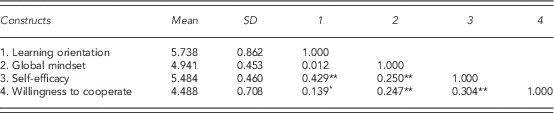
Table 1 shows the descriptive statistics of the study constructs. Of all four constructs, learning orientation had the highest mean (5.738), while willingness to cooperate in virtual teams received the lowest mean value (4.488). In terms of the correlations among the constructs, except for the correlation value between learning orientation and global mindset, the correlations were statistically significant (p<.05) among the constructs.
Descriptive statistics and correlations for the study constructs
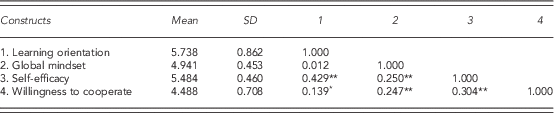
Note. *p<.05; **p<.01
Hypothesis testing
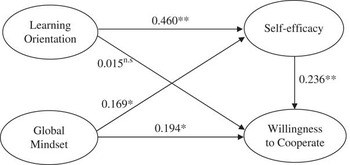
To test the hypotheses initially proposed, we used Amos 21.0 to conduct structural equation modeling. The path diagram of the structural model is demonstrated in Figure 1. The model fit indices demonstrate a good-fit model. Specifically, the current study has χ2/df value of 1.190 and p-value of .130, which are associated with a good-fit model (Hair et al., Reference Hair, Anderson, Tatham and Black1998; MacLean & Gray, Reference MacLean and Gray1998). Additionally, the study has a normed fit index=0.970, goodness-of-fit index=0.951, root mean square error of approximation=0.029, adjusted goodness of fit index =0.928, and Tucker-lewis inde)=0.994, suggesting that the model fits well (Hu & Bentler, Reference Hu and Bentler1999).
The path diagram of the structural model. *p<.05; **p<.01; n.s.=not significant

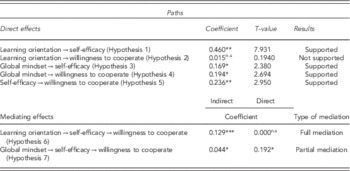
Hypothesis 1 tested the relationship between learning orientation and self-efficacy and was supported (β=0.460; p<.01). In contrast, Hypothesis 2, which tested the relationship between learning orientation and willingness to cooperate in virtual teams, was not supported as the β was 0.015 and p-value was .822 (p>.05). The hypothesized relationship between global mindset and self-efficacy (Hypothesis 3) was supported as the β was 0.169 and p had the value of .031 (p<.05). Similarly, the relationship between global mindset and willingness to cooperate in virtual teams (Hypothesis 4) was also supported (β=0.194; p<.05). Finally, Hypothesis 5, which examined the relationship between self-efficacy and willingness to cooperate in virtual teams, was also supported (β=0.236; p<.01).
In order to test the mediating effect of self-efficacy on the relationship among learning orientation, global mindset, and willingness to cooperate in virtual teams, we conducted a bootstrapping test with a bootstrap sample of 5,000. The results, presented in Table 2, show that self-efficacy has a full mediating role in the relationship between learning orientation and willingness to cooperate in virtual teams (β=0.129; p<.001). Therefore Hypothesis 6 was supported. Self-efficacy was also proven to partially mediate the relationship between global mindset and willingness to cooperate in virtual teams (β=0.044; p<.05). Accordingly, Hypothesis 7 was supported.
Standardized estimates from the structural model

Notes. χ2=84.514 (df=71, p=.130); RMR=0.020; GFI=0.951; AGFI=0.928; RMSEA=0.029; NFI=0.970; IFI=0.995; TLI=0.994
*p<.05; **p<.01; ***p<.001
DISCUSSION AND CONCLUSION
The study investigated the effects of learning orientation and global mindset on employees’ willingness to cooperate in virtual teams and the mediating role of self-efficacy in these relationships. First, the current study proved that learning orientation is positively related to self-efficacy. This finding is similar to those presented by Gist (1987) and Sujan, Weitz, and Kumar (Reference Sujan, Weitz and Kumar1994) who addressed the relationship between learning orientation and self-efficacy in conventional contexts and stated that learning orientation enhances self-efficacy. With these findings, we conclude that virtual team members with learning orientation tend to become more self-efficacious in regard to working with their virtual teammates from dispersed places. The possible reasons for this could be that learning orientation helps virtual team members develop their competences (Porter, 2005) and buffer the effects of failures during the cooperation processes (Button, Mathieu, & Zajac, Reference Button, Mathieu and Zajac1996).
Second, the study indicates that learning orientation is not related to willingness to cooperate in virtual teams, which is contrary to studies presented by Dweck and Leggett (1988) and Donavan et al. (2004) as those studies showed a positive connection between learning orientation and willingness to cooperate with organizational members. One possible explanation for this difference in the findings is that the nature of the virtuality of working teams may exert strong impacts on employees’ willingness to cooperate with other team members. Team members tend to have an uncertainty about others’ behaviors and intentions in virtual teams (Handy, Reference Handy1995); hence, they feel less psychologically safe in regard to cooperating with others (Griffith & Neale, Reference Griffin, Neal and Parker2001) even though they have learning orientation.
Third, consistent with the findings presented by Adler and Bartholomew (Reference Adler and Bartholomew1992), Dekker (Reference Dietz-Uhler and Bishop-Clark2013), and Luthans, Youssef, and Avolio (Reference Luthans, Youssef and Avolio2007), our study shows that the global mindset is positively related to self-efficacy. Accordingly, virtual team members with a high degree global mindset are more self-efficacious in regard to working with other members in virtual teams. Possible factors leading to this positive relationship may come from the capability to handle tensions and possess the broader perspectives that accompany the global mindset (Rhinesmith, Reference Rhinesmith1992; Kedia & Mukherji, Reference Kedia and Mukherji1999; Dekker, Reference Dietz-Uhler and Bishop-Clark2013).
Fourth, global mindset was found to have direct and positive influences on willingness to cooperate in virtual teams. This finding supports the view point proposed by Rhinesmith (Reference Rhinesmith1992) that people with global mindsets seek to be open and willing to cooperate with others. Ourempirical results add to the existing literature by offering solid evidence on the positive link between global mindset – a specific personality characteristic – and willingness to cooperate in virtual teams. This result may be useful for organizations when they consider the criteria by which to choose virtual team members. To be more precise, while organizations are often encouraged to carefully consider a set of personal qualities when selecting virtual team members (Hurn & Jenkins, Reference Hurn and Jenkins2000), they may face difficulty measuring some characteristics like flexibility, adaptability, and the ability to think both globally and locally. Our study specifies that the global mindset can be a significant construct that organizations should pay attention to when attempting to enhance employees’ willingness to cooperate in virtual teams.
Fifth, self-efficacy was found to be positively related to willingness to cooperate in virtual teams. This results mirrors those presented by Agarwal (Reference Agarwal2003) and Black, Morrison, and Gregersen (Reference Black, Morrison and Gregersen1999) who found that self-efficacy determines the degree of cooperation in virtual teams. Our study suggests that members’ willingness to cooperate in virtual teams can be improved with an increase in employee self-efficacy.
Finally, self-efficacy serves as a mediator in the relationship among learning orientation, global mindset, and willingness to cooperate in virtual teams. This role is particularly important, especially when we detected no direct relationship between learning orientation and willingness to cooperate in virtual teams. As such, learning-oriented individuals do not tend to have a high willingness to cooperate with teammates in virtual teams unless they have high self-efficacy.
Our study has four theoretical implications. First and foremost, this study provides an understanding of the personal characteristics influencing employees’ willingness to cooperate in virtual teams. This area has received little attention in prior studies of virtual teams. Our results show that individuals’ self-efficacy lets them cooperate with virtual team members, particularly when they have learning orientation and global mindset. Thus, these individual characteristics may improve the performance of virtual teams, which have significantly different organizational structures and boundaries from conventional face-to-face teams.
Second, this study extends research on learning orientation and the global mindset. The results suggest that learning orientation does not always lead to positive work outcomes such as a willingness to work in virtual teams. The term global mindset has been mostly used by researchers to refer to a pursuit at the organizational-level (Paul, Reference Paul2000; Begley & Boyd, Reference Begley and Boyd2003) and a characteristic of senior managers (Oddou, Mendenhall, & Bonner Ritchie, Reference Oddou, Mendenhall and Bonner Ritchie2000; McCall & Hollenbeck, Reference Martins, Gilson and Maynard2002; Levy et al., Reference Levy, Beechler, Taylor and Boyacigiller2007; Ananthram & Nankervis, Reference Ananthram and Nankervis2014). Unlike previous studies, our research explored the global mindset at the individual-level in virtual teams.
Finally, the study explored the mediating role of self-efficacy in the context of virtual teams. The findings from this study may inspire researchers to explore underlying mechanisms, such as a mediating role of self-efficacy, when they examine a variety of relationships, especially when direct relationships are not likely to be captured.
With regard to managerial implications, when forming virtual teams, managers need to consider both the employees’ technical expertise and their personal characteristics, which are akin to technical expertise. Managers need to be aware that selecting team members on the basis of learning orientation alone does not guarantee their willingness to cooperate in virtual teams. In contrast, more attention is needed on members’ global mindsets because global mindset directly influences willingness to cooperate in virtual teams, as indicated by our findings. As such, managers should assess employees’ self-efficacy and favorably select employees with a high level of self-efficacy. In addition, firms and managers provide favorable conditions in which to foster self-efficacy. In light of Gist and Mitchell’s (Reference Gist and Mitchell1992) model of self-efficacy development, managers need not only assign suitably challenging tasks to employees, but also have timely rewards. For instance, managers may organize virtual reward ceremonies to reward virtual team members’ contributions. In addition, increasing local managers’ awareness of virtual team members’ contributions may be a useful way (Malhotra, Majchrzak, & Rosen, Reference Maznevski and Lane2007) to improve virtual team members’ self-efficacy, and ultimately, their willingness to cooperate in virtual teams.
Although this study offers several implications, we should acknowledge some research limitations. First, we measured global mindset by focusing on employees’ global openness. Although managerial behaviors such as the decision-making process were not part of our research focus, future research might assess global mindset in a comprehensive way including both global openness and decision-making behavioral aspects of global mindset (Rhinesmith, Reference Rhinesmith1992). Furthermore, future studies should explore the systematic effects of global mindset by considering a comparative analysis between managers and employees, which was not the focus of this study.
The second limitation lies in the scope of the study. While we included two elements of goal orientation – that is, learning orientation and performance orientation (Kaplan & Maehr, Reference Kanawattanachai and Yoo2007) – the present study only focused on the former and the latter was excluded from the study. Therefore, we call for future research that explores the relationship between performance orientation and employees’ willingness to cooperate in virtual teams. Researchers may also want to focus on other possible personality characteristics and the cultural characteristics of teams as they both relate to cooperation within virtual teams. This this area may be fertile ground for future studies.
CONCLUSION
While we found that the global mindset had a significant and positive impact on team members’ willingness to cooperate in virtual teams, learning orientation was insignificant to this process. We also found that self-efficacy in virtual team members had a direct impact on willingness to cooperate and positive mediating effects on both learning orientation and the global mindset. We consider the empirical treatment of the effect of the global mindset and other individual characteristics on willingness to cooperate in virtual teams. This study suggests that managers should recognize how team members’ individual characteristics influence the formation of cooperative team climates in virtual teams.