Drafting an international agreement is difficult. Negotiations typically take many years and include representatives from hundreds of states. If an agreement is reached, it often involves major compromises. Provisions that experts consider important are watered down, or even omitted altogether. To reach a compromise, negotiators often replace firm language with flexible language: they make controversial terms vague or optional and introduce caveats and conditions.Footnote 1
How much do these compromises in agreement language affect the chances that the agreement will produce the results that negotiators desire? Some theories imply that variation in agreement language will matter little because international agreements generally have small effects on states' choices.Footnote 2 These theories predict especially small effects in the human rights field because mechanisms that could drive compliance in other areas—such as reciprocity, reputation, and retaliation—are unlikely to influence a state's conduct toward its own residents.Footnote 3
Other scholars, and many international negotiators, expect all agreement provisions—even flexible ones—to have some effects on states' behavior.Footnote 4 In these accounts, precise language without any options or caveats is most likely to influence states because it can prevent self-interested interpretations. Imprecise language, with caveats or options, functions as a second-best solution that triggers smaller but still positive changes in states' behavior.Footnote 5
We introduce a third theoretical possibility and argue that variation in agreement language can have large and unintended consequences. When an agreement specifies some tasks firmly, some flexibly, and does not mention others, governments may respond strategically, redirecting efforts toward firmly specified tasks, and away from flexibly specified or omitted tasks. When tasks are specified using precise and unconditional formulations, there is less room for dispute about the adequacy of implementation efforts. If a government ignores a firmly specified task, foreign and domestic monitors can easily spot the discrepancy and withhold agreement benefits. Governments face the strongest incentives to focus on firmly specified tasks when they face tight constraints in an issue area, but want to signal that they are performing at the international standard. Flexible language can therefore induce some states to move in the opposite direction from what an agreement's drafters intended.
However, these theories, and theories about agreement form more generally, are difficult to test empirically. To assess the impact of agreement language on states' choices, researchers must hold constant the substantive importance of agreement provisions. Yet, if language is a tool for reaching compromise, firm language will often be associated with provisions of minor substantive importance. If governments comply swiftly with provisions that employ firm language, it is hard to tell if this is because of the firm language, or because these provisions called for only minor substantive change.
We move away from this conundrum by focusing on an agreement that was negotiated in an unusual way, leaving governments almost no opportunity to dilute the language of controversial terms. As a result, provisions of comparable substantive importance ex ante were sometimes specified in firm language and sometimes expressed in flexible language. Moreover, because the agreement we study is a nonbinding UN General Assembly resolution, it would be surprising to find it had any effects, much less effects traceable to linguistic variations in individual provisions.
We examine the influence of the Paris Principles, an agreement that calls on all countries to establish a National Human Rights Institution (NHRI), and specifies how these institutions should be designed.Footnote 6 NHRIs are independent regulatory agencies created to protect human rights.Footnote 7 Most NHRIs can receive individual complaints by harmed parties and can either help steer them through the state's administrative mechanisms or, in some cases, review them in a quasi-judicial manner. Additionally, many NHRIs also play an active part in the law-making process by reviewing legislation and submitting recommendations.
Because NHRIs place important limits on government conduct, adopting an NHRI can impose significant costs on governments, especially on authoritarian governments that otherwise operate without much domestic monitoring. Case studies from diverse countries show that NHRIs have assisted torture victims in seeking redress before domestic and international courts, stewarded truth and reconciliation processes, improved legislation protecting vulnerable groups, mediated social conflicts, and mobilized public opinion on environmental rights.Footnote 8 That said, not all NHRIs are effective. Case studies indicate that NHRIs without institutional safeguards of independence and grants of power are less likely to make a mark.Footnote 9 NHRIs established in constitutions or national laws rather than through executive orders, or whose officials can be removed only for cause, are less vulnerable to political interference.Footnote 10 In turn, NHRIs with explicit powers to launch public inquiries, compel testimony or other evidence, and bring complaints to courts can pursue their mandate more effectively. As a leading commentator noted, when NHRIs without strong institutional safeguards were effective, “this was despite, not because, of their absence.”Footnote 11
We compiled an original data set of twenty-two institutional design safeguards in NHRIs in 107 countries. The Paris Principles prescribe some of these safeguards in firm language, which we characterize as “strongly recommended.” For other safeguards, the Paris Principles use flexible language; we label these “weakly recommended.” Finally, our data set also includes features that were omitted from the Paris Principles, although they existed in NHRIs that predate the agreement.
We seek to examine how small differences in the language of international agreements affect subsequent state behavior. To develop causal claims, we must reject the alternative hypothesis that states assigned strong recommendation status to provisions they expected to implement easily. We researched the origins of the Paris Principles—the drafters of the principles lacked the information, incentives, and capabilities to assign strong recommendation status to easy-to-implement features. Drafts of the principles submitted by negotiators, the minutes of the formal meeting, and interviews with key participants in an informal working group show that a handful of participants—who did not represent states—made decisions about what to include and exclude in three days and with very limited information. Strong recommendations, weak recommendations, and nonrecommendations were similar in key respects, including how prevalent recommended safeguards were in NHRIs established before Paris, how controversial they were at the Paris meeting, and how they were rated by experts.
Our quantitative analyses suggest that whereas both authoritarian and democratic states followed the Paris Principles' strong recommendations, authoritarian regimes likely ignored and may have even reduced their efforts on tasks that were weakly recommended. We first examine only NHRIs set up after Paris and find that strongly recommended features were much more likely to be included in these new institutions than either weakly recommended or omitted features; we see no differences between weak recommendations and omissions. Next, we compare NHRIs set up before Paris with NHRIs set up after Paris. These additional findings are more tentative because some country differences might remain. Nevertheless, the patterns are suggestive: strongly recommended features became more common among both democracies and authoritarian states, whereas weakly recommended and omitted features became rarer among authoritarian states. Finally, we analyze each of the twenty-two institutional safeguards separately, and show that nearly every strongly recommended feature that could increase in prevalence (because it had not already reached widespread prevalence before Paris) did increase, whereas this almost never happened for other features.
Our qualitative inquiry explores how policy-makers and human rights advocates referred to the Paris Principles as they designed national agencies. We focus on hard cases where there were competing templates for NHRI design. Interest groups pointed to firm language in the principles to pressure politicians to set up NHRIs with all the strongly recommended features. However, politicians also pointed to flexible language in the principles to exclude institutional safeguards common to NHRIs in their region.
Our findings suggest that the language of international agreements can have large consequences for subsequent state behavior, even when the entire agreement is nonbinding. When negotiators cannot agree on strong recommendations, they hope that weak recommendations are a good second-best option, and that a partial agreement will achieve some desired results.Footnote 12 Our data imply that weak recommendations may have no net effect on average and can even be used to undermine the agreement's goals in certain countries.
Our project contributes to human rights debates by shedding light on the origins and design of new monitoring bodies. We also add to the literature on compliance by studying state responses to individual agreement provisions rather than to entire agreements. Our findings suggest that small net effects on state behavior reported in prior work might not stem from governments' indifference to international agreements but from large strategic responses that push in opposite directions. We also add clear evidence to theories on norm diffusion and constructivism by identifying the precise time and place at which an international norm changed and how it spread around the world.
How the Language of International Agreements Shapes State Behavior
Prominent theories distinguish between three dimensions of the form of international agreements.Footnote 13 One dimension, legality, concerns states' formal obligation under international law to comply with a set of rules. Another dimension, delegation, describes whether an independent third party is entrusted with monitoring and enforcement. A third dimension, described in the legalization literature as precision, distinguishes between rules that unambiguously specify the content of the commitment and rules that are vague.
We build on this third dimension of the legalization literature and label the concept we study “flexibility in agreement language,” which includes three related linguistic techniques: vagueness, options, and caveats. To reach agreement, international negotiators can make controversial provisions vague and allow them to admit multiple interpretations, as the legalization literature posits.Footnote 14 Moreover, negotiators can make controversial provisions optional. Finally, negotiators can qualify states' commitment to comply and require compliance only if certain political, economic, and social conditions occur. All three techniques are commonly found in international agreements and are discussed in older international law literatures, but are not foregrounded in current international relations debates.Footnote 15 The linguistic formulations we emphasize are not the only tools that enhance state flexibility; other scholars use the term flexibility to refer to derogations, reservations, withdrawal, and opt-out clauses. The key difference is that each of these devices requires individual states to invoke them explicitly in specific times and circumstances, whereas the linguistic techniques we study are broadly available to states at many points in time. In short, we label agreement language as firm if it is precise, without options and conditions; we label agreement language as flexible if it is imprecise, or optional, or conditional; and we recognize that additional techniques can enhance an agreement's flexibility.
How does variation in agreement language shape subsequent state behavior? The sections that follow develop two theoretical arguments drawn from the existing literatures in international law and international relations, and introduce a third, novel, theoretical possibility. We also explain why all theories about the form of international agreements present empiricists with big challenges.
Why Variation in Agreement Language May Produce No Effects
Diverse scholars predict that international law rarely influences states' choices, and that nonbinding human rights agreements are especially likely to be ignored. Some suggest that international law seldom matters because states themselves choose the commitments they will be held to. In the course of drafting international agreements, states promise to complete only tasks they were planning to complete anyway.Footnote 16
Related literatures emphasize the weakness of global institutions. In the absence of a global police force, states comply with international agreements only when they expect concessions to be reciprocated and rewarded with future cooperation. States' interests in reciprocity, their concerns about their reputation, and their fears of retaliation can explain compliance in fields such as trade or arms control.Footnote 17 However, these mechanisms are less effective in fields such as human rights. Because human rights violations primarily harm a country's own residents, foreign states have limited incentives to identify and punish violations abroad.Footnote 18
Finally, nonbinding agreements are considered even less powerful than binding ones. International, regional, and domestic courts give limited weight to nonbinding sources. In addition, states can more easily discount nonbinding agreements as aspirational, without suffering reputational harms.Footnote 19
For these reasons, many scholars would be surprised to see a nonbinding human rights agreement produce effects. If the entire agreement has limited influence, it would be even more surprising to find effects traceable to variation in the language of individual provisions.
Why Variation in Agreement Language May Produce Moderate Effects and Lead to a Continuum of Influence
Other international relations theorists, and most international law scholars and practitioners, expect that variation in the form of an international agreement in general, and flexibility in agreement language in particular, shapes compliance. They expect that firm language will induce the biggest changes in state behavior, flexible language will induce smaller changes, while omissions are unlikely to influence states.Footnote 20 For example, Abbott and colleagues suggest that there exists “a multidimensional continuum.”Footnote 21 When international agreements score highly on each of the three dimensions of legality, monitoring, and precision, states are most likely to comply; weakening the agreement on any dimension lowers the likelihood of compliance.Footnote 22 Similarly, Chayes and Chayes argue that precise language is more likely to elicit compliance than ambiguous language.Footnote 23 Prior work is not crystal clear on why this is the case.
We hypothesize that when agreement language is firm—that is, precise, without options and qualifications—governments, international audiences, and domestic audiences can more easily agree on whether particular conduct meets the agreement standard. In contrast, vague language, as well as language introducing options and conditions, makes it harder for states and third-party monitors to concur on whether particular behavior conforms to the agreement. For example, whereas an obligation to destroy 1,000 tons of a dangerous chemical is precise, the obligation to destroy “substantial quantities” of the dangerous chemical is vague. One could debate whether a state that destroys 500 tons of the chemical is in compliance or not with the “substantial quantities” requirement. Optional provisions can similarly elicit debate. Optional provisions open with verbs such as “may” or “shall make efforts to,” instead of “shall” or “must.” Again, it is difficult to assess whether a state that destroyed 500 tons of a chemical has complied with an agreement indicating that the state shall make efforts to destroy 1,000 tons. Language that qualifies states' obligations to comply by conditioning compliance on certain criteria can similarly lead to disagreements. For example, an agreement may indicate that the state shall destroy 1,000 tons of the dangerous chemical as long as this is not inconsistent with its national security needs. Again, debate could follow about whether the destruction of 500 tons was appropriate, given particular security threats. International lawyers have written extensively about how vagueness, as well as conditions and caveats, have generated significant interpretation debates around prominent international agreements.Footnote 24
In short, firm language makes it harder for governments performing below the international standard to hide, and easier for governments performing at or above the international standard to shine. Other states, international organizations, and domestic constituencies can then more easily reward compliance and punish noncompliance. Although reciprocity and retaliation are rarely used in the human rights arena, other rewards and punishments are employed. Some types of international lending decline when UN bodies condemn a country's human rights practices.Footnote 25 Similarly, preferential trade access is sometimes linked to compliance with human rights agreements.Footnote 26 In addition, domestic advocacy groups can be especially convincing when they highlight clear discrepancies between international agreements and government practices.Footnote 27
For these reasons, and consistent with prior writings, we expect that firm language is more likely than flexible language to elicit compliance with an agreement's goals. However, existing theories of international agreements assume that any changes in the behavior of states will be in the direction the agreement's drafters intended. They expect that at best, flexible language will generate some limited compliance pull, while at worst, flexible language will have no effect.
Variation in Agreement Language May Produce Large Effects, Including Unintended Effects
We also develop a novel theoretical possibility: that flexible agreement language can sometimes lead states to behave in ways an agreement's drafters did not intend. An agreement that has both firm and flexible terms creates incentives for a government to focus its energies on tasks that are specified firmly. If a government ignores a firmly specified task, international and domestic monitors can easily identify the discrepancy and withhold some benefits. In contrast, if a government ignores a flexibly specified task, it could argue that it is still substantially in compliance with the agreement and should enjoy the promised benefits.
A government might redirect resources toward tasks that are specified firmly, and away from tasks that are specified flexibly (or entirely omitted), whenever the government finds it difficult to make progress across the board. Governments can redirect resources in many ways: for example, if an international agreement prioritizes human rights, states could cut back on environmental protection. Although many trade-offs are possible, we examine whether substitution happens within the issue area of the agreement, among items that could plausibly be included in the agreement. This narrower focus helps us study the practical questions negotiators face: whether to conclude an imperfect agreement or keep negotiating.
We expect any substitution effects to be concentrated among states that want to appear to conform to an agreement but find it costly to do so. For example, in the case of an arms control agreement, we expect states with many hostile neighbors to have the strongest incentives to focus on firmly worded agreement provisions and perhaps reduce their disarmament efforts in other ways.
In the case of an agreement concerning human rights monitors, we expect any substitution effects to be concentrated among authoritarian states. This is because authoritarian states want to impress domestic and international audiences with their human rights progress, but fear monitoring bodies that are too powerful. Authoritarian states have established a variety of partially independent institutions—notably courts—to satisfy foreign critics and build support among domestic constituencies.Footnote 28 While setting up judiciaries with some independence, authoritarian states prioritize regime stability and thus they limit court jurisdiction on sensitive issues, reduce claimants' access through tough standing rules, and in extreme cases, dissolve courts that displease leaders.Footnote 29
In designing NHRIs, authoritarian leaders could also behave strategically and offer only those institutional safeguards strongly recommended in the Paris Principles, while ignoring safeguards that were weakly recommended or omitted. This would be problematic because the Paris Principles, like many international agreements, call on states to make progress on multiple tasks, but do so imperfectly. Even the principles' drafters never believed they had identified the exact institutional safeguards all NHRIs should have, but simply listed some basic features, and encouraged countries to set up NHRIs in accordance with national conditions. The Paris Principles might thus induce unintended substitution effects that would be avoided if the agreement emphasized all important safeguards equally, and strongly recommended or weakly recommended or entirely omitted them all.
In short, this third theoretical possibility suggests that flexible agreement language could have different effects on different types of states. States that find it difficult to perform well in a policy area because of tight domestic policy constraints are especially likely to make trade-offs, and redirect their efforts on tasks that are inflexibly specified and away from tasks that are flexibly specified or omitted.Footnote 30 In contrast, states that find it easy to perform well in an issue area will have weaker incentives to substitute tasks in this way. In such states, even flexible agreement provisions may lead to policy change in the direction intended by the agreement's drafters because the international agreement may put a new item on their national agendas.
Empirical Challenges
Theories about agreement form present empiricists with huge challenges. To assess the impact of agreement form on state behavior, a researcher should hold constant the substance of the agreement—that is, whether the agreement calls for major or minor deviations from what states would otherwise do. However, states typically trade off form and function when they negotiate. When an agreement requires major substantive change, states often weaken its form and make it nonbinding, flexible, and lacking in monitoring.Footnote 31
Such trade-offs between form and substance complicate identification strategies. In a large cross-section of international treaties, we would expect a positive correlation between firm language and high compliance. However, we would not be able to determine whether firm language causes high levels of compliance, or whether firm language is reserved for modest substantive commitments. Scholars in the legalization literature recognize that “there is considerable difficulty in identifying the causal effects” of agreement form on state behavior.Footnote 32 Although they compare human rights agreements with agreements governing other issues, such as trade and arms control, they acknowledge that it is difficult to hold all else constant, and that “these examples do not provide a true empirical test of our theory.”Footnote 33
A unique opportunity to identify whether states around the world respond to variation in agreement form arises from the Paris Principles. When outlining features for effective NHRIs, the principles provide strong recommendations in some cases—expressed in precise, nonoptional, and unqualified language—and weak recommendations in others. Other features that experts consider important were entirely omitted from the principles. Because of an extraordinary set of events surrounding their negotiation, the principles assign strong or weak recommendation status to various features in ways that are unlikely to influence the likelihood that states will later adopt these features. By focusing on the language used in different provisions of the same international agreement, we are able to hold constant other elements of an agreement's form that also influence compliance.
States often choose not only the terms of an international agreement but also whether or not to join the agreement. However, for many nonbinding agreements, there is no step similar to accession through ratification; UN General Assembly resolutions such as the one we study are addressed to all states. Thus, we never compare countries that ratify with countries that do not and so sidestep a selection issue that complicates other work.Footnote 34 Instead, we compare a country's behavior to itself, using fixed-effects models, by studying twenty-two separate NHRI safeguards, only some of which were prioritized in the agreement. We also compare countries that adopted NHRIs before and after the international agreement; these specifications are more tentative.
We can test our hypothesis that states prioritized firmly worded provisions, and treated flexibly worded provisions no differently from omissions, among only countries that chose to adopt NHRIs. However, we expect that the patterns we report would be even sharper if more countries had adopted NHRIs. This is because our theory and available data suggest that trade-offs between firm and flexible provisions are sharpest for countries that find it costly to adopt NHRIs. It is likely that countries finding it costly to adopt NHRIs are overrepresented among nonadopters, relative to adopters. We explore these patterns further in the sections that follow, and in the online appendix, which studies nonadopters.Footnote 35
The Paris Negotiations and the Paris Principles
In this section, we introduce the Paris Principles and describe how this unusually negotiated agreement allows us to make significant progress in disentangling the causal effect of agreement language.
Negotiating the Paris Principles
In a typical international negotiation, states have the information, capacities, and incentives to assign flexible language to provisions they expect to be difficult to implement. In contrast, negotiators in Paris had little information, only three days, and few incentives to dilute the language of difficult-to-implement provisions. This original historical narrative helps us reject the alternative hypothesis that features assigned strong recommendation status were given this status because they were especially easy to implement.
Prior to the 1991 meeting in Paris “there were virtually no limitations on the definition of a national human rights institution.”Footnote 36 Indeed, a leading expert recalls that the term “NHRI” was simply not in circulation then.Footnote 37 Institutions that would later be labeled NHRIs varied dramatically in form.
With the benefit of hindsight, we now see two loosely defined NHRI archetypes in 1991: the commission and the ombudsman. A human rights commission has a broad mandate, is composed of multiple representatives with human rights expertise, including civil society representatives, and typically researches entire situations and advises on legislation. By contrast, the ombudsman model involves a single appointee, empowered to investigate individual citizens' grievances against the administration.
Before 1991, UN bodies had sought to harmonize and promote the NHRI concept, to close big gaps between international human rights treaties and human rights practices on the ground. However, Cold War politics made this difficult. In 1978, the UN Human Rights Commission convened a meeting on NHRIs that resulted in draft guidelines. But there was an impasse because the US civil rights commission model was very different from the procurador system found in socialist countries. So the document languished because neither the Human Rights Commission nor the General Assembly endorsed these draft guidelines.Footnote 38
The end of the Cold War elevated human rights in the international agenda and prompted the UN to revisit the question of NHRIs. In a typical human rights treaty negotiation, representatives from hundreds of states take almost a decade to hammer out compromises.Footnote 39 Fully aware that some international obligations may involve costly domestic reforms, diplomats submit carefully crafted proposals that preserve leeway for their governments on matters of national importance.
When the UN Human Rights Committee convened a workshop on NHRIs in 1991, its plans were modest. The objective was to “encourage existing National Institutions to step up their action” and to enhance cooperation among them.Footnote 40 Few expected a concrete outcome document to result from the workshop, and thus many governments chose not to participate.Footnote 41 The meeting took place over three days in Paris. Fifty individuals from thirty-five countries attended, representing various national institutions, nongovernmental organizations (NGOs), UN agencies, regional human rights bodies, and a small number of governments.Footnote 42 There was no precedent for global NHRI peer-to-peer meetings and most participants were encountering colleagues from other regions for the first time.Footnote 43
“Everyone was surprised that the Paris Principles came out of the [Paris] meeting,” Chris Sidoti, a leading NHRI practitioner, recalls.Footnote 44 Multiple factors, including the meeting's stated goals, the diversity of the participants, and the fact that these actors were meeting for the first time for only three days, posed formidable challenges to achieving any consensus on a defined set of NHRI characteristics.Footnote 45
Among the recognizable NHRIs in attendance, two commission models were especially well represented in Paris. First, because the meeting took place in Paris, the French delegation was the largest in size, set the agenda, and ensured crucial negotiations took place in French. Unsurprisingly, features of the French NHRI, an advisory commission, gained heightened prominence in the final text. Also, the Australian NHRI Commissioner had come prepared with a draft document, based on the recently established Australian commission. This happened to be a quasi-judicial human rights commission, and its features gained special consideration. In fact, while individuals from thirty-five countries attended the plenary session, interviews with key participants indicate that a working group of only four NHRI representatives (from Australia, France, Mexico, and the Philippines) drafted a document behind the scenes. Minutes of the meeting and interviews suggest that the first two days of the meeting were devoted to statements about how existing NHRIs worked. Then, the draft Paris Principles prepared by the working group suddenly appeared on the final day and were unanimously adopted in plenary without debate.
The Paris Principles' genesis shaped their content. The absence of a formal diplomatic process with the requisite support and expertise, combined with extreme time pressure, ensured these negotiators made a number of mistakes. Some are simple translation errors, but others are fundamental. Significant mistakes include the relegation of features typical of Latin-American ombudsmen to weak recommendations and to omissions. In Paris, the experts promoted the advisory and quasi-judicial commission models rather than the ombudsman model because human rights ombudsmen from Latin America were severely underrepresented at the Paris meeting, and other participants did not know enough about human rights ombudsmen to promote their features. As someone close to the negotiation process highlights: “it was a different time … we didn't have Google, we literally did not know that the Spanish Defensor del Pueblo existed.”Footnote 46 Moreover, European “classical” ombudsmen, with a more limited human rights mandate than Latin American “human rights” ombudsmen, made statements at the meeting that led some participants to believe that ombudsmen in general were not well suited to address human rights concerns.Footnote 47
Few, if any, of the Paris meeting participants would have predicted that a year later the Human Rights Commission would endorse the principles, and two years later, in December 1993, the UN General Assembly would do the same, without modification.Footnote 48 Observers speculate that many delegations were simply not aware of what they were endorsing. If the resolution had been subject to debate and a vote it may have been blocked. As it was, the resolution—like many General Assembly resolutions—passed without a vote.
In sum, in a normal treaty-drafting process, with hundreds of countries negotiating over many years, we would expect the final document to reflect key compromises among powerful states. But the significant time pressures and unusual composition of the Paris meeting generated an atypical document. Because the drafters of the Paris Principles lacked the incentives, information, or capabilities to assign easy-to-implement features to the strongly recommended category, we are less worried that selection effects drive our subsequent results.Footnote 49
The Content of the Paris Principles: NHRI Institutional Design Safeguards
Although individual safeguards vary in substantive importance and in ease of implementation, on average, strongly recommended features are no less important or more difficult to implement than features that were weakly recommended or omitted. We thus provide further evidence disconfirming the alternative theory of selection effects.
Our data set of NHRIs in 107 countries codes NHRI institutional structures at the time each NHRI was established. NHRI institutional design is quite stable over time; we examine some changes through qualitative case studies. The twenty-two features were selected based on the minutes of the Paris meeting, the text of the Paris Principles, an extensive review of NHRI scholarly and practitioner literature, and consultation with leading NHRI practitioners. Prior research examines NHRI adoption as a binary variable;Footnote 50 our data set is thus significantly more fine-grained. Data were coded by law students who were provided with a codebook and detailed guidance to ensure NHRI charters were coded in conformity with the coding rules. The data were drawn from a variety of sources, principally NHRI compendia and institutional charters contained on official websites and state outlets. Where necessary, historical records were used.
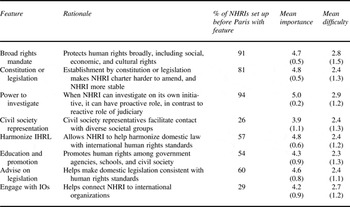
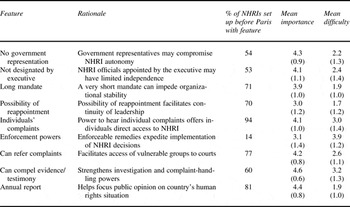
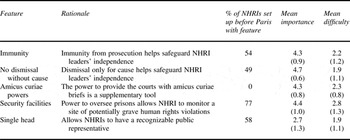
Because the Paris Principles call on all states to establish NHRIs and emphasize particular institutional safeguards, compliance with this agreement involves the establishment of an agency with these safeguards, rather than a reduction in arbitrary detention, an expansion of religious freedoms, or the improvement of living conditions for minority communities. That said, we focused on institutional safeguards considered consequential for NHRI effectiveness on the ground. Many features we study protect NHRI independence by limiting the power of the executive to disestablish the institution, fire its members, or pack it with pro-executive appointees. Other safeguards ensure that the agency has the formal power to take monitoring actions that governments could have otherwise blocked. Tables 1A to 1C list the twenty-two safeguards we studied and briefly describe how each safeguard could contribute to NHRI effectiveness.Footnote 51

The Paris Principles: Weakly recommended features

The Paris Principles: Features not mentioned

The goal of our study is not to assess whether NHRIs with particular safeguards are especially able to improve human rights practices on the ground; we are devoting a separate paper to this critical question. However, our theory assumes that NHRIs have some impact—more specifically, that adopting an NHRI with many institutional safeguards is somewhat costly for governments, especially governments of authoritarian states.Footnote 52 To better assess the performance of NHRIs on the ground, we conducted an expert survey among NHRI heads and others with extensive knowledge of NHRIs.Footnote 53 Thirty-six of the sixty experts we contacted (60 percent), drawn from all five continents, completed the survey. Respondents rated the effectiveness of various NHRIs in different countries. We found that NHRIs that incorporated more of the twenty-two safeguards in their design were rated more effective. This positive correlation holds when we limit our sample to authoritarian states and when we break down our data by region. This suggests that institutional design is positively linked to effectiveness on the ground, but we plan to investigate this question in more detail in further work.
We characterize a feature as strongly recommended if the relevant language in the Paris Principles is precise, nonoptional, and unqualified. Accordingly, we code a feature as weakly recommended when it comes with language that is either vague, or optional, or imprecise (or a combination). Features that were on the agenda in the Paris meeting, but not included in the final document because of time pressures, are coded as omitted. Classifying individual provisions is relatively straightforward because the principles mainly use the modal verb shall to preface strong recommendations and may to preface weak recommendations. Nevertheless, there is some subjectivity in the classification so we asked another international law scholar to recode the provisions. Twenty-one of the twenty-two provisions were placed in the same categories, giving us very high intercoder reliability (Krippendorff's alpha = 0.93).
Although each of the safeguards in Tables 1A to 1C can help an NHRI perform its mission effectively, not all are equally important or easy to implement. If relatively unimportant and easy-to-implement features were especially likely to be strongly recommended, this would give credence to the alternative theory of selection effects. We assess this alternative hypothesis.
Features that were prevalent in NHRIs established before Paris may have been especially important to effective NHRI function, or especially easy for governments to adopt. Yet both common and rare features ended up strongly recommended, weakly recommended, and omitted from the Paris Principles. On average, NHRIs established before Paris had 62 percent of features that ended up strongly recommended, 64 percent of features that ended up weakly recommended, and 48 percent of features that were omitted.Footnote 54
Institutional features considered important or hard to implement might have attracted increased attention or controversy during negotiations in Paris. To identify these features, we examined the minutes of the plenary.Footnote 55 Overall, strongly recommended features were no less controversial than weakly recommended ones. Strongly recommended features had an average controversy score of 0.63, weakly recommended features had a score of 0.67; the difference in means is small and not statistically significant. Features in the “not mentioned” category were not discussed because of time constraints.Footnote 56
Pre-1990 efforts to create a global NHRI template can also help determine whether some institutional features were understood as critical, and thus received “strong recommendation” status in the principles. In particular, the discarded 1978 UN template provides a set of features that had attracted states' attention before the Paris meeting. Yet we find no association between the two documents: included in the 1978 UN template were 75 percent of the strongly recommended features in Paris, 56 percent of the weakly recommended features, and 80 percent of the omitted features.Footnote 57 This suggests that the Paris Principles did not reflect a clear pre-1990 consensus on what safeguards NHRIs should include.
We also took advantage of the expert survey we discussed earlier to understand how institutional safeguards vary.Footnote 58 According to the average expert ratings, features strongly recommended are no less important than weak recommendations or features not mentioned, and no easier to implement. More specifically, experts consider strongly recommended features to be slightly more important than weakly recommended ones. On a five-point scale, where 5 is very important, strongly recommended features receive a score of 4.5, weakly recommended features a score of 4.0, and features not mentioned a score of 4.1. The difference between the mean importance of strongly and weakly recommended features is significant at the 0.05 level. On a five-point scale where 5 indicates that a feature is very difficult to implement, our experts gave strongly recommended features a score of 2.54, weakly recommended features a score of 2.53, and features not mentioned a score of 2.22. The difference between strongly recommended features and features not mentioned is significant at the 0.10 level. Nevertheless, these differences are not consistent with an alternative theory based on selection effects; that is, the alternative theory would predict that strongly recommended features would be less important and easier to implement than other features. Because our survey was fielded after the Paris Principles were adopted, and could thus be influenced by the principles, we give less weight to this measure. With these caveats, we include our expert survey data in Table 2, to offer a clear picture of how experts view each safeguard.
NHRI feature adoption: Only countries adopting NHRIs after Paris

Notes: Cell entries are logit coefficients, followed by robust standard errors clustered by country in parentheses. * p < .10; ** p < .05; *** p < .01.
In short, we could not find evidence to support the alternative theory of selection effects. We find that a global template available before Paris, and features common to institutions established before Paris, do not correlate with the assignment choices made in Paris. We also see that strongly recommended features were no less controversial at the Paris meeting than other features. Our expert survey also did not suggest that strongly recommended features were especially easy to implement or unimportant. Each of these tests has important limitations, but put together, they increase our confidence that strongly recommended features were not systematically different from weak recommendations in ways that could speed up their later adoption by diverse governments.
Instead, accidents of the negotiating process seemed to determine the category to which particular provisions were assigned. To the extent that we can identify any pattern, we note that features rarely found in commissions, but common in ombudsmen, were more likely to be weakly recommended or omitted. But this did not reflect a consensus view that commissions or ombudsmen were better at protecting human rights, or more costly or challenging for governments to introduce. Instead, this assignment simply reflects the fact that participants at the Paris meeting had limited knowledge of the ombudsman model.
The Impact of the Paris Principles on State Behavior: Quantitative Analysis
Using an original data set of twenty-two features of 107 NHRIs, we study whether countries that adopted NHRIs after the Paris meeting followed the principles' recommendations in establishing new institutions. Next, we compare the design of NHRIs established before and after Paris. In the online appendix, we examine each of the twenty-two features separately and conduct robustness checks that exclude particular features to check whether a few unusual features drive our aggregate results.Footnote 59 Each of these analyses indicates that strong recommendations influenced countries significantly more than weak recommendations or omitted features, that weak recommendations were no different from omissions, and that distinctions between strong and weak recommendations were especially sharp for authoritarian states. The last two analyses suggest that, compared with authoritarian states adopting NHRIs before Paris, authoritarian states adopting NHRIs after Paris included many more strongly recommended features, and many fewer weakly recommended and omitted features. However, this last inference is more tentative because it is based on comparisons of NHRIs in different countries and we may not be able to fully control for every relevant country characteristic.
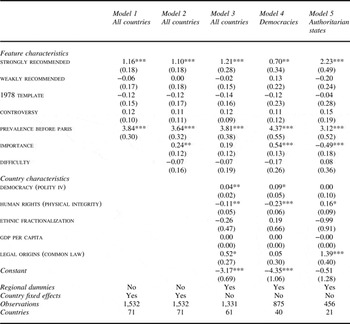
First, we study only countries that adopted NHRIs after Paris. The dependent variable is whether a country adopted a safeguard (1) or not (0). Thus, we present pooled logit models; ordinary least squares (OLS) models yield very similar results. We report robust standard errors, clustered by country. Models in Table 2 estimate whether safeguards that were strongly or weakly recommended in the principles were more likely to be adopted compared with safeguards not mentioned in the principles (the omitted category). Estimates of the relative effects of strong recommendations are very similar when we use weak recommendations as a baseline (and exclude omitted features).
Model 1 includes country fixed effects, as well as three feature-level variables—whether a feature was included in a 1978 template, how controversial it was at Paris, and how prevalent it was in NHRIs set up before Paris. Model 2 also includes two feature-level variables that were measured after the Paris Principles—experts in 2013 considered how important and difficult to implement particular features were. Model 3 removes the country-level fixed effects to explore what types of countries were likely to adopt NHRIs with more of the features we study.
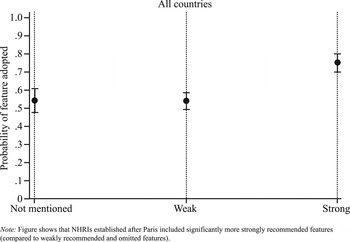
Across specifications, we find that strong recommendations had statistically and substantively significant effects, whereas weak recommendations made no difference. For example, Model 3 shows that whereas the probability that a country adopts a feature omitted from the Paris Principles is 0.54, the probability increases to 0.75 if the feature is strongly recommended, holding all other variables at their mean. Figure 1 graphs these predicted probabilities. Similarly, each model indicates that features that were common in institutions established before Paris were common in institutions set up after Paris. NHRIs set up after Paris, Model 2 tells us, are also slightly more likely to include features experts consider important, but this result is tentative because we conducted our expert survey after the Paris Principles were adopted. In Model 3, we include country- and region-level controls, and discuss these in the online appendix.Footnote 60
Features adopted by all countries after Paris

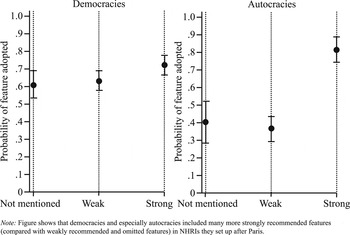
Although both democracies and authoritarian states responded to the Paris Principles' strong recommendations and ignored their weak recommendations, authoritarian governments responded much more than democracies. Specifically, Model 4, which limits our sample to democracies, shows that among democracies, the probability of adoption of an omitted feature is 0.61, and increases to 0.72 for a strongly recommended feature. Model 5 shows that among authoritarian states, the probability of adoption of omitted features is 0.40, and it increases to 0.81 for strongly recommended features. Figure 2 presents these predicted probabilities. Authoritarian states may desire weak monitoring bodies, but they may find themselves exposed to strong criticism of their practices. To balance these two competing pressures they could design institutions that have almost every feature that is strongly recommended by the Paris Principles, but few other safeguards.
Features adopted by democracies and authoritarian states after Paris

We also study the influence of the Paris Principles by comparing countries that adopted NHRIs before the Paris Principles with countries that adopted them afterward. This comparison requires us to carefully consider how differences in the characteristics of countries in the before and after group could influence our results. If countries that are richer, more democratic, or more protective of human rights are overrepresented among the early adopters of NHRIs, and wealth, democracy, and human rights levels lead countries to adopt strong NHRIs with more safeguards, we should see a decrease in the prevalence of all twenty-two NHRI features. Although this would influence our results, it would lead to a change across the board, rather than to an effect concentrated among strongly recommended features. Thus, most country-level differences would not lead us to conclude that agreement language matters, and would not lead us to find that strong recommendations have bigger effects than weak recommendations, or that weak recommendations have bigger effects than no recommendations.
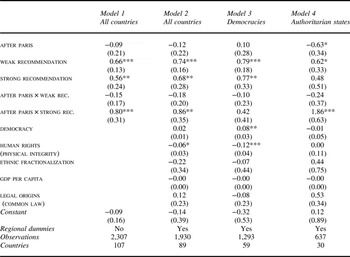
It turns out that countries that established NHRIs before Paris are very similar in their levels of wealth, democracy, and human rights protection to countries that adopted NHRIs after Paris.Footnote 61 This makes the before/after comparison more plausible. In Table 3, Model 1 includes only the main theoretical variables of interest to us: the interactions between recommendation strength and adoption of an NHRI after the Paris meetings, and the component terms of these interactions. Model 2 also includes controls for democracy, human rights (physical integrity index), ethnic fractionalization, gross domestic product (GDP) per capita, a common law legal system, plus regional dummy variables. Models 3 and 4 repeat Model 2 results separately for democracies and authoritarian regimes. Our results are consistent across these and additional specifications.
Adoption of NHRI features: Countries adopting NHRIs before and after Paris

Notes: Cell entries are logit coefficients, followed by robust standard errors clustered by country in parentheses. * p < .10; ** p < .05; *** p < .01.
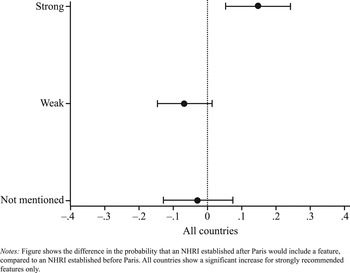
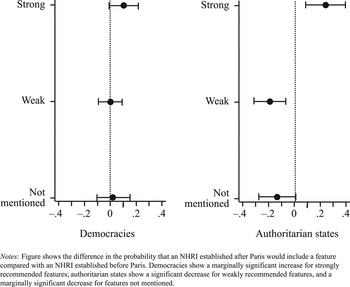
Figure 3 presents the change in prevalence of different safeguards, based on our main specification, Model 2. Features that were strongly recommended in Paris increased in prevalence; on average, and with all control variables held at their means, the probability that an NHRI established before Paris would have a strongly recommended feature was 0.63, and the corresponding probability for NHRIs established after Paris was 0.78, a highly significant increase of 0.15 (p < 0.01). In contrast, the probability that an NHRI established before Paris would have a weakly recommended feature was also 0.64, but fell to 0.57 for NHRIs established after Paris, a decrease of 0.07 that is marginally statistically significant (p < 0.10). Features that were not mentioned were just as prevalent before and after Paris.
Comparison of features adopted by all countries before and after Paris

Figure 4 illustrates a sharp difference between the responses of democracies and authoritarian states. The prevalence of strong recommendations increases somewhat among democracies. Among democracies, the probability than an NHRI established before Paris would have a strongly recommended feature was 0.65, compared with 0.75 for NHRIs established after Paris, an increase of 0.10 (p < 0.10). In contrast, the prevalence of weak recommendations does not change in democracies. For NHRIs established before Paris, the probability of inclusion of a weakly recommended feature was 0.65, which is the same as for NHRIs established after Paris. Similarly, the prevalence of features not mentioned in the principles also does not change among democracies.
Comparison of features adopted by democracies and authoritarian states before and after Paris

The increase in strongly recommended features is even more pronounced in authoritarian states. Among authoritarian states, the probability of inclusion of a strongly recommended feature increased from 0.58 in the before group, to 0.81 in the after group, an increase of 0.23 (p < 0.10). However, the prevalence of weakly recommended features falls sharply among authoritarian states. Among authoritarian states, for NHRIs established before Paris, the probability of including a weak recommended feature was 0.61, whereas it fell to 0.42 for NHRIs established after Paris, a decrease of 0.19 (p < 0.01). Similarly, the prevalence of features not mentioned in the Paris Principles declines among authoritarian states; the difference is marginally significant (p < 0.10).Footnote 62
To examine whether the effects we report are driven by a few unusual and unimportant features, we break down our data feature-by-feature in the online appendix,Footnote 63 and also rerun the models while excluding outliers. We find that the effects we report are generally homogenous within feature types. Indeed, almost every strongly recommended feature increases in prevalence, both in authoritarian states and in democracies, whereas this happens for few weakly recommended features or features not mentioned; this pattern strengthens the inference that strongly recommending a feature matters.
Case Studies
We selected cases unlikely to confirm our theory. “Least-likely” cases offer strong “support for the inference that the theory is even more likely to be valid in most other cases, where contrary winds do not blow as strongly.”Footnote 64 The Paris Principles are least likely to influence states that have a competing template available. Such alternatives to the Paris Principles often come from dominant regional paradigms and from former colonial relationships. We present evidence from Chile because the hybrid ombudsman model common to much of Latin America was a plausible alternative. In the online appendix, we present evidence from Ireland and Morocco because models common to the (British) Commonwealth and to the francophone world, respectively, were plausible alternatives templates.Footnote 65 Our case studies highlight that within each country, the language of the principles mattered to progressives and conservatives alike, and strong recommendations often got adopted whereas weak recommendations often did not.
Almost all Latin American countries now have NHRIs. Many NHRIs were established before the Paris Principles, and follow the Spanish hybrid ombudsman, or Defensoría del Pueblo model. Ombudsman offices are typically led by a single head and their main task is to investigate individual complaints. In addition, in much of Latin America, ombudsman offices are constitutionally entrenched and have no government representation. Without the Paris Principles, Chile would likely have followed the ombudsman model common in much of Latin America.
Instead, Chile followed the commission model promoted in Paris, and incorporated a number of institutional safeguards strongly recommended in the Paris Principles, but rare in Latin American NHRIs set up before Paris. These include civil society representation, an explicit mandate to engage with international organizations, and authorization to harmonize domestic law with international human rights standards. Indeed, compliance with the Paris Principles was a prominent concern for NHRI adopters in Chile, with the president of the republic emphasizing that the new law “takes into account comparative models and strictly adheres to the Paris Principles in light of our recent history.”Footnote 66
At the same time, Chile did not have a long and continuous history of democracy, unlike many democracies in our data set. Likely because of this recent history of authoritarianism, Chile's response to the Paris Principles was similar to that of some authoritarian states that declined to adopt safeguards that were only weakly recommended in Paris. Chile only emerged in 1990 from a protracted period of authoritarian government and the Pinochet regime remains highly controversial.Footnote 67 Chile's NHRI was created in only 2009 because conservative political actors stalled earlier efforts, worried that an NHRI might revisit the Pinochet era and advocate for repeal of the amnesty laws decreed by Pinochet prior to his departure from office.
The resulting NHRI structure bears the hallmarks of built-in authoritarian enclaves, designed to facilitate peaceful transition to democracy from authoritarian rule.Footnote 68 The Chilean NHRIs lack several features typical of Latin American ombudsmen and did not fully satisfy human rights advocates in Chile. For example, the Human Rights Centre of the University Diego Portales pointedly asked in its 2008 Annual Human Rights Report, “is the National Institute for Human Rights an authentic national human rights institution?”Footnote 69 A question of particular importance in NHRI design is whether they can receive individual complaints. Individual complaint-handling encourages NHRIs to directly engage with victims and provides marginalized groups with a rare point of access to official redress. Also, the accumulation of individual complaints may help in exposing systematic abuses. The Chilean Institute lacks this faculty, as well as other investigative prerogatives such as inspection powers.Footnote 70
Government leaders used the Paris Principles' weak recommendations to justify this omission. For example, the prominent socialist politician Antonio Viera-Gallo, serving at the time as the Minister Secretary General of the Presidency, argued that because the Paris Principles only weakly recommend individual complaint-handling, this tool was not necessary:
According to the Paris Principles, it is not indispensable that institutions of this kind have the faculty to receive complaints—there exist various [NHRIs] that do not have this facility—especially given that in our penal system the prosecutor's office holds a quasi-monopoly over such matters. What no one denies is that the Institute is entitled to denounce violations just like any other individual or entity, although, obviously, its denunciations would carry enormous political and juridical weight.Footnote 71
Indeed, civil society advocates and even UN representatives took the unusual position of arguing against the strict application of the international template because the regional template provided for more features than the international principles. Robert Garretón, the UN Representative of the High Commissioner for Human Rights in Latin America, argued that Chile would be the only Latin American country whose NHRI would not be able to receive individual complaints:
A National Institute for Human Rights with no mandate to receive and investigate complaints is not exactly what is needed for the citizen whose rights have been violated. In concrete terms, the project does not grant the Institute the ability to receive, process, investigate and adopt recommendations in respect to individual complaints. It would be the only NHRI in Latin America to lack these essential attributes.Footnote 72
Similarly, civil society advocates in Chile, such as Cecilia Medina, the director for the Center of Human Rights at the University of Chile, advocated that a margin of appreciation should be applied in Chile's interpretation instead of holding firmly to the integrity of the Paris Principles as design obligations:
The Paris Principles related to the status and functioning of national institutions for the promotion and protection of human rights … should not be understood necessarily as meaning that all of these attributes are to be found within one institution. The situation of each country will determine how the Principles are implemented.Footnote 73
Chile also disregarded other weak recommendations in the Paris Principles. For example, the Paris Principles only weakly recommend “no government representation,” and the Chilean NHRI is highly unusual in Latin America for the fact that the president appoints two of its seven council members.Footnote 74
In the end, the Chilean NHRI generally follows the Paris Principles closely on items that are strongly recommended, and top Chilean leaders take pride in noting that their institute is Paris Principles compliant. However, the Chilean case also illustrates that weak recommendations in the Paris Principles can empower opponents of strong NHRIs to argue that other safeguards are not essential. We see very similar patterns in Uruguay whose NHRI, also created in 2009, conforms closely to the letter of the Paris Principles and diverges from the more traditional Latin American ombudsman model.Footnote 75
Scope Conditions and Generalizability
Because our empirical strategy focuses on a single international agreement with an unusual negotiation process, it is important to explore how our results might generalize to agreements with other features. Whereas the Paris Principles are nonbinding, many international agreements are legally binding, and states may see compliance with any resulting obligations as especially important, or especially likely to be given heightened consideration by international and domestic courts. Moreover, we expect the distinction between may and shall, and firm and flexible language more generally, to matter more in a legally binding agreement because one can debate whether flexibly phrased provisions are legally binding. Also, the Paris Principles concern human rights; in other issue areas, the mechanism of reciprocity provides additional incentives for compliance. For example, a government can credibly propose that it will comply with a truce only as long as the enemy also complies, but cannot easily signal that it will protect its own residents' human rights only as long as another state reciprocates. These arguments each suggest that the Paris Principles were a hard test case for theories of compliance, and that we should find effects that are at least as large in other fields.
Another feature of the Paris Principles—their unusual negotiation process—could also influence generalizability. In many settings, such as negotiations between individuals, we might expect a close link between negotiation processes and compliance since bitter negotiations could sour subsequent implementation efforts. But in international negotiations, different branches of the state are often tasked with negotiation and implementation; for example, foreign ministry diplomats might negotiate an agreement and environmental ministry staffers might be called on to implement it years later as part of a different administration. Moreover, many small states often lack the capacity to participate meaningfully in negotiations; agreement terms can be treated as exogenous for such states. If negotiation and implementation are separable, an agreement that has the same terms should elicit the same type of compliance response, whether it was carefully negotiated or randomly designed. This (admittedly strong) assumption underlies existing empirical work on compliance because prior empirical work controls for the content of the agreement (as do we), but not for the negotiation process.
Nevertheless, it remains theoretically plausible that the process of agreement negotiation influences compliance. Most prominently, Franck argues that problematic negotiation processes reduce international agreements' compliance pull because the absence of ritual, pedigree, and symbolic validation can create the perception that an agreement is unfair and illegitimate.Footnote 76 If negotiation and compliance are closely interlinked, and governments called on to implement the Paris Principles were aware of and troubled by their limited role in the principles' drafting, then we should see even larger effects in agreements negotiated with more buy-in from states. That is, our finding that strong recommendations shape state behavior should be even more pronounced in other contexts. In contrast, our more tentative finding that weak recommendations are no different from omissions might not travel as well. Further research on how international agreements are negotiated, and on the relationship between negotiation and compliance, is much needed, especially because a small but growing number of agreements, especially nonbinding ones, are now drafted primarily by nongovernmental actors. In short, concerns about generalizability are somewhat mitigated by the fact that the Paris Principles constitute a hard test case for our theory.
Conclusion and Implications
This study documents a remarkable transformation in the world of human rights monitoring. In the early 1990s, the UN General Assembly proposed that all countries establish national monitoring bodies to help close the gap between human rights ambitions and uneven practices on the ground. NHRIs spread around the world—from approximately twenty before 1990 to more than one hundred today. Not only is the spread of NHRIs surprising but so is the growing homogeneity in their design. Before 1990, NHRIs took varied forms. Prominent examples included the commission model, which focused on shaping legislation, and the ombudsman model, which focused on processing individual complaints through the administrative state. For idiosyncratic reasons, the UN favored the commission model over the ombudsman model, and thus the commission model spread widely, even to parts of the world where ombudsmen had traditionally been powerful.
We find that negotiators' choices to strongly recommend particular NHRI safeguards were rushed and unexpected. Moreover, these recommendations were placed in a nonbinding General Assembly resolution, rather than in a legally binding treaty with strong implementation mechanisms. Nevertheless, both democratic and authoritarian governments in very different parts of the world, including in regions with prominent alternative templates for NHRI design, followed the Paris Principles' strong recommendations.
In contrast, negotiators' weak recommendations failed to produce the hoped-for results. Governments may have simply ignored weak recommendations. Our data are also consistent with a more disconcerting theory. Governments most likely to be constrained by the establishment of powerful NHRIs—authoritarian governments—may have redirected their efforts because the Paris Principles gave different weight to different institutional safeguards. Authoritarian governments may have reduced their efforts on safeguards that were weakly recommended or omitted from their principles to offset some of their increased efforts on safeguards that were strongly recommended.
Our findings add much-needed empirical data to important debates on norm diffusion and human rights. It is often difficult to test important theories about norm diffusion because norms develop slowly and in similar ways in many parts of the world. However, we pinpoint the moment when a particular set of norms was born and trace their influence. Because we do not use a binary dependent variable but study twenty-two dimensions of institutional design, we build on constructivist work on isomorphism—or how institutions with similar forms spread.Footnote 77 We identify a top-down international mechanism that displaced alternative regional transmission mechanisms and led to significant homogeneity around the world.
We suspect that strongly recommended features spread quickly in part because a peer network gave “A” grades to NHRIs that included all of the principles' strong recommendations. These letter grades did not have major material consequences for states. For example, no foreign lending or aid seems to have been directly conditioned on a good grade, only status and speaking rights in certain UN bodies. Nevertheless, letter grades may have helped advocacy groups draw attention to underperforming NHRIs because a simple summary grade from an external monitor helps focus diverse audiences' attention. We thus add to an emerging literature on indicators that suggests that advocacy may be especially effective when information is summarized in a number, a letter grade, or a ranking.Footnote 78 That said, the more powerful nongovernmental standard-setting bodies become, the more we should worry about their accountability and grading methods. In particular, important recent work suggests that, over time, human rights monitors such as Amnesty International look harder for abuse, and classify more acts as abuse, thus masking some progress.Footnote 79 Our study adds to this literature by offering firm language as a tool that may not only properly incentivize governments but could also facilitate consistent grading.
We also contribute to human rights debates. Although there is ample data connecting human rights agreements to human rights practices on the ground, not all of it points in the same direction.Footnote 80 By focusing our attention on NHRIs as a key intervening institution connecting international pronouncements with the protections of rights at the national level, and improving on causal identification, we can understand states' decisions to respond to international agreements step by step. We show that states responded strongly to the international agreement we studied, though they may have also responded strategically. By promoting a template that enshrined particular institutional design features as essential, the Paris Principles provided a baseline for the institutional design of NHRIs. Although this baseline was idiosyncratic, once a national structure is in place it can be more difficult for governments to violate human rights undetected and to resist human rights norms as illegitimate, as a body of case study work and some preliminary survey work we include documents. Nevertheless, further research is needed to explain exactly how particular institutional features safeguards contribute (or fail to contribute) to NHRI effectiveness.
With some additional assumptions, outlined in the section on scope conditions and generalizability, we can also shed light on debates on treaty negotiation and compliance with international agreements more generally. Scholars have long debated whether international agreements, and international norms more generally, influence governments' decisions. We offer evidence that a nonbinding and hastily negotiated agreement can have large effects on state behavior. Although our evidence is drawn from a single agreement, we believe these findings could extend to other agreements both because negotiation and compliance are often separable, and because the Paris Principles constitute a hard test case for our claim. Effects in this context are surprising since several theorists expect compliance to be greatest when agreements are legally binding, and the negotiation process is thorough. They are also surprising given prior work suggesting that compliance is especially challenging in the area of human rights. Given these caveats, perhaps the small net effects of treaty ratification on national human rights practices are not a result of government indifference to international law, as some prior scholarship assumes. Indeed, rigorous new work suggests that, over time, human rights monitors have been looking harder, and classifying more actions as abusive, perhaps inadvertently concealing progress.Footnote 81 We provide an additional potential explanation for the puzzle of apparently limited treaty effects: small net effects could conceal larger strategic responses to individual agreement provisions that push in opposite directions. Our research implies that studying the effects of individual agreement provisions may yield very different conclusions than studying the net effects of an entire agreement.
The final contribution concerns the process of international negotiations. When should negotiators settle on an agreement in which important terms are included in flexible language? Prior work emphasizes a key advantage of flexible agreement structure: namely, that it can encourage a broader range of countries to join.Footnote 82 In the human rights field, widespread participation could lead to gradual progress over time and to norms that derive their legitimacy from their near-universal acceptance. But widespread, formal acceptance of obligations decoupled from any implementation efforts could also undermine the entire regime. If some of the strong recommendations we study had been more flexible, might more countries have created NHRIs earlier on? We explore this question in the online appendix by studying why a dozen countries we would expect to have active NHRIs do not.Footnote 83 Our qualitative data suggest that a different template would not have mattered in most of these cases because obstacles such as civil war, brutal dictatorships, and general disengagement from the international community would have probably impeded the creation of any human rights agency. We find some tentative evidence that three important countries, Pakistan, Iran, and China might have set up NHRIs more quickly if the Paris Principles' strong recommendations had been phrased more flexibly.
Although flexibility may have broader participation as an important advantage, our data point to an underestimated cost. Many international negotiators and academics believe that even flexible language can help advance agreement goals by leading some states to improve their behavior gradually, and serving as a complement to other more precise agreement terms. Our data suggest that language intended to introduce some flexibility for states dramatically reduces the impact of those provisions on state behavior, and thus that the trade-offs between firm and flexible language are starker than previously believed. We can observe this finding among only countries willing to set up an NHRI. But because the data we have indicate that authoritarian regimes are especially likely to distinguish sharply between firm and flexible terms, we suspect that other authoritarian regimes that have not yet adopted NHRIs might also ignore or reduce efforts when tasks are specified flexibly. We thus end on a cautionary note, and suggest that we focus more attention and research on potential downsides of compromises struck in the course of international negotiations.
Supplementary Material
Supplementary material for this article is available at http://dx.doi.org/10.1017/S0020818316000138.