A video camera pans over the wheels and body of a red motorcycle and comes to rest on its rider, who introduces himself as he dismounts: “What's up, Internet? My name's Freddie.” As a deferential roadie helps remove his black leather jacket, Freddie Wong proclaims his intention “to come and rock you with ‘YYZ.’” He explains the heavy chains he wears around his neck: “The reason I have them on is that my solos are so blisteringly fast that if I didn't keep them tied down somehow, I might impregnate women.” Another assistant hangs a miniature electric guitar around Freddie's neck, and he turns to a TV topped with liquor bottles to begin a virtuosic rendition of Rush's “YYZ.” Guitar Hero II's on-screen streaming notation is superimposed over close-up views of his performance. Every hammer-on and pull-off has its exaggerated flourish; Freddie plays some passages with the guitar held behind his head, turns away from the screen to demonstrate his mastery of the material, and often lifts the guitar neck into rock-god phallic position. At the end of the song, he smashes his instrument into pieces. This YouTube video has been viewed over six million times and has inspired over 37,000 comments since it was posted in October 2006.Footnote 1 Freddie Wong is a film student at the University of Southern California; he took first place in the 2007 World Series of Video Games Guitar Hero II competition.
By way of contrast, consider another portrait of a champion Guitar Hero player, a Minnesota teenager named Chris Chike who was profiled by Dave Itzkoff in the New York Times:
The sounds were coming from the basement: a rapid, staccato clicking of plastic against plastic, hundreds of times a minute, too quick and orderly to be described as a rattle and too rhythmic to be considered noise.
In the downstairs den of his family's home, Chris Chike was sitting in an easy chair with a toy guitar across his lap. While his eyes were trained on a big-screen television inches away, his hands were frantically working the bruised plastic instrument held together with masking tape. His left hand was tapping manically at five colored buttons on the guitar's neck, while his right hand made graceful leaps between the neck and a large black button on the guitar's body, where a real musician would be strumming at strings. His movements were precisely choreographed to the action on his television set, where color-coded musical notes stampeded down the neck of a simulated guitar in time to a relentlessly bombastic heavy-metal ballad.Footnote 2
This account captures the tone of many media assessments of Guitar Hero. Itzkoff employs markedly ominous language—unclassifiable mechanistic sounds emerging from a basement, a “bruised” guitar—and focuses on a “frantic,” “manic” player who is not a “real musician” but an expert automaton. Later in the article, he acknowledges Chris Chike's “preternatural dexterity” and “peculiar blend of athleticism and showmanship,” but repeatedly differentiates Chike's performance from musicianship: “He is clearly not making music with the instrument, but his performance is a feat of coordination in its own right.” The game code choreographs Chike's movements. What could be further from the spontaneity, originality, total musical engagement, and flamboyant iconoclasm of a real guitar hero?
***
The Guitar Hero and Rock Band games are designed to put players in the virtual shoes of live rock-concert performers. The early Guitar Hero games included guitar and bass parts; Rock Band and the latest edition of Guitar Hero add a drum kit and karaoke vocals.Footnote 3 A single player may choose to play any one of these four musical lines, or up to four people may play together, forming the classic four-piece rock band lineup. (Some players use a mike stand so that one person can play an instrument and sing karaoke simultaneously.) In each game, players choose their performance repertoire from a long list of popular songs—mostly rock, punk, and metal, dating from the 1960s to the present. The guitar, bass, drum, and vocal parts of each song have been transcribed at four difficulty levels using a special notation system. Additional songs or entire albums can be downloaded for a fee; new downloadable content is released regularly.
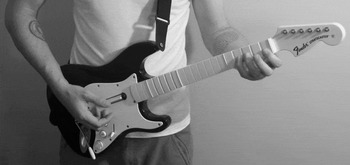
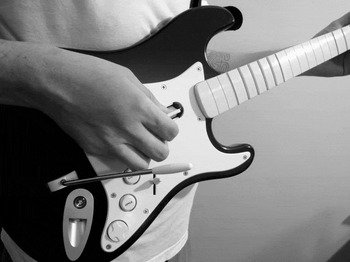
To play a song, a Guitar Hero guitarist must read the on-screen notation, simultaneously pressing a particular fret button with the left hand and a strum bar with the right hand (Figures 1, 2, 3, and 4). The player functions as the gatekeeper for prerecorded material; correct fretting/strumming allows each note to make its way from the game console to the speakers. If the player misses a note, that note drops out of the audio playback. (At the lower difficulty levels, a single on-screen note may correspond to a short riff on the recording.) At the borders of the streaming notation track, animated avatars perform the song in a rock club or arena. Frenetic camera angles and stage effects add to the excitement. A virtual crowd shouts praise to good players, boos incompetent players off the stage, and sometimes sings along.
Guitar controller for Rock Band. Photograph by the author.

Drum controller for Rock Band. Photograph by the author.

Strum bar, whammy bar (bends the pitch on sustained notes), and effects switch on the guitar controller body. Photograph by the author.

Color-coded fret buttons on the guitar controller neck. Rock Band guitar controllers include a second set of fret buttons close to the body of the guitar for extended play techniques (“tapping”) and to make fretting easier for small children. Note that the player must change hand position or extend a finger to access all five buttons. Photograph by the author.

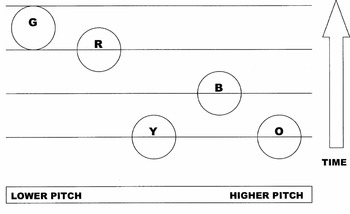
Figure 5 provides a schematic diagram of Guitar Hero and Rock Band guitar and bass notation. Imagine the notes in the diagram falling from the top of the page to the bottom, but with perspective applied so that they appear to be coming directly at you, like the roadway in a driving game. The letters in the diagram indicate the color of the note (green, red, yellow, blue, orange). These colored notes mirror the layout of the five colored fret buttons on the guitar controller. As each note—or several notes, in the case of power chords—crosses a fixed reference line of colored notes at the bottom of the screen, the player must fret and strum. (In drum notation, there are only four note columns, corresponding to four color-coded drumheads. A horizontal orange bar across the staff indicates the kick-drum.) This notation system reverses the conventions of Western staff notation: here, the horizontal axis represents relative pitch and the vertical axis represents the passage of time. The horizontal lines correspond to strong beats; notes between the lines subdivide beats. There is no uniquely correct staff-notation transcription of this diagram, because melodic contour and rhythmic relationships are represented only in relative terms. However, any competent Guitar Hero player would read this diagram from bottom to top and would know that it represents a two-note chord (YELLOW + ORANGE) followed by a descending melodic line of three notes (BLUE, RED, GREEN), most likely with a melodic skip from BLUE to RED and stepwise motion from RED to GREEN. The player would also surmise that this notation is from a song being played at the “Hard” or “Expert” difficulty level, because it employs all five fret buttons. The “Easy” version of a guitar part uses only green, red, and yellow; “Medium” adds blue; “Hard” and “Expert” add orange. Because the player has only four fingers available for fretting, s/he must change hand positions when the notation requires all five fret buttons—a design decision that creates technical fingering puzzles for players to solve. As Dominic Arsenault notes in an article assessing Guitar Hero as a guitar simulator, there is “an emphasis on breadth and a deliberately limited depth” in the simulation; the designers’ apparent strategy was “to represent a little of everything.”Footnote 4
Schematic diagram of Guitar Hero and Rock Band guitar/bass notation. In the games, sustained notes are represented with a long tail following a note head. Smaller note heads designate “hammer-on” notes (which may be played by fretting without strumming). Diagram created by the author.

Guitar Hero and Rock Band gameplay is clearly a form of performance, whether it's for the virtual crowd in the game, for YouTube viewers (who don't mince words in assessing a player's skills), or for live audiences in a living room, at a local bar, or at a formal competition. These game performances have proved unsettling to many people, in large part because of their schizophonic character. Audiences came to terms with the original schizophonia—R. Murray Schafer's term for the split between a sound and its source, made possible by recording technology—by establishing value-laden distinctions between the live and the recorded.Footnote 5 These games threaten the sanctity of those distinctions by combining the physical gestures of live musical performance with previously recorded sound, a phenomenon that I refer to as “schizophonic performance.” Numerous journalists, professional musicians, and online commenters have expressed disdain, discomfort, or a kind of wistful regret about the whole Guitar Hero phenomenon; many of their assessments focus on asking why Guitar Hero virtuosos don't pick up a real guitar (or celebrating when some do). Commenters on thousands of Guitar Hero and Rock Band YouTube videos evince a deep concern with the authenticity of players’ performances, not only by exhorting players to repeat their feats on real instruments but by accusing them of faking high game scores through technical trickery. Faced with Chris Chike's well-documented mastery of the guitar controller, many viewers resort to nerd-baiting dismissals: “woow congratulations. uve won title of biggest loser on the planet.”Footnote 6
This article addresses Guitar Hero and Rock Band gameplay as a developing genre of collaborative, participatory rock music performance that is generating debate about the nature of musical and performative authenticity. My research draws on the methodological and theoretical orientations of ethnomusicology, performance studies, popular music studies, and a growing body of interdisciplinary digital media scholarship. An ethnographic approach highlights the complex, diverse experiences of the human beings who use these media; equally complex and diverse theories of performance inform my interpretation of those experiences. My hope is that this research will enhance our understanding of performance at the intersection of the “virtual” and the “real,” while also documenting the changing nature of amateur musicianship in an increasingly technologically mediated world. If sales figures are any indication, the cultural impact of these games has already been substantial. The Guitar Hero franchise has sold more than twenty-one million game units since 2005; the Rock Band franchise exceeded one billion dollars in North American retail sales within fifteen months of its November 2007 release (including revenue from over forty million individual song downloads).Footnote 7
Guitar Hero and Rock Band are deeply theatrical by design, and many players choose to enhance that theatricality in their gameplay. As Samuel Weber notes, “placement” is a defining trait of all theater: “the arrangement of the place, the positioning of the people and things in it[,] is constitutive of what is taking place there.”Footnote 8 Like all videogames, Guitar Hero gathers players (and appreciative audience members) around a screen; their gameplay is always configured in a particular space. They rely on special props and stage machinery—the game-controller instruments and game console—and often employ a recognizable repertoire of rock-star moves in the course of their performances. As they play, they watch their on-screen avatars perform this same gestural repertoire in a second theater, a virtual space that has been meticulously designed to mimic a live rock performance venue: a crowd screams or boos, feedback crackles through the speakers, elaborate lighting flashes across the stage. (The games feature a wide range of performance venues, most modeled on identifiable real-life clubs or arenas.) When people play these games in bars or at public competitions, the avatar's stage and the player's stage come to mirror one another.
This basic distinction between virtual and physical staging grounds is crucial in the analysis of any videogame, of course, but the performance frames for Guitar Hero and Rock Band are far more complex than this binary opposition might suggest. In the Freddie Wong video, for instance, at least six performances are layered together: the edited video performance designed for YouTube, the living room performance, the avatar's performance on-screen, the human performances in a motion-capture studio that provided the physical model for the avatar's performance, a studio band's cover performance of the song “YYZ” (the game development company wasn't able to license the Rush recording), and Rush's studio recording of the song. Of these six performances, I would argue that it is Freddie's energetic physical performance for an audience of friends in a living room that comes closest to the rock ideal of an authentic live show—yet it's his performance that is also the most explicitly theatrical, a parody of rock authenticity.
How is experiencing a prerecorded rock song by playing Guitar Hero or Rock Band different from simply listening to that song? Is playing a game controller anything like playing a musical instrument? How do players and their audiences identify and assess musicality, creativity, and virtuosity—among other hallmarks of guitar heroism—in these music-oriented videogames? How do game design decisions, media coverage, and pre-existing discourses about rock authenticity, liveness, and gendered performance influence those assessments? I have investigated these issues by interviewing game designers and players, administering a qualitative Web-based survey, reading player messageboard discussions, watching YouTube videos, trying to keep up with a flood of print and online media coverage, and playing the games myself in a variety of settings (e.g., at home alone, with my spouse, in party situations, and at work). For six weeks in the summer of 2008 I played Rock Band with Kate Reutershan, my undergraduate research assistant, nearly every day; friends and colleagues filled out our band from time to time. We also recruited fifteen Brown University undergraduates and graduate students for gameplay/interview sessions.
My Web survey has been active since August of 2007; as of this writing I have received 509 responses and have conducted follow-up e-mail correspondence with a 5 percent sample of these respondents (this sample matched the total pool with respect to gender, age ranges, and proportion of yes/no answers to some key questions).Footnote 9 Survey questions focused on Guitar Hero and Rock Band gameplay contexts, the games’ impact on players’ musical tastes, and comparisons to other musical experiences (e.g., playing real instruments or singing karaoke). Survey respondents were self-selecting; most heard about the survey by word of mouth or through recruitment messages posted on several high-traffic online messageboards devoted to these games. There is no reason to assume that these players represent an ideal demographic sample of the millions of people who have purchased or played the games.Footnote 10 However, the range of experiences represented in the responses to my qualitative questions does seem to match the range of perspectives I have encountered through other research channels. A few statistics should give a sense of the respondent pool and the key questions:
• 86 percent male, 13 percent female, 1 percent intergender/trans/other
• 57 percent aged twenty-one or younger, 25 percent aged twenty-two to thirty, 18 percent over thirty
• 99 percent had played some version of Guitar Hero; 45 percent had also played some version of Rock Band; 1 percent had played only Rock Band
• 92 percent owned some version of Guitar Hero; 28 percent owned Guitar Hero and Rock Band; 3 percent owned only Rock Band
• 46 percent typically played for one-to-two hours at a time
• 17 percent usually played at the “easy” or “medium” difficulty levels; 20 percent at “hard”; 63 percent at “expert”
• 74 percent had used “practice mode” (which breaks songs down into short sections that can be drilled at slower tempos)
• 55 percent often played with other people watching; 70 percent often played in a multiplayer mode
• 59 percent reported that they knew fewer than half of the songs in the games very well before encountering them during gameplay
• 79 percent indicated that the games had increased their appreciation for new songs/genres; 75 percent had added new music to their listening collections because of the games
• 74 percent had experience playing an instrument; half of all respondents had experience playing guitar; 32 percent had played in a band; 13 percent regularly performed music in public
• 35 percent indicated that they felt creative during gameplay.
Those who assume that these games offer only hollow simulacra of musical performance might be surprised to learn that three-quarters of respondents had experience playing an instrument—particularly given that respondents were recruited primarily from gamer discussion boards (as opposed to some more specifically music-oriented population). This fact stands in intriguing tension with the mission statement often repeated in media interviews with designers at Harmonix Music Systems, the company that developed Guitar Hero and Rock Band: “to give that awesome feeling [of performing music] to people who aren't musicians, who would never get to have it” (in this instance articulated by audio director Eric Brosius).Footnote 11 Such statements are meant to broaden the reach of the games; Harmonix designers are certainly aware that many musicians love these games, and quite a few Harmonix staff members play in rock bands themselves.Footnote 12 As we shall see, however, critics of the games have often assumed that there is a fundamental split between people who play controllers and people who play instruments.
“Won't Get Fooled Again”: Evaluating Authentic Musicality
Since the 2005 release of the first Guitar Hero game, reception discourses have been dominated by concerns about the authenticity of players’ musical experiences. The word “real” comes up over and over in article titles and in responses to my survey. For instance, a San Francisco Chronicle article is titled “Rock Band, Guitar Hero III Video Game Do Rock, but Real Is Better”; an article in Guitar Player magazine about the cover musicians who recorded some of the in-game songs is titled “The Real Heroes of Guitar Hero III”; and a review of Rock Band published in Spin appears under the heading “Even Better than the Real Thing.”Footnote 13 These value judgments bring to mind the lip-syncing scandals that have beset popular music performers from time to time; as Philip Auslander writes, lip-syncing threatens rock ideology by suggesting the possibility of “a new era of music performance in which the visual evidence of performance would have no relation to the production of sound.”Footnote 14Guitar Hero and Rock Band seem to represent the realization of this threat. Performers go through the motions of playing instruments, but they have no creative dominion over the song that comes out; it was originally produced by some other guitarist in a recording studio.
One might identify precursors to this phenomenon in the world of electronic art music. By the mid-twentieth century, composers were experimenting with what Leta Miller calls “a model of cooperative interdependency” among composers, musicians, dancers, and audio engineers; in works such as John Cage's and Merce Cunningham's Variations V (1965), “the interaction of sound and motion was facilitated by a sophisticated technological component.”Footnote 15 In such works, performance processes were sometimes defined with great specificity, but in most cases “the resulting sound remained variable.”Footnote 16 In Guitar Hero and Rock Band, by contrast, very different physical performances may result in the same sound output—a fact that brings to mind Jacques Attali's argument that “representation has become an auxiliary of repetition” in our present era.Footnote 17 As Henry Adam Svec observes, “The player can either conform to the game's logic by reproducing the requisite hits, which are presented as measurable, stable, complete, and eternal (structural), or not play at all.”Footnote 18
The more a player's physical performance matches that of a live performing musician—the more s/he showboats like Freddie Wong—the more unsettled some audience members become. Their distress brings to mind an Adornian nightmare, in which “popular music divests the listener of his spontaneity and promotes conditioned reflexes” and “pseudo-individualization” hides standardization, “endowing cultural mass production with the halo of free choice.”Footnote 19 Adorno put forward the idea that in popular music “the composition hears for the listener” by establishing repetitive patterns that encourage simple recognition rather than serious musical listening.Footnote 20Guitar Hero seems to go a step further, making it possible for the composition to play for the performer.
Media critics and professional rock musicians have advanced similar arguments about Guitar Hero and Rock Band. The San Francisco Chronicle writer cited above, for example, suggested that “something . . . seems fundamentally wrong when you pick up the video games. . . . What kid will ever want to pick up a real guitar, when learning to play a fake one is so easy? If Rock Band had been available in the late 1980s, would we even have a Green Day—or just three more no-name slackers killing a lot of time in their parents’ basement?”Footnote 21 Sleater-Kinney guitarist Carrie Brownstein asked in a Slate article, “Really, if you are going to play the game with a group of friends for more than a night, shouldn't you just form a real band?”Footnote 22 Guitarist John Mayer was more pointed when a Rolling Stone interviewer asked what he thought about these games: “Guitar Hero was devised to bring the guitar-playing experience to the masses without them having to put anything into it.”Footnote 23 An online commenter on this interview concurred: “‘Guitar Hero’ and ‘Rock Band’ are the epitome of what's wrong with 21st century pop culture. It's all easy, hollow, and accessible to any fucking moron.”Footnote 24
In Pop Music and the Press, Steve Jones and Kevin Featherly interrogate the concepts of authenticity most often employed in rock criticism; as they note, “since standards are difficult to come by in popular music, critics often refer to authenticity as a measure of aesthetic soundness.”Footnote 25 Their survey of forms of authenticity includes the authentic articulation of the ideas or desires of a particular audience (i.e., not selling out/pandering to the “mainstream”); historical authenticity (roots-oriented music); cultural or ethnic authenticity (being true to one's musical culture of origin); and personal authenticity (self-expression).Footnote 26 As many scholars and critics have demonstrated, this last standard generally relies on assessments of both authenticity of intention and authenticity of creative artistry. Personal authenticity derives from “a perceived quality of sincerity and commitment” (in Simon Frith's words), “some kind of unmediated openness of expression” (Robert Christgau), and heroic genius, “the myth that had first arisen in the 1820s of the creative individual, uncompromising in passion and bearing unique gifts” (Deena Weinstein).Footnote 27 Nearly all of the repertoire included in Guitar Hero and Rock Band has received critical endorsement in accordance with one or more of these standards, either upon the music's original release or in the course of its reception history; indeed, the authenticated iconic status of these songs is what qualified them for inclusion in the games. To many critics, though, this fact only enhances the offensiveness of Guitar Hero and Rock Band gameplay. As Sarah Thornton writes, musical authenticity is not just “a vague sensibility or aesthetic,” but rather “a cultural value anchored in concrete, historical practices of production and consumption.”Footnote 28 A mass-market videogame that simulates the performance of authentic music potentially undoes all that authenticating work, devaluing the repertoire's subcultural capital. Musical works that formerly represented creative genius, technical mastery, and sincere commitment become “easy, hollow, and accessible.”
Players hear and respond to these arguments all the time, and many pass similar judgments: they want to make it clear that they understand the difference between authentic musicianship and videogame prowess. I discussed the matter of Guitar Hero virtuosity in an interview with Kevin Grubb, an undergraduate who volunteered to participate in my research. He described his mixed feelings about better players:
Even though when you are playing you wish, “Oh, I wish I was as good as those guys,” but when you watch them do it, it's kinda like, “How much time did you spend doing that?” . . . Those guys—you can also look at their appearance and see, like, the Cheeto stains on their shirts. . . . And the line of dialogue associated with that is, “Dude, just learn how to play the instrument.” . . . I mean, I guess they are tricking themselves into believing, like, “Oh, I can five-star this song, and it's much easier than to actually learn to play the guitar.” But they are tricking themselves to the point where they have—maybe it's because of the incentive. Because when you have Rock Band or Guitar Hero, it's getting you points; it's saying “New high score, godlike performance, awesome solo,” and stuff like that. But you don't have that, necessarily, when you are learning to play an instrument, especially if you are self-teaching. . . . With this you can pick it up any time you want and do it and still get that reward.Footnote 29
Devon O'Dell, a more committed and accomplished player—who noted that he had once been a Guitar Hero skeptic himself—traced the “‘pick up a real guitar’ attitude” to the realistic features of the games:
I think initially it's hard to come to the conclusion that—at the end of the day—it's just a game. There's so much emphasis on the reality of it, going right to the controller itself being shaped like a guitar and containing guitar-like features. . . . I love music, and I love making music (however good or bad I may be at that notwithstanding)[.] I felt like playing a game to make music was silly.
He went on to explain how he now justifies the fact that he has become a hardcore player:
Comparing a game, which one may or may not take very seriously, with a [musical] hobby or profession . . . is, quite frankly, comparing apples to oranges. . . . Nobody who plays the game—whether they're serious or simply playing for fun—is under the impression that playing the game is anything like playing a “real” instrument. . . . Guitar Hero and Rock Band are nothing more than hand-eye coordination games that reward your ability to push buttons rhythmically. People may or may not find bliss in doing that, but actively despising an entire franchise and millions of people who play the game because they are doing something they enjoy seems counterintuitive to me.Footnote 30
These apples-and-oranges, chalk-and-cheese, “just a game” defenses are common among devotees of Guitar Hero and Rock Band, many of whom would prefer to lift the games straight out of the ideological morass of “real music” comparisons. As a commenter in one of countless online debates put it, “It isn't supposed to be a real instrument and shouldn't be compared to one. It is for fun, like every other game. Why play racing games when you can go out and drive your car? Why play Guitar Hero when you can just learn a real instrument? Why play RPGs [role-playing games] when you can go stab squirrels in your back yard? Why do we even have video games if everyone can just do the real thing?”Footnote 31
These points are well taken; the quality of digital gameplay should be evaluated based on a game's own design merits and its players' experiences, not through comparisons that treat it as an imitation of some other activity. However, my research has shown that the boundary between playing these games and “really playing music” can be quite porous to players. Remember that three-quarters of my survey respondents also have experience playing instruments; it would be hard to argue that they have been deluded into taking up a cheap imitation of the real thing. Many of these players have emphasized that their musical experiences with Guitar Hero and Rock Band feel as “real” as the other musical experiences in their lives, and that this fact is a crucial aspect of the games' appeal. As an interviewee explained, “There's a big difference between pressing X and having someone shoot someone else on the screen, and pressing X a couple times and successfully putting out a guitar riff. Even though you haven't actually put out the guitar riff, the game makes you feel like you have.”Footnote 32
This interviewee, an experienced rock drummer, struggled with the apparent contradiction between feeling like he was really playing music, even playing creatively, and knowing that he was following on-screen instructions in a videogame. His remark about the “big difference” between first-person shooters and Rock Band seemed cryptic to me at first, but it highlights a crucial experiential distinction: shooting another character in a video game doesn't put a real bleeding corpse in your living room, but pressing buttons or hitting drum pads on game-controller instruments brings forth real music. This “realness” is constituted in two ways: first, through players' sincere respect for the aesthetic quality, technical difficulty, and affective power of the original recordings coming out of the speakers; second, through the games' capacity to inspire the feeling of making music.
Guitar Hero's (Rock) Music Pedagogy
Descriptions of Guitar Hero gameplay often reduce the basic game activity to “pushing buttons in time.” This summation is not inaccurate, strictly speaking, but it fails to capture the feeling and the appeal of gameplay for most players—much as it would fail to capture the feeling of playing a Chopin nocturne at the piano, which might also reasonably be described in these terms. If one sets aside all of the rock-related framing devices—the instrument controllers, the on-screen avatars, the repertoire—the core challenge-and-reward system in these games is a sight-reading simulator. (Indeed, many YouTube videos of gameplay include “sightread” in the title, as a disclaimer or a boast.) The notation streams toward you at a constant pace. If you miss a note, you don't hear that note, and may also hear a “mistake” indicator—a kind of twangy clank—depending on the version of the game. The rest of the band plays on; only your line drops out.
This design decision plays a huge role in the overall gameplay experience in Guitar Hero and Rock Band. It provides sensory evidence that the player is producing the sounds that come from the speakers. The player has no choice as to what comes next, but neither does anyone who is trying to read from sheet music. Attempting a guitar, bass, or drum part on the “Easy” setting, players see and play notation that corresponds to a skeleton of the music that comes out of the speakers; playing on “Expert” entails note-to-note correspondence. At even the “Medium” or “Hard” settings, the pace of the streaming notation can be overwhelming to players who keep their eyes at the bottom of the screen. Without exception, the players I interviewed said that they read ahead: they keep their eyes on the new notation streaming from the top of the screen, while using the sound of the music, their sense of rhythm, and occasional downward glances to play the notes that are passing over the bottom line. Most players said that they read the descending notes in chunks, looking for patterns and familiar material (e.g., scalar passages, drum patterns, or riffs that repeat from song to song); several reported having learned this technique either from sight-reading standard notation or from playing Dance Dance Revolution, which employs a similar notation system to indicate dance moves on a floor pad.Footnote 33
Chris Sanders, a St. Louis player who is a proficient guitarist with additional choir and piano experience, broke down the technical challenges of playing at the “Expert” level into three skill sets:
1) Learning to quickly “scan” the rapidly descending note cascades on the screen and mentally process them into the appropriate notes. This was primarily a “visual processing” function, and it took a while until I was able to accurately “decipher” the “swarm” of notes and could comfortably read them as note/chord instructions rather than being overwhelmed by the speed of the visual input. . . . The first attempts on Expert by most players often result in getting “completely overwhelmed” by the notes since they cannot process the instructions quickly enough. This includes deciphering the “code” and recognizing the following: A) what note (button) or chord (buttons) was being called for[;] B) whether single notes required strumming or whether they were “hammer-on” or “pull-off” notes that did not require a simultaneous strum[;] C) and using their spacing and relationship to the other notes to accurately interpret their timing/rhythm in relation to the music.
2) The next step in the process was learning to manually carry out the now decoded instructions. “Expert” songs tend to possess numerous rapid chord changes or “flurries” of notes and trills during solos. Even once I could “decode” what buttons I was supposed to hit and when I was supposed to hit them, I still had to get my fingers to execute them accurately . . . and at precisely the right time. This part is still a challenge as there are songs with “odd” (read: infrequently used) chord transitions that I cannot always perform quickly or accurately enough, or crazy solo parts that would require hours of practice in order to master.
3) . . . When playing songs on Expert, you will often encounter challenging solos or tricky sections where you will not be able to succeed in hitting the right notes. Therefore, in order to “pass” the song and move on to the next challenge, you start learning when to use (and when to hoard) the game's Overdrive/Star Power feature that helps prevent [you] from failing out. Similarly, once you can play the songs without fear of failing, in order to increase your score you need to think strategically on exactly when to deploy the Overdrive/Star Power in order to maximize your score. For example, given a set number of measures in the song, you would earn more points for multiple individual notes than you would for a lesser number of sustained notes. Similarly, you get more points for chords than for individual notes. So you learn to analyze the structure and “charting” of the song and time your use of Overdrive/Star Power for those sections with more potential points.Footnote 34
The first two technical challenges described by Sanders will be familiar to anyone who has learned to read a notation system or play an instrument. At the most abstract level, they point to the considerable overlap between playing any videogame and playing notated instrumental music. One must realize specific, time-sensitive visual instructions in an environment that provides multisensory feedback (e.g., in the traditional musical context, one's own musical output, as well as the reactions of teachers, ensemble members, or audience; in the gameplay context, one receives aural and visual feedback from the game itself as well as from other players or observers). As Sanders makes clear, however, the resemblance is very much heightened in Guitar Hero and Rock Band, in which high-level players must seamlessly integrate notation-reading, analytical listening, and total technical mastery of their instruments. Moreover, as Peter Shultz notes, the “reductive analysis” that the transcribers use to create the four tiered difficulty levels for each song “encourag[es] the player to hear and think about each level in terms of the ones they have already played. . . . The game becomes an advocate for a hierarchical order of musical awareness: players conceive of difficult patterns as elaborated versions of simpler ones, in a manner analogous to Schenkerian and other reductive or generative theories of music.”Footnote 35
Chris Sanders identified numerous similarities in the processes of learning to play guitar and learning to play Guitar Hero and Rock Band. He also observed that through these games, “I've learned to listen to music differently. Whereas before . . . I would typically listen to a song as a whole, I now find myself picking out the various individual instruments and assessing their particular contributions to the music. I'm thoroughly convinced that the method these games use to ‘reward’ good play (playing the particular instrument's soundtrack when you do well, and cutting it off when you don't) is directly responsible for this increased sensitivity to the individual instrumentation of songs.”Footnote 36 Sanders's comments resonate with those of many survey respondents and interviewees who discussed the games' impact on their listening approach and their appreciation for particular genres. When asked how these games changed their listening experience, players explained that the combination of reading notation and the physical act of playing a particular part (guitar, bass, drums) made them hear songs differently, including songs they had never played in the games. Several reported “playing along” mentally as they listened to music, sometimes also playing air guitar or drums (with game controller performance mechanics in mind) and/or visualizing appropriate on-screen notation.
These accounts of the link between heightened listening and the movement practices associated with the games bring to mind Simon Frith's observations about dancing, which he characterizes as “a form of enhanced listening” that generates “a heightened, more intense, above all more concentrated sense of the music.”Footnote 37 Like dance, Guitar Hero and Rock Band gameplay could be described as “movement which draws attention to itself, in the very act of ceding control to the music. . . . The dancer's technique, that which allows her body to do whatever the dance requires, is precisely that which allows her to forget about her body altogether and just think the music.”Footnote 38 This sense of immersive engagement, commonly referred to as being “in the zone,” “in the groove,” or in a “flow” state (following Csikszentmihalyi), is common among dancers, athletes, musicians, and participants in many forms of play and ritual; it is also an explicit goal of virtually all videogame design.Footnote 39
For many musicians, the affective experience generated by physical engagement and heightened listening is a defining quality of genuine, successful music making. Harris Berger vividly describes a rock guitarist's “entering into the music” through intense attention to “flows of sound phenomena,” a musical experience that Berger characterizes as a “creative act of perception” and a “culturally specific style in the organization of attention.”Footnote 40 Many Guitar Hero and Rock Band players—including myself—organize our attention and channel our affective experience in exactly this way as we play our plastic instruments. Sitting at my Rock Band drum kit, sight-reading my way through a song I've never heard before, I suddenly “feel the form” of the piece, get into a groove, and the drums seem to play themselves.Footnote 41 Some readers may protest that in Rock Band the drums are playing themselves! Yet I'm always aware that the music would stop if my seemingly possessed hands and kick-drum foot stopped moving. This knowledge makes my efforts feel authentic, and that feeling generates a sense of affective affinity with the drummer who recorded this track.
Star Power: Designing Affective Experience
In the fall of 2007 I explored the question of Guitar Hero's musicality with Rob Kay, the lead designer for Rock Band and the original Guitar Hero game. I interviewed him in his office at Harmonix Music Systems, the Cambridge, Massachusetts, company that developed the first two Guitar Hero games and was, at the time of my visit, on the verge of releasing Rock Band. Kay is from Manchester, England, a crucible of British rock; he acknowledged that this background gave him a different perspective than that of his U.S. colleagues. The first Guitar Hero game focused on U.S. rock and often referenced Boston-area music venues and bands. Kay told me, “It's definitely good that it's got that local feel, because it gives the people that are on the [game design] team a real feeling of ownership, and that means that everything that the team puts into the game has got that kind of love and creativity of wanting to represent your people and your space really well. So for me, as a Brit coming over, it's different because, I mean, we're not representing Manchester. We're representing Boston.”Footnote 42 By the time of this interview, the Guitar Hero series was no longer in Harmonix's hands, because MTV had acquired Harmonix and Activision had acquired Guitar Hero's publisher, Red Octane. Activision turned Guitar Hero over to another development company, Neversoft, which produced Guitar Hero III and subsequent editions—putting the Harmonix team in the curious position of designing Rock Band as a head-to-head competitor with the series they had originally developed.
Rob Kay discussed the original design intentions for Guitar Hero, and particularly how designers worked toward “bringing people the feeling of playing music.” He was careful to differentiate the Guitar Hero guitar experience from what the team was hoping to achieve with Rock Band, which added karaoke and drum parts to the mix; he assessed the latter as “much closer to actually playing the real instrument or being musical,” because karaoke uses one's actual singing voice and the Rock Band drum kit provides a close physical correlation with playing real drums (as well as the opportunity to play improvised fills at certain points in each song). In contrast, the Guitar Hero and Rock Band guitar controllers don't even have strings; they reduce an electric guitar's complex play mechanics to five fretting buttons, a strum bar that moves up and down, and a whammy bar that allows players to bend the pitch of sustained notes. Kay told me that Guitar Hero was never meant to be a guitar simulator, or even simply an instrument-playing simulator. Instead, it was intended to be a musical performance simulator, and more specifically a rock performance simulator:
We definitely wanted, in the design stage, to find a way to make the simulation more than just a clinical recreation of music, and we had this whole kind of ambition that started out pretty loosely articulated to bring some showmanship, as well as musicianship to the experience. So we kind of decided early on that we were going to have this metric of “star power,” and we didn't know what it was. . . . Somehow, we were going to try to find a way of raising your rock-star persona and your showmanship.
The solution devised by the design team was a kind of on-screen energy meter that fills up with light when a player performs well—which means not only hitting a lot of the notes, but also using the guitar controller's whammy bar on sustained notes and accurately playing complete musical phrases. The game presents this meter as a representation of crowd approval. At any time after the meter has passed the halfway point, the player can deploy “star power” by raising the neck of the guitar controller, which has an integrated tilt sensor. The result is a burst of multisensory feedback: the screen explodes with light and sparks, the notation track shakes, the crowd roars, and all the notes turn electric blue (an additional spur to performance adrenaline, because it requires the player to read notes by their relative horizontal position without the aid of color coding).
The Harmonix designers were very much attuned to the emotional impact of this feedback and to the significance of requiring an iconic rock performance gesture—raising the guitar neck—as part of successful gameplay.
Rob Kay: I think we're always kind of keen to get people doing that move because . . . it's really obvious that once you give people this cue that their physical performance has got something to do with the game, even though that's the only physical performance that has something to do with the game—you're suddenly in the mind-set and thinking about all of those rock-star moves that you see people do, and then they will just jump around and do the rest. And it seems that that's often the case with these kinds of things. You don't have to go the whole way. You just need to give people a beginning—a shove in the right direction, and they'll do everything else.
KM: Are there other design elements in the game that you would think of in that same way, as just giving them a shove in the right direction?
Rob Kay: I mean, the whammy bar was in that area as well, that even though it's this “Hey, you're altering the pitch of the sound,” it's as much about getting yourself into the rock-star mind-set and imagining yourself as a guitarist and you're playing on the whammy bar. And even just the process of playing, you know, playing a guitar and holding something, and doing this with your right hand, and doing this with your left hand. People recognize that motion from guitarists, and suddenly they're less playing a game and pretending to be a rock star, and more putting themselves in the shoes of a rock star.
Kay also described how the design team worked to make the “star power” visual and audio feedback enhance the electric guitar performance framework:
We thought it'd be fun to go with the whole, hey, it's electric guitar you're playing. Electric guitar, so let's make the theme electricity, and, like, overloading, and all that kind of vibe. So we went with this electric blue color scheme, and little fizzes and sparks sound effects when you deploy it as well. So it was trying to bring a little bit of the raw amp overload feel to the feedback, and that's what drove the visuals. . . . You know when you've earned star power because you see the blue little sparks go up. . . . It's serving that functional job but it's also serving an aesthetic and experiential kind of thing as well. Making you feel like, “Oh yeah, it's electricity and I'm overloading the crowd with energy by releasing it.”
In designing Guitar Hero, Harmonix clearly built on the “the power of the guitar as metaphor” and the long-established symbolic importance of electricity in connection with the electric guitar.Footnote 43 As Charles McGovern notes, the use of lightning bolts in music equipment ads and on guitars and amps has long implied that “the guitarist had in hand something beyond a mere musical instrument”; invoking electricity still has connotations of “transformation, a connection to the cosmos, a vital tie to the future, and the attainment of strength and power.”Footnote 44 The game designers also chose to enhance Guitar Hero's symbolic cohesiveness by sticking with a rock-oriented aesthetic and repertoire. Kay explained why they chose not to include other guitar music, such as blues or country:
It just seemed right to us to make it about, you know, balls-out rock guitar. . . . It's the iconic thing. . . . I was always joking [with other designers], “It's got to be like a balls-out American thing.” People identify with that I think, and it's just the clichéd thing, and often in videogames it's those clichés that are easy to hold onto and get into. You just—you step out of yourself for a little while. And I enjoy it even though I wouldn't necessarily identify, for me, that American guitar rock as being my favorite thing. I know what it is and I know how to get into it.
By giving players an immersive gaming experience filled with rock-oriented cues—including the musical repertoire, archetypal rock-star avatars, a responsive crowd, a guitar-shaped controller, and physical performance cues—Harmonix encouraged them to adopt a rock-star identity. As James Gee has noted in his work on gaming and learning, “When learners adopt and practice such an identity and engage in the forms of talk and action connected to it, facts come free—they are learned as part and parcel of being a certain sort of person needing to do certain sorts of things.”Footnote 45 In the case of Guitar Hero and Rock Band, the facts that come free include new modes of musical listening, a sense of the physical relationship musicians develop with their instruments, an intimate knowledge of a particular selection of songs, and assorted elements of rock history and ideology (some of which are presented in explicitly didactic form, written on a chalkboard that appears between songs). Players readily identify all of these things as important “musical” features of their gameplay experience. However, some point to a major obstacle to feeling as though they are really making music: the apparent absence of musical creativity, originality, and authorship.
Creativity and Conformity
There is a fundamental mismatch between these games' musical-production mechanics and their guiding musical aesthetic. Rock musicians don't perform from notation, and the guitar hero in particular is “a representative icon of individual creative expression” whose musical-genius status relies on apparent originality and spontaneity.Footnote 46 Kevin Grubb, the undergraduate player who brought up the “Cheeto stains” stigma of Guitar Hero virtuosity, summed it up this way: “When you go see an actual musician perform . . . if you get the perfect musician, they are going to perform something differently every time, and it's going to be amazing every time. But if you get the perfect Rock Band player, it's going to be the same.”Footnote 47 That kind of conformist perfectionism is the antithesis of authentic rock, of course, and it drives the “just pushing buttons in time” assessment of these games.
However, not all players would agree that the games' ultimate objective is the production of identical performances. Such a claim privileges audio output, excluding players' physical performances and affective experiences; moreover, no two audio outputs are likely to be identical. Even if one only considers guitar or bass parts—disregarding Rock Band's free drum fills and the karaoke option—the game-generated changes in crowd noise, shifts in the volume of different tracks, and players' use of the whammy bar and effects switch all have a significant impact on the audible performance. Players often have complicated views about their own creativity and musicality, derived from their approaches to gameplay and their pre-existing assumptions about the nature of authentic musical performance. In my online survey, I posed the question, “Do you feel creative when you play Guitar Hero/Rock Band?” The form required a yes or no answer and requested an explanation of that choice. Among my 509 survey respondents, answers to the creativity question are two-thirds negative. However, the responses entered in the “Please explain” box suggest that players employ many different parameters for assessing creativity. Consider this sample of responses:Footnote 48
[players who answered “no”]
Nothing really creative about working to master playing a game someone else made (anon. male, 18–21)
im not being creative i am just re-enacting someone else's work (Jake, 18–21)
Guitar Hero is more a matter of pressing the right sequence of buttons at the right time. There isn't the freedom to actually improvise anything. The only way to be creative is in how best to incorporate the furniture into my stage act. (Boxy, female, Ottawa, Canada, 27–30)
there is no creation involved in playing Guitar Hero (yet). it is essentially the same exercise as playing Simon Says, which, to be successful, requires players to reproduce without personal expression. that said, in social situations, the crowd will reward players for being entertaining above and beyond what the game environment strictly allows. (davidicus, male, Los Angeles, 36–40)
[players who answered “yes”]
Yes I do, because I feel like I am actually the guitarist playing the songs; the guitarist who spent years of dedication to create such works of music. (anon. male, 18–21)
I like to feel as if I am actually playing an instrument and making music. It's a good feeling when I play well. (Saundra Doyle, Mt. Pleasant, Michigan, 18–21)
I feel like I'm jumping into the artist in their time and playing along and maybe even feeling what it was to be that creative individual in their time. Plus it feels good to attempt to thrash along with their solos. I get too wrapped up in playing correctly to enhance the experience (formative musical experience was in the orchestra . . . used to sitting and playing), but I try a little. (iRone [band name alias], male, 31–35)
I am a creative person . . . so I think this is a substitute for some of the craft type stuff that I would otherwise be doing. So, I guess I have to say yes, it does in a way make me feel like I am creating music, even if I'm only pressing the button when I'm supposed to. (Donna, over 50)
Yes and no. No because I don't attempt to learn showboating techniques (behind the head, eyes closed, etc.) Yes, because my mind analyzes how to play certain segments the more I play them. Although I can learn new techniques here [on scorehero.com], ultimately it is up to the creative side of [my] mind that will help me coordinate the finger patterns necessary to perform a difficult solo. I can not comprehend how a number of people (maybe 50) are able to “tap” Jordan. (mrkuo, male, 27–30)
As one might expect, many of the “no” answers to the creativity question point to the fact that Guitar Hero players are playing someone else's compositions, re-enacting someone else's specific performance, and have almost no control over the resulting sound, apart from playing around with tremolo by using the whammy bar on long notes or simply dropping notes by making mistakes. However, a lot of the players who answered “no” went on to use the “please explain” box to discuss the creative aspects of physical performances techniques—not only “showboating” moves like playing behind the head or with one's eyes closed, but also the specific fingering patterns or alternative playing techniques required for the mastery of particularly challenging passages. A subgenre of Guitar Hero YouTube videos is devoted to teaching fingering patterns, “tapping,” and hammer-on techniques for certain songs.
Many players also point out the creativity of those who have created custom song charts and software hacks for inserting them into the games. Gabe, a teenaged survey respondent from Denver, answered “yes” to the creativity question and explained, “In Guitar Hero, I'm just hitting pre-placed notes. But when I make a custom song chart, I can inject my own style into it.” A thriving area of the ScoreHero.com Web site is devoted to these custom charts, and the chart makers also advertise their work on YouTube.Footnote 49 Over 6,000 of these custom charts are available on ScoreHero alone. ScoreHero and other forums also track numerous hardware hacks, ranging from custom paint jobs, to adding more realistic weight to the controller by gluing stacks of metal washers inside its body, to rewiring the Rock Band guitar for use in the Guitar Hero games.Footnote 50
The discussions on these Web forums demonstrate that guitar controllers can acquire the same collectible fetish-object status as real guitars. A Guitar Player writer made this connection explicit: “For a while, it even appeared that PlayStation, XBox, and Wii were supplanting Fender, Gibson, and PRS as objects of desire for young and old alike. But, ironically, it may turn out to be a video game that helps shift the balance back.”Footnote 51 Clearly, some players invest considerable creative energy in both individual instrument customization and generalizable modifications designed to bring the controller closer to a real guitar's size, look, and feel. New commercial products also attempt to bridge the gap between instrument and controller: for instance, the ArtGuitar RiffMaster Pro Bundle consists of two actual Peavey guitars modified to work as controllers, plus a set of speakers, at a cost of $2,000.Footnote 52
Many of the survey respondents who answered “yes” to the creativity question gave explanations that had nothing to do with developing special techniques, showboating, making custom charts, or modifying controllers. Instead, they pointed to the creative aspects of role-playing—“jumping into the artist in their time,” in iRone's words, or imagining another form of rock star identity. Still others reported that Guitar Hero makes them more creative listeners, or that it amplifies and channels the creative inspiration that they usually get from listening to music. Interviewees generally had mixed responses, best summed up by a math graduate student who plays Rock Band drums: “I don't know necessarily if you are being creative, but you certainly feel creative.”Footnote 53 One interviewee referred to a sense of “channeling” a creative force that already existed, as though he were stepping into the flow of music-always-already-in-progress. Another interviewee (a classical pianist) observed, “You're aware that you're no composer doing this, you haven't generated anything, you haven't added to the body of music as a whole. . . . [But] you're still generating something, you're still making something there. You're causing a song . . . I guess you're allowing an audio track to play, by replicating it well enough, but I guess the next step from that is: it's not that or be Stravinsky; you can just play it like a Mozart sonata. Is that not creative because you didn't write it?”Footnote 54
When I asked Rob Kay to what extent he felt that Guitar Hero was a musically creative experience, he replied, “Very low. . . . From the beginning, we didn't ever think that Guitar Hero was creative in its direct application. . . . The real kind of creative space of actually deciding to do your own thing isn't really there in Guitar Hero.” However, he also drew attention to the creativity that people bring to their physical performances: “It was a revelation to me seeing my dad get into that. And I've never seen him pull a rock move before, and there he is—lifting his guitar up and jumping around and twirling around. . . . There's nothing more dull than watching someone play a song on Expert and just—kind of working away. . . . The nerd in me is really impressed by [certain special high-scoring techniques]. And then, I guess the human in me is more impressed by people who do it for show-manship.”
Spectacular physical performance is certainly the most obvious creative contribution that players can make to their own gameplay; unlike one's mental orientation, it can be verified and acknowledged by an audience. It is also something that goes mostly unrewarded in terms of earning game points. This fact has contributed to the formation of two broad camps of players, which I will call the score-oriented and the rock-oriented. Members of both groups are generally performance-oriented, but they employ different performance-evaluation criteria. (Of course, some players use blended criteria, as implied in Rob Kay's description of his own “nerd” and “human” aspects.) The score-oriented treat these games as well-defined rule-bound systems, in which the main challenge and satisfaction lies in determining how to exploit the scoring mechanism to best advantage. They strive to be “score heroes” and share tips, techniques, and evidence of their triumphs at ScoreHero.com. Their form of schizophonic virtuosity foregrounds speed, dexterity, efficiency (no extraneous body movement), total mental focus, and strategic innovation. Score-oriented players point out that “star power” can be activated using a button on the controller rather than the tilt sensor; they see no reason to risk accuracy by changing their physical position. They generally don't feel creative when they play, and they often indicate that the question irritates them: the games aren't designed to reward creativity; so why make an issue of it?
The players I characterize as “rock-oriented” have quite different ideas about the purpose and potential of these games. They aren't all extreme showboaters, but they play guitar standing up, they love Freddie Wong's videos, and they would never dream of activating “star power” by discreetly pressing a button. Their theatrical performances represent glam rock's legacy. As Auslander notes, “the [1960s] counterculture's deep investment in the idea of authenticity entailed a necessary antipathy to theatricality . . . derived from . . . the emphasis on spontaneity and living in the present moment, the desire for community, and the suspicion that spectacle served the interests of the social and political status quo.”Footnote 55 In the 1970s, glam performers began to undermine those ideals by “present[ing] clearly staged spectacles [that] opened a gap between the figures on the stage and the ‘real’ people performing them.”Footnote 56Guitar Hero and Rock Band dramatize and continually restage this “opening of a gap” by reframing the virtuosic rock repertoire in a glam performance mode. Auslander's account of a televised, lip-synced 1972 Marc Bolan performance shows how closely rock-oriented players follow in the footsteps of their glam forebears: “Bolan took a vocabulary of movement and gesture that is associated in musical performance with the physical expression of musical sound structure, and the emotions attendant on playing, and used it essentially as an autonomous choreographic language from which to build physical routines.”Footnote 57 The spectacular schizophonic performances of rock-oriented players share this choreographed yet affect-driven quality.
Rock-oriented players recognize that rock authenticity is performative. They generally do value their videogame high scores, but they also believe creative performance is its own reward. As they play these games, they explore the implications of their role as live performers of prerecorded songs.
Liveness, Schizophonic Spectacle, and Rock Drag
Like album covers, videos, and live concert tours, Guitar Hero and Rock Band are now among the commercial products that tend to shore up rock music's status as a performing art, as opposed to a studio-recording art.Footnote 58 The guiding narrative of the games reproduces the classic rock career model of building a fan base through long tours and live performances—despite the games' own obvious reliance on sophisticated studio recording technology. Players advance through each game by using “career mode,” which consists of performances at increasingly large, prestigious, and geographically distant concert venues. All the games after the first Guitar Hero also supply a “practice mode,” in which players can break songs down into short segments and learn them at slower tempos—something many players do in private in order to be more impressive public performers. The games not only provide engaged and vocal virtual crowds but are also designed to attract human spectators, who watch the antics of the on-screen avatar band. This spectacle is wasted on many players (because they need to stay totally focused on the streaming notation track until they have memorized a song), but it entertains friends, family, and coworkers—and once an audience has gathered, many players feel pressure to put on more of a show themselves. Following the lead of the games' designers, these players tend to integrate indices of “live” rock authenticity into their performances. As Simon Frith observes, “Rock performers are expected to revel in their own physicality. . . . Rock acts conceal not the physical but the technological sources of their sounds; rock audiences remain uneasy about musical instruments that appear to require no effort to be played.”Footnote 59
At the same time, players are aware that Guitar Hero and Rock Band celebrate models of musical creativity, originality, and authenticity that cannot be realized in the context of their own game designs. Players develop the kind of virtuosic technical precision and sight-reading finesse that could garner limited praise in classical music contexts, but they can never live up to the improvisational-genius model of the rock guitar hero. In subtle ways, these games continually remind players that what they're doing is not really playing rock music; the games often generate respectful appreciation of the gap between the player's performance and the recorded musician's performance. Player after player has hastened to assure me that he or she “understands the difference” between playing these games and being a real rock performer.
That difference can manifest itself as a kind of rock drag. Like drag performances, rock-oriented schizophonic virtuosity is plainly discomfiting to some viewers; not only is the performing body almost entirely severed from the musical sound, but the physical performance gestures draw attention to their own theatricality.Footnote 60 The term “drag” seems particularly well suited to these performances because ideologies of gender and sexuality also play an important role here. As André Millard and Rebecca McSwain note, “the erect guitar” has long been “an essential part of the formalized ritual of the rock concert,” contributing to the process by which “the meaning of the sound meshed with contemporary notions of masculinity.”Footnote 61Guitar Hero's focus on this particular instrument undoubtedly enhanced the game's appeal to the young, male players who didn't buy Harmonix's previous, less-successful music performance game, Karaoke Revolution.Footnote 62
For many Guitar Hero commentators, though, there seems to be a transparent connection between playing a real guitar and being a real man. A fake guitar implies a false masculinity, and the “star power” tilt creates an offensively fake erection. I have read countless homophobic and feminizing insults in YouTube comments about these performances; for instance, one commenter on Freddie Wong's video wrote, “yur a gay ass mother fuckin fag ill bett you 20 mother fuckin dollars that this shit is fake.”Footnote 63 Homophobic insults are a common feature of YouTube comment threads, but the connection hardly seems incidental in this case. Sexuality-oriented assessments also appear in media reviews; for instance, San Francisco Chronicle reviewer Peter Hartlaub wrote, “Playing a Guitar Hero or Rock Band guitar is a fairly effective form of birth control. Seriously, look at yourself in the mirror. No one who sees you playing this thing will want to have sex with you.”Footnote 64 Most famously (at least for fans of U.S. television), an episode of the animated sitcom South Park was titled “Guitar Queer-o.” When the show's characters earn one million points playing a Guitar Hero clone, they are rewarded with the on-screen text “Congratulations! You are fags!”Footnote 65
Steve Waksman has described the gradual naturalization and incorporation of the electric guitar, which allowed the instrument “to invest the body of the performer with meaning, to confer upon it a unique identity whose authentic, natural appearance works to conceal its reliance upon artifice and technology,” so that “every note takes explicit shape as a physical manifestation of the performing musician.”Footnote 66 The Guitar Hero controller undoes this incorporation, creating a marked separation between embodied performance and musical sounds. The resemblance to the destabilizing effects of cross-gender performance is striking; as Judith Butler writes, drag denaturalizes sex and gender “by means of a performance which avows their distinctness and dramatizes the cultural mechanism of their fabricated unity. . . . Although the gender meanings taken up in these parodic styles are clearly part of hegemonic, misogynistic culture, they are nevertheless denaturalized and mobilized through their parodic recontextualization.”Footnote 67
In some sense, then, homophobic critics are right to suspect that there's something queer about Guitar Hero and Rock Band. The games both cite and encourage camp-inflected performances, in which “hegemony is queered, denaturalized, and, thus, subverted through overarticulation.”Footnote 68 According to Moe Meyer, the queer signifiying practices that constitute “camp” pose an ontological critique by displacing “notions of the Self as unique, abiding, and continuous while substituting instead a concept of the Self as performative, improvisational, discontinuous, and processually constituted by repetitive and stylized acts.”Footnote 69 In general, videogames and other forms of interactive digital media tend to draw attention to the unstable, performative nature of identity, through role-playing and character-customization features.Footnote 70 In Rock Band, for instance, players not only choose the gender, body type, clothes, and instruments for their avatars but also must select a physical performance style, choosing from rock, punk, metal, and goth “attitudes” that govern the avatar's physical mannerisms, stance, and affect. As Derek Burrill writes, the movement practices of videogame avatars always draw on “a more general set of reflected and represented cultural choreographic practices.”Footnote 71 However, Guitar Hero and Rock Band present a special case because the player's performance may closely mirror or even out-do the avatar's. One may integrate “goth attitude” into one's own physical performance on guitar or drums, rather than simply directing an avatar's movements through button-mashing on a standard game controller. The games invite players to make a spectacle of themselves, something Robert Walser identifies as at odds with “a patriarchal order that is invested in the stability of signs.”Footnote 72 Both naturalized rock authenticity and its associated masculinist gender ideologies are potentially at stake here, as in the glam rock performances that the games commemorate.
Considered in these terms, schizophonic performance in Guitar Hero and Rock Band has the markings of “the camp trace” or “residual camp”—Meyer's terms for un-queer appropriations of queer praxis. Meyer's account of the queering effects of “residual camp” helps explain the homophobic responses to spectacular game performances: following Andrew Ross, he argues that when the un-queer camp cognoscente appropriates queer signifying practices, “because the queer constitutes him-/herself processually, the un-queer is now unwittingly performing the queer. The final effect is the reproduction of the queer's aura by the un-queer camp liberator who has been transformed into a drag queen with no other choice but to lipsynch the discourse of the Other.”Footnote 73 Or, to return to South Park, “Congratulations, you are fags!”
My aim here is not to valorize these games and their players by identifying them as inherently subversive or resistant, in the manner of early cultural studies scholarship. As Butler writes of camp, “Parody by itself is not subversive, and there must be a way to understand what makes certain kinds of parodic repetitions effectively disruptive, truly troubling, and which repetitions become domesticated and recirculated as instruments of cultural hegemony.”Footnote 74 Freddie Wong and his ilk are savvy parodists of rock authenticity, but one could also argue that their performances “take rock's ideology of authenticity as [their] point of reference and [are] therefore allied with that ideology.”Footnote 75 It's also important to note that some players adopt quite sincere and serious approaches to the game content, especially in terms of respect for the music; many others readily switch between sincere and ironic stances depending on the particular song or performance context.Footnote 76 The point is that these games give players such rich scores and scripts to interpret, with respect to ideology as well as musicality and theatricality. Rather than creating musical automatons, Guitar Hero and Rock Band afford players enough agency to craft a tremendous range of performances that inspire widely divergent audience responses.
In an e-mail interview with Freddie Wong, I asked him about the thousands of comments on his YouTube videos.Footnote 77 He broke them down into several categories, including calling him names, defending him, bragging about the commenter's own skills, and telling him he should play a real guitar instead. In fact, he has been playing electric guitar far longer than Guitar Hero, and he eventually added a link from his “Rush YYZ on Expert” YouTube video to one that shows him rocking out on a Fender.Footnote 78 Early in this video, which is entitled “True Guitar Heroism,” Freddie offers an irony-drenched, doth-protest-too-much defense of his heterosexual prowess, exhorting viewers to click on a link that will provide “video proof . . . that I hang out with hot chicks all day, all the time.” The guitar performance that follows is a campy extravaganza, laden with as many rock clichés and fetishistic fretboard close-ups as the “YYZ” production. At the end, Freddie looks straight into the camera and asks, “Who's a faggot now?”
Freddie won his Fender guitar in an MTV-sponsored Rock Band tournament. (Because MTV owns Harmonix Music Systems, the tournament functioned as an extended advertisement for the game.) The YouTube video of the winning performance, in which Freddie's band performed the Ramones classic “Blitzkrieg Bop,” provoked several exchanges like this one:
almostwilt: these guys fucking suck
bigboee415 [reply]: keep in mind theyre doing it live bitchFootnote 79
Another defender addressed the score-oriented/rock-oriented divide: “To all the haters: This video isn't about score. It's about performing like rock stars. They had the crowd going nuts when they were using PLASTIC INSTRUMENTS. That's way more impressive than note streaks and FC's.”Footnote 80 Performances like these perfectly illustrate Weber's observation that “a major function of the theatrical in an age of electronic media is to articulate the ways in which sites—and sights, but also sounds and other ‘sensations’—remain linked . . . to bodies, although not necessarily to human bodies as traditionally understood.”Footnote 81 Their spectacular theatricality makes it possible for Freddie's band to forge a compelling connection between a prerecorded song and their live performing bodies, without denying or concealing the technological mediation involved. Built from the stylized gestural repertoire of rock performance and lubricated with genuine sweat, their performance drives the crowd wild.
Conclusion: Schizophonic Performance and Rethinking the Real
A major question in the reception discourses surrounding Guitar Hero and Rock Band has been whether the games might revitalize and perpetuate “real” rock performance and fandom. For every media story that wonders why players don't pick up a real instrument, there is one that celebrates the players who have—like the Guitar Player article that asserts, “The game itself is a bit of a hero, as it leads generations of game-console fiends to consider the joys of actually playing the real thing.”Footnote 82 Sleater-Kinney guitarist Carrie Brownstein also ends up adopting this position: “With so much of music blurring the lines between ersatz and authenticity, at least the Rock Band game is a tribute to rock, rather than an affront. . . . Maybe by pretending to be in a band, there will be those who'll find the nerve to go beyond the game, and to take the brave leaps required to create something real.”Footnote 83 Capitalizing on that hope, the Web site GuitarHeroTab.com provides real guitar tablature for songs featured in Guitar Hero and Rock Band; the site promises, “If you want to be a real Guitar Hero or play in a real Rock Band, we've got all the tunes you need to get rocking on stage!”Footnote 84
These invocations of rock authenticity neglect to acknowledge the possibility that these games might be compelling and valuable not just as simulations, fantasy-enablers, and stepping stones to real instruments, but because they offer people a new kind of musical experience. Playing Guitar Hero and Rock Band isn't just like playing a real instrument, but it's nothing at all like just listening to music. Schizophonic performance is collaborative performance: the players and their audiences join the game designers and recorded musicians in stitching musical sound and performing body back together. The satisfactions of this endeavor are not necessarily undermined by the fact that the player doesn't occupy the same performing body as the person who first produced the music.
In short, playing these games “feels like” making music to so many players not because of some sort of false consciousness or cult of repetition, but because the affective experience of making music is so bound up with embodied performance. It's no coincidence that in English we use the same term to talk about playing games, playing music, and playing a role on the stage. Playing Guitar Hero and Rock Band is deeply theatrical; yet there is no simulation or false promise in the games' offer of musical collaboration, and no lack of felt “reality” in the mental, social, and physical engagement with music that they engender. Player Chris Sanders put it more elegantly: “The energy and commitment to the music is quite real, even if the instruments are not.”Footnote 85
Writing about earlier representational technologies, Michael Veal makes observations that might shed some light on “realness” and simulation in the Guitar Hero and Rock Band context: “Virtual technologies such as sound recording and film were often misunderstood in their early years as serving purely documentary functions; their creations were often dismissed as inferior simulations of reality. A more expansive take is that creative manipulations of these technologies in fact create new forms of reality (that is, new ways of ‘hearing’ the world) within which they function as ‘prosthetic’ devices, ultimately extending human sensory perceptions into new areas.”Footnote 86
Guitar Hero, Rock Band, and similar videogames are working in exactly this way to create new modes of musicality. A rock orientation has proved particularly effective in generating meaningful musical experiences for players because the games draw on such broad and deep reservoirs of existing musical and cultural knowledge. As designer Rob Kay freely acknowledged, rock's well-defined ideological profile did a great deal of work for the game designers, because so many people instantly know “how to get into it.” Players' own musical histories and their engrained understanding of rock performance inform their every move. Some players still judge their own game experiences according to familiar rock ideologies of originality, creativity, and heroism—but many have concluded that these authenticity discourses, like rock music itself, constitute a performance repertoire rather than the rules of the game.