Introduction
Cognitive behavior therapy (CBT) for obsessive–compulsive disorder (OCD) has been investigated in clinical trials for more than 40 years (Rachman et al. Reference Rachman, Hodgson and Marks1971), and results have shown that this treatment is effective, in both group and individual format, with response rates averaging 50–70% (Abramowitz, Reference Abramowitz2006; Simpson et al. Reference Simpson, Huppert, Petkova, Foa and Liebowitz2006). In recent years, Internet-based CBT (ICBT) with therapist guidance, a treatment format that has increasing empirical support (Andersson, Reference Andersson2009), has also shown promise in the treatment of OCD. In ICBT, the treatment is provided through an Internet-based treatment platform comprising the same main components as conventional CBT. Therapist and patient communicate through text messages and generally have no face-to-face contact during treatment. Two open trials have investigated ICBT for OCD, showing large within-group effect sizes with 61–71% responders (Andersson et al. Reference Andersson, Ljotsson, Hedman, Kaldo, Paxling, Andersson, Lindefors and Ruck2011; Wootton et al. Reference Wootton, Titov, Dear, Spence, Andrews, Johnston and Solley2011). A randomized trial (n = 101) by our research group compared ICBT with online supportive therapy (Andersson et al. Reference Andersson, Enander, Andren, Hedman, Ljotsson, Hursti, Bergstrom, Kaldo, Lindefors, Andersson and Ruck2012). The results revealed a large between-group effect size (Cohen's d = 1.12) at post-treatment favoring the ICBT group and 60% versus 6% responders in the ICBT and control group respectively. Improvements were sustained at 4 months and the mean total therapist time spent was 129 min per participant. Similar effect sizes were found in a recent randomized trial by Wootton et al. (Reference Wootton, Dear, Johnston, Terides and Titov2013). Thus, ICBT seems to be clinically effective in the short term and also a cost-effective treatment for OCD.
There is strong evidence for beneficial effects of CBT for OCD in the short term, but what are the effects of this treatment in the longer run? One example of a long-term follow-up trial is a study by Braga et al. (Reference Braga, Cordioli, Niederauer and Manfro2005) (n = 42) that showed a total relapse frequency of 36% at 12 months. Whittal et al. (Reference Whittal, Robichaud, Thordarson and McLean2008) found a lower relapse frequency in a study where 7–10% of participants experienced relapse (i.e. recovery at post-treatment but not at the 2-year follow-up), and 10–20% showed late recovery (i.e. recovery at follow-up but not at post-treatment). van Oppen et al. (Reference van Oppen, van Balkom, de Haan and van Dyck2005) found that a total of 73% of patients had made improvements from pre-treatment to the 5-year follow-up and a 7-year follow-up study by Rufer et al. (Reference Rufer, Hand, Alsleben, Braatz, Ortmann, Katenkamp, Fricke and Peter2005) showed that, in a sample of patients receiving CBT+fluvoxamine or placebo, 40% remained unchanged from post-treatment to follow-up, 30% had a further reduction in OCD symptoms and 30% had a relapse. Thus, the long-term outcome of conventional CBT is impressive but there are no research studies on the long-term effects of the Internet-based treatment for OCD.
Despite the overall sustained long-term outcome, a significant number of OCD patients relapse and there has been a debate since the early 1960s on how to improve the long-term effects of CBT (Eysenck, Reference Eysenck1963). One suggested approach to sustain long-term effects is by adding booster programs, so that treatment is continued after the acute treatment has been completed. This may involve, for example, one or two additional treatment sessions 3 months after treatment completion. One advantage with booster programs is that the therapist and patient can use the information obtained after the acute treatment has ended and discuss implementation problems that have occurred during this time (Whisman, Reference Whisman1990; Eyberg et al. Reference Eyberg, Edwards, Boggs and Foote1998). Some CBT protocols have included booster programs in the treatment of OCD (Menzies & De Silva, Reference Menzies and De Silva2003; Jonsson et al. Reference Jonsson, Hougaard and Bennedsen2011), and there are some case reports supporting this procedure (Rachman, Reference Rachman, Foa and Emmelkamp1983; Espie, Reference Espie1986). However, to our knowledge, no large-scale randomized trials have evaluated the specific effects of a booster program. Thus, it remains unclear whether booster programs could indeed improve long-term effects and prevent relapse.
The aims of the current study were therefore to investigate: (1) the long-term effects of ICBT for OCD and (2) the effect of adding an Internet-based booster program after completed ICBT. We used a randomized controlled design where all participants who received acute ICBT in the initial phase were randomized to undergo or not undergo a booster program. We hypothesized that the overall effects would be sustained for both groups at follow-up, but that participants in the booster group would experience less OCD symptoms and show lower relapse rates and a longer time to relapse than the group that did not receive the booster program.
Method
This study was a continuation of a previously published clinical trial on ICBT for OCD (Andersson et al. Reference Andersson, Enander, Andren, Hedman, Ljotsson, Hursti, Bergstrom, Kaldo, Lindefors, Andersson and Ruck2012). Participants in the original trial were recruited by advertisements in national newspapers and through information to primary care physicians and mental health professionals in Sweden. After an initial screening of 212 applicants, 101 patients with a principal diagnosis of OCD were randomized to receive either 10 weeks of ICBT (n = 50) or supportive therapy (n = 51). The ICBT treatment consisted of written self-help material and homework assignments that were reviewed by an online therapist. The main treatment components of this acute ICBT treatment consisted of psycho-education, cognitive restructuring, exposure and response prevention (ERP) and a relapse prevention program. The self-help text was mainly inspired by a book by Abramowitz (Reference Abramowitz2009), and was tailored to the patients’ OCD subtype (i.e. washing, checking, symmetry, violent thoughts). At the post-treatment assessment, the study showed a between-group effect size (Cohen's d) of 1.12 on the Yale–Brown Obsessive Compulsive Scale (YBOCS; Goodman et al. Reference Goodman, Price, Rasmussen, Mazure, Fleischmann, Hill, Heninger and Charney1989), with 60% of the ICBT group showing significant improvement versus 6% of controls. A complete description of the original trial is available elsewhere (Andersson et al. Reference Andersson, Enander, Andren, Hedman, Ljotsson, Hursti, Bergstrom, Kaldo, Lindefors, Andersson and Ruck2012).
Sample participants
The original ICBT trial was open for participants with a principal diagnosis of OCD. Concurrent use of psychotropic medication was allowed, if it had been stable for at least 2 months prior to inclusion, and if the participant agreed to maintain a constant dosage throughout the original trial. We excluded participants with either extreme or minimal OCD symptoms, or if the symptoms were associated primarily with hoarding. Furthermore, participants with severe co-morbidity (e.g. bipolar disorder, psychosis, alcohol and drug abuse or strong suicidal ideation) were excluded.
After the post-treatment assessment in the original trial, the control group was crossed over to ICBT. Thus, the present study comprised two cohorts of participants, the first cohort that was originally randomized to receive ICBT directly, and the second cohort that was originally randomized to supportive therapy and then crossed over to ICBT. For the remainder of this report, these two cohorts are pooled into one sample. However, it should be noted that the procedures described in the present study, that is the assessments (post-treatment and 4-, 7-, 12- and 24-month follow-up assessments), the randomization to receive or not receive booster treatment, and the booster treatment were not conducted simultaneously for the two cohorts but were spaced apart by 10 weeks, corresponding to the duration of the ICBT in the original study. The exception to this rule is the pre-treatment assessment, which was conducted simultaneously for the whole sample before randomization in the original trial. Pooling of samples was considered adequate, as there were no significant differences between the two regarding baseline severity of OCD symptoms, demographic characteristics and improvement rates after completed ICBT.
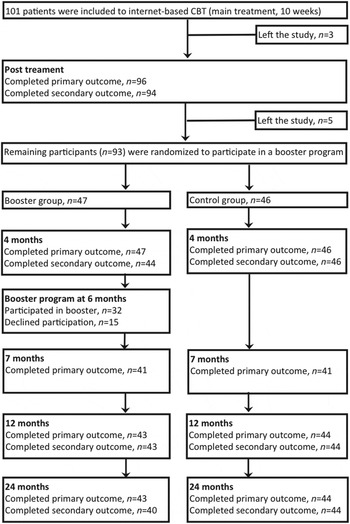
For the purpose of evaluating the long-term effects of ICBT, the sample consists of all 101 participants who were included and randomized in the original trial and thus eligible for ICBT (immediately or after 10 weeks). However, for the purpose of evaluating the effect of adding a booster program, the sample consists of the participants who completed the 4-month follow-up assessment after treatment completion, after which the randomization to the booster treatment was conducted. Before the acute ICBT was concluded, three participants withdrew from the study and five participants did not complete the 4-month follow-up assessment. Thus, the sample analyzed in evaluating the effect of the booster treatment consists of the 93 participants who participated in the 4-month follow-up assessment and were randomized to receive booster treatment or not.
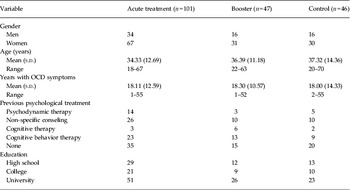
The participant flow through the trial is displayed in Fig. 1 and participant demographics are presented in Table 1. This trial was approved by the regional ethics committee and registered at clinicaltrials.gov (registration ID: NCT01525576).
Participant flowchart.

Patient demographics

OCD, Obsessive–compulsive disorder; s.d., standard deviation.
Randomization and assessment procedures
Participants who completed the 4-month follow-up assessment were randomly selected (using a true random number service; www.random.org) at a 1:1 ratio to be offered a booster program (i.e. the present study's experimental group, n = 47) or not to be offered a booster program (i.e. the present study's control group, n = 46). For practical reasons, the participants were randomized before the assessment so that they could be offered participation in the booster treatment immediately after conducting the interview part of the assessment. Thirty-two out of 47 participants randomized to the booster chose to participate and were treated 6 months after ICBT. Participants in the control condition did not receive any information about the booster treatment but were only aware of the 4-, 7-, 12- and 24-month assessments that they had agreed to complete in the original ICBT trial. Thus, they were blind to the present booster study design. After randomization, the 4-month assessment was considered the baseline for the purpose of evaluating the booster program.
The pre-treatment, post-treatment and 4-, 12- and 24-month follow-up assessments included both clinician- and self-administered instruments whereas the 7-month assessment only included clinician-administered assessments. All clinical interviews were conducted by telephone by either a psychologist or a psychiatrist or with a student in the final semester of the 5-year clinical psychologist program, under the supervision of a licensed psychologist. Assessors were blind to booster allocation at 7, 12 and 24 months.
Outcome measures
Clinician-administered outcome measures
The primary outcome measure was the clinician-administered YBOCS (Goodman et al. Reference Goodman, Price, Rasmussen, Mazure, Fleischmann, Hill, Heninger and Charney1989), which is regarded as the gold standard for assessing the severity of OCD symptoms (Baer & Blais, Reference Baer and Blais2010). Global functioning and improvement were assessed using the Global Assessment of Functioning (GAF; APA, 2000).
Self-rated outcome measures
The Obsessive-Compulsive Inventory – Revised (OCI-R; Foa et al. Reference Foa, Huppert, Leiberg, Langner, Kichic, Hajcak and Salkovskis2002) was used as the secondary outcome measure of OCD symptoms by calculating both the total score and the subscale with the largest score (Simpson et al. Reference Simpson, Foa, Liebowitz, Ledley, Huppert, Cahill, Vermes, Schmidt, Hembree, Franklin, Campeas, Hahn and Petkova2008). Depressive symptoms were assessed using the self-rated Montgomery–Åsberg Depression Rating Scale (MADRS-S; Svanborg & Åsberg, Reference Svanborg and Åsberg1994). Adverse events data were collected using a self-rating questionnaire with a free text option where the participant was instructed to describe the possible event in detail. If the participant reported any adverse event, follow-up questions (e.g. about the intensity and duration of the possible adverse event) were then conducted and assessed by a psychologist and a psychiatrist. All self-rated outcome measures were Internet administered, which is a valid administration format (Coles et al. Reference Coles, Cook and Blake2007; Hedman et al. Reference Hedman, Ljótsson, Rück, Furmark, Carlbring, Lindefors and Andersson2010; Hollandare et al. Reference Hollandare, Andersson and Engstrom2010).
Booster treatment
The booster treatment consisted of a self-help text with worksheets and an integrated email system on a secured online platform. This treatment format was identical to the format that the participants had received in the original ICBT trial with consecutive modules (similar to book chapters) followed by homework exercises and frequent written contact with an online therapist. The active booster treatment lasted for 3 weeks with one module each week. The first module consisted of a repetition of the psycho-education regarding OCD symptoms and a rationale for ERP. Different types of stressors that could amplify OCD symptoms, along with common treatment setbacks, were exemplified. The participants were instructed to perform a retrospective analysis of treatment progression during the past 6 months. The focus of the second module was on involving family or friends in the treatment. The rationale for this intervention was explained as incorporating external stimuli in the participants' natural environment to reinforce ERP-related behaviors. Some research has indicated that patients with elevated OCD symptoms are more dependent on external stimuli, compared to healthy controls, in their information processing (Lazarov et al. Reference Lazarov, Dar, Oded and Liberman2010, Reference Lazarov, Dar, Liberman and Oded2012). Thus, we considered it more likely that the participants would continue ERP if they had a friend or relative who was involved and reminded the participants to do their ERP exercises. The homework in module 2 was intended to establish new treatment goals and also to make a plan of how to report treatment progression to a friend or relative. Participants who did not have any friends or relatives were instructed to make systematic reports to themselves at least once a week. Instead of reporting how ERP went during the week, the participants in the booster program reported how the reports of ERP to their friends/relatives/themselves went. In module 3, long-term goals were further elaborated with techniques mainly inspired by acceptance and commitment therapy (Hayes, Reference Hayes2004) (i.e. a short exercise in defining life values and how to pursue them on a daily basis). The participants were instructed to continue and report ERP progression weekly to a person in their natural environment, and also to set a date for reporting long-term goals within 3 months. The long-term goal worksheet consisted of a prognosis of potential future stressors using data from the retrospective analysis in module 1 and also different suggestions on how to cope with these stressors. In summary, the treatment content first aimed at teaching the participant to carry out a retrospective analysis of treatment progression and the impact of potential stressors, then to incorporate external stimuli that could further reinforce ERP-related behaviors, and finally to establish long-term goals with a prognosis of potential future stressors. Except for repetition of the ERP strategies in module 1, the treatment content in the booster program was new and was not incorporated in the previous main treatment. Although ERP was still thought to be the active ingredient to symptom reduction, the focus in the booster modules was instead to establish natural reinforcers that could maintain these behaviors.
The online therapists provided feedback on homework assignments, granted consecutive access to the different treatment modules, and supported the participants in establishing a relapse plan and helped to incorporate external stimuli in the participant's natural environment to further reinforce ERP-related behaviors. The participants were encouraged to contact the therapist if they needed support and received a response within 24 h on weekdays. A short mobile text message (SMS) was sent to the participant that they had received a new message from their therapist in the treatment platform. The therapist called the participant if they had not logged on within a few days after this SMS. The therapists were two psychologists with 7 years of experience in treating OCD who also had access to on-demand supervision from a psychologist who also frequently monitored treatment adherence in the treatment platform. Participants interacted with same therapist throughout the whole booster program. After receiving the booster program for a 3-week period, the participants had access to the modules for another 6 months but without therapist support.
Statistical analyses
Statistical analyses were conducted using SPSS version 22.0 (IBM Inc., USA) and Stata 13/IC (StataCorp Inc., USA). We first investigated the overall long-term effects in the entire sample that had completed ICBT (n = 101) and compared the post-treatment and follow-up assessments with pre-ICBT using paired t tests. In the next step, we compared the relative efficacy of the booster treatment based on the sample of 93 participants who were randomized to receive booster or not. Interaction effects on continuous variables were tested using a linear mixed effects model fitted with full information maximum criteria (Verbeke & Molenberghs, Reference Verbeke and Molenberghs2009). Linear mixed models have the advantage of incorporating the non-independence of intra-individual change and have been shown to be superior to traditional intention-to-treat methods for handling missing data (Mallinckrodt et al. Reference Mallinckrodt, Clark and David2001; Lane, Reference Lane2008). We used the best model fit with a fixed linear effect combined with a random intercept from booster baseline (4 months). Recovery status was, as in the original trial, calculated using the Jacobson & Truax (Reference Jacobson and Truax1991) criterion of clinically significant improvement with a cut-off of 2 standard deviations below the pre-treatment value. We used a binomial log-linear regression framework (Cummings, Reference Cummings2009) to calculate risk of relapse (i.e. fulfilling the recovery criteria at baseline but not at follow-up), including the booster baseline (4 months) YBOCS score as a covariate. The relapse rate was visualized using Kaplan–Meier curves and significance tested using the log-rank test. Cases where data were lost were censored from this analysis. Independent t tests were used to test baseline continuous differences. χ 2 tests were used to test between-group dichotomous differences. The study was powered to detect a between-group effect size of d = 0.6 (80% power, α = 0.05) between the participants who received the booster and participants who did not.
Ethical standards
All procedures contributing to this work complied with the ethical standards of the relevant national and institutional committees on human experimentation and with the Declaration of Helsinki of 1975, as revised in 2008.
Results
Long-term outcome (entire sample)
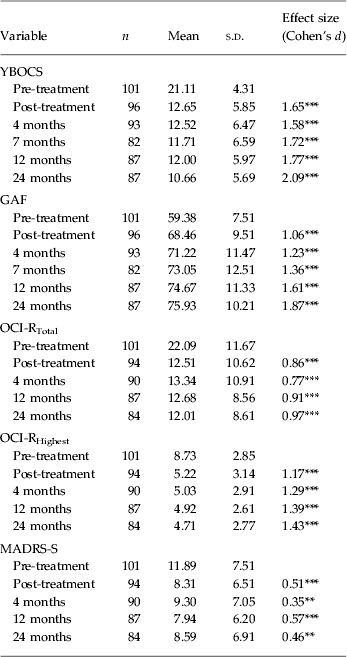
The within-group change in the pooled sample (n = 101) was significant when comparing pre-treatment data with the post-treatment, 4-, 7-, 12- and 24-month assessments on all continuous measurements (p < 0.05–0.001). Within-group effect sizes were large on the YBOCS (Cohen's d = 1.58–2.09) and the proportion of participants in recovery were 49–64% at 7, 12 and 24 months. Means, p values and effect sizes are displayed in Table 2.
Long-term efficacy of Internet-based cognitive behavior therapy (ICBT)

YBOCS, Yale–Brown Obsessive Compulsive Scale; GAF, Global Assessment of Functioning; OCI-R, Obsessive Compulsive Inventory – Revised; MADRS-S, self-rated Montgomery–Åsberg Depression Rating Scale; s.d., standard deviation.
** p < 0.01, *** p < 0.001 of paired t tests comparing pre-treatment assessment to the respective post-treatment or follow-up assessment.
Evaluation of the booster program
Baseline characteristics
There were no baseline differences on the continuous outcomes but χ 2 tests revealed a significant difference in recovery frequency, where the booster group had a significantly lower recovery rate at booster baseline (17/47; 36%) compared to the control group (29/46; 63%) (χ 2 1,93 = 6.72, p < 005).
Attrition and adherence
The mean therapist time for the 32 who actively participated in the booster program was 72 min (s.d. = 45) over the 3 weeks. This time included active treatment (such as emailing the participants) and also other work such as reading the communication from the original ICBT trial and establishing a behavior analysis. A majority (59%) of the 32 participants completed all three modules.
Main outcomes
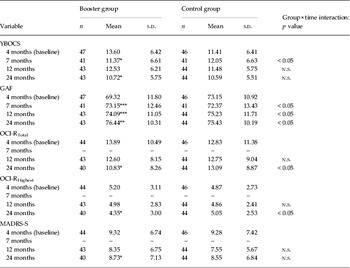
There was a significant interaction effect from 4 to 7 months on the YBOCS favoring the booster group (F 83.35 = 5.951, p < 0.05). There were no significant interaction effects from 4 to 12 or 24 months (F 78.46–83.59 = 1.494–2.520, p = 0.225–0.116). Continuous variables means are shown in Table 3.
Evaluation of booster program
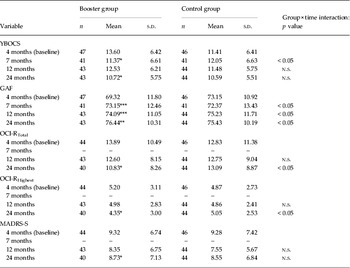
YBOCS, Yale–Brown Obsessive Compulsive Scale; GAF, Global Assessment of Functioning; OCI-R, Obsessive Compulsive Inventory – Revised; MADRS-S, self-rated Montgomery–Åsberg Depression Rating Scale; s.d., standard deviation; n.s., not significant.
* p < 0.05, ** p < 0.01, *** p < 0.001 of paired t tests comparing booster baseline (4 months) to each follow-up assessment.
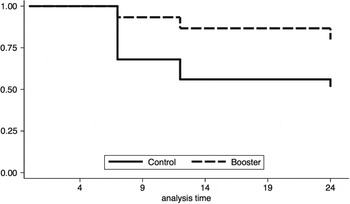
The frequency of participants in recovery in the booster group was 23/41 (56%) at 7 months, 22/43 (51%) at 12 months and 27/40 (68%) at 24 months. The recovery rate in the control group was 20/41 (49%) at 7 months, 22/46 (48%) at 12 months and 27/44 (61%) at 24 months. In the booster group, one participant experienced relapse at 7 months, two experienced relapse at 12 months and four experienced relapse at 24 months. The control group had eight relapses at 7 months, 10 relapses at 12 months and seven relapses at 24 months. The binomial log-linear regression, using the YBOCS baseline value held as a covariate, showed that this relapse difference was significant at both 7 and 12 months (Z 1,78 = 1.97–2.00, p < 0.05), but not at 24 months (Z 1,81 = 0.76, p = 0.45). The estimated risk reduction of having a relapse in the booster group compared to the control condition was 87% [95% confidence interval (CI) 1–98] at 7 months and 79% (95% CI 3–95) at 12 months. The log-rank test showed a significant between-group difference in time to relapse favoring the booster group (χ 2 1 = 6.257, p < 0.05). Kaplan–Meier curves of this difference are shown in Fig. 2.
Kaplan–Meier relapse curve.

Secondary outcomes
There was a significant interaction effect on the GAF from booster baseline to 7, 12 and 24 months (F 82.21–93.65 = 4.25–4.67, p < 0.05) and also on both OCI-R scales at 24 months (F 89.28–92.52 = 4.03–5.60, p < 0.05), suggesting larger improvements in the booster group compared to baseline (4 months). No other interaction effects were significant. Continuous variables means are shown in Table 3.
Blinding integrity
Blinding was broken on four occasions at 7 months. The reason for these broken blinding was that the participants by mistake mentioned which treatment they had received. There was no broken blinding at 12 or 24 months.
Adverse events
Five adverse events were reported at the 12-month follow-up. Two participants reported that anxiety and depressive symptoms had increased during the original ICBT trial but that these symptoms were not present at 12 months. One participant reported drop-out from the original trial because of a traumatic event not associated with the treatment. One participant in the booster group reported increased compulsions during the original trial in one specific situation associated with compulsive washing. This adverse event was, according to the participant, a direct consequence of an ERP exercise that had gone awry and the participant experienced this as very troublesome several months after the original treatment had ended. However, these problems were not present at 12 or 24 months. Another participant in the booster group, who had not achieved any treatment response in the original trial, experienced an increased level of compulsions at 12 months compared to before she was included in the booster treatment. There were no reported adverse events at 24 months.
Subgroup analysis
Participants who went through the booster program were compared with those who were offered booster but declined participation. There were no baseline differences between the groups on any variables, and no significant interaction effects on the continuous scales except on the GAF at 12 and 24 months (F 41.17–45.43 = 4.82–5.11, p < 0.05), favoring participants who declined participation in the booster program. Subgroup means are shown in the online Supplementary Table S1.
Discussion
The aim of this study was to explore the long-term effects of ICBT for OCD and also to investigate if an Internet-based booster program could further enhance the long-term results. There are, to our knowledge, no previous long-term outcome studies of ICBT for OCD or randomized trials investigating if a booster program can further improve and/or prevent relapse for OCD patients. The results show that ICBT for OCD generates large long-term effects. These results are in line with previous long-term outcome studies on face-to-face CBT for OCD patients, with large within-group effect sizes 2 years after treatment. The booster program also changed the outcome pattern in terms of a significant interaction effect on the YBOCS rating, favoring the booster group at 7 months, but this difference disappeared at 12 and 24 months. However, being randomized to booster was associated with an 87% and a 79% risk reduction of having a relapse compared to the control condition at the 7- and 12-month follow-up assessments respectively. Kaplan–Meier analysis also indicated a slower relapse rate for the booster group and several secondary outcomes favored the booster group such as the OCI-R scales (at 24 months) and the GAF (at 7, 12 and 24 months). Major strengths in this study were the multiple follow-ups, randomized design and blinded assessments.
Delivering booster treatments using the Internet can have promising implications for both health care providers and OCD patients. The amount of therapist time in the booster treatment was only 72 min, including preparation time and active treatment. Consequently, this treatment format is probably a cost-effective alternative in terms of reduced therapist time. An interesting aspect for future research would be to investigate the optimal time period to give booster programs. The booster program in this trial started 6 months after the main treatment had ended but it is currently unknown when these interventions should be implemented to give optimal results. Intervention research in other areas has suggested that booster sessions should be instituted within 3 months after treatment completion (Hennessy et al. Reference Hennessy, Bolan, Hoxworth, Iatesta, Rhodes and Zenilman1999) and it is important to investigate this issue further in OCD.
Of note, the effects of the booster program seem to be stronger at 7 months than at 12 or 24 months. One interpretation of this could be that booster programs, as an adjunct to ICBT, are not very effective in the long run. Another interpretation could be that booster programs are effective but these patients perhaps need even more therapist contact than was added in this study to acquire long-term benefits. Another possible explanation of the decline in between-group effects could lie in the fact that the control group made further improvements. The results also favored the booster group in terms of general functioning and it is unclear whether this is a result of better sensitivity on the GAF compared to the YBOCS or whether the booster program had an additional effect besides OCD symptom reduction such as better skills in how to handle anxiety and stress in other domains in life. It is also unclear whether the results from this study could be translated other treatment formats such as face-to-face or group CBT. More research is needed to clarify these issues.
One-third of the randomized sample never participated in the booster program but these participants seemed to make similar, and partially even better, progress compared with the participants in the booster group. We could not find any baseline differences between those who participated or those who declined participation in the booster program. However, the results are in line with our subjective impression from talking to these patients; thus, a majority of those who declined participation did so because they felt confident that they would make further progress on their own and did not experience any more demand for professional help. One recommendation for future studies is therefore to further investigate for whom booster programs might be most effective.
This study also collected data on adverse events, which might lead to improved interventions and, as a consequence, better long-term outcomes and fewer relapses. Adverse events have been systematically reported in the medical field for decades and our recommendation for future research is to also incorporate this methodology in psychological treatments (Barlow, Reference Barlow2010). The data from this study suggest that ICBT with or without booster is associated with relatively few and mild adverse events.
This trial has several limitations. First, we found significant between-group differences at booster baseline (4 months). Although we tried to circumvent this issue by using the YBOCS as the covariate in the analyses, this may have affected the estimated treatment effects (e.g. regression to the mean). Thus, the results should be interpreted with some caution. Second, this study was a priori underpowered to detect small effect sizes and this limitation increases the risk of conducting type 2 errors. Future research should therefore use larger sample sizes. Third, the level of OCD symptoms at the booster baseline was low and the outcome assessments were not specifically designed to measure subclinical change. Thus, there was a substantial risk of floor effects in this study, which also increases the risk of conducting type 2 errors. One recommendation for future research is therefore to develop outcome assessments that are more sensitive to change at a subclinical level. Fourth, as the control group was completely blinded to randomization, the results could also be an effect of more general therapist support or knowledge of the fact that the participants were in a treatment intervention.
We conclude that ICBT has strong long-term effects for OCD patients. Furthermore, although the effects are small and are associated with a high degree of uncertainty, Internet-based booster programs have the potential to further improve long-term outcomes for this patient group. More research in this field is warranted.
Supplementary material
For supplementary material accompanying this paper visit http://dx.doi.org/10.1017/S0033291714000543.
Acknowledgments
We thank G. Brander, P. Söderholm and O. Wiklund for the follow-up assessment interviews. Financial support was provided through the regional agreement on medical training and clinical research (ALF) between Stockholm County Council and Karolinska Institutet. The Swedish Research Council and the Swedish Society of Medicine (Söderströmska Königska sjukhemmet) provided funding for this study.
Declaration of Interest
None.