The use of breast tissue expanders (BTEs) is common in breast reconstructive surgeries; ∼74,000 BTE implantation procedures were performed in the United States in 2017.1 The reported BTE-associated infection rates range from 4.8% to 24%.Reference Kato, Nakagami and Iwahira2 – Reference Hvilsom, Friis and Frederiksen5 These infections are associated with significant costs and suboptimal patient outcomes,Reference Francis, Ruberg and Stevenson4 often resulting in loss of the expander and the option for reconstruction.Reference Fischer, Nelson, Serletti and Wu6 Risk factors associated with BTE infections include previous radiation,Reference Nahabedian, Tsangaris, Momen and Manson3 , Reference Francis, Ruberg and Stevenson4 , Reference Alderman, Wilkins, Kim and Lowery7 obesity,Reference Alderman, Wilkins, Kim and Lowery7 axillary node dissection,Reference Nahabedian, Tsangaris, Momen and Manson3 and bilateral reconstruction.Reference Francis, Ruberg and Stevenson4
After reconstructive surgery, tissue expansion is achieved through multiple gradual infusions of saline. Studies have shown that the BTE infection risk is higher in the tissue expansion (ie, postaccess) period compared to the preaccess period.Reference Kato, Nakagami and Iwahira2 , Reference Hvilsom, Friis and Frederiksen5 Although this process represents a modifiable risk factor, there is no specific infection prevention guidance for tissue expansion. The Centers for Disease Control (CDC) surgical site infection (SSI) surveillance period ends once an expander is accessed because any subsequent infection is no longer attributable to the breast surgery. However, a consensus on the definition of BTE infections after access has not been reached.Reference Nahabedian, Tsangaris, Momen and Manson3 , Reference Francis, Ruberg and Stevenson4 , Reference Azouz, Mirhaidari and Wagner8
In this study, we investigated BTE infections during the expansion phase of reconstruction at a tertiary-care facility over 2 years, prompted by a growing concern about infections following expansion missed by the CDC surveillance definition. Here, we provide a definition for postaccess SSI, and we identify factors contributing to BTE infection during the expansion period. In this quality improvement project, we report BTE-associated infection rates before and after an infection prevention intervention focused on the process of tissue expansion.
Methods
Patient population and postaccess BTE case identification
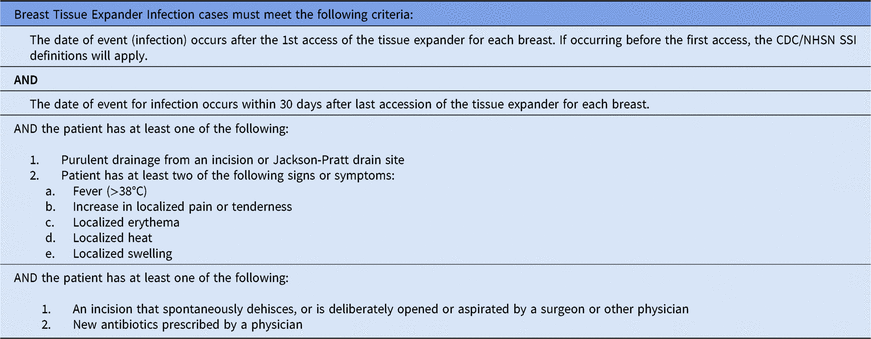
An infection preventionist (IP) performed retrospective chart surveillance on all immediate BTE insertions postmastectomy at The Johns Hopkins Hospital (JHH), a 1,194-bed tertiary-care center in Baltimore, Maryland, between January 2016 and December 2017. The CDC National Healthcare Safety Network SSI surveillance definition was applied until BTE access, after which an internal definition, modified from the CDC SSI surveillance definition, was used to continue surveillance for infection postaccess (Table 1). The internal definition was created through a collaborative process with members of the departments of infection prevention, infectious disease, and plastic surgery.
Definition Developed for Classifying Postaccess Breast Tissue Expander Infectionsa

Note. CDC, Centers for Disease Control and Prevention; NHS, National Healthcare Safety Network; SSI, Surgical Site Infection.
a Adapted from CDC NHSN SSI surveillance definitions.
Clinic observations of expansion procedure
Overall, 2 infection preventionists and 1 infectious disease physician and hospital epidemiologist observed BTE procedures performed by nurses in the breast clinic to identify potential factors contributing to infection and opportunities for improvement in infection prevention. Direct feedback reports, including specific observations and recommendations, were provided to the plastic surgery team following each procedure observed, and changes were made to the equipment, room set up, and workflow procedures. The infection prevention recommendations were implemented between July and September 2016. Observations of the BTE procedure with direct verbal feedback were continued through May 2018 to ensure that changes in practice were adopted and sustained.
Data collection and analysis
Postaccess BTE infection surveillance continued throughout and after the intervention period. Pre- and postintervention BTE infection rates were compared (excluding the implementation period) using the test of 2 proportions (α < 0.05).
Results
Clinic observations of expansion procedures
Observations of the expansion procedure revealed several potential contributing factors to postaccess BTE infections: skin preparation with an inadequate amount of chlorohexidine and inconsistent application technique; preparation and storage of multiple saline syringes for BTE fills from a single-use saline bag; an open saline infusion system; and clean, rather than aseptic, technique used for expansion. These observations were used to develop targeted infection prevention interventions (Appendix A online).
Development of BTE access protocol
The BTE manufacturer’s instructions call for aseptic technique for saline expansion, but they do not provide a specific protocol for BTE access. The plastic surgery and infection prevention teams developed a standardized institutional protocol for BTE expansion using the protocol for venous ports as a guide (Appendix B online). The BTE access protocol requires 2 sets of sterile gloves for providers to maintain sterility after priming the nonsterile saline bag if the expansion is performed without an assistant. To maintain a closed system during filling and to reduce the potential for contamination, a bag of saline is connected to IV tubing with a stopcock attached to one of the injection ports. This allows saline to be pulled from the bag and infused into the patient without opening the infusion system by repeatedly disconnecting the syringe (Appendix C online).
BTE infection before and after implementation of recommendations
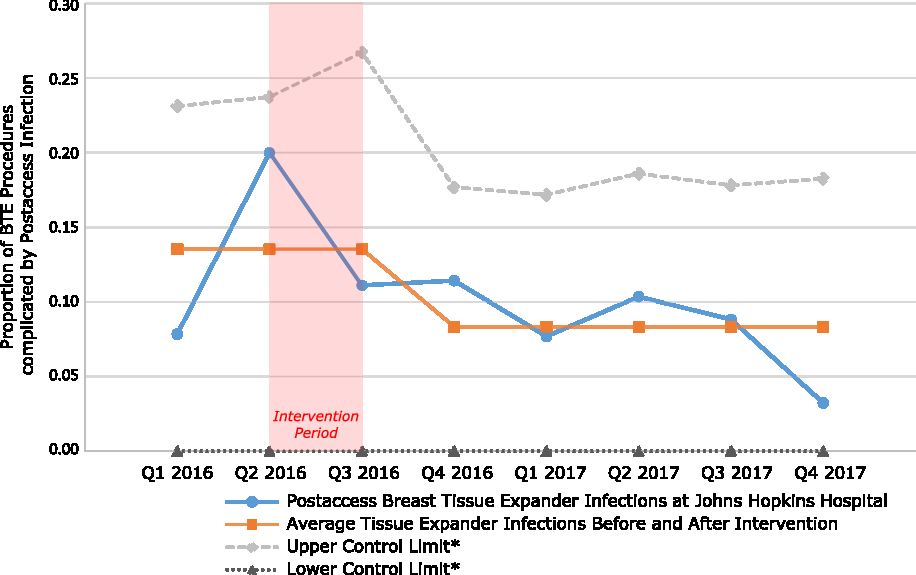
Overall, 158 and 166 BTE surgeries were performed at JHH in 2016 and 2017, respectively. During the preintervention surveillance period, 9 of 45 (20%) patients had a postaccess BTE infection (Fig. 1). During the intervention, a reduction in postaccess BTE infections to 3 of 27 (11.1%) was achieved, with a declining trend in subsequent quarters, though the difference did not reach statistical significance (P = .0652). The most common organisms recovered from postoperative wounds were Staphylococcus aureus (26%), coagulase-negative Staphylococcus spp (18%), and Pseudomonas spp (12%). Cultures of apparently infected wounds did not grow any organisms for 32% of cases.
P-Chart of Postaccess Breast Tissue Expander (BTE) Infection Rates by Quarter (January 2016-December 2017). During the intervention period (July-September of 2016), changes were implemented to optimize breast tissue expander access technique.

Discussion
Infection surveillance and prevention interventions are strongly associated with reductions in SSI rates and improved patient outcomes.Reference Francis, Ruberg and Stevenson4 By developing a modified SSI surveillance definition to identify infections in the postaccess period, and through the observation of BTE procedures, we identified areas for improvement in the expansion process. The focus of the SSI prevention intervention included (1) single-use saline delivered in a closed system (2) improved preaccess skin preparation, and (3) the use of aseptic technique when filling BTEs. The modified SSI definition developed to detect postaccess BTE infection facilitated quality improvement efforts. Based upon the observations in the breast clinic, we developed a standardized technique for saline expansion using infection prevention best practices and we have demonstrated that this method can reduce the risk of BTE infection.
Few studies have described infection rates during the postaccess period of tissue expansion. The CDC SSI definition surveillance period stops once the BTE is accessed, and detection of infections during expansion requires a modified definition to continue surveillance during this period. A retrospective study of 981 patients found that most infections after breast reconstruction surgery occurred during the expansion period.Reference Kato, Nakagami and Iwahira2 A multicenter study of 189 breast reconstructions also found a significantly higher risk of complications in the expansion period, including 6-month infection risk of 16.9%.Reference Hvilsom, Friis and Frederiksen5 Pegues et alReference Pegues, Shireley and Riddle9 reported a cluster of BTE infections requiring explantation caused by Serratia marcescens that was cultured from the bag of commercial saline used as expander fluid. They describe poor hand hygiene practices, nonsterile expansion technique, and multiple use of the same saline bags during tissue expansion.Reference Pegues, Shireley and Riddle9 However, none of these studies provide specific case-identification criteria or recommend an infection prevention protocol.
Our study has several limitations. This descriptive observational study with a limited time frame and sample size does not allow for a time-series analysis. The lack of sufficient data preceding the intervention also limited our ability to detect a statistically significant difference in the proportion of infections before and after the intervention. Longitudinal studies are needed to quantify the reduction in postaccess BTE infections following implementation of infection prevention protocols. The postaccess BTE surveillance definition should be validated in other settings to ensure it accurately discriminates BTE infections from noninfectious inflammatory or necrotic processes. A need remains for a manufactured closed system for BTE fills to standardize the process and to reduce opportunities for contamination.
In summary, the postaccess BTE expansion period represents a significant risk for infection following breast reconstruction surgery. The use of a modified surveillance definition can help quantify these infections and promote infection prevention efforts. Implementation of infection prevention best practices during BTE expansion, such as single-use saline, adequate skin preparation, and a standardized aseptic-technique protocol, can reduce infections and improve patient outcomes in breast reconstructive surgery.
Acknowledgments
We would like to acknowledge the Department of Hospital Epidemiology and Infection Control at the Johns Hopkins Hospital for their valuable mentorship throughout this project. We also gratefully acknowledge Leah Jager, PhD for assistance with data analysis.
Financial support
No financial support was provided relevant to this article.
Conflicts of interest
C.R. has received grants from Clorox company outside the submitted work. S.E.C. has received personal fees from Theravance and Novartis outside the submitted work. J.M.S. is a consultant for Allegran outside the submitted work. G.D.R. has received grants from Allergan, AxoGen, and Integra outside the submitted work. L.L.M. is cochair of the Healthcare Infection Control Practices Advisory Committee (HICPAC) for the Centers for Disease Control and Prevention (CDC). All other authors report no conflicts of interest relevant to this article.