Introduction
This article honors and celebrates the legacy of the dipterists at the Canadian National Collection of Insects, Arachnids and Nematodes (CNC) who coordinated the Manual of Nearctic Diptera — a resource that has been extremely important to all students of Diptera in the past several decades, and which has served as a model for subsequent regional Diptera manuals. Specifically, I want to honor two of my idols in Dipterology — both premiere experts in the systematics of Lauxanioidea, and both of whom have greatly influenced my work in the superfamily. I had the pleasure of meeting Frank McAlpine on a few occasions in my pursuit of an understanding of the Chamaemyiidae, finding him always happy to help and share. On one of my trips to the CNC, I also had the good fortune to meet Guy Shewell, who enthusiastically pulled me aside to show me many interesting Lauxaniidae, essentially instigating my fascination with the family. In addition, Frank's earlier work (McAlpine Reference McAlpine1968) considering the placement of Eurychoromyia mallea Hendel within the Lauxanioidea was critical to my recent assessment of its placement as a member of the Lauxaniidae, as one of the several genera of Eurychoromyiinae (Gaimari and Silva Reference Gaimari and Silva2010b). The genus described herein adds the eighth genus to this subfamily, with two of the three new species described in honor of Frank and Guy; the third species is described to honor Brian Brown for his work on the Manual of Central American Diptera.
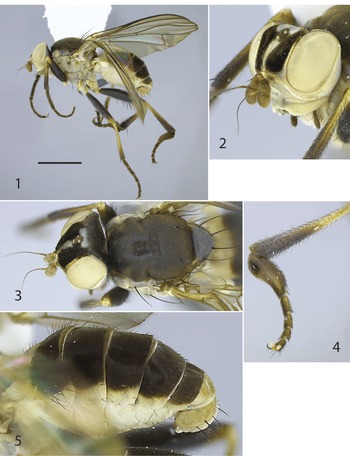
Exalla browni sp. nov., holotype male: 1, habitus, lateral view (scale bar =2.0 mm); 2, head, frontal oblique view; 3, thorax and head, dorsal view; 4, hind tarsus, ventral oblique view; 5, abdomen, dorsolateral view.

Materials and methods
Specimens for this study were sent via the University of Guelph Insect Collection, Guelph, Ontario, Canada (DEBU), with some of them originating from the National Science Foundation-funded Colombian Arthropod Project under the direction of Mike Sharkey (University of Kentucky, Lexington, Kentucky, United States of America) and Brian Brown (Natural History Museum of Los Angeles County, Los Angeles, California, United States of America). Primary types from Colombia are deposited in the Instituto de Investigación de Recursos Biológicos Alexander von Humboldt, Villa de Leyva, Boyacá, Colombia (IAVH). For one species, a paratype is deposited in IAVH and in each of the following collections: California State Collection of Arthropods, Plant Pest Diagnostics Center, California Department of Food and Agriculture, Sacramento, California, United States of America (CSCA), and National Museum of Natural History, Smithsonian Institution, Washington, D.C., United States of America (USNM). For the species from Ecuador, the primary type is deposited in DEBU.
Terminology
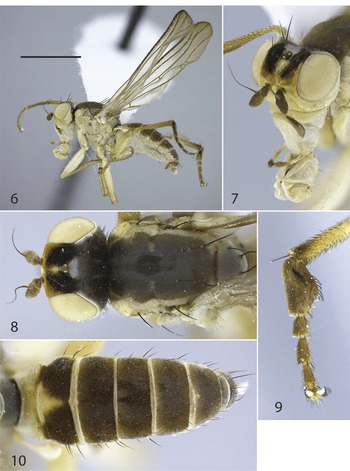
Basic terminology follows Cumming and Wood (Reference Cumming, Wood, Brown, Borkent, Cumming, Wood, Woodley and Zumbado2009), with some remarks specific to Eurychoromyiinae in Gaimari and Silva (Reference Gaimari and Silva2010b). Body length was measured by adding the length of the head (without antennae) through the thorax to the length of the abdomen, to account for differential curling of the abdomens among specimens. For head ratios, head length and height were measured from lateral view, from the tip of the frons through the posterior occiput, and from the ocelli through the bottom edge of the subgena, respectively; head width, frons width, and frons length were measured from dorsal view, with head width measured through the widest part, frons width through the anterior ocellus, and frons length from the anterior ocellus through the anterior edge of the frons. On the thorax, scutal width was measured at the level of the supra-alar setae and scutellar width through the area of contact with the scutum. On the wing, the width was measured just proximal to the tip of CuA1 and discal medial cell length was measured from crossvein bm-cu through the anterior tip of crossvein dm-cu. All other measurements were made through maximum widths, lengths, heights, etc.
Data for holotypes are presented in the form of the exact label information, annotated with brackets ([ ]) to be more complete. Individual lines on each label are separated by a backslash (/). Paratype data are presented according to the information provided, rather than verbatim. Genitalia, where dissected from a specimen, are stored in glycerin in a microvial mounted on the pin below the specimen.
Key to reach the genus Exalla
(abbreviated from the key to New World genera of Lauxaniidae in Gaimari and Silva (Reference Gaimari, Silva, Brown, Borkent, Cumming, Wood, Woodley and Zumbado2010a) and the key to eurychoromyiine genera in Gaimari and Silva (Reference Gaimari and Silva2010b)).
1. Frons with two pairs fronto-orbital setae, posterior seta strong and reclinate, anterior seta strong or weak and reclinate to inclinate; prescutellar acrostichal seta usually present, strong………other Lauxaniidae
— Frons with fronto-orbital setae absent or with one pair only; prescutellar acrostichal seta absent or weak………2
2. Body and legs elongate, with mid and hind femora each longer than mesonotum; hind tarsus either longer than hind femur or with basal tarsomere expanded into flattened pad………Exalla, gen. nov.
— Body and legs more compact, with femora shorter than mesonotum; hind tarsus unmodified, shorter than hind femur………other Lauxaniidae
Exalla gen. nov.
“Undescribed Genus S” — Gaimari and Silva, Reference Gaimari, Silva, Brown, Borkent, Cumming, Wood, Woodley and Zumbado2010a: 990 (in key).
“undescribed genus” — Gaimari and Silva, Reference Gaimari and Silva2010b: 8 (in key).
Type species:Exalla shewelli sp. nov., by present designation.
Etymology
From Greek exallos, meaning quite different; feminine.
Diagnosis
This genus can be differentiated from other eurychoromyiines and other lauxaniids by the following combination of characteristics. The body, legs, and wings are distinctly elongate, with the mid and hind femora each longer than the mesonotum, and the wing is 3 or 4 times longer than high. The mostly brown pruinose fronto-orbital plates are wide and slightly raised relative to the frontal vitta, bulge forward slightly beyond the eye from lateral view, and are mostly bare of setulae except for sparse tiny setulae on the lower half. Fronto-orbital setae are absent or only one pair is present. The ocellar triangle is dark-brown pruinose, and is slightly raised and placed anterior to the vertex; ocellar setae are absent. Postocellar setae are present, but are either strong and cruciate (one species) or tiny and convergent. The face, parafacial, gena, subgena, postgena, clypeus, and prementum are uniformly pale yellowish pruinose. The subgena is conspicuous and equal in height to the gena. The pleuron is entirely pale grayish yellow pruinose, except for a brown spot at the base of the anepisternal seta. The intra-alar seta is absent, the proepisternal seta is either strong or tiny and hairlike, the postpronotal seta is either strong or tiny and hairlike, and the prescutellar acrostichal seta is absent or weak. There are 2 katepisternal setae, with the anterior seta small. The hind tarsus is modified, either being longer than the hind femur or having the basal tarsomere expanded into a flattened subrectangular pad. The wing is sapromyziform (thick setulae along the costal vein end at a point between veins R2+3 and R4+5). The abdomen is as long as or longer than the head and thorax together, and is about 2 times longer than wide. In the genitalia, the surstylus is articulated with the epandrium, and is long, straplike, strongly incurved, and tapering distally.
Exalla macalpinei sp. nov., holotype male: 6, habitus, lateral view (scale bar=2.0 mm); 7, head, frontal oblique view; 8, thorax and head, dorsal view; 9, hind tarsus, ventral oblique view; 10, abdomen, dorsal view.

Immatures
Unknown.
Biology
All specimens were collected between May and July in wet montane rainforest habitats, between 1500 and 2000m elevation.
Distribution
This genus is only known from Ecuador (Napo Province) and Colombia (Department of Nariño), and likely occurs in at least the area between these localities.
Remarks
By gestalt, or at first glance, members of this genus hardly look like lauxaniids, with their elongate bodies and long legs, but close examination readily reveals their family and subfamily placement. The new genus displays all the typical external characteristics typical of lauxaniids, although, as in other eurychoromyiines, there are sharp reductions and (or) losses of certain head and thoracic setae. Some of the important lauxaniid characteristics present in this genus are the unique state of the male accessory glands, which form an elongate dense tangle of bifurcating tubes filling most of the abdomen (cf. fig. 4 in Gaimari Reference Gaimari2004), the unexposed lunule, the adaptations of the adult labellum for fungal grazing (Broadhead Reference Broadhead1984; Mello and Silva Reference Mello and de, and Silva2006) including the pseudotracheal canals fanning out from the oral opening without branching, and the large tergite 6 in males. The new genus shares the following characters recognized as defining features of Eurychoromyiinae by Gaimari and Silva Reference Gaimari and Silva(2010b): the widely separated antennal bases, the fully exposed scape, the broad parafacial, the enlarged and conspicuous subgena, the eye being longer than high, the posterior edge of the vertex being concave from dorsal view, the small ocellar triangle with closely approximated ocelli, the frons with broad fronto-orbital plates, the elongate wings with vein A1 long and nearly reaching the wing margin, the male phallus being broad with the lateral edges sclerotized and the medial portion membranous, the fusion (or loss, as discussed in Gaimari and Silva Reference Gaimari and Silva2010b) of the phallapodeme into the anterior part of the phallus, the large anteriorly oriented hooks over a wide gonopore, the absence of the male pregonite, and the ribbonlike postgonite. Unfortunately, no females are yet known for this new genus, but one might expect that the epiproct is absent, there are 4 spermathecae (2+2 conformation), and the tergite and sternite of the seventh abdominal segment are fused into a ring. The autapomorphies for the genus include the brown pruinose fronto-orbital plates, the elongate mid and hind femora (each longer than the mesonotum), and the long, thin abdomen (longer than the head and thorax together, and about 2 times longer than wide).
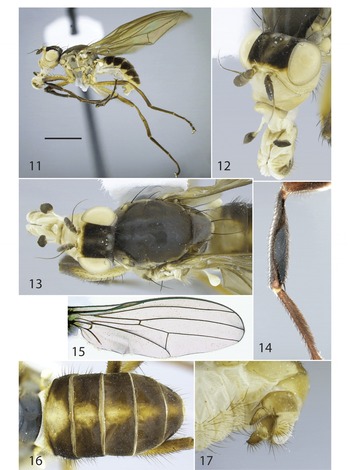
Exalla shewelli sp. nov. (11–13, holotype male; 14–17, paratype male): 11, habitus, lateral view (scale bar=2.0 mm); 12, head, frontal oblique view; 13, thorax and head, dorsal view; 14, fore tibia, anterior view; 15, wing, dorsal view; 16, abdomen, dorsal view; 17, male genitalia in situ, oblique anteroventral view.

Key to the species of Exalla
1. Postocellar setae strong, cruciate. Maxillary palpus flattened, paddle-shaped. Fore femur strongly bowed outward. Tibiae each lacking preapical dorsal seta. Fore tibia thickened through the middle, with ventral surface entirely a distinctly flattened, black concavity. Hind basitarsus long, cylindrical, not expanded………Exalla shewelli, sp. nov.
— Postocellar setae small, hairlike, converging. Maxillary palpus cylindrical, slightly clavate. Fore femur straight, not bowed. Tibiae each with strong preapical dorsal seta. Fore tibia cylindrical, lacking ventral concavity. Hind basitarsus strongly expanded into flattened lobe………2
2(1). Frons lacking fronto-orbital seta. Thorax with 1 dorsocentral seta. Femora dark brown (nearly black), yellow only at tip. Epandrial complex pale yellow………Exalla browni, sp. nov.
— Frons with single fronto-orbital seta. Thorax with 2 dorsocentral setae. Femora yellow. Epandrial complex brown………Exalla macalpinei, sp. nov.
Exalla browni sp. nov.
Type material
Holotype male (Fig. 1 (in undissected state); glued to point, excellent condition): deposited in DEBU with the following labels: (1) “ECU[ador]: Napo [Province], Baeza, 1500/m, wet montane rain/forest, malaise trap, 16–19/May 1987, [L.D.] Coote and/[B.V.] Brown, debu00148239”; (2) “SDG dissection/1389 ♂,”; (3) “Holotypus/Exalla/browni/Gaimari” [red label].
Etymology
Named for Brian V. Brown, dipterist at the Natural History Museum of Los Angeles County for his work on the monumental Manual of Central American Diptera, in addition to his having collected the single specimen of this species.
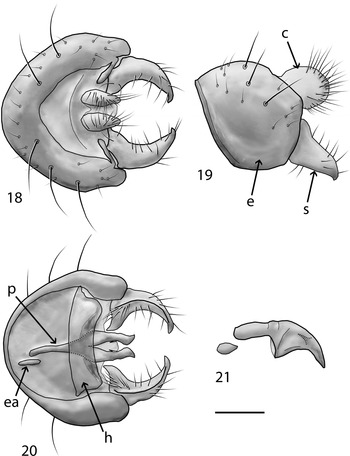
Exalla browni, sp. nov., holotype male, male genitalia: 18, 19, epandrial complex (18, dorsal view; 19, lateral view); 20, phallus complex in situ within epandrial complex, ventral view; 21, phallus and ejaculatory apodeme, lateral view (c, cercus; e, epandrium; ea, ejaculatory apodeme; h, hypandrium; p, phallus; s, surstylus). Scale bar=0.2 mm.

Diagnosis
This species (Fig. 1) is distinguishable from congeners by the following combination of characteristics. The frons lacks fronto-orbital setae. On the vertex, the outer vertical seta is tiny and hairlike. Postocular setae are absent, and the postocellar setae are tiny, hairlike, and convergent. The parafacial is about as wide as an antennal socket. The maxillary palpus is cylindrical and slightly clavate. The thorax has 1 dorsocentral seta, and the postpronotal seta and proepisternal seta are tiny and hairlike. There is 1 strong seta and several weaker setae on the ventral part of the katepisternum near the midline. The fore coxa has 1 strong apical seta on the inner surface and lacks setae on the anterior surface. The midcoxa has a row of 4 strong setae anterodistally. The femora are thickened and dark brown, only yellow distally. The fore femur is straight. All tibiae have a strong preapical dorsal seta. The fore tibia is not thickened, and has two apicoventral spurs. The midtibia has one strong apicoventral spur flanked on either side by a weaker spur. The fore tarsus is longer than the fore tibia. The hind basitarsus is strongly expanded into a subrectangular dorsoventrally flattened lobe. The discal medial cell of the wing is more than 5 times longer than crossvein dm-cu. In the male genitalia the epandrial complex is pale yellow and the surstylus tapers distally to a sharpened tip.
Description
Adult
Male (female unknown). Body length 4.8mm.
Head (Figs. 2, 3). 1.5 times higher than long, 1.25 times wider than high; eye 1.5 times longer than high. Median occipital sclerite, occiput, and lateral part of vertex brown pruinose; inner vertical seta strong (indicated by size of alveolus, as both are broken off); outer vertical seta tiny, hairlike; postocular setae absent; occiput with sparse tiny, hairlike setulae. Ocellar triangle dark-brown pruinose, slightly raised, located anterior to vertex; median part of vertex behind ocellar triangle silvery gray pruinose; ocelli form isosceles triangle, with anterior ocellus slightly larger than posterior, and with distance to a posterior ocellus slightly more than distance between posterior ocelli; ocellar setae absent; with a few tiny, hairlike setulae. Postocellar setae tiny, hairlike, converging. Frons 1.6 times wider than long; with sides subparallel, with wide dark-brown pruinose fronto-orbital plates slightly raised relative to silvery gray pruinose frontal vitta; bulging forward slightly beyond eye from lateral view; mostly bare of setulae, except sparse tiny erect setulae on lower half of fronto-orbital plate; fronto-orbital setae absent. Lunule straight. Antenna uniformly dark orange to brown, with arista slightly darker in distal half; bases separated by distance less than width of antennal socket; scape mostly exposed, shorter than pedicel; pedicel with 1 small dorsal and 1 small ventral seta in addition to smaller setulae along distal edge of outer surface; 1st flagellomere rounded apically, 1.5 times longer than high; arista pubescent. Face, parafacial, gena, subgena, postgena, and clypeus uniformly pale yellowish pruinose; face slightly concave, 1.5 times higher than wide at level just below antennae, with upper part sloping into lower frons from lateral view; parafacial subequal in width to antennal socket; gena with row of 5 or 6 tiny, hairlike setulae below eye; subgena conspicuous, subequal in height to gena; postgena setulose; clypeus small, exposed. Maxillary palpus yellow in basal half, dark brown in distal half; slightly clavate; with sparse fine erect dorsal setulae. Prementum yellow, sparsely setulose. Labellum with long yellow hairs laterally; pseudotracheal canals uniformly directed to oral opening, without anastamosing.
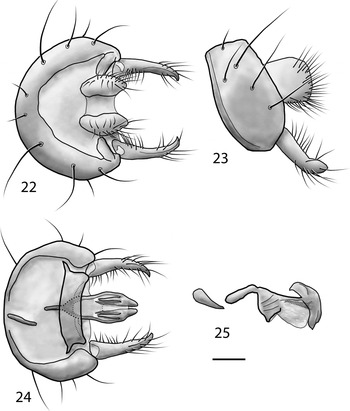
Exalla macalpinei, sp. nov., holotype male, male genitalia: 22, 23, epandrial complex (22, dorsal view; 23, lateral view); 24, phallus complex in situ within epandrial complex, ventral view; 25, phallus and ejaculatory apodeme, lateral view. Scale bar=0.2 mm.

Thorax (Fig. 3). Scutum 1.2 times longer than wide; arched; bronzy brown pruinose except silvery grey along lateral margin (well below supra-alar and postalar setae) and on postpronotum. Scutellum width at base 1.7 times greater than length; slightly arched dorsally; grayish pruinose. Pleuron entirely pale grayish yellow pruinose except small brown spot at base of anepisternal seta. Prosternum pale yellow pruinose, lacking setulae. Chaetotaxy (all setae long and strong, except as noted): 1 dorsocentral seta, posteriorly located; 1 postpronotal seta tiny, hairlike, scarcely distinguishable from 3 or 4 additional tiny, hairlike setulae present; 2 notopleural setae in anterior and posterior corners, with anterior seta nearly 2 times longer than posterior; intra-alar setae absent; 1 supra-alar seta; 2 postalar setae; prescutellar acrostichal seta absent, with sparse tiny acrostichal setulae; 1 tiny, hairlike proepisternal seta at ventral tip; 1 anepisternal seta posterodorsally, anepisternum otherwise with a few tiny, hairlike setulae; 2 katepisternal setae, with posterior seta strong and anterior seta tiny, hairlike, scarcely distinguishable from other tiny, hairlike setulae on upper part of katepisternum, and with 1 strong seta and several weaker setae ventrally near midline; two pairs scutellar setae, anterior seta slightly longer than posterior. Legs. Coxae and trochanters pale yellow; fore coxa with 1 strong apical seta on inner surface, lacking setae on anterior surface; midcoxa with row of 4 long, strong setae anterodistally; hind coxa with 1 or 2 strong setae anterodistally. Femora dark brown (nearly black) in ground color, except orange apically; elongated, slightly longer than entire length of thorax; distinctly thickened, with hind femur thickest; fore femur lacking ctenidium, with posterodorsal row of 5 strong setae, posterior (slightly dorsal) row of 3 strong setae, and ventral row of 1 strong seta at midlength and 2 weaker setae in basal third; midfemur with ventral row of 3 strong setae in basal third; hind femur with strong preapical dorsal seta, with posteroventral row of 5 long, strong setae increasing in length distally, with anteroventral row of 4 or 5 strong setae in subdistal part with additional strong setulae continuing row to apex. Tibiae orange basally, becoming dark brown in distal half; each slightly shorter than corresponding femur; each with strong preapical dorsal seta; midtibia thickening slightly distally; hind tibia thickening evenly from base to thick apex; fore tibia with two apicoventral spurs; midtibia with one strong apicoventral spur flanked on each side by a weaker spur, and with 1 strong apicoanterior seta and 1 weak apicoposterior seta; hind tibia with cluster of long thin setulae in posteroventral apical third. Tarsi brown, concolorous with distal tibiae; fore tarsus 1.5 times longer than fore tibia, with basitarsus subequal in length to remaining tarsomeres together; midtarsus subequal in length to midtibia, with basitarsus subequal in length to remaining tarsomeres together; hind tarsus (Fig. 4) slightly shorter than hind tibia, with basitarsus 0.7 times length of remaining tarsomeres together; hind basitarsus strongly expanded into subrectangular dorsoventrally flattened lobe, dorsally with central part of lobe bare except for 2 longitudinal rows of small setulae, ventrally with central part of lobe bare, lobe anteriorly with numerous short thick brown setulae encompassing edge in distal two-thirds, and lobe posteriorly and posteroventrally with dense cluster of long thick brown setulae on basal half. Wing. Length 5.3mm; 3.1 times longer than high. Hyaline, except subcostal cell clouded brown; veins brown. Crossvein r-m at midpoint of discal medial cell. Discal medial cell 5.3 times longer than crossvein dm-cu; crossvein dm-cu straight. Veins R2+3, R4+5, and M1 subparallel distally. Vein A1+CuA2 long, nearly reaching wing margin; vein A2 visible only as fold. Halter entirely pale yellow to white.
Abdomen (Fig. 5). Long and narrow; subequal in length to head and thorax together; approximately 2 times longer than wide, slightly tapering distally. Syntergite 1+2 yellow pruinose in anterior half, dark-brown pruinose in posterior half, except lateral edges yellow pruinose; with dense long thin setulae on lateral third, and sparse short thin setulae medially. Tergites 3–6 dark-brown pruinose except lateral margins yellow pruinose; with sparse short thin setulae, slightly longer along posterior edges. Sternites yellow pruinose; sternite 1 rectangular, 2.5 times wider than long, lacking setulae, without posterior invagination; sternites 2–5 subequal in size, each as wide as long, sparsely setulose. Spiracles set in membrane adjacent to tergites.
Male genitalia (Figs. 5 (in situ), 18–21). Syntergite 7+8 simple, yellow, as long medially as preceding tergite, saddle-shaped, tapering laterally, lacking setulae. Epandrial complex pale yellow. Epandrium simple; with 2 or 3 strong setae on each side; sparsely setulose. Surstylus articulated with epandrium; long, straplike, strongly incurved, and tapering distally to sharpened tip; sparsely setulose, densest on basal part of inner surface. Cercus rounded distally, setulose. Phallus broadest in middle, with arms tapering anteriorly, and strongly curved dorsally in distal part; forming a broadly opened sclerotized short cylindrical tube; anteriorly tapering into thin anteromedial extension; at half distance from base, with dorsal extension articulating with postgonite; at distal third with pair of anteriorly oriented inner hooks extending into open gonopore. Hypandrium straplike; width 4 times medial length; bare. Postgonite small, thin, ribbonlike, curved dorsally from hypandrium to articulate with anteriormost dorsal extension of phallus. Ejaculatory apodeme small; narrow; flat.
Biology
The single specimen was collected by Malaise trap in mid-May in a wet montane rain-forest habitat at an elevation of 1500m.
Distribution
Known only from Ecuador (Napo Province).
Remarks
Autapomorphies for this species include the lack of fronto-orbital and postocular setae, the tiny hairlike state of the outer vertical seta, the single pair of dorsocentral setae, the lack of setae on the anterior surface of the fore coxa, the two apicoventral spurs on the fore tibia, and the three apicoventral spurs on the hind tibia. This species appears to be mostly closely related to E. macalpinei, sharing the following synapomorphies: the postocellar setae, postpronotal seta, and proepisternal setae are tiny and hairlike, the hind basitarsus is strongly expanded into a subrectangular dorsoventrally flattened lobe, and the surstylus tapers to a sharpened tip.
Exalla macalpinei sp. nov.
(Figs. 6–10, 22–25)
Type material
Holotype male (Fig. 6 (in undissected state); glued to point, excellent condition): deposited in IAVH with the following labels: (1) “COL[ombia]: Dep[artamen]to. [del] Nariño, R[eserva].N[atural]. La/Planada, Via Hondón,/1°15′N, 78°15′W, 1930m,/16 Jun–2 Jul 2000, G. Oliva,/debu00200729”; (2) “SDG dissection/1390 ♂,”; (3) “Holotypus/Exalla/macalpinei/Gaimari” [red label].
Etymology
Named for J. Frank McAlpine, retired dipterist at the Canadian National Collection of Insects, Arachnids and Nematodes, to honor his major impact on North American dipterology through his monumental efforts on the Manual of Nearctic Diptera, in addition to his great contributions to the study of Lauxanioidea and other acalyptrates.
Diagnosis
This species (Fig. 6) is distinguishable from congeners by the following combination of characteristics. The frons has one pair of fronto-orbital setae. On the vertex, the outer vertical seta is strong. The postocular setae are small and in a row of 4, and the postocellar setae are tiny, hairlike and convergent. The parafacial is nearly 2 times wider than an antennal socket. The maxillary palpus is cylindrical and slightly clavate. The thorax has 2 dorsocentral setae, and the postpronotal seta and proepisternal seta are tiny and hairlike. There is 1 strong seta and several weaker setae on the ventral part of the katepisternum near the midline. The fore coxa lacks an apical seta on the inner surface, and has 1 strong seta on the anterior surface. The midcoxa has 1 strong seta and a row of 4 weaker setae anterodistally. The femora are thickened and yellow. The fore femur is straight. All tibiae have a strong preapical dorsal seta. The fore tibia is not thickened and has one apicoventral spur. The midtibia has one strong and one weaker apicoventral spur. The fore tarsus is longer than the fore tibia. The hind basitarsus is strongly expanded into a subrectangular dorsoventrally flattened lobe. The discal medial cell of the wing is nearly 7 times longer than crossvein dm-cu. In the male genitalia, the epandrial complex is brown and the surstylus tapers distally to a sharpened tip.
Description
Adult
Male (female unknown). Body length 4.7mm.
Head (Figs. 7, 8). 1.3 times higher than long, 1.3 times wider than high; eye 1.3 times longer than high. Median occipital sclerite, occiput, and lateral part of vertex brown pruinose; inner and outer vertical setae present, strong, with inner seta stronger; postocular setae present, small, in row of 4; occiput with sparse setulae. Ocellar triangle dark-brown pruinose, slightly raised, placed anterior to vertex; median part of vertex behind ocellar triangle silvery gray pruinose; ocelli form isosceles triangle, with anterior ocellus slightly larger than posterior, and with distance to a posterior ocellus slightly more than distance between posterior ocelli; ocellar setae absent; with a few tiny, hairlike setulae. Postocellar setae tiny, hairlike, converging. Frons 1.9 times wider than long; with sides subparallel; with wide fronto-orbital plates slightly raised relative to frontal vitta; bulging forward slightly beyond eye from lateral view; mostly bare of setulae, except sparse tiny erect setulae on lower half of fronto-orbital plate; fronto-orbital plate dark-brown pruinose becoming orange in anterior quarter of frons and along eye margin; with 1 strong fronto-orbital seta. Lunule straight. Antenna uniformly dark orange to brown, with arista slightly darker in distal half; bases separated by distance equal to width of antennal socket; scape mostly exposed, shorter than pedicel; pedicel with 1 small dorsal and 1 small ventral seta in addition to smaller setulae along distal edge of outer surface; 1st flagellomere rounded apically, 1.5 times longer than high; arista pubescent. Face, parafacial, gena, subgena, postgena, and clypeus uniformly pale yellowish pruinose; face slightly concave, 1.1 times higher than wide at level just below antennae, with upper part sloping into lower frons from lateral view; parafacial nearly 2 times width of antennal socket; gena with row of 4 or 5 tiny, hairlike setulae below eye; subgena conspicuous, subequal in height to gena; postgena setulose; clypeus small, exposed. Maxillary palpus yellow in basal half, dark brown in distal half; slightly clavate; with sparse fine erect dorsal setulae. Prementum yellow, sparsely setulose. Labellum with long yellow hairs laterally; pseudotracheal canals uniformly directed to oral opening, without anastamosing.
Thorax (Fig. 8). Scutum 1.35 times longer than wide; arched; bronzy brown pruinose except silvery grey along lateral margin (encompassing supra-alar and postalar setae) and on postpronotum. Scutellum width at base 1.5 times greater than length; slightly arched dorsally; grayish pruinose. Pleuron entirely pale grayish yellow pruinose except small brown spot at base of anepisternal seta. Prosternum pale yellow pruinose, lacking setulae. Chaetotaxy (all setae long and strong, except as noted): 2 dorsocentral setae, posteriorly located; 1 postpronotal seta tiny, hairlike, scarcely distinguishable from 3 or 4 additional tiny, hairlike setulae present; 2 notopleural setae in anterior and posterior corners, with anterior seta nearly 2 times longer than posterior; intra-alar setae absent; 1 supra-alar seta; 2 postalar setae (posterior seta minute); prescutellar acrostichal seta absent, with sparse tiny acrostichal setulae; 1 tiny, hairlike proepisternal seta at ventral tip; 1 anepisternal seta posterodorsally, anepisternum otherwise with a few tiny, hairlike setulae; 2 katepisternal setae, with posterior seta strong and anterior seta tiny, hairlike, scarcely distinguishable from tiny, hairlike setulae on upper part of katepisternum, and with 1 strong seta and several weaker setae ventrally near midline; two pairs scutellar setae, anterior seta slightly longer than posterior. Legs. Coxae and trochanters pale yellow; fore coxa lacking apical seta on inner surface, with 1 strong seta near middle of anterior surface; midcoxa with 1 strong seta and row of 4 weaker setae anterodistally; hind coxa with 1 or 2 weak setae anterodistally. Femora pale yellow, except hind femur slightly darker apically; elongated, slightly longer than entire length of thorax; distinctly thickened, with hind femur thickest; fore femur lacking ctenidium, with posterodorsal row of 4 weak setae, lacking posterior row of setae, and ventral row of 1 strong seta basally and 2 weaker setae slightly more apically; midfemur with 1 strong seta basoventrally; hind femur with strong preapical dorsal seta, posteroventrally with 1 strong seta just basal to midlength, and row of 4 weaker setae continuing basally and row of 5 weaker setae distally to apex, anteroventrally with 1 strong seta just basal to midlength, and row of 6 weak setae continuing basally and 9 weak setae distally to apex. Tibiae pale yellow, except hind tibia slightly darker; each slightly shorter than corresponding femur; each with strong preapical dorsal seta; midtibia narrow throughout; hind tibia thickening evenly from base to thick apex; fore tibia with one apicoventral spur; midtibia with one strong and one weaker apicoventral spur, and with 2 strong apicoanterior setae and 1 weak apicoposterior seta; hind tibia with cluster of long thin setulae (slightly longer than other hind-tibial setulae) in posteroventral apical third. Tarsi pale yellow, concolorous with tibiae, except hind tarsus brown; fore tarsus 1.3 times longer than fore tibia, with basitarsus slightly shorter than remaining tarsomeres together; midtarsus slightly longer than midtibia, with basitarsus 0.6 times length of remaining tarsomeres together; hind tarsus (Fig. 9) subequal in length to hind tibia, with basitarsus 0.6 times length of remaining tarsomeres together; hind basitarsus strongly expanded into subtriangular dorsoventrally flattened lobe, dorsally with central part of lobe bare except for 2 longitudinal rows of small setulae, ventrally setulose with clustered row of thick wavy hairs, lobe anteriorly with row of 7–9 short thick brown setulae encompassing edge, and lobe posteriorly and posteroventrally with dense long thick brown setulae, thickest on basal half. Wing. Length 5.0mm; 3.9 times longer than high. Hyaline, except subcostal cell clouded brown; veins brown. Crossvein r-m slightly beyond midpoint of discal medial cell. Discal medial cell 6.7 times longer than crossvein dm-cu; crossvein dm-cu straight. Veins R2+3, R4+5, and M1 subparallel distally. Vein A1+CuA2 long, nearly reaching wing margin; vein A2 visible only as fold. Halter entirely pale yellow to white.
Abdomen (Fig. 10). Long and narrow; slightly longer than head and thorax together; approximately 2 times longer than wide, slightly tapering distally. Syntergite 1+2 yellow pruinose in anterior half, dark-brown pruinose in posterior half, except lateral edges and median posteriorly directed triangle (nearly reaching posterior margin) yellow pruinose; with long thin setulae on lateral third and sparse short thin setulae medially. Tergites 3–6 dark-brown pruinose except lateral margins yellow pruinose; with sparse short thin setulae, longer along posterior edges and laterally. Sternites yellow pruinose; sternite 1 rectangular, 2.5 times wider than long, lacking setulae, without posterior invagination; sternites 2–5 subequal in size, each as wide as long, sparsely setulose, with longest setulae in posterolateral corners. Spiracles set in membrane adjacent to tergites.
Male genitalia (Figs. 22–25). Syntergite 7+8 simple, brown medially and yellow laterally, shorter than preceding tergite, saddle-shaped, tapering laterally, lacking setulae. Epandrial complex brown. Epandrium simple; with 3 strong setae on each side, with pair of weak dorsomedial setulae; otherwise with shorter setulae. Surstylus articulated with epandrium; long, straplike, abruptly incurved, and tapering distally to sharpened tip; setulose, densest on basal part of inner surface, with setae longest apicolaterally. Cercus rounded distally, setulose. Phallus broadest at distal third, tapering anteriorly and posteriorly; forming a broadly opened sclerotized cylindrical tube; anteriorly tapering into thin anteromedial extension; at one-third distance from base, with dorsal extension articulating with postgonite; distally with pair of large anteriorly oriented flanges over paired anteriorly oriented hooks extending into broadly open gonopore. Hypandrium straplike; width 4 times medial length; bare. Postgonite small, thin, ribbonlike, curved dorsally from hypandrium to articulate with anteriormost dorsal extension of phallus. Ejaculatory apodeme small; narrow, teardrop-shaped; flat.
Biology
The single specimen was collected in mid-June to early July in a wet montane rainforest habitat at an elevation near 2000m.
Distribution
This species is known only from Colombia (Department of Nariño).
Remarks
Autapomorphies for this species include the lack of an apical seta on the inner surface of the fore coxa and a single seta present on the anterior surface, and the greatly elongate discal cell (7 times longer than crossvein dm-cu). See the remarks for E. browni for a discussion of the likely sister-group relationship with that species.
Exalla shewelli sp. nov.
(Figs. 11–17, 26–29)
Type material
Holotype male (Fig. 11; glued to point, excellent condition, but left midleg missing): deposited in IAVH with the following labels: (1) “COL[ombia]: Dep[artamen]to. [del] Nariño, R[eserva].N[atural]. La/Planada, Via Hondón,/1°15′N, 78°15′W, 1930m,/16 Jun–2 Jul 2000, G. Oliva,/debu00200727”; (2) “Holotypus/Exalla/shewelli/Gaimari” [red label]. Paratypes: COLOMBIA. Department of Nariño: La Planada Nature Reserve: 1 ♂, debu00200728 (USNM), 1 ♂, debu00200726, SDG dissection 1246 ♂, (CSCA), same data as holotype; 1 ♂, (IAVH), Parcela Permanente, 1°15′N, 78°15′W, 1885m, 2–16 May 2000, G. Oliva, debu00200730.
Etymology
Named for Guy Shewell, late dipterist at the Canadian National Collection of Insects, Arachnids and Nematodes, to honor his major impact on North American dipterology through his efforts on the Manual of Nearctic Diptera, in addition to his great contributions to the study of Lauxaniidae.
Diagnosis
This species (Fig. 11) is distinguishable from congeners by the following combination of characteristics. The frons has one pair of fronto-orbital setae. On the vertex, the outer vertical seta is strong. Postocular setae are small and in a row of 10 or more, and the postocellar setae are strong and cruciate. The parafacial is about as wide as the distance between the antennal sockets. The maxillary palpus is flattened and paddle-shaped. The thorax has 2 dorsocentral setae, and the postpronotal seta and preoepisternal seta are strong. There are 4 or 5 strong setae and several smaller setae on the ventral part of the katepisternum near the midline. The fore coxa has 1 strong apical seta on the inner surface and a row of 4 strong setae on the anterior surface. The midcoxa has 1 or 2 strong setae and a row of several shorter setae anterodistally. Only the fore femur is thickened, and it is also conspicuously bowed outward, while the mid and hind femora are elongate. The femora are not uniformly colored or shaped, the fore femur being yellow in the upper half and brown in the lower half, and the mid and hind femora being orange except darker distally and having a yellow strip along the ventral surface. All tibiae lack a preapical dorsal seta. The fore tibia is thickened, has one apicoventral spur, and has a ventral surface that is distinctly flattened into a black concavity, the anterior margin of which is lined with a dense brush of short setulae. The midtibia has two short thick apicoventral spurs. The fore tarsus is slightly shorter than the fore tibia. The hind basitarsus is long, cylindrical, and neither expanded nor flattened. The discal medial cell of the wing is about 5 times longer than crossvein dm-cu. In the male genitalia the epandrial complex is pale yellow and the surstylus tapers distally to a blunt tip.
Description
Adult
Male (female unknown). Body length 5.9–7.1mm.
Head (Figs. 12, 13). 1.2–1.3 times higher than long, 1.1–1.25 times wider than high; eye 1.2 times longer than high. Median occipital sclerite, occiput, and lateral part of vertex at base of inner vertical seta brown pruinose; inner and outer vertical setae present, strong, with inner seta 2 times longer than outer; postocular setae present, small, in row of 10 or more; occiput with sparse setulae. Ocellar triangle dark-brown pruinose, slightly raised, placed anterior to vertex; median part of vertex (and lateral part, beyond inner vertical seta) behind ocellar triangle silvery gray pruinose divided medially by brown strip; ocelli form isosceles triangle, with anterior ocellus slightly larger than posterior, and with distance to a posterior ocellus slightly more than distance between posterior ocelli; ocellar setae absent; with few tiny, hairlike setulae. Postocellar setae strong, cruciate. Frons 1.4–1.5 times wider than long; with sides subparallel; unicolorous dark-brown pruinose except anterior edge orange, with wide fronto-orbital plates slightly raised relative to frontal vitta; bulging forward slightly beyond eye from lateral view; mostly bare of setulae, except sparse tiny erect setulae on lower half of fronto-orbital plate; with 1 strong fronto-orbital seta. Lunule straight. Antenna uniformly dark orange to brown, except scape yellowish to orange, and with arista slightly darker in distal half; bases separated by distance 2 times width of antennal socket; scape mostly exposed, shorter than pedicel; pedicel with 1 small dorsal and 1 small ventral seta in addition to smaller setulae along distal edge of outer surface; 1st flagellomere rounded apically, 1.5 times longer than high; arista pubescent. Face, parafacial, gena, subgena, postgena, and clypeus uniformly pale yellowish pruinose; face straight from lateral view, 2 times higher than wide at level just below antennae; parafacial subequal in width to distance between antennal sockets; gena with row of 6–9 small setulae below eye and extending onto lower parafacial; subgena conspicuous, subequal in height to gena; postgena setulose; clypeus small, exposed. Maxillary palpus with dark-brown, round, flattened, paddle-shaped distal half and yellow basal stalk; with sparse fine erect dorsal setulae. Prementum yellow, sparsely setulose. Labellum with long yellow hairs laterally; pseudotracheal canals uniformly directed to oral opening, without anastamosing.
Thorax (Fig. 13). Scutum 1.3 times longer than wide; arched; bronzy brown pruinose (edge encompassing supra-alar seta but not postalar setae) except silvery grey along lateral margin and on postpronotum. Scutellum width at base 1.5–1.7 times greater than length; slightly arched dorsally; grayish pruinose except for basal median faint-brown triangle, and yellow at tip between posterior scutellar setae. Pleuron pale grayish yellow pruinose except small brown spot at base of anepisternal seta and upper part of katepisternum yellow pruinose. Prosternum pale yellow pruinose, with 1 to several tiny setulae. Chaetotaxy (all setae long and strong, except as noted): 1 dorsocentral seta, posteriorly located; 1 postpronotal seta, with 5 or more tiny, hairlike setulae; 2 notopleural setae in anterior and posterior corners, with anterior seta nearly 2 times longer than posterior; intra-alar setae absent; 1 supra-alar seta; 2 postalar setae; 1 weak prescutellar acrostichal seta present, with sparse tiny acrostichal setulae; 1 proepisternal seta at ventral tip; 1 anepisternal seta posterodorsally, anepisternum otherwise with 12 or more hairlike setulae; 2 katepisternal setae, with posterior seta strong and anterior seta small (approximately one-third length of posterior seta), hairlike, clearly distinguishable from other tiny, hairlike setulae on upper part of katepisternum, and with 4 or 5 strong setae and several weaker setae ventrally near midline; two pairs scutellar setae, anterior seta slightly longer than posterior. Legs. Coxae and trochanters pale yellow; fore coxa with 1 strong apical seta on inner surface and row of 4 strong setae on anterior surface; midcoxa with 1 or 2 long strong setae and row of several shorter setae anterodistally, and with 2 strong setae on lateral surface; hind coxa with 3 or 4 strong setae and several smaller setae anterodistally, and 1 strong seta on lower part of posterior margin. Femora not uniformly colored or shaped; fore femur shorter than thorax, distinctly thickened and conspicuously bowed outward, yellow in upper half and brown in lower half (darkest distally) except for yellow strip along ventral surface, lacking ctenidium, with dorsal row of 5–7 strong setae, with posterodorsal row of 4–7 strong setae in basal half; mid and hind femora elongate, subequal, each slightly longer than entire thorax, not thickened, orange except darker distally and with yellow strip along ventral surface; midfemur with posteroventral row of 7–9 strong setae, with dense irregular anteroventral row of 10 or more short thin erect setae on distal two-thirds; hind femur with strong preapical dorsal seta and 2 additional smaller setae slightly posterior to this seta, with irregular posteroventral row of 7–10 long strong setae, with irregular anteroventral row of 6–10 strong setae. Tibiae all lacking preapical dorsal seta (or indistinguishable from surrounding setulae), each slightly shorter than corresponding femur; fore tibia (Fig. 14) dark brown, heavily setulose, thickened through middle and with entire ventral surface a distinctly flattened black concavity with anterior margin lined with dense brush of short setulae, densest basally, with one apicoventral spur; mid and hind tibiae subequal in length, orange with distal part darkened; midtibia with two short thick apicoventral spurs, 1 or 2 short thick apicoanterior setae, and 1 or 2 weaker apicoposterior setae; hind tibia thickening evenly from base to apex. Tarsi brown, concolorous with distal tibiae; fore tarsus slightly shorter than fore tibia, with basitarsus 0.6 times length of remaining tarsomeres together; midtarsus slightly shorter than midtibia, with basitarsus 0.9 times length of remaining tarsomeres together; hind tarsus 0.7 times length of hind tibia, with basitarsus 0.6 times length of remaining tarsomeres together, cylindrical, not expanded. Wing (Fig. 15). Length 5.8–6.1 mm; 3.6 times longer than high. Hyaline, except subcostal cell clouded brown; veins brown. Crossvein r-m at midpoint of discal medial cell. Discal medial cell 4.9–5.0 times longer than crossvein dm-cu; crossvein dm-cu straight. Veins R2+3, R4+5, and M1 subparallel distally. Vein A1+CuA2 long, nearly reaching wing margin; vein A2 visible only as fold. Halter entirely pale yellow to white.
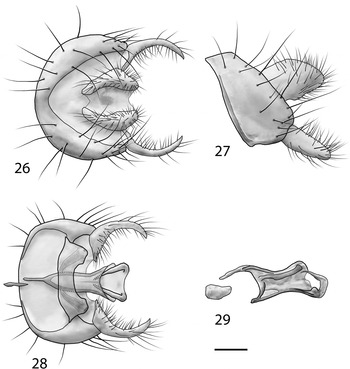
Exalla shewelli, sp. nov., paratype male, male genitalia: 26, 27, epandrial complex (26, dorsal view; 27, lateral view); 28, phallus complex in situ within epandrial complex, ventral view; 29, phallus and ejaculatory apodeme, lateral view. Scale bar=0.2 mm.

Abdomen (Fig. 16). Long and narrow; subequal in length to head and thorax together; approximately 2 times longer than wide, slightly tapering distally. Syntergite 1+2 yellow pruinose in anterior half, dark-brown pruinose in posterior half, except lateral margins and wide median longitudinal spot (from anterior edge nearly to, but not reaching, posterior edge) yellow pruinose; with dense long thin setulae on ventral third and sparse short thin setulae medially. Tergites 3–6 dark-brown pruinose, except lateral margins and wide median longitudinal spot (from anterior edge nearly to, but not reaching, posterior edge) yellow pruinose; with sparse short thin setulae, slightly longer along posterior edges. Sternites (Fig. 17) yellow pruinose; sternite 1 rectangular, 2.5 times wider than long, lacking setulae, without posterior invagination; sternites 2–5 subequal in size, each slightly wider than long, setulose, with longest setae along posterior edge and laterally. Spiracles set in membrane adjacent to tergites.
Male genitalia (Figs. 17 (in situ), 26–29). Syntergite 7+8 simple, yellow, as long medially as preceding tergite, saddle-shaped, tapering laterally, lacking setulae. Epandrial complex yellow. Epandrium simple; with numerous strong setae on each side. Surstylus articulated with epandrium; long, straplike, strongly incurved, and tapering distally to blunt tip; setose, except basolaterally, with setae long and dense on dorsal surface, shorter and dense on inner surface, and longest apicolaterally. Cercus slightly elongated, rounded distally, setulose. Phallus broadest distally, tapering anteriorly (2 times broader distally); forming a broadly opened sclerotized cylindrical tube; anteriorly tapering into thin anteromedial extension; at one-third distance from base, with dorsal extension articulating with postgonite; distally with pair of large anteriorly oriented hooks extending into broadly open gonopore. Hypandrium bilobed, with lobes directed posteriorly; width 5 times medial length and 2.8 times length of lobe; bare. Postgonite small, thin, ribbonlike, curved dorsally from hypandrium to articulate with anteriormost dorsal extension of phallus. Ejaculatory apodeme small; narrow; flat.
Biology
This species was collected in mid-May through early July in wet montane rainforest habitats at an elevation near 2000 m.
Distribution
This species is known only from Colombia (Department of Nariño).
Remarks
Autapomorphies for this species include the flattened and paddle-shaped maxillary palpus, the strongly bowed fore femur, the lack of preapical dorsal tibial setae, and the ventral surface of the fore tibia being distinctly flattened into a black concavity with the anterior margin lined with a dense brush of short setulae. For characters thought to be synapomorphies for E. browni+E. macalpinei, this species displays the plesiomorphic states, including the strong and cruciate postocellar setae, the strong postpronotal seta and proepisternal seta, the cylindrical (not expanded into a lobe) hind basitarsus, and the surstylus tapering distally to a blunt tip.
Acknowledgements
I heartily thank Steve Marshall (DEBU) and Matthias Buck (Royal Alberta Museum, Edmonton) for sending me these specimens, which had been sorted and loaned to Steve as micropezids. And of course, my heartfelt thanks are extended to Frank McAlpine and Guy Shewell for their influence on my fascination with lauxanioids. This paper is partly based upon work supported by the National Science Foundation (NSF) under DEB Award No. 0075206. Any opinions, findings, and conclusions or recommendations expressed in this publication are those of the author and do not necessarily reflect the views of the NSF.