Introduction
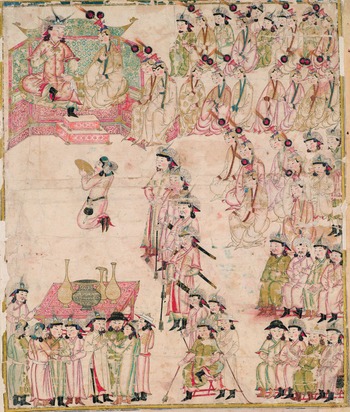
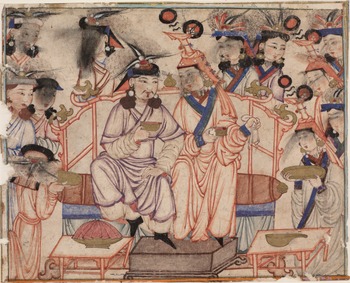
Studies of women in Ilkhanid Iran and Mongol Central Asia have gained traction in recent years, shedding more light on their societal, cultural, economic and political impact.Footnote 1 Most recently, the important role that elite Mongol women played in the economy of their tribes, and their political acumen and influence, has been deeply explored.Footnote 2 Lacking as a part of this wider discourse is an art historical analysis of female representation at this time. Prior to the fourteenth century, the most common portrayal of women in Islamic Art was as a subsidiary female trope, such as a servant or dancer. For a brief period of time, however, in Ilkhanid Iran, a new type of imagery began to be produced, one which pictured Mongol women participating in courtly life and in their contemporary place within societal hierarchies (Fig. 1). Such paintings were made in the first half of the fourteenth century before (mostly) disappearing. A study specifically examining the circumstances surrounding this phenomenon, and why it lasted so briefly, has not yet been undertaken. This paper, dedicated to Barbara Brend, is my attempt to do so.Footnote 3
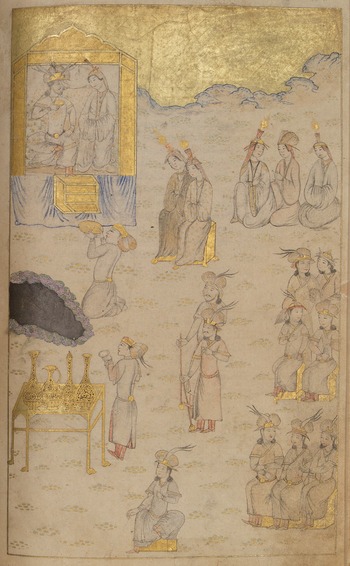
Ilkhanid enthronement scene, Tabriz, 1330s. Ink, colours and gold on paper. With permission of the Topkapı Sarayı Museum and the Presidency of National Palaces Administration, Istanbul, H. 2153, fol. 148v.

Fourteenth-century Ilkhanid Iran was a discrete period during which the portrayal of ‘real’ elite women in courtly settings occurred in Persian painting, as opposed to the aforementioned ‘types’ or literary characters.Footnote 4 It will be argued that a correlation exists between the power wielded by these women in the Mongol socio-economic and political spheres, and their depictions as formative, important members of the ruling elite. During the early Turco-Mongol period, women, especially the Khātūns (queens or royal consorts), had a heightened visibility—both physical and figural, in line with the socio-cultural norms of Mongol society. They had independence in financial matters, in issues relating to inheritance, and wielded an extraordinary amount of influence when it came to political and economic concerns. As the Ilkhanids became more entrenched in their Persianate, Islamic sphere, alterations in cultural and societal traditions began to take place. It will be seen that the decrease, and ultimate halt, of Ilkhanid female representations discussed in this article coincided with a change in the political, cultural and social power of elite women during the Ilkhanate, especially in the visibility of these aspects of their power. Scholars have established the link between Mongol cultural heritage and the political and cultural place of women in the public sphere,Footnote 5 and here it is also correlated with the occurrence of historical female depictions in Ilkhanid painting.
Picturing the Khātūn
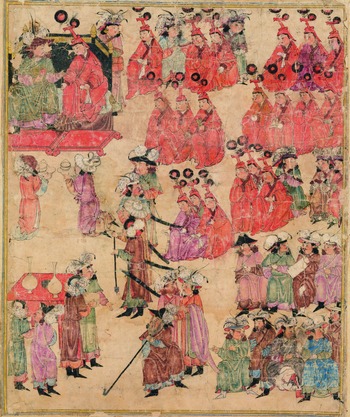
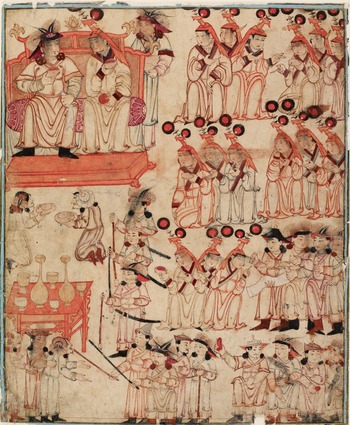
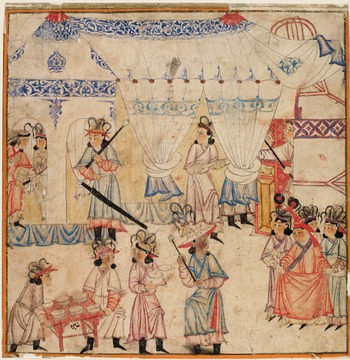
In the Ilkhanid period, the Khātūn and elite women appear in illustrated court scenes, the reality of which is validated by textual sources, discussed below. The same iconography is repeated in many instances—the Khan and Khātūn are seated on an elevated throne or a platform, located at the upper left of the picture, the Khātūn seated on the left-hand side of the Khan (Figs. 1–3). The courtly scene takes place outdoors, in a setting that recalls the nomadic life of the Mongols. Both the ruler and his consort—in traditional Mongol costume—are seated facing each other with their feet elevated off of the ground. Prominently depicted on the head of the Khātūn is the distinctive boqtaq, typically surmounted by a feather.Footnote 6 To the left of the Khātūn are seated a group, or groups, of elite Mongol women, perhaps intended to be other wives, female members of the royal family, or the Khātūn's female attendants. Whoever they are, they are also represented in Mongol costume, each also wearing the boqtaq.
Ilkhanid enthronement scene, Tabriz, 1330s. Ink, colours and gold on paper. With permission of the Topkapı Sarayı Museum and the Presidency of National Palaces Administration, Istanbul, H. 2153, fol. 53v.

Ilkhanid enthronement scene, Tabriz, 1330s. Ink, colours and gold on paper. Courtesy of the Staatsbibliothek zu Berlin - Preussischer Kulturbesitz, Orientabteilung, Diez A fol. 70, S. 23 no. 1.

Some of the most remarkable of these images appear in the Diez Albums in the Staatsbibliothek zu Berlin and in an album in the Topkapı Palace Musuem.Footnote 7 Especially interesting is that these paintings were very likely commissioned for inclusion in illustrated versions of the Jāmi‘ al-Tavārīkh,Footnote 8 the great ‘History of the World’ written by Rashid al-Din, vizier for the Il-Khan Ghazan Khan (r. 1295–1304), and his successor, Öljeitü (r. 1304–1316). Within the manuscript itself, Rashid al-Din wrote that pictures depicting coronation scenes of the Khans should be included in illustrated versions of the text, and that they should depict the throne, contemporary Khātūns (italics mine), princes, and amirs.Footnote 9 That the enthronement scenes in question were intended to illustrate a manuscript of world history, and that they were to be depictions of historical Khans’ enthronements, can only lead one to assume that the Khātūns pictured were also meant to be representations of actual historical women. In addition to these full-page enthronement scenes, vignettes of Khātūns in acts of courtly life and miniaturised enthronement scenes were also made, the latter likely to illustrate Mongol genealogical charts included in the text.
In the Muslim world, prior to the late twelfth and early thirteenth centuries, historical representations of elite women in contemporary society are exceptionally rare. Representations of courtly and enthronement scenes exist from the Umayyad era onwards in many different media, including plaster, ceramics, sculpture, painting and metalwork. While these have included both male and female figures, the role of women has typically been relegated to that of a particular ‘type’, such as a servant, a dancer, or a musician. Contrast this with the innumerable instances of male rulers enthroned, or of them and their male courtiers participating in princely activities, such as hunting, warfare, drinking and being entertained. In short, there is an absence of historical female imagery picturing queens, consorts, princesses, or even ladies-in-waiting. It is only in the era of and after that of the Great Seljuqs (r. 1040–1194) that a noticeable difference in female representation can be detected in the lands they conquered. As Oya Pancaroğlu has rightly noted, in the late Seljuq period there was a surge in representations of the human figure throughout the visual arts, on and across all media.Footnote 10 It is because of this occurrence that it is possible to note the change in female representation.
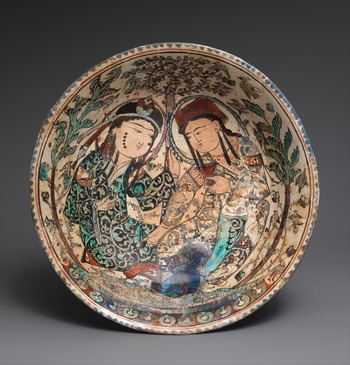
Due to the dearth of painting on paper from the pre-Mongol Persianate world, it is from images on other media, including wall paintings, ceramics and metalwork, that we are able to see the kinds of figural imagery being created. While much of it was based on the princely cycle, and included women in the roles of servants or entertainers, it is also in these works that depictions of seated courtly couples start to be produced. Numerous such examples are to be found on Seljuq ceramics.Footnote 11 However, while these are ‘new’ depictions of women, they are still representations of a generic ‘type’—in this case seated courtly couples typically engaging in conversation, or drinking (Fig. 4). The male and female figures are represented equal in size, facing one another. Yet, they are removed from a courtly setting and while equal weight is given to the female in the pictorial image, the aspect of historical documentation present in the Ilkhanid paintings under discussion is lacking.Footnote 12 Despite this, the introduction of women in such a fashion to the decorative repertoire during the Seljuq era must be noted, especially as in some instances a single female, or groups of women,Footnote 13 are depicted. As such, the pictorial prominence given to the female figure in these scenes is noteworthy and does raise the visual status of the elite female. That this continues in the wider Persianate world in the post-Seljuq era is very prominently demonstrated by the Blacas Ewer, where, in addition to the individual scenes in the decorative medallions of male figures engaging in courtly activities, the hunt, and musicians and entertainers, two isolated images of women are included: in one, a noblewoman looks into a mirror watched by her female attendant, and in the other a women sits in a howdah on a camel with attendants walking alongside.Footnote 14 While these are again generic images of courtly women, it seems very significant that they were included on the ewer.
Mina’i bowl, Iran, late 12th-13th Century, Iran. Fritware, stain and overglaze paint. Courtesy of The MET, New York, 1975.1.1643.

Returning to the Ilkhanid enthronement scenes, as has been stressed they depict the Khan and Khātūn seated together on a throne, in a courtly setting, equal in size and stature. Eight such examples of full-page enthronement scenes are known to me: six are one-half of double-page enthronement scenes, depicting the Khan and Khātūn seated at the top left of the right-hand folio in an elaborate court setting that includes the Khātūn's female attendants (see Figs. 1–3);Footnote 15 while two are single-page enthronement scenes with the figures much larger on the page, restricting the total number of individuals represented (Fig. 5).Footnote 16
Ilkhanid enthronement scene, Tabriz, 1330s. Ink, colours and gold on paper. Courtesy of the Staatsbibliothek zu Berlin - Preussischer Kulturbesitz, Orientabteilung, Diez A fol. 71, S. 52.
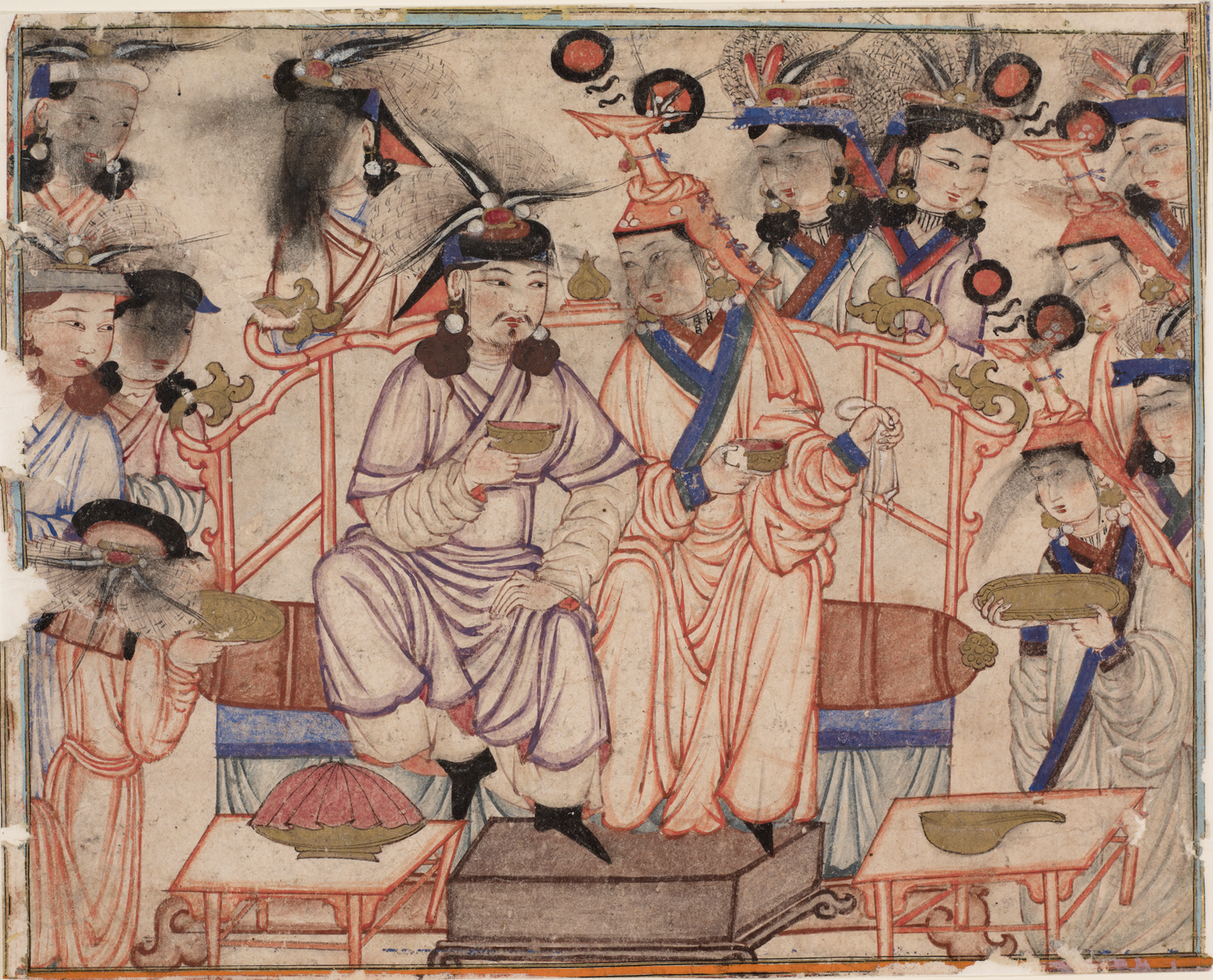
Such scenes, chosen to be illustrated within Ilkhanid historical manuscripts and considered necessary for inclusion were, more importantly, accurate representations, authentically conveying the courtly setting in which primacy of place was awarded to both the Khātūn and the Khan. Seated side by side in such a fashion, the realities of political power at the lkhanid court and within Mongol culture, and the integral and important role played by women, are unambiguously presented to the viewer. In addition to these full-page enthronement scenes are a group of small, simple miniatures of a Khan and Khātūn seated together, likely made to accompany Mongol genealogical tables.Footnote 17 While the full-page enthronement scenes depict the Khātūns within their political milieu, two important pictures show a Khātūn walking with her pages, one within a camp setting (Fig. 6). This image further reflects the reality of the contemporary society, in this instance the freedom of movement enjoyed by Mongol women as the Khātūn walks through a bustling camp.Footnote 18
An Ilkhanid noblewoman walking with pages in an ordo, Tabriz, 1330s. Ink, colours and gold on paper. Courtesy of the Staatsbibliothek zu Berlin - Preussischer Kulturbesitz, Orientabteilung, Diez A fol. 70, S. 18, no. 1.

A precedent for the depiction of historical Mongol women can be found in Yuan painting; for example, a painting of Chabi, the consort of Qubilai Khan, made in the second half of the thirteenth century.Footnote 19 A series of portraits of the same type were produced that included Doquz Khātūn, wife of the first Il-Khan, Hülegü. That portraits of these Mongol Khātūns were ever made is automatically indicative of their status. Images of females as donor portraits have also been discovered in wall paintings; two such examples survive from the thirteenth and fourteenth centuries, both depicting the female donor in traditional contemporary costume, including the boqtaq.Footnote 20 Very interesting also is a Yuan mural of an elite Mongol couple found in a tomb in Dongercun, dated 1270.Footnote 21 The manner in which they are portrayed is very similar to the Ilkhanid enthronement scenes being examined here, except that the Yuan couple are seated on two separate chairs rather than together on a platform; regardless, their depiction, with the female to the left-hand side of the male, reflects one of the “established customs in medieval Mongol society”.Footnote 22
Historical Context: Mongol Culture and Ilkhanid Women
As mentioned earlier, the Ilkhanid enthronement scenes under discussion are believed to have been made to illustrate copies of Rashid al-Din's Jāmi‘ al-Tavārīkh. More specifically, they are thought to be from the Tarīkh-i Mubārak-i Ghāzānī, (The Blessed History of Ghazan), the history of the Mongols that serves as the first volume of Rashid al-Din's compendium. The historical nature of the manuscript, and the role of these images in the text as shown by Karin Rührdanz,Footnote 23 further indicate that these were all intended to be representations of real Khans and Khātūns. They were likely, for the most part, produced in Tabriz, in the 1330s, coinciding with the final years of the Ilkhanate; the relevance of this is discussed below.
Such representations of historical elite Mongol women reflect the integral and important part they played in Mongol society, being both major economic and political players. One woman was even given the leading role in the establishment of Mongol lineage: the mythical queen Alanqua (Alan Qo'a), from whom the Mongol tribes, most importantly that of Chinggis Khan, claimed descent.Footnote 24 It is in chronicles like Rashid al-Din's Jāmi‘ al-Tavārīkh that we are told the names and attributes of important Mongol women, including Sorghaghtani Beki, Chinggis Khan's daughter-in-law and the mother of Qubilai Khan. Rashid al-Din wrote of her extreme intelligence, and that she governed her husband's lands after his death,Footnote 25 thereby providing her four sons with an example of good rulership though her own actions.Footnote 26 She was also responsible for their education.Footnote 27 Of the many prominent Mongol women, there are even several examples of those who served as rulers in their own right or as regents, maintaining political power and the loyalty of tribes and allies until their sons came of age.Footnote 28 One such example is Terken Khātūn, who effectively reigned over the Ilkhanid province of Kirman from 1257 for a period of 26 years, a time considered to be the golden age of the region.Footnote 29 Her reign, and the circumstances through which she was granted political and military control of the province, show that it was not only possible for Mongol women to hold power as a consort in the Ilkhanate, but effectively also as rulers in their own right. Many other instances of Mongol women during the Ilkhanid era in such positions of power are also known, including the daughter of Terken Khātūn, Padishah Khātūn, and several other Khātūns who ruled in Shiraz.Footnote 30
The economic strength of Mongol women came from their personal ordo (Mongol camp establishments that included people and property, similar to the concept of a ‘household’), from which they financially benefitted, and which they could dispose of through inheritance as they wished, to either male or female heirs. Ordos were maintained through steppe customs that saw them supported by taxes from the local population, through gifts, and, most interestingly, through the share these women were awarded of booty gained through military success.Footnote 31 As a result, elite Mongol women had large incomes at their disposal.
Once the Ilkhanate had been established, the traditional cultural, economic and societal roles of the Khātūns and elite Mongol women continued within their new settled political sphere. The Khātūns continued to benefit from booty and riches acquired through military conquest, even though Ilkhanid military campaigns were more expansive than many of those undertaken during their earlier incarnation as nomadic tribes. Their financial independence and importance continued in other ways as well, with women of the royal family receiving large quantities of goods and gifts from the treasury.Footnote 32 Land grants were also made to the Khātūns, from which they received revenues. They, in turn, distributed wealth to their community and society through gifts and mercantile activities; their ability to participate in the latter greatly increased in their settled existence, expanding their wealth and that of their tribe(s).Footnote 33 Therefore, despite no longer living a nomadic life, elite Mongol women continued to maintain the lifestyle and their economic importance, even maintaining the habit of personally interacting with traders and merchants. As noted by Rashid al-Din, “In this period of plenty… merchants were a common feature in female camps, where they moved goods to benefit the Khātūns and were depositaries of the ladies’ revenues”.Footnote 34
Textual Corroboration for Visualising the Political Importance and Independence of the Khātūns
Both Ilkhanid texts and accounts of foreign visitors to Mongol courts convey cultural and societal norms relating to elite women. As stated earlier, in his Jāmi‘ al-Tavārīkh, Rashid al-Din declared that pictures depicting the Khan's coronation scenes should be included in illustrated versions of the text.Footnote 35 As he specified that these images should include the throne, contemporary Khātūns, princes and amirs, they were presumably intended to authentically depict these historical events. At the coronation of Möngke Khan (Chinggis Khan's grandson) in 1251, for instance, Rashid al-Din writes that the ruler sat enthroned with the princesses assembled to his right, his brothers standing in front of him, and the Khātūns seated to his left.Footnote 36 As becomes clear, the Khātūns and elite women being so prominently present at court functions was a well-known Mongol custom.
The seating of the primary wife to the ruler's left, as pictured in Figs 1–3 and 5, was another convention of medieval Mongol society.Footnote 37 This placement, and the unique place of women within the courtly milieu, was often remarked upon in travellers’ accounts as they marvelled at the freedoms these women enjoyed. One such account is given by William of Rubruck, who between 1253 and 1255 served as a missionary to Mongol lands. At an audience with Möngke Khan, Rubruck described the Khan's young wife sitting next to him, and a daughter, along with other children, seated behind him. Rubruck also reported that he and his people were made to sit on a bench near the ladies,Footnote 38 the implication being that other women were also part of the courtly audience, visible to the attendees and in a prominent place. Another account was made in the first half of the 1270s, when Marco Polo, visiting the court of Qubilai Khan (Möngke's brother and successor), wrote: “When his majesty holds a grand and public court, those who attend it are seated in the following order. The table of the sovereign is placed before his elevated throne, and he takes his seat on the northern side, with his face turned towards the south; and next to him, on his left hand, sits the empress”.Footnote 39
The placement of women at the court was part of a wider presentation of societal and political power. As Judith Pfeiffer says, “In a society in which the seating order clearly reflected the political hierarchies this (referring to where people were seated in a courtly audience) was of extreme importance”.Footnote 40 This established Mongol custom—the importance of positioning, and placing the Khātūn(s) on equal standing with the Khan in a courtly setting—continued in the new Mongol kingdoms of Iran and Central Asia. Ibn Battuta, for example, on visiting the Khan of the Golden Horde, Muhammad Uzbek, in the 1330s, recounted that after Friday prayers, in a magnificent gold pavilion, the Khan sat with two of his wives to his right, two to his left, and in front of him sat his sons and daughter. In detailing these audiences, Ibn Battuta writes: “As each of the khātūns comes in the sultan rises before her, and takes her by the hand until she mounts to the couch. As for Taitughlī, who is the queen and the one of them most favoured by him, he advances to the entrance of the pavilion to meet her, salutes her, takes her by the hand, and only after she has mounted to the couch and taken her seat does the sultan himself sit down. All this is done in full view of those present, without any use of veils. Afterwards the great amirs come and their chairs are placed for them to the right and left…”.Footnote 41 Not only do Ibn Battuta's words convey the prominence and respect publicly given to the Khātūns by the Khan, but also that their placement within these audiences, with men of the court seated in secondary positions to them, was a mark of status. Ibn Battuta also specifically states that this took place in front of the entire court, emphasising that the women were visible to all. This was obviously an alien concept to him, so much so that he remarked upon the absence of the veil as part of the female costume.
In addition to such descriptions of courtly audiences, in which the prominence of the Khātūn and royal women is clear, the freedom of movement they enjoyed (see Fig. 6) is also something visitors remarked upon. Ibn Battuta, again in describing his visit to the Golden Horde, comments upon the interactions of women within the wider society. Speaking in general, he writes that Mongol women are held in such respect, “they are higher in dignity than the men”.Footnote 42 Describing his first time seeing a wife of one of the amirs, he writes that she was in her own wagon with four girls in attendance, followed by numerous other wagons, each carrying the other women of her entourage. When she descended, about 30 of the girls did so as well to carry her train by the loops which were sewn on to the garment: “She walked thus in a stately manner until she reached the amir, when he rose before her, saluted her, and sat her beside him, while her maidens stood around her”.Footnote 43 On arriving at the Khan's ordo, which he described as “a vast city on the move”,Footnote 44 Ibn Battuta noted that the wives of the Khan each passed by with their own retinues. One of them even sent a servant to Ibn Battuta to convey her greetings,Footnote 45 exemplifying that the Khātūn could, of her own volition, speak with visitors to the camp, even foreign males, and did not need to seek permission to do so. These accounts plainly imply that the Khātūns enjoyed freedom of movement and a certain degree of autonomy. Ibn Battuta then witnessed the ceremonial movement of the Khātūns through the camp-city, commenting on their costume—including the traditional headdress of married elite Mongol women, the boqtaq—and describes his and his entourage's visits to the four Khātūns.Footnote 46
‘Veiling’ the Khātūns
The role of Alanqua in establishing Mongol genealogy foreshadowed the importance of women in the social, economic and political machinations of Mongol society. The significant role women continued to play in these areas persisted even after Chinggis Khan swept west and Mongol kingdoms were established in Iran and Central Asia.Footnote 47 From 1258, the Mongol conquest of Baghdad, to the Il-Khan Ghazan Khan's conversion to Islam in 1294, “the Mongols tried to remain aloof and maintain their identity based on the life of the steppe and the yāsa of Chinghiz Khan”.Footnote 48 Gilli-Elewy attributes this to an attempt to preserve aspects of their nomadic lifestyle at this time and to a continued deference to the traditional status of women in Turco-Mongol societies,Footnote 49 highlighting how integral they were to the socio-cultural context of these tribes.
In the first part of the fourteenth century, however, tensions began to arise between how elite Ilkhanid females were perceived, or beginning to be perceived, and how they were still able to act. This appears to have been a result of political and financial matters. As mentioned earlier, the royal women were given land grants from which they received revenues. Over time, though, the system became corrupt, with servants of the royal women and the local governors of the areas where these tracts of land were located manipulating the system for their own gain.Footnote 50 New laws were put in place which placed the wealth of the Khātūns under the control of the Royal Divan, and they were no longer able to bequeath their wealth to their daughters, but instead had to leave it to their sons.Footnote 51 The Khātūns continued to be politically powerful into the fourteenth century, but their autonomy and economic power were certainly curtailed because of these administrative reforms,Footnote 52 and the changes in how they could will their personal wealth. Their daughters no longer being allowed to inherit led to a generational shift that saw an even greater decrease in the economic power of Ilkhanid women.Footnote 53
It also seems to be the case that as the Ilkhanate became more Islamicised, the general independence of the Khātūns was slowly curtailed. This had started during the reign of Ghazan Khan, but by the time the last Il-Khan, Abu Sa‘id (r. 1316–35), came to the throne, there appears to have been a sharper shift away from Mongol cultural norms and a further entrenchment of local Persian ones, as well as an additional emphasis on Islamic rituals. I would argue that the tension between the accepted Mongol cultural status of elite women and the slow Islamisation of the Ilkhanate was key in the eventual disappearance of historical royal women being pictured in Persian painting. This exclusion from the visual record has been touched upon by Charles Melville: “Both the depictions of the court and the position of women within it changed rapidly as time and the process of Islamisation progressed; not only do the turbaned figure of the religious classes and the civilian bureaucracy find their place in the assembly, but women are often omitted, both from coronations and even from weddings”.Footnote 54
As already noted, many of the Ilkhanid pictures of females under discussion are thought to have been created in the 1330s. That this decade is associated with these productions is quite interesting, as it was when there was less tolerance for traditional female Mongol customs and norms, and more emphasis was placed on the court and culture being ‘Islamicised’. That many of these images were made for Rashid al-Din's Jāmi‘ al-Tavārīkh is also curious, especially as he was not in favour of women being culturally and socially prominent. He actually considered it improper even to mention women in his history and when he included them within the Jāmi‘ al-Tavārīkh, he apologised to the reader for doing so!Footnote 55 And yet, it was he who dictated that the enthronement scenes created to illustrate his history must include the Khātūns.Footnote 56 Does this, then, make it all the more significant that Ilkhanid rulers and their consorts contemporary with Rashid al-Din were not depicted enthroned in such a fashion? That it was only the (by then) historical Mongol rulers and their Khātūns who were? This would seem to indicate that there was a direct correlation between the importance of the Khātūn's presence and the portrayal of genealogy for legitimacy in the full-page enthronement scenes, not just in the miniature depictions of enthroned couples made to illustrate genealogical tables. Pfeiffer points out that Ghazan Khan's reforms, while they decreased the economic power of the Khātūns, “did nothing to diminish the Chinggisid ladies’ standing through their blood line…”.Footnote 57 Clearly it was the case, therefore, that while their financial and economic power was diminished, the political significance of the Khātūns remained as they continued to be a source of dynastic legitimacy and political prestige. Their inclusion in the enthronement scenes at Rashid al-Din's demand, therefore, is logical.
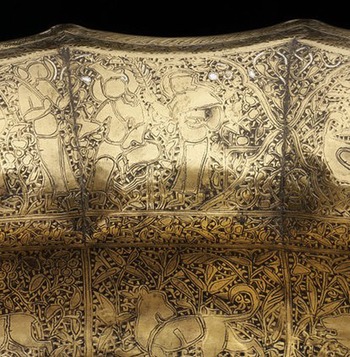
We know from the corroboration between textual sources and the painted page that the images of the Khātūns were intended to reflect reality, of not only the Khātūn as a royal consort within the contemporary courtly milieu, but also within their wider socio-cultural context. Intriguing as well is that a small number of examples portraying women in these fashions in other media exist from the latter half of the Ilkhanid period, on objects created for the contemporary Ilkhanid court. While the full-page paintings under discussion convey the Khātūns in courtly ceremonial activities and freely moving through their camps, representations on Ilkhanid metalwork also convey the former. One such example is a copper basin made in Iran, dated 1300–1320 in the Victoria & Albert Museum; of the many human figures portrayed on it, one is a female wearing a boqtaq. She is, if not enthroned, seated on a chair of the same type as the male ruler also depicted, and with an attendant before her (Fig. 7).Footnote 58 The Ilkhanid metalwork bag in the Courtauld Gallery, dated 1300–1330, is a second example. Here, on the lid, is a court scene with a male and female figure seated at the centre on a bench, facing each other. Equal in size and stature to the male figure, the woman wears not the boqtaq but a miqna‘a, a veil from Mongol costume which covered the head but not the face,Footnote 59 likely chosen for depiction here because the spatial constraints of the lid shape did not allow for the portrayal of the taller headpiece.
Detail showing seated Khātūn with female attendant, Basin, Iran, 1300-1320. Copper Alloy engraved and originally inlaid with silver and gold. Courtesy of the Victoria and Albert Museum, London, 546-1905. (© Victoria and Albert Museum, London)

An Ilkhanid legacy of depicting power and prestige
Despite the end of the Ilkhanate in 1335 and the rise of other powers to replace them in the region, historical Mongol authority, tradition and lineage were still considered validating features for rulers. Whatever the intentions behind the creation of the enthronement scenes for the Jāmi‘ al-Tavārīkh, they became symbolic of Ilkhanid royalty and political power. There was undoubtably a resonance between these scenes and their expressions of power and prestige, evidenced by the creation of post-Ilkhanid enthronement scenes that included the ruler's consort, in regions formerly under Ilkhanid rule, and in later copies or versions made both in Iran and elsewhere. It is the continued inclusion of the Khātūn/consort in these pictures which indicates the inherent importance of her presence as a defining feature of royal Ilkhanid imagery reflective of political power.
The potency and symbolism of this iconography emanated from Tabriz, where the majority of these Ilkhanid scenes were probably produced, and continued to have a visual and political resonance elsewhere in the Persianate world. In the first quarter of the fourteenth century, Shiraz was governed by Sharaf al-Din Mahmud, the regional administrator for the Ilkhanids. He effectively made the province of Fars his own, establishing his own rule in c.1325—even before the death of the last Il-Khan, Abu Sa‘id, in 1335. Abu Ishaq Inju (r. 1343–53) was the last ruler of this new dynasty established by Mahmud. Elaine Wright argues that Abu Ishaq purposefully appropriated imagery associated with Ilkhanid rulership in order to proclaim his dynastic lineage as he was the “first of the Injuids to see himself as a ruler in his own right, fully independent of the Ilkhanids”.Footnote 60 One of the ways he did this “…was his apparent appropriation of Ilkhanid dynastic imagery, through the production of images of enthroned couples, used outside the traditional context of the Tarīkh-i ghāzānī text”.Footnote 61 Wright stresses how firmly entrenched the imagery of the Khan and Khātūn enthroned together was as a legitimising iconography, so much so that an Injuid prince purposefully appropriated it to convey his right to the throne. This is visible on several items associated with the patronage of Abu Ishaq: a candlestick, now in the Museum of Islamic Art, Doha,Footnote 62 and two manuscript frontispieces, one from the 1341 Mūnis al-aḥrār in the al-Sabah Collection, Kuwait,Footnote 63 and the other from the 1352–3 Stephens Shāhnāma, on long-term loan to the Arthur M. Sackler Gallery, Washington D.C.Footnote 64 There is also a tray in the Museum of Fine Arts, Tbilisi which features an enthroned couple; this is undated but Linda Komoroff has attributed it to Injuid Shiraz.Footnote 65
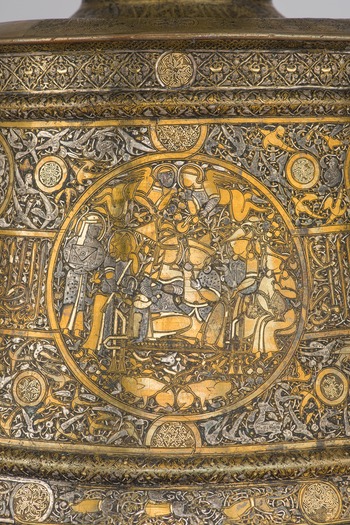
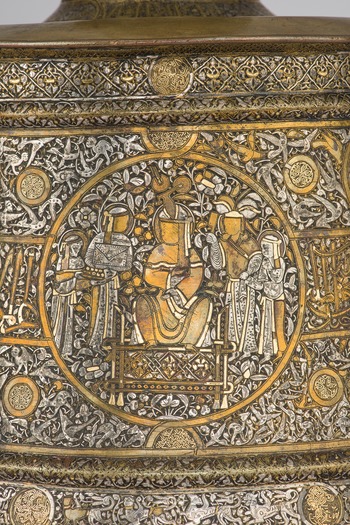
The only item of these four believed to be commissioned directly by Abu Ishaq is the Doha candlestick, on which a female consort is present in two of the four roundels decorating its body. In one she is seated enthroned with the ruler (Fig. 8), and in the other she is seated alone but flanked by standing female attendants (Fig. 9). In his study on this candlestick, James Allan commented on the rarity of enthronement scenes that include both the ruler and his consort, giving the just-mentioned frontispieces of the Mūnis al-aḥrār and Stephens Shāhnāma as the two examples he knew of.Footnote 66 Even more remarkable, however, and not stressed by Allan, is the rarity of the inclusion of the image of the consort enthroned in her own right. On the Doha candlestick, she sits flanked by attendants, but she is the largest figure in the scene, even while seated. Her costume, importantly, is clearly still Mongol/Ilkhanid as here, in her solo depiction, she is wearing the boqtaq. This is notable as in the roundel which pictures both the ruler and consort, she is not. The visual association of this prominent female figure therefore immediately makes one think of the Ilkhanid court scenes from Tabriz.
Detail of a roundel showing a royal couple enthroned, Candlestick, Iran (probably Shiraz), 14th Century, made by Sa’s ibn Abdallah. Brass with gold and silver inlay and a black compound. Courtesy of The Museum of Islamic Art, Qatar Museums, MW.122.1999; photo: Chrysovalantis Lamprianidis.

Detail of a roundel showing a royal woman enthroned, Candlestick, Iran (probably Shiraz), 14th Century, made by Sa’s ibn Abdallah. Brass with gold and silver inlay and a black compound. Courtesy of The Museum of Islamic Art, Qatar Museums, MW.122.1999; photo: Chrysovalantis Lamprianidis.

On the frontispieces cited by Allan, in both these images the enthronement scene is on the left of the double-page opening; the ruler and his consort sit side by side on a throne, but in these instances the consort is to the ruler's right. The ruler raises a glass as he looks at his consort. Around them are courtiers, musicians and other courtly officials. In her discussion of frontispieces in Ilkhanid and Injuid manuscripts, Marianna Shreve Simpson also remarks on the two examples.Footnote 67 She writes that between 1300 and 1353 in Shiraz and Isfahan the royal image was the dominant iconographic type used for frontispieces,Footnote 68 but it is only these two examples that include the female consort alongside the male ruler. The rarity of such a depiction stands out even more when one considers that Simpson's 2006 study indicated there were eleven frontispieces produced in Shiraz and Isfahan in the last 35 years of the Ilkhanate, none of which employed this iconography. It makes it even more relevant, then, that both the frontispieces depicting the royal couple enthroned were made around the mid-fourteenth century for manuscripts associated with the patronage of Abu Ishaq.Footnote 69 Whether or not the Tblisi tray is also attributable to him is unclear, but it is broadly attributed to Fars in the first half of the fourteenth century. However, the iconography depicted on it is typically Ilkhanid: an enthronement scene with a female consort wearing a boqtaq sitting to the left of the ruler, with her female attendants grouped together to her left.Footnote 70
The appropriation of Ilkhanid enthronement scenes in Injuid Shiraz, and in particular by Abu Ishaq, to portray power, prestige and legitimacy did not seem to be utilised by other fourteenth-century princes and rulers. Perhaps despite the aura of kingship connected with this iconography they actually did not want to be associated with Ilkhanid imagery and practice. However, it did continue into the fifteenth century in a series of enthronement scenes made for illustrated copies of the Jāmi‘ al-Tavārīkh and in an Anthology made for the Timurid prince Iskandar Sultan. Yuka Kadoi's use of the phrase ‘iconographic resonance’ in relation to the impact of these Ilkhanid enthronement scenes on Persian painting after the Ilkhanid period is therefore very apt.Footnote 71 Representative examples from the first half of the fifteenth century include the enthronement scene made in Shiraz, in 1410–11, for Iskandar Sultan's Anthology (Fig. 10),Footnote 72 and one of Ghazan Khan and his consort from a Jāmi‘ al-Tavārīkh made in Herat c.1430–1434.Footnote 73 The placement of the royal couple within an outdoor audience setting, the layout of the painting, the representation of costumes, and the positioning and placement of the figures—all indicate that enthronement scenes produced in the Ilkhanid era were available as models for the artists of these workshops. The artists (and patron?), in their new productions of enthronement scenes, chose to look to historical imagery to utilise and copy from, particularly for those included in copies of the Jāmi‘ al-Tavārīkh, rather than reflect the contemporary fifteenth-century court culture which denied this prominence of place to the royal women (see Appendix II for a list of these historicising images). Rather, these artists looked to the Ilkhanid images for accepted representations of power and prestige, copying what they saw, speaking to the potent nature of these images and how vital and important the inclusion of the consort was in accurately reflecting this. That such an enthronement scene was created for Iskandar Sultan's Anthology stresses this, as the scene is even further removed from its original purpose of illustrating a historical manuscript. For its inclusion in later version of the Jāmi‘ al-Tavārīkh, it is interesting to note that the Herat artists chose this typical Ilkhanid iconography for Ghazan Khan's enthronement scene when he himself did not to depict his own court, but rather used it to portray those of his predecessors. His own historical image however, produced roughly 140 years after Ghazan's reign ended, pictorially grouped his court's representation with his Mongol ancestors, indicating just how strongly Ilkhanid enthronement scenes depicting a royal couple had become synonymous with the Ilkhanid court itself.
Enthronement scene, from an Anthology for Iskandar Sultan, Shiraz, 1410-11. Ink, colour, gold and silver on paper. Courtesy of the Calouste Gulbenkian Museum, Lisbon, LA 161, fol. 260v; photo: Catarina Gomes Ferreira (©Calouste Gulbenkian Foundation, Lisbon. Calouste Gulbenkian Museum - Founder’s Collection.)

The continued importance of this enthronement iconography is again evident in a late sixteenth-century Mughal addition to a fourteenth-century copy of the Jāmi‘ al-Tavārīkh, a Mughal historical image of Chagatai Khan and his consort that, at first glance, could be taken as an Ilkhanid-era production.Footnote 74 In this instance, it is possible that the scene was stylistically created to match the enthronement scenes already in or added to the manuscript in the fourteenth and fifteenth centuries.Footnote 75 However, the tableaux added in the late fifteenth century are not exact copies of Ilkhanid enthronement scenes; some liberty having been taken, for example, with the portrayal of the throne and the placement of the attendant females.Footnote 76 Also, of the many Mughal additions to the manuscript, not all were done in this historicising style.Footnote 77 Those that were, however, are very true to the Ilkhanid originals.
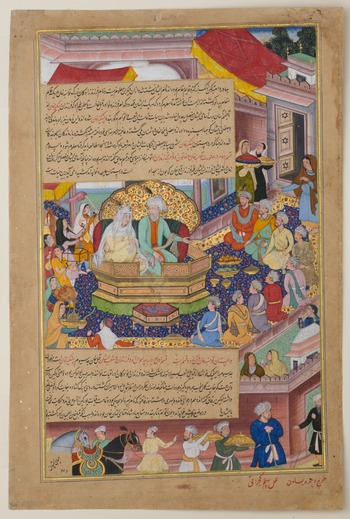
Using this Ilkhanid imagery, Mughal artists also adapted their enthronement iconography in certain other historical manuscripts they produced and illustrated. For example, in an illustrated Chingiznama (the history of Chinggis Khan, a text extracted from the Jāmi‘ al-Tavārīkh) made at Akbar's court, the artists Basawan and Bhim Gujarati created a painting of one of Chinggis Khan's ancestors, Tumanba Khan, enthroned with his family in a courtly setting (Fig. 11). Now placed within a Mughal milieu, typical of many Mughal court scenes painted in the last twenty years of Akbar's reign, Tumanba is seated next to his wife on an elevated throne with their sons before them and female attendants to the right of the Khātūn. The image of the royal couple enthroned resonates in this Mughal pictorial representation of their Mongol ancestor, recalling, but not copying, the importance of the enthroned couple in the Ilkhanid scenes. As Kadoi observes, “… the iconography of the Mongol couple enthroned exerted a long-lasting impact on the subsequent painting tradition of the Persian cultural realm, not only in the Jāmi‘ al-Tavārīkh but also for other subject matter”.Footnote 78 I would qualify this to state that the Ilkhanid enthronement scenes carried with them a stark political potency, speaking to legitimacy and kingship in a royal Persianate landscape, and that this was recognised even in the two and a half centuries after their rule. An integral part of the appropriated visual language used by later rulers, which was key in representing the tropes of power and prestige, was the inclusion of the Khātūn within these scenes.
Tumanba Khan, His Wife, and His Nine Sons, from a Chingiznama (Book of Genghis Khan), Mughal India, probably Lahore, c.1596; artists Basawan and Bhim Gujarati. Opaque watercolour, ink and gold on paper. Courtesy of The MET, New York, 48.144.

Conclusion
The Khātūns enjoyed a status of high privilege across the Mongol empire. As ever, proximity to the ruler equated with proximity to power. After the establishment of the Ilkhanid dynasty, this new class of ruling Mongol elite continued the steppe tradition that saw royal women occupying an elevated space in the socio-economic fabric of their newly settled courts. This reality of the contemporary society—and the role of women within it—was visualised in manuscripts like the Jāmi‘ al-Tavārīkh. When the ruling society shifted away from their Mongol social order, becoming more entrenched within the Persianate, Islamic cultural environment, one of the consequences was a decrease in the financial and political power of the Khātūns. This ‘new’ secondary role they played was then reflected in the material culture, with ‘real’ depictions of these women no longer being produced.
In thinking of the Diez Albums, Charles Melville noted that they and their contents can be viewed as a way of seeing the fourteenth and fifteenth century Turco-Mongol world, as a means of understanding the history of the period, and that the pictures serve as a way of illustrating that history.Footnote 79 He further writes that through the images contained therein we are privileged to see an “observed world”.Footnote 80 Regarding them as such highlights their documentary quality, and therefore reinforces the fact that in the Ilkhanid enthronement scenes of the royal couples and the vignettes of Khātūns within ordos, the viewer experiences the Turko-Mongol courtly milieu as it truly was, a fact attested to by contemporary written accounts. It proves the unique circumstances of elite and royal Ilkhanid/Mongol women actively participating—in full view—in society. Once this visualisation of historical women ceased, the image of the female was by and large relegated to literary and poetic characters painted to illustrate stories and tales, as a ‘type’ within historical representations, or as a general character in a male storyline.
The enthronement scenes in the Diez and Istanbul albums collectively confirm the visibility and prominence of Mongol women,Footnote 81 matching the visual record created in these albums to the written testimonials by visitors to the Mongol courts. The importance of the female Mongol bloodline and its necessity for the establishment of legitimacy is also given pictorial form in the visual representations of the Khātūns in genealogical trees found within the Jāmi‘ al-Tavārīkh.Footnote 82 The issue of legitimacy is what drew post-Ilkhanid rulers in the immediate aftermath of the fall of the Ilkhanate, in particular Abu Ishaq, to appropriate the image of the royal couple enthroned as a means of promoting his own right to rule. Later, in the fifteenth and sixteenth centuries, historicising images of full-page Ilkhanid enthronement scenes were created by Timurid and Mughal artists who looked at, copied, or reinterpreted the Ilkhanid originals. Clearly, the power and politics of representation is ever-present, and, as this particular study has shown, the Khātūns in the Ilkhanid images examined here carried and conveyed the weight of legitimacy and political potency.
Appendix I: Ilkhanid-era representations of the Khātūn

Appendix II: A selection of Historicised Ilkhanid-type Enthronement Scenes from the 14th–16th centuries