Introduction
One of the major problems facing the poultry industry today is the high cost of feeds resulting from a shortage of high energy grains such as maize (Mmereole, Reference MMEREOLE2008). The grains are known to constitute 60-70% of the poultry feed (Mmereole, Reference MMEREOLE2009). The high cost of grains is largely due to competition for grains between livestock and humans. Maize serves as the major energy ingredient in the diets of most livestock and particularly poultry. Alternative uses of maize for ethanol production in the United States, along with a high level of consumption, have a large impact on prices (Kreutzer, Reference KREUTZER2012). A decrease in the availability of maize and an increase in the price for feed have a direct impact on the poultry industry worldwide (Ayuk, Reference AYUK2004) and in some cases, production output is reduced (Donohue and Cunningham, Reference DONOHUE and CUNNINGHAM2009). Some low-income and food deficit countries have shut down their broiler farms due to the high cost of feed (Sakib et al., Reference SAKIB, SULTANA, HOWLIDER and RANA2014). An increase in the price of grains and the cost of producing poultry meat and eggs has resulted in a decreased ability of some of the world's population to purchase and consume chicken meat (Aho, Reference AHO2007). To compensate for this change, alternative feed ingredients need to be identified. Any new ingredients must be able to substitute for maize totally or partially and not have a negative impact on the efficiency or quality of poultry production (Ojewola et al., Reference OJEWOLA, OLOJEDE and EHIRI2006).
One promising alternative is sweet potato (Ipomoea batatas L. [Lam]). Sweet potato is one of the seven crops producing over 105 hundred million metric tonnes of edible food products in the world annually (FAO, 2011). China produces 80-85% of the total sweet potato production in the world, while the rest of Asia has the next highest production levels, followed by Africa and Latin America (Centro Internacional de la Papa, 2009). It is ranked fifth among the most important food crops on a fresh weight basis in the tropics after rice, wheat, maize and cassava (An, Reference AN2004). It is consumed mainly as a starch source in the diet of humans but is also rich in other important nutrients (Beckford and Bartlett, Reference BECKFORD and BARTLETT2015). The storage roots of sweet potato are a valuable source of carbohydrates, vitamins, and micro-nutrients especially in the orange and yellow-fleshed cultivars, which contain β-carotene (Bromfield and Bovell-Benjamin, Reference BROMFIELD and BOVELL-BENJAMIN2002; Byamukama et al., Reference BYAMUKAMA, GIBSON, ARITUA and ADIPALA2003).
Maize and sweet potato have comparable metabolisable energy values of 14.5 and 14.8 MJ/kg, respectively (Woolfe, Reference WOOLFE1992). The digestibility of the carbohydrate fraction from sweet potato is reported to be above 90% (Ravindran et al., Reference RAVINDRAN, RAVINDRAN, SIVAKANESAN and RAJAGURU1995). The roots are rich in nitrogen-free extract indicating its potential value as an energy source, with carbohydrates generally making up about 80-90% of the sweet potato root. Some studies have shown that sweet potato can replace maize in the diet of broilers by 17-27% and 30-40% for starter and finisher broiler chickens respectively (Ravindran and Sivakanesan, Reference RAVINDRAN and SIVAKANESAN1996; Agwunobi, Reference AGWUNOBI1999; Ayuk and Essien, Reference AYUK and ESSIEN2009). The aim of this review paper is to give an overview on the use of sweet potato as a carbohydrate source and its effect on broiler and laying hen performance.
Chemical composition
carbohydrates
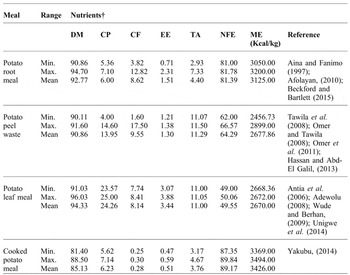
Sweet potatoes are rich in nitrogen-free-extract indicating its potential value, mainly as an energy source ( Table 1 ). The main nutritional importance of sweet potato is its starch content. Starch accounts for about 60-70% of dry matter (DM) in sweet potato roots (Padmaja, Reference PADMAJA2009). Starches are made up of two main polymers, an essentially straight chain glucose polymer called amylose, which constitutes about 10-30% of the total, and the highly branched glucose polymer, amylopectin, which makes up the rest. The proportion depends on the species of root crop (Afolayan, Reference AFOLAYAN2010).
The physiochemical properties of sweet potato starch depend at least in part on the amylose/amylopectin ratio, since the digestibility of sweet potato is negatively correlated with amylose content (Zhang and Li, Reference ZHANG and LI2004). The reduced digestibility is a result of the amylose forming a tightly packed structure which limits access of amylase enzymes (Waramboi et al., Reference WARAMBOI, DENNIEN, GIDLEY and SOPADE2011). Uncooked starch in sweet potato is highly resistant to hydrolysis by amylase. When cooked, their susceptibility to the enzyme increases. After cooking, the easily hydrolysable starch fraction of sweet potato has been shown to increase from 4% to 55% (Dominguez, Reference DOMINGUEZ1990). The higher digestibility is more likely due to maize starches having more A-type granules (flatter with a larger surface area) and sweet potato starches having more B-type (rounder and smaller with less surface area). The less easily hydratable B type granules of sweet potato is a major influencing factor for digestibility (Aprianita et al., Reference APRIANITA, VASILJEVIC, BANNIKOVA and KASAPIS2014). This should be taken into consideration when replacing highly digestible starches in maize with less digestible sweet potato starches, and the effect this might have on bird performance. Sugar contents are extremely variable, usually between 0.38 and 5.64% (Bradbury and Holloway, Reference BRADBURY and HOLLOWAY1988), but some US cultivars contained as much as 38% of their DM as sugars. The sugar composition of a cultivar, especially the sucrose values, gives a reliable indication of its sweetness (Labot, Reference LABOT2009). Sweet potato contains some non-starch polysaccharides (NSPs); cellulose, pectins, hemicelluloses and other associated structural protein and lignin, which are collectively known as dietary fibre. Studies carried out by Mei et al. (Reference MEI, MU and HAN2010) on the proximate dietary fibre components of sweet potato residues showed that the main dietary fibre fractions obtained were cellulose (31.2%), lignin (16.9%), pectin (15.6%) and hemicellulose (11.4%).
crude protein and amino acids
Sweet potato roots are low in crude protein (CP) ( Table 1 ) and are lower in essential lysine and sulphur containing amino acids (Dominguez, Reference DOMINGUEZ1992). Methionine and lysine and cysteine are low in sweet potato roots (Beckford and Bartlett, Reference BECKFORD and BARTLETT2015). Deficiency in these limiting amino acids can be overcome by adding protein concentrates or synthetic amino acids when used as a feed ingredient in poultry diets. Sweet potato leaf meal has high CP content (24%) as compared to other sources of potato ( Table 1 ). Sweet potato vines have lower carbohydrate content but are higher in fibre and protein and so their principal nutritive value is as a source of protein and vitamins. In this regard, Thuy and Ogle, (Reference THUY and OGLE2004) reported that sweet potato vine meal (leaves + stems) contained 28.4% CP on a DM basis. Farrell et al. (Reference FARRELL, JIBRIL, PEREZ-MOLDONADO and MANNION2000) reported that sun-dried sweet potato vine meal contained 19.1% CP. Amino acid analysis showed modest levels of lysine, threonine and the sulphur containing amino acids. Variation in values of nutrients composition within sources of potato meals may be a result of differences in the cultivars, soil type or type of fertilizer used, condition under which the crop was grown and the procedure used in proximate analysis of the samples.
Nutrient profile of different types of sweet potato meal presented as% dry matter basis.

†DM: dry matter; CP: crude protein; CF: crude fibre; TA: total ash; NFE: nitrogen free extract; ME: metabolisable energy
minerals and phytochemicals
The minerals found in sweet potato include calcium (0.27%), potassium (2.04%), sodium (0.01%), magnesium (0.30%), phosphorus (0.17%), copper (9.47 ppm), iron (136.4 ppm), manganese (86.18 ppm) and zinc (16.10 ppm) (Beckford and Bartlett, Reference BECKFORD and BARTLETT2015). The major mineral in sweet potato is K, while Na tends to be low. However, a reasonable amount of Ca (1.0%) was reported in sweet potato vine meal by Farrell et al. (Reference FARRELL, JIBRIL, PEREZ-MOLDONADO and MANNION2000). Moreover, sweet potato leaf meal contained a higher content of Mg (3.40%) and P (0.37%; Antia et al., Reference ANTIA, AKPAN, OKON and UMOREN2006). Ezekiel et al. (Reference EZEKIEL, NARPINDER, SHAGUN and AMRITPAL2013) reviewed the beneficial phytochemicals in sweet potato and reported that in addition to supplying energy, sweet potatoes contain a number of health promoting phytonutrients such as carotenoids, folates, flavonoids, anthocyanins, kukoamines and phenolics. They established that phytochemicals content in sweet potatoes can be enhanced by developing new varieties from available germplasm high in these compounds. Carotenoids in sweet potato roots are present as β-carotene and range in concentration from 0 to 20,000 ug/100 g (Woolfe, Reference WOOLFE1992). The average carotene content of 17 local clones from Taiwan was 0.400 mg/100g, while the American and Philippines cultivars had an average of 24.8 and 11.45 mg/100 g in fresh material, respectively (Woolfe, Reference WOOLFE1992). The mean values of vitamin C, thiamine (B1), riboflavin (B2) and pantothenic acid are 17.00, 0.09, 0.06 and 0.59 mg/100 g respectively in fresh roots (Woolfe, Reference WOOLFE1992).
Apparent metabolisable energy (AME)
The feeding value of a sweet potato cultivar obtained in an AME bioassay, using the total collection method with 21 day (d)-old broilers, was 15.39 MJ/kg (Glatz, Reference GLATZ2007). This value was higher than maize (14.34 MJ/kg; Ravindran and Blair, Reference RAVINDRAN and BLAIR1991) and sweet potato meal prepared from different cultivars (mean, 14.54 MJ/kg) evaluated by Ravindran et al. (Reference RAVINDRAN, RAVINDRAN, SIVAKANESAN and RAJAGURU1995). The variation between studies may be attributed to the different types of sweet potato cultivar and collection methods used, as broilers consistently derive higher AME values than cockerels (Lopez and Leeson, Reference LOPEZ and LEESON2007). Despite this divergence, the AME value of the sweet potato cultivar is comparable to maize and can be utilised as an energy source for broilers and other poultry types. The AMEn value of dehydrated potato roots in cockerels and broilers is reported as 14.5 and 15.9 MJ/kg DM, respectively (FAO and INRA CIRAD AFZ, 2012-2015). It may be concluded that sweet potato has potential as an energy source for poultry feeding.
Anti-nutritional factors
Raw sweet potato roots contain trypsin inhibitors, and the level of these trypsin inhibitors may vary between different cultivars. The values obtained by Ravindran et al. (Reference RAVINDRAN, RAVINDRAN, SIVAKANESAN and RAJAGURU1995) ranged from 2.6 to 32.0 TIU/g, whilst Bradbury and Holloway (Reference BRADBURY and HOLLOWAY1988) reported a mean value of 13 TIU/g from 164 sweet potato samples from the South Pacific. Such anti-nutritional factors caused low DM digestibility and low metabolisable protein and energy values, even when the broiler diets contained adequate and high quality proteins in animal feed (Gerpacio et al., Reference GERPACIO, PASCUAL, QUERUBIN, VERGEL DE DIO and MERCADO1978). Moist heat treatment at temperatures above 80◦C is recommended by Zhang and Corke (Reference ZHANG and CORKE2001) to effectively eliminate trypsin inhibitors present in sweet potato roots. Dominguez (Reference DOMINGUEZ1990) reported only 16.7% inhibition of trypsin in cooked sweet potato compared to 78.8% inhibition in raw sweet potato. Sasi Kiran and Padmaja (Reference SASI KIRAN and PADMAJA2003) reported that when sweet potato tuber was cooked, between 17 and 31% of trypsin inhibitor activity remained, which further reduced to 5-12% when prepared as flour.
Cooking sweet potato is necessary on account of two factors; to increase its starch digestibility and reduce presence of trypsin inhibitors. The sweet potato vines do not contain great quantities of inhibitors. Oboh et al. (Reference OBOH, OLOGHOBO and TEWE1989) recorded the mean value of total oxalate content of 49 varieties of sweet potatoes as 0.7% of DM. Potato leaf meal also has anti-nutritional factors such as invertase, protease inhibitors, cyanide (30.24 mg/100g), tannins (0.21 mg/100g) and oxalate (308 mg/100g; Antia et al., Reference ANTIA, AKPAN, OKON and UMOREN2006). However, these substances can be inactivated by various processing methods such as oven or sun drying, boiling or steaming and grinding prior to inclusion in the feed (Adewolu, Reference ADEWOLU2008).
Feeding sweet potato to broiler chickens
Sweet potato roots, vines, peel and leaf products have been evaluated in many forms as a feedstuff for poultry. These products were fed to birds in raw, cooked or dehydrated forms (Afolayan, Reference AFOLAYAN2010). Some studies have indicated that sweet potato can replace maize in the diet of broilers to some extent (Ahaotu et al., Reference AHAOTU, AYO-ENWEREM, OGBUOKIRI, EDIH, ONYEKWERE, KOMOLONG, WANAPAT and TULLET2011; Afolayan et al., Reference AFOLAYAN, DAFWANG, TEGBE and SHEKONI2012). In an earlier study, Hulan et al. (Reference HULAN, PROUDFOOT and ZARKADAST1982) carried out two experiments to determine the nutritional value of potato waste meal (PWM) as a replacement for maize in broiler diets fed from 1 to 46 days of age (exp. l) and 49 days old (exp.2). Birds were fed either a maize-soy basal diet or test diets containing 5, 10, 15, 20 and 30% PWM in replacement for maize. The inclusion of PWM in both starter and finisher diets at the rate of 20% resulted in better body weight gain (BWG) response compared to the control. Woolfe (Reference WOOLFE1992) reported the replacement of 50% to 75% maize in broilers diets fed with dried sweet potato flour without an adverse effect on the growth of chickens. Agwunobi (Reference AGWUNOBI1999) fed starter diets containing 0, 9, 18, 27 and 36% sweet potato meal (SPM) and finishing diets containing 0, 15, 30 and 45% SPM as a replacement for maize. The carcass quality of broilers was improved due to reduction of abdominal fat in the birds fed on the 45% SPM finisher diets. However, the birds on the SPM diet continually passed wet droppings, resulting in a reduction in BWG and feed conversion efficiency. The optimum levels of inclusion of SPM in the diets were considered to be 27% and 30% for starter and finisher broiler chickens, respectively.
Maphosa et al. (Reference MAPHOSA, GUNDUZA, KUSINA and MUTUNGAMIRI2003) tested 25, 50, 75 and 100% of raw SPM as a direct substitute for maize in starter and finisher broiler diets. Increasing the proportion of SPM in the starter diet negatively influenced BWG, feed intake (FI) and feed conversion ratio (FCR), however, it had no effect on BWG when included up to 50% in finisher diets. Higher mortality was recorded for birds when SPM inclusion levels were increased to over 25%. The relative weight of the pancreas, gizzard, intestines and caeca was augmented with increasing SPM inclusion due to presence of trypsin inhibitors. Similarly, Mozafari et al. (Reference MOZAFARI, GHAZI and MOEINI2013) reported that SPM (sun dried raw SPM or cooked then sun dried SPM) can replace up to 25% of maize in broiler diets, without any significant decrease in performance and growth rate. The quality of the carcass improved due to lower abdominal fat content. At higher rates of substitution the laxative effect increased and adversely affected FCR, growth rate and carcass weight. Recently, Beckford and Bartlett (Reference BECKFORD and BARTLETT2015) studied the effect of four dietary treatments containing SPM, replacing 0, 10, 20 and 30% of the maize in the broiler diets. The results showed that BWG and average daily gain (ADG) were lowest in birds fed the 20% SPM diet compared with those fed the 30% diet, but did not differ significantly from those fed the 0 and 10% SPM diets. No differences were observed in FI and dressing percentage between treatments. The birds fed the SPM diets showing lowest FCR and this can mean a significant difference in feed cost to the producer. With the increasing cost of maize, feeding SPM could increase the profit margin of the producer. This is because sweet potatoes used as a feed ingredient are generally those that are unsalable and would otherwise be discarded.
In contrast, Ayuk and Essien (Reference AYUK and ESSIEN2009) supplemented SPM up to 50% in the diet of broilers and reported that, as the level of SPM increased from 0 to 50%, BWG, FI and ADG decreased. Tewe (Reference TEWE1994) replaced maize with oven-dried and sun-dried SPM, found a reduction in BWG and nutrient utilisation of birds fed the SPM diets. In another study, Diarra et al. (Reference DIARRA, IGWEBUIKE, KWARI, SINODO, BABANGIDA, AHMADU, SHETTIMA and JIBRIN2012) tested broiler diets containing 0, 15, 30 and 45% yam-sweet potato peels mixture (YSPPM) as replacement for maize grain. During the starter period, FI and feed cost/kg gain were not adversely affected by feeding the test ingredient, but BWG and FCR were depressed above 15% replacement of maize with the test material. In the finisher phase, FI was increased on the 45% replacement diet compared to the control. The highest BWG was in birds fed the 15% replacement diet, while FCR was significantly increased when maize was replaced at higher levels. Feed cost/kg gain was significantly reduced on the 15 and 45% replacement diets. The authors recommended that YSPPM can replace maize up to 15 and 45% in broiler starter and finisher diets respectively without adverse effects on the growth performance.
Yakubu, (Reference YAKUBU2014) found that broiler chicks can tolerate no more than a maximum of 5.4% cooked sweet potato meal (CSPM) which represented a 10% replacement for maize in starter diets, and resulted in reduction in feed cost. For the finisher phase, however, inclusion of CSPM reduced weight gain even at the low 10% replacement level for maize. The white-flesh variety of CSPM was the best among the three common varieties of sweet potato (yellow- or orange-flesh) in broiler feeds. Contradictory results from such studies could be attributed to differences in chicken strain, variety and preparation methods of SPM.
Dried sweet potato vines can be used in poultry diets as a source of protein and carotenoids, mainly β-carotene and xanthophylls, and have been included in diets to enhance yellow pigmentation of broiler skin and eggs, which is desirable in certain consumer sectors. Early-harvested vines were as efficient as alfalfa meal at colouring skin and yolks. Late-harvested vines were less efficient at colouring broiler skin (Woolfe, Reference WOOLFE1992). Farrell et al. (Reference FARRELL, JIBRIL, PEREZ-MOLDONADO and MANNION2000) reported that when sweet potato vine meal replaced alfalfa meal at 0-16%, broilers grown to 21d showed no difference in BWG, FI and FCR. However, there was a tendency for growth rate to decline at the two highest levels (12 or 16%) of sweet potato vine inclusion.
Some studies have been conducted using sweet potato leaf meal (SPLM) in broiler diets. Unigwe et al. (Reference UNIGWE, OKORAFOR, ATOYEBI and OGBU2014) fed diets consisting of 0, 5, 10, 15% SPLM and recommended that inclusion up to 5% in the diet of broilers enhanced BWG, FCR and protein efficiency ratio. However, in another study, 10% SPLM in the broiler finisher diet was considered as the optimum level, where birds were sold on live weight basis (Wude and Berhan, Reference WUDE and BERHAN2009). These researchers suggested that if the SPLM could be treated with exogenous enzymes, it can be possible to use it to substitute maize beyond the 10% level.
Sweet potato leaf meal contains a higher percentage of NSPs (soluble and insoluble/crude fibre) along with starch as compared to other parts of plant. These NSPs are polymeric carbohydrates which differ in composition and structure from starch (Morgan and Bedford, Reference MORGAN and BEDFORD1995) and possess chemical cross-links that are not well digested by poultry (Adams and Pough, Reference ADAMS and POUGH1993). The water-soluble NSP fraction is well known for forming a gel-like consistency in the intestinal tract (Ward, Reference WARD1995), thereby reducing digestion. To-date, the work conducted by Mmereole (Reference MMEREOLE2009) and Nunes et al. (Reference NUNES, MAIER, GONCALVES, GENTILINI, ANCIUTI and RUTZ2010) are the only published data on the use of exogenous feed enzymes with SPLM and SPM. SPM with or without enzyme inclusion showed no improvement in broiler performance (Nunes et al., Reference NUNES, MAIER, GONCALVES, GENTILINI, ANCIUTI and RUTZ2010). However, Mmereole (Reference MMEREOLE2009) found that the birds fed diets containing 20% SPLM plus enzyme (Roxazyme G) proved superior in BW and FCR traits than those birds fed 100% maize diet during the trial with an eight weeks growing period. The results indicated a decrease in the average daily BWG in birds fed diet with 20% SPLM as compared to 100% maize diet. However, at the end of the trial (10 weeks) FI, daily BWG and FCR were found to not be significantly different between 100% maize and enzyme treated SPLM diets. They speculated that the exogenous enzyme treatment hydrolysed the NSPs contained in the high fibre diet and thus made the nutrients available to the birds. These findings suggest a potential for partially replacing maize in poultry diets with sweet potato.
Feeding sweet potato to layers
Most studies on sweet potato have indicated that it can partially replace maize in the diet of layers (Bekibele, Reference BEKIBELE1984; Agwunobi, Reference AGWUNOBI1993). Aina and Fanimo (Reference AINA and FANIMO1997) fed a diet in which sun dried SPM replaced 100% of maize in the basal diet of layers during a 12 week trial period. The results showed that hen-day egg production, egg weight, FI, shell thickness, Haugh unit, feed/dozen eggs or feed/kg egg were not significantly affected when birds were fed diets with maize and SPM. In another study, 15% inclusion of peeled sun-dried SPM maintained egg production, while higher rates tended to reduce performance, though only significantly at rates higher than 45% (Agwunobi, Reference AGWUNOBI1993). Ladokun et al. (Reference LADOKUN, ADEREMI and TEWE2007) utilised SPM as a replacement for maize and sweet potato top (SPT) as a replacement for wheat bran in layers diet. The SPM was included at levels of 21 and 42% to partially and completely replace maize, respectively. The SPT was incorporated at levels of 10 and 20% to partially and completely replace wheat bran, respectively. The results showed that the birds fed diets containing complete replacement of maize and partial replacement of wheat bran gained higher BWG than birds fed other diets. Inclusion of both SPM and SPT caused delay in sexual maturity i.e. age at first egg laying. Hen-day production, yolk colour and Haugh units were higher in birds fed diet containing 50% replacement of maize with SPM than birds fed other trial diets. They recommended that SPM and SPT could be included in layer diet at not more than 50% maize and wheat bran replacement levels. Hassan and Abd-El Galil (Reference HASSAN and ABD-EL GALIL2013) tested levels (0, 15, 20, 25 or 30%) of sun dried potato peel waste (PPW) in layer diets for 12 weeks and reported that 25% PPW (as a substitute for maize) could be used successfully and safely in formulating diets for laying hens (52-64 wk) without adversely affecting their laying performance or egg quality. Final body weight decreased with increasing levels of PPW. Significant changes in FCR were recorded for hens fed 20% PPW compared to those fed a diet containing 25% PPW. Hens fed diet containing 30% PPW had the highest yolk weight, egg shape index and shell weight. Increasing PPW level in laying hens diets caused a decline in the values for egg surface area, egg shell volume, shell thickness, shell ash, shell calcium, shell phosphorus and tibia ash. Blood cholesterol decreased with increasing the PPW levels which may due to the content of solanine (glycoalkaloids) or increasing fibre levels.
Kaya and Yildirum (2009) added dried tubers and vines of sweet potato to layer feeds with the ratios of 1, 2, 3 and 4%. Although dried sweet potato tubers did not result in increased pigmentation in egg yolk, 3% dried vines treatment resulted in increased colour of up to 5.8 on the Roche Color Fan (RCF). Later, the same researchers (Kaya and Yildirim, Reference KAYA and YILDIRIM2011) determined the effects of dried vines powder of sweet potato cultivars (Hatay Beyazı, Hatay Kırmızı and Beauregard) on performance and egg yolk colour in layers aged 44-52 weeks. They reported that daily FI was affected by treatments and varied between 105-118 g. In Beauregard and Hatay Beyazı cultivars, the daily FI decreased with increasing inclusion; while this increased with higher doses of Hatay Kirmizi cultivar. There was no significant difference for egg production, live weight and feed efficiency among treatments. Egg production varied between 90.95-94.1%. The highest RCF value was obtained from those fed with Hatay Kırmızı. The greatest mean for ‘a’ (redness of the egg yolk) was seen in ‘Hatay Kırmızı’ treatments (6.23, 6.50 and 6.60 with the doses of 15, 20 and 25 mg/kg total xanthophylls, respectively). Similarly, ‘Hatay Kırmızı’ variety treatments had the greatest ‘b’ colour values as well (25.54, 27.93 and 27.97 with the doses of 15, 20 and 25 mg/kg total xanthophylls, respectively). They concluded that, to obtain the desired level of RCF values in the egg yolk, the dried vine powder of the Hatay Kırmızı cultivar contains enough natural carotenoid content to be viable as a natural pigment in layer diets.
Conclusions
Sweet potato is an important human food and has potential for use as an energy source for poultry diets, as its AME value is comparable to that of maize. It can replace maize by up to 30% in broiler diets and 25% in layer diets without adversely affecting performance. The main anti-nutritive factors present in sweet potato are trypsin inhibitors, which can be eliminated with heat plus moisture treatments. Sweet potato vine powder has a naturally high carotenoid content, and can be used as a natural pigment source in layer diets for yolk colouring where this is important for local marketing. More research into the effect of sweet potato fibre in certain cultivars with high NSPs content is warranted. Based on feed cost, SPM could be an effective alternative feed ingredient in poultry diets, especially where it is locally grown. However, more work needs to be done to determine the level of inclusion that will allow for optimal performance and where it offers the most cost effective solution.