

Introduction
The effects of training on a horse's gait are easily observed by horsemen, but quantification by gait analysis has been difficult and has led to some conflicting descriptions of changes in gait in the literature. The problems in describing the changes associated with training may be related to the differences in the training objectives and in over-ground versus treadmill-based assessment. In Swedish Standardbred trotters observed over a 3-year period, there was an increase in stride length, stride duration and swing phaseReference Drevemo, Dalin, Fredricson and Bjorne1. However, during a 7-month training period on a high-speed treadmill, there was no change in gait during training in a group of 2-year-old Standardbred trottersReference van Weeren, van den Bogert, Back, Bruin and Barneveld2. More recently, a cross-sectional study has identified that elite performing French trotters had significantly higher stride frequency and longer stance and propulsion durations at both submaximal and maximal velocities than the trotters performing at medium-level racingReference Leleu, Cotrel and Barrey3. After 6 months of race training, National Hunt horses also had a significantly increased stride frequency and reduced protraction time, and the authors proposed that this was associated with increased muscular strengthReference Ferrari, Pfau, Wilson and Weller4.
In assessing the effect of race training, it is never clear how much if any change in gait detected is directly due to one or more of the (intended) effects of training, such as neurological development, temperament change, improved athletic skill or increased fitness level. As fitness increased in 3- to 4-year-old Andalusian horses after a 28-week training programme, there was an associated increase in stride length and reduction in stride frequencyReference Munoz, Santisteban, Rubio, Vivo, Aguera and Escribano5. However, in race training, the horses are exposed to repeated cyclic load, which has been implicated in some diseases (obvious examples of which are dorsal metacarpal disease and osteoarthritis), which may confound any training-related response or its quantification. A longitudinal study of the trot of a group of 2-year-old Thoroughbreds in race training showed that compared with untrained control horses, trained horses trotted with a higher velocity which was achieved by a longer stride length, which in turn was associated with a shorter stance phase and earlier attainment of midstanceReference Rogers, Firth and Anderson6. The interpretation was that the trained horses propelled the trunk over the limb more rapidly than did the control horses.
The rate of increase in the workload of the 2-year-old racehorses, specifically the distance at which the horses are cantered at low speed, is related to the incidence of dorsal metacarpal diseaseReference Boston and Nunamaker7, Reference Verheyen, Henley, Price and Wood8, which is the major reason for lost training days within AustralasiaReference Bailey, Rose, Reid and Hodgson9–Reference Cogger, Perkins, Hodgson, Reid and Evans11. Before the appearance of obvious clinical signs of dorsal metacarpal disease, trainers often notice that horses are unwilling to stride out and work to their full potential. These sometimes more than subtle changes in gait, due to responses in tissues (such as pain), provide a confounding factor for the interpretation of training-related changes in gait. It is therefore important that the workload and clinical history are recorded and analysed in association with the gait analysis.
In the last decade, we have become increasingly aware of the long-term effects that the early rearing environment can have on the musculoskeletal development of the equine athleteReference Barneveld and van Weeren12, Reference van Weeren, Firth, Brommer, Hyttinen, Helminen and Rogers13. Early exercise may have a beneficial effect in priming a variety of tissues, and it is essential for long-term cartilage health. Foals reared at pasture, compared with those reared at a stall or exposed to a stall and exercise regimen, had greater heterogeneity in the biochemical composition of the extracellular matrix, which reflected the type of loading that would be experienced later in life. If no advantage is taken of exercising the foals early in life when the cartilage can respond, then exercise later in life can not provide compensatory development of the extracellular matrixReference Brama, Karssenberg, Barneveld and van Weeren14, Reference Brama, TeKoppele, Bank, Barneveld and van Weeren15. The positive role of pasture rearing in orthopaedic health led to the proposal that additional controlled exercise may provide benefits over and above those observed with pasture exercise aloneReference McIlwraith16. To date, this certainly appears true for cartilage, with foals exposed to conditioning exercise while at pasture having greater numbers of viable chondrocytes and cartilage quality than the pasture-reared controls. It would appear logical that if some race training as 2-year-olds was an explanation for the dramatically reduced incidence of dorsal metacarpal disease in 3-year-oldsReference Bailey, Reid, Hodgson and Rose17, then early conditioning while at pasture may offer some ‘protective’ or ‘stimulatory’ effect on the musculoskeletal system, and provide horses with a greater capacity to adapt to the rigours of early and later race training.
We hypothesized that there would be differences in the linear and temporal parameters of the trot over time in horses in 2-year-old race training. We also proposed that there would be an interaction of previous rearing environment and the changes observed in the linear and temporal parameters.
Materials and methods
Horses
The horses were part of a larger trial investigating the effect of early exercise on the musculoskeletal health of young racehorsesReference Rogers, Firth, McIlwraith, Barneveld, Goodship and Kawcak18, Reference Rogers, Firth, McIlwraitth, Barneveld, Goodship and Kawcak19. In short, 33 foals born and raised on the same stud farm were divided into early exercise (CONDEX) and control groups (PASTEX) after being blocked for sex and sire. The horses of the CONDEX group started gentle exercise on a specially built (515 m) racetrack from an average of 3 weeks of age until they were sent to the trainer for training as early 2-year-olds (642 ± 26 days old, mean ± SD). The exercise programme consisted of three phases. Phase 1A was the period from birth until weaning when the groups of three or four foals cantered 1030 m (two rounds of the track) with their dams at an average velocity of 5.36 ± 0.89 m s− 1 (mean ± SD). Phase 1B started after weaning (138 ± 10 days) and consisted of cantering 1030 m at an average velocity of 7.52 ± 1.75 m s− 1. At 236 ± 31 days, phase 1C started with a base exercise of 9.62 ± 0.71 m s− 1 and the introduction of a 129 m sprint (12.52 ± 3.39 m s− 1) after completion of the first round of the track, with a total exercise distance of 1030 m.
Both the PASTEX and CONDEX groups were reared at pasture in 4 ha paddocks, and all aspects of the care, examination, growth and development of these horses have been described in detail previouslyReference Rogers, Firth, McIlwraith, Barneveld, Goodship and Kawcak18. At the start of race training, the dataset consisted of eight previously PASTEX horses (one gelding and seven fillies, mean age 658 ± 22 days) and 11 CONDEX horses (three geldings and eight fillies, mean age 630 ± 23 days).
Training
The race training regimen was typical of that used in AustralasiaReference Cogger, Perkins, Hodgson, Reid and Evans11, Reference Rogers, Firth, McIlwraith, Barneveld, Goodship and Kawcak18, Reference Perkins, Reid and Morris20. The horses spent 6–8 weeks being broken to saddle and acclimatized to the training environment. The horses were then trained 6 days per week with 4 weeks of slow canter (7–9 m s− 1) at distances of approximately 2400–3200 m, and then worked at the same distance but at a faster canter (9–11 m s− 1), and gallops (~600 m at>13 m s− 1) were introduced three times per week. This protocol was continued until the horses had starts in jump-outs, trials and races. The training period covered a median of 185 days (range 125–215)Reference Rogers, Firth, McIlwraith, Barneveld, Goodship and Kawcak18.
Throughout the training period, the horses were monitored by the same experienced clinician at fortnightly intervals. At each assessment, the horses underwent a general physical examination and a more detailed orthopaedic examination, including lameness examination at walk and trot and the assessment of periarticular oedema, pain on palpation, joint distension and pain on flexion of the distal limb joints. A detailed description of the examination process and the resultant findings are published in the study done by Rogers et al. Reference Rogers, Firth, McIlwraith, Barneveld, Goodship and Kawcak18.
Filming
Video footage was collected over a 4-month period as the horses progressed through their training programme. The initial video footage was collected on day 52 (once broken in and able to be ridden), and then on days 60, 77, 109 and 176 after the horses entered the training stable. The horses were measured at the trot, as this is the gait that is commonly used by clinicians and trainers to evaluate any unevenness or shortness in gait. Data were collected as horses were trotted in-hand at a constant velocity of 3.6 ± 0.4 m s− 1 on a hard asphalt surface 4–5 h after their early morning training session at the race training centre.
The horses were filmed from the right side of a running path of approximately 14 m using a protocol based on that of Rogers et al. Reference Rogers, Firth and Anderson6. Two S-VHS video cameras (Panasonic MS-4; Matsushita Electrical Industrial Company Ltd, Osaka, Japan) were placed at a focal distance of 12 m with an overlapping field of view directly parallel to the running path. The trotting path of the horses was defined by the placement of cones 6.5–7.0 m apart. A 2 m calibration stick was used to calibrate the path of the horses. Reflective markers (20 mm diameter, Oracal Reflective Tape; Orafol Europe Gmbh, Oranienburg, Germany) were placed on the following anatomical landmarks previously described by Back et al. Reference Back, Barneveld, Bruin, Schamhardt and Hartman21: the lateral hoof wall over the site of the centre of the coffin bone, the distal and proximal end of the metacarpus, distal end of the radius and the lateral styloid process, lateral epicondyle of the humerus, caudal aspect of the greater tubercle and distal and proximal ends of the scapular spine. In the hindlimb, the markers were placed on the lateral hoof wall at the site representative of the centre of the coffin bone, distal and proximal metatarsals, the distal and proximal tibia, lateral epicondyle of the femur, and cranial part of the femoral greater trochanter and the tuber coxae.
Kinematics
The S-VHS video footage was imported and digitized within APAS XP (Ariel Dynamics, Inc., Trabuco Canyon, CA, USA). From each horse, three runs were recorded, generating either two or three strides (depending on stride phase on entering the field of view) for digitizing. Data were collected on velocity, stride duration, stride length, stance, time of midstance and time taken for retraction during the swing phase. Stance was defined as the time from the initial hoof contact until the instant the toe was no longer in contact with the ground, which was expressed as a percentage of total stride duration. Mid-stance was the interval from the initial ground contact until the axis (between the two markers) of the third metacarpal bone was perpendicular to the ground surface, which was also expressed as a percentage of stride duration. Retraction was defined as the interval from maximum protraction to initial hoof contact.
Statistics
The data were analysed using the general linear model (GLM) procedure in SPSS v12.1 (SPSS, Inc., Chicago, IL, USA) with significance set at P < 0.05. Within the model, training week, previous exercise history (CONDEX or PASTEX) and whether or not the horses had completed their first gallop in training were treated as fixed effects. The horse identification was treated as a random factor, and the velocity of run was treated as a covariate in the model. To examine the effect of training load, the cumulative workload index (CWI)Reference Rogers and Firth22, the cumulative product of the distance travelled and the average velocity were included as covariates into the GLM.
The experiment was approved by the Massey University Animal Ethics Committee.
Results
Examination day
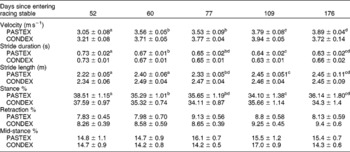
Descriptive data related to training milestones and training load are presented in Table 1. The horses trotted at a slower velocity on day 52 than on the subsequent examination days (Table 2). The slower velocity on day 52 was associated with a significantly longer stride length and greater stride duration, which had a longer stance percentage. There was no significant difference in the retraction percentage or mid-stance percentage across examination days.
Descriptive data of the training programme and the training load for the cohort of 2-year-old Thoroughbred racehorses at the time of the kinematic data collection

CWI, cumulative workload index; PASTEX, foals reared at pasture; CONDEX, foals reared at pasture and exposed to controlled exercise. a,b,c Different superscript letters indicate a significant difference between days.
i Mean CWI gallop is calculated for only the horses that had galloped on the day of the kinematic data collection.
ii Full list of clinical scores and data published in the study done by Rogers et al. Reference Rogers, Firth, McIlwraitth, Barneveld, Goodship and Kawcak19.
Linear and temporal stride parameters (mean±SE) of the 2-year-old Thoroughbred racehorses at the time of the kinematic data collection

PASTEX, foals reared at pasture; CONDEX, foals reared at pasture and exposed to controlled exercise. a,b,c,d Different superscript letters indicate a significant difference between days within a row.
Preconditioned versus controls
On day 52, there was no significant difference between the PASTEX and CONDEX groups for any of the parameters. On day 77, the CONDEX horses trotted faster (P = 0.01), had an associated longer stride length (P = 0.03) and achieved mid-stance (P = 0.04) earlier than the PASTEX group. At the subsequent examinations (days 109 and 176), these differences between the two groups were no longer apparent.
Relationship to training workload (CWI) and introduction of galloping
There was no significant difference in any of the CWI measures between days 52 and 77, after which the CWI of the horses increased significantly between the two subsequent examination days (P < 0.01). There was no significant difference in CWI between the CONDEX and PASTEX groups on any examination day.
The introduction of galloping into the training programme was associated with a significant reduction in stride duration (mean ± SE) (0.69 ± 0.01 vs. 0.66 ± 0.01 s, P = 0.001), stride length (2.49 ± 0.029 vs. 2.38 ± 0.02 m, P = 0.004) and stance duration (27.29 ± 1.0 vs. 32.03 ± 0.69%, P = 0.001). The introduction of galloping into the training programme had no significant effect on the retraction percentage or mid-stance percentage.
Discussion
This study followed a cohort of 2-year-old Thoroughbred racehorses during their first racing campaign. These horses were part of a larger study examining the effect of early exercise. The small sample size (n = 19) may preclude recognition of subtle changes in gait associated with training. However, the advantage was that detailed data were available on the training workload and clinical examinations, which were thought to allow greater understanding of the factors that may contribute to changes in gait during race training.
Day 0 represented the day the horses first entered the stable as unbroken early 2-year-olds. Data were not collected from the horses at this time, as there was considerable variation between horses in their capability to trot in-hand at a consistent velocity. The initial data collection was done on day 52, once all the horses had been broken in and were familiar with the training environment.
On day 52, there was no significant difference between the CONDEX and PASTEX groups in any kinematic parameter analysed. The only time there were significant between-group differences was on day 77. The lack of difference between groups at the initial examinations indicates that the conditioning exercise had no significant effect on the gait of the horses during the initial stages of race training, even though conditioning exercise had a significant effect on some tissues, such as cartilageReference van Weeren, Firth, Brommer, Hyttinen, Helminen and Rogers13, Reference Dykgraaf, Firth, Rogers and Kawcak23. However, the relatively low sampling rate of the analysis may mean that very subtle changes in gait were not able to be detected.
In an experiment with more pronounced differences in early exercise, foals boxed early in life had less biochemical heterogeneity and therefore less tolerance to high-speed loads than foals reared at pastureReference Brama, TeKoppele, Bank, Barneveld and van Weeren15. In vitro loading of the metacarpophalangeal joint (MCPJ) has demonstrated that with increasing velocity, load on the cartilage increased and became more focalReference Brama, Karssenberg, Barneveld and van Weeren14. Prior to day 77, there was no significant difference in mean weekly CWI between groups, with the exception of a brief 2-week period covering days 46–58 when the CONDEX group had a higher mean weekly CWIReference Rogers, Firth, McIlwraith, Barneveld, Goodship and Kawcak18. Therefore, any differences in gait observed on day 77 may reflect differences in the ability of the tissue to tolerate the training load. The clinical data published by Rogers et al. Reference Rogers, Firth, McIlwraith, Barneveld, Goodship and Kawcak18 support the hypothesis. During the 2-year-old racing campaign, the CONDEX horses had reduced risk of MCPJ pain on flexion (OR 0.46, 95% CI 0.29–0.75, P = 0.002) and MCPJ loss of flexion (OR 0.34, 95% CI 0.2–0.55, P < 0.001) than the PASTEX horses. Survival analysis revealed that median time until a clinical score ≥ 1 was achieved was later in the training programme for the CONDEX group than for the PASTEX group (median training days 116 (95% CI 98–134) vs. 67 (95% CI 46–88), P = 0.0007). It is of interest that the day 77 filming occurred at the end of the 95% CI for the PASTEX horses and before the lower 95% CI interval for the CONDEX horses.
Reduced joint tolerance to training load would provide joint distension and pain on flexion, both of which lead to negative mechanical feedback and alteration in gait. Previous studies have demonstrated similar changes in gait in relation to negative mechanical feedbackReference Rogers, Firth and Anderson6, Reference Rogers, Davies, Pfeiffer and Davie24. The proposed greater tolerance of the CONDEX horses to training may have permitted this group to trot faster, with a longer stride length and attain mid-stance earlier, all of which are associated with greater strain in the MCPJ than in the PASTEX horses.
In the first phase of the training the development of the neuromuscular coordination was focused upon and, after the development of the appropriate skill base in the second phase of the training, the development of fitness for the competition was focused uponReference Perkins, Reid and Morris20, Reference Rogers, Rivero, van Breda and Linder25. It is possible that the conditioning programme had effected some modification in responsiveness to training. The CONDEX group appeared to have some differences in behaviour and acceptance to training, which meant that this group took less time to break in and was more willing to work at a consistent gait when first introduced to canter exercise on the racetrack. However, at the initial examination of gait, there was no significant difference between the groups, indicating that these differences were predominantly in relation to the horses' response to the trainer/rider rather than to modification in gait. At no time during the trial was there any interaction of gait and previous conditioning status, indicating that the responses to training stimuli were similar in both the PASTEX and CONDEX horses.
In contrast to the expected increase in stride length and stride frequency, there was an observed decrease in stride length as training progressed. The changes in the gait occurred at the second examination after about 60 days of training, and remained consistent at these levels for the remainder of the observation period. The change in gait was associated with the introduction of the first galloping sessions into the training programme. It is possible that the introduction of galloping and the transition into this phase of training produced some subtle changes in the horses' way of going, or in the behaviour of the horses. The shortening of the stride and a higher stride frequency are often associated with mechanical feedback, such as the early onset of shin soreness or dorsal metacarpal diseaseReference Rogers, Firth and Anderson6. Within the literature, the predominant risk factor for the onset of dorsal metacarpal disease is increasing the high-speed exercise distance in short periods of timeReference Verheyen, Henley, Price and Wood8, which is consistent with the indications of the gait transition occurring after the introduction of the initial gallops.
Within the cohort of horses, a distension of the MCPJ was observedReference Rogers, Firth, McIlwraith, Barneveld, Goodship and Kawcak18. These ‘puffy fetlocks’ were first observed in some horses on day 49, but they did not appear to be associated with lameness. Anecdotal evidence indicates that MCPJ distension is a common occurrence in 2-year-old racehorses during their first race training preparation. This apparently common occurrence of MCPJ distension in 2-year-old Thoroughbred racehorses implies that the musculoskeletal response to race training may be the primary reason for the observed changes in the gait of these 2-year-olds.
Conclusion
The changes in gait appeared to be associated with the introduction of galloping and associated tolerance to musculoskeletal loading. The combination of the tissue response data obtained from the early exercise phase, clinical findings and the kinematic data supports the hypothesis that previously conditioned CONDEX horses had a greater tolerance to the musculoskeletal loading imposed during 2-year-old training than the conventionally reared PASTEX horses.
Acknowledgements
Funding for this project was provided by the New Zealand Equine Research Foundation. Funding for the GEXA project was provided by the Marilyn Simpson Trust (USA), the Horserace Betting Levy Board (UK), Utrecht University (The Netherlands) and the New Zealand Racing Board.